

Demystifying Ice: A Deep Dive into Commercial Ice Machine Operations
Why Understanding Commercial Ice Makers Matters for Your Business
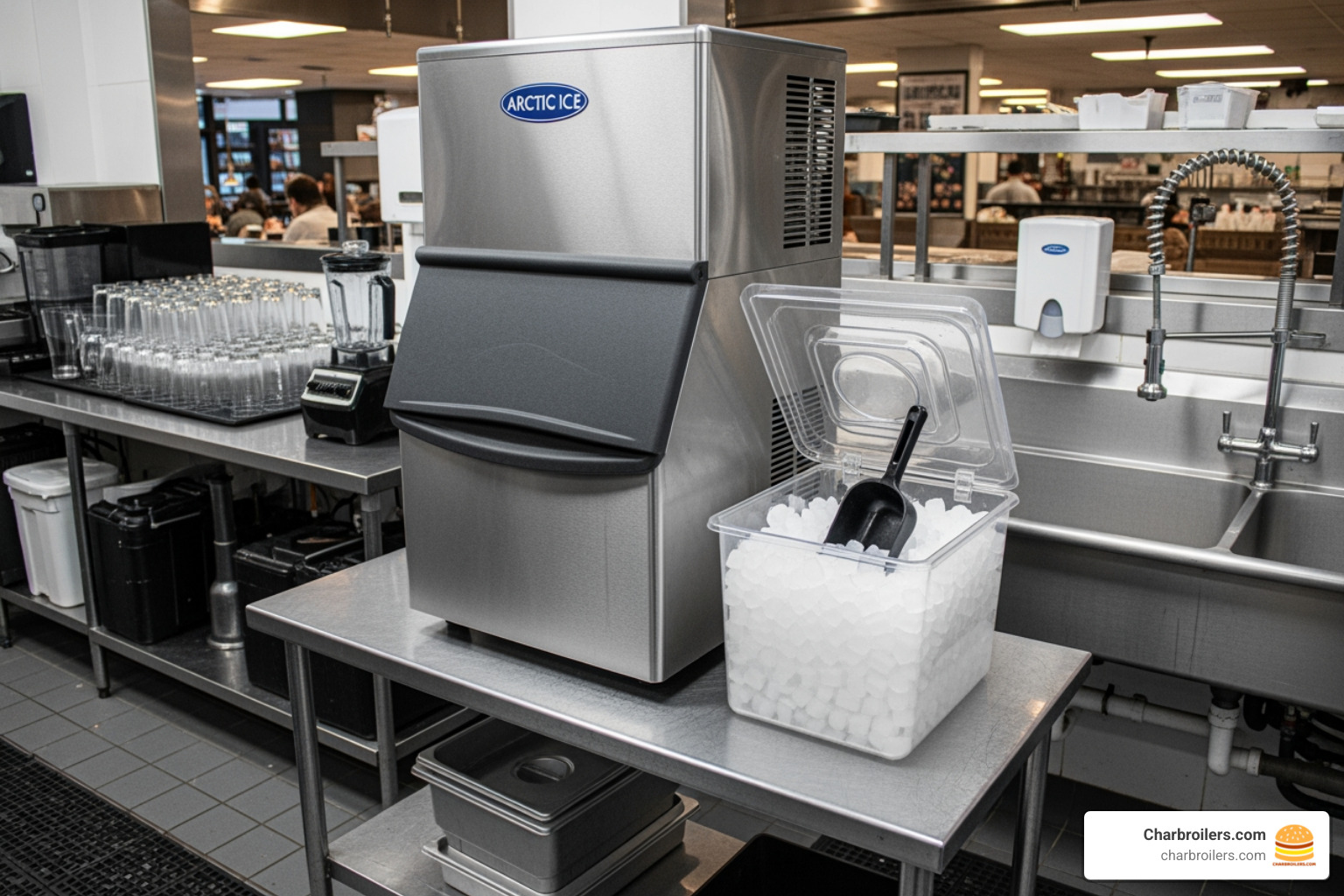
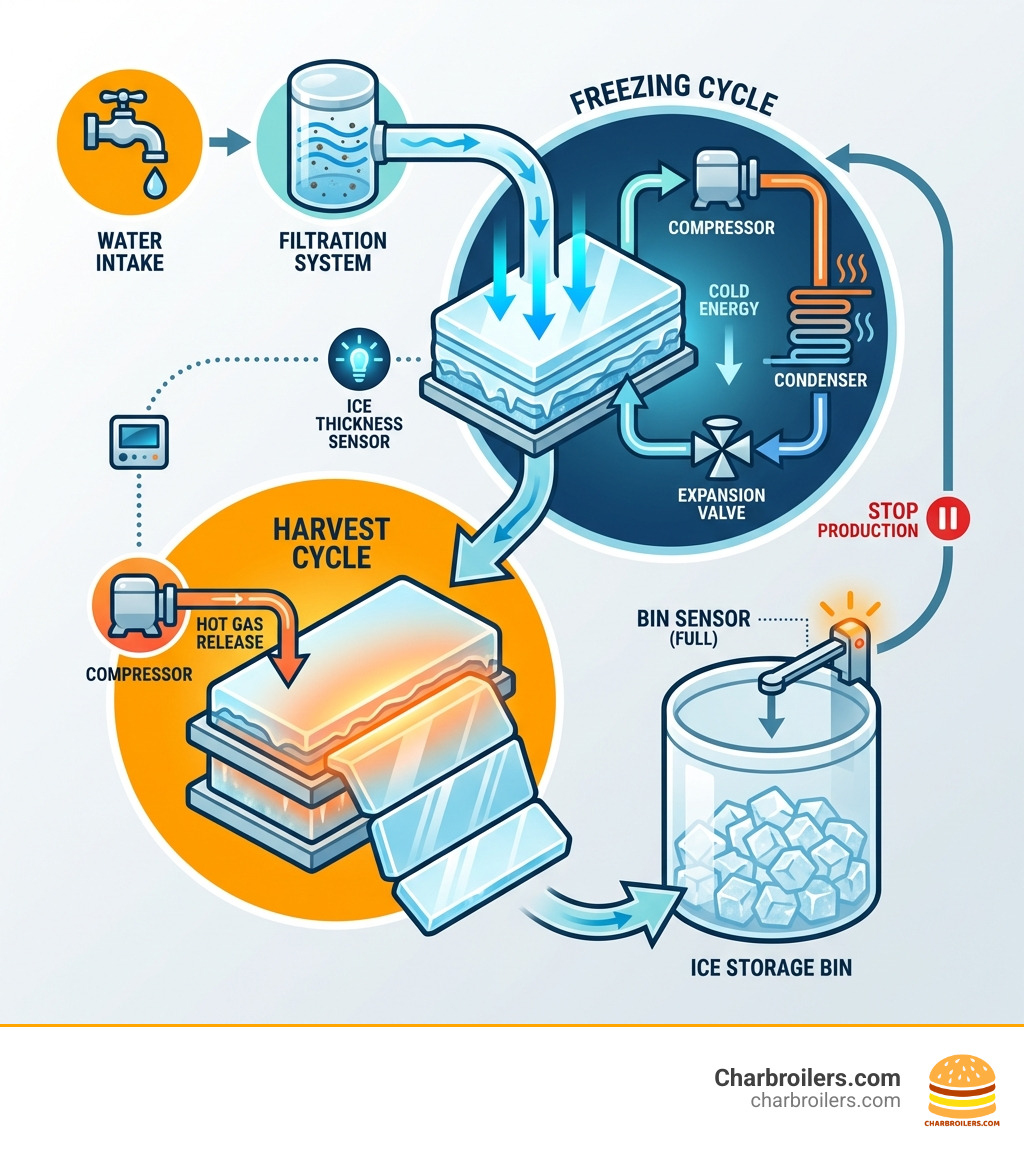
How commercial ice makers work is something every restaurant owner should understand—these machines use a refrigeration cycle to freeze water into ice, then harvest it into storage bins automatically. Here's the basic process:
- Refrigeration Cycle: A compressor pressurizes refrigerant, which flows through a condenser (releasing heat), then through an expansion valve (dropping temperature), and finally through an evaporator (where ice forms).
- Water Flow: Filtered water flows over the super-cold evaporator plate, freezing layer by layer.
- Harvest Cycle: When ice reaches the right thickness, sensors trigger hot gas to warm the evaporator slightly, releasing the ice sheet into the storage bin.
- Repeat: The cycle automatically restarts until the bin is full.
Only a century ago, ice was a luxury item that required delivery services or industrial refrigeration plants. When John Gorrie created the first commercial ice maker in 1845, he couldn't have imagined how essential these machines would become to modern food service. Today, a steady supply of clean ice isn't just convenient—it's the backbone of restaurant operations, from keeping drinks cold to preserving fresh seafood displays.
Understanding the mechanics behind your ice maker helps you choose the right machine, maintain it properly, and troubleshoot issues before they disrupt service. Whether you're running a busy bar, a quick-service restaurant, or a healthcare facility, knowing what happens inside that stainless steel box can save you money and headaches.
As Sean Kearney from Charbroilers.com, I've spent over a decade helping restaurant owners understand how commercial ice makers work and find the right equipment at fair prices. My experience in the restaurant equipment industry has shown me that educated buyers make better decisions and get more value from their investments.
Key how commercial ice makers work vocabulary:
The Heart of the Machine: The Refrigeration Cycle Explained
At the core of every commercial ice maker lies a powerful refrigeration cycle, a marvel of engineering that continuously transforms water into ice. This isn't just about making things cold; it's about moving heat. The fundamental principle is heat transfer: absorbing heat from one area (the water) and expelling it in another (the surrounding environment). This cycle relies on a special chemical called refrigerant, which changes between liquid and gas states, carrying heat along the way. Think of it as a microscopic heat shuttle, constantly working to chill things down.
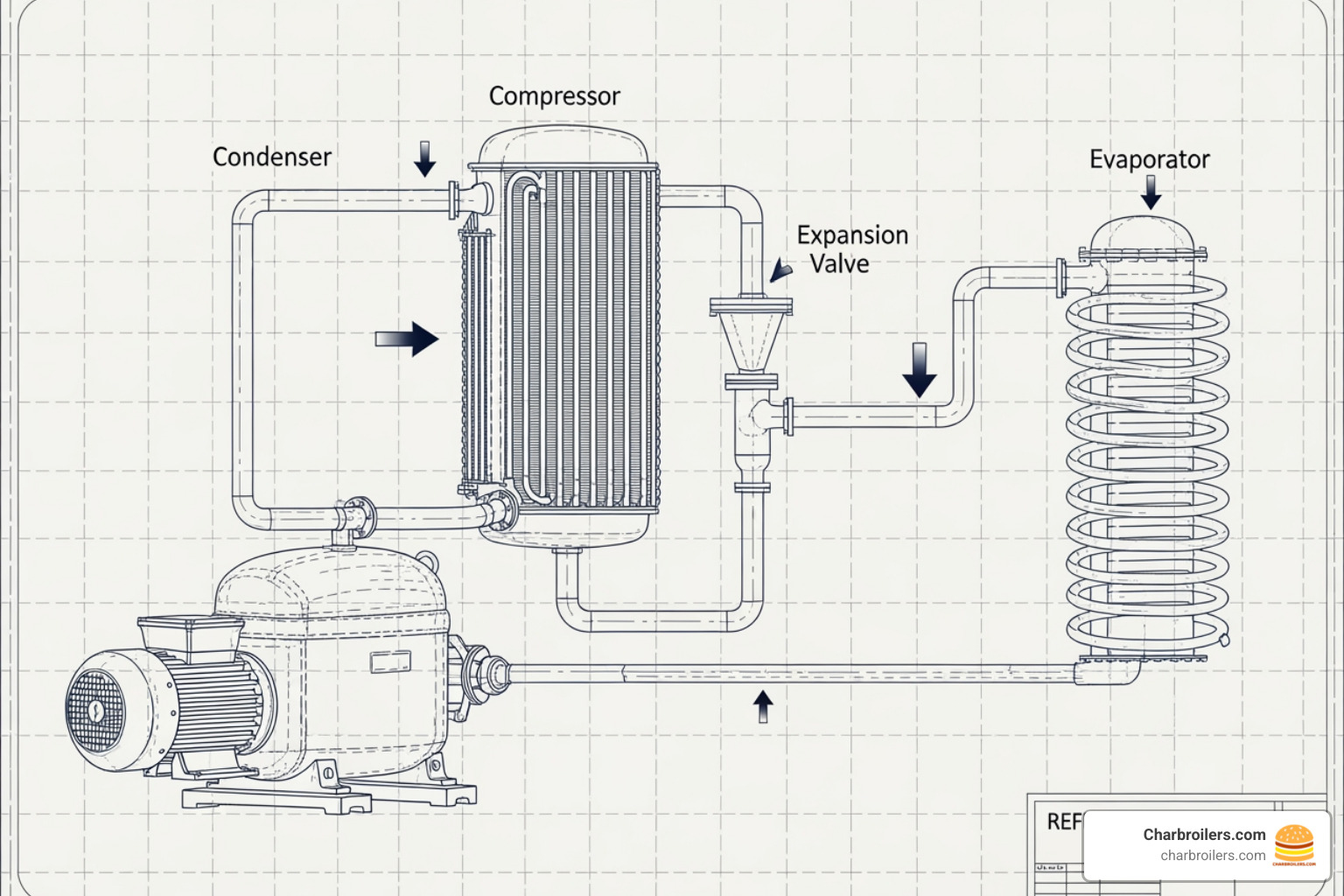
This closed-loop system, often involving heat-exchanging pipes, is what makes ice production possible. The magic, as we'll see, often comes down to what's known as adiabatic cooling – the rapid temperature drop that occurs when a pressurized gas expands.
The Fundamental Principle of How Commercial Ice Makers Work
The entire process hinges on the refrigerant, the "magic ingredient" that facilitates cooling. This chemical flows through the ice maker's system, undergoing a series of phase changes that allow it to absorb and release heat. When the refrigerant changes from a liquid to a gas, it absorbs a significant amount of heat from its surroundings. Conversely, when it changes back from a gas to a liquid, it releases that absorbed heat. This continuous cycle of absorption and release is the backbone of how commercial ice makers work, ensuring the water eventually freezes. The refrigerant is truly the unsung hero, making the change from liquid to solid possible.
The Compressor: The Powerhouse
If the ice maker were a body, the compressor would undoubtedly be its heart. This vital component is responsible for receiving the low-pressure, low-temperature gaseous refrigerant from the evaporator. Its primary job is to pressurize this gas and, in doing so, significantly increase its temperature. Imagine squeezing a balloon – the air inside gets hotter. This high-pressure, high-temperature vapor is then pumped to the next stage of the cycle, ready to shed its heat. Most icemakers use an electric motor to power this crucial part of the process.
The Condenser: Releasing the Heat
Once the hot, high-pressure refrigerant leaves the compressor, it enters the condenser. Here, its mission is simple: release the heat it absorbed earlier. The condenser works to cool the refrigerant, causing it to change from a high-pressure vapor back into a high-pressure liquid. This heat dissipation is achieved in one of two main ways:
- Air-cooled systems: These use a fan to blow ambient air over the condenser coils, transferring heat from the refrigerant to the air. They are common, use less water, and are suitable for well-ventilated areas.
- Water-cooled systems: These circulate water over or through the condenser coils, using the water to carry away the heat. They are generally more efficient in hot environments, but they consume more water.
Regardless of the method, the goal is the same: cool the refrigerant down so it's ready for the next step.
The Expansion Valve (TXV): The Big Chill
After leaving the condenser as a high-pressure liquid, the refrigerant encounters the expansion valve (often a Thermostatic Expansion Valve, or TXV). This small but mighty component is where the "big chill" happens. The TXV drastically reduces the pressure of the refrigerant. As the refrigerant passes through this constricted opening, it undergoes a rapid expansion, which causes its temperature to plummet. This phenomenon, known as adiabatic cooling, is like the cold blast you feel when releasing air from a pressurized can. The result is a cold, low-pressure liquid refrigerant, perfectly primed to absorb heat.
The Evaporator: Where the Magic Happens
Finally, the super-cold, low-pressure liquid refrigerant flows into the evaporator. This is the stage where the actual freezing of water into ice occurs. The evaporator is typically a metal plate or a series of chilled tubes, often referred to as the ice formation surface. As water flows over this extremely cold surface, the refrigerant inside the evaporator absorbs the water's heat. This heat transfer causes the water to gradually freeze onto the evaporator plate, forming the ice cubes we all rely on.
How Commercial Ice Makers Work: The Complete Production Cycle
Commercial ice makers are sophisticated machines designed for continuous, automated ice production. The entire process, from water intake to ice dropping into the bin, is orchestrated by a control board, ensuring efficiency and consistency. A water pump helps circulate water, often drawing from a collection sump, to facilitate the freezing process.
Step 1: Water Intake and Flow
The journey to a perfect ice cube begins with water intake. Our commercial ice makers connect to a dedicated water supply line. When the machine signals a need for water, an electrically operated solenoid water valve opens, allowing water to flow into the system.
Crucially, before it ever touches the ice-making components, this water typically passes through a robust filtration system. We cannot overstate the importance of water filtration; it removes impurities, sediment, chlorine, and other contaminants. This not only ensures cleaner, better-tasting ice but also protects the machine from scale buildup and corrosion, extending its lifespan. Many commercial setups use specialized ice machine water filters to achieve superior water quality. After filtration, the clean water is directed to a distribution tube, ready for freezing.
Step 2: The Freezing Process
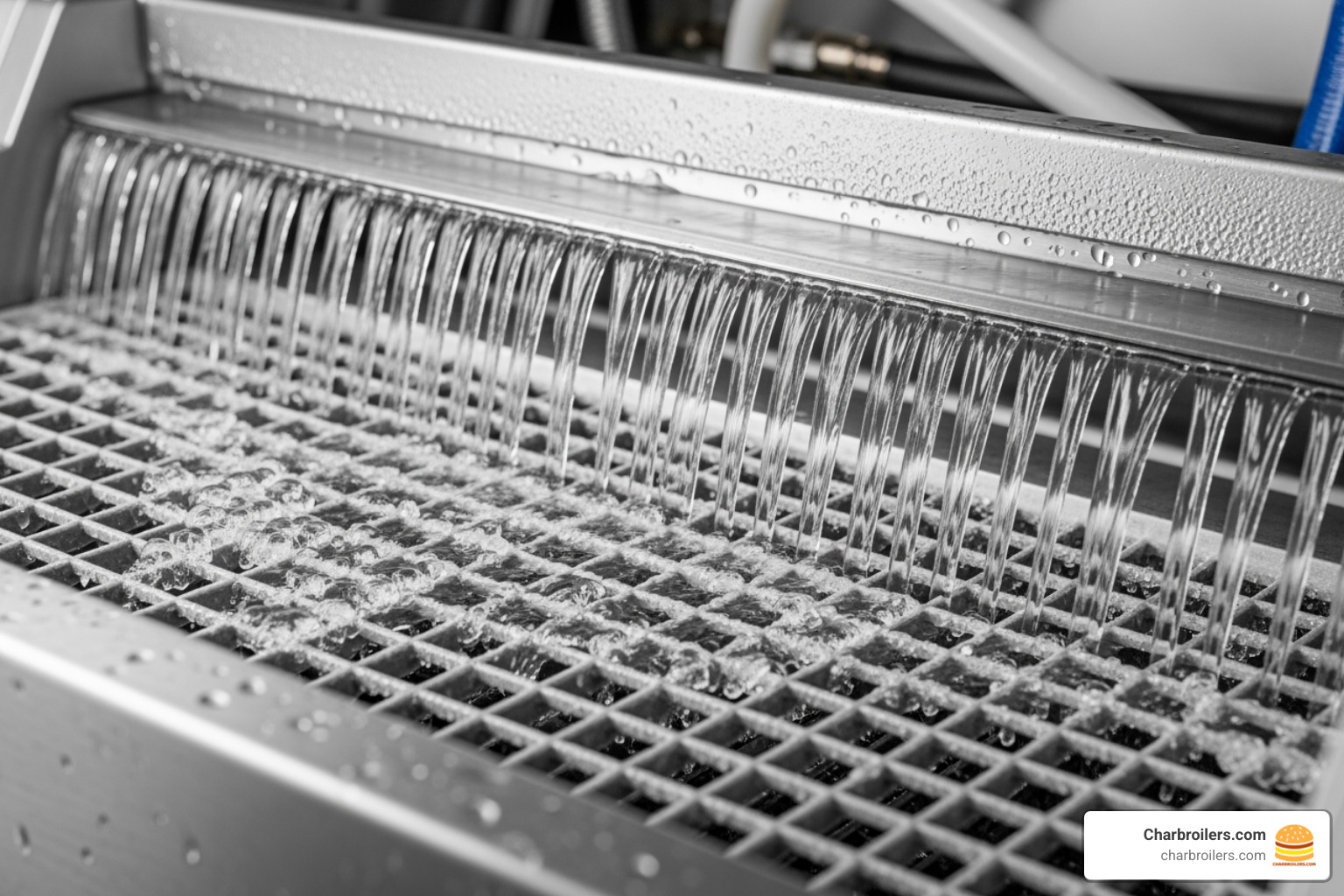
With the water now clean and ready, it's pumped and allowed to cascade evenly over the super-chilled evaporator plate. This is where the magic of freezing truly unfolds. Instead of freezing all at once, commercial ice makers employ a layer-by-layer freezing method. As the water flows over the cold surface, a thin film freezes, and then another, and another. Any dissolved minerals or impurities in the water are less likely to freeze and are instead washed away with the excess water into the collection sump, to be recirculated or drained.
This layered freezing is key to producing clear, hard ice. When water freezes all at once, air and impurities get trapped, resulting in cloudy, softer ice. By freezing layer by layer, air bubbles and minerals are flushed out, leaving behind crystal-clear ice cubes, much like the ones you admire in high-end restaurants. If you've ever wondered How do you make clear ice cubes?, this controlled, gradual freezing is the answer.
Step 3: The Harvest Cycle
Once the ice reaches its predetermined thickness—which is typically detected by an ice thickness sensor or a timer—the machine initiates the harvest cycle. This is a clever process designed to release the ice from the evaporator plate. The control board temporarily diverts hot refrigerant gas, using a hot gas bypass valve, directly to the evaporator. This warming of the evaporator plate causes a thin layer of ice directly in contact with the plate to melt slightly, effectively loosening the ice sheet.
With the bond broken, the sheet of ice is now ready to be released. This warming process is brief but effective, allowing the ice to detach cleanly.
Step 4: Ice Collection and Storage
As the ice sheet separates from the evaporator, gravity takes over, and the ice falls into the waiting storage bin below. Depending on the ice maker's design, an agitator might also help dislodge the cubes or break larger sheets into individual pieces.
The storage bin is equipped with a mechanism, often a bin shut-off arm or an infrared sensor, that detects when the bin is full. Once the ice level reaches this point, the sensor signals the machine to pause production, preventing overfilling and ensuring efficient operation. When ice is removed from the bin, the sensor detects the drop in level, and the ice-making cycle automatically restarts. This continuous, automated process ensures a steady supply of fresh ice for your business. For more on keeping your ice safe and sound, check out Your Guide to Buying the Best Commercial Ice Storage Bin.
Not All Ice is Created Equal: Machine Types and Ice Shapes
The world of commercial ice extends far beyond the simple cube. Different businesses have different needs, and ice makers are designed to produce a variety of shapes, each with its unique characteristics and ideal applications. Matching the right ice type to your business—whether it's for beverage service, food display, or healthcare—can significantly impact customer satisfaction and operational efficiency.
Cube, Nugget, and Flake: How Different Shapes are Made
Here's a look at how some of the most popular commercial ice shapes are produced:
- Cube Ice (Full and Half): These are the classic, hard, dense ice cubes, known for melting slowly and diluting drinks less. They are formed when water freezes in individual molds or cavities on the evaporator plate. The layer-by-layer freezing process we discussed is particularly effective here, producing clear ice. Full cubes are robust for general beverage service, while half cubes are ideal for soft drinks and blending. If you're looking for How to Choose the Right Large Cube Ice Machine for Premium Drinks, you're likely considering these types.
- Nugget Ice: Also known as chewable ice, pellet ice, or Sonic ice, nugget ice is soft, porous, and highly popular in healthcare settings and self-serve beverage stations. It's made by freezing water in a cylinder, then using an auger system to compress and extrude the semi-frozen ice into small, irregular, chewable pieces. This process creates a softer ice that absorbs flavors well. You can dive deeper into this with Everything About Commercial Nugget Ice Machines.
- Flake Ice: This soft, pliable, and fast-cooling ice is perfect for displaying seafood, meats, and produce, as well as for therapeutic use in hospitals. Flake ice machines typically freeze water on the inside of a vertical, cylindrical evaporator. A rotating scraper or auger continuously shaves off thin layers of ice from the cylinder wall, producing irregular flakes that then fall into the storage bin.
- Crescent Ice: This unique, half-moon shaped ice is known for its displacement properties, making drinks appear fuller and melting slowly. It's typically formed by water cascading over a vertical, grid-style evaporator plate, with the ice freezing on one side to create its distinctive curved shape.
Air-Cooled vs. Water-Cooled: Choosing Your Condenser
When selecting a commercial ice maker, one of the most critical decisions is the type of condenser. This choice impacts efficiency, operating costs, and where the machine can be installed.
| Feature | Air-Cooled Ice Makers | Water-Cooled Ice Makers |
|---|---|---|
| Heat Discharge | Discharges heat into the surrounding air. Requires good ventilation. | Discharges heat into circulating water, which then goes down the drain or is recirculated through a cooling tower. |
| Water Usage | Low water consumption (only for ice making). | High water consumption (for ice making AND cooling the condenser). |
| Energy Efficiency | Efficiency can decrease in hot ambient temperatures as the compressor works harder. | Generally more energy-efficient, especially in hot environments, as water is a more effective cooling medium than air. However, this efficiency gain can be offset by water utility costs. |
| Ambient Temperature | Best suited for environments with ambient temperatures between 50°F and 80°F (10°C and 27°C). | Ideal for hot environments (e.g., commercial kitchens) where ambient air temperatures frequently exceed 80°F (27°C). |
| Installation | Requires adequate clearance around the machine for airflow. Can add heat to the room. | Requires a constant water supply and drain connection. Does not add heat to the ambient air, making it suitable for enclosed spaces. |
| Upfront Cost | Often lower upfront cost. | Typically higher upfront cost due to more complex plumbing and potentially a cooling tower. |
| Operational Costs | Lower water utility costs, but potentially higher electricity costs in warm settings. | Higher water utility costs, but potentially lower electricity costs for refrigeration. Local water costs in Seattle, WA, USA, should be considered. |
| Maintenance | Requires regular cleaning of air filters and condenser coils. | Requires regular descaling of water lines and condenser to prevent mineral buildup, which can be significant depending on water hardness in Seattle, WA, USA. |
| Noise Level | Can be louder due to fan operation. | Generally quieter as there is no fan. |
| Environmental Impact | Contributes to indoor heat load. | High water usage can be a concern in areas with water restrictions or high utility costs. |
| Best Use Case | Restaurants, cafes, and bars in well-ventilated areas where conserving water is a priority. | High-volume operations, hot kitchens, or locations where quiet operation and consistent performance in high temperatures are critical, provided water usage is manageable. |
A third option, less common but highly efficient for large operations, is a remote-cooled system. Here, the condenser unit is located separately from the ice maker itself, often outdoors or on the roof. This keeps heat and noise out of the kitchen, improving comfort and potentially reducing HVAC costs, but involves more complex installation.
Keeping It Cool and Clean: Maintenance and Troubleshooting
Regardless of how commercial ice makers work, they are sophisticated pieces of equipment that require diligent care. Regular maintenance is not just about keeping the machine running; it's about ensuring the hygiene of your ice, preventing costly breakdowns, and extending the lifespan of your investment. Think of it as preventative care for your profit margins.
Ensuring Hygiene and Clean Ice Production
A clean ice machine is paramount for any food service business. A dirty machine can lead to smelly, unappetizing ice and, more critically, creates a perfect environment for dangerous bacteria and mold to thrive. This can compromise food safety and customer health.
Here's how we ensure hygiene:
- Water Filters: As we discussed, high-quality water filters are the first line of defense, removing impurities that could affect ice quality and promote microbial growth.
- Regular Cleaning Schedules: This includes daily tasks like emptying the ice bin and sanitizing scoops. Weekly, the bin interior should be cleaned, and sensors wiped. Monthly, descaling of the evaporator and replacing inline water filters are essential. Bi-annual deep cleaning, including insulation inspection and system pressure checks, is highly recommended.
- Sanitizing Scoops and Bins: All surfaces that come into contact with ice must be regularly cleaned and sanitized to prevent contamination.
For detailed instructions on how to clean an ice maker, always refer to your manufacturer's guidelines, but general principles apply.
Why Regular Maintenance is Crucial
Preventive maintenance is the secret ingredient to consistent ice production. Without it, you're setting yourself up for unexpected downtime and expensive repairs. For example, some leading service providers manage tens of thousands of ice machines, with each receiving at least two preventive maintenance and cleaning visits per year. This proactive approach yields several benefits:
- Avoiding Scale Buildup: Minerals in water, especially in hard water areas like parts of Seattle, WA, USA, can accumulate on the evaporator plate and other components. This scale acts as an insulator, reducing efficiency and making the machine work harder.
- Maintaining Efficiency: Dirty condenser coils force the compressor to work harder, consuming more energy and increasing your utility bills. Regular cleaning ensures the machine operates at peak performance.
- Extending Lifespan: Just like any complex appliance, well-maintained commercial ice makers last longer, delaying the need for costly replacements.
- Preventing Breakdowns: Addressing minor issues during routine checks prevents them from escalating into major, operation-halting failures.
Many businesses find value in managed services or even Renting Commercial Ice Machines Made Easy and Breezy, as these options often include comprehensive maintenance.
Troubleshooting Common Issues: How Commercial Ice Makers Work Best When Maintained
Even with the best maintenance, issues can arise. Understanding basic troubleshooting can save you time and money. Here are some common problems and what they might indicate:
- Low Ice Production: This could be due to a dirty condenser, clogged water filter, low water flow, or scale buildup on the evaporator. Checking these commercial ice machine parts and accessories is a good starting point.
- Cloudy or Soft Ice: Often a sign of poor water filtration, but can also indicate issues with the freezing cycle or short cycles.
- Machine Not Making Ice: Start with the basics: Is the power on? Is the water supply valve open? Is the bin full? Beyond that, it could be a clogged filter, a faulty water inlet valve, or a more serious component failure requiring a technician.
- Unusual Noises: Can indicate a problem with the fan, compressor, or loose parts.
- Water Leaks: Check drain lines for clogs, inspect water valves, and ensure water level controls are functioning correctly.
Regular maintenance greatly reduces the likelihood of these issues, ensuring your commercial ice makers work optimally when you need them most.
Key Considerations When Choosing Your Commercial Ice Maker
Selecting the right commercial ice maker for your business in Seattle, WA, USA, is a strategic decision that impacts everything from operational efficiency to customer satisfaction. It's not just about getting any ice maker; it's about getting the right ice maker.
Here are the key considerations we guide our clients through:
- Production Capacity (lbs per day): This is arguably the most important factor. How much ice do you realistically need in a 24-hour period? Overestimate slightly to account for peak demand and unexpected needs. Daily output for commercial ice makers can range from 100–2,000+ lbs.
- Ice Type and Shape: As we've seen, different ice shapes serve different purposes. Do you need slow-melting cubes for cocktails, chewable nuggets for soft drinks, or flake ice for food displays? Your menu and service style will dictate this choice.
-
Machine Size and Configuration:
- Modular units: High-output systems, typically installed on top of a separate ice storage bin, ideal for businesses needing over 500 lbs of ice per day.
- Undercounter units: Compact, all-in-one machines with built-in storage, perfect for bars, cafes, or smaller operations where space is limited.
- Countertop dispensers: Often found in offices or healthcare settings, these provide convenient, sanitary ice dispensing.
- Condenser Type (Air, Water, or Remote): We covered the pros and cons of air-cooled, water-cooled, and remote-cooled systems. Consider your kitchen's ambient temperature, ventilation, water costs, and noise sensitivity.
- Energy and Water Efficiency: Look for ENERGY STAR® certified models. These machines are designed to use less energy and water, leading to significant long-term savings on utility bills, which is especially important in a city like Seattle, WA, USA, where operational costs are a factor. Opting for lower-GWP (Global Warming Potential) refrigerants like R-290 or CO₂ over older options like R-134a or R-404A is also a forward-thinking choice for environmental responsibility.
Choosing the right commercial ice maker requires a thorough understanding of your specific needs and the machine's capabilities. For a deeper dive, explore The Ultimate Guide to Comparing Commercial Ice Makers and check out our insights on Stay Cool Under Pressure: Commercial Ice Makers Machines Reviewed.
Conclusion
Understanding how commercial ice makers work reveals a fascinating interplay of physics and engineering, all orchestrated to deliver that essential ingredient: ice. From the fundamental refrigeration cycle with its compressor, condenser, expansion valve, and evaporator, to the meticulous process of water filtration, layer-by-layer freezing, and automated harvesting, every step is crucial.
We've learned that not all ice is created equal, with different production methods yielding distinct shapes like cubes, nuggets, and flakes, each suited for specific applications. We've also explored the critical differences between air-cooled and water-cooled condensers, emphasizing the importance of choosing a system that aligns with your operational environment and utility considerations.
The value of a commercial ice maker extends beyond its mechanical prowess. It's about ensuring hygiene, maintaining efficiency through regular maintenance, and making informed choices when selecting a machine to perfectly match your business's needs. The quality and availability of ice can significantly impact your service, customer satisfaction, and bottom line.
At Charbroilers.com, we understand the intricacies of commercial kitchen equipment, including ice makers. We're here to help you steer these choices, ensuring you select a robust, efficient, and reliable machine that keeps your operations running smoothly.
Ready to explore the best commercial equipment options for your establishment? Explore our comprehensive guide to commercial equipment for your restaurant.