
Chew on This: Everything About Commercial Nugget Ice Machines
Why Commercial Nugget Ice Makers Are Taking Over Food Service
Commercial ice makers nugget are machines that produce soft, chewable ice by scraping frozen water from a cold surface and compressing it into small pellets. Here's what you need to know:
- What it is: Nugget ice (also called chewable ice or pellet ice) is about 90% water, soft enough to chew, and absorbs beverage flavors
- Why businesses use it: Higher liquid displacement means lower syrup costs per cup, and customers love the texture
- Common types: Countertop dispensers (33-65 lbs/day), undercounter units (79-167 lbs/day), and modular heads (456-2,185 lbs/day)
- Best for: Beverage service, healthcare facilities, bars, restaurants, convenience stores, and smoothie shops
- Key consideration: Match your daily production capacity to peak demand to avoid ice shortages
After introducing "The Original Chewable Ice" in 1981, manufacturers like Scotsman helped nugget ice become the preferred choice for countless operators. The reason is simple: consumers enjoy how the ice absorbs flavor, while operators appreciate the lower operating costs.
The soft, compressible texture makes nugget ice stand out from traditional cube ice. It's easier on blenders for smoothies, gentler for patients in healthcare settings, and creates a premium drink experience that keeps customers coming back.
I'm Sean Kearney from Charbroilers.com, and over my decade-plus in the restaurant equipment industry, I've helped hundreds of operators find the right commercial ice makers nugget for their specific needs and budget. Whether you're running a busy bar, a healthcare facility, or a convenience store, choosing the right nugget ice machine comes down to understanding your volume requirements and space constraints.
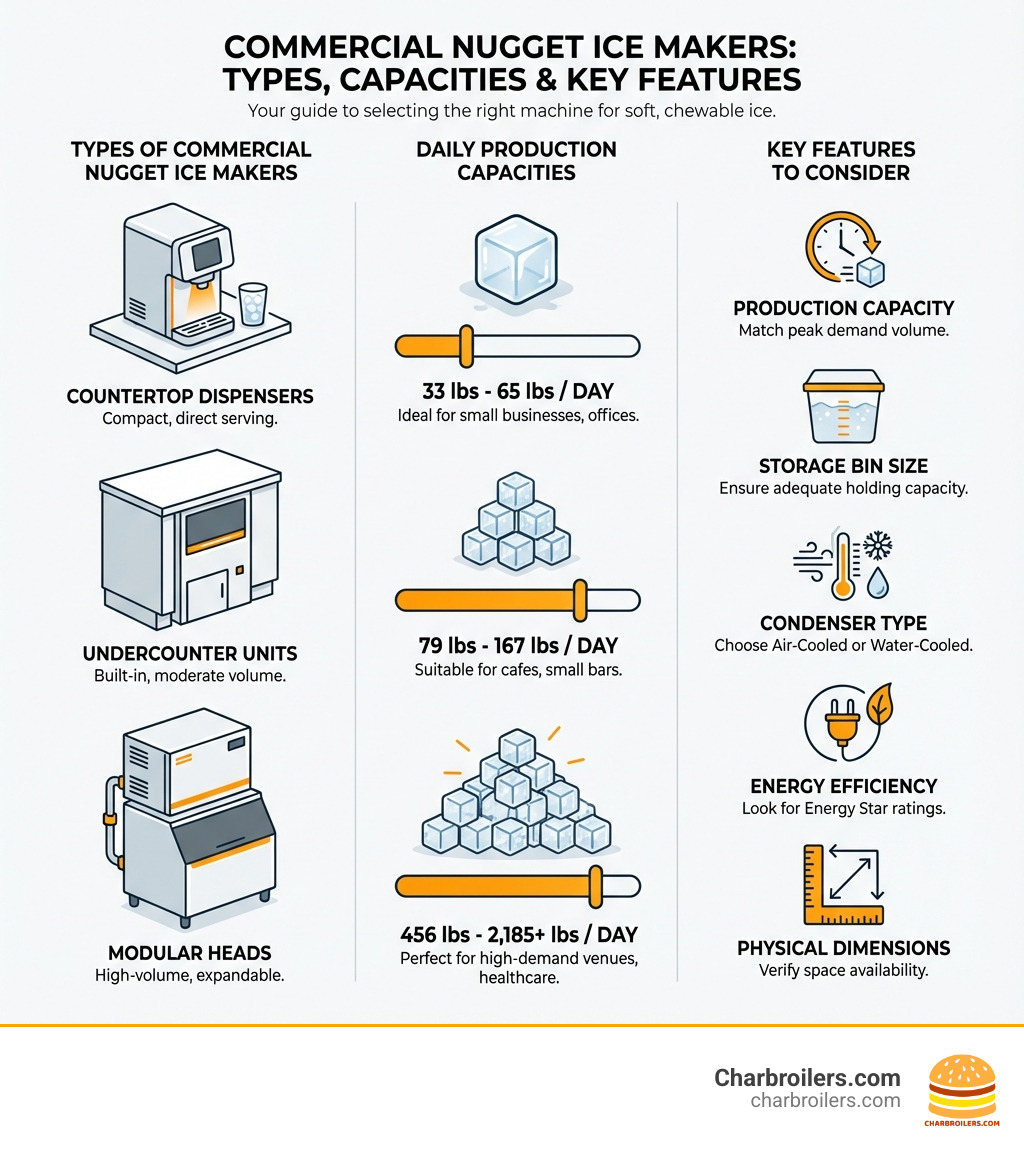
Commercial ice makers nugget terminology:
The Undeniable Appeal: Why Nugget Ice is a Customer Favorite
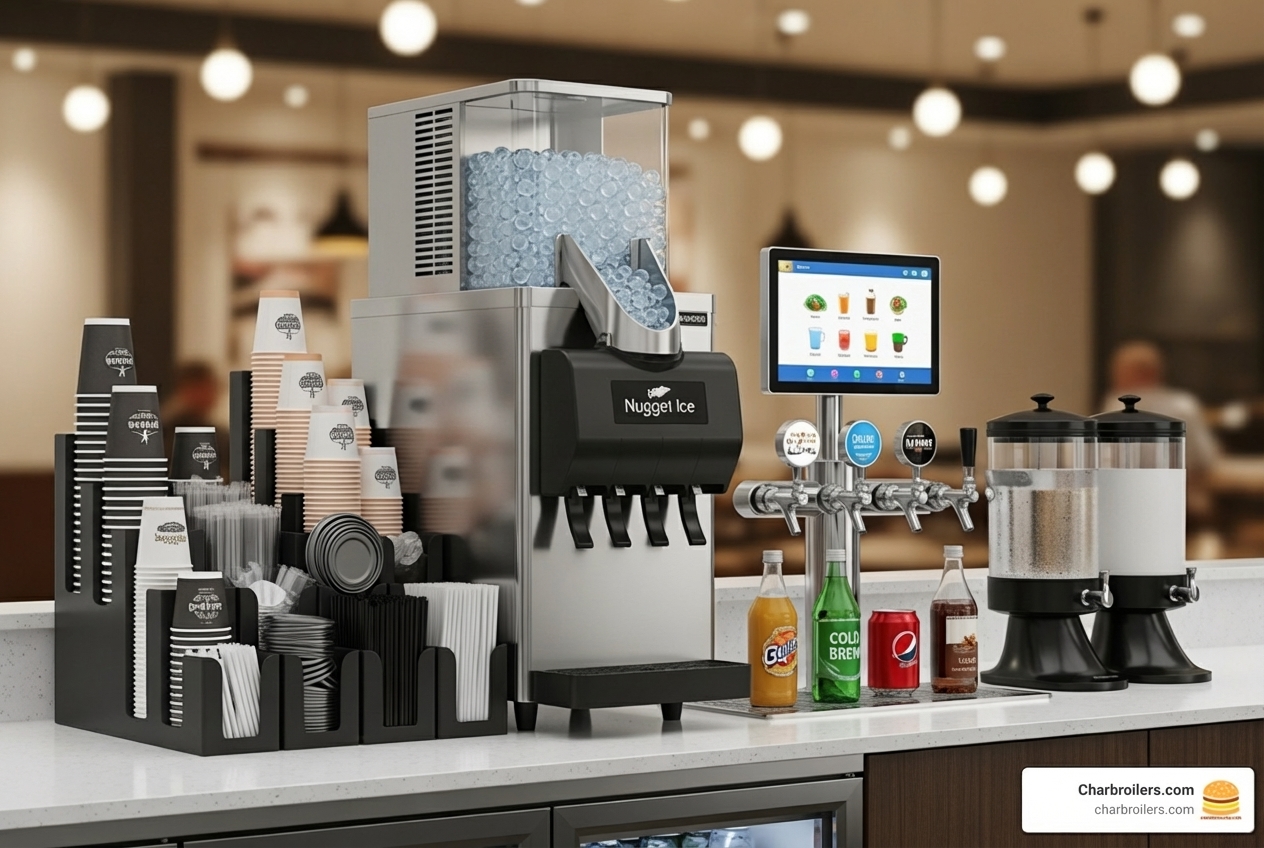
Nugget ice's popularity isn't just a trend; it's a strategic choice for many businesses. Its unique qualities offer distinct advantages for both customers and operators. It’s no wonder Scotsman's nugget ice has grown to become the preferred ice choice for countless consumers and operators alike since its introduction.
Benefits for Customers and Businesses
For customers, the appeal of nugget ice is immediate and delightful. Its soft, chewable texture is a major draw, offering a satisfying crunch that many prefer over hard, dense cubes. Consumers enjoy how the chewable nugget ice absorbs the flavor of beverages, enhancing the overall drinking experience. Imagine a refreshing soda or a custom cocktail, each sip infused with flavor from the ice itself – it’s a small detail that makes a big difference. This unique characteristic can even lift a simple drink into a memorable experience, encouraging repeat business.
Operators, on the other hand, appreciate nugget ice for its significant operational advantages. One of the most compelling benefits is its higher liquid displacement. This means that nugget ice takes up more space in a cup than traditional cube ice, requiring less liquid to fill the container. For businesses that rely on syrup-based beverages, such as soda fountains or specialty coffee shops, this translates directly to lower syrup costs per cup. Less syrup used per drink can lead to substantial savings over time, boosting profitability. Furthermore, the soft nature of nugget ice makes it easier to scoop and handle, potentially reducing product waste during service. Its versatility means it's suitable for a wide range of applications, making it a smart investment for diverse commercial settings.
| Characteristic | Nugget Ice | Cube Ice | Flake Ice |
|---|---|---|---|
| Texture | Soft, chewable, compressed | Hard, solid | Soft, snowy, non-compressed |
| Melt Rate | Moderate to fast | Slow | Fast |
| Drink Displacement | High | Low to Moderate | High |
| Best Commercial Uses | Beverages, smoothies, cocktails, healthcare, salad bars | General chilling, mixed drinks, high-end spirits | Food displays, therapeutic applications, cold packs |
Common Applications in Commercial Settings
The unique properties of nugget ice make it an ideal choice for a variety of commercial applications, extending far beyond just beverages.
- Beverages and Sodas: This is perhaps the most common application. Its chewable texture and ability to absorb flavor make it a favorite for fountain drinks in convenience stores, fast-food restaurants, and casual dining establishments. Customers often seek out locations specifically for their "good ice."
- Smoothies and Blended Cocktails: The soft, compressible nature of nugget ice makes it perfect for blending. It creates a smoother consistency in drinks with less wear and tear on blender blades compared to harder cube ice. This is a huge win for juice bars, coffee shops, and cocktail lounges.
- Healthcare for Patient Hydration: In hospitals, clinics, and nursing homes, nugget ice is invaluable. Its soft texture is gentle on sensitive teeth and gums, making it easier and more comfortable for patients to consume, especially those with oral discomfort or swallowing difficulties. It aids in hydration and can even be used for therapeutic purposes.
- Therapeutic Use in Clinics: Beyond hydration, nugget ice is often used in physical therapy and sports medicine for cold compression, molding easily to body parts for effective pain and swelling relief.
- Keeping Salad Bars Fresh and Appealing: Its high displacement and soft texture also make it excellent for displaying fresh produce and cold foods on salad bars or seafood counters. It creates an attractive, cold bed that keeps items chilled without bruising delicate ingredients.
- The Best Commercial Ice Dispensers for Your Business can provide more insights into how these machines serve various needs.
Key Factors for Selecting Commercial Ice Makers Nugget
Choosing the right commercial ice makers nugget is crucial for meeting demand and ensuring operational efficiency in your business. It's not just about getting any machine; it's about getting the right machine. Consider these key features before making a purchase.
Production Capacity and Storage
One of the first and most critical considerations is the machine's daily production rate, measured in pounds per day (lbs/day). This figure tells you how much ice the machine can generate over a 24-hour period under ideal conditions. To avoid the dreaded ice shortage during peak hours, you need to match this output to your business's specific demand. For instance, a small coffee shop might need a machine producing under 100 lbs/day, while a large restaurant or healthcare facility could require a modular unit churning out over 1000 lbs/day, with some high-capacity models reaching over 2,000 lbs/day, like Follett's Horizon Elite™ D2110R, which produces 2039 lbs.
Equally important is the ice bin storage capacity. This is where the ice is held after it's produced, ready for use. A machine might have a high production rate, but if its bin is too small, you'll still run out of ice quickly. For example, the Manitowoc Ice 720hid540awx1a produces 540 lbs/day but has an integrated bin capacity of 120 lbs. Scotsman's Meridian™ series offers various storage options, from 196 lbs to 500 lbs, while their Prodigy Plus® models can store up to 2,185 lbs. Follett's Maestro Plus™ ice bins hold 75 lbs. We always advise our clients to calculate their peak hourly demand and then add a buffer for unexpected rushes or equipment downtime.
Machine Types and Configurations
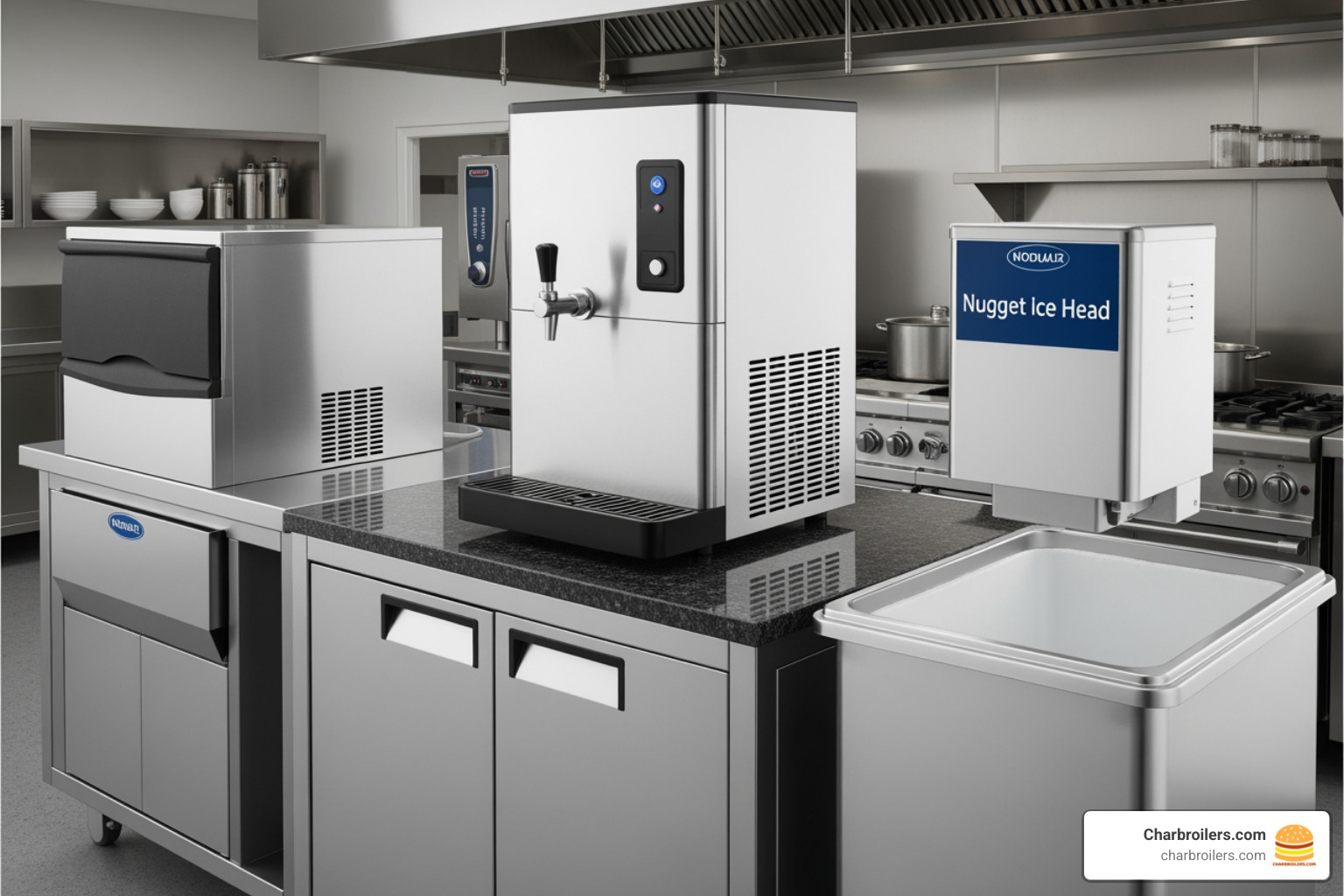
Commercial ice makers nugget come in various configurations, each designed to fit different operational needs and space constraints.
- Undercounter Units: These compact machines are designed to fit snugly under existing counters, making them ideal for bars, small cafes, or offices where space is at a premium. They typically have a lower production capacity, like Scotsman's UN series, which offers models with 79 lbs to 167 lbs storage. They're self-contained, meaning the ice maker and bin are in one unit.
- Countertop Dispensers: Perfect for self-serve beverage stations in convenience stores, healthcare facilities, or breakrooms, these units sit directly on a countertop. They dispense both ice and water, offering convenience and hygiene. Manitowoc's countertop commercial ice machines dispense nugget ice and water, making them great for breakroom applications. Maxx Ice offers a countertop nugget ice dispenser with a 33 lbs capacity.
- Modular Ice Heads: These are the workhorses of high-volume operations. A modular ice head produces the ice and sits on top of a separate, often much larger, ice storage bin. This setup offers maximum flexibility in matching production capacity to storage needs. Brands like Scotsman (Prodigy Plus®) and Follett (Horizon Elite™) offer modular heads with production capacities ranging from hundreds to thousands of pounds daily, allowing you to choose a bin size that perfectly complements your output.
- No Bin, No Problem: Commercial Ice Makers for Modular Setups provides a deeper dive into these flexible solutions.
Condenser, Size, and Efficiency
The condenser type is a critical component that affects both the machine's performance and its placement within your establishment.
- Air-cooled: The most common type, air-cooled condensers use ambient air to cool the refrigerant. They are generally more affordable and easier to install. However, they require adequate ventilation around the machine to dissipate heat effectively. If placed in a confined space without proper airflow, their efficiency can drop significantly, and they can heat up your kitchen.
- Water-cooled: These condensers use water to cool the refrigerant, making them more efficient in hot environments or areas with poor ventilation. They tend to be quieter than air-cooled units. The downside is that they consume a significant amount of water, which can increase utility costs and requires a dedicated water line and drain.
- Remote Systems: For operations where noise and heat are major concerns, remote condenser systems are an excellent solution. With these, the noisy and heat-generating condenser unit is located remotely, often outdoors, while the ice-making head remains indoors. Manitowoc's QuietQube® Remote Ice Machines are a prime example, keeping added heat and noise out of the kitchen and dining area. Follett also offers remote air-cooled models with high production capacities.
The physical footprint and dimensions of your commercial ice makers nugget are vital. Before purchasing, measure your available space carefully, considering not just the width and depth but also the height and necessary clearances for maintenance and ventilation. Manitowoc's 720hid540awx1a, for instance, is 22" W x 28.5" D x 36" H, while Follett's models vary from 18.80" to 29.15" in width. Undercounter units are designed to fit under standard counter heights, but always double-check.
Finally, energy and water efficiency can significantly impact your long-term operating costs. While an initial investment might seem higher for an ENERGY STAR certified model, the savings on electricity and water bills over the machine's lifespan can be substantial. Maxx Ice offers several ENERGY STAR models, which is a good indicator of efficiency. Always review the energy and water consumption ratings provided by manufacturers to understand the true cost of ownership.
For a comprehensive look at various factors, check out The Ultimate Guide to Comparing Commercial Ice Makers.
Installation, Upkeep, and Operational Costs
Proper installation and regular maintenance are essential for the longevity and performance of your commercial ice makers nugget. Neglecting these aspects can lead to costly breakdowns, reduced ice quality, and even health code violations.
The Installation Process
Installing a commercial ice makers nugget involves several key steps to ensure it operates correctly and safely. It's not quite as simple as plugging in a toaster, but with proper planning, it's straightforward.
- Plumbing Requirements: All commercial ice makers require a dedicated water line to supply fresh water for ice production. This line should ideally have a shut-off valve for maintenance. Equally important is a proper drainage system. Nugget ice machines, like many other ice machines, require a drain for meltwater and during cleaning cycles. Ensure the drain is easily accessible and correctly sloped to prevent standing water.
- Electrical Needs: Ice machines are powerful appliances and demand specific electrical requirements. Always check the manufacturer's specifications for voltage (e.g., 115V, 208-230V, 220V are common, as seen in Follett and Ice-O-Matic models) and amperage. It's crucial to have a dedicated circuit for your ice machine to prevent overloading your electrical system, which can trip breakers or damage the unit.
- Ventilation: Especially for air-cooled units, adequate airflow is paramount. The machine needs to draw in cool air and exhaust warm air. Placing it in a cramped space without proper clearance can lead to overheating, reduced ice production, and increased energy consumption. Remote condenser units, like Manitowoc's QuietQube®, solve this by moving the heat and noise outdoors.
- For detailed planning and integration into your commercial kitchen design, you can often Find professional design files for planning your installation directly from manufacturers.
Maintenance for Commercial Nugget Ice Makers
Regular maintenance is the backbone of a reliable commercial ice makers nugget. Think of it like taking care of your car – neglect it, and you're asking for trouble!
- Water Filtration: This is arguably the most crucial maintenance step. Untreated water can lead to mineral buildup (scale) on internal components, reducing efficiency and eventually causing breakdowns. Scale also affects the taste and clarity of your ice. Installing a high-quality water filter, such as the IOMQXL recommended by Ice-O-Matic or the TLC-3200S carbon block filter from Maxx Ice, is highly recommended. Some manufacturers even extend warranty coverage if you enroll in their filter program.
-
Cleaning Schedule: A consistent cleaning regimen is vital for hygiene and performance. This typically includes:
- Daily wiping: Wiping down exterior surfaces and dispensing areas (if applicable) to remove spills and grime.
- Weekly deep cleaning: This might involve cleaning the ice bin and accessible internal components.
- Monthly/Quarterly descaling and sanitizing: This is where you clean the internal water system to remove mineral deposits and sanitize to prevent mold, mildew, and bacteria growth. Many modern machines, like the Manitowoc Ice 720hid540awx1a with its self-sanitizing function or the Ice-O-Matic CIM0330FW with one-touch sanitize/descaling controls, make this process easier. Some models even have dishwasher-safe components for convenience.
- Antimicrobial Technology: To further improve hygiene, some commercial ice makers nugget incorporate antimicrobial protection. For example, Ice-O-Matic's PURE ICE® system uses a built-in antimicrobial compound, and Marvel's residential units feature BrightShield Antimicrobial Lighting. These technologies help inhibit the growth of bacteria, mold, and slime, contributing to cleaner ice.
For a deeper understanding of how these machines work and how to keep them running smoothly, explore Chill Out: A Deep Dive into Commercial Ice Production Methods.
Energy and Water Consumption
When investing in a commercial ice makers nugget, understanding its energy and water consumption ratings is key to managing long-term operational costs. These machines run continuously, so even small differences in efficiency can add up.
- Understanding Consumption Ratings: Manufacturers provide detailed specifications on how much electricity (kWh) and water (gallons) a machine uses per 100 lbs of ice produced. We always advise our clients to compare these figures across different models. Energy Star certified models, while sometimes having a higher upfront cost, are designed to be significantly more efficient, leading to lower utility bills over time.
- Calculating Potential Utility Costs: By knowing your local electricity and water rates, you can estimate the monthly and annual operating costs of a specific machine. This helps in making an informed decision that balances initial investment with ongoing expenses.
- Impact of Ambient Temperature: A machine's stated production capacity and efficiency are often based on ideal conditions (e.g., 70°F ambient air and 50°F incoming water). In hotter environments, or if the machine is poorly ventilated, its production capacity will decrease, and its energy consumption per pound of ice will increase. Ice-O-Matic provides production data for both 70°/50° and 90°/70° conditions, illustrating this impact.
For more insights into optimizing your ice machine's performance, check out Beyond the Chill: Unveiling the Best Commercial Ice Makers for Peak Performance.
Frequently Asked Questions about Nugget Ice Machines
What are the different types of commercial nugget ice makers available?
The main types of commercial ice makers nugget are categorized by their configuration and how they integrate into your space. Firstly, there are countertop dispensers, which are excellent for self-serve areas in convenience stores, breakrooms, or healthcare facilities. These often dispense both ice and water, offering convenience and hygiene. Examples include Manitowoc's countertop units and Maxx Ice's MAXNG30, which can produce around 33 lbs of ice.
Secondly, we have undercounter models. These are compact, self-contained units designed to fit neatly beneath standard countertops, making them ideal for bars, small cafes, or back-of-house areas with limited space. Scotsman's UN series offers undercounter models with storage capacities ranging from 79 lbs to 167 lbs, providing a good balance of production and discreet placement.
Lastly, there are modular ice machine heads. These are high-capacity units that sit on top of a separate, typically much larger, ice storage bin. This configuration offers the most flexibility and highest production volumes, suitable for large restaurants, hospitals, or high-traffic beverage stations. Brands like Scotsman (Prodigy Plus®) and Follett (Horizon Elite™) offer modular heads capable of producing hundreds to thousands of pounds of nugget ice daily, allowing you to pair the ice maker with a bin size that perfectly matches your demand.
How do commercial nugget ice makers differ from cube or flake ice makers?
The primary difference lies in the ice production method and the resulting ice type. Commercial ice makers nugget work by freezing a thin layer of water onto a refrigerated cylinder. A rotating auger then scrapes this frozen water off the cylinder, creating small ice shavings or flakes. These soft flakes are then compressed together and extruded through a die, forming the characteristic small, chewable, porous "nuggets" or "pellets." This process results in ice that is about 90% water, making it softer and more compressible.
In contrast:
- Cube ice makers freeze water in trays or on plates, forming individual, dense, hard cubes (full cube, half cube, crescent, gourmet). This ice melts slowly and is ideal for chilling drinks without diluting them quickly.
- Flake ice makers also scrape ice from a freezing surface, similar to the initial step for nugget ice. However, they do not compress the ice. The result is small, soft, irregular flakes of ice that melt quickly. Flake ice is often used for food displays (like seafood or salad bars), therapeutic applications, or as a cooling medium in food processing, but it's not typically preferred for beverages due to its rapid melt rate and potential for dilution.
The key distinction for nugget ice is its unique chewable texture and its ability to absorb beverage flavors, attributes not shared by hard cube ice or loose flake ice.
What is the typical price range for commercial nugget ice makers?
The price range for commercial ice makers nugget varies significantly based on their production capacity, size, features, and brand. It’s a bit like buying a car – you can find a compact model for city driving or a heavy-duty truck for serious work.
- Small countertop nugget ice dispensers might start around $500 to $1,500. For instance, Maxx Ice offers a countertop nugget ice dispenser (MAXNG30) for around $519. These are generally lower production units, suitable for light-duty use.
- Undercounter nugget ice machines with moderate production (e.g., 50-150 lbs/day) typically range from $1,500 to $4,000. For example, some Maxx Ice self-contained units fall into this range, like their MIM75 at $1,559.
- Modular nugget ice machine heads designed for high-volume production (e.g., 300 lbs to over 2,000 lbs/day) can range from $3,000 to $10,000 or more, not including the separate ice storage bin. A Maxx Ice modular unit (MIM452) with a 460 lbs capacity is listed around $2,911, while larger units from brands like Follett or Scotsman will be at the higher end of this spectrum, reflecting their robust construction and massive output.
- Ice storage bins themselves are an additional cost, usually ranging from $500 to $2,000 depending on capacity.
When budgeting, remember to factor in installation costs, water filtration systems, and ongoing maintenance. While the initial investment can be substantial, the long-term benefits in customer satisfaction and operational efficiency often justify the expense. Your Essential Ingredient: A Cube Ice Machine Price Guide can provide a general sense of commercial ice machine pricing, though nugget ice models may vary slightly.
Conclusion: Lift Your Business with the Perfect Ice
Investing in a commercial ice makers nugget is an investment in customer satisfaction and operational efficiency. From delighting guests with chewable ice in their beverages to optimizing your cost-per-cup through higher liquid displacement, the benefits are clear. The versatility of nugget ice in various commercial settings—from busy bars and restaurants to critical healthcare facilities—underscores its value.
By carefully assessing your production needs, available space, budget, and considering factors like condenser type and maintenance requirements, you can find the perfect machine to keep your business cool and your customers happy. We've seen how the right ice machine can transform beverage service and contribute to a smoother, more profitable operation. For all your commercial kitchen needs, the experts at Charbroilers.com are here to help you find the right equipment to succeed.
Explore our complete guide to commercial equipment for your restaurant.