

Say Goodbye to Griddle Rust: A Commercial Cleaning Tutorial
Why Rust on Your Commercial Griddle is Costing You Money
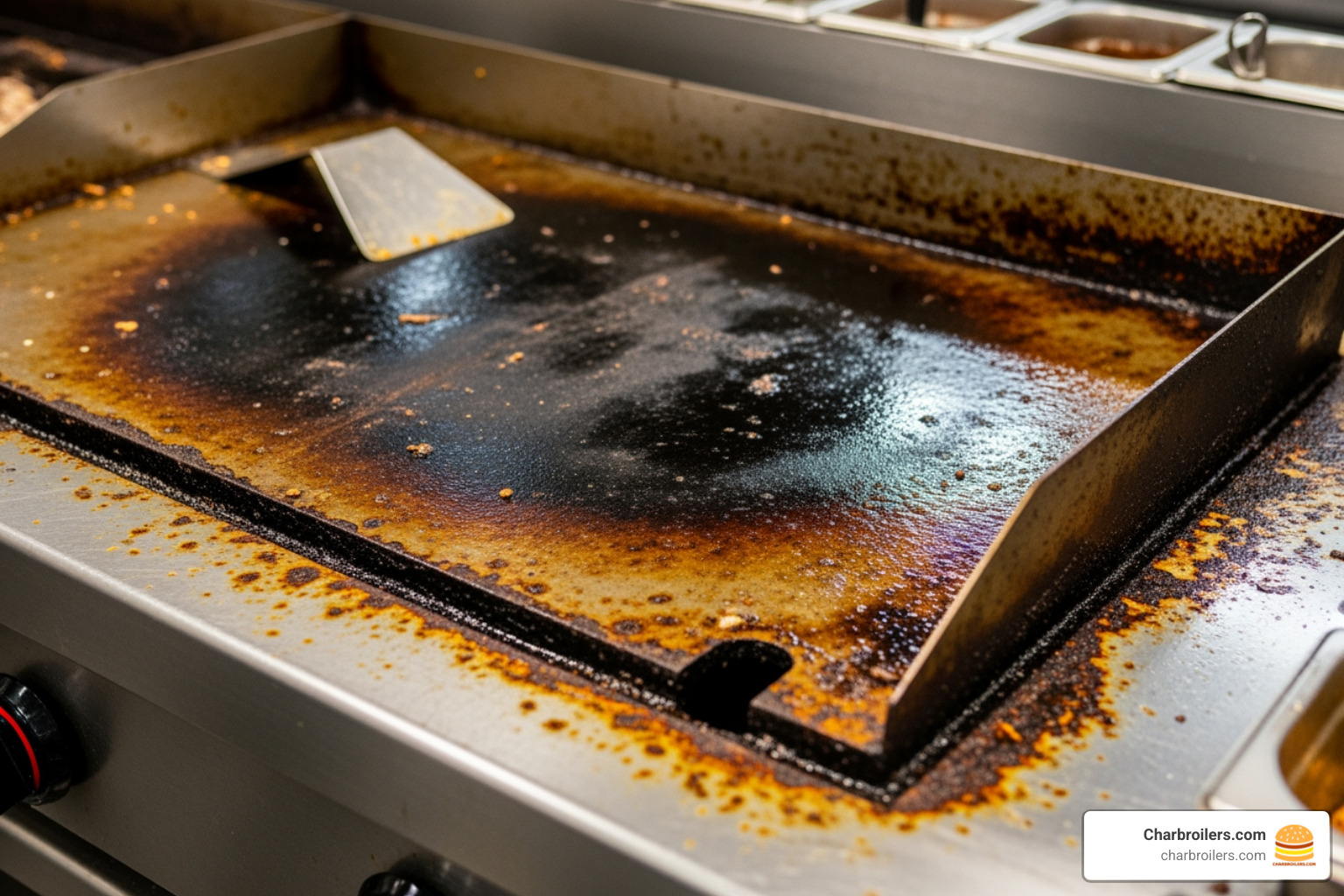
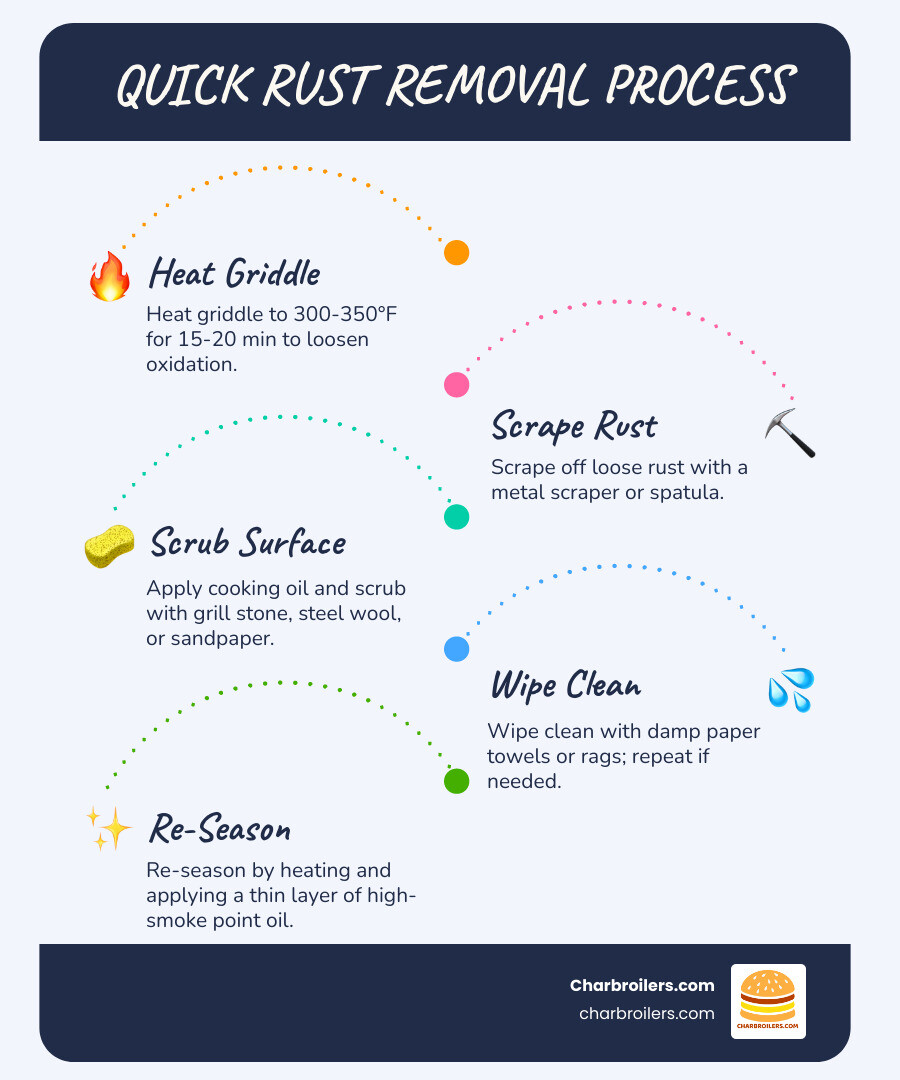
How to clean rust off a commercial griddle is a common challenge that affects food quality, equipment longevity, and even your bottom line. Here's the quick answer:
Quick Rust Removal Process:
- Heat the griddle for 15-20 minutes to loosen oxidation
- Scrape off loose rust with a metal scraper or spatula
- Scrub with oil and a grill stone, steel wool, or medium-grit sandpaper
- Wipe clean with damp paper towels or rags
- Re-season by heating and applying a thin layer of high-smoke point oil
Rust forms when iron in your griddle's surface reacts with water and oxygen—a natural process that's accelerated in busy commercial kitchens. Whether it's from improper drying after cleaning, leaving the griddle exposed to moisture overnight, or simply extended periods between uses, that reddish-brown coating isn't just unsightly. It causes food to stick, creates uneven heating, flakes into your dishes, and can eventually damage your griddle beyond repair.
The good news? Most rust on commercial griddles is surface-level and completely reversible with the right technique. Cast iron and carbon steel griddles are particularly prone to rust but also respond well to proper cleaning and seasoning. Even stainless steel griddles, while more resistant, can develop oxidation spots that need attention.
I'm Sean Kearney, founder of Charbroilers.com, and I've spent over a decade helping restaurant owners maintain their commercial kitchen equipment. Throughout my years in the industry, I've seen countless griddles saved from the scrap heap by following the proper steps on how to clean rust off a commercial griddle and implementing simple preventive maintenance.
Key how to clean rust off a commercial griddle vocabulary:
Why Your Commercial Griddle is Rusting
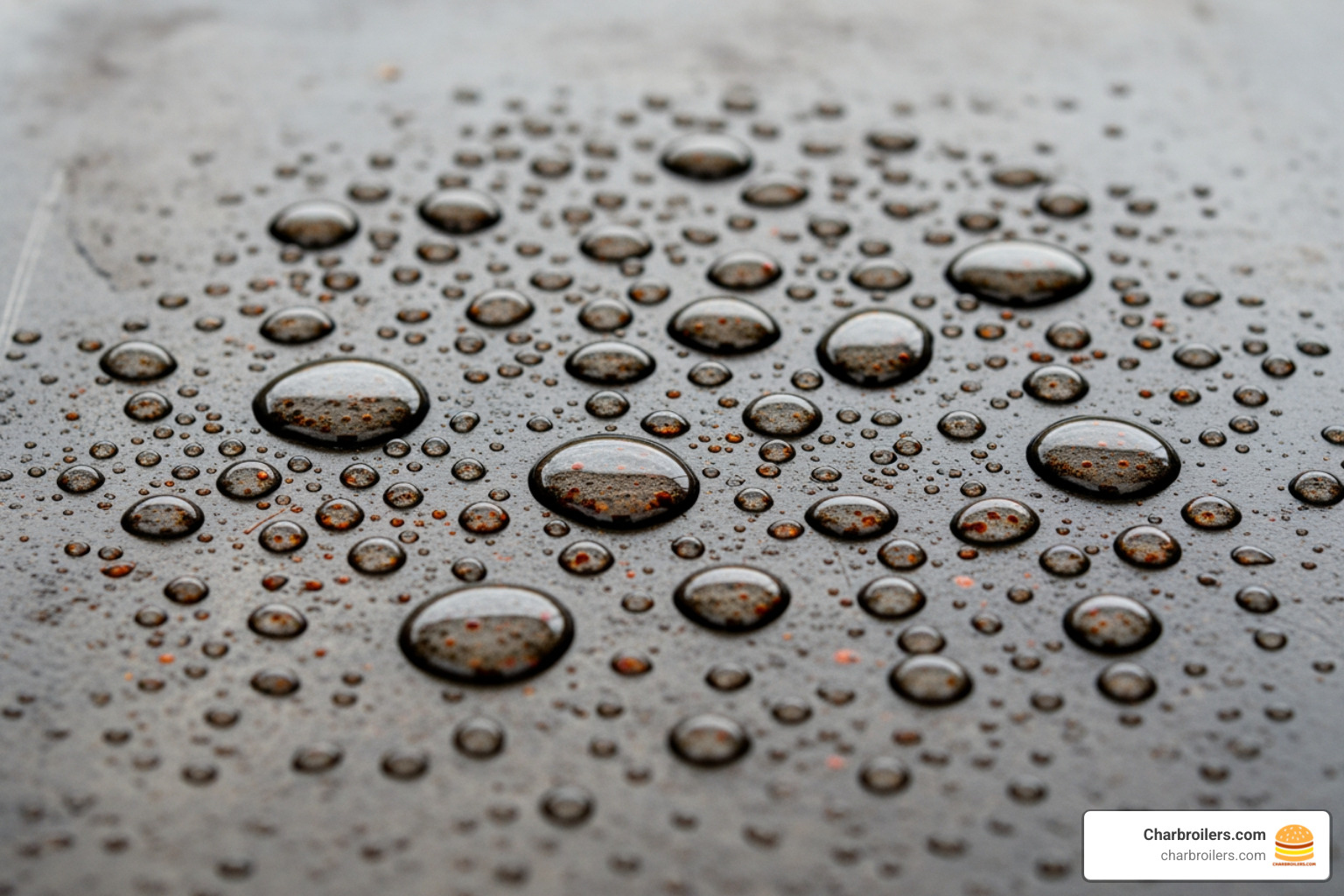
Rust is the archenemy of any commercial griddle, and understanding why it forms is the first step in winning the battle. Simply put, rust is iron's reaction to prolonged exposure to water and oxygen. This natural oxidation process can be accelerated by several factors common in a busy commercial kitchen.
One of the primary culprits is moisture exposure. Leaving water on the griddle surface, whether from cleaning, condensation, or even just high humidity, creates the perfect breeding ground for rust. If a griddle isn't dried thoroughly after washing, or if it's left in a damp environment, rust can begin to form quickly. We've seen many cases where griddles left in the sink or dishwasher for too long develop significant rust.
Improper cleaning also plays a significant role. If food residues, especially acidic ones, are left on the griddle, they can eat away at the protective seasoning layer, exposing the bare metal to moisture and oxygen. A lack of seasoning is another major contributor. Seasoning, which is a polymerized layer of oil baked onto the griddle surface, acts as a natural barrier against rust. Without it, the griddle's iron is vulnerable.
The type of griddle materials also influences rust susceptibility:
- Cast iron and carbon steel griddles are highly prized for their heat retention and even cooking, but they are also the most prone to rust due as they are essentially bare iron. They require diligent seasoning and care.
- Stainless steel griddles are generally more rust-resistant due to their chromium content, but they aren't entirely immune. They can develop rust spots or "flash rust" if exposed to harsh chemicals, abrasive scrubbing, or prolonged contact with certain minerals in water.
Understanding Surface Rust vs. Pitting Corrosion
When we talk about rust, it's important to distinguish between surface rust and more severe pitting corrosion. Most of the time, the rust we encounter on commercial griddles is surface rust. This is the reddish-brown layer that forms on the very top of the griddle's iron. It often appears as a powdery or flaky coating and is relatively easy to remove with the right techniques. As the research notes, rust only forms on the top layer of a griddle's iron, which is good news for us!
However, if left untreated, surface rust can progress to deep pitting. This is where the rust eats into the metal, creating small craters or depressions on the griddle surface. Pitting compromises the griddle's structural integrity, leading to uneven heating, food sticking, and eventually, the potential for holes in the surface. This kind of damage can be much harder, if not impossible, to reverse.
Knowing when to repair vs. replace is crucial. If your griddle has only surface rust, it's almost always salvageable with a thorough cleaning and re-seasoning. If you notice deep pitting, warping, or actual holes in the surface, it might be a sign that the griddle is too far gone, and it's time to consider a replacement for the sake of food safety and cooking quality. For more insights into maintaining all your commercial kitchen equipment, we have a detailed guide available. More info about commercial kitchen equipment.
Your Step-by-Step Guide on How to Clean Rust Off a Commercial Griddle
Tackling rust on a commercial griddle might seem daunting, but with the right approach, it's a manageable task. Our goal is to restore your griddle to its former glory, ensuring it's safe, efficient, and ready to churn out delicious food. Safety first!
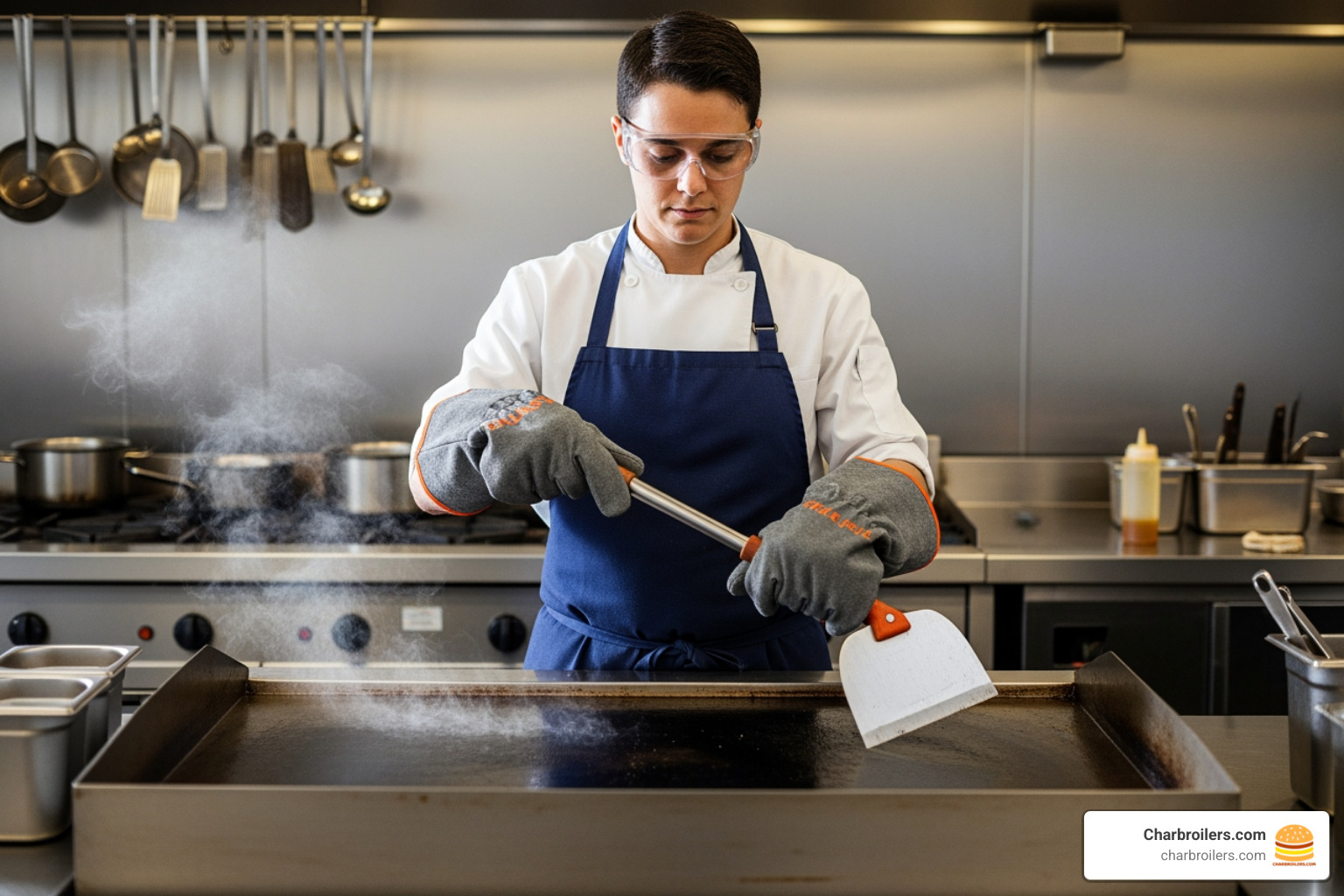
Before we dive into the scrubbing, let's talk safety precautions. Always wear heat-resistant gloves and safety goggles to protect yourself from hot surfaces, steam, and cleaning agents. Ensure your kitchen has adequate ventilation to disperse any fumes from cleaners or smoke from heating oils. We always recommend turning off the griddle and allowing it to cool down to a warm (but not scalding hot) temperature before you start any heavy-duty cleaning. This prevents burns and also helps some cleaners work more effectively.
Essential Tools and Cleaning Agents
Having the right arsenal of tools and cleaning agents is half the battle won. Here's what we recommend for most rust removal tasks:
- Metal scraper: Essential for removing loose rust, burnt-on food, and large debris. A dedicated griddle scraper prevents damage.
- Grill stone or pumice brick: These abrasive tools are highly effective for scrubbing off stubborn rust and carbon build-up on cast iron and steel surfaces.
- Fine-grade steel wool (for cast iron/steel): Great for aggressively scrubbing rust from resilient surfaces.
- Non-abrasive scouring pads (for stainless steel): Scotch-Brite™ sponges are excellent for stainless steel, as they clean effectively without scratching.
- Heat-resistant gloves: Crucial for protecting your hands from heat and chemicals.
- Safety goggles: To shield your eyes from splashes and debris.
- Paper towels or clean rags: For wiping away residue and drying the griddle.
- High-smoke point cooking oil: Such as canola, vegetable, or flaxseed oil, essential for seasoning and protecting the griddle after cleaning.
- White vinegar: A natural acid that helps dissolve rust, especially effective in a 1:1 mixture with water.
- Baking soda: Forms an abrasive paste for stubborn stains and light rust, particularly useful for stainless steel.
How to Clean Rust Off a Commercial Griddle: The Physical Removal Method (For Cast Iron/Steel)
This method is our go-to for cast iron and carbon steel griddles, which are typically more robust and can handle aggressive scrubbing.
- Heat the griddle: Begin by heating your griddle for about 15-20 minutes. This helps to loosen oxidation and makes the rust easier to remove. We aim for around 300-350°F, warm enough to work but not so hot that it's dangerous.
- Scrape loose rust: Once the griddle is warm, use your metal scraper to scour off any loose rust, charred food, and debris. Apply firm, even pressure, pushing the debris into the grease trap.
- Apply oil: Drizzle about 3-4 tablespoons of high-smoke point cooking oil directly onto the rusty areas. The oil will help lubricate the surface and lift the rust.
- Scrub with grill stone or steel wool: With your heat-resistant gloves on, use a grill stone, steel wool, or even medium-grit sandpaper to vigorously scrub the griddle surface. Work in small sections, applying circular motions or scrubbing back and forth. You'll see the rust mixing with the oil and turning into a dark sludge.
- Wipe away residue: Use paper towels or a clean rag to wipe away the rust-oil mixture. You'll likely need several towels, as they'll quickly become saturated with grime.
- Repeat process: Continue applying oil, scrubbing, and wiping until all visible rust is gone and the griddle surface appears clean and smooth. This might take a few rounds, especially for heavily rusted areas.
For more detailed strategies on rust removal, especially for grill grates, we've compiled additional resources. More info about removing rust from grills.
How to Clean Rust Off a Commercial Griddle: The Chemical & Gentle Method (For Stainless Steel/Chrome)
For stainless steel or chrome-plated griddles, a gentler approach is often necessary to avoid scratching the surface while still effectively removing rust.
- Baking soda paste: For minor rust spots or stubborn stains on stainless steel, mix baking soda with a little water to form a thick paste. Apply the paste directly to the rusty areas and let it sit for 15-20 minutes. The mild abrasive nature of baking soda, combined with its cleaning properties, helps to lift the rust without damaging the finish.
- Vinegar and water solution: A 1:1 mixture of white vinegar and water is a fantastic, food-safe solution for tackling light rust and general grease on stainless steel. Spray or pour the solution onto the affected areas and let it sit for 5-10 minutes. The acetic acid in vinegar helps dissolve the rust.
- Non-abrasive pads: Use a non-abrasive scouring pad or a Scotch-Brite™ sponge to gently scrub the treated areas. Always scrub in the direction of the grain on stainless steel to prevent visible scratches.
- Polishing: After scrubbing, wipe the surface clean with a damp cloth. For an extra shine and to remove any streaks, you can use a fresh cloth dampened with a vinegar-water solution and polish the surface.
- Rinsing thoroughly: Always rinse the griddle surface thoroughly with clean water to remove all traces of cleaning agents. This is crucial to prevent chemical residues from contaminating food or causing further damage. Dry the griddle immediately and completely.
Maintaining stainless steel requires specific care to keep it gleaming. We have a comprehensive guide that covers all you need to know about cleaning stainless steel grill grates, which applies well to griddles too. More info about cleaning stainless steel.
The Crucial Final Step: Re-Seasoning and Rust Prevention
Cleaning rust off your commercial griddle is only half the battle. The truly crucial step is re-seasoning, which creates a protective barrier against future rust and establishes a naturally non-stick surface. This process involves polymerization, where layers of oil are baked onto the griddle, changing into a hard, slick, and protective coating. This seasoned layer is what makes your griddle a joy to cook on and much easier to maintain.
How to Re-Season Your Griddle for a Protective Finish
Re-seasoning is vital after any deep cleaning or rust removal, especially for cast iron and carbon steel griddles.
- Ensure a clean and dry surface: Before seasoning, your griddle must be completely free of rust, cleaning agents, and moisture. Any residue will interfere with the seasoning process.
- Apply a thin oil layer: Choose a high-smoke point oil like canola, vegetable, or flaxseed oil. Apply a very thin, even layer across the entire cooking surface using a paper towel or clean cloth. The key here is thin—too much oil will result in a sticky, gummy surface.
- Heat to smoke point: Turn on your griddle and heat it gradually. Allow the griddle to reach its smoke point, the temperature at which the oil begins to smoke. Maintain this temperature for 15-30 minutes. You'll see the oil polymerize and bond to the metal.
- Cool down: Turn off the griddle and allow it to cool completely. This slow cooling process helps the seasoning to set properly.
- Wipe excess: Once cooled, wipe off any remaining excess oil. The surface should feel smooth and dry, not sticky.
- Repeat for durability: For optimal durability and a truly non-stick, rust-resistant surface, we recommend repeating this seasoning process 2-3 times. Each thin layer builds upon the last, creating a robust protective finish.
For a deeper dive into the art of seasoning, including techniques used for various types of pans, we found this detailed guide incredibly helpful. A detailed guide on seasoning pans. You can also explore our specific tips for cast iron. More info about seasoning cast iron.
Daily Habits to Prevent Future Rust
Prevention is always better than cure, especially in a busy commercial kitchen. Implementing these daily habits will drastically reduce the chances of rust returning:
- Clean after each use: Make it a routine to clean your griddle immediately after each cooking session. This prevents food residues and grease from hardening and becoming difficult to remove.
- Dry thoroughly: After cleaning, ensure the griddle is completely dry. Use paper towels or clean rags to wipe away all moisture. Any standing water is an open invitation for rust.
- Apply a light oil coat: After drying, apply a very thin layer of high-smoke point cooking oil to the griddle surface. This reinforces the seasoning and provides a fresh protective barrier.
- Use griddle covers: For outdoor griddles, or those that might be exposed to environmental moisture, a waterproof griddle cover is an excellent investment. It shields the surface from humidity, rain, and dust.
- Proper ventilation: Good ventilation in your kitchen helps to reduce ambient moisture and humidity, which can contribute to rust formation.
Consistency is key. By making these steps a part of your daily kitchen routine, you'll ensure your griddle remains rust-free and performing at its best. For more tips on daily griddle cleaning, we have an extensive guide. More info about daily griddle cleaning.
Advanced Griddle Care and Troubleshooting
When it comes to griddle care, it's worth noting that the approach for a commercial griddle versus a home griddle differs significantly. Commercial griddles face much heavier use, operate at higher temperatures for longer durations, and are subject to stringent food safety standards. This means our cleaning methods must be more robust, efficient, and often involve heavy-duty equipment and specialized cleaners. The stakes are higher in a commercial setting; a rusty or poorly maintained griddle can lead to health code violations, inconsistent food quality, and costly downtime.
Commercial Rust Removers vs. DIY Solutions
Deciding between commercial rust removers and DIY solutions often comes down to the severity of the rust, the griddle material, and your budget.
| Feature | Commercial Rust Removers | DIY Solutions (Vinegar, Baking Soda) |
|---|---|---|
| Food Safety | Often formulated for commercial kitchen use, but always check for food-safe certifications and rinse thoroughly. Some can be dangerous if not used correctly. | Generally food-safe (vinegar, baking soda, salt). Electrolysis, while effective, requires careful setup and is not a "food-safe" process, rather a restoration process after which the griddle must be thoroughly cleaned and re-seasoned. |
| Effectiveness | Designed for aggressive rust, can be highly effective for heavy build-up and tough oxidation. Products like CLR (Calcium, Lime, Rust remover) are powerful, but caution is advised as some commercial cleaners are not food-safe or can be abrasive. | Best for minor rust spots, discoloration, and general grime. Vinegar's acidity helps dissolve rust, while baking soda provides a gentle abrasive action. Less effective for deep or extensive rust. |
| Cost | Can be more expensive per application, but some concentrated formulas might offer better value for large-scale or frequent use. | Very inexpensive, utilizing common household ingredients. |
| Labor | Can be faster and require less manual scrubbing for severe rust, especially when using specialized systems like the 3M Scotch-Brite™ Quick Clean Griddle Cleaning System, which can clean a griddle 30% faster than a griddle brick and in 3-5 minutes. | Often more labor-intensive, requiring more scrubbing and repeat applications for effective rust removal. |
| Application | Follow manufacturer instructions precisely. May involve specific application methods, dwell times, and protective gear. | Simple application (spraying, pasting, scrubbing). |
| Material | Some commercial cleaners are specialized for specific metals (e.g., stainless steel polishes vs. cast iron rust removers). | Vinegar is generally safe for most metals but can strip seasoning from cast iron/carbon steel. Baking soda is gentle enough for stainless steel. Electrolysis is particularly effective for cast iron and bare steel. |
For extensive rust on cast iron or bare steel, electrolysis is an advanced method suggested by some experts. It's a process that uses an electric current to reverse the oxidation, effectively removing rust and gunk. While it sounds complicated, it's simpler than you might think and can yield incredibly clean results, especially for neglected items. We recommend consulting specialized resources for setting up an electrolysis tank safely. http://www.wag-society.org/Electrolysis/electros.php
When is a Griddle Too Damaged by Rust?
While most surface rust is treatable, there comes a point when a griddle is simply beyond salvaging. Recognizing these signs can save you time, effort, and potential food safety risks:
- Deep pitting: If rust has eaten deep into the metal, creating noticeable craters or uneven surfaces, it's a strong indicator of irreparable damage. This affects cooking consistency and cleanliness.
- Warping: Severe rust can sometimes lead to uneven heating and warping of the griddle surface. A warped griddle won't cook food evenly, leading to hot and cold spots.
- Holes in the surface: This is the most obvious sign of terminal damage. If rust has corroded all the way through the griddle plate, it's a clear indication that it needs to be replaced.
- Uneven heating that persists: Even after cleaning and re-seasoning, if your griddle continues to heat unevenly due to previous rust damage, it's likely time to consider an upgrade.
If your griddle exhibits these severe signs, it's often more cost-effective and safer in the long run to invest in a new unit. Continuing to use a heavily damaged griddle can compromise food quality, increase energy consumption, and pose safety hazards. For those considering new equipment, our guides on commercial gas griddles can help you find the perfect fit. More info about commercial gas griddles.
Frequently Asked Questions about Griddle Rust
Can you use vinegar to clean a commercial griddle?
Yes, you can use vinegar to clean a commercial griddle, especially for light rust and general grease. A 1:1 solution of white vinegar and water is quite effective. Simply spray the mixture onto the griddle surface, let it sit for a few minutes to allow the acid to work on the rust and grease, then scrub with a non-abrasive pad. For more stubborn grime, you can add a bit of lemon juice to the vinegar solution. It's crucial to always rinse the griddle thoroughly with clean water afterward to remove all vinegar residue, and then immediately dry and re-season the surface, particularly for cast iron or steel griddles, as vinegar can strip away seasoning.
How can you tell if all the rust has been removed?
You can tell if all the rust has been completely removed by both touch and sight. The griddle surface should feel smooth to the touch, with no rough, gritty, or flaky patches remaining. Visually, the tell-tale reddish-brown color of rust should be entirely gone. For seasoned griddles (cast iron or carbon steel), the surface should have a uniform dark, almost black, appearance from the seasoning. For stainless steel, it should return to its bright, unblemished finish. If you see any lingering reddish hues or feel any bumps, another round of cleaning and scrubbing is needed.
Is it safe to cook on a rusty griddle?
While minor surface rust is generally not considered immediately harmful if ingested, it's certainly not ideal or recommended to cook on a rusty griddle. Rust can flake off into your food, affecting its taste, texture, and appearance. More importantly, rust can harbor bacteria and make it impossible to properly clean and sanitize the cooking surface, posing a food safety risk in a commercial setting. A heavily rusted griddle will also cook food unevenly and cause sticking. For these reasons, it's always best practice and critical for food safety to remove all rust before cooking.
Conclusion: A Clean Griddle is a Profitable Griddle
Rust on your commercial griddle doesn't have to be a death sentence for your equipment. By understanding its causes, knowing the right tools and techniques for removal, and diligently re-seasoning, you can extend the life of your griddle and maintain high food quality.
Remember our mantra: Clean, Dry, Season. These three steps are the cornerstone of effective griddle maintenance and rust prevention. Consistent care not only keeps your griddle looking its best but also ensures even cooking, prevents food from sticking, and helps you pass those crucial health inspections. A well-maintained griddle is a reliable workhorse in your kitchen, directly contributing to your bottom line through efficiency and customer satisfaction.
For all your commercial kitchen needs, from high-performance griddles to charbroilers, explore the selection at Charbroilers.com. We're here to help you keep your equipment in top shape, ensuring your kitchen runs smoothly and profitably. Explore our guide to commercial charbroilers for your restaurant.