

From Bakery to Bistro: Choosing the Best Commercial Oven for Your Business
Why the Right Commercial Oven is the Heart of Your Kitchen
Commercial ovens are the workhorses of any foodservice operation, from busy pizzerias to artisan bakeries. Choosing the right one impacts everything from your food quality to your energy bills.
Quick Guide to Commercial Oven Types:
| Oven Type | Best For | Key Benefit |
|---|---|---|
| Convection | All-purpose cooking, roasting, baking | Even heat distribution, faster cooking |
| Deck | Pizza, artisan bread, crispy crusts | Radiant heat from stone or steel decks |
| Combi | Versatile cooking, roasting, steaming | Steam + convection in one unit |
| Conveyor | High-volume pizzerias, sandwich shops | Consistent output, reduced labor |
| Rotisserie | Roasted meats, especially poultry | Self-basting, visual appeal |
Whether you're upgrading a single unit or outfitting a new kitchen, the right oven isn't just equipment—it's an investment in your business. The decision affects your menu capabilities, kitchen workflow, energy costs, and ultimately your bottom line.
Your commercial oven needs to handle high-volume service during peak hours, deliver consistent results across shifts, and fit within your kitchen's footprint and budget. A quality convection oven is often called "the workhorse of your kitchen," delivering superior results and long-lasting value. That durability matters when you're cooking hundreds of meals per day.
The marketplace offers an overwhelming array of options. There are over 5,800 commercial oven products available across dozens of categories—from basic convection models to sophisticated combi ovens with programmable controls that store up to 99 menu presets. Some ovens feature removable, dishwasher-safe doors. Others offer independent deck controls that let you bake bread at one temperature while roasting chicken at another.
Modern commercial ovens also incorporate advanced technology. Precision heating systems, controlled airflow, and adjustable steam settings help you achieve perfect results whether you're baking delicate pastries or searing steaks. Many models now carry ENERGY STAR certification, helping you reduce utility costs while meeting environmental standards.
I'm Sean Kearney, founder of Charbroilers.com, and I've spent over a decade helping restaurants find the right *commercial ovens and equipment at fair prices.* My experience in the restaurant equipment industry has shown me how the right oven choice transforms kitchen efficiency and food quality.
This guide breaks down the different oven types, key features to evaluate, and practical considerations like energy efficiency and maintenance. By the end, you'll know exactly which commercial oven fits your menu, your space, and your budget.
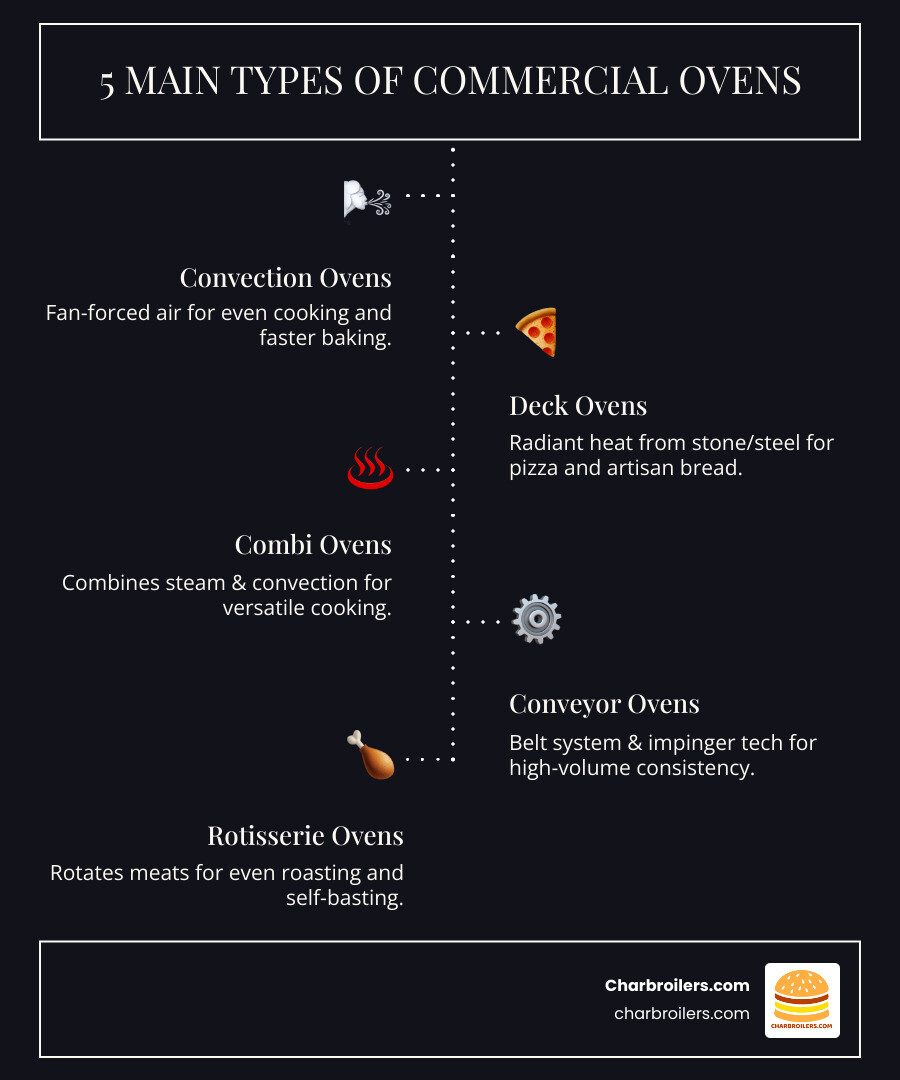
Commercial ovens terms made easy:
The Core Types of Commercial Ovens and Their Specialties
Choosing the right commercial oven is a lot like choosing the right tool for a specific job; you wouldn't use a screwdriver to hammer a nail, and you wouldn't use a deck oven for delicate soufflés. This section will help you match an oven type to your menu and workflow, answering what are the different types of commercial ovens and their primary uses.

Convection Ovens: The All-Purpose Workhorse
If there's one oven type that truly lives up to the "workhorse" moniker, it's the commercial convection oven. These ovens use internal fans to circulate hot air evenly throughout the cooking chamber, ensuring consistent temperatures and faster cooking times. This fan-forced air is a game-changer, eliminating hot and cold spots that plague traditional ovens.
Convection ovens excel at a wide range of tasks, making them incredibly versatile for almost any commercial kitchen. They are fantastic for roasting meats, baking pastries, and cooking casseroles. The even heat distribution means perfectly browned and cooked items every time. With faster cook times, you can turn tables quicker and increase your output, directly impacting your bottom line. Many chefs consider them a "go-to" piece of equipment. We've even discussed Convection Perfection: Top Ovens for Your Commercial Kitchen and Demystifying Commercial Convection Ovens: A Deep Dive into Their Operation in more detail.
Many top brands offer robust convection ovens, recognized as industry stalwarts for their great baking performance. These systems are highly regarded for features like portability, expandable platforms, increased tray loading capacity, and smart door designs for safety. Whether you're baking, roasting, or reheating, a convection oven delivers reliable results.
Deck Ovens: The Artisan's Choice
For those who prioritize crispy crusts and authentic textures, particularly for pizza and artisan bread, deck ovens are unparalleled. These ovens rely on radiant heat from stone or steel decks, which absorb and retain heat, transferring it directly to the food. This direct contact creates a distinct, crispy bottom crust that's difficult to achieve with other oven types.
In a deck oven, each deck can often be set to operate independently at different temperatures. This means you can bake delicate pastries on one deck while simultaneously crafting a perfectly charred pizza on another. This independent control allows for incredible flexibility in a busy kitchen. Our Guide to Gas Deck Ovens provides further insights into these specialized ovens.
Some industrial gas ovens, for example, are known as 'Sectional Ovens' and are available in various combinations, highlighting their versatility for different baking needs. Patented burner systems can ensure even heat distribution, a critical factor for consistent baking results.
Combination (Combi) Ovens: The Ultimate in Versatility
Imagine an oven that can roast a chicken to perfection, steam delicate vegetables, and then bake a batch of cookies, all with precise control. That's the power of a combi oven. These marvels of engineering combine the functionalities of a convection oven and a steam oven into a single unit.
Combi ovens allow you to choose between convection, steam, or a combination of both modes. The steam function helps retain moisture, ensuring juicy meats and vibrant vegetables, while the convection function provides browning and crisping. The combination mode offers the best of both worlds, perfect for precision cooking that maintains food quality and reduces shrinkage. The importance of steam is emphasized by many, with some ovens offering adjustable steam settings for specific products. You can learn more in our white paper on Why Steam is Key to Cooking: White Paper Download. This versatility allows chefs to achieve consistent results for a wide array of dishes, adapting to changing demands and tastes.
Conveyor Ovens: For High-Volume Consistency
When your business thrives on speed and consistency, particularly for high-volume items like pizzas, sandwiches, or even baked goods, conveyor ovens are the answer. These ovens feature a conveyor belt that moves food through a heated chamber, ensuring every item receives the exact same cooking time and temperature.
Often utilizing "impinger" technology, conveyor ovens blast hot air directly onto the food, cooking it quickly and evenly. This design significantly increases production capacity and ensures uniform results, reducing the need for constant monitoring and specialized labor. They are indispensable in high-volume pizzerias, sandwich shops, and quick-service restaurants where speed and consistency are paramount.
Specialized Ovens for Unique Menus
Beyond the core types, many commercial kitchens benefit from specialized commercial ovens designed for niche culinary needs.
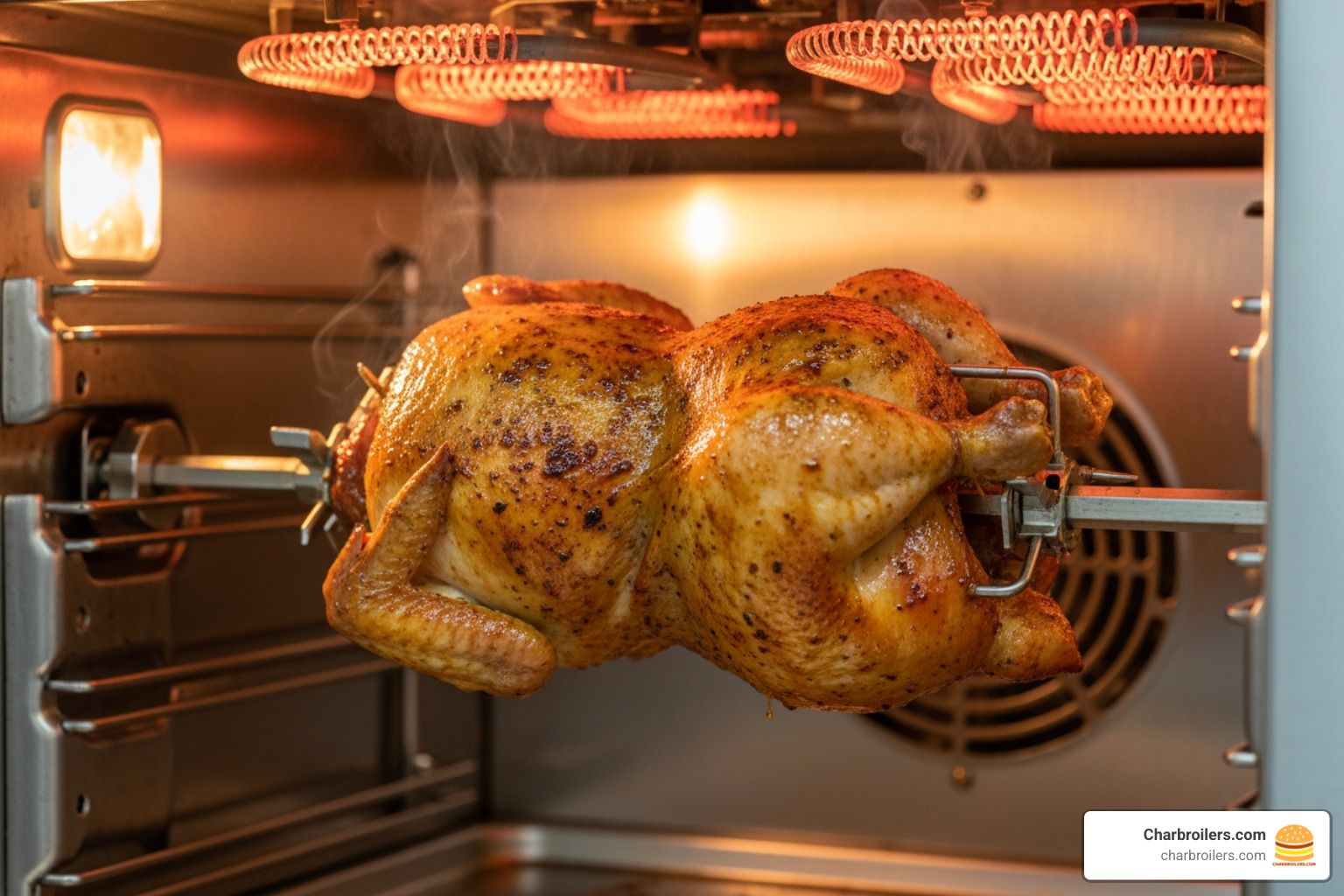
- Rotisserie Ovens: These ovens are designed to roast meats, especially poultry, evenly by rotating them on spits or baskets inside the oven chamber. The continuous rotation ensures consistent heat exposure, leading to juicy interiors and crispy exteriors, while also self-basting the meat. They also provide an eye-catching display, especially when placed in customer-facing areas. However, rotisserie ovens require robust grease collection systems (drip trays/pans) that are accessible for frequent cleaning, and often necessitate grease-rated hoods due to grease-laden vapors.
- Cook-and-Hold Cabinets: These units cook food at low temperatures and then hold it at serving temperature for extended periods, reducing shrinkage and preserving moisture. They are excellent for preparing large cuts of meat overnight.
- Tandoor Ovens: Traditional clay ovens used in Indian and Middle Eastern cuisine, reaching extremely high temperatures to cook flatbreads (like naan) and marinated meats quickly, imparting a unique smoky flavor.
- Smoker Ovens: Designed for slow cooking and infusing food with smoky flavors from wood chips or pellets. Ideal for BBQ restaurants and establishments offering smoked meats.
These specialized ovens allow businesses to cater to specific culinary demands, enhancing their menu offerings and attracting a broader customer base.
Key Features to Consider When Buying a Commercial Oven
Choosing the best commercial oven for your business isn't just about picking a type; it's about delving into the details. This section breaks down the essential features to evaluate, ensuring you select the best commercial oven for your needs.
Power Source: Gas vs. Electric
One of the most fundamental decisions you'll make is the oven's power source. Both gas and electric commercial ovens have their advantages, and the best choice often depends on your existing kitchen infrastructure, operating costs, and cooking preferences.
| Feature | Gas Ovens | Electric Ovens |
|---|---|---|
| Initial Cost | Often lower | Can be higher |
| Operating Cost | Generally lower (natural gas often cheaper) | Can be higher (electricity often more expensive) |
| Heat Response | Quick to heat up, good temperature recovery | Slower to heat, but very stable heat |
| Installation | Requires gas line and ventilation | Requires appropriate electrical wiring |
| Heat Quality | Moist heat, often preferred for roasting | Dry heat, often preferred for baking |
- Operating Costs: Natural gas is often more cost-effective than electricity, leading to lower utility bills over time, especially for ovens that run for many hours a day. This is a significant factor for any business looking to control expenses. We've explored Unlocking Efficiency: The Power of Gas Convection Ovens in depth.
- Heat Response Time: Gas ovens typically heat up faster and recover temperature quickly when the door is opened, which is beneficial in busy kitchens. Electric ovens, while slower to heat, often provide a more consistent and even heat distribution once at temperature, which can be ideal for delicate baking.
- Installation Requirements: Gas ovens require a gas line and proper ventilation (typically a hood system). Electric ovens need adequate electrical wiring and amperage. Your existing kitchen setup and local codes will heavily influence this choice. For those considering electric, we have a guide on Power Up Your Kitchen: The Best Commercial Electric Ranges with Convection Ovens.
Many industrial gas ovens, for example, can be set up for natural or LP gas, offering flexibility in fuel choice.
Size and Capacity: From Countertop to Double Stack
The physical dimensions and cooking capacity of your commercial oven are critical for fitting into your kitchen and matching your output needs.
- Kitchen Footprint: Measure your available space carefully. Countertop models are great for smaller operations or as supplementary units. Full-size and half-size ovens are standard, but consider whether you have the floor space for them. We've covered how to Maximize Your Space: Understanding Full-Size Commercial Countertop Convection Ovens.
- Standard Depth vs. Bakery Depth: Standard depth ovens accommodate full-size sheet pans placed sideways. Bakery depth (or deep depth) ovens are deeper, allowing full-size sheet pans to be placed front-to-back. This can improve airflow around baked goods, leading to more even results, especially in convection models.
- Stacking Options: To maximize vertical space, many commercial ovens can be stacked—single, double, or even triple units. This is particularly common with convection ovens. Stacking allows you to double or triple your cooking capacity without expanding your kitchen's horizontal footprint. Check out our Commercial Double Stack Ovens: A Comprehensive Buyer's Guide for more information. Many brands, for instance, offer various configurations, including single and double deck options, as well as half-size units.
Controls and Technology: Precision at Your Fingertips
Modern commercial ovens offer a spectrum of control options, from simple manual dials to sophisticated digital interfaces, each impacting precision and ease of use.
- Manual Dials vs. Programmable Digital Controls: Manual dials are straightforward and robust, ideal for basic operations. However, programmable digital controls offer unparalleled precision. Many modern ovens, for example, feature programmable digital controls that allow you to store up to 99 menus for consistent results. This means you can recall exact cooking parameters for your most popular dishes, ensuring consistency regardless of who is operating the oven.
- Precision Heating and Airflow Technology: Advanced ovens boast superior heat distribution, often through unique airflow systems, like those found in rotating rack ovens. This ensures even cooking and browning. High-quality ovens are lauded for their gentle air circulation and even heat distribution, critical for perfectly cooked meals.
- Specific Functions: Look for features like precise steam control for specific products, retherm technology for reheating, or even specialized gentle bake modes for delicate items.
- Self-Cleaning Functions: Some high-end models offer self-cleaning modes, significantly reducing labor and ensuring hygiene. Even without full self-cleaning, features like award-winning dishwasher-safe removable doors simplify the cleaning process.
Optimizing for Efficiency, Durability, and a Clean Kitchen
Investing in a commercial oven is a long-term commitment. This section covers the long-term value considerations, from energy savings to maintenance, that impact your bottom line.
The Value of Energy-Efficient Commercial Ovens
In today's competitive foodservice landscape, every penny saved matters. Energy-efficient commercial ovens offer substantial benefits beyond just being environmentally friendly.
- Lower Utility Bills: Ovens with superior insulation, advanced heat recovery systems, and efficient burner designs consume less energy. This directly translates to lower operating costs and improved profitability.
- Faster Preheat Times: Energy-efficient ovens often reach desired temperatures more quickly, saving time and energy during startup.
- Environmental Benefits: Reduced energy consumption means a smaller carbon footprint, which can be a selling point for environmentally conscious customers.
- ENERGY STAR Certification: This is a crucial certification to look for. Products that earn the ENERGY STAR label meet strict energy efficiency guidelines set by the U.S. Environmental Protection Agency. Many commercial ovens are designed with energy-saving features, and finding an ENERGY STAR certified model can lead to significant long-term savings. You can Find and Compare certified energy-efficient ovens to make an informed choice. Many leading manufacturers offer numerous ENERGY STAR certified options, demonstrating a commitment to efficiency.
Maintenance and Cleaning for Longevity
A well-maintained commercial oven performs better, lasts longer, and ensures food safety. Neglecting cleaning can lead to decreased efficiency, uneven cooking, and even fire hazards.
- Daily Cleaning: Assign and schedule daily cleaning duties. Brush crumbs out of the oven, wipe down the interior with a non-abrasive sponge or cloth, and clean oven racks (soaking them in soapy water often helps). For rotisserie ovens, accessible grease collection systems (drip trays or pans) must be cleaned frequently due to the significant amount of grease produced.
- Deep Cleaning: Monthly deep cleaning is essential. Use a commercial oven cleaner for caked-on grease and food residue. For pizza ovens, cleaning methods vary: brick ovens require brushing/scraping, while deck ovens need debris loosened with a pizza brush (avoiding water on the pizza stone). Conveyor ovens require cleaning the belt and oven fingers separately. We've compiled some great Baked on Mess? Convection Oven Cleaning Hacks to the Rescue! and tips on Safe Cleaning for Self-Cleaning Convection Ovens.
- Self-Cleaning Modes and Removable Parts: Some advanced ovens offer self-cleaning functions or have components designed for easy removal and cleaning, like dishwasher-safe removable doors. Stainless steel construction, common in commercial ovens, also aids in cleaning and hygiene.
Durability, Warranty, and Reputation
A commercial oven is a significant investment, and its ability to withstand the rigors of a busy kitchen is paramount.
- Built to Last: Look for heavy-duty construction using durable materials. Quality convection ovens are known as "workhorses" that offer "long-lasting value." These ovens are designed to handle continuous, demanding use in busy kitchens. Our article Built to Last: Best Commercial Stainless Steel Convection Ovens Reviewed dives deeper into this.
- Warranty Coverage: A strong warranty indicates a manufacturer's confidence in their product. Many ovens, for instance, come with a 1-year Parts and Labor warranty. Understanding what your warranty covers (parts, labor, duration) is crucial for protecting your investment.
- Brand Reliability: Research brand reputation. Companies with a long history of quality and customer support, some with over 100 years in oven manufacturing, often provide more reliable equipment and better service. A reputable brand ensures you have access to parts and skilled technicians when needed.
Integrating Your Oven and Staying Ahead of Trends
The best commercial oven won't perform optimally if it's not properly integrated into your kitchen's workflow. Plus, staying informed about new technologies can give you a competitive edge.
Kitchen Layout and Ventilation
Thoughtful placement and proper ventilation are essential for safety, efficiency, and comfort in your commercial kitchen.
- Workflow Optimization and Space Efficiency: Consider how the oven fits into your kitchen's workflow. Placing it near prep areas and serving lines can minimize handling time. For smaller kitchens, countertop models or double-stacked units can maximize space.
- Ventilation Hoods: Most gas ovens and any oven producing significant steam or grease-laden vapors (like rotisserie ovens) will require a ventilation hood system. These hoods capture and filter airborne contaminants, maintaining air quality and complying with health codes. Rotisserie ovens, in particular, often require grease-rated hoods. We've discussed Commercial Convection Ovens: Unpacking Venting and Hood Requirements previously.
- Ventless Technology: For specific applications and locations where traditional hoods are not feasible or desired, ventless commercial ovens are a fantastic alternative. These ovens use internal filtration systems to remove smoke, grease, and odors, eliminating the need for a spacious ventilation hood. Our guide on Ventless Commercial Convection Ovens That'll Blow You Away (Without the Vent!) offers more details.
The Future of Cooking: Innovations in Oven Technology
The world of commercial ovens is constantly evolving, with new technologies aimed at improving efficiency, precision, and ease of use.
- Smart Ovens and IoT Connectivity: Increasingly, ovens are incorporating Internet of Things (IoT) technology, allowing for remote monitoring, diagnostics, and even recipe management from a tablet or smartphone. This connectivity can streamline operations and provide valuable data.
- Advanced Energy Recovery Systems: Beyond basic energy efficiency, cutting-edge ovens are designed to recapture and reuse heat, further reducing energy consumption and operating costs.
- Touchscreen Interfaces: Intuitive touchscreen controls are replacing traditional buttons and dials, offering easier programming, clearer displays, and access to more advanced features.
- Automated Cooking Cycles: Some high-end combi ovens now feature fully automated cooking cycles, where the oven senses the food type and adjusts temperature, humidity, and fan speed to achieve perfect results with minimal human intervention. This kind of technology ensures consistency and reduces training time for staff.
Frequently Asked Questions about Commercial Ovens
We often hear similar questions from our customers in Seattle, WA, USA, and beyond when they're navigating commercial ovens. Here are some of the most common ones:
How do I choose the right size oven for my restaurant?
Choosing the right size commercial oven involves a careful assessment of several factors:
- Consider your menu: What types of dishes will you be cooking? How many items require simultaneous oven space?
- Peak service volume: How many customers do you serve during your busiest hours? Your oven needs to keep up with demand during these critical times.
- Available kitchen space: Measure your kitchen carefully. Factor in not just the oven's footprint, but also clearance for doors, maintenance, and staff movement. Stacking ovens can help maximize vertical space if horizontal space is limited.
- Future growth potential: If you anticipate expanding your menu or increasing your volume in the future, it might be wise to invest in a slightly larger or more versatile oven now to avoid needing an upgrade too soon.
Do all commercial ovens require a ventilation hood?
Not all, but most.
- Gas and steam ovens typically do: Any commercial oven that produces combustion byproducts (gas ovens) or a significant amount of steam and grease-laden vapors (like combi ovens or rotisseries) will require a commercial ventilation hood system.
- Local health codes are critical: Always check with your local health department and fire marshal in Seattle, WA, USA, as regulations can vary. They will dictate the specific requirements for ventilation based on your oven type and kitchen setup.
- Ventless ovens are an alternative: For certain applications, particularly in front-of-house or limited-space environments, ventless commercial ovens are available. These units have built-in filtration systems that remove smoke, grease, and odors, eliminating the need for an external hood. However, they are generally suitable for specific types of cooking and should be chosen carefully based on your menu.
What is the difference between a standard depth and a bakery depth oven?
The difference lies in how they accommodate full-size sheet pans and how that impacts airflow.
- Standard depth: A standard depth commercial oven is designed to fit full-size 18" x 26" sheet pans sideways (with the 26" side running left to right). This configuration is common for general cooking and roasting.
- Bakery depth (deep depth): A bakery depth commercial oven, sometimes called a "deep depth" oven, is deeper front-to-back. This allows full-size 18" x 26" sheet pans to be placed front-to-back (with the 18" side running left to right). This orientation often provides better airflow around baked goods, especially in convection ovens, leading to more even baking and browning, which is crucial for consistent results in bakeries.
Conclusion
Choosing the right commercial oven is a cornerstone of success for any food service business. It's not just about heating food; it's about culinary excellence, operational efficiency, and ultimately, your bottom line.
We've explored the diverse world of commercial ovens, from the versatile convection workhorses to the artisan-focused deck ovens, the all-in-one combi units, and the high-volume conveyor systems. We've highlighted the importance of considering key features like power source, size, capacity, and advanced controls that offer precision at your fingertips.
Remember to prioritize long-term value by opting for energy-efficient models, understanding maintenance requirements, and choosing durable equipment from reputable brands with solid warranties. Thoughtful integration into your kitchen layout and staying abreast of technological innovations will ensure your business remains competitive and efficient.
By carefully matching the oven to your menu, volume, and space, you're not just buying equipment; you're making a strategic investment that will pay dividends for years to come.
Ready to lift your kitchen? Find the right equipment for your restaurant at Charbroilers.com.