

Compact Display Freezers: Perfect for Point-of-Sale Power
Why Compact Display Freezers Drive Restaurant Sales
A compact display freezer is a small commercial freezer with a glass door designed to showcase frozen products while keeping them at optimal temperatures. These space-saving units typically range from 0.9 to 8.5 cubic feet and are perfect for boosting impulse sales in restaurants, cafes, and convenience stores.
Key Features of Compact Display Freezers:
- Temperature Range: -10°F to 5°F (-23°C to -15°C)
- Capacity Options: 0.9 to 8.5 cu. ft.
- Common Types: Countertop, upright, and under-counter models
- Price Range: $512 to $1,400+ depending on size and features
- Best For: Ice cream, frozen treats, specialty items, and impulse purchases
These freezers solve a common problem for busy restaurant owners - how to maximize sales in limited space. With transparent glass doors and LED lighting, they turn frozen products into eye-catching displays that customers can't ignore.
Whether you're running a coffee shop wanting to sell frozen yogurt or a convenience store looking to boost ice cream sales, the right compact display freezer can increase your revenue without eating up precious floor space. The triple-pane glass doors maintain consistent temperatures while the compact design fits into tight spaces where traditional freezers won't.
I'm Sean Kearney from Charbroilers.com, and with over a decade in the restaurant equipment industry, I've helped countless businesses find the perfect compact display freezer to boost their sales. My experience at Amazon.com and founding The Restaurant Warehouse taught me that the right equipment can transform how customers interact with your products.

Know your compact display freezer terms:
- small commercial freezer
- commercial upright frost free freezer
- nsf ansi standard 7 commercial refrigerators and freezers
Why Your Business Needs a Compact Merchandiser Freezer
Every successful restaurant owner knows that space is money. That's exactly why a compact display freezer isn't just another piece of equipment – it's your secret weapon for turning every corner of your business into a profit center.

Imagine a customer buying their morning latte. While waiting, they spot a beautifully lit display freezer with artisan gelato and frozen pastries. Suddenly, their $4 order becomes a $9 sale. This is the power of strategic impulse merchandising.
Boosting impulse sales is where these freezers truly shine. Unlike traditional chest freezers that hide products, a compact display freezer puts everything on stage. The crystal-clear glass doors and bright LED lighting create an irresistible showcase that catches customers' attention and triggers spontaneous purchases.
The improved product presentation transforms ordinary frozen items into eye-catching displays. Your premium ice cream bars, specialty frozen meals, or unique frozen cocktails become part of the shopping experience, not afterthoughts buried in storage.
Space-saving design is perhaps the most compelling reason to invest in these units. Whether you're working with limited counter space in a busy café or trying to maximize every square foot in a convenience store, there's a compact display freezer that fits. We're talking about units as small as 14.6″ x 17.3″ x 20.3″ that pack serious merchandising power into tiny footprints.
The versatility of these freezers is remarkable. Convenience stores can showcase frozen pizzas and ice cream, while cafes display gelato and pastries. Bars can offer frozen cocktails, small groceries can highlight specialty items, and gyms can provide frozen protein snacks.
The beauty lies in how these freezers let you expand your product offerings without major renovations or sacrificing operational space. You're not just buying a freezer – you're investing in a merchandising tool that works 24/7 to boost your bottom line.
The Ultimate Buyer's Guide: Choosing Your Compact Display Freezer
Choosing the right compact display freezer means matching its features to your business needs. Think beyond just needing a freezer and ask what you want it to accomplish. Are you boosting impulse sales, displaying premium ice cream, or seeking flexible storage? Your answers will guide you to the perfect model.
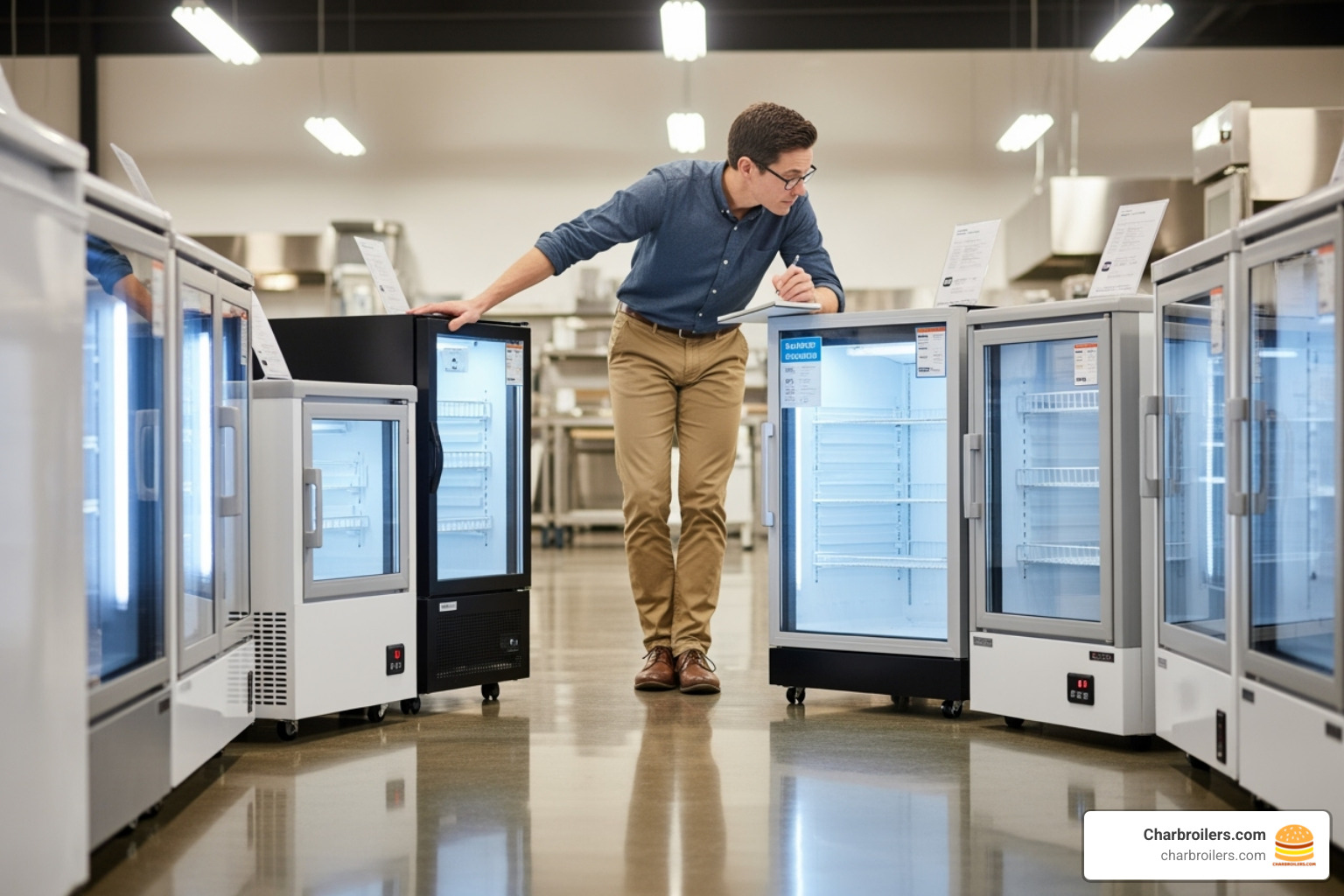
Sizing and Capacity: Finding the Perfect Fit
The term "compact" is relative, covering tiny countertop units to larger upright models with small footprints.
Countertop models (0.9 to 3.4 cu. ft.) are ideal for tight spaces, sitting right at the point of sale. The PROCOOL FT-25 Glass Door Mini Freezer packs 0.9 cu. ft. into just 14.6″x17.3″x20.3″. For more capacity, the Whynter 1.8 cu. ft. Countertop Reach-In Upright Freezer or the Avantco CFM3 (3.4 cu. ft.) offer more room without overwhelming your counter.
Under-counter units save counter space while keeping products accessible, but have specific ventilation needs.
Small upright freezers maximize display potential vertically without using much floor space. Models range from the 2.0 cu. ft. Summit SCFU386 to the 8.5 cu. ft. PeakCold Upright Display Freezer (IM9MF).
When planning capacity, consider your products. A 0.9 cu. ft. unit might hold a dozen ice cream bars, while an 8.5 cu. ft. model can display cases of frozen meals. Always measure your products first to ensure they fit. For more space-saving ideas, check out our guide on Space Savers: Best Under Cabinet Freezers for Small Kitchens.
Critical Features for Your Compact Display Freezer
The right features turn a storage freezer into a sales-boosting tool, directly impacting your bottom line.
| Feature | Countertop Freezer | Upright Display Freezer | Horizontal Display Island Freezer |
|---|---|---|---|
| Visibility | Excellent (eye-level display) | Excellent (vertical product showcase) | Good (top-down view, often with sliding glass lids) |
| Footprint | Very small (sits on existing counter) | Small to medium (vertical, narrow base) | Medium to large (wider base, often standalone) |
| Capacity | Small (0.9 - 3.4 cu. ft.) | Small to medium (2.0 - 8.5+ cu. ft.) | Medium to large (12.4 - 56.5+ cu. ft.) |
| Best Use Case | Impulse buys at POS, limited space | High-volume impulse buys, organized product lines | Bulk display, promotional items, "treasure hunt" |
Glass doors are non-negotiable. Look for triple-pane, thermal-insulated glass to maintain steady temperatures and prevent condensation. The Avantco CFM3 and some Procool models feature this.
Adjustable shelves (often rated for 33 lbs) offer flexibility to change your product display without buying a new freezer.
Security locks, like the one on the Summit SCFU386, are essential for public-facing units to protect inventory and prevent tampering.
Self-closing doors are a lifesaver in busy settings. They prevent doors from being left open, saving energy and protecting products, especially during rush hours.
Digital thermostat controls allow for precise temperature management and programmable features. Some, like the Summit SCFU386, include probe holes for detailed temperature logging, which is useful for health code compliance.
Temperature, Cooling, and Defrosting
Correct temperature is crucial for food safety, quality, and protecting inventory. A compact display freezer must perform reliably despite frequent door openings.
Commercial units offer superior temperature control over residential models. Most frozen foods require -18°C (-0.4°F) or below. Commercial freezers operate between -10°F to 0°F (-23°C to -18°C), with some models like the Summit SCFU386 holding a steady 0°F.
Compressor cooling, used in the Whynter 1.8 cu. ft. freezer, is the gold standard for powerful, consistent performance. Fan-forced cooling, found in the Bromic UF0374S-NR, circulates cold air to eliminate hot spots. Static cooling, used in many Procool mini freezers, is energy-efficient and ideal for delicate items.
Defrosting systems impact convenience and performance. Manual defrost (e.g., Summit SCFU386) requires periodic shutdowns but provides incredibly stable temperatures. Auto-defrost systems are convenient but can cause minor temperature fluctuations, though advanced "hot gas auto-defrost" systems minimize this issue.
For more insights into frost-free options and their benefits, check out our comprehensive guide on Commercial Upright Frost-Free Freezers That Keep Their Cool.
Design, Lighting, and Energy Efficiency
A compact display freezer is both an appliance and a marketing tool; its design can trigger impulse purchases.
LED interior lighting turns your freezer into an attractive display. Bright, efficient LEDs make products look irresistible without adding heat.
Advertising and branding opportunities turn your freezer into a marketing tool. Many units have lightboxes for logos or promotions. Customization options include engraved logos, LCD advertising heads, wooden styles, UV printing, glass door branding, special colors, metallic stickers, lightbox handles, and EL stickers for unique lighting effects. Units like the Bromic UF0374S-NR can also be decaled.
Energy efficiency impacts operating costs. Prioritize ENERGY STAR certified appliances to reduce energy bills. The Summit 24" Wide ADA Compliant 2-Drawer All-Freezer, for example, carries this certification.
Eco-friendly refrigerants like R290 or R600a are better for the environment and can lower running costs.
Quality insulation, like triple-glazed heated safety glass, reduces energy loss. Check the kWh/24h rating for energy consumption.
For commercial use, ensure your freezer meets NSF/ANSI Standard 7 for sanitation and safety compliance. For more details, consult our guide on Cool Compliance: Your Guide to NSF/ANSI Standard 7 for Refrigerators and Freezers.
Some commercial appliances may carry a California Proposition 65 warning regarding chemicals like nickel, a standard component of stainless steel. This is normal for commercial kitchen equipment.
Keeping It Cool: Essential Maintenance Tips
A compact display freezer is an investment, and like any valuable piece of equipment, it thrives on proper care. Regular maintenance ensures its longevity, optimal performance, and continued ability to drive sales.
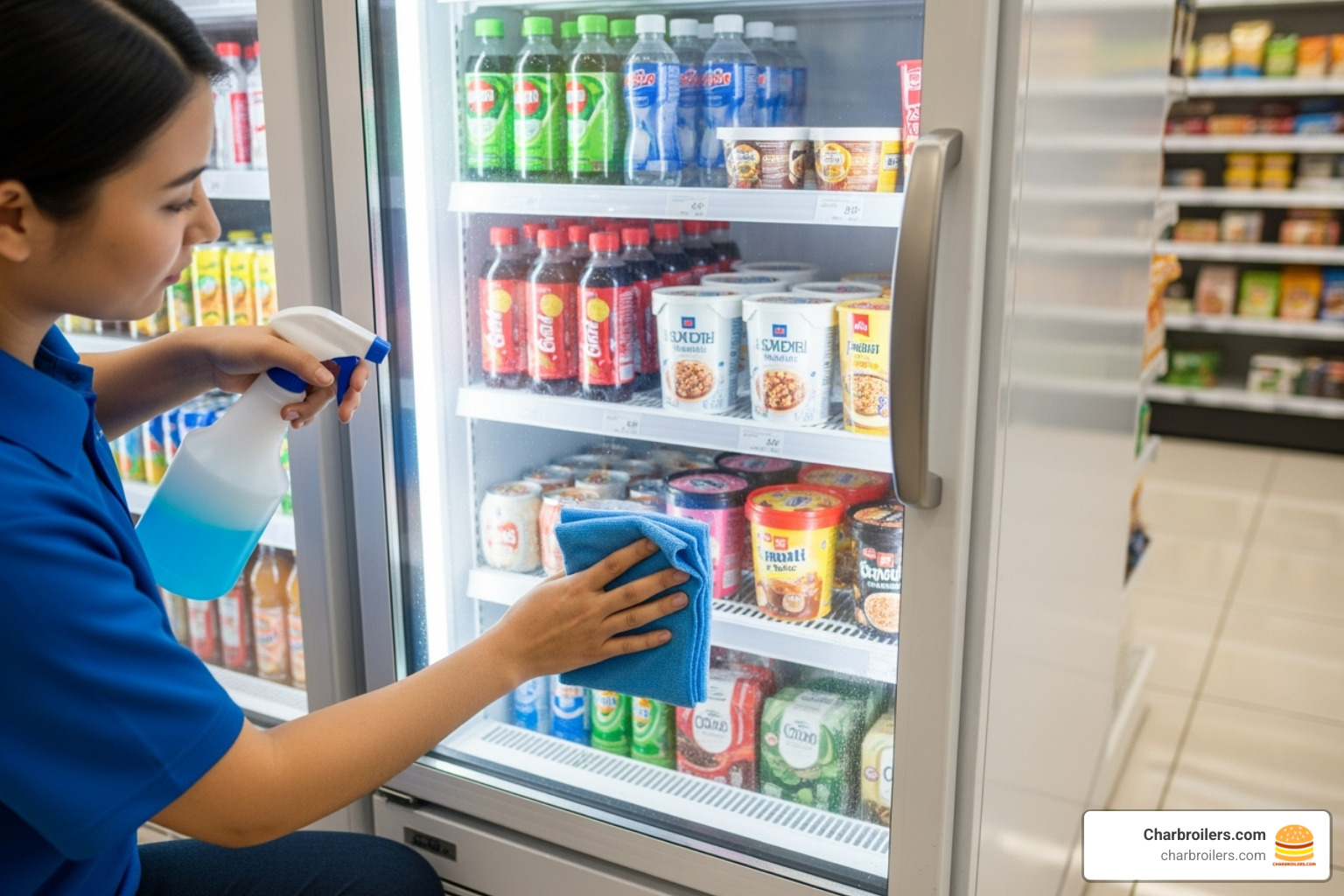
- Regular Cleaning Schedule: The glass door is your salesperson, so keep it sparkling clean! Wipe down the interior and exterior regularly with a mild, food-safe cleaner. Pay attention to spills and crumbs, as they can attract pests or harbor bacteria. For units with a self-evaporation water tray, this process is usually automatic, but general cleaning is still a must.
- Checking Door Seals (Gaskets): The door gasket is crucial for maintaining internal temperature and energy efficiency. Periodically check the seals for cracks, tears, or signs of wear. A simple test is to close the door on a dollar bill; if you can pull it out easily, the seal might need replacing.
- Clearing Ventilation: Freezers generate heat, and proper ventilation is essential to dissipate it. Ensure that the condenser coils and vents are not blocked by debris, dust, or other equipment. Clean the coils regularly (as often as monthly in dusty environments) to prevent the compressor from overworking, which can lead to higher energy consumption and premature failure.
-
Manual Defrosting Best Practices: If you have a manual defrost unit, follow these steps to ensure efficient and safe defrosting:
- Empty the Freezer: Transfer all frozen products to another freezer or insulated containers.
- Turn Off and Unplug: Safety first!
- Allow to Melt: Leave the door open. You can place towels at the bottom to absorb water. Never use sharp objects to chip away ice, as this can damage the evaporator coils.
- Clean Interior: Once defrosted, wipe down the interior thoroughly.
- Dry Completely: Ensure the interior is completely dry before turning it back on.
- Reload: Once the freezer has reached its operating temperature, return your products.
- For issues with frost-free systems or other common problems, our guide on Fixing Common Issues with Imperial Frost-Free Commercial Freezers can provide further assistance.
- When to Call a Professional: While routine cleaning and maintenance can be done in-house, some issues require expert attention. If you notice persistent temperature fluctuations, unusual noises, excessive frosting (in an auto-defrost unit), or if the unit stops cooling, it's time to call a qualified refrigeration technician. Don't attempt complex repairs yourself, as this can void warranties or cause further damage. Warranties vary; for instance, some compressors have a 1-year warranty, while others, like Danby's, offer a 5-year parts and labor warranty with in-home service.
Frequently Asked Questions about Compact Display Freezers
Let's tackle the questions we hear most often from business owners looking to add a compact display freezer to their operation. These aren't just technical details – they're the real-world concerns that can make or break your investment.
Can I place a compact display freezer in a built-in cabinet or under a counter?
Ventilation is critical. Most compact display freezer models are free-standing and require space around them (especially at the back and sides) for their condenser coils to dissipate heat. Blocking this airflow by placing the unit in a tight cabinet will cause the compressor to overwork, increase energy bills, and lead to equipment failure. As Procool notes, their mini freezers are not for built-in use.
However, some specialized under-counter models have front-venting designs that are perfect for built-in applications, like the Summit 24" Wide ADA Compliant 2-Drawer All-Freezer (though it's not a display model).
The bottom line: unless a freezer is specifically designed for built-in use, give it room to breathe for reliable service.
What is the difference between a manual defrost and an auto-defrost freezer?
This is a choice between convenience and control.
Manual defrost freezers, like the Summit SCFU386, require periodic shutdowns for defrosting. However, they maintain incredibly stable temperatures, making them ideal for delicate items like premium ice cream. They are also quieter and more energy-efficient. The trade-off is the manual labor and downtime.
Auto-defrost (frost-free) freezers are convenient, automatically melting frost to keep the display clear without downtime. This convenience can cause slight temperature fluctuations, though advanced systems like "hot gas auto-defrost" minimize this. For most busy, high-traffic operations, auto-defrost is the preferred choice. For premium products where temperature stability is paramount, manual defrost is better.
How much can a compact display freezer hold?
Capacity is about more than cubic feet; it's about smart merchandising.
Very small units (e.g., the 0.9 cu. ft. PROCOOL FT-25) hold about a dozen ice cream bars, perfect for the register. Small to medium units (2.0 to 4.2 cu. ft.), like the Summit SCFU386 or Avantco CFM3, can display 30-50 ice cream pints or a mix of frozen items. Larger compact models like the 8.5 cu. ft. PeakCold Upright Display Freezer can hold over 100 pints, ideal for busy stores.
Beyond volume, consider shelf weight limits (typically around 33 lbs) to avoid overloading. The key is smart merchandising: use adjustable shelves for eye-catching tiers, rotate stock, and choose products that encourage impulse buys. A well-merchandised freezer, regardless of size, can quickly become a profit center.
Conclusion: Power Up Your Sales with the Right Freezer
The restaurant business moves fast, and smart operators know that success often comes from the details. A compact display freezer isn't just another piece of equipment taking up space – it's your silent sales partner working around the clock to turn browsers into buyers.
Think about it: your customer comes in for a quick coffee and suddenly spots those artisanal ice cream bars gleaming under LED lights in your compact display freezer. That $3 coffee just became an $8 sale. We've seen this happen countless times, and it's exactly why these units are such game-changers for food service operations.
We've covered the technical specs and merchandising strategies to help you choose the right unit, from tiny countertop models to larger uprights. The right compact display freezer can transform how customers interact with your products.
The benefits are clear: increased impulse sales, better product visibility, and space-saving versatility. We've highlighted key features like triple-pane glass doors, adjustable shelves, and energy-efficient cooling systems.
Proper maintenance keeps your investment running smoothly for years. Regular cleaning, checking door seals, and understanding your defrosting system will ensure your freezer keeps performing at its best. And when you do need professional help, don't hesitate to call in the experts.
At Charbroilers.com, we believe in helping food service businesses grow with the right equipment. That's why we offer financing options specifically designed for restaurant operations – because we know cash flow matters in this business. Finding the perfect compact display freezer shouldn't break your budget or your peace of mind.
Ready to turn that empty corner into a profit center? The right freezer is waiting for you. And if you're looking to expand your cold storage options beyond display units, check out our comprehensive guide on Cool Picks: Top Small Commercial Freezers to Keep Your Products Fresh.
Your customers are already coming through the door. Now give them something irresistible to take home.