
The Sizzle and Steel: Everything You Need to Know About Commercial Griddles
Why Commercial Stainless Steel Griddles Are Your Kitchen's Hardest-Working Equipment
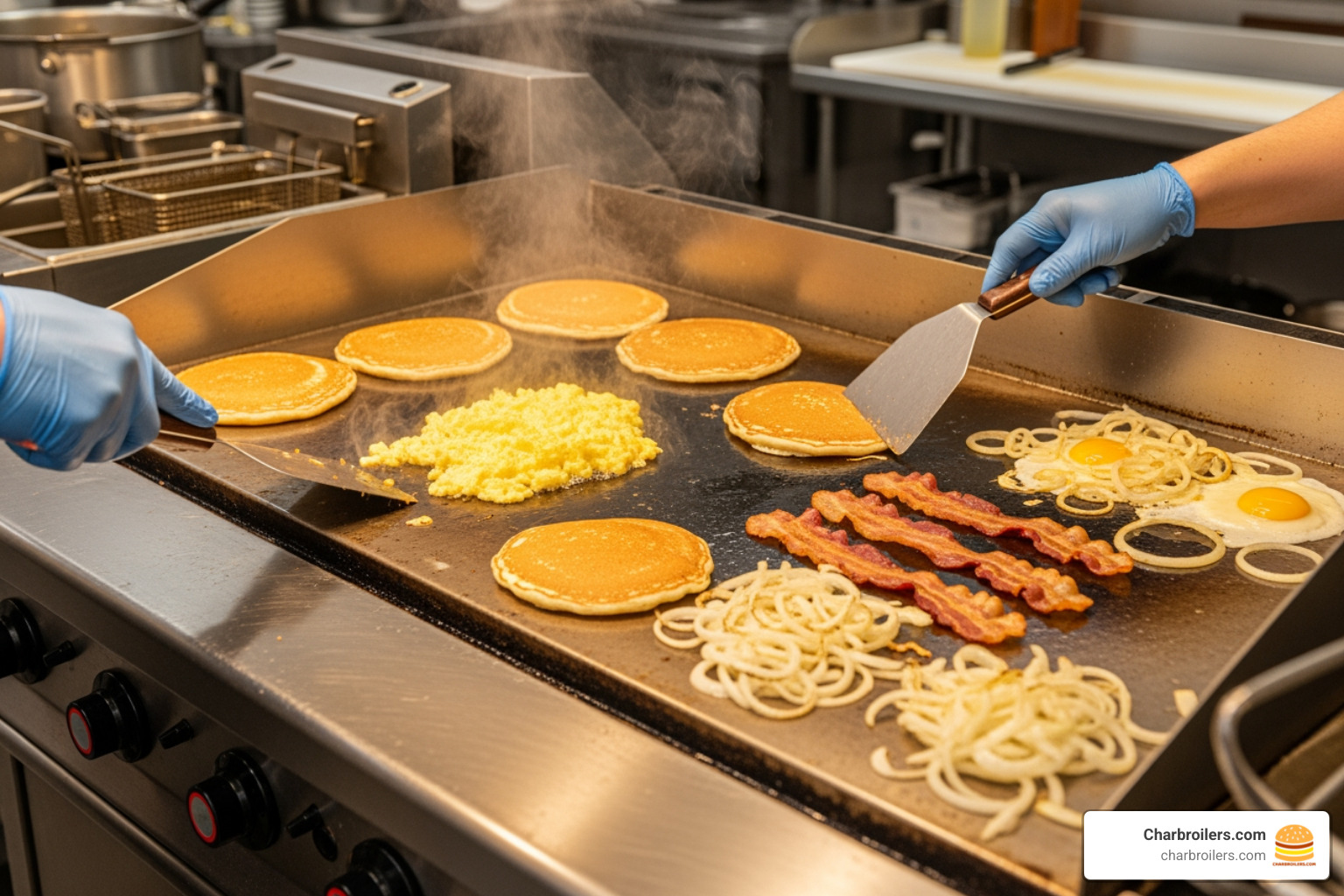
A commercial stainless steel griddle is a flat cooking surface made from durable stainless steel, heated by gas or electric burners beneath a thick steel plate, designed for high-volume cooking of everything from breakfast items to seared meats and vegetables.
Key Features to Know:
- Construction: 304 stainless steel exterior with 3/4" to 1" thick carbon steel or chromium-plated cooking surface
- Power Output: Ranges from 60,000 BTU (24" models) to 120,000+ BTU (48"+ models)
- Control Types: Manual controls for experienced chefs or thermostatic (150°F-575°F) for consistent temperatures
- Common Sizes: 24", 36", 48", 60", and 72" widths
- Fuel Options: Natural gas (field-convertible to propane) or electric
- Essential Features: Grease trays, side/back splashes, U-shaped burners for even heat
If you've ever watched a short-order cook juggle pancakes, hash browns, and eggs all at once, you've seen a commercial griddle in action. These flat, gleaming surfaces are the workhorses of restaurant kitchens, diners, food trucks, and cafeterias. They handle breakfast rushes, lunch crowds, and dinner services with equal ease, cooking everything from delicate crepes to seared steaks.
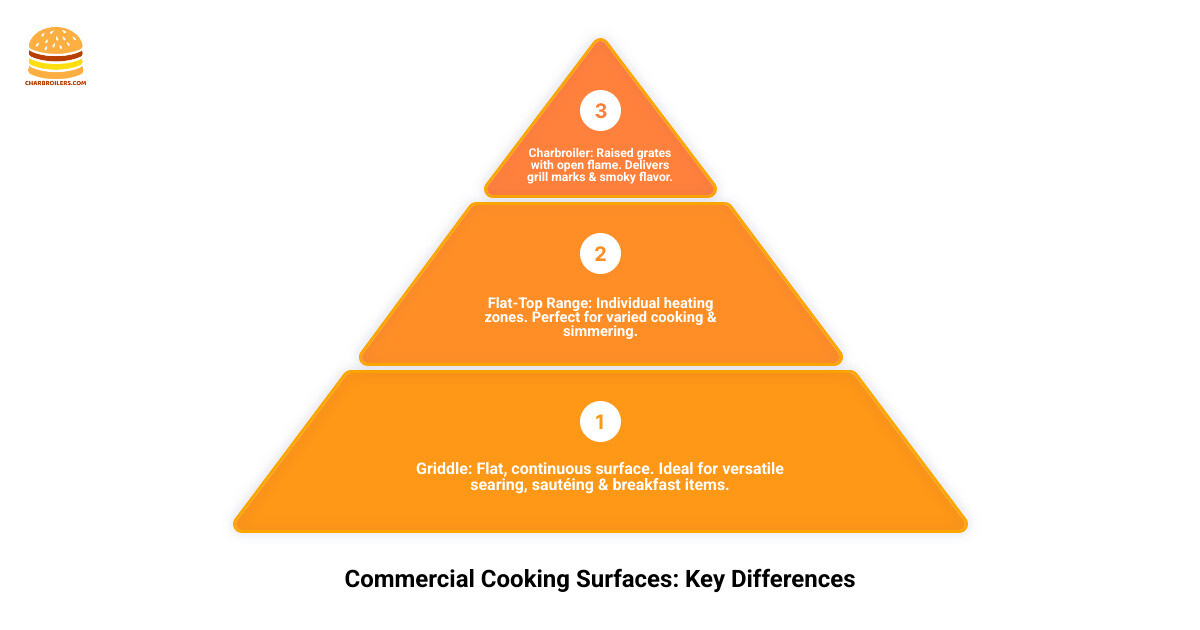
Unlike a charbroiler (which has grates and produces grill marks) or a flat-top range (which has individual heating zones), a griddle provides one continuous cooking surface with even heat distribution. This makes it incredibly versatile for sautéing vegetables, cooking breakfast items, searing proteins, or keeping food warm during service.
I'm Sean Kearney, founder of The Restaurant Warehouse and Charbroilers.com, and I've spent over a decade helping restaurants find the right commercial stainless steel griddle solutions that balance performance with budget constraints. Whether you're opening your first diner or upgrading a busy breakfast spot, choosing the right griddle comes down to understanding your space, volume, and cooking style.
Simple commercial stainless steel griddle glossary:
Anatomy of a Griddle: Materials and Key Features
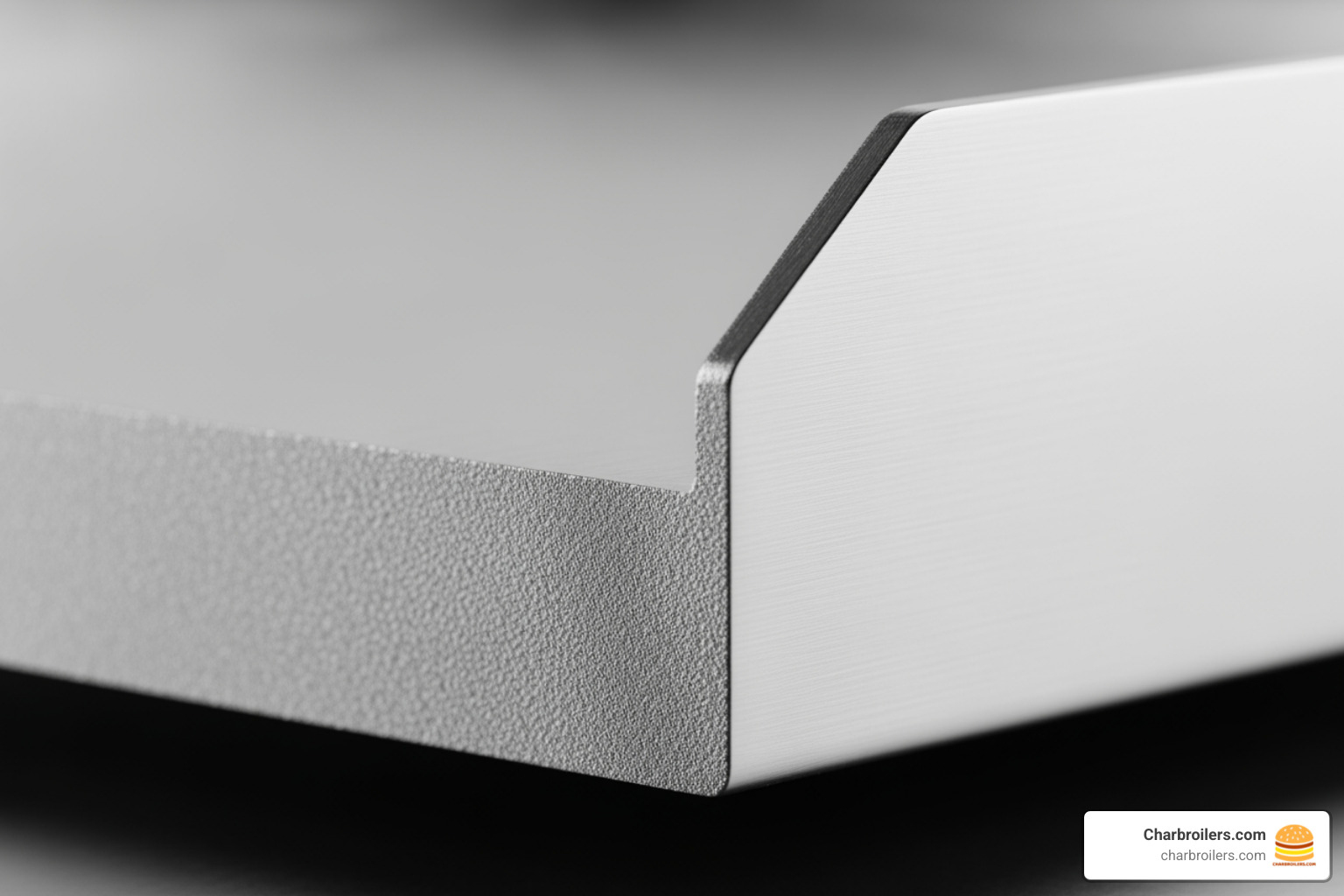
When we talk about the anatomy of a commercial stainless steel griddle, we're primarily focusing on the cooking surface itself and the external construction. The griddle plate is where all the magic happens, and its material and thickness are critical for performance. For instance, a 3/4" thick polished steel cooking surface is common, offering excellent heat retention and even cooking. This robust thickness ensures that when you drop a cold steak onto the griddle, the temperature doesn't plummet, allowing for consistent searing.
Durability is paramount in a busy commercial kitchen in Seattle, WA. That's why features like heavy-duty construction and high-quality materials are non-negotiable. Grease management is another key aspect; commercial griddles are designed to handle high volumes of grease, often featuring removable grease trays and 1-1/2" high side walls. These thoughtful design elements make cleanup a breeze and help maintain a safer, cleaner cooking environment. And let's not forget the unsung heroes: the back and side splashes. These aren't just for looks; they protect your walls and countertops from splatters, keeping your kitchen cleaner and reducing cleanup time.
Why Choose a Commercial Stainless Steel Griddle?
So, why stainless steel? It’s simple, really. When you invest in a commercial stainless steel griddle, you're choosing a material that defines durability, hygiene, and a professional aesthetic. Most high-quality commercial kitchen equipment, including our griddles, is constructed from 304 stainless steel. This particular grade of stainless steel is renowned for its exceptional corrosion resistance, meaning it can stand up to the acidic foods, harsh cleaning agents, and constant use found in a demanding commercial kitchen without rusting or degrading.
Beyond its strength, stainless steel is incredibly easy to clean. Its non-porous surface doesn't harbor bacteria or absorb food odors, which is crucial for maintaining food safety standards in your restaurant. A quick wipe-down and proper cleaning routine can keep your griddle looking new and performing optimally. Plus, let's be honest, the gleaming, professional appearance of stainless steel simply looks fantastic in any modern kitchen. For more detailed tips on keeping your griddle sparkling, check out The Ultimate Guide to Cleaning a Commercial Stainless Steel Griddle.
Comparing Griddle Plate Materials
While the exterior of a commercial stainless steel griddle is typically stainless steel, the actual cooking surface can vary. The material of the griddle plate significantly affects its performance, durability, and maintenance.
- Carbon Steel: This is a very common choice for commercial griddle plates. It offers excellent heat retention and distribution. For example, some 'add-on' griddles feature 7 gauge carbon steel (approximately 3/16" thick) with 1-1/2" side walls, designed to handle high grease volumes. Carbon steel heats up quickly and maintains temperature well, making it ideal for high-volume cooking. It requires seasoning, similar to cast iron, to create a non-stick surface and prevent rust.
- Chromium-Plated: Chromium-plated surfaces are gaining popularity for their superior non-stick properties and ease of cleaning. They offer a very smooth cooking surface, which can be great for delicate foods. The Bull Commercial Style Griddle, for instance, uses a chromium-plated griddle designed for outdoor applications, showcasing its durability. This material often provides even better corrosion resistance and a smoother finish than plain carbon steel.
- Cast Iron: While less common for the entire griddle plate in modern commercial units, cast iron is celebrated for its exceptional heat retention. Some older models or specialized units might feature cast iron. It requires careful seasoning and maintenance but, once properly cared for, provides an incredibly even and consistent cooking surface. If you're curious about cast iron, we have a whole guide dedicated to Heavy Metal Heroes: Choosing Your Commercial Cast Iron Griddle.
The choice among these materials boils down to your specific cooking needs, maintenance preferences, and budget. Carbon steel offers a great balance of performance and cost, chromium-plated provides premium non-stick and easy cleaning, and cast iron excels in heat retention with specific maintenance requirements.
Choosing Your Powerhouse: Griddle Types and Control Systems
Selecting the right commercial stainless steel griddle for your establishment in Seattle, WA, involves more than just picking a size. You need to consider the power source and the control system, as these factors directly impact precision, efficiency, and suitability for your kitchen's unique demands. Whether you're running a busy diner, a food truck, or a high-volume restaurant, the right griddle can be a game-changer. Our goal at Charbroilers.com is to help you find that perfect match. To start exploring your options, check out Top Professional Griddles: A Buyer's Guide to Commercial Excellence.
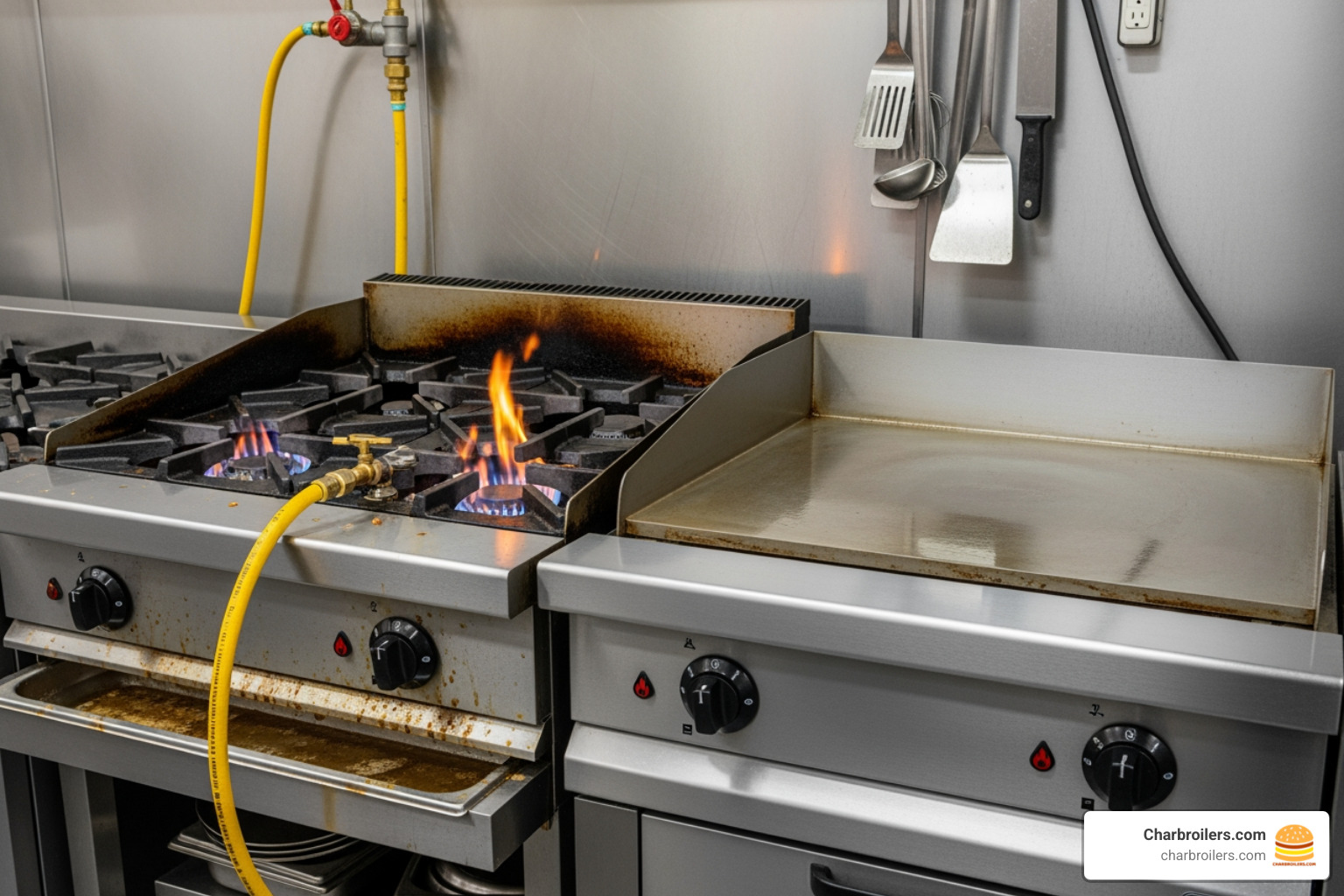
Gas vs. Electric Griddles
The fundamental choice for any commercial griddle is between gas and electric power. Both have their advantages and ideal use cases:
| Feature | Gas Griddles | Electric Griddles |
|---|---|---|
| Cost | Generally lower operating costs (natural gas often cheaper than electricity) | Higher operating costs, but potentially lower initial purchase price for some models |
| Heat-Up Time | Often faster heat-up due to direct flame, but depends on BTU output | Can be slower to heat up, but very consistent once at temperature |
| Temperature Control | Good control, but can have more temperature fluctuations near burner zones | Excellent, precise, and consistent temperature control across the entire plate |
| Installation | Requires professional gas line connection and ventilation | Easier to install (just plug in if voltage allows), but still needs proper ventilation |
| Utility Needs | Natural Gas (NG) or Liquid Propane (LP) | Specific voltage and amperage (e.g., 208V, 240V, 480V, single or three-phase) |
| Portability | Less portable due to gas line requirements | More portable for countertop models, ideal for food trucks or temporary setups |
Gas Griddles: These are the stalwarts of many commercial kitchens. They typically offer high BTU outputs, meaning powerful and quick heating. Gas models are often field-convertible, meaning a unit factory-set for natural gas (NG) can be converted to accept liquid propane (LP) by a qualified service professional. This flexibility is great for kitchens where gas lines might be an issue or for food trucks that rely on propane tanks. For example, a Migali 24" wide manual griddle boasts 60,000 BTU, while a 36" model can reach 90,000 BTU, showcasing their raw power.
Electric Griddles: While gas griddles are popular, electric models offer exceptional temperature stability and consistency, which can be crucial for delicate items or precise cooking. They don't require gas lines, simplifying installation in some cases. Though they might have higher operating costs, their precise control can lead to less wasted energy and more consistent product. For more insights on electric options, check out Power Up Your Kitchen: Best Commercial Indoor Electric Grills, Griddles.
Manual vs. Thermostatic Controls
Once you've decided on gas or electric, the next big decision is your control system:
- Manual Controls: These griddles feature simple knobs that control the gas flow to the burners (for gas models) or the heating elements (for electric). They are often favored by experienced chefs who prefer direct control and can "feel" the heat. Manual controls are excellent for zoned cooking, where different sections of the griddle can be set to varying temperatures. For example, you might have one zone for searing burgers, another for sautéing onions, and a cooler zone for holding cooked items. The Cooking Performance Group 36GMSSNL manual griddle, with its three powerful 30,000 BTU burners, is a great example of a robust manual control unit.
- Thermostatic Controls: These griddles feature thermostats that automatically maintain a set temperature. You simply dial in your desired temperature (e.g., 150°F to 450°F or even 200°F to 575°F), and the griddle's elements or burners cycle on and off to hold that temperature precisely. This offers unparalleled consistency, which is vital for delicate foods like eggs or pancakes, or for operations where multiple staff members need to achieve the same results. While a 36" Migali Manual Griddle has 90,000 BTU, a 36" Migali Thermostatic Griddle has 75,000 BTU, highlighting that thermostatic control prioritizes consistent temperature maintenance over raw, maximum power output.
The choice between manual and thermostatic controls often comes down to your kitchen's workflow and the skill level of your staff. For a deeper dive into these control systems, we recommend our guide: The Ultimate Atosa Griddle Guide: Manual, Thermostatic, and Beyond.
Performance Metrics: Sizing Up Your Griddle
Choosing the right size for your commercial stainless steel griddle is a critical decision that impacts your kitchen's efficiency and workflow. It's about balancing your available kitchen space with your anticipated menu volume and peak hour demands. A griddle that's too small will leave your cooks struggling to keep up, while one that's too large might waste energy and valuable real estate. We understand that finding the perfect fit is essential for any busy restaurant in Seattle, WA. That's why we invite you to Explore various griddle options on our site to see the range of sizes and configurations available.
Understanding BTU and Cooking Power
BTU, or British Thermal Unit, is the standard measurement for the heating power of gas griddles. In simple terms, a higher BTU output means more heat, faster heat-up times, and better heat recovery when cold food is placed on the surface. For example, the 30″ Bull Commercial Style Griddle uses four burners to produce a hefty 60,000 BTUs of power. Similarly, the Cooking Performance Group 36GMSSNL griddle features three powerful 30,000 BTU stainless steel U-shaped burners, totaling 90,000 BTU.
These U-shaped burners are specifically designed to distribute heat evenly across the griddle plate, minimizing cold spots and ensuring consistent cooking results. Some advanced griddles even incorporate infrared burner technology, like Vulcan's IRX™ system, which can reduce gas consumption and improve efficiency. For electric griddles, power is measured in watts (W) or kilowatts (kW), and similar principles apply regarding heat output and recovery. Understanding these metrics is key to selecting a griddle that can keep up with your kitchen's demands. To truly master your griddle's potential, consult The Hot Plate Handbook: Mastering Commercial Griddles and Flat Top Grills.
Choosing the Right Griddle Size
The ideal griddle size depends entirely on your operation's volume and menu. Griddles come in a wide range of widths, from compact countertop models to expansive freestanding units. Here's a breakdown of common sizes and their typical applications:
- 24-inch Griddles: Perfect for smaller kitchens, food trucks, or operations with limited griddle-cooked items. A 24" wide model might offer 60,000 BTU, making it surprisingly powerful for its size. These are great for breakfast spots or cafes needing to cook a few burgers or eggs at a time.
- 36-inch Griddles: This is often considered the workhorse size for many restaurants. A 36" wide griddle can provide 90,000 BTU (manual) or 75,000 BTU (thermostatic), offering ample space for simultaneous cooking of multiple items. Ideal for diners, medium-sized restaurants, and busy lunch services. Learn more about these versatile units in our guide to 36 Commercial Griddles: Gas vs. Electric and Top Picks.
- 48-inch Griddles: For high-volume establishments, a 48" wide griddle, potentially offering 120,000 BTU, provides significant cooking capacity. This size is excellent for busy cafeterias, large diners, or restaurants with extensive breakfast or lunch menus. Dive deeper into these larger units with our 48-inch Commercial Flat-Top Grill Guide: Cooking Up Success.
- 60-inch+ Griddles: These massive griddles are designed for institutional cooking, large-scale catering, or very high-volume operations where multiple cooks need extensive flat-top space. They are often custom-built or specialized units for peak performance.
Consider how many items you need to cook simultaneously during your busiest hours. Will you be cooking eggs, bacon, pancakes, burgers, and stir-fries all at once? Or just a few specialty items? This will guide your decision on the optimal griddle width.
Installation, Safety, and Maintenance
Acquiring a commercial stainless steel griddle is a significant investment for any food service operation in Seattle, WA. To ensure its longevity, peak performance, and safe operation, proper installation, adherence to safety certifications, and diligent maintenance are absolutely essential. We're here to help you Find quality restaurant equipment that meets all these criteria.
Installation and Safety Certifications
First and foremost, professional installation is non-negotiable for any commercial griddle, especially gas models. Gas lines must be connected correctly and safely, and any field conversion from natural gas to liquid propane must be performed by a qualified service professional. Failure to do so can void warranties and, more importantly, create significant safety hazards. If your business operates at high elevations (over 2,000 feet), it's crucial to contact our Special Orders team before purchasing, as gas equipment may require adjustments for optimal performance and safety.
Safety certifications like NSF (National Sanitation Foundation) and ETL (Electrical Testing Laboratories) are vital. NSF certification ensures that the equipment meets strict public health and safety standards, particularly concerning material safety and cleanability. ETL US & Canada certification indicates compliance with electrical and gas safety standards, ensuring the unit is safe to operate in North America. Always look for these certifications when purchasing commercial kitchen equipment. Proper ventilation, including a commercial exhaust hood, is also a legal requirement and critical for removing heat, smoke, and grease-laden vapors from your kitchen.
Maintenance Tips for Your Commercial Stainless Steel Griddle
Regular cleaning and maintenance are the keys to extending the life of your commercial stainless steel griddle and ensuring it consistently delivers delicious results.
- Daily Cleaning: After each shift or at the end of the day, scrape off food debris with a griddle scraper. While the griddle is still warm, squirt water or griddle cleaner onto the surface and use a griddle brick or pad to scrub it clean. Rinse thoroughly and dry completely to prevent rust. Removable grease trays should be emptied and cleaned daily.
- Deep Cleaning: Periodically, you'll want to deep clean your griddle, especially if you notice stubborn carbon buildup. This might involve using specialized griddle cleaners and a more abrasive griddle screen.
- Seasoning the Surface: For carbon steel or cast iron griddle plates, seasoning is crucial. This involves applying a thin layer of cooking oil and heating the griddle until the oil polymerizes, creating a natural non-stick surface and protecting against rust. Even chromium-plated surfaces benefit from a light oiling to maintain their luster.
- Troubleshooting Uneven Heat: If you notice uneven heating, first check for proper burner operation (for gas models) or heating element function (for electric). Ensure the griddle plate itself is clean and free of carbon buildup, which can act as insulation. Sometimes, simply rotating food or adjusting cooking zones can help.
For a comprehensive guide on keeping your griddle in top condition, be sure to read Griddle Glory: Simple Steps to a Spotless Surface. With proper care, your griddle will be a reliable workhorse for years to come.
Conclusion
The commercial stainless steel griddle stands as a true essential in the modern professional kitchen. It's not just a cooking surface; it's a versatile tool that empowers chefs to tackle an incredible array of dishes, from the fluffiest pancakes to perfectly seared steaks, all with remarkable efficiency. This makes it a cornerstone of Commercial Kitchen Equipment.
As we've explored, choosing the right griddle involves several crucial decisions. The material of the cooking plate, whether it's robust carbon steel, sleek chromium-plated, or classic cast iron, directly impacts performance and maintenance. The power source – gas or electric – dictates installation and operating costs, while the control system, manual or thermostatic, caters to different cooking styles and precision needs. Finally, selecting the appropriate size and understanding BTU output ensures your griddle can keep pace with your kitchen's demands, even during the busiest rushes in Seattle, WA.
Investing in a high-quality commercial stainless steel griddle and committing to its proper installation, safety protocols, and diligent maintenance will ensure its longevity and peak performance. At Charbroilers.com, we pride ourselves on offering expert guidance and a wide selection of top-tier commercial kitchen equipment. We believe that equipping your kitchen with the right tools is the first step towards culinary success and operational efficiency. Let us help you find the perfect match for your restaurant's needs.
Ready to lift your kitchen's capabilities? Explore our extensive range and Find the perfect charbroiler or griddle for your restaurant.