
Find Your Perfect Sizzle: A Guide to the Best Griddles Available
Why Griddles Are Essential for Commercial Kitchens
Griddles are flat cooking surfaces using direct heat for even cooking across a large area. They're available in gas and electric models, with sizes ranging from compact 24-inch countertop units to massive 72-inch freestanding stations. Commercial griddles typically feature stainless steel or cast iron cooking surfaces, BTU outputs from 12,000 to 75,000+, and specialized grease management systems.
Quick Griddle Overview:
- Types: Countertop, freestanding, drop-in, and range-top models
- Power Sources: Gas (propane or natural) and electric
- Materials: Cast iron (superior heat retention), stainless steel (durability), chrome-plated (easy cleaning)
- Sizes: 24" to 72" widths with cooking surfaces from 200 to 700+ square inches
- Key Features: BTU output, thermostatic controls, grease troughs, high sides for splatter control
For commercial kitchens with limited space and tight budgets, the right griddle can transform operations. A quality griddle gives you consistent cooking results across a massive surface area—meaning you can cook dozens of burgers, pancakes, or fajitas simultaneously without hot spots or uneven heating.
The versatility alone makes griddles indispensable. Breakfast service demands eggs and pancakes. Lunch calls for smash burgers and grilled sandwiches. Dinner service needs seared steaks and stir-fried vegetables. One piece of equipment handles it all.
Commercial griddles have evolved significantly. Modern units feature infrared burner technology to reduce gas consumption, ENERGY STAR certifications to cut utility costs, and heat diffuser plates that eliminate hot spots. For example, some models offer over 400 square inches of cooking space with 90-degree sides to contain grease and prevent splatter, addressing a major pain point in high-volume kitchens.
Grease management has also improved dramatically. Today's griddles include front-mounted grease troughs, angled surfaces that channel drippings away from food, and easy-access collection systems that simplify cleanup.
I'm Sean Kearney from Charbroilers.com. With over a decade of experience helping restaurant owners find the right commercial griddles, I know which features matter most when you're cooking under pressure.

Quick look at griddles:
Understanding the World of Griddles
When we talk about griddles in a commercial setting, we're not just discussing a single type of appliance. The world of griddles is vast, designed to meet the diverse needs of busy kitchens in places like Seattle, WA. Understanding these differences is crucial for selecting the perfect equipment for your culinary operations.
Types of Griddles: From Countertop to Freestanding
The first step in finding your ideal griddle is understanding the different forms they take. Each type offers unique advantages depending on your kitchen's layout and menu.
- Countertop Griddles: The most common type, countertop griddles sit on existing work surfaces, making them ideal for kitchens with limited floor space. Manufacturers offer gas and electric models in widths from 24 to 72 inches, providing flexibility for various kitchen sizes.
- Drop-in Griddles: These griddles are integrated into a countertop for a seamless, easy-to-clean cooking surface. They are often used in open kitchens or buffet lines where aesthetics are important.
- Teppanyaki Griddles: Teppanyaki griddles are large, flat surfaces designed for Japanese-style theatrical cooking. They feature multiple heat zones and handle high temperatures for searing and mixing ingredients in front of customers.
- Freestanding Griddles: Freestanding griddles are robust, self-contained units on legs or a cabinet base. They are ideal for high-volume kitchens with ample space needing a dedicated, heavy-duty cooking station.
- Range-top Griddles: These are griddles built into a commercial range, replacing burners with a flat cooking surface. This integrated design saves space and offers versatility for kitchens needing both griddle and burner functionality.
For a deeper dive into selecting the right professional griddle for your needs, we encourage you to explore our comprehensive guide: Top Professional Griddles: A Buyer's Guide to Commercial Excellence.
Griddle vs. Plancha: What's the Difference?
While often used interchangeably, there are important distinctions between a traditional griddle and a plancha that can refine your cooking techniques.

- Plancha Heat Source: A plancha is a thick metal plate heated from below to very high temperatures. It creates intense, direct heat for quick searing, and the surface is often slightly sloped to drain grease.
- Griddle Heat Distribution: A griddle, by contrast, is designed for more even and controlled heat distribution. Multiple burners or elements ensure a uniform temperature, making it ideal for consistently cooking a wider variety of foods.
- Surface Material Differences: While both can be made from similar materials, planchas are often characterized by their extreme thickness for exceptional heat retention. Griddles also prioritize heat retention but may be designed for more nuanced temperature control.
- Cooking Style Variations: A plancha excels at quick, high-heat cooking like searing seafood or charring vegetables. Griddles are more versatile, handling everything from breakfast items to lunch sandwiches and dinner proteins where uniformity is key.
While a plancha is a specialized tool for high-heat searing, a griddle offers broader utility and more controlled, even heating for a wider range of culinary applications.
How Griddle Materials Impact Your Cooking
The material of your griddle's cooking surface is a critical factor influencing performance and maintenance. For commercial operations in Seattle, choosing the right material for your griddles can significantly impact efficiency.
- Cast Iron: Cast iron offers exceptional heat retention, making it great for a consistent sear. It requires regular seasoning to create a natural non-stick surface and prevent rust. While durable, it is heavy and needs specific care. For more on this, check out our insights on Heavy Metal Heroes: Choosing Your Commercial Cast Iron Griddle.
- Stainless Steel: Stainless steel griddles are durable, easy to clean, and resistant to rust. They are less reactive than cast iron, so you can cook acidic foods without imparting a metallic taste. Modern designs compensate for lower heat retention with thick plates for even temperature distribution.
- Chrome-Plated: Chrome-plated griddles have an extremely smooth surface, providing excellent non-stick properties and making cleanup easy. They also reflect heat, which helps keep the kitchen cooler. Though the upfront cost is higher, the savings in cleaning time can make them a cost-effective option.
Key Features to Consider When Buying a Griddle
Choosing the right commercial griddle means evaluating key features that align with your operational needs. Let's explore what truly matters when you're in the market for new griddles.
Size and Cooking Surface
A griddle's size directly impacts cooking capacity. In a commercial kitchen, every square inch counts.
- Cooking Area: This is the usable flat surface where food is prepared. For example, a 2-burner griddle might offer a cooking area of 448 sq. in., a substantial space for high-volume orders.
- Total Dimensions: Consider the overall footprint of the griddle. Countertop models must fit your existing counter space, while freestanding units require dedicated floor space. Commercial griddles are available in standard widths like 24, 36, 48, 60, and 72 inches, ensuring a fit for nearly any kitchen layout.
- Primary vs. Secondary Cooking Surface: Some larger setups might boast a total cooking surface of 771 sq. in., with 547.69 sq. in. of primary cooking surface. This scale is designed for maximum output.
Don't underestimate the importance of matching your griddle's size to your peak demand. A 48-inch griddle can be a game-changer for high-volume operations. Learn more with our 48-Inch Commercial Flat-Top Grill Guide: Cooking Up Success.
Heat Control and Power
Consistent, precise heat is crucial for avoiding hot spots and uneven cooking.
- BTU Output: For gas griddles, British Thermal Units (BTU) indicate burner power. Higher BTU means faster heat-up and recovery times. A powerful unit might have five 12,000 BTU burners (60,000 BTU total), plus a 15,000 BTU side burner for a total of 75,000 BTU.
- Burner Configuration: The number and placement of burners are crucial for even heating. More burners generally lead to fewer hot and cold spots.
-
Thermostatic vs. Manual Controls:
- Manual Controls: Offer basic high/medium/low settings, requiring more operator experience for consistent temperatures.
- Thermostatic Controls: Allow you to set a precise temperature, which the griddle automatically maintains. This is invaluable for consistency.
- Models are available with Manual, Snap Action, or Solid State controls, with the latter two providing more precise temperature regulation.
- Even-Heat Systems: Many modern griddles feature heat diffuser plates or angled flame tamers to distribute heat uniformly and eliminate hot spots.
- Infrared Burner Technology: Innovations like infrared burner technology are designed to reduce gas spend while providing efficient heating, which can significantly cut operating costs.
Mastering your griddle's heat is key. Our guide, The Hot Plate Handbook: Mastering Commercial Griddles and Flat Top Grills, offers more insights.
Grease Management Systems
Effective grease management is non-negotiable for safety and efficiency, especially for griddles handling fatty foods.
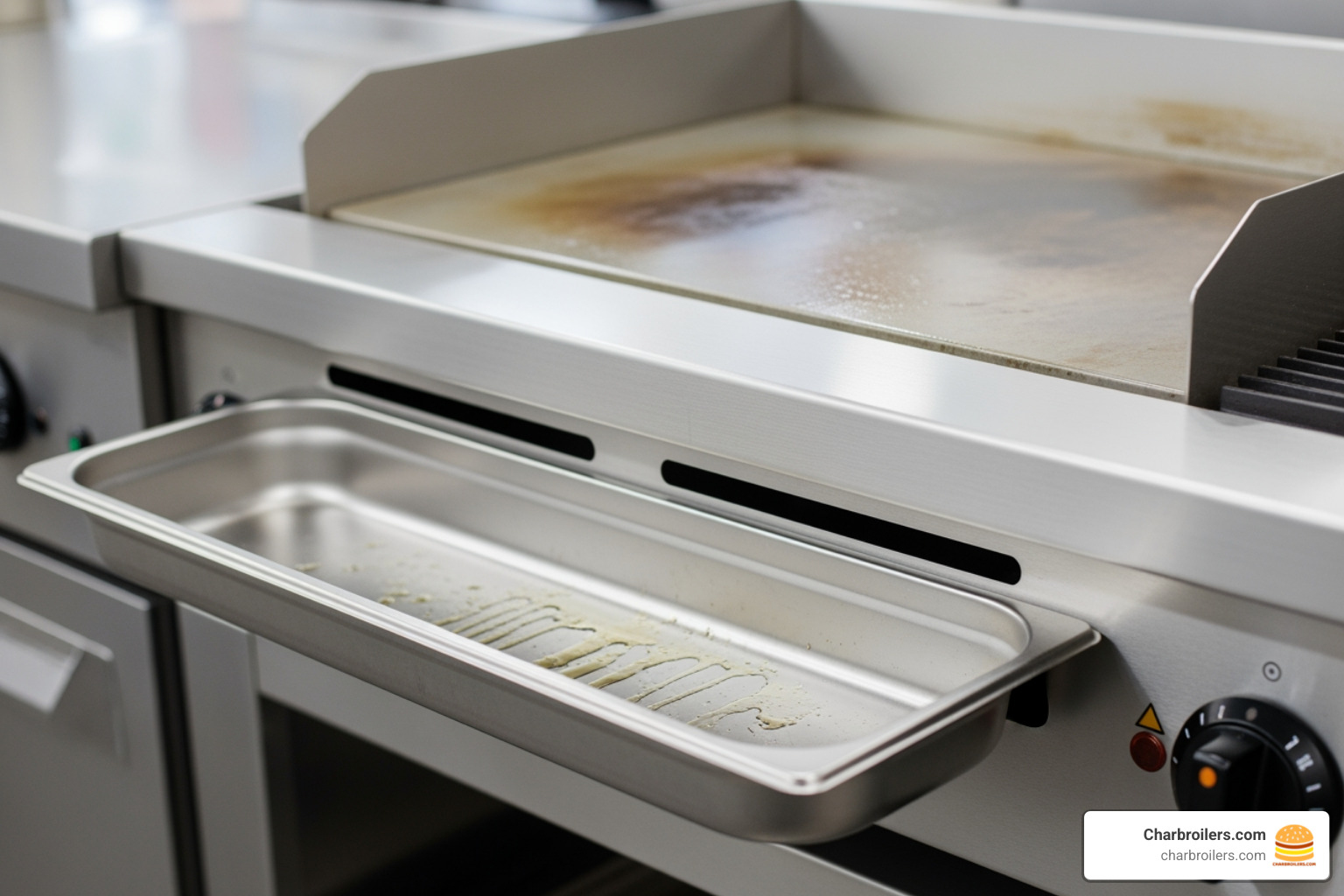
- Grease Troughs: A well-designed grease trough captures and channels drippings away from the cooking surface. Front-mounted troughs are convenient, allowing easy access for scraping.
- Drip Trays: These removable trays collect grease for easy disposal. Large-capacity trays are essential for busy operations.
- High Sides for Splatter Containment: Some griddles feature high, 90-degree sides to contain grease splatter and prevent food from falling off. This design keeps the cooking area cleaner and safer.
- Ease of Cleaning: The overall design should prioritize easy cleaning. Smooth surfaces, rounded corners, and accessible components make daily maintenance quicker and more thorough.
Gas vs. Electric: Which Power Source is Right for You?
Choosing between a gas or electric power source is a fundamental decision. Each has distinct advantages suited to different kitchens, and local factors like utility costs in Seattle may influence your choice.
The Advantages of Commercial Gas Griddles
Gas griddles are a favorite in commercial kitchens for their power and responsiveness.
- Portability (Propane): While natural gas models are fixed, propane gas griddles offer portability, making them excellent for outdoor events, food trucks, or catering.
- Rapid Heating: Gas burners heat up quickly and recover heat rapidly after adding cold ingredients, which is crucial during peak service times.
- Precise Temperature Control: Modern gas griddles, especially those with thermostatic controls, offer fine-tuned control over different cooking zones as the flame adjusts almost instantly.
- Outdoor Cooking Benefits: For restaurants with patios or catering businesses, gas griddles (especially propane models) are ideal as they perform well in various outdoor conditions.
If you're considering gas for your commercial kitchen, our detailed guide on Commercial Gas Griddles can provide more in-depth information.
The Benefits of Commercial Electric Griddles
Electric griddles offer a different set of advantages for specific kitchen setups.
- Consistency: Electric griddles are renowned for their incredibly consistent heat distribution, minimizing hot and cold spots for more predictable cooking results.
- Indoor Use: Since they don't produce combustion byproducts, electric griddles are ideal for indoor use, especially in kitchens with strict ventilation requirements or where gas lines are unavailable.
- Energy Efficiency: Electric models can offer better energy efficiency due to precise temperature control and less heat loss. ENERGY STAR® Certified models further improve energy savings.
- Simple Installation: Installing an electric griddle is often simpler than a gas unit, as it typically only requires an appropriate electrical outlet, reducing setup costs.
Here's a quick comparison to help you weigh your options:
| Feature | Gas Griddles | Electric Griddles |
|---|---|---|
| Heat-up Time | Generally faster | Can be slightly slower, but very consistent |
| Temperature Control | Responsive, good for searing | Extremely consistent, precise, less fluctuation |
| Installation | Requires gas line (natural) or propane tank | Requires appropriate electrical outlet |
| Operating Cost | Can be lower depending on local gas prices | Can be more energy-efficient, especially ENERGY STAR |
| Environment | Requires good ventilation | No combustion byproducts, ideal for indoor |
For a comprehensive look at electric options, dive into our Choosing Your 36" Electric Griddle: A Commercial Buyer's Guide.
Beyond Breakfast: Opening Up Your Griddle's Versatility
While famous for breakfast, a griddle's utility extends far beyond the morning rush. In a commercial kitchen, it's a workhorse capable of handling a wide array of dishes. Let's explore the full potential of these versatile griddles.
Advanced Cooking Techniques
A commercial griddle is a dynamic stage for advanced cooking techniques.
- Searing Meats: The consistent, high heat is perfect for achieving the Maillard reaction, creating a flavorful crust on steaks, chicken, and pork chops.
- Stir-Frying: A large, hot griddle can serve as an expansive stir-fry station, allowing for easy tossing and even heat distribution.
- Blackening Fish: For a bold, spicy flavor, blackening fish on a super-hot griddle is ideal. The direct heat quickly cooks the exterior while keeping the inside moist.
- Cooking Delicate Items: The controlled heat of a griddle is also excellent for delicate items like scallops, shrimp, or thinly sliced vegetables that require precise temperatures.
- Smash Burgers: The griddle is the natural habitat for this technique. Pressing ground meat onto the hot surface creates maximum contact for an incredibly crispy crust.
Expanding Your Menu with a Griddle
With these techniques, the possibilities for expanding your menu are virtually limitless.
- Fajitas: Sizzling fajitas are a griddle classic. The high heat and large surface allow for cooking multiple portions of marinated meats and vegetables simultaneously.
- Philly Cheesesteaks: The griddle is essential for authentic Philly cheesesteaks, allowing you to cook and chop thinly sliced beef and onions directly on the hot surface.
- Hibachi-Style Meals: Prepare rice, noodles, vegetables, and proteins on your griddle to mimic the engaging cooking style of a Japanese hibachi grill.
- Toasted Sandwiches: Create gourmet toasted sandwiches, paninis, and reubens with beautifully golden-brown exteriors and perfectly melted interiors.
- Outdoor Cooking Benefits: For restaurants with outdoor dining or catering services, a griddle's versatility shines, handling a diverse range of dishes for any event.
The griddle’s ability to handle such a wide variety of dishes makes it an indispensable piece of equipment. If you're looking to release more culinary power, consider how a griddle can complement a multi-burner stove: Unleash Culinary Power: Best 4-Burner Commercial Stoves with Griddle.
Essential Maintenance and Accessories
Properly maintaining your commercial griddle is key to its longevity, performance, and food safety. Consistent care and the right tools are essential for all griddles.
Maintenance Tips for Your Commercial Griddles
Proper maintenance extends the life of your griddle and ensures every dish is of the highest quality.
- Daily Cleaning: After each shift, scrape debris and grease from the warm griddle into the trough. Use a scraper for stuck-on bits, then scrub with warm water and a griddle pad before wiping clean.
- Deep Cleaning: Periodically, perform a deep clean. Disassemble and clean removable parts. Use a specialized cleaner on the griddle plate to break down carbon buildup, then rinse and wipe thoroughly.
- Seasoning Cast Iron and Steel: For cast iron and steel griddles, seasoning is vital. This process involves applying a thin layer of cooking oil and heating it until the oil polymerizes, creating a natural non-stick surface that protects against rust.
- Scraping Techniques: Always scrape towards the grease trough to efficiently remove debris. Use a sturdy, flat-edged griddle scraper. A griddle brick can be used for heavy buildup.
- Water and Steam Cleaning: Carefully pouring a small amount of water onto a warm griddle creates steam, which helps loosen tough residue. Always exercise caution to avoid steam burns.
For a comprehensive guide on keeping your griddle sparkling and efficient, refer to The Ultimate Guide to Cleaning a Commercial Stainless Steel Griddle.
Must-Have Griddle Accessories
Having the right tools makes cooking on and maintaining your griddle easier and more efficient.
- Spatulas: Sturdy, stainless steel spatulas with beveled edges are perfect for flipping, scraping, and managing food.
- Scrapers: A heavy-duty griddle scraper is indispensable for removing food residue and carbon buildup.
- Squeeze Bottles: Use these for precise application of oil, water, or cleaning solutions.
- Tongs: Long-handled tongs are essential for safely handling and turning food on a hot griddle.
- Melting Domes: These trap heat and moisture, perfect for melting cheese on burgers or steaming vegetables.
- Griddle Bricks/Pads: These abrasive tools are used to scrub away stubborn residue without damaging the griddle surface.
- Grease Bucket: A dedicated, heat-resistant bucket to collect drippings from the griddle's drain.
You can find a wide range of these essential tools and more for your griddles on platforms like Amazon.com. Investing in quality accessories is as important as investing in a quality griddle.
Conclusion
Griddles are versatile, invaluable assets in any commercial kitchen. We've covered the diverse types, from countertop to freestanding, and how materials like cast iron, stainless steel, and chrome affect cooking. We also highlighted crucial features like size, heat control, and grease management for optimal performance.
Choosing between gas and electric griddles depends on your kitchen's needs, with each offering distinct advantages. We've also seen how griddles can expand your menu well beyond breakfast. Finally, proper maintenance with the right accessories is essential to keep your griddle a high-performing, long-lasting workhorse in your kitchen.
At Charbroilers.com, we understand the demands of a commercial kitchen in Seattle, WA. Our expertise is dedicated to helping you steer these choices and find the perfect griddles that will not only meet but exceed your culinary expectations.
Explore our comprehensive guide to commercial charbroilers and other essential kitchen equipment to further improve your restaurant's capabilities: Explore our comprehensive guide to commercial charbroilers and other essential kitchen equipment