

What Is an SEO Report A Guide for Restaurant Equipment Suppliers
An SEO report is your window into how your website performs in search engines like Google. Think of it as a digital health check that turns a mountain of data into simple, actionable steps, showing you exactly how restaurant owners and chefs find your business when they're hunting for products like commercial charbroilers.
Your Website's Digital Health Check
Picture an SEO report like a head chef doing a full kitchen audit. The chef constantly checks inventory, food costs, and sales numbers to see what’s flying off the menu and what’s not. In the same way, an SEO report digs into your website's performance, giving you a clear picture of your online visibility and how customers are interacting with your brand.
This report is so much more than a spreadsheet full of numbers; it’s your strategic roadmap for your equipment supply business. It helps you answer the big questions:
- Who is visiting your website? Are they chefs digging into specs for a new convection oven or restaurant owners with a credit card in hand?
- How are they finding you? Are they typing "countertop charbroiler" or "best commercial grill" into Google?
- What are they doing on your site? Are they just browsing, or are they downloading spec sheets and calling your sales team?
- Where are the real growth opportunities? What keywords could you be targeting to bring in more qualified buyers for your equipment?
The Digital Kitchen Audit Analogy
Imagine you’re a restaurant owner searching online for the perfect countertop charbroiler to get that authentic smoky flavor on your steaks. An SEO report is the digital kitchen audit that reveals how well your restaurant equipment website is attracting these exact customers through Google.
This kind of reporting really took off in the early 2010s when Google's "Panda" update started penalizing sites with thin, low-quality content. That shift forced agencies to start sending out monthly reports to show clients how algorithm changes could tank their traffic—sometimes by as much as 80% overnight for sites on the wrong side of the update.
By regularly reviewing these insights, you can stop guessing and start making informed decisions that drive real growth, turning online searches into actual equipment sales. To see how these numbers are typically organized, a good SEO monthly report template can give you a solid starting point for structuring your own data.
An SEO report translates clicks, rankings, and traffic into a story about your restaurant equipment business. It tells you whether your online marketing efforts, like blog posting and local citation services, are just busywork or if they are actively contributing to your bottom line.
This kind of structured analysis is a lot like performing an internal review of your website's health. You can learn more about that process in our guide on how to perform a website audit.
Core Components at a Glance
Before we get into the nitty-gritty of each metric, here’s a quick look at the essential sections of a typical SEO report. Each component is like a different station in your kitchen audit, from checking your inventory to analyzing sales data.
Core Components of an SEO Report
This table summarizes the essential sections of a typical SEO report, giving you a quick reference guide to what each part measures.
| Component | What It Tells You | Example for a Charbroiler Website |
|---|---|---|
| Organic Traffic | The number of visitors who find your site through search engines. | Shows how many chefs found your "floor model charbroilers" page from a Google search. |
| Keyword Rankings | Your website’s position for specific search terms. | Tracks if you rank on the first page for "commercial gas charbroiler." |
| Backlink Profile | The quantity and quality of other websites linking to yours. | Identifies if a popular culinary blog linked to your guide on "grilling techniques." |
| Technical Health | How easily search engines can crawl and index your site. | Flags issues like slow page speed that might deter mobile users. |
Think of these components as the fundamental building blocks. When you put them all together, they paint a complete picture of your online performance and show you exactly where to focus your efforts for the biggest impact.
The Key Metrics Your SEO Report Must Include
An SEO report gets its power from the data inside. Think of it like a restaurant manager tracking food costs, labor hours, and daily sales to see if they're profitable. Your SEO report uses specific metrics to measure your online health, telling a story about who's finding your business, how they're getting there, and what they do once they arrive.
Understanding these key performance indicators (KPIs) is the first step toward turning raw data into profitable decisions for your equipment supply company. Without them, you're just cooking in the dark. Let's break down the essential metrics that belong in every report, using some foodservice analogies to make it all click.
This diagram gives a quick look at the core areas a good SEO report digs into.
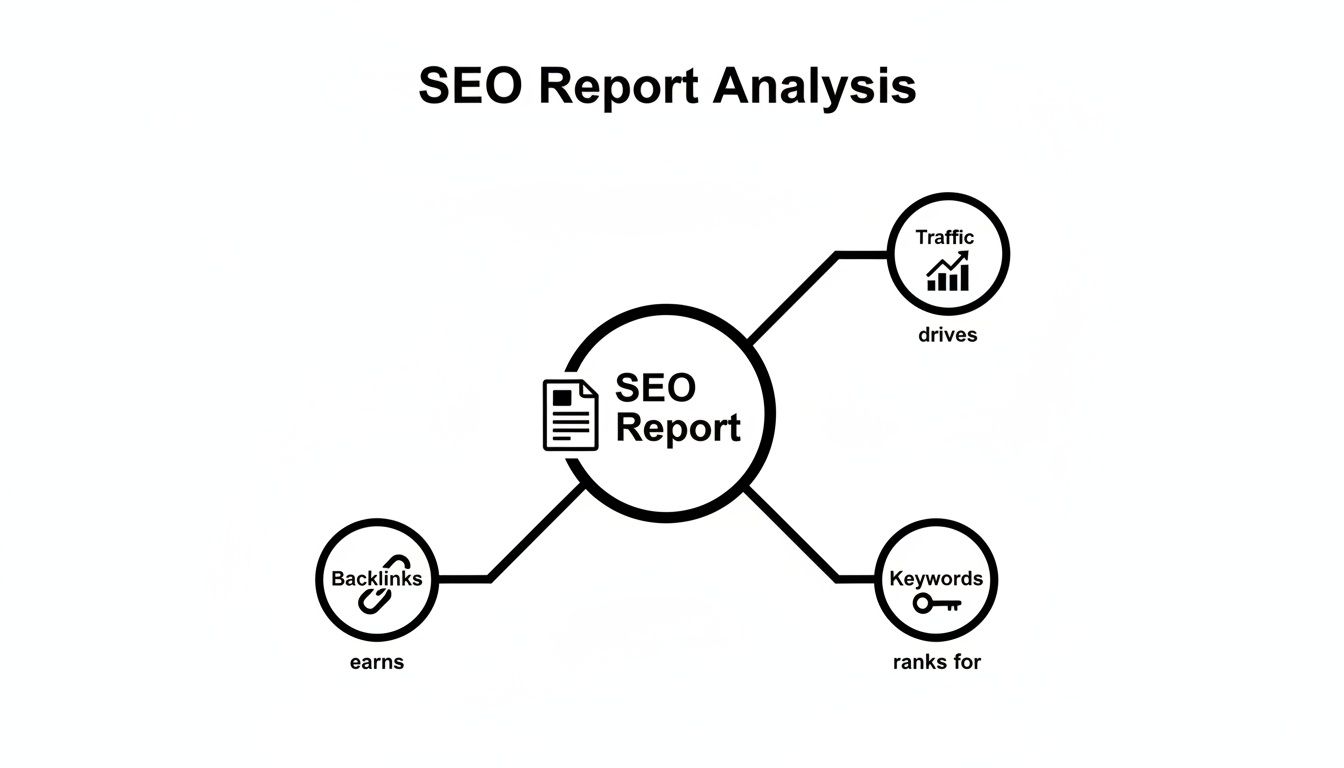
As you can see, the goal is to connect the dots between your traffic, keyword performance, and backlink authority to paint the full picture of your online presence.
Measuring Foot Traffic and Visibility
At its core, an SEO report is all about traffic and rankings. These are the numbers that directly show your brand’s visibility and whether you’re attracting potential customers for your restaurant equipment.
Organic Traffic
Think of organic traffic as the number of customers who walk into your showroom because they saw a billboard on the highway. They weren't looking for you by name; they were searching for a solution—like "commercial charbroiler"—and Google pointed them your way. This is the best kind of traffic because it’s earned, not paid for.
A healthy SEO report will show a steady increase in organic traffic over time. That’s a clear sign your website is becoming more visible for the searches that matter.
Keyword Rankings
If organic traffic is the "how many," keyword rankings are the "how." This metric shows your website's position on Google for specific search terms. Ranking on the first page for "best floor model charbroilers" is like being the first restaurant listed on a "best places to eat" guide. The higher you rank, the more clicks you get.
Keeping a close eye on these rankings is crucial. A drop from position 2 to position 8 can slash your traffic for that keyword by more than half.
Understanding User Engagement
Once a potential customer lands on your website, you need to know if they're finding what they came for. Engagement metrics tell you how people interact with your content, signaling whether it’s hitting the mark or sending them running.
Your SEO report shouldn't just show you how many people visit; it should reveal the quality of those visits. High traffic with poor engagement is like a full dining room where no one orders an entrée.
This table breaks down the most important metrics and what they actually mean for a business selling something like commercial charbroilers.
Essential SEO Metrics and Their Business Impact
| Metric | What It Measures | Good Benchmark for Charbroilers.com |
|---|---|---|
| Organic Traffic | Visitors who find your site through a search engine like Google, not from paid ads. | 10,000+ monthly sessions from non-branded searches. |
| Keyword Rankings | Your website's position in search results for specific terms (e.g., "gas griddle"). | Top 3 positions for 50+ high-intent keywords. |
| Click-Through Rate (CTR) | The percentage of people who see your site in search results and click on it. | 5% or higher for key commercial equipment terms. |
| Conversion Rate | The percentage of visitors who complete a goal, like requesting a quote or a demo. | 2% or higher for quote requests. |
These numbers, when looked at together, tell a much richer story than any single metric can on its own. They help you connect your SEO work directly to business results.
Click-Through Rate (CTR)
CTR is the percentage of people who see your website in search results and actually click on it. A high CTR means your page title and meta description are working. It's like an enticing menu posted in a restaurant window that convinces passersby to come inside.
Bounce Rate
This metric measures the percentage of visitors who land on a page and leave without clicking anywhere else. A high bounce rate can be like a customer walking in, looking around for a second, and immediately walking out. It often means the page didn't meet their expectations or was a pain to navigate.
Conversion Rate
This is the ultimate measure of success. A conversion is when a visitor takes a desired action, like filling out a "request a quote" form, downloading a spec sheet for a charbroiler, or calling your sales line. This metric directly ties your SEO efforts to your bottom line.
By analyzing these KPIs together, your SEO report moves beyond simple numbers and provides a detailed narrative of your online performance. We explore this further in our article on how to measure SEO performance.
Building Authority with Backlinks and Content
Beyond just looking at traffic numbers, a solid SEO report gets into the two things that really build your website's reputation: your backlinks and your content. These two work hand-in-hand to establish your authority with search engines, which is the key to any long-term success online.
Think of it like this: your website is your digital restaurant. The content you create is the menu, and the backlinks are the glowing reviews from food critics and happy diners.

Backlinks: The Digital Word-of-Mouth
A backlink is just a link pointing from another website to yours. Simple, right? But in the world of SEO, these links are like currency. They're one of the strongest signals you can send to Google that your site is trustworthy and authoritative. Each quality link is a vote of confidence.
Imagine a well-respected culinary blog links to your article, "A Chef's Guide to Perfect Grill Marks." That's the digital version of a five-star review. It sends their readers your way and, just as importantly, tells Google that you're a serious player when it comes to charbroilers.
An SEO report will break down your backlink profile by looking at:
- Referring Domains: How many unique websites are linking to you.
- Link Quality: The authority of those sites. A link from a major restaurant supply directory is worth way more than one from some random, unrelated blog.
- Anchor Text: The actual clickable words in the link (like "commercial charbroilers").
A healthy backlink profile is diverse and grows steadily. Ever since Google's 2012 Penguin update—which hammered sites with spammy links and caused traffic drops of up to 40%—this analysis has become standard. Today, it’s not uncommon for top e-commerce sites to have 500-2,000 quality links. If you want to dig deeper, Helium SEO has some great insights on SEO reporting trends.
Content Performance: The Menu That Pulls People In
Your content is the main event. It’s how you attract potential buyers, answer their questions, and eventually turn them into customers. For a restaurant equipment supplier, this is everything from your detailed product pages to blog posts that solve real-world kitchen problems. Our article writing and blog posting services specialize in creating exactly this kind of valuable content.
The content section of an SEO report answers the big questions:
- Which pages are bringing in the most organic traffic? This tells you exactly what topics are hitting the mark with your audience.
- Which articles are earning backlinks? This shows you what other industry players find valuable enough to share.
- Which pages have the highest engagement? This helps you spot the content that keeps visitors hooked and builds trust.
An SEO report pinpoints your star performers. If your guide on "Maintaining Your Commercial Grill" is getting thousands of views a month, that's a huge sign you need to create more content just like it for chefs and kitchen managers.
By looking at this data, you can stop guessing and start doubling down on what actually works. If that blog post on grill marks is pulling in chefs, you know you’ve found a hot topic. That insight can lead directly to better brand awareness and even qualified leads for your charbroiler sales team.
For restaurant equipment businesses, great content paired with a strong backlink profile is an unbeatable combination. To learn more about making this happen, check out our guide on strategic link building for your business.
Keeping Your Digital Kitchen Spotless
Think of the technical side of an SEO report as a full health and safety inspection for your online store. Just like a spotless, well-run commercial kitchen operates efficiently, a technically solid website just plain performs better in search results. It also creates a much better experience for your customers.
This part of the report goes beyond the menu (your content) and the rave reviews (your backlinks) to check the very foundation of your site. We're looking at the plumbing, the wiring, and the structural integrity of your digital presence. Ignoring these details is like having a leaky faucet or bad wiring in your restaurant; sooner or later, it’s going to cause bigger problems that hurt your bottom line.

Core Technical Health Checks
An SEO report digs into a few key technical areas to make sure your site is running smoothly for both real people and the search engine bots. These are the absolute non-negotiables.
- Site Speed: This is all about how fast your pages load. A slow-loading product page for a charbroiler is the digital version of a long wait for a table—it’s frustrating, and it sends potential customers straight to your competitors.
- Mobile-Friendliness: The vast majority of your customers are browsing on their phones. Your site absolutely must be easy to use on a small screen. A busy chef trying to look up specs for a new convection oven during service isn't going to waste time pinching and zooming on a site that's not built for mobile.
- Crawlability: This is just a fancy word for how easily search engines like Google can "read" and understand what’s on your website. Crawl errors are like blocked hallways in your kitchen; they stop search engines from reaching and indexing important pages, making them invisible online.
Getting these elements right forms the bedrock of a good user experience. A site that’s fast, mobile-friendly, and easy for search engines to navigate is set up for success.
Site Security and Foundational Integrity
Beyond what the user sees, an SEO report also inspects the behind-the-scenes security and structure of your website. These things are crucial for building trust with both visitors and Google.
One of the most critical pieces is HTTPS, which shows your site has a secure, encrypted connection. A website without HTTPS is like a restaurant with no locks on its doors. It tells visitors their information isn't safe, which is a massive red flag that will scare away buyers.
A technically clean website isn't just about pleasing search engines. It’s about providing a seamless and secure experience that turns a curious visitor into a confident buyer.
The report will also flag things like broken links (404 errors). These are like menu items that you don't actually serve anymore—they lead to a dead end and a frustrating experience. It also looks at your site's overall structure, making sure it has a logical flow that helps customers easily find the exact countertop fryer or floor model mixer they're looking for.
By keeping your digital kitchen spotless, you ensure every single visitor has a positive, efficient, and secure interaction with your brand.
Turning Data into Profitable Decisions
Think of an SEO report like a detailed inventory check for your restaurant’s kitchen. It tells you what you have and what’s moving, but the numbers alone won’t pad your bottom line. The real magic happens when you interpret that data and use it to make smart, profitable moves for your business.
An SEO report that just sits in your inbox is a wasted opportunity. You need a clear process for turning those insights into action. It’s about looking past the percentages and graphs to understand the story they tell about your customers and your online presence.
Starting with the Big Picture
Before you get lost in the details, start high-level. A restaurant manager checks the total daily sales before digging into how many burgers were sold; you should do the same by starting with the executive summary.
This section gives you a quick, digestible overview of your website's performance. It flags the most important wins and losses from the reporting period, giving you an immediate sense of direction. For instance, you might see a 15% jump in organic traffic but a 5% drop in quote requests.
This initial snapshot tells you exactly where to focus. A quick glance can reveal if your overall strategy is working or if you need to make immediate adjustments, saving you from getting bogged down in minor details that don’t move the needle.
Identifying Key Trends and Patterns
With the overview in hand, it’s time to hunt for trends. Your goal is to connect the dots between different metrics to understand not just what happened, but why. This is where you graduate from simply collecting data to generating real business intelligence.
Look for patterns over the last three to six months, not just the past 30 days. One month can be a fluke; a consistent trend is a clear signal.
- Is organic traffic steadily climbing? Great! Your content and backlink strategies are likely paying off.
- Are your rankings for "commercial charbroilers" on the rise? This shows you’re building authority for core product categories.
- Is your bounce rate consistently high on certain product pages? This could point to an issue with your pricing, images, or even page load speed.
An SEO report is a diagnostic tool. A single bad number isn’t a failure—it’s a symptom pointing you toward an area of your business that needs attention. It helps you ask the right questions to find the cure.
From Insights to Actionable Strategies
This is the most critical step: turning your analysis into a concrete action plan. Every piece of data in your report should lead to a "so what?" moment. What are you actually going to do with this information? This is where the real return on your SEO investment is made.
Let's walk through a real-world example for a restaurant equipment supplier.
Scenario: Your SEO report shows that your product page for "countertop gas charbroilers" is getting tons of traffic from Google. People are finding you for all the right keywords, but the conversion rate—the number of visitors who actually request a quote—is dismal.
The Insight: High traffic and low conversions almost always signal a problem with the page itself. People are interested enough to click, but something is stopping them from taking that next step.
The Action Plan:
- Review the Product Page: Are the product images high-quality? Are the technical specs clear and easy to find without a magnifying glass? Our professional copyrighting can ensure your descriptions are persuasive and clear.
- Clarify the Call-to-Action (CTA): Is the "Request a Quote" button bright, bold, and obvious? Or is it buried at the bottom of the page?
- Add Trust Signals: Include testimonials or reviews from other restaurant owners who have purchased that specific charbroiler.
- Create Supporting Content: Add a short video showing the charbroiler in action. Help chefs visualize it in their own kitchen.
By following this process, you transform a passive data point ("low conversion rate") into a proactive strategy designed to generate more leads and sales. This is how a simple SEO report becomes one of the most powerful tools for growing your business.
Essential Tools for Your SEO Report
To really see what's happening with your website's performance, you need the right set of tools. Think of these platforms like your restaurant's point-of-sale (POS) system; they gather all the crucial data you need to figure out what's working, what isn't, and where your customers are coming from. Without them, you're just flying blind.
The good news is that some of the most powerful tools out there are completely free. They give you the foundational data every restaurant equipment supplier needs to put together a meaningful SEO report.
Core Data Gathering Platforms
For any business, the place to start collecting data is with Google's own suite of tools. They offer a direct line of sight into how the world’s biggest search engine actually sees your website.
- Google Analytics: This is your digital POS system. It tracks every single visitor—how they found your site, which pages they looked at (like your top-selling charbroiler models), and how long they stuck around. It's absolutely essential for measuring traffic and understanding user behavior.
- Google Search Console: If Analytics is your POS, then Search Console is your kitchen expediter. It tells you exactly which search terms are bringing people to your site, flags any technical problems like crawl errors, and shows you your click-through rates.
Beyond Google, many businesses use third-party platforms to get a deeper look at the competition. Tools like Ahrefs and Semrush are fantastic for digging into your backlink profile, tracking a wider set of keyword rankings, and seeing what your competitors are doing right. To pull these insights together effectively, you'll need the right tech. You can explore the top SEO reporting tools that help automate and simplify your whole reporting process.
A great tool doesn't just hand you data; it helps you ask smarter questions. It turns a sea of numbers into a clear story about how your online business is performing.
Finally, remember that a well-structured report template is a tool in itself. It should organize all this information in a logical way, maybe starting with a high-level KPI dashboard, followed by detailed breakdowns of traffic and rankings, and ending with a clear, actionable plan. This makes sure the data isn’t just collected, but is also easy to understand and act on.
A Few Common Questions About SEO Reports
Jumping into the world of SEO reports can bring up a few questions, especially when you’re busy running a restaurant or managing a foodservice business. Let's tackle some of the most common queries we hear from folks in the restaurant equipment industry.
How Often Should I Get an SEO Report?
For most restaurant equipment businesses, a monthly SEO report is the sweet spot. This timing gives you enough data to spot real trends in your online performance without getting bogged down in the day-to-day fluctuations. It lets you track progress, catch potential issues with keyword rankings for products like "commercial charbroilers," and adjust your game plan.
Sure, a bi-weekly check-in might make sense during a huge website launch or a big sales push, but monthly reporting really strikes the perfect balance. It keeps you in the loop and ready to make smart moves without drowning you in data.
What Is the Difference Between SEO and Google Analytics Reports?
Think of it like this: Google Analytics gives you all the raw ingredients, but an SEO report is the fully-cooked, plated meal. A Google Analytics report is a firehose of raw data about who visits your website and what they do once they're there. It’s incredibly powerful but lacks context on its own.
An SEO report, on the other hand, takes that data, mixes it with insights from other tools, and tells a clear story about how you're doing in search engines. It zeroes in on organic search, keyword rankings, and backlink health. It adds interpretation and, most importantly, a clear action plan to help you get seen by more chefs and restaurant owners.
An SEO report doesn't just throw numbers at you; it explains why your organic traffic is climbing or why a certain product page isn't selling. It turns raw data into real business intelligence.
My Report Shows High Traffic but Low Sales. What Should I Do?
This is a classic—and fixable—problem. It usually means there's a disconnect between the people you're attracting and what they find on your page.
- Check Your Keyword Intent: First, dig into the keywords bringing in all that traffic. Are people searching for informational things like "how to clean a charbroiler" instead of purchase-focused terms like "buy commercial charbroiler"? If so, you're attracting researchers, not buyers. The fix is to create content that gently guides them from learning to buying.
- Analyze the User Experience: Next, take a hard look at those high-traffic pages. Are the product photos top-notch? Is your pricing easy to find and competitive? Is there a big, obvious call-to-action, like a "Request a Quote" button?
An SEO report is brilliant at flagging this gap. The next move is what we call conversion rate optimization (CRO), where you tweak your pages to better match what your visitors expect and turn that hard-earned traffic into revenue.
At Charbroilers.com, we understand that the right equipment is crucial for your restaurant's success. From countertop models perfect for a small diner to powerful floor models for a high-volume steakhouse, we have the selection and expertise to help you create unforgettable dishes. Elevate your menu and achieve perfect results with our top-quality commercial charbroilers. Explore our full catalog at https://charbroilers.com.