

What Is a Referring Domain and Why It Matters for SEO
Think of a referring domain as a unique website that sends a link your way. It’s essentially another site giving you a nod of approval, a digital vote of confidence in your brand.
Here’s a simple way to picture it: if one popular food blogger writes ten different posts about your commercial kitchen supplies, you've gained ten backlinks. But you've only earned one referring domain.
Understanding the Power of a Referring Domain
In the world of SEO, not all endorsements carry the same weight. Search engines like Google are always trying to figure out which websites are true authorities in their field. One of the biggest clues they look for is who is linking to you, not just how many times they do it. This is the real difference between backlinks and referring domains.
Imagine your commercial charbroiler business gets a glowing mention from a single, very enthusiastic food blogger. They love your product so much they link to your sales page ten times across their site. That’s great, but it’s still just one person’s opinion.
Now, picture this instead: ten different websites each link to you just once. We're talking about a mix of respected chef forums, foodservice industry publications, and equipment review sites. That second scenario is infinitely more powerful in Google's eyes.
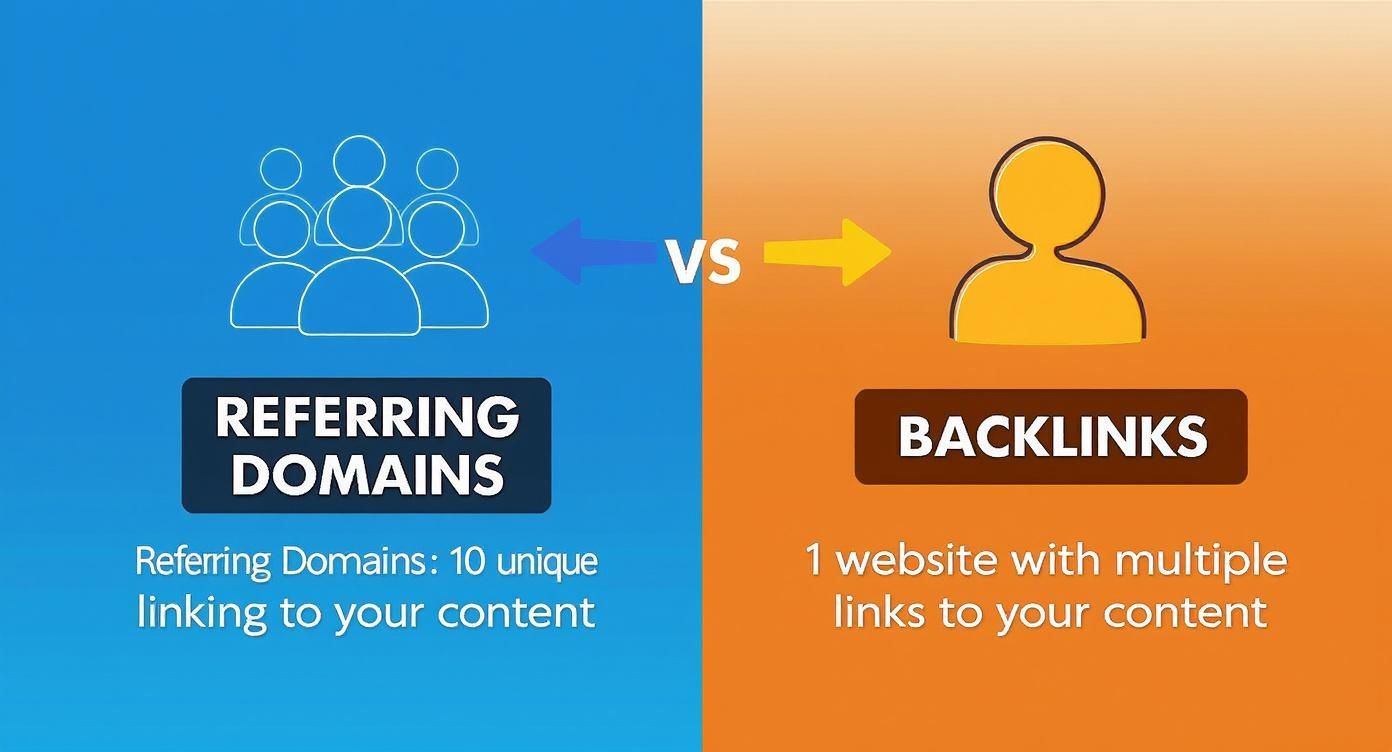
As the graphic shows, a diverse crowd of supporters (referring domains) signals much broader authority than one superfan shouting your name over and over.
Why Diversity Matters More Than Volume
Google sees each referring domain as an independent vote for your website's credibility. When you have a wide variety of these votes coming in from different sources, it strongly suggests your content is genuinely valuable and trusted across the web.
To make this crystal clear, let's break down the key differences in a simple table.
Referring Domains vs Backlinks at a Glance
| Metric | Definition | SEO Value | Restaurant Analogy |
|---|---|---|---|
| Referring Domain | A unique website that links to your site at least once. It's the source of the link. | High. Signals broad authority and trust from different corners of the internet. | Getting a positive review from 10 different food critics. |
| Backlink | An individual link from another website pointing to yours. It's the link itself. | Variable. Quality matters more than quantity. Too many from one source has diminishing returns. | Getting a positive review from 1 food critic who mentions you 10 times. |
The takeaway is simple: while both are important, focusing on increasing the number of unique, high-quality referring domains is a far more effective SEO strategy.
A strong and diverse profile of referring domains is a foundational element of SEO success. It tells search engines that your website is a go-to resource, recognized by many different voices in your industry.
Each unique website that links to you adds another layer of trust. These external hyperlinks act like bridges, not just for bringing potential customers to your site but also for passing along what SEOs call "link equity" or authority. To dig deeper into how these connections work, check out our guide on what is an external hyperlink.
Ultimately, your goal should be to build a portfolio of high-quality, relevant referring domains. It's one of the most reliable strategies for climbing the search engine rankings and cementing your brand as a leader in the foodservice industry.
The Critical Difference Between Referring Domains and Backlinks
While they’re often mentioned in the same breath, referring domains and backlinks tell two completely different stories about your website’s authority. Getting this distinction right is the key to an SEO strategy that actually moves the needle. It's less about a simple tally and more about measuring the true breadth and depth of your online reputation.
Here's the breakdown: a backlink is any single hyperlink pointing from another site to yours. A referring domain is the unique website that a backlink comes from.
So, if a popular culinary blog links to your new line of commercial charbroilers ten times across various articles, you’ve earned ten backlinks but only one referring domain.
Why Search Engines Prioritize Domain Diversity
Search engines like Google are hardwired to value diversity. A wide variety of referring domains is a powerful signal that your content is trusted and respected across the web. Think of each unique domain as an independent vote of confidence. The more of these votes you get from relevant, high-authority sources, the more credible your own website becomes.
This is the core idea behind what's known as link equity. A single link from a major foodservice publication like Foodservice Equipment & Supplies magazine passes on far more authority than a dozen links from some brand-new, unknown blog. The source matters. A lot.
Think of it like collecting business cards at a trade show. One card from a major industry influencer is more valuable than a stack of cards from attendees you don't know. Each unique referring domain is a valuable, high-level connection.
This is exactly why earning links from a wide range of reputable websites is a cornerstone of modern SEO. Search engines see the number of unique referring domains as a sign of broad trust and recognition, often prioritizing it over the total backlink count. The more unique sites vouching for you, the better. You can learn more about the SEO impact of referring domains and see the data for yourself.
The Power of One vs. Many
Let’s put this into a real-world scenario for a restaurant equipment supplier. Consider these two situations:
- Scenario A: One equipment leasing partner links to your website 25 times from their site.
- Scenario B: 25 different websites—industry blogs, chef forums, and local business directories—each link to you just once.
Both scenarios give you 25 backlinks. But for SEO, Scenario B is exponentially more powerful.
It proves your brand has earned trust from a wide cross-section of the internet. This broad base of support is precisely what Google is looking for when deciding who deserves the top spots. Building a strategy around getting links from diverse, high-quality sources is how you build long-term SEO success.
How Referring Domains Drive Your SEO Success
So, you know what a referring domain is. That's the first step. The real magic happens when you connect this SEO concept to actual growth for your restaurant equipment supply company. A healthy, diverse group of referring domains brings three major benefits that directly boost your bottom line.
A strong backlink profile builds your website’s authority, proves its relevance to Google, and sends high-quality referral traffic straight to your product pages. Think of these three benefits working together as a powerful engine for search engine visibility and lead generation.
Building Digital Authority
Think of each quality referring domain as a solid professional endorsement. When a respected industry site, like the National Restaurant Association, links to your website, it does more than just send visitors your way. It sends a strong signal to search engines that your brand is a credible, authoritative voice in the foodservice world.
Google sees this vote of confidence and raises your site's overall authority. This makes it easier for all of your pages to rank higher in search results. Over time, these authoritative links stack up, building a powerful digital reputation that your competitors will find incredibly difficult to match.
Proving Topical Relevance
Search engines are smart, but they still need help understanding exactly what your website is about. A link from a culinary school’s blog that’s discussing the best commercial ovens, pointing directly to your oven category page, provides undeniable context. It tells Google in no uncertain terms that you are a relevant source for that specific topic.
This kind of topical signal is huge. When a popular chef's blog features your charbroilers, it confirms your expertise and relevance in that niche. This helps you rank for specific, high-intent keywords that potential customers are typing into Google right now. To dig deeper into how these external signals boost your visibility, check out these actionable steps to improve your Google rankings.
A diverse referring domain profile is like having experts from every corner of the culinary world pointing to your business and saying, "They are the go-to source for this."
Driving Qualified Referral Traffic
Beyond just climbing the SEO rankings, referring domains open up new streams of direct traffic and brand visibility. Each unique domain can funnel a different, highly-targeted audience right to your site. Imagine a feature on a popular restaurant management website—that can send qualified, ready-to-buy customers directly to your product pages.
Statistically, it’s been shown that sites with over 200 referring domains can see millions of monthly visitors. This highlights the direct connection between domain diversity and traffic volume. A well-placed link isn't just an SEO play; it's a direct pipeline to your next customer.
How to Analyze Your Referring Domain Profile
Knowing what a referring domain is puts you ahead of the game, but the real magic happens when you start digging into your own profile. Auditing your referring domains gives you a clear, data-driven picture of where your website stands right now and uncovers some immediate opportunities for growth. Think of it like taking inventory of your walk-in freezer—you need to know what you have before you can plan a better menu.

The whole point of this analysis is to answer a few critical questions. Who’s linking to you? Are they high-quality, relevant sources? And most importantly, are there any sketchy links that might be dragging you down?
Getting Started with SEO Tools
To get these answers, you're going to need the right tools for the job. While paid platforms like Ahrefs and Semrush offer incredibly deep data, you can get started for free with Google Search Console. This is a must-have tool for any website owner, and it gives you a solid overview of which sites link to you most often.
Just head over to the “Links” report in Google Search Console, and you'll see your "Top linking sites." This gives you a baseline list of your current referring domains. For a more detailed guide, check out our post on how to check backlinks in Google. This first look is all about understanding your current digital footprint.
Once you have that list, the real work begins: figuring out the quality of those linking sites.
Assessing the Quality of Your Referring Domains
Let's be clear: not all referring domains are created equal. You have to learn how to separate the valuable endorsements from the low-quality noise. SEO tools help with this by assigning authority scores to every website, like Domain Rating (DR) or Authority Score (AS), which grade a site's backlink profile on a 1 to 100 scale.
A higher score generally means a more authoritative and trustworthy website. A link from a domain with a high score passes on more "link equity," giving your own site a much bigger SEO boost.
For example, a link from a major foodservice publication with a high DR is exponentially more valuable than a link from some random, unknown blog with a low score.
The goal is to spot which of your referring domains are the heavy hitters. Once you know that, you can focus your efforts on getting more links from similarly powerful sources.
As you audit your profile, keep an eye on these key metrics:
- Total Number of Referring Domains: This is your big-picture number. Is it trending up over time?
- Domain Authority/Rating: Are your links coming from industry titans or from websites in the digital bargain bin?
- Relevance: Do the linking sites actually have something to do with the restaurant equipment world? A link from a food blogger makes sense; a link from a casino website does not.
- Spam Signals: Be on the lookout for links from weird, foreign-language, or just plain sketchy-looking sites. These can actively harm your SEO and might need to be "disavowed" (basically, telling Google to ignore them).
Checking in on your referring domain profile regularly is a cornerstone of any good SEO strategy. It lets you build on your strengths, shore up your weaknesses, and protect your site from bad actors, making sure your online reputation stays solid.
Proven Strategies to Earn High-Quality Referring Domains
Okay, so you get what a referring domain is and you know how to peek at your own link profile. That's a great start, but it's only half the game. Now it's time to roll up your sleeves and get to work.
Earning links from top-notch sites isn't something that just happens. It takes a real strategy, one that goes way beyond just publishing a blog post and hoping for the best. For restaurant equipment suppliers, this means getting laser-focused on industry-specific tactics that build genuine authority and pull in the right kind of traffic.

The big idea here is to become an indispensable resource within the foodservice world. When your brand is the first name people think of for expertise, the valuable referring domains will start showing up on their own.
Build Your Foundation with Local Citations
Local citations are basically online mentions of your business's name, address, and phone number (NAP), and they often come with a link back to your site. For a restaurant equipment supplier, these are the foundational links that prove you're a legitimate, real-world business to both customers and search engines.
A great place to start is by getting listed in key foodservice directories and associations. These sites are already seen as trusted and relevant in the industry, which makes a link from them extra valuable.
- Industry-Specific Directories: Get your business listed on platforms like the Foodservice Equipment Distributors Association (FEDA) or any regional supplier directories.
- General Business Listings: Make sure your profile is complete and totally accurate on Google Business Profile, Yelp, and other major local players.
- Niche Supplier Portals: Hunt down any online portals that cater specifically to restaurants looking for equipment and make sure you have a solid presence there.
Create Ultimate Guides and Link-Worthy Resources
Honestly, one of the best ways to earn authoritative links is to create content that other websites simply have to reference. Stop writing basic product descriptions for your charbroilers. Instead, create the ultimate, no-stone-unturned guide to selecting, maintaining, and using commercial kitchen grills.
Create content so valuable that it becomes the go-to resource for your industry. This turns your website into a magnet for high-quality referring domains from blogs, culinary schools, and even competitors.
This kind of deep-dive content instantly positions you as an expert. Food bloggers, chefs, and industry journalists are always on the lookout for credible sources to back up their own content. When your guide is the definitive answer they've been searching for, they'll link to it. It’s as simple as that.
Partner with Food Suppliers and Industry Influencers
Smart partnerships can unlock a ton of new referring domains you couldn't get otherwise. Think about collaborating with non-competing businesses in the foodservice space, like food suppliers or restaurant consultants, to create something together. This could be a joint webinar on kitchen efficiency or an article about pairing the right equipment with certain menu items.
Another powerful move is blogger outreach. Offer a brand-new piece of equipment, like a high-performance commercial charbroiler, to a respected chef or food blogger in exchange for an honest review. Their detailed post will not only give you a fantastic backlink but will also act as powerful social proof for your brand.
To really dig into the practical steps for getting these kinds of links, check out these proven strategies to build high-quality backlinks. And don't forget that guest posting on other industry blogs is still a hugely effective tactic. We help restaurant equipment websites like yours with everything from blogger outreach to article writing to secure these valuable placements.
Common Link Building Mistakes to Avoid
Building a solid profile of referring domains is all about smart strategy, but knowing what not to do is just as critical. Earning high-quality links is a marathon, not a sprint. If you sidestep the common pitfalls, you'll build a sustainable SEO foundation that search engines will actually reward for the long haul.
One of the biggest mistakes I see is chasing quantity over quality. Think of it this way: would you rather have a single rave review from a well-respected food critic or hundreds of fake online reviews from spam accounts? It’s a no-brainer. In the same way, one link from a top-tier foodservice publication will do more for your authority than a hundred links from sketchy, irrelevant directories.
The Dangers of Black Hat Tactics
Chasing quick wins with risky link schemes is a recipe for disaster. These shady tactics can land you in hot water with search engines, leading to severe penalties that can wipe out all your hard-earned progress overnight.
Here are a few common mistakes that can absolutely tank your SEO:
- Buying Links: Paying for backlinks is a direct violation of Google's guidelines. Don't be fooled—search engines are incredibly good at sniffing out paid links, and getting caught can get your site penalized or even de-indexed.
- Ignoring Link Relevance: Getting a link from a casino or a fashion blog for your commercial charbroiler site just doesn't make sense. It sends confusing signals to Google. Irrelevant links provide almost no value and can easily be flagged as manipulative.
- Participating in Link Farms: These are networks of websites created for the sole purpose of linking out to each other to game the system. Links from these sources are considered toxic and will destroy your site’s reputation.
SEO has changed a lot over the years, and it's all moved toward rewarding quality. In the early days, many strategies were just about piling up backlinks without any thought for domain diversity, which led to a ton of manipulation. But as the algorithms got smarter, the focus shifted. To really get why authentic endorsements are so important now, you can learn more about the evolution of referring domains in SEO.
Frequently Asked Questions About Referring Domains
Even after getting the hang of referring domains, a few questions always seem to pop up. Let's clear the air and tackle some of the most common ones so you can move forward with your link-building with total confidence.
How Many Referring Domains Do I Need?
There's no magic number. Chasing a specific count is the wrong way to think about it.
The real goal is steady, consistent growth from relevant, high-quality domains. A much better approach is to simply build a stronger, more diverse backlink profile than your direct competitors. Use SEO tools to see who is linking to them, and set that as your benchmark. Quality will always, always beat quantity.
A single, authoritative link from a top foodservice publication is worth more than a hundred spammy, irrelevant links. Focus on earning endorsements that actually mean something in our industry.
What Is a Referring Domain vs a Root Domain?
When we're talking about backlink analysis, these two terms pretty much mean the same thing. They both point to the unique website linking to you.
For example, if you get links from blog.example.com and shop.example.com, they both come from the same root domain: example.com.
Good SEO tools are smart enough to count this as just one referring domain because, at the end of the day, the "vote of confidence" is coming from the same website.
Can Referring Domains Hurt My SEO?
Yes, they absolutely can. If you get links from low-quality, spammy, or totally unrelated websites, search engines see that as a bad sign.
These are often called "toxic backlinks," and they can seriously drag your rankings down and damage your site's credibility. It's crucial to check your referring domain profile every so often to find these harmful links. You can use tools like Google's Disavow Tool to tell search engines to ignore them, protecting all the hard-earned authority you've built.
Ready to serve up a superior online presence? The right equipment makes all the difference, both in the kitchen and in your SEO strategy. At Charbroilers.com, we provide top-tier commercial charbroilers designed for performance and flavor. Explore our collection today and start building a brand that gets noticed.