
What Are Serp Features? A Guide for Restaurant Equipment Suppliers
Think of SERP features as all the special, interactive results Google shows you that aren't just the classic list of blue links. They’re designed to give you quick answers and a much richer search experience, like image carousels, maps, review stars, and those handy answer boxes right at the top of the page.
Understanding SERP Features Beyond the Blue Links
Imagine walking into a restaurant and being handed a text-only menu. The standard organic search results—those simple blue links—are a lot like that. They tell you what’s available, but that's about it.
SERP features are the vibrant photos of the signature dishes, the chef's recommendations, and the glowing customer reviews printed right on the menu. They immediately grab your attention and help you decide what you want, faster.
Google's Search Engine Results Page (SERP) works the same way. It's no longer just a static list; it's a dynamic, interactive space built to answer your questions as quickly as possible. These features are Google's way of upgrading the search experience from a simple directory into a genuinely helpful guide.
The Evolution from Links to Answers
Years ago, a search result was just a title, a URL, and a short description. That was it. But today, Google’s goal is to be an answer engine, not just a search engine. For businesses, especially in competitive B2B markets like restaurant equipment supply, that shift changes everything.
For a restaurant equipment supplier, it means a potential customer searching for a new grill is going to see much more than just a link to your homepage.
They might see:
- Image Packs: A swipeable carousel of different charbroiler models.
- Review Snippets: Bright yellow star ratings shining right next to your product link.
- People Also Ask boxes: Direct answers to common questions like "gas vs. electric charbroiler."
These features completely change the game. To really get a handle on how search results work today, you have to dig into the core concepts of SERP features that go beyond the old-school organic listings.
Mastering them is like getting your best products featured on the front page of that restaurant menu. You capture the buyer’s attention before they even think about clicking on a competitor.
This is especially true when you consider how big the market is. For instance, in the food service industry, gas charbroilers are king, with the global market projected to be worth around USD 855.6 million in 2025 and expected to climb to USD 1,316.1 million by 2035. You can dig into the commercial charbroiler market growth stats on datainsightsmarket.com.
Standard Results vs SERP Features at a Glance
To make this crystal clear, let's break down the key differences between a plain old search result and one that's been enhanced with these powerful features.
| Attribute | Standard Organic Result | Result with SERP Features |
|---|---|---|
| Appearance | Plain text: blue title, green URL, black description. | Visually rich: may include images, stars, maps, or interactive elements. |
| Information | Provides a brief meta description of the page's content. | Offers direct answers, pricing, reviews, or other key data on the spot. |
| Position | Appears in the main list of 10 blue links. | Can appear anywhere, often above the #1 organic spot (Position Zero). |
| User Goal | Encourages a click to find the answer on the website. | Aims to answer the query directly on the search results page. |
As you can see, the difference is night and day. One is a simple signpost, while the other is an interactive storefront designed to draw customers in.
The Most Valuable SERP Features for Restaurant Suppliers
Think of Google's results page as a massive, bustling food court. A standard blue link is like a stall with a plain, handwritten sign—easy to walk right past. The most valuable SERP features, on the other hand, are the bright, glowing menus and special boards that grab hungry customers' attention and pull them in. For a restaurant equipment supplier, knowing which of these features to target is the secret to standing out in a very crowded market.
Not all SERP features are created equal, especially for a B2B e-commerce site focused on restaurant equipment. Some are far better at catching the eye of qualified buyers, like chefs and restaurant owners. When you focus on the right ones, you transform your search presence from just another listing into an interactive, powerful digital storefront.
This diagram shows how a basic search result can evolve into something much more engaging and valuable for a user.
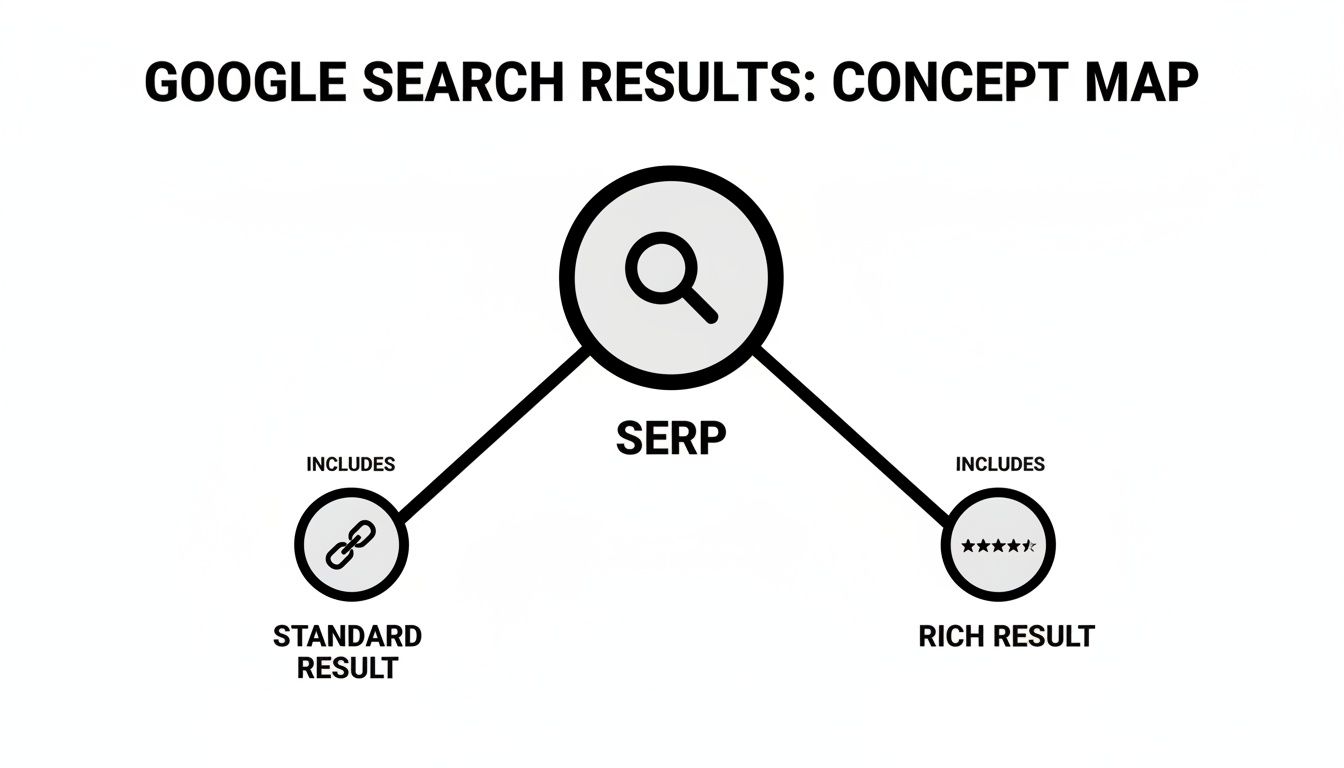
As you can see, the path splits. Rich results add layers of useful information that a standard blue link just can't compete with.
The Local Pack: Your Digital Map
For a restaurant owner frantically searching "commercial kitchen suppliers near me," the Local Pack is a lifesaver. It’s that map at the top of the results showing the top three local businesses, complete with addresses, phone numbers, and those all-important star ratings. Owning a spot here is like being the first supplier a local chef sees when a critical piece of equipment goes down.
Winning this spot requires a solid local SEO foundation, driven by accurate local citations and a well-optimized business profile. If you want to dive deeper, our guide on how to get a Google Business listing is the perfect place to start, as this is the first step to even appearing in the Local Pack.
Featured Snippets: The Chef's Tip
A Featured Snippet is the ultimate "chef's tip" that Google displays right at the very top of the page, a spot so valuable it's often called "Position Zero." It gives a direct answer to a question like, "what is the best charbroiler for a steakhouse?" Securing this snippet instantly positions your brand as an authority, giving the searcher a clear, concise answer and often stopping them from scrolling any further. This is achieved through well-written article content and clear blog posting.
People Also Ask: Answering Every Customer Question
Closely related to Featured Snippets are the People Also Ask (PAA) boxes. You've seen them—those expandable accordions of related questions that pop up for a search. For a supplier, these get triggered by real buyer questions like "gas vs. electric charbroiler?" or "how to clean a commercial grill?" By creating high-quality copyrighting and article writing that answers these specific questions clearly on your product pages or blog, you can land your content right in front of buyers while they're deep in the research phase.
Rich Snippets and Image Packs: Your Visual Catalog
Finally, think of Rich Snippets (like review stars) and Image Packs as your visual product catalog right on Google. Seeing five glowing stars next to your charbroiler link makes it dramatically more appealing and trustworthy. It's a simple visual cue that can make all the difference.
Similarly, an Image Pack lets potential buyers see your equipment in action without ever leaving the search results page. In a visual industry like restaurant equipment, these visual elements are often the deciding factor that gets you the click over a competitor.
Why SERP Features Are a Competitive Advantage
Scoring a spot in the SERP features is like getting your best charbroiler displayed right in the front window of a packed kitchen supply store. While your competitors are stuck on the back shelves, you're the first thing a serious buyer lays eyes on. This isn't just about catching their attention; it's about building instant trust.
Instead of just telling a potential customer your product is great, SERP features actually show them. They offer immediate proof—like five-star reviews or a direct answer to a burning question—before anyone even has to click. This turns a simple search result into a powerful first impression that can make or break a sale.
From Higher Visibility to Higher Sales
The most immediate payoff from winning SERP features is a massive jump in visibility and your Click-Through Rate (CTR). It’s just human nature. When your charbroiler shows up with shiny review stars or in a big image pack, it's going to get more clicks than a plain old blue link. Think of it as a customer walking past a dozen plain brown boxes to grab the one with the vibrant, appealing packaging.
Owning the top spot with something like a Featured Snippet is what we call claiming 'Position Zero.' You’re literally placed above all other organic results, making your brand Google's top recommendation for that search.
This prime real estate has a direct impact on your bottom line. The global commercial charbroilers market hit USD 826.4 million in 2024 and is expected to climb to USD 1,238.8 million by 2033. What's driving that? A universal craving for that unique charred flavor you can only get from a real charbroiler. By showing up in SERP features, you're putting your products right in front of this growing wave of buyers. You can dig into the growth of the commercial charbroilers market for more details.
Capturing Voice Search and Building Authority
The benefits go way beyond just clicks. A huge chunk of voice searches—whether from a Google Home or a chef's phone—pull their answers directly from SERP features like Featured Snippets. Imagine a busy chef asking their phone, "What's the best way to clean a commercial charbroiler?" If Google reads back an answer from your website, you've just won a hugely valuable, hands-free search.
Ultimately, showing up in these features over and over again builds incredible brand credibility. Whether it's through an official-looking Knowledge Panel about your company or by answering a buyer's question in a "People Also Ask" box, you are cementing your business as a trusted expert. This authority can be further amplified through strategic blogger outreach to get your content in front of more industry professionals. And that trust is what turns a one-time click into a loyal, long-term customer.
How to Find Your Best SERP Feature Opportunities
Alright, you see the massive advantage SERP features offer. Now it’s time to get your hands dirty. Finding the best opportunities for your own site isn't about guesswork or blind luck; it's about having a clear, data-driven plan to pinpoint which keywords offer the most valuable search real estate.
This is how you turn your SEO strategy from a shot in the dark into a targeted attack.
The simplest way to start is by doing it yourself. Just open an incognito browser window—this is important because it keeps your personal search history from skewing the results—and type in one of your main keywords.
For instance, a quick search for "commercial countertop charbroiler" might immediately show you an Image Pack at the top, a People Also Ask box, and several product listings glowing with review stars. This manual check gives you a real-time snapshot of the battlefield for your most important terms and shows you what Google thinks is important for that specific search.
Using SEO Tools for Scaled Analysis
While putting on your detective hat for manual searches is insightful, it’s just not practical for hundreds or thousands of keywords. To do this at scale, you need to bring in the big guns: professional SEO tools. Platforms like Ahrefs and Semrush are built to do this heavy lifting, turning hours of tedious work into a few simple clicks.
These tools let you dump in a whole list of your keywords and instantly see which ones are triggering specific SERP features. You can filter your list to show only the terms that are currently bringing up a Featured Snippet or a Local Pack, letting you zero in on what matters most.
By focusing on keywords that already have SERP features, you're not trying to create a new opportunity from scratch. Instead, you're competing for a known, high-value prize that Google has already placed on the results page.
This data-first approach is the bedrock of a winning strategy. To really nail this, you need the right software in your corner. You can explore some of the best SERP tracking tools to find a platform that fits your budget and goals.
These tools don't just help you track your own progress; they give you a clear view of what your competitors are winning, too. We have a detailed guide on how to check SERP position for a keyword that dives deeper into this. Think of this knowledge as your roadmap to capturing more visibility and leaving your competitors in the dust.
How to Optimize Your Site for Rich Results
Knowing which SERP features you want is one thing, but actually claiming them is another. The secret to transforming your standard blue links into eye-catching, information-rich results is learning to speak Google's language. That language is called Schema Markup, often referred to as structured data.
Think of Schema as adding super-specific labels to the back end of your website. It's like putting a clear "Price Tag," "Star Rating," and "In Stock" sticker on each of your products so Google doesn't have to guess what's on the page. That clarity is exactly what the search engine needs to reward you with those valuable rich results.
This isn't just a technical box-ticking exercise; it's your direct line of communication with Google. You're telling it precisely what information matters most and what it should highlight for potential buyers.
Use Product Schema for E-Commerce Wins
For an e-commerce site selling restaurant equipment, the most powerful tool in your entire kit is Product Schema. This markup is specifically designed to pull key commercial details right onto the search results page, making your listings infinitely more appealing to someone ready to buy.
By adding Product Schema, you can tell Google to show crucial info like:
- Price: Put the cost of a charbroiler right in front of them.
- Availability: Let them know if a popular model is in stock or on backorder.
- Review Ratings: Show off those hard-earned five-star ratings.
- Brand: Clearly display the manufacturer of the equipment.
When a restaurant owner is scrolling through search results and sees your listing complete with a price and glowing reviews, their confidence in your store skyrockets. That little bit of pre-click validation can be the deciding factor that gets them to choose your link over a competitor’s plain one, boosting your CTR and driving genuinely qualified traffic.
Essential Schema Markup for Charbroiler Product Pages
To get started, focus on the Schema types that deliver the biggest bang for your buck on product and category pages. Here’s a quick breakdown of what to prioritize.
| Schema Type | Information It Provides Google | Target SERP Feature |
|---|---|---|
| Product | The core details of a single item, including name, brand, SKU, and description. | Rich Snippets (Price, Reviews) |
| Offer | Pricing, availability (e.g., InStock), currency, and condition of the product. | Price & Availability Snippets |
| AggregateRating | The average review score and total number of ratings received for the product. | Review Stars (Star Ratings) |
| FAQPage | A list of frequently asked questions and their corresponding answers on a given page. | FAQ Dropdowns |
| BreadcrumbList | The page's position in the site hierarchy, helping users understand your site structure. | Breadcrumbs in SERPs |
Implementing these gives Google a crystal-clear picture of your products, making it far more likely to feature them prominently.
Answer Questions Directly with FAQPage Schema
Beyond just product specs, you can also snatch up SERP real estate by proactively answering your customers' questions. This is where FAQPage Schema shines. It lets you wrap code around a list of questions and answers on your product or category pages.
This markup essentially tells Google, "Hey, here are some common questions about this charbroiler, and here are the direct answers." Google can then display these as an interactive dropdown menu right below your search result.
For example, on a page comparing different charbroiler models, you could build out an FAQ section to answer questions like:
- What is the difference between a gas and an electric charbroiler?
- How many BTUs do I need for a steakhouse?
- What is the best way to clean cast iron grates?
Capturing this space turns your listing into an instant resource, solving a searcher's problem before they even click. This builds immediate authority and trust.
And if you're aiming for that coveted answer box at the very top of the page, check out our guide on how to optimize for featured snippets for more advanced strategies. When you start using Schema effectively, you stop just competing for links and start winning the most valuable real estate on Google.
Frequently Asked Questions About SERP Features
When you're diving into the world of SEO, especially for a niche like restaurant equipment, a lot of questions about SERP features pop up. Let's clear up some of the most common ones so you can move forward with a solid plan.
Can I Pay Google to Get a SERP Feature?
This is probably the most common question we hear, and it's a good one. For most of the organic SERP features—think Featured Snippets, People Also Ask boxes, and Image Packs—the answer is a hard no. You can't buy your way into these spots. They are earned, plain and simple. Google’s algorithm gives them to the content it believes is the most helpful and authoritative for a specific search.
But, of course, there's a paid side to Google. Some features are definitely ads:
- Top and Bottom Ads: These are the classic pay-per-click (PPC) results you see flagged with a "Sponsored" label.
- Shopping Results: That slick, image-heavy carousel of products is a paid placement, run through Google Ads and your Google Merchant Center account.
For a restaurant equipment supplier, the best approach is usually a mix of both. You earn organic features with great content and proper Schema markup while using paid ads to get guaranteed visibility for those money-making keywords like "buy commercial charbroiler."
How Long Does It Take to Win a SERP Feature?
There's no magic number here. How quickly you can snag a SERP feature depends on a few things: your site's current authority, how tough the competition is for your target keyword, and how fast Google gets around to crawling and indexing your newly optimized pages.
If you're starting from scratch with a brand-new page for a competitive term, you could be looking at several months of hard work. On the other hand, if you're just tweaking an existing page that already ranks on page one, you might see results like an FAQ dropdown or review stars pop up much faster—sometimes in just a few weeks after you add the right code.
The key takeaway is that SERP feature optimization is a long-term strategy, not an overnight fix. Consistency in creating high-quality, well-structured content is what ultimately earns you these valuable placements.
Do SERP Features Guarantee More Traffic?
It's not a 100% guarantee, but winning most SERP features is strongly linked to getting more traffic and a better click-through rate (CTR). Think about it—features like glowing review stars or a sharp image pack make your result stand out. They build trust and are way more eye-catching than a standard blue link, which naturally pulls in more clicks.
There is one little catch, though: "zero-click" searches. Some features, like a Featured Snippet or a Knowledge Card, are built to give the user the answer right there on the results page. In that situation, they might not need to click through to your site at all.
Even so, these features are fantastic for building your brand. They position your company as the go-to authority, which builds the kind of trust that leads to direct visits and sales down the road.
Which SERP Feature Is Best for My Business?
The "best" feature really depends on what you're trying to achieve and what your customers are searching for. For a restaurant equipment supplier, different features are superstars for different jobs.
- For Product Pages: Getting Product Schema (for review stars, pricing, and availability) is a must. It hits buyers right when they are making a decision.
- For Local Buyers: The Local Pack is your number one target. It's how you connect with restaurant owners in your area who need equipment right now.
- For Informational Keywords: Featured Snippets and People Also Ask boxes are perfect for answering questions like "how to season a new charbroiler?"
- For Visual Shoppers: Image and Video Packs are critical. They show your equipment in a real kitchen setting, helping chefs and owners picture it in their own space.
The smartest strategy is to see which features already show up for your most important keywords and then build a plan to go after them. Don't chase every shiny object; focus on the features that will actually make a difference to your bottom line.
At our agency, we provide the expert SEO, local citation services, blog posting, blogger outreach, copyrighting, and article writing your restaurant equipment supply website needs to dominate the SERPs. Contact us to learn how we can help you capture more high-value features and grow your business.