

What Are LSI Keywords? A Modern SEO Guide
Forget the tech-speak for a moment. At their core, LSI keywords are simply terms and phrases that are conceptually related to your main topic. Think of them as the supporting cast that gives your star performer—the main keyword—real depth and context. They're the secret sauce that helps search engines like Google truly understand what your content is all about.
So, What Are LSI Keywords In Plain English?
Let's cut through the jargon. Imagine your main keyword is "commercial ice machine." If you just hammered that one phrase over and over, Google would get the basic idea, but it wouldn't have much confidence that you're an expert. It's a bit one-dimensional.
Now, what if you started talking about things like “cube ice,” “water filter,” “daily production,” and “bin capacity”? These aren't just synonyms. They're the real-world concepts that surround the topic, painting a complete picture for search engines and proving your page is a genuinely comprehensive resource. For restaurant equipment supply websites, demonstrating this deep product knowledge through effective content is key to standing out.
This diagram shows how different concepts connect to a central idea, much like related terms add crucial context to your main keyword.
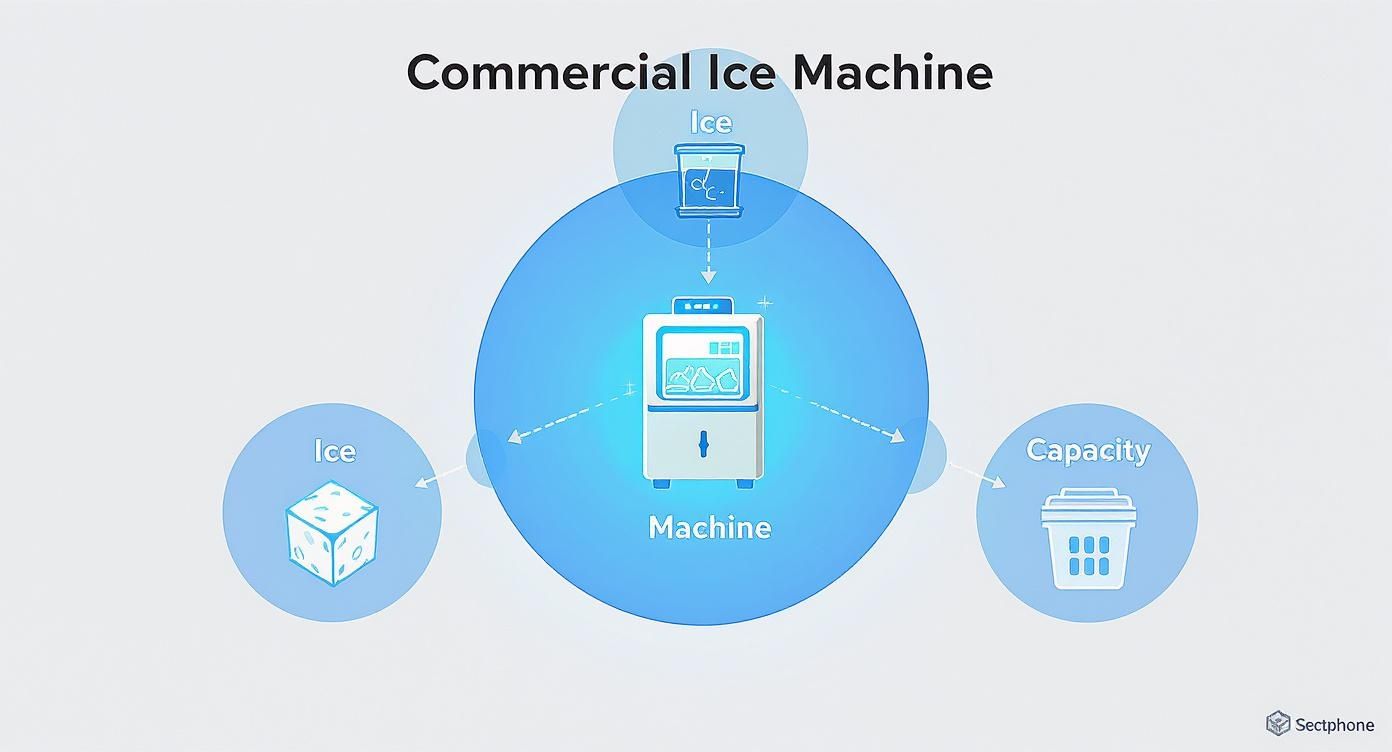
As you can see, things like the type of ice, the filtration system, and storage are all directly tied to the main product. This is how you build a complete topical map that Google can easily understand and reward. Our approach to SEO and article writing focuses on creating this kind of comprehensive content.
Synonyms vs. Contextual Terms
One of the biggest hang-ups people have is confusing these contextual terms with simple synonyms. They aren't the same thing. While synonyms definitely have their place, the terms that truly add context are way more powerful for signaling your expertise.
A synonym just gives you another way to say the exact same thing. A related, contextual term, on the other hand, explores a different facet of the topic entirely. For a restaurant equipment supply site, that distinction is everything. It shows you understand the real-world needs of chefs and kitchen managers.
The core idea is simple: You're not just trying to rank for a single phrase. You're aiming to own the entire conversation around that topic by including the words and concepts an expert would naturally use. This is a central principle in our copyrighting and blog posting services.
To make this crystal clear, let's break down the differences for our primary keyword, "commercial ice machine."
Primary Keyword vs Related Terms Explained
This table shows the difference between LSI Keywords (or related terms), simple synonyms, and terms that are just plain unrelated. Notice how the related term adds a layer of specific, functional detail.
| Term Type | Example Term | Relationship to 'Commercial Ice Machine' |
|---|---|---|
| LSI Keyword | "Daily production" | Describes a key functional specification of the machine. |
| Simple Synonym | "Commercial ice maker" | A different name for the exact same piece of equipment. |
| Unrelated Term | "Freezer" | A different type of refrigeration equipment. |
Seeing them side-by-side really clarifies the role each type of term plays. While a synonym like "commercial ice maker" is fine, talking about "daily production" proves you understand how these machines are actually evaluated and purchased. That's the level of detail that builds authority.
The Truth About LSI and Modern Search Engines

To really get a handle on how related keywords work in today's SEO, we first need to clear up some major confusion. The term "LSI," or Latent Semantic Indexing, actually comes from a research paper written way back in the 1980s—long before Google was even a thought. It was an early method for computers to spot relationships between words in a stack of documents.
Somewhere along the way, the SEO world latched onto "LSI keywords" and turned it into a buzzword for any term related to a main keyword. It caught on, but it's not technically correct anymore. The original LSI technology is basically a museum piece now. It was an important ancestor, but it’s definitely not what’s running the show today.
Think of the original LSI tech as the great-grandfather of modern search AI. It laid some important groundwork, sure, but today’s search engines have evolved into something far more sophisticated and powerful.
Debunking The LSI Ranking Factor Myth
Here’s the single most important thing to understand: Google does not use Latent Semantic Indexing as a direct ranking factor. This isn't just a theory—Google's own people have confirmed it. The idea that you need to "add LSI keywords" as some kind of technical SEO trick is a myth that just won't die.
While the original LSI technology is obsolete for modern search, the core idea behind it—using related concepts to prove expertise and add context—is more critical than ever. The strategy is sound, even if the name is outdated.
Even though it was pushed by the SEO community for years, Google has been very clear that it doesn't use this old tech to rank pages. This has forced a big shift in how real SEO professionals talk about content. Now, experts acknowledge that search engines have moved way beyond LSI. They see it as just an early step toward the complex systems that now figure out content based on context and related searches.
From LSI To Semantic SEO
So, what does this mean for us? The conversation has finally moved away from the outdated "LSI" label and toward a much more accurate concept: semantic SEO. This is the modern way of creating content that covers a topic from all angles, not just hitting a single keyword over and over.
Semantic SEO is all about building topical authority. You do this by including the concepts, questions, and terms that naturally come up when you talk about a subject. For a restaurant equipment supplier writing about charbroilers, that means you'd naturally talk about things like "radiant heat," "lava rock," "BTU rating," and "cast iron grates."
This approach is what helps modern search engines, powered by systems like BERT and MUM, to see the depth and expertise in your content. If you want to get a better sense of how things have changed, exploring the differences between AI SEO versus traditional SEO offers some great context. The goal isn't to sprinkle in a list of "LSI keywords" anymore. It's to create the absolute best, most helpful resource on a topic for a real person, a core focus of our article writing services.
Why Semantic SEO Is Your Competitive Edge
While you might still hear the term "LSI" thrown around, the real strategy that moves the needle today is semantic SEO. This is what separates content that just sits there from content that absolutely dominates the search results. It’s a complete shift in focus from targeting a single keyword to covering an entire topic from top to bottom.
Think about it from Google's point of view for a second. Its goal is to serve up the single best, most complete answer to a user's query. A page that only mentions "commercial refrigerators" is okay, but a page that also talks about "walk-in cooler," "NSF certification," "compressor type," and "energy efficiency" is way more authoritative.
This is exactly how you build topical authority. You're not just telling Google you know about one product; you're proving you understand the entire ecosystem around it, from the nitty-gritty technical specs to the industry standards that actually matter to a buyer. This is a cornerstone of effective SEO for restaurant equipment sites.
Satisfy Users and Search Engines Simultaneously
One of the best things about this approach is that it naturally aligns with what your customers are actually thinking. When a restaurant owner starts searching for equipment, they aren't just thinking about a product name. Their head is full of related questions about performance, compliance, and long-term costs.
By weaving these related concepts into your content, you start answering their unasked questions, which keeps them on your page longer. This is a huge win. That improved engagement sends powerful positive signals back to Google, lowering your bounce rates and proving your content is the definitive resource they were looking for. Embracing semantic SEO is a core piece of any modern digital content strategy.
By thoroughly covering a subject, you not only rank for your primary keyword but also for dozens of related long-tail and question-based searches. This broadens your reach and captures a much larger audience.
Broaden Your Ranking Potential
Honestly, one of the most powerful results of doing semantic SEO right is seeing your content rank for a massive array of different searches. A single, well-written, in-depth blog post can start pulling in traffic from hundreds of queries simply because it covers the topic so completely.
This is even more critical as voice search continues to grow. People tend to ask full questions when using a voice assistant, and a semantically rich page is far more likely to contain the exact, specific answer they need. If you want to dive deeper into this trend, check out our guide on how to optimize for voice search.
Ultimately, this ability to rank for multiple queries is your true competitive advantage. You're not just competing for one keyword anymore; you're winning the entire topic.
How To Find The Right Keywords For Your Niche

Okay, now that you get why semantic SEO is so important, it’s time to roll up our sleeves and get to work. Finding the right conceptually related terms for your content doesn't require a secret decoder ring. You just have to know where to look.
Believe it or not, some of the best tools are hiding in plain sight, and you can start finding valuable terms in seconds without spending a dime. The best place to start is right where your customers are: Google.
Start With Google Search Features
The easiest way in is to simply look at what Google itself is telling you on the search results page. Features like 'People Also Ask' and 'Related Searches' are a direct line into your customers' minds—and into how Google understands a topic.
-
People Also Ask (PAA): This little box is pure gold. It shows you the exact questions people are asking related to your main keyword. Weaving the answers into your content is a brilliant way to add that contextual depth Google loves.
-
Related Searches: Scroll to the bottom of the page, and you'll find a list of other popular searches. These are often perfect for subheadings or for exploring secondary topics within your main article.
Think about it. If you’re a restaurant equipment supplier targeting "commercial deep fryer," the PAA box might show "What is the best oil for a commercial deep fryer?" or "How often should you change fryer oil?" Boom. Instant, relevant sub-topics for your content.
Using SEO Tools For Deeper Insights
While Google’s built-in features are a fantastic starting point, dedicated SEO tools can really kick your research into high gear. Platforms like Semrush and Ahrefs are built to uncover mountains of keyword data, saving you time and spotting opportunities you'd almost certainly miss on your own.
For instance, you could pop "commercial charbroiler" into Semrush's Keyword Magic Tool and instantly get hundreds of related phrases. The tool neatly groups them by topic, like "gas charbroiler" or "charbroiler cleaning," practically outlining your article for you.
What’s crucial here is the extra data you get, like search volume and keyword difficulty. This helps you prioritize your efforts. After all, knowing how to determine search volume for keywords is the difference between guessing and making a smart, strategic decision.
By blending the free insights from Google with the hard data from a specialized SEO tool, you get the best of both worlds. You'll understand high-level user questions and have the granular data needed to build a truly comprehensive piece of content.
To help you figure out what might work best for you, here’s a quick rundown of some popular options out there.
Comparison of Top Keyword Research Tools
Choosing the right tool often depends on your specific needs and budget. Some are great for quick, free insights, while others offer a deep well of data for serious professionals. This table breaks down a few of the top contenders.
| Tool Name | Key Feature | Pricing Model | Best For |
|---|---|---|---|
| Google Search | People Also Ask & Related Searches | Free | Quick, high-level insights into user intent and common questions. |
| Semrush | Keyword Magic Tool | Subscription | In-depth competitive analysis and generating large lists of keywords. |
| Ahrefs | Keywords Explorer | Subscription | Analyzing top-ranking pages to see exactly what terms they rank for. |
Ultimately, the best approach is to start with what’s free—Google—to get your bearings, and then consider investing in a paid tool as you get more serious about creating content that truly dominates the search results.
How To Use Related Keywords Without Sounding Like A Robot

Finding a solid list of related terms is just the starting line. The real skill is weaving them into your content so naturally that your reader doesn't even notice they’re there. The absolute golden rule here is to always write for your human audience first and the search engine second.
If you try to jam keywords where they don't belong, you’ll end up with clunky, robotic text that sends readers running. That old-school trick, known as keyword stuffing, is also a great way to get penalized by Google, which unravels all your hard work. The goal is to add value and context, not just tick boxes off a list.
A well-placed term can clarify a point or add a new layer of detail, which ultimately makes your content more helpful. That’s the entire point of good semantic SEO.
Strategic Placement For A Natural Flow
The trick is to place your terms where they just make sense within the structure of your article. Think about how a real expert would explain a topic. They’d introduce concepts in headings, flesh them out in the body paragraphs, and use specific terms to describe images.
You have a few natural opportunities to work these words in:
- In Headings and Subheadings (H2, H3): Using a related term in a subheading is a powerful signal to both users and Google about what a section covers. It's a simple way to create a logical, easy-to-follow structure.
- Throughout Your Body Text: This is where most of your terms will naturally fit. Sprinkle them in where they support your main points and make your explanations more thorough.
- In Image Alt Text: Describing an image with a relevant, related term is a win-win for SEO and accessibility. For example, the alt text for a picture of a charbroiler could be "cast iron grates on a commercial charbroiler."
Here's a shift in mindset: Stop thinking about "placing keywords" and start thinking about "covering topics." When you focus on writing the most comprehensive, genuinely helpful article you can, the right terms will almost always show up on their own.
Putting It All Into Practice
Let's walk through a real-world example for a restaurant equipment supply website. Your main keyword is "restaurant ovens." You could write a stiff, repetitive paragraph, or you could create something that actually helps a potential customer make a decision.
Here’s how to do it right:
"Choosing the right restaurant oven is all about matching the equipment to your menu. A high-volume pizzeria will need a specialized deck oven that can handle consistent production, so you'll want to pay close attention to the stone's heat retention. Meanwhile, a bakery-cafe would get more value from a convection model, which uses fans to circulate air for perfectly even baking. No matter the model, checking the BTU rating is critical to ensure it has enough power for your kitchen's demands."
See how terms like "deck oven," "convection," and "BTU rating" just slide right into the text? They add specific, valuable information that a chef or restaurant owner actually needs to know. This is how you build authority and trust without sounding like you swallowed a thesaurus.
For more guidance on creating content that connects with readers and ranks well, check out our detailed guide on how to write SEO-friendly blog posts.
Here’s the rewritten section, designed to sound like it was written by an experienced human expert.
Your Semantic SEO Implementation Checklist
Alright, let's turn all this theory into action. This isn't just a one-off task; it's a repeatable workflow you can use for every single piece of content you create for your restaurant equipment supply website. Follow this, and you’ll be building real topical authority with every post.
This is how you move from a basic idea to a comprehensive, semantically rich article that actually ranks.
Pre-Writing and Research
-
Identify Your Primary Keyword: It all starts with a core concept. Let's say you’re targeting "commercial convection oven." That's your anchor.
-
Generate Related Terms: Now, brainstorm. What do people really want to know? Use Google's "People Also Ask" and your favorite SEO tools to dig up related concepts like "BTU rating," "gas vs electric" ovens, "fan speed," and "baking evenness." These are the building blocks of a great article.
-
Analyze Top Competitors: Go look at what the top-ranking articles are doing. I mean really look. Note the subtopics they cover, see how they structure their content, and most importantly, find the gaps. What did they miss? That’s your opening.
-
Create a Semantic Outline: Before you write a single word, map out your article's structure. Use those related terms you found to create logical H2 and H3 subheadings. This isn't just an outline; it's the framework that guides your reader (and Google) through the topic.
Think of your outline as a blueprint for expertise. Each heading built from a related term adds another layer of value, proving to Google that your content is a definitive resource on the subject.
Writing and Optimization
-
Write for Humans First: This is the golden rule. Draft your content for the chef or restaurant manager who will actually be reading it. Focus on being clear, helpful, and providing genuine value. Forget about the algorithm for a minute.
-
Integrate Terms Naturally: Once you have a solid draft, go back and weave your related keywords into the body text, headings, and even image alt text. The key here is "naturally." If it sounds forced, it is. The terms should fit right into the context of the sentence.
-
Answer Key Questions: Remember all those questions you found in your research? Answer them. Directly. This is one of the fastest ways to prove you're satisfying user intent.
-
Review and Refine: Read your final draft out loud. Does it flow well? Does it sound authoritative, or does it sound like a robot stuffed it with keywords? Be honest. Make the edits needed to ensure it sounds like an expert talking to a colleague.
Here are some of the questions that always seem to pop up when people start digging into semantic SEO. Let's get these cleared up so you can move forward with confidence and build a content strategy that actually works.
The goal here is to cut through the myths and focus on what the search engines are really looking for today.
How Many Related Keywords Should I Use In An Article?
Honestly, there's no magic number. If you're counting, you're already on the wrong track.
Instead of hitting some arbitrary keyword quota, your only job is to cover the topic completely for your reader. Think about it: a truly helpful article on "commercial freezers" is naturally going to talk about things like "defrost cycles" and "temperature ranges." You can't explain one without the other.
The aim is to add value, not just stuff in more words. Jamming in extra terms will make your content clunky and hard to read, which ultimately hurts your rankings more than it helps.
Focus on creating the single most helpful resource on a topic. When you put your human audience first, the right keywords just tend to fall into place. It all feels natural, never forced.
Are Semantic And Long-Tail Keywords The Same Thing?
Nope, they play different roles on the team.
A long-tail keyword is a very specific, longer search phrase. Something like, "best undercounter glass door refrigerator for a small cafe." It’s designed to capture a very precise search from someone who knows exactly what they want.
A semantic keyword for "refrigerator," however, is a related concept, like "compressor" or "energy efficiency." These are the building blocks that add depth and context. While these concepts can definitely show up in long-tail searches, they are distinct ideas that prove to Google you know what you're talking about.
Can I Get Penalized For Using Too Many Keywords?
Let's be clear: you absolutely can get penalized for keyword stuffing. That's the old-school, spammy tactic of unnaturally cramming keywords into your content to try and trick the algorithm. It doesn't work.
But will you get penalized for writing an incredibly detailed article that uses a wide variety of related terms to explain a topic inside and out? No. That’s exactly what Google wants to see.
Always, always prioritize the reader's experience. If a term adds value, clarifies a point, and fits naturally into the sentence, use it. Don't overthink it.
We provide expert SEO, local citation services, blog posting, blogger outreach, copyrighting, and article writing for restaurant equipment supply websites. Understanding concepts like semantic SEO is central to creating content that drives results. Explore our selection of commercial charbroilers to see how deep product knowledge can be turned into a powerful online presence.