
10 Proven Ways to Advertise Your Website in 2025
Building a great website is a critical first step, but it's only half the battle. Owning a digital space is one thing; getting it in front of the right audience is the real challenge. A passive, 'build it and they will come' strategy is no longer viable, especially for specialized industries like restaurant equipment supply, where every visitor is a potential high-value client. Effectively learning the best ways to advertise your website is what separates a static online brochure from a dynamic, lead-generating powerhouse.
This guide moves beyond generic advice to provide a comprehensive roadmap. We will explore 10 powerful and distinct methods to drive targeted traffic, from mastering the immediate impact of Google Ads to building long-term authority through strategic content marketing and SEO. You will find actionable strategies tailored for businesses aiming for sustainable growth and a competitive edge.
Whether your goal is to showcase a new line of commercial refrigeration units, promote specialized blog posting and local citation services, or secure high-quality leads for your catering business, this list provides the framework. We'll break down the specific tactics that deliver tangible results, equipping you with the practical knowledge needed to attract, engage, and convert your ideal customers. It’s time to transform your website from a digital asset into your most effective marketing tool.
1. Search Engine Marketing (SEM) / Google Ads
Search Engine Marketing (SEM) is one of the most effective ways to advertise your website by placing paid ads directly in front of users actively searching for your products or services. Unlike organic search, SEM provides immediate visibility on search engine results pages (SERPs) like Google, targeting users with high purchase intent. This method operates on a pay-per-click (PPC) model, meaning you only pay when a user clicks your ad.
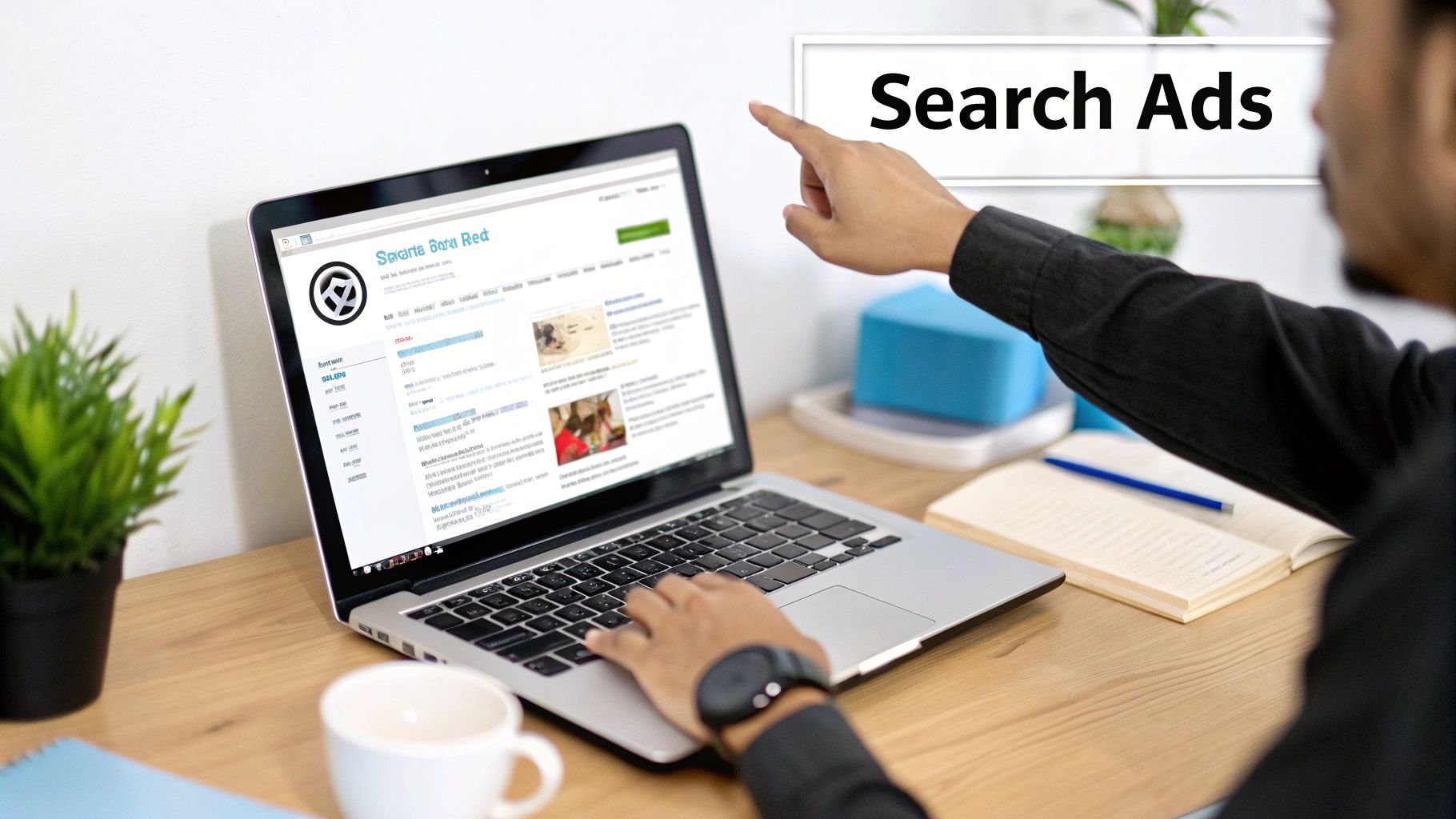
For a restaurant equipment supply website, this means you can bid on keywords like "commercial convection oven" or "restaurant-grade stand mixer" and have your product appear at the very top of the search results. A local restaurant could use geo-targeted ads to appear for searches like "best Italian food near me," driving immediate foot traffic. To dive into search engine marketing effectively, start with understanding what search advertising is and how it works.
Why Use SEM?
SEM is ideal for generating immediate, targeted traffic and leads. It allows you to compete with larger businesses by targeting niche keywords and provides precise control over your budget and audience. The data-rich environment of platforms like Google Ads offers deep insights into customer behavior, ad performance, and return on investment (ROI).
Actionable Tips for Implementation:
- Start with Long-Tail Keywords: Instead of bidding on a broad, expensive term like "restaurant equipment," target a more specific, less competitive phrase like "energy-efficient undercounter freezer." This lowers your cost-per-click and attracts more qualified buyers.
- Use Negative Keywords: Actively add negative keywords to your campaigns. For example, a supplier of new equipment should add terms like "used," "repair," and "free" to their negative keyword list to avoid paying for irrelevant clicks.
- Maintain a High Quality Score: Google rewards relevant ads with lower costs and better placement. Aim for a Quality Score of 7/10 or higher by ensuring your ad copy, keywords, and landing page are tightly aligned.
- Implement Conversion Tracking: From day one, set up conversion tracking to measure which ads and keywords are driving sales or lead form submissions. This data is critical for optimizing your campaigns for profitability.
2. Social Media Advertising
Social Media Advertising leverages the immense user bases and sophisticated targeting capabilities of platforms like Facebook, Instagram, LinkedIn, and TikTok to place paid ads directly into user feeds. Unlike search ads that capture existing demand, social ads excel at creating it, reaching potential customers based on their demographics, interests, and online behaviors. This method allows you to visually showcase your products and services to highly specific audiences who may not yet be actively searching for them.
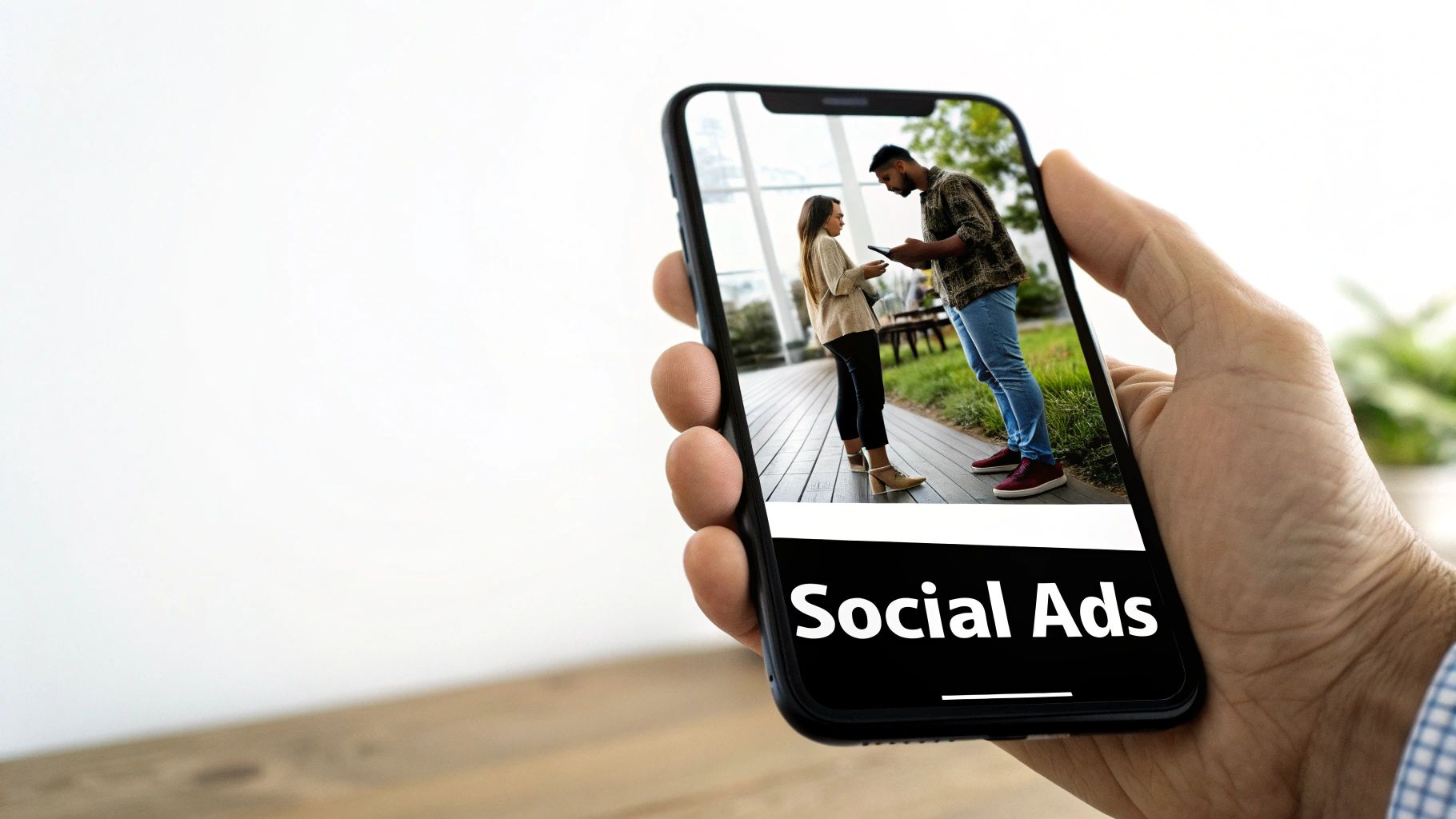
For a restaurant equipment supplier, this means running carousel ads on Instagram to display a new line of commercial mixers to users who follow celebrity chefs or culinary school accounts. A local restaurant could use geo-targeted Facebook ads to promote a weekend special to people within a 10-mile radius who have shown an interest in "fine dining." For more B2B-focused marketing, a marketing agency could use LinkedIn to target restaurant owners with ads for their SEO and article writing services.
Why Use Social Media Advertising?
This approach is powerful for building brand awareness, driving website traffic, and generating leads from a targeted but passive audience. Its visual nature makes it perfect for industries like foodservice, and its advanced targeting ensures your advertising budget is spent reaching relevant users. The platforms provide robust analytics to track everything from engagement rates to conversions, allowing for data-driven campaign optimization.
Actionable Tips for Implementation:
- Implement Lookalike Audiences: Upload a list of your best customers (e.g., high-value equipment purchasers or loyal restaurant patrons) and let the platform find new users with similar characteristics. This is one of the most effective ways to scale your customer acquisition efforts.
- Leverage Video Content: Short-form video ads on platforms like Instagram Reels or TikTok can generate significantly higher engagement than static images. Showcase a new piece of equipment in action or give a behind-the-scenes look at your restaurant's kitchen.
- Retarget Website Visitors: Install the Meta Pixel or TikTok Pixel on your website. This allows you to create custom audiences of users who visited specific pages (like a product page for a commercial oven) but didn't convert, and serve them reminder ads.
- Test Multiple Ad Creatives: Never rely on a single ad. Run A/B tests with different images, headlines, and call-to-action buttons simultaneously to identify which combinations resonate most with your audience and deliver the best return on ad spend.
3. Content Marketing & SEO
Content Marketing, powered by Search Engine Optimization (SEO), is a long-term strategy for advertising your website by attracting organic, high-intent traffic. Instead of paying for placement, you create and optimize valuable content like blog posts, guides, and videos that answer your audience's questions. This approach builds trust, establishes your brand as an industry authority, and generates a consistent stream of visitors over time without direct ad spend.
For a restaurant equipment supplier, this could mean creating a comprehensive guide titled "The Ultimate Checklist for Opening a New Restaurant Kitchen" or a detailed blog post comparing different types of commercial refrigeration. These resources attract chefs and restaurant owners actively searching for information, positioning your website as the go-to expert. By understanding how to write SEO-friendly blog posts, you can capture this valuable audience. Learn more about how to write SEO-friendly blog posts on restaurantequipmentseo.com.
Why Use Content Marketing & SEO?
This strategy is ideal for building sustainable, long-term growth and establishing brand credibility. Unlike paid ads that stop when you stop paying, a well-ranking article can drive traffic for years. It attracts users at every stage of the buyer's journey, from initial research to final purchase decisions, making it one of the most cost-effective ways to advertise your website.
Actionable Tips for Implementation:
- Target Long-Tail Keywords: Focus on highly specific, low-competition keywords first. Instead of "commercial ovens," target a phrase like "best countertop convection oven for small bakery" to attract more qualified, ready-to-buy traffic.
- Create Comprehensive Content: Aim for in-depth articles (often 2,000+ words) that thoroughly cover a topic. Our copywriting and article writing services are designed to produce detailed guides that become the definitive resource on a subject, making them more likely to rank high and earn valuable backlinks.
- Optimize On-Page Elements: Ensure your title tags, meta descriptions, and headers include your target keyword. Proper on-page optimization is a fundamental signal to search engines about your content's relevance.
- Build Quality Backlinks: Actively seek backlinks from reputable websites in the food service or hospitality industry through strategies like blogger outreach. Backlinks act as "votes of confidence" that significantly boost your search rankings.
- Refresh Existing Content: Regularly update and republish your older blog posts with new information, statistics, and images to maintain and improve their search engine rankings over time.
4. Email Marketing
Email marketing is a powerful method to advertise your website by communicating directly with a pre-qualified audience that has opted-in to receive your messages. It involves sending targeted campaigns, newsletters, promotions, and personalized content to a list of subscribers. Far from being outdated, email consistently delivers one of the highest returns on investment (ROI) of any marketing channel because it nurtures relationships with potential and existing customers.
For a restaurant equipment supplier, this could mean sending a monthly newsletter featuring new products, maintenance tips for commercial kitchens, or exclusive discounts on popular items. E-commerce giants like Amazon excel at this with personalized product recommendations, while a local catering business could use it to announce seasonal menu updates and special offers. As an effective way to advertise your website, email campaigns can directly drive sales, website visits, and customer loyalty.
Why Use Email Marketing?
Email marketing is ideal for nurturing leads and driving repeat business. It allows you to build a direct line of communication with your audience, independent of algorithm changes on search engines or social media. By segmenting your audience, you can deliver highly relevant, personalized content that resonates with specific customer needs, making it an incredibly efficient tool for conversion and retention.
Actionable Tips for Implementation:
- Build Your List Organically: Offer a clear value proposition in exchange for an email address. For a restaurant equipment site, this could be a free downloadable guide like a "Commercial Kitchen Startup Checklist" or a 10% discount on their first order. Never buy email lists.
- Segment Your Audience: Group your subscribers based on their behavior and interests. You might create segments for "New Subscribers," "Pizzeria Owners," "Catering Businesses," or customers who have purchased refrigeration units. This allows you to send targeted, relevant content.
- Create Automated Sequences: Set up automated "drip" campaigns for key customer moments. Implement an abandoned cart email series to recover lost sales, a welcome sequence for new subscribers, and a re-engagement campaign for inactive contacts.
- Test and Personalize Everything: Go beyond just using a subscriber's first name. Personalize content based on past purchases or browsing history. A/B test your subject lines, send times, and calls-to-action (CTAs) to continuously improve your open rates and click-through rates.
5. Influencer Marketing
Influencer marketing is a powerful strategy to advertise your website by collaborating with individuals who have established credibility and a dedicated following in your niche. This approach involves partnering with content creators, from top chefs to food bloggers, who promote your brand to their engaged audience. Instead of advertising directly to a large group of consumers, you inspire or pay influencers to get the word out for you, leveraging their trust and authenticity.
For a restaurant equipment supplier, this could mean partnering with a well-known pastry chef on Instagram to feature your new stand mixer in their recipe video. A local restaurant could collaborate with a popular food blogger in their city to review their new menu, driving both online visibility and foot traffic. This method taps into the creator's authentic voice, making the promotion feel more like a trusted recommendation than a traditional advertisement.
Why Use Influencer Marketing?
Influencer marketing is excellent for building brand awareness, credibility, and reaching highly targeted, engaged audiences. It bypasses the ad-fatigue common with traditional advertising and generates social proof that can be more persuasive than a direct brand message. It is one of the most effective ways to advertise your website because it builds genuine connections with potential customers who trust the influencer’s judgment.
Actionable Tips for Implementation:
- Start with Micro-Influencers: Don't just chase influencers with millions of followers. Partner with micro-influencers (10k-100k followers), like a local food critic or a specialized kitchen equipment reviewer. They often have higher engagement rates and a more dedicated, niche audience at a lower cost.
- Verify Audience Authenticity: Before committing, use tools to analyze an influencer's follower demographics, engagement rates, and authenticity. Look for a high percentage of real followers and consistent, genuine interaction on their posts, not just high follower counts.
- Provide Creative Freedom within Guidelines: The best collaborations feel natural. Provide your brand's key messaging and goals, but give the influencer creative freedom to produce content in their own unique style. This ensures the promotion resonates authentically with their audience.
- Use Unique Tracking Codes: Assign each influencer a unique discount code or trackable link. This allows you to accurately measure the traffic, leads, and sales generated from each partnership, proving its direct impact on your business goals.
6. Video Marketing (YouTube & Video Ads)
Video marketing is a powerful way to advertise your website by creating and promoting engaging visual content on platforms like YouTube, TikTok, and Instagram. This strategy encompasses everything from viral brand stories and organic channel content to targeted pre-roll and in-stream video ads, capturing audience attention in a highly shareable format. Video allows you to demonstrate products, share expertise, and build a strong brand personality.
A restaurant equipment supplier, for instance, could create a YouTube series like Blendtec’s "Will It Blend?" to showcase the durability of their blenders or post short-form videos on TikTok demonstrating cleaning hacks for commercial ovens. These engaging formats not only attract views but also build a loyal community around the brand. For small businesses, an ultimate guide to video marketing can be an invaluable resource for cutting through the noise and engaging with potential customers.
Why Use Video Marketing?
Video marketing is exceptionally effective for building brand awareness and driving engagement. It excels at explaining complex products and telling compelling stories that resonate emotionally with viewers, leading to higher conversion rates. With its massive audience and powerful search capabilities, YouTube also functions as the world's second-largest search engine, making it a crucial platform for discoverability.
Actionable Tips for Implementation:
- Hook Viewers Immediately: The first 3-5 seconds are critical. Start with a compelling question, a visually striking shot, or a bold statement to capture attention before viewers skip.
- Optimize for Search (Video SEO): Treat your YouTube videos like a blog post. Use relevant keywords in your title, description, and tags to help them rank in both YouTube and Google search results.
- Use Clear Calls-to-Action (CTAs): Direct viewers on what to do next. Use YouTube’s built-in cards and end screens to link directly to your website, a specific product page, or a lead-magnet landing page.
- Create a Content Series: Develop a recurring series, such as weekly cooking tips using your equipment or a monthly maintenance guide. This encourages subscriptions and builds a loyal audience that repeatedly returns for more content.
- Repurpose and Distribute: Maximize your efforts by editing your long-form YouTube video into shorter clips for Instagram Reels, TikTok, and Facebook Stories to reach a wider audience across multiple platforms.
7. Affiliate Marketing
Affiliate marketing is a performance-based advertising model where you partner with external publishers, known as affiliates, to promote your website. These partners earn a commission for every sale, lead, or click they generate through their unique affiliate link. It's essentially a referral program at scale, allowing you to leverage the audiences of established bloggers, content creators, and industry influencers.
For a restaurant equipment supply company, this could involve partnering with a popular food blogger who reviews commercial kitchen gear. When the blogger links to your "heavy-duty planetary mixer" in a review, and a reader clicks that link and makes a purchase, the blogger earns a pre-agreed commission. This approach is one of the most cost-effective ways to advertise your website because you only pay for tangible results, not just for exposure.
Why Use Affiliate Marketing?
Affiliate marketing is ideal for scaling your sales efforts with minimal upfront cost and risk. It expands your brand reach into new, relevant audiences that you might not otherwise access. Because it is performance-based, your return on investment is directly measurable, ensuring your advertising budget is spent efficiently on actions that drive revenue.
Actionable Tips for Implementation:
- Set Competitive but Sustainable Commissions: Research what competitors offer to attract top affiliates. A commission of 5-10% on high-ticket items like commercial ovens can be very appealing, but ensure the rate is sustainable for your profit margins.
- Provide High-Quality Marketing Materials: Equip your affiliates for success by providing them with a suite of professional marketing assets. This includes high-resolution product images, pre-written ad copy, promotional banners, and detailed product fact sheets.
- Build Relationships with Top Performers: Don't treat your affiliates as just another number. Identify your top-performing partners and build personal relationships. Offer them exclusive commissions, early access to new products, or performance bonuses to keep them motivated.
- Monitor Affiliate Channels and Use Fraud Detection: Regularly review where your affiliate traffic is coming from to ensure brand alignment. Implement fraud detection tools to prevent paying commissions on invalid clicks or fraudulent transactions, protecting your marketing investment.
8. Paid Display Advertising (Banner Ads & Programmatic)
Paid display advertising is a powerful way to advertise your website visually across a vast network of publisher sites, from news outlets to niche blogs. Unlike search ads that capture active demand, display ads excel at creating it. They use banner images, videos, and rich media to build brand awareness and retarget users who have previously interacted with your site.
For a restaurant equipment supply website, this means your ad for a new line of commercial refrigerators could appear on a popular food industry blog or a culinary news site. A local catering business could use programmatic display to show video ads to users within a specific zip code who have shown interest in event planning, keeping their brand top-of-mind. This method allows you to reach potential customers while they are browsing content relevant to their interests.
Why Use Paid Display Advertising?
Display advertising is unparalleled for building brand recognition and executing sophisticated retargeting campaigns. It allows you to stay in front of warm audiences, re-engaging users who have visited your site but didn't convert. With programmatic buying, you can automate ad placements with immense precision, targeting users based on demographics, online behavior, and interests at a massive scale.
Actionable Tips for Implementation:
- Focus on Retargeting First: Begin by creating retargeting campaigns for users who visited specific product pages or abandoned their shopping carts. These warm audiences are far more likely to convert than cold traffic, providing a higher initial ROI.
- Use Compelling Visuals and a Clear CTA: Your banner ad must grab attention instantly. Use high-quality images or short videos of your equipment in action, and include a strong, unambiguous call-to-action (CTA) like "Shop Ovens Now" or "Get a Free Quote."
- Implement Frequency Capping: To avoid annoying potential customers (ad fatigue), set a frequency cap on your campaigns. This limits the number of times a single user will see your ad within a specific period, ensuring a positive brand association.
- Monitor Viewability Metrics: It's not enough for your ad to be served; it needs to be seen. Pay close attention to viewability metrics to ensure your ads are appearing in prominent positions where users will actually notice them, rather than below the fold.
9. Local SEO & Google My Business Optimization
Local Search Engine Optimization (SEO) is a specialized strategy focused on advertising your website to customers in a specific geographic area. It involves optimizing your online presence to appear in local search results, such as Google’s "local pack" (the map with three business listings) and localized organic rankings. This method is crucial for businesses with a physical location or a defined service area, as it targets users searching with local intent.
Unlike broader SEO, local SEO leverages signals like proximity, relevance, and prominence to connect you with nearby customers actively seeking your products or services. For a restaurant equipment supply company, this means appearing when a local chef searches for "commercial kitchen supplies near me." Similarly, a local plumber can dominate search results for "emergency plumbing in [City]" by having a perfectly optimized Google My Business (GMB) profile and consistent local listings.
Why Use Local SEO?
Local SEO is the most effective way to attract high-intent local customers at the exact moment they need you. It drives both online traffic and physical foot traffic, building trust and authority within your community. Since these searches often have immediate commercial intent (e.g., "restaurant open now"), the conversion rates are typically much higher than for non-local searches. It's a foundational advertising method for any business serving a local clientele.
Actionable Tips for Implementation:
- Fully Optimize Your GMB Profile: Complete every single section of your Google My Business profile. This includes services, products, business hours, photos, attributes, and a detailed description packed with relevant keywords.
- Ensure NAP Consistency: Your Name, Address, and Phone number (NAP) must be identical across your website, GMB profile, and all other online directories. Inconsistencies can confuse search engines and harm your rankings.
- Generate and Respond to Reviews: Actively encourage satisfied customers to leave reviews on your GMB profile. Respond professionally to all reviews, both positive and negative, to show Google and potential customers that you are engaged.
- Build Local Citations: A citation is any online mention of your business's NAP. Systematically build these on relevant local and industry-specific directories. Our local citation services can help ensure your business information is accurate and widespread, boosting your local visibility.
- Create Location-Specific Pages: If you serve multiple areas, create unique service pages on your website for each location (e.g., "Commercial Oven Repair in Brooklyn"). This helps you rank for geo-specific searches in each target market.
10. Public Relations & Guest Posting
Public Relations (PR) and guest posting are powerful ways to advertise your website by leveraging the authority and audience of established media outlets and industry blogs. Unlike direct advertising, this method builds credibility and brand visibility through earned media coverage, creating a halo effect that paid ads cannot replicate. It involves securing mentions, interviews, or bylined articles on reputable platforms, driving referral traffic and significantly boosting your website's authority.
This strategy positions you as a thought leader. For instance, a restaurant equipment supply website could secure a feature in a major food service magazine about new energy-efficient kitchen technology, or a CEO could contribute a guest post to an industry blog about supply chain trends. These placements introduce your brand to a highly relevant audience and generate valuable, high-authority backlinks.
Why Use PR & Guest Posting?
This approach is perfect for building long-term brand equity, credibility, and organic search rankings. While it may not produce the immediate traffic spike of a PPC campaign, it creates a sustainable foundation of trust and authority. Earned media placements serve as powerful social proof, and the backlinks acquired are a cornerstone of any successful SEO strategy, signaling to search engines that your site is a credible resource.
Actionable Tips for Implementation:
- Create Newsworthy Stories: Don't just pitch your products. Announce new data-driven industry reports, highlight a unique company milestone, or offer expert commentary on a trending topic relevant to the restaurant industry.
- Target Relevant Publications: Focus your outreach on blogs and publications your target audience actually reads. A restaurant equipment supplier will gain more value from a feature in Restaurant Business Magazine than a generic business publication.
- Build Genuine Media Relationships: Instead of sending cold, generic pitches, follow journalists and editors on social media, engage with their work, and offer value before asking for anything in return. A personalized approach yields far better results.
- Prioritize High-Authority Guest Posts: Focus on contributing well-researched, non-promotional content to high-authority websites. Our blogger outreach services specialize in this, helping you master the fundamentals of effective guest posting outreach and strategy.
Top 10 Website Advertising Strategies Comparison
| Channel | Implementation Complexity 🔄 | Resources & Speed ⚡ | Expected Outcomes 📊 | Ideal Use Cases | Key Advantages ⭐ / Tip 💡 |
|---|---|---|---|---|---|
| Search Engine Marketing (SEM) / Google Ads | High 🔄: ongoing bidding & optimization required | Moderate–High ⚡: immediate traffic but ongoing budget needed | Immediate, high-intent clicks and conversions; measurable ROI 📊 | Time-sensitive promotions, e‑commerce, high‑intent keywords | ⭐ Highly targeted & measurable. 💡 Start with long‑tail keywords; track conversions. |
| Social Media Advertising | Medium 🔄: multi‑platform creative and targeting setup | Moderate ⚡: quick to launch; creative production can be heavier | Strong awareness and engagement; variable conversion rates 📊 | Brand awareness, visual products, younger audiences | ⭐ Broad reach & sophisticated segmentation. 💡 Use video and lookalike audiences. |
| Content Marketing & SEO | Medium–High 🔄: strategy, technical SEO, content creation | Low immediate speed ⚡: slow results (months), lower ongoing ad spend | Sustainable organic traffic, authority, lower CPA over time 📊 | Long‑term growth, thought leadership, evergreen topics | ⭐ Compounding, long‑term ROI. 💡 Target long‑tail keywords; refresh content. |
| Email Marketing | Low–Medium 🔄: list building, segmentation and automation | High efficiency ⚡: fast deployments; low cost per send | High ROI and strong conversions for repeat customers 📊 | Lead nurturing, retention, abandoned carts, promotions | ⭐ Direct access to engaged users. 💡 Segment and automate personalized flows. |
| Influencer Marketing | Medium–High 🔄: sourcing, vetting and campaign coordination | Variable ⚡: can be quick with micro‑influencers; costly at scale | Boosted awareness and authentic endorsements; conversion varies 📊 | Brand awareness, niche communities, younger demos | ⭐ Authentic reach & engagement. 💡 Start with micro‑influencers; verify audiences. |
| Video Marketing (YouTube & Video Ads) | High 🔄: production, optimization, channel growth | Resource‑intensive ⚡: longer production timelines, higher costs | Very high engagement and shareability; strengthens brand & SEO 📊 | Product demos, storytelling, explaining complex concepts | ⭐ High engagement and retention. 💡 Hook viewers in the first 3 seconds. |
| Affiliate Marketing | Medium 🔄: program setup, partner recruitment and management | Low upfront cost ⚡: pay‑per‑performance; scalable with affiliates | Performance‑driven sales and scalable referral traffic 📊 | E‑commerce, subscription services, performance campaigns | ⭐ Low risk — pay for results. 💡 Provide creatives and monitor for fraud. |
| Paid Display Advertising (Banner & Programmatic) | Medium 🔄: creative production and targeting via platforms | Moderate ⚡: quick to run, lower CTR than search | Broad awareness and effective retargeting; lower direct CVR 📊 | Retargeting, brand campaigns, large‑scale awareness | ⭐ Visual reach at scale. 💡 Use frequency caps and dynamic creative optimization. |
| Local SEO & Google My Business Optimization | Low–Medium 🔄: listing, citations, review management | Cost‑effective & local ⚡: faster local lift than broad SEO | High‑intent local traffic and strong conversion rates 📊 | Local businesses, multi‑location services, “near me” searches | ⭐ Efficient local conversions & map visibility. 💡 Keep NAP consistent and gather reviews. |
| Public Relations & Guest Posting | High 🔄: relationship building and pitching | Slow ⚡: timelines uncertain; depends on media response | Third‑party validation, high‑authority backlinks; indirect traffic 📊 | Thought leadership, brand credibility, backlink building | ⭐ Strong credibility and authoritative links. 💡 Build genuine media relationships and craft newsworthy angles. |
Putting It All Together: Crafting Your Custom Advertising Blueprint
We’ve navigated a comprehensive landscape of digital advertising, exploring ten powerful avenues from the immediate impact of Google Ads to the long-term authority built through Content Marketing and SEO. The journey through social media, email campaigns, influencer collaborations, and even offline strategies reveals a crucial truth: there is no single "best" way to advertise your website. The most potent approach is not about choosing one path, but about building a custom, integrated marketing engine that works for your unique business.
The sheer number of options can feel overwhelming, but this diversity is your greatest asset. It allows you to create a resilient, multi-channel strategy that doesn't rely on a single source of traffic. Think of it less as a checklist to complete and more as a menu of ingredients to create your own signature recipe for success.
From Theory to Action: Building Your Strategic Mix
The core takeaway is that a synergistic blend of tactics will always outperform a siloed approach. For a specialized B2B business, like a restaurant equipment supplier, this principle is paramount. Your ideal customer isn't just browsing; they are actively researching solutions for their commercial kitchen needs.
Your blueprint might start by combining these three pillars:
- Foundational Visibility (Local SEO): Begin with optimizing your Google Business Profile and building local citations. This ensures that when a local restaurant manager searches for "commercial oven repair near me" or "restaurant supply store," you appear prominently. This is your digital storefront, the first and most critical touchpoint for local buyers.
- Authoritative Content (SEO & Blogging): Develop high-quality blog content that answers your customers' most pressing questions. A detailed article comparing different types of commercial charbroilers or a guide to maintaining walk-in freezers doesn't just attract organic traffic; it establishes your company as a trusted expert. This is how you build credibility long before a purchase is ever considered.
- Targeted Outreach (Paid Ads & Guest Posting): Layer in highly specific Google Ads campaigns targeting keywords like "buy commercial deep fryer." Simultaneously, pursue guest posting opportunities on respected hospitality and food service blogs. This two-pronged approach captures immediate purchase intent while building valuable backlinks and brand authority for the long run.
The Power of Measurement and Adaptation
Executing this strategy is only half the battle. The true key to mastering the many ways to advertise your website lies in a commitment to measurement and iteration. Every campaign, from a Facebook ad to a monthly email newsletter, generates valuable data.
Key Insight: Your marketing data is not just a report card; it's a roadmap. It tells you what's working, what's not, and where your next opportunity lies. Don't just collect data; act on it.
Establish clear Key Performance Indicators (KPIs) for each channel. For your SEO efforts, this might be keyword rankings and organic traffic growth. For paid ads, it could be click-through rate (CTR) and cost-per-acquisition (CPA). For email marketing, track open rates and conversion rates. Regularly review these metrics and be prepared to reallocate your budget and effort toward the channels delivering the highest return on investment.
Advertising is a dynamic, ever-evolving discipline. The strategy that works today may need adjustments next quarter. By embracing a test-and-learn mindset, you transform your marketing from a set of static tasks into a living, breathing system that drives sustainable growth. You build a powerful engine that consistently delivers qualified leads and customers to your digital doorstep, securing your competitive edge in a crowded marketplace.
Just as a well-executed marketing strategy is essential for driving traffic, having an expertly designed and SEO-optimized website is crucial for converting that traffic into sales. At Charbroilers.com, we not only understand the commercial kitchen equipment industry, but we also built our digital presence using the very principles discussed in this article. See how a specialized niche site can effectively capture its target audience by visiting us at Charbroilers.com.