
Unlocking SEO Power with Tiered Link Building
Tiered link building is an advanced SEO strategy that involves building backlinks to your backlinks. This creates a pyramid-like structure that channels authority and link equity up to your main website.
Think of it as a system designed to amplify the power of your very best links, all while insulating your site from the sketchier, lower-quality ones. It’s a technique often pulled out of the toolbox for hyper-competitive niches, like restaurant equipment supply.
What Is Tiered Link Building and How It Works
Imagine your restaurant equipment website is the star of the show. A direct link from a major food industry blog is like getting a rave review from a top critic. That's a huge win.
Tiered link building is like getting a bunch of smaller, local food bloggers and forum members to start buzzing about that rave review. Instead of talking about you directly, they're all pointing to your best press, which makes that original review look even more influential. Ultimately, that amplified credibility flows right back to you.
This whole strategy is about creating a multi-level structure that funnels "link juice" up toward your most important asset: your money site. It’s a clever way to squeeze every last drop of value out of the high-quality backlinks you worked so hard to get.
The Foundational Pyramid Structure
The entire system is built on a simple hierarchy. At the top, you have your money site. Tier 1 links point directly to your site. Tier 2 links point to your Tier 1 links. And Tier 3 (and beyond) links point to your Tier 2 links. It's that straightforward.
This visual pyramid helps make sense of how authority flows from a broad base of lower-tier links right up to your website at the very top.
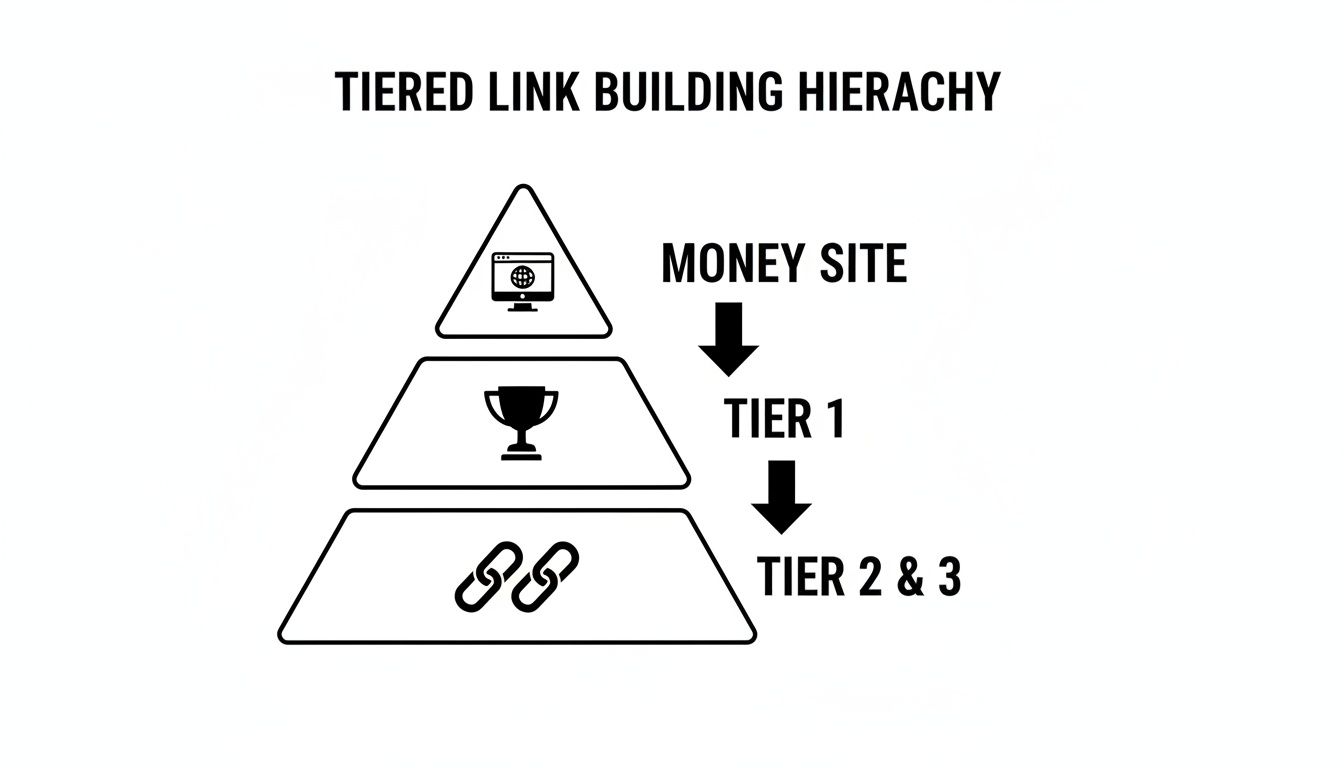
As the diagram shows, your money site is supported by a strong foundation of Tier 1 links, which are then beefed up by an even wider base of links from Tiers 2 and 3.
Breaking Down the Tiers
Each level in this pyramid has a very different job, quality standard, and purpose. Getting these differences right is what makes or breaks the strategy.
Let's quickly break down what each tier does.
The Three Tiers of Link Building Explained
| Tier Level | Primary Purpose | Common Link Sources | Target |
|---|---|---|---|
| Tier 1 | Build direct authority to your site | High-quality guest posts, industry features, editorial links | Your "Money Site" |
| Tier 2 | Boost the power of your Tier 1 links | Niche-relevant blogs, Web 2.0 properties, press releases | Your Tier 1 pages |
| Tier 3 | Amplify Tier 2 with volume | Social bookmarks, blog comments, directory submissions | Your Tier 2 pages |
This table gives you a bird's-eye view, but let's dig into the details of each layer.
-
Tier 1: The VIP Section. These are your highest-quality backlinks, the only ones that point directly to your website. They must come from authoritative and relevant sources—think a guest post on a major culinary blog or a feature in a foodservice trade publication. Quality is absolutely non-negotiable here.
-
Tier 2: The Support Crew. These links point to your Tier 1 pages, never your main site. Their sole job is to strengthen your best backlinks. For example, if we secured a guest post for you about choosing the right countertop charbroiler (your Tier 1 link), a Tier 2 link would be a post from another blog pointing to that guest post.
-
Tier 3: The Broad Foundation. This is the largest and lowest-quality layer, built to support your Tier 2 links. These can come from all sorts of places like social media shares, forum comments, or Web 2.0 properties. Here, it’s about sheer volume creating signals that boost the layers above it.
The core idea is simple: You protect your most valuable asset—your website—by building a buffer. Risky or lower-quality links are kept at a safe distance, while their collective power gets channeled upward.
For a business like Charbroilers.com, a link from a major food magazine would be Tier 1. A handful of links from smaller recipe blogs pointing to that magazine article would be Tier 2. This structure creates a backlink profile that's both powerful and insulated.
You can learn more about identifying these valuable links in our complete guide on how to find backlinks on Google.
Weighing The Rewards And The Risks

Tiered link building is one of those SEO strategies that feels both tempting and dangerous. It promises a way to really amplify your efforts, but it also walks a very fine line between a clever tactic and something that could get your website in serious trouble. Before you even think about building your first tier, you have to get your head around this balance.
For a restaurant equipment supplier, the potential upside is obvious. Imagine finally breaking through and ranking for a huge money term like "best commercial charbroiler." A well-planned tiered link building campaign could be the final nudge you need to get to the top of page one, making a real difference to your sales.
But this isn't a strategy to take lightly. If you get it wrong, you’re gambling with your website’s health.
The Allure Of Amplified Authority
The biggest draw of this method is its power to multiply your wins. Let's say we work hard and land a fantastic link for your site on a top-tier culinary blog. Tiered link building lets you squeeze every last ounce of SEO juice from that single link by building more links to it.
This also gives you a level of control that you just don't get with direct link building. You can be much more aggressive with your anchor text on Tier 2 and Tier 3 links, hammering home specific keywords without making your main site’s backlink profile look spammy or unnatural.
Perhaps the biggest advantage is that you're creating a protective buffer. The lower-quality, riskier links are never pointing directly at your money site. This insulates your most valuable asset from potential penalties.
That protective layer can be a huge competitive edge, letting you build link volume at a scale that would be far too risky if you pointed it all at your main domain.
The Unmistakable Dangers Involved
On the other side of the coin, the risks are just as big. Let's be clear: the whole idea of building links just to manipulate search rankings goes directly against search engine guidelines. When you're even considering this, you have to read up on Google's link schemes policies.
If Google figures out what you're doing and decides your link tiers are manipulative, the consequences are brutal. A manual penalty can vaporize your rankings overnight, making your site totally invisible in search results. Trying to recover from that is a long, painful, and often unsuccessful process.
On top of that, tiered link building is a ton of work. It’s not a "set it and forget it" tactic. You have to manage multiple layers of links, make sure everything looks natural, and constantly monitor it all. This takes time, skill, and usually, a handful of specialized tools. If you don't manage it carefully, you'll leave behind obvious, spammy footprints that Google's algorithms are built to find.
A Clear Comparison Of Pros And Cons
To really make an informed call, it helps to put the good and the bad right next to each other. This comparison really drives home the high-stakes nature of the game.
Risk vs Reward in Tiered Link Building
Here’s a direct look at the potential upsides versus the very real downsides of launching a tiered link building campaign.
| Potential Benefits (Pros) | Significant Risks (Cons) |
|---|---|
| Link Power Amplification: Squeezes more value from your best Tier 1 backlinks. | Violation of Google Guidelines: Directly conflicts with rules against manipulative link schemes. |
| Protective Buffer: Insulates your main site from lower-quality or risky links. | Risk of Severe Penalties: Can lead to manual actions or total loss of search visibility. |
| Enhanced Anchor Text Control: Allows for more aggressive keyword targeting on lower tiers. | Resource Intensive: Requires significant time, expertise, and tools to manage effectively. |
| Creates a Diverse Profile: Can help your overall backlink profile appear more natural if done well. | Spam Footprints: Poor execution can create obvious, unnatural patterns that are easily detected. |
At the end of the day, deciding to use tiered link building comes down to a simple calculation of risk versus reward. The dream of shooting up the rankings is powerful, but the nightmare of a penalty is a huge deterrent. For most businesses, especially in the competitive restaurant equipment space, sticking to safer, more sustainable strategies is almost always the better long-term play.
Building Your High-Impact Tier 1 Foundation
In any tiered link building setup, your Tier 1 is the absolute bedrock. This is the only layer that directly links to your website, which means every single one of those links has to be exceptional—high-quality, relevant, and authoritative.
Think of them like the main support columns for your entire building. If those columns are weak or cracked, the whole structure is at risk of coming down. For a restaurant equipment supplier, this means getting backlinks from sites that chefs, restaurant owners, and food service managers already know and trust. These aren't just any old links; they're powerful endorsements from respected voices in your field.
What Makes a Powerful Tier 1 Link
Not all backlinks are created equal, especially when they form your first tier. The quality of this layer really sets the tone for the entire campaign and is the biggest factor in whether it succeeds or fails. A strong Tier 1 link is never bought from a list; it's earned through providing real value and smart outreach.
Here’s what you should be looking for in a high-impact Tier 1 link:
- High Domain Authority: The site linking to you should be a recognized authority in the culinary, hospitality, or business world.
- Strong Topical Relevance: The source has to be directly related to restaurant equipment, cooking, or the foodservice industry. A link from a major culinary blog is gold. A link from a car blog is worthless.
- Genuine Organic Traffic: The website should have a real, engaged audience. A site with actual readers is far more valuable than one built just to link out.
- Clean Backlink Profile: The linking domain itself can't have a history of spammy or manipulative link building.
A single, powerful link from an authoritative food industry publication is worth more than a hundred low-quality links. Your Tier 1 strategy must prioritize this level of quality above all else to remain safe and effective.
Proven Strategies for Acquiring Elite Tier 1 Links
Building a pristine Tier 1 requires a proactive, value-driven approach. You can't just ask for these links. You need to create assets and build relationships that naturally attract them. This is where our expertise in content creation and blogger outreach for the restaurant equipment industry comes in.
Digital PR in the Foodservice Niche
Digital PR is about creating newsworthy stories, data, and content that journalists and industry bloggers actually want to cover. Instead of just pitching your products, you’re giving them valuable information that helps their audience.
This is a massively underutilized tactic. In the world of SEO, digital PR is rated as the most effective Tier 1 tactic by 48.6% of professionals, yet only 17.7% use it regularly. This gap presents a huge opportunity for a forward-thinking restaurant equipment site to stand out. You can find more data on this trend by reviewing the latest link building statistics.
Example: We could help you commission a data-driven report on "The Rise of Open-Flame Grilling in Fast-Casual Restaurants" and pitch the exclusive findings to major foodservice publications.
Authoritative Guest Posting
When done right, guest blogging is still a cornerstone of effective link building. The key is to avoid low-quality guest post farms and instead target highly respected culinary or business blogs with strict editorial standards. The goal is to contribute genuine expertise that benefits their readers. For those looking to master this approach, our team has put together a detailed guide on guest blogging for high-quality backlinks.
Example: We would write and place a detailed guide for a popular chef’s blog on "How to Choose Between a Radiant and Lava Rock Charbroiler for Your Steakhouse."
Creating Link-Worthy Assets
Linkable assets are high-value pieces of content on your own site that others naturally want to reference and link to. This is about becoming a primary source of information in your niche. Our article writing and copywriting services specialize in creating these assets that attract passive, high-quality links over time.
Think about the common questions your customers ask, and then create the ultimate resource to answer them.
- Comprehensive Guides: An in-depth article on "The Complete Guide to Commercial Kitchen Ventilation for Charbroilers."
- Unique Tools: A free calculator that helps restaurant owners estimate the ROI of upgrading to a new, more efficient charbroiler.
- Original Data Visualizations: An infographic comparing the long-term energy costs and efficiency of different charbroiler models.
Constructing Tier 2 and Tier 3 Support Layers

Once you’ve landed those high-impact Tier 1 links, the real work of amplification can begin. The next layers, Tier 2 and Tier 3, are all about building a support system. Their entire purpose is to channel authority upward to your best Tier 1 assets, making them even more powerful without ever directly touching your main website.
This is where the strategy pivots from pure quality to a calculated blend of quality and quantity. The idea is to create a groundswell of support that looks natural to search engines, boosting the value of your best links while keeping your site safely at arm's length from any risk.
Fortifying Your Assets With Tier 2 Links
Think of Tier 2 links as the immediate support crew for your Tier 1 content. If your Tier 1 is a guest post on a major culinary blog, your Tier 2 links are backlinks you build to that specific guest post. The quality standard here is still important, but it’s a noticeable step down from the elite requirements of Tier 1.
The key is to use good-quality, contextually relevant sources that add credibility. It's like creating a buzz around your best content. For a restaurant equipment supplier, this means pointing links from other relevant corners of the internet toward your most authoritative articles.
Common sources for building effective Tier 2 links include:
- Niche-Relevant Blogs: These are smaller, specialized blogs in the foodservice or hospitality industry. It's much easier to get links from them compared to the top-tier publications you used for Tier 1.
- Well-Moderated Forums: Platforms like Reddit or industry-specific forums can be goldmines, as long as the links are dropped in genuinely helpful and relevant conversations.
- Web 2.0 Properties: Using platforms like Medium or Blogger to create content that links back to your Tier 1 assets can add a solid layer of authority.
- Press Releases: A well-written press release can generate links from various news outlets that point back to your feature article or guest post, amplifying its reach.
The principle for Tier 2 is diversification. You want to create a varied profile of links pointing to your Tier 1 content. This makes the authority boost look organic rather than like a manufactured scheme.
Building Volume With Tier 3 Links
Tier 3 is the broad, foundational base of your link pyramid. Here, the focus shifts almost entirely to volume. These links are built to support your Tier 2 pages, adding a final, widespread layer of signals that push value up the chain.
Because these links are so far removed from your main website, the quality standards for Tier 3 are the most relaxed. The goal is simply mass indexing and activity. This is where many automated or high-volume tactics come into play, casting a wide net to give your Tier 2 assets a small but cumulative boost.
Effective sources for Tier 3 links often consist of:
- Social Bookmarking: Submitting your Tier 2 URLs to sites like Reddit or Digg can generate signals and help with indexing.
- Blog Comments: While often "nofollow," relevant and non-spammy blog comments can contribute to a natural-looking link profile for your Tier 2 properties.
- Directory Submissions: Submitting your Tier 2 assets to general or niche directories.
- Profile Links: Creating profiles on various websites that allow a link back to your Tier 2 pages.
The sheer number of links in this tier—often thousands—helps get your Tier 2 links noticed and indexed faster by search engines.
The Anchor Text Diversification Strategy
A critical piece that holds this entire support structure together is your anchor text strategy. Getting this wrong is the fastest way to raise red flags with Google. The guiding rule is simple: decrease keyword aggression as you get closer to your money site.
- Tier 3 Anchors: This is where you can be the most aggressive. Use a high percentage of partial-match and exact-match keywords that relate to your main target terms.
- Tier 2 Anchors: Ease up a bit. Use a mix of partial-match keywords, branded terms, generic phrases ("click here"), and naked URLs.
- Tier 1 Anchors: Be extremely conservative. As we covered earlier, these should be almost entirely branded, naked URL, or generic anchors.
This graduated approach ensures your main site's backlink profile remains clean and natural. Of course, you need to monitor this intricate web. You can learn more about that process in our guide on how to check backlinks in Google. This diligence ensures your tiered link building efforts support, rather than sabotage, your SEO goals.
Safer SEO Alternatives That Build Lasting Value

Given how risky and resource-intensive tiered link building is, it's smart to look at more sustainable ways to grow your SEO. The promise of a quick win is always tempting, but real, long-term growth for a business like a commercial charbroiler supplier comes from a foundation of trust and authority, not from complicated link schemes.
Fortunately, our SEO services for restaurant equipment websites focus on powerful, Google-approved strategies that deliver real value without putting your website at risk. These methods are all about earning high-authority links naturally by turning your brand into a genuinely helpful resource for chefs, restaurant owners, and foodservice managers.
Build Authority With High-Value Content Marketing
Instead of trying to manipulate link signals, the most durable SEO strategy is simply to become the source others want to link to. Our copywriting and article writing services get you there by providing real value to your target audience—the pros who depend on your kind of equipment every single day. The goal is to answer their biggest questions so well that your site becomes their go-to reference.
This approach goes way beyond simple product descriptions. It’s about creating deep, practical resources that solve actual problems for kitchen staff and restaurant operators.
- Expert Guides: Think about publishing comprehensive articles like "How to Properly Season and Maintain Your Commercial Charbroiler for Peak Performance." This is exactly the kind of content that attracts links from culinary schools and professional chef forums.
- Detailed Comparisons: Create a side-by-side analysis of "Radiant vs. Lava Rock Charbroilers: Which Is Right for Your Steakhouse?" This helps buyers make smart decisions and gets passed around in industry discussion groups.
- Safety and Maintenance Checklists: Offer up downloadable PDFs that cover critical cleaning protocols for commercial grills. A kitchen manager will bookmark and share a resource like that in a heartbeat.
By consistently putting out content that helps your audience do their jobs better, you naturally attract the kind of high-quality backlinks that form a solid Tier 1—no artificial boosting required.
Dominate Local Search With Consistent Citations
For any restaurant equipment supplier, local customers are the lifeblood of the business. Local SEO is a powerful and safe alternative to sketchy link schemes, and its foundation is the local citation. A citation is just any online mention of your business's name, address, and phone number (NAP).
Consistent NAP information across high-authority directories like Yelp, Yellow Pages, and industry-specific listings sends strong trust signals to Google. It confirms your business is legitimate and physically located where you claim, boosting your visibility in local map packs and search results.
Building a solid citation profile is a straightforward process that directly strengthens your local footprint. Our local citation services ensure that when a nearby restaurant owner searches for "commercial charbroiler suppliers near me," your business shows up right at the top. This strategy builds stable, localized authority that drives foot traffic and sales.
Earn Links Through Genuine Blogger Outreach
Connecting with established voices in the foodservice industry is another potent, white-hat strategy. Our blogger outreach service has nothing to do with buying links; it's about building real relationships with culinary bloggers, industry journalists, and restaurant consultants. The goal is to get your brand, products, and expertise featured in their content organically. For those looking to build authority the right way, understanding effective digital PR strategies is a must.
This could look like:
- Offering Expert Commentary: Pitching your experts for a journalist’s article on commercial kitchen trends.
- Providing Products for Review: Sending a new countertop charbroiler model to a trusted food blogger to test drive for their audience.
- Collaborating on Content: Partnering with an influential chef to create a video series on advanced grilling techniques using your equipment.
Each of these actions creates a path to authentic, high-authority backlinks that vouch for your brand's credibility. These earned links are infinitely more valuable—and safer—than any link built through a tiered structure, creating a strong online presence that will actually last.
Common Questions About Tiered Link Building
Let's be honest, tiered link building is one of those advanced SEO topics that brings up a lot of questions. It has a lot of moving parts, and it’s smart to get clear answers before you even think about adding it to your SEO plan.
So, let's cut through the noise and tackle some of the most common questions restaurant equipment businesses have about this strategy. Getting these details straight will help you decide if this high-risk, high-reward tactic is right for you, or if you're better off using our safer, more sustainable SEO services.
Is Tiered Link Building Still Effective for SEO?
Yes, it can be, but not like it used to be. The game has completely changed. Today, it’s all about quality over quantity.
Years ago, tiered link building was a pure numbers game. SEOs would build massive link pyramids with cheap, automated links, and it worked for a while. Try that today, and you're practically asking for a Google penalty.
The effectiveness of this strategy now depends entirely on the strength of your Tier 1 links. If your Tier 1 is made up of genuine, high-authority backlinks—the kind we secure for clients via digital PR or guest posting on top-tier industry sites—then a well-built support structure can squeeze every last drop of value out of them. It amplifies the power of your best assets.
But if your lower tiers are just a pile of spammy, low-quality junk, the whole thing becomes a dangerous gamble. For most restaurant equipment businesses, focusing on earning great backlinks directly to your site is a much safer path to building long-term authority.
How Do You Choose Links for Each Tier?
The golden rule is this: the quality standard drops as you move further away from your main website. Think of it like a ripple in a pond—the strongest energy is closest to the center. This layered approach is what keeps the strategy from blowing up in your face.
Here’s a simple way to think about the selection criteria for each level:
-
Tier 1 Selection: You have to be incredibly picky. These links must come from authoritative, relevant websites with real readers and real traffic. We're talking major food industry publications or respected culinary blogs. There is zero room for compromise here.
-
Tier 2 Selection: You can loosen the reins a bit. The goal here is to prop up your Tier 1 assets with links from good-quality niche blogs, industry forums that are actually moderated, or solid Web 2.0 properties. They should still be reputable sources.
-
Tier 3 Selection: This is where the criteria are most relaxed. These links often come from places like social bookmarking sites or blog comments, and they form a broad base of support for your Tier 2 pages. But even at this level, you still need to avoid anything that's obviously spammy or on a penalized domain.
What Is a Safe Anchor Text Strategy?
Getting your anchor text strategy right is non-negotiable if you want to avoid tripping Google's spam filters. The whole point is to make your backlink profile look as natural as possible, especially for the links pointing right at your website.
The core principle is simple: the closer a link is to your money site, the more conservative its anchor text should be. Aggressive, keyword-stuffed anchors should be kept at the furthest tiers.
A properly layered anchor text strategy looks something like this:
-
Tier 1 Anchors: Be extremely conservative. The vast majority of these should be branded anchors (like "Charbroilers.com"), naked URLs ("https://www.charbroilers.com"), and generic phrases like "click here" or "learn more." You should use your exact-match keywords very, very sparingly, if at all.
-
Tier 2 Anchors: Here, you can get a little more strategic. You'll want a healthy mix of partial-match keywords, branded terms, and generic phrases pointing to your Tier 1 content. This helps build topical relevance without looking unnatural.
-
Tier 3 Anchors: This is where you can finally be more aggressive. Since these links are the furthest from your site, you can use a high percentage of keyword-rich, exact-match anchors. This builds the strong topical signals that will flow up through the tiers.
This layered approach helps you target important keywords without creating a risky, over-optimized backlink profile for your main domain—and protecting your main domain is always priority number one.
Building a powerful online presence for your restaurant equipment business requires a smart, sustainable strategy. While complex tactics have their place, the foundation of great SEO is always providing value. At Charbroilers.com, we not only offer top-of-the-line charbroilers but also strive to be a trusted resource for the entire foodservice industry. Explore our selection and see how the right equipment can elevate your culinary offerings. Find the perfect countertop, modular, or floor model charbroiler for your kitchen today at https://charbroilers.com.