

SEO Project Management: A Practical Guide for Restaurant Equipment Suppliers
Running a successful SEO project isn't about ticking boxes on a generic checklist. It's about crafting a repeatable system that ties every single task—every blog post, every technical tweak, every link built—back to real business goals. This approach transforms a jumble of to-do items into a clear roadmap, guaranteeing that your efforts actually move the needle for your restaurant equipment business.
We provide expert SEO services, including local citation building, strategic blog posting, blogger outreach, and professional article writing, all tailored for restaurant equipment supply websites. Let us help you manage your next project.
Building Your SEO Project Management Framework
Solid SEO project management is the bedrock of any successful campaign. Without it, even the most brilliant strategies will crumble. For a niche B2B e-commerce site like a restaurant equipment supplier, a strong framework gets marketing, sales, and IT all rowing in the same direction. It’s what stops common problems like scope creep and mismatched expectations before they start.
Think about it this way: launching an SEO campaign without a framework is like a chef trying to run a dinner rush without a prep list or clearly defined roles in the kitchen. The result is chaos, wasted energy, and a meal that’s just not right. A well-defined framework brings the clarity and accountability you need to get from planning to execution without the drama.
Define Clear and Measurable Objectives
First things first, you have to get past vague goals like "get more traffic." Your objectives need to be specific, measurable, and tied directly to the health of the business. This is where you connect your SEO work to the bottom line.
For a restaurant equipment supplier, good objectives sound like this:
- Increase organic quote requests for commercial charbroilers by 20% in the next six months.
- Achieve top-five rankings for high-intent keywords like "floor model charbroiler financing" in the next quarter.
- Grow non-branded organic traffic to the "Modular Charbroilers" category page by 30% year-over-year.
Goals like these give your project a real purpose and provide concrete benchmarks for success. They turn SEO from a mysterious cost center into a predictable source of revenue.
Identify Key Stakeholders and Their Roles
An SEO project is never a one-person show. It takes a village, or at least a few different departments. Figuring out who is responsible for what is absolutely critical to keeping things moving. When you map out roles clearly, you eliminate bottlenecks and make sure everyone knows how they fit into the bigger picture.
A common failure point in SEO projects is ambiguous ownership. When everyone thinks someone else is handling a task—like implementing technical redirects or approving content—nothing gets done. A clear stakeholder map is your first line of defense against project delays.
If you're looking to get your process buttoned up, digging into a comprehensive guide to marketing workflow management can help lay a solid foundation for your entire operation.
Map Precise Responsibilities for Each Role
Once you know who is involved, you need to document exactly what they’re supposed to do. This level of transparency is non-negotiable for accountability. A project for a restaurant equipment supplier, for example, would probably loop in the marketing manager, a content writer, an IT specialist, and someone from sales.
Having a clear breakdown of responsibilities means every piece of the campaign, from keyword research to the nitty-gritty technical fixes, has an owner. This kind of structure is especially vital when you're tackling complex jobs like overhauling your site's navigation. After all, a well-planned website structure is everything, which you can learn more about in our guide on site architecture SEO for restaurant equipment websites.
Mapping out who's on the hook for what is a crucial step. It ensures every team member knows their exact part in the project's success and how their performance will be measured.
Key Stakeholder Roles in an SEO Project
| Role | Primary Responsibilities | Key Performance Indicator (KPI) |
|---|---|---|
| SEO Project Manager | Oversees the entire project timeline, coordinates tasks between teams, and reports on progress to executives. | Project milestone completion rate |
| Content Writer | Researches and writes blog posts, category descriptions, and product pages based on content briefs. | Organic traffic to new content |
| IT Specialist | Implements technical SEO fixes, such as schema markup, site speed optimizations, and redirect management. | Core Web Vitals scores |
| Sales Lead | Provides insights on customer pain points and high-value product lines to inform keyword and content strategy. | Lead quality from organic search |
By setting these roles and responsibilities from the start, you create a system where everyone is aligned and accountable, paving the way for a much smoother and more effective SEO campaign.
The Discovery and Strategic Planning Phase
Every solid SEO project I've ever run started with a deep discovery phase. Jumping straight into writing content or chasing technical fixes without this groundwork is like building a new restaurant kitchen without blueprints. Sure, you might end up with a functional space, but it’ll be inefficient, and you'll blow your budget fixing mistakes that were completely avoidable. This is the strategic planning phase—where you audit, analyze, and map out the entire campaign.
For a complex B2B e-commerce site selling something as specific as restaurant equipment, this process goes way beyond a quick keyword search. You have to dig into the competitive landscape, understand the site's technical quirks, and tie your SEO goals directly to business outcomes, like launching a new product line.
Auditing Your Digital Footprint
The first part of discovery is always a comprehensive audit. This isn't just about finding what's broken; it's about spotting hidden opportunities and getting a clear picture of your starting line. I always look at a site through three critical lenses: its technical health, content relevance, and backlink authority.
A thorough audit for a site like a restaurant equipment supplier, for instance, would have to involve:
- Technical SEO Analysis: I'd be assessing the site architecture for major crawlability and indexing problems. Can Google actually find and understand the product pages for floor model charbroilers, or are they buried five clicks deep under a clunky navigation menu?
- Content and Keyword Gap Analysis: This is where we identify the high-intent keywords real customers are using. I'm looking for long-tail queries like “countertop commercial charbroiler reviews” or “best gas charbroiler for a small diner.” These phrases tell you a buyer is getting close to pulling the trigger.
- Competitive Backlink Audit: It's crucial to analyze the backlink profiles of direct competitors. Where are they getting good, authoritative links from? You'll often find patterns you can replicate, like getting links from restaurant trade publications or influential food service blogs.
This initial audit gives you the raw data needed to build a real strategy. It shifts your seo project management from pure guesswork to a data-driven process, making sure every single action is designed to fix a specific weakness or jump on a clear opportunity.
The flow below visualizes the core steps of building a solid SEO framework, from defining goals to getting stakeholders on the same page.
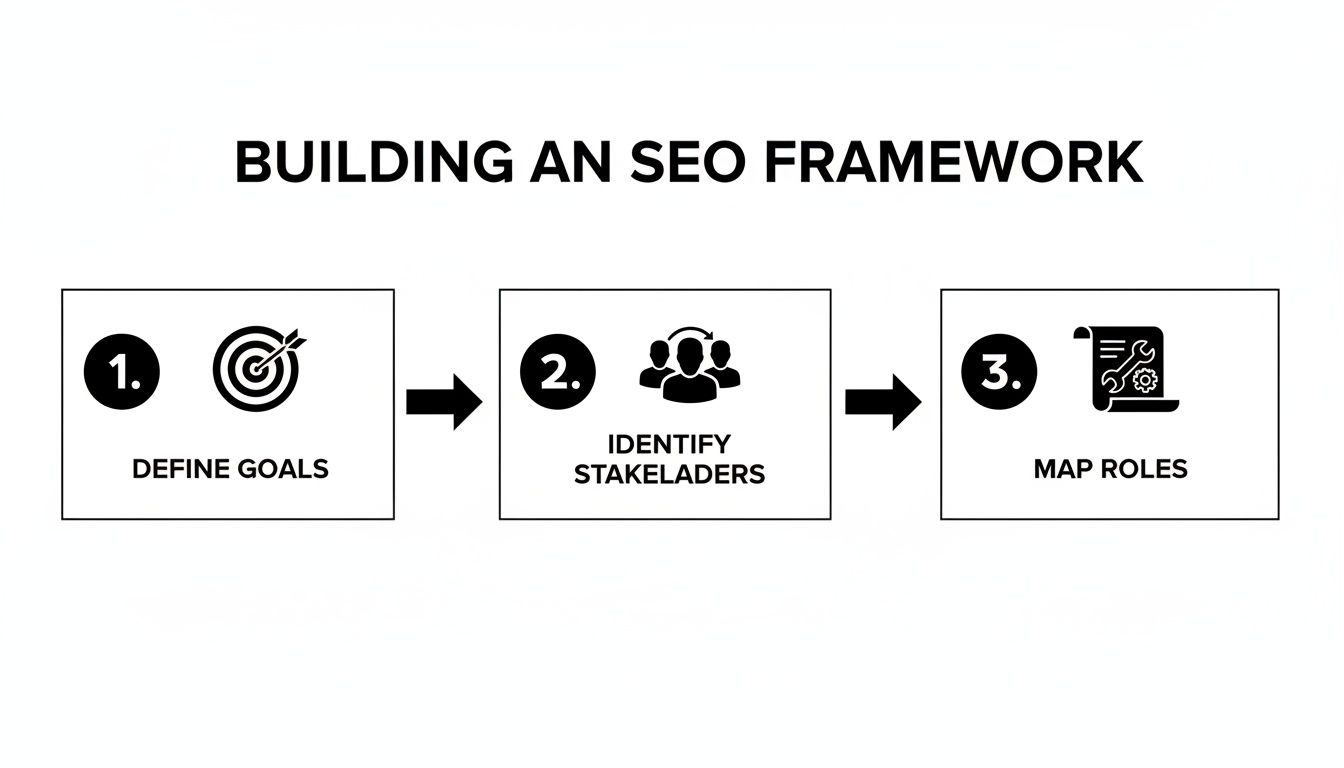
This visual just reinforces the idea that a successful project isn't a random list of tasks. It’s a structured system that aligns your team around clear, shared objectives.
Translating Findings into a Practical Timeline
Once you have all your audit findings, the next move is to translate that data into an actionable project plan. A vague plan is a recipe for missed deadlines and scope creep. A detailed timeline with clear milestones, however, keeps everyone accountable and laser-focused.
Let's imagine a restaurant equipment company is launching a new line of floor model charbroilers. A six-month project timeline would be absolutely essential to nail that launch.
An effective project timeline doesn't just list tasks; it sequences them logically. You must complete your technical audit and keyword research before you can create effective content briefs, and those briefs must be done before you can start writing.
A timeline forces you to prioritize tasks based on their potential impact and their dependencies on other activities. It's the roadmap that keeps the entire project from veering off-course.
Building a Six-Month Launch Timeline
For that new charbroiler line, a practical timeline would look something like this. Notice how it's not just a list of due dates, but a strategic sequence of activities designed to build momentum over time.
-
Month 1-2: Discovery and Technical Foundation
- Week 1-2: Kick things off with a full technical audit of the website, paying close attention to the new product category structure.
- Week 3-4: Complete all keyword research and competitive analysis specifically for "floor model charbroilers."
- Week 5-8: Implement the critical technical fixes uncovered in the audit. This could be anything from improving site speed to making sure the site is mobile-friendly for chefs browsing on their phones between shifts.
-
Month 3-4: Content Creation and On-Page SEO
- Week 9-12: Develop and write the core content: new product pages, a main category page, and a seriously comprehensive buyer's guide comparing the different models.
- Week 13-16: Optimize every new page with target keywords, compelling meta descriptions, and high-quality images. This is also when you'd add schema markup for product details like price and availability.
-
Month 5-6: Outreach and Promotion
- Week 17-20: Begin a targeted blogger outreach campaign to get reviews and features in well-respected restaurant industry publications.
- Week 21-24: Launch the main promotional campaign, monitor initial keyword rankings, and start analyzing how users are engaging with the new pages.
This structured approach means that by the time you start your outreach, the technical and content foundations are rock-solid, giving you the best possible shot at ranking and, most importantly, driving sales.
Executing Your Content and Technical SEO Strategy

Alright, you’ve got a solid plan. Now it's time to roll up your sleeves and get to work. This is where all that meticulous planning starts to pay off, turning those content briefs into high-value assets and the technical audit findings into real, tangible site improvements.
For a restaurant equipment supplier, this phase is a balancing act. You need to create expert content that speaks to chefs and restaurant owners while simultaneously implementing the critical technical fixes that help them find it in the first place.
Success here means running two workstreams in parallel: content production and technical SEO implementation. While one team is deep in the weeds crafting a detailed guide on commercial charbroilers, another is chipping away at tasks to improve page load times. The trick is making sure both efforts are perfectly in sync and pushing toward the same business goals.
Bringing High-Value Content to Life
Content execution always starts with a stellar content brief. Think of this document as the blueprint for your writers. It’s what ensures every article, blog post, and category page hits your SEO targets and speaks directly to your ideal customer. It’s how you translate keyword research and user intent into clear, actionable instructions.
A great brief for a restaurant equipment dealer does more than just list a few keywords. It digs into the specific questions a chef has, points out competitor articles you need to outperform, and dictates the exact internal links needed to guide a user from a blog post to a product page.
Let’s say you’re creating a guide for "Best Commercial Charbroilers." A detailed brief is the difference between a generic article that gets lost on page five and a powerful resource that actually drives sales.
A content brief is your project's single source of truth for a piece of content. It guarantees that the writer, editor, and SEO specialist all share the same vision, minimizing revisions and maximizing impact from the moment you hit "publish."
Here’s a quick look at what that brief might include.
Example Content Brief Template
- Primary Target Keyword: Best Commercial Charbroilers
- Secondary Keywords: countertop charbroiler reviews, floor model gas charbroiler, infrared vs radiant charbroilers
- Target Audience: Restaurant owners and head chefs researching a major kitchen equipment purchase.
- User Intent: The user is in the comparison stage. They need to understand the pros and cons of different models, fuel types, and sizes to make an informed decision.
-
Key Topics to Cover:
- Comparison of gas vs. electric charbroilers.
- Benefits of infrared technology for steakhouses.
- Sizing guide based on restaurant seating capacity.
- Required Internal Links: Link to the main "Commercial Charbroilers" category page and to specific high-margin product pages.
This level of detail is what makes content not just optimized for search engines, but genuinely useful for your customers.
The Hybrid Human-AI Approach to Content
These days, content creation is rarely a purely manual effort anymore. AI has become an incredibly powerful assistant for drafting content at scale, but it absolutely cannot replace human expertise—especially in a technical field like restaurant equipment.
The most effective approach is a hybrid model. Use AI tools to generate first drafts of product descriptions or to outline blog posts. This can cut production time dramatically. But then, your subject matter experts—the people who actually know the difference in BTUs on a charbroiler—must step in to review, edit, and enrich that content.
They are the ones who ensure technical accuracy, inject your brand’s unique voice, and add the kind of real-world insights that AI just can’t replicate. It's this combination that produces content that both search engines and buyers will trust.
AI is quickly becoming a core part of modern SEO project management, changing how teams plan and create content. Recent research shows 86% of SEO professionals now use AI in their workflows for everything from keyword clustering to mapping internal links. But—and this is the important part—the same research found that 93% of successful marketers still use human review before publishing any AI-assisted content. That confirms it: the hybrid model is what works.
Tackling Critical Technical SEO Roadblocks
While the content team is writing, your technical team should be executing the fixes you identified during the discovery phase. For e-commerce sites selling high-ticket items like commercial ovens or refrigerators, technical health is completely non-negotiable.
A huge area of focus has to be the Core Web Vitals (CWV). These metrics—loading speed, interactivity, and visual stability—measure the real-world experience a user has on your site. For equipment suppliers, whose customers are often busy chefs squeezing in research on their phones between shifts, a slow or clunky website is a dealbreaker. Poor CWV scores don't just hurt your rankings; they kill your conversion rates.
Another critical task is implementing structured data, often called schema markup. This is code you add to your site that helps search engines understand your content on a much deeper level.
For a product page, this markup can tell Google the price of a charbroiler, whether it's in stock, and its average customer rating. That information can then show up directly in the search results as a rich snippet, making your listing stand out and significantly improving click-through rates.
If you want to dive deeper into this and other technical elements, our guide on how to perform a comprehensive technical SEO audit is a great place to start.
Choosing Your Tools and Managing Workflows
Trying to run a big SEO project without the right tools is like trying to outfit a commercial kitchen with a single hot plate and a dull knife. It's just not going to work. You need a solid toolkit and a clear, repeatable process to keep everything moving, avoid bottlenecks, and make sure nothing critical falls through the cracks.
The right software does more than just organize tasks. It becomes the central hub for communication and the single source of truth for your entire team. From keyword research all the way to performance reporting, your tools need to work together. This creates a space where everyone, from the content writers to the dev team, knows exactly what they’re responsible for and how their work fits into the bigger picture.
Assembling Your SEO Project Management Toolkit
Your toolkit should be lean and purposeful, with each platform serving a specific function. While there are countless tools out there, most successful teams I’ve worked with build their stack around a few core categories. This avoids tool fatigue and keeps the team focused.
For a restaurant equipment supplier, a killer toolkit would include:
- Task Management: A visual board like Trello or Asana is non-negotiable. This is where you track everything, from writing a blog post on charbroiler maintenance to implementing new product schema.
- Research and Analysis: You absolutely need a powerhouse tool like Ahrefs or Semrush. This is where you'll do your keyword research, spy on competitors, and audit your backlink profile. The data you get here fuels your entire strategy.
- Technical Audits: A crawler like Screaming Frog is your best friend for digging into your site's technical health. It finds the nasty stuff—broken links, redirect chains, and other gremlins that hold back performance.
- Reporting and Dashboards: Google Looker Studio is a fantastic free tool for building custom reports. You can pull in data from Google Analytics and Search Console to show stakeholders exactly how things are progressing.
This simple stack covers the entire project lifecycle, giving you everything you need to plan, execute, and measure your SEO campaigns without overcomplicating things.
Structuring Your Workflow with a Kanban Board
One of the most intuitive ways to manage an SEO project is with a Kanban board, which is exactly what Trello is built on. It's no surprise that a Search Engine Journal study found that 41% of SEO professionals use Trello to manage their projects. Its drag-and-drop interface is just perfect for seeing progress at a glance.
A simple Kanban setup can bring immediate clarity to a complex restaurant equipment SEO campaign. You can instantly see what's being worked on, what's coming up next, and—most importantly—where things are getting stuck.
The real power of a Kanban board lies in its simplicity. It forces you to visualize the flow of work, making it immediately obvious where tasks are getting stuck. This visibility is crucial for proactive project management, allowing you to address issues before they derail your timeline.
Let's walk through how to set up a practical Trello board for your next big project.
A Practical Trello Board for SEO Tasks
Getting a board up and running is fast. You just need a few columns that represent the key stages of your work. You can always customize it later, but this is a great place to start.
Here's a sample structure that just works:
- Content Backlog: This is your idea bank. Every approved content idea gets its own card here. Think blog posts like "How to Clean a Commercial Charbroiler" or new category pages like a "Modular Charbroiler Buying Guide."
- In Progress: When a writer or developer grabs a task, they move the card here. This column gives you a real-time snapshot of what the team is actively working on right now.
- Under Review: Once a task is done, it lands here. A senior SEO specialist or an editor will give it a final check to make sure it meets all the requirements from the brief.
- Complete/Published: The finish line. When a piece of content goes live or a technical fix is deployed, the card moves here. This column becomes a running log of everything you've accomplished, which is a great morale booster for the team.
As cards move from left to right, everyone on the team gets a live look at the project's status. This visual approach cuts down on endless status meetings and keeps the whole team aligned and pushing forward.
How to Measure and Report on SEO Success
Executing an SEO project is one thing. Proving its value to the people signing the checks? That’s a whole different ballgame. The real test of any SEO project management is your ability to measure what actually matters and report on it in a way that connects your work directly to business goals. It's time to ditch the vanity metrics and start speaking the language of revenue.
The old days of popping champagne for a number-one ranking are pretty much over, especially with AI Overviews and SERP features muddying the waters. Rankings are nice, but they don't pay the bills. Your reporting needs to tell a clear, compelling story about how SEO is generating real business for your restaurant equipment site.
Shifting Focus from Rankings to Revenue
The single most important shift in modern SEO reporting is moving away from tracking keyword positions and toward measuring business-centric KPIs. A top ranking for some broad term feels good, but it’s totally meaningless if it doesn't lead to a single sale or qualified lead.
Your mission is to draw a straight, undeniable line from an SEO task to a business outcome. For a commercial kitchen supplier, this means zeroing in on metrics that directly reflect customer acquisition and revenue.
Key Business-Centric KPIs to Track:
- Organic Lead Conversions: This is the gold standard. You need to be tracking the number of quote requests, contact form submissions, or even phone calls that came straight from organic search traffic.
- Assisted Organic Conversions: SEO often plays a vital role early in the buying journey. Someone might find your "charbroiler vs. gas grill" article through a search, leave, and then come back a week later by typing your URL directly to request a quote. Assisted conversions give you credit for that critical first touchpoint.
- Branded Search Volume Growth: An increase in people specifically searching for your brand name (like "Charbroilers.com reviews") is a huge sign that your content and visibility efforts are building real brand equity and trust.
When you focus on these metrics, the conversation changes from "Hey, we're ranking higher!" to "We generated 20% more quote requests from organic search this quarter." See the difference?
Building a Monthly SEO Performance Dashboard
To communicate value effectively, you need a reporting tool that's clean, concise, and gets straight to the point. A monthly performance dashboard, built in a free tool like Looker Studio, is perfect for this. It lets you pull data from Google Analytics and Google Search Console into one visual report that stakeholders can actually understand without needing a Ph.D. in data science.
This dashboard should be a snapshot of performance, not a data dump. You have to highlight the connection between your work and the bottom line. For instance, you could create a specific segment to track how a top-ranking article on 'charbroiler maintenance' directly contributes to quote requests for related parts and services.
The point of an SEO report isn't just to show data; it's to provide insights. For every chart and metric, your dashboard needs to answer the question, "So what?" It should tell a powerful story about the tangible ROI your project is delivering.
Let's be realistic about the competitive landscape. A massive analysis found that a shocking 96.55% of all pages get zero organic traffic from Google. For a niche B2B retailer like a commercial charbroiler supplier, that means less than one in 20 pages will ever see a searcher without a disciplined, ongoing project. It’s a tough world out there.
Connecting Content Performance to Sales
To truly prove the value of your SEO project management, you have to connect individual pieces of content to actual sales. For a restaurant equipment site, this could mean tracking users who land on a blog post comparing commercial oven types and then go on to request a quote for a specific model you talked about. To really get a handle on your impact, you have to diligently track content performance and use what you learn to tweak your strategy.
A practical way to do this is by setting up conversion goals in Google Analytics that track key actions, like someone downloading a spec sheet or filling out a "Request a Quote" form. By analyzing user paths, you can show exactly how an informational article warmed up a lead that the sales team later closed. Our guide on how to measure SEO performance dives deeper into setting up this kind of tracking.
This is how you shift SEO from being seen as a marketing expense to being recognized as a documented revenue driver, ensuring you get the buy-in you need for all your future projects.
Here are some of the most common questions we get about managing an SEO project for a restaurant equipment supplier. Getting clear answers on timelines, roles, and how to handle those dreaded Google updates helps everyone stay on the same page.
How Long Until We See Real SEO Results?
This is always the first question, and the only honest answer is: it depends.
You'll usually see some early signs of life—like a jump in impressions—within 3 to 6 months. But for the kind of results that actually drive business, like a meaningful increase in quote requests for commercial charbroilers, you're looking at something closer to 6 to 12 months.
What makes that timeline swing so much?
- How Fierce the Competition Is: Trying to rank for "restaurant equipment financing" is a whole different ballgame than a long-tail keyword like "replacement grates for floor model charbroilers."
- Your Site's Starting Point: If your website is a technical mess, the first few months are just about pouring the foundation. You can't build a skyscraper on shaky ground.
- How Fast You Move: The pace at which you can publish genuinely helpful content and earn authoritative backlinks has a direct impact on how quickly Google decides to pay attention.
Strategist vs. Project Manager — What's the Difference?
These hats can sometimes be worn by the same person on smaller teams, but the roles themselves are very different.
Think of the SEO Strategist as the architect. They're the ones digging into audits, doing the deep keyword research, and drawing up the blueprint for the entire campaign. They figure out the what and the why.
The SEO Project Manager, on the other hand, is the general contractor. They take that blueprint and make sure the house gets built—on time and on budget. They live in the Trello boards, wrangle the writers and developers, and own the how and the when. A brilliant strategist can spot a golden opportunity, but it takes a great project manager to make sure the team actually seizes it.
An SEO project without a dedicated project manager is like a kitchen without an expeditor during a dinner rush. You might have great chefs (strategists and writers), but without someone coordinating the orders, the whole system grinds to a halt.
What Should We Do After a Big Google Update?
When a major Google algorithm update hits, the number one rule is don't panic. Knee-jerk reactions and sudden strategy shifts are almost always the worst thing you can do. The right move is to monitor, analyze, and then react with a clear head.
First, just watch. Keep a close eye on your analytics for a week or two to see if you were actually impacted. If you do see a major drop, dig into which pages got hit the hardest. Compare them against what Google has said about the update.
More often than not, the fix isn't some new, shiny tactic. It's usually about doubling down on the fundamentals: improving your content, making the user experience better, and shoring up your site's technical health.
At Charbroilers.com, we understand that the right equipment is crucial for success. Explore our extensive selection of high-quality countertop, modular, and floor model charbroilers perfect for any restaurant at https://charbroilers.com.