

SEO How Many Keywords Per Page A Guide for Modern Search
If you're wondering how many keywords to target per page, the modern SEO answer is simple: focus on one primary keyword and a small group of 3-5 closely related secondary keywords. The goal isn't to cram as many terms as possible onto a page, but to create a deep, comprehensive resource around a single topic for your restaurant equipment supply website.
From Keyword Count To Topical Authority

The conversation around keywords has changed completely. Ten years ago, SEO felt like a numbers game where you just repeated a phrase over and over. Today, search engines like Google are much smarter. They reward pages that show true expertise on a subject.
Think of your page like a specialized chapter in a cookbook. If a chapter is titled "Commercial Convection Ovens," you wouldn't expect it to just repeat that phrase. A genuinely helpful chapter would naturally cover related ideas to give a chef or restaurant owner the full picture.
This is how that strategy breaks down:
- A Primary Keyword: This is your page's main topic, like "commercial convection ovens." It sets the core purpose.
- Secondary Keywords: These are closely related terms and questions that add context and depth. Think "gas vs electric convection oven," "baking consistency," or "oven maintenance tips."
This approach proves to search engines that your page is a high-quality, authoritative resource that completely answers a user's search. It's a fundamental shift from mindless repetition to building genuine topical relevance, a key component of the SEO and content writing services we provide for restaurant equipment suppliers.
The Myth Of Keyword Density
Old-school SEO advice was obsessed with keyword density—the percentage of times a keyword showed up on a page. That metric is pretty much irrelevant now.
In fact, most studies show that well-written, top-ranking content naturally has a keyword density between 0.5% and 1%. This isn't a target to aim for; it's just what happens when you write good content about a topic without sounding like a broken record.
The table below breaks down the shift in thinking from outdated SEO practices to what works today.
Keyword Targeting Shift From Old SEO to Modern SEO
| SEO Factor | Old SEO Approach (Outdated) | Modern SEO Approach (Recommended) |
|---|---|---|
| Primary Goal | Rank for a specific keyword phrase at all costs. | Answer the user's underlying question or need. |
| Keyword Strategy | Stuff one keyword repeatedly into the text. | Focus on one primary topic and related semantic terms. |
| Key Metric | Keyword Density (e.g., "Hit 2% density"). | Topical Coverage and User Engagement. |
| Content Focus | Written for search engine crawlers. | Written for a human audience first. |
| Success Indicator | High ranking for a single, exact-match term. | High rankings for a cluster of related search queries. |
This evolution shows a clear move toward creating content that is genuinely valuable and helpful, which is what search engines have always wanted to reward.
The key takeaway is this: Write for your human audience first. When you create valuable, in-depth content that thoroughly covers a topic, you will naturally use the right keywords the right number of times.
This modern approach to keywords is a core part of any good content marketing plan. To see how this fits into the bigger picture, you can explore these essential content marketing best practices. By focusing on user intent and topical depth, you create content that not only ranks well but also builds lasting trust with your audience.
Why Keyword Density Is an Outdated Metric
If you've ever been told to repeat a keyword a specific number of times on a page, it's time to unlearn that advice. That idea is a relic from the early, wild-west days of the internet. Back then, search engines were much simpler. They basically just counted words to figure out what a page was about, a metric we call keyword density.
This led to a clumsy practice called "keyword stuffing." Website owners would cram their target phrase into a page over and over again, hoping to trick the system. The result was often unreadable content like, "We sell commercial ice machines. Our commercial ice machines are the best commercial ice machines you can buy." It was terrible for anyone actually trying to read the page.
The Shift to Understanding Meaning
Thankfully, search engines grew up. Google rolled out sophisticated algorithms that could understand context, synonyms, and the intent behind what someone was searching for. They stopped just counting keywords and started analyzing the relationships between different words and concepts on a page.
This evolution was a total game-changer. It meant a page no longer needed to repeat the same phrase ten times to prove it was relevant. Instead, it needed to cover a topic comprehensively, just like a real expert would when talking to a customer. Our article writing and blog posting services focus on this modern approach, ensuring content is valuable and ranks effectively.
Search engines no longer reward pages for repeating a keyword. They reward pages that show deep knowledge of a topic by using a variety of related terms, concepts, and answers to common questions.
A Modern Example for Restaurant Equipment Suppliers
Let's bring this into the real world. Imagine you want to rank a page for "commercial ice machines."
-
The Outdated Approach: Force the phrase "commercial ice machines" into the text a dozen times, making it sound robotic and unnatural.
-
The Modern Approach: Build a genuinely helpful resource that naturally uses a whole family of related terms.
Instead of stuffing your main keyword, a high-quality page would use a cluster of phrases that a real person would actually search for. This builds a strong "semantic map" around your core topic, telling Google you're an authority.
This might include terms like:
- Ice makers for restaurants
- High-capacity ice machine maintenance
- Undercounter ice cube maker reviews
- Nugget ice machine for bars
- Flake ice vs. cube ice
This strategy proves your expertise to Google far more effectively than any keyword density percentage ever could. In fact, one analysis of over 1,500 search results found the average keyword density for top-ranking pages was a tiny 0.04%.
What does that tell us? As content becomes more natural and comprehensive, density becomes almost irrelevant. You can explore the data behind these ranking factors at Rankability. By focusing on providing real value and covering a topic from all angles, you align your content with what modern search engines are actually built to reward.
Choosing Your Primary and Secondary Keywords
Now that we agree that topical focus crushes keyword repetition, let's put it into practice. Picking the right keywords is the bedrock of any successful page. The whole process boils down to identifying one primary keyword—your page's north star—and a few secondary keywords to add crucial context and depth.
Your primary keyword is simply the main topic of your page. It’s the single most important phrase you want to rank for. Think of it like a chapter title in your website's book; it has to be specific, clear, and perfectly aligned with what your customers are actually searching for.
Secondary keywords are like the subheadings within that chapter. They're all the closely related terms, questions, and different ways of phrasing things that fill in the details. They help search engines see that your page is a comprehensive resource, not just a thin summary.
Aligning Keywords with User Intent
The absolute most critical part of choosing keywords is getting inside the searcher's head and understanding their user intent. You have to ask yourself: what is this person actually trying to do? Are they just kicking tires and gathering information? Are they comparing products? Or are they ready to pull out their credit card?
Matching your keyword choice to the user's goal is everything. Get it right, and you attract the right audience. For a restaurant equipment supplier, the intent behind a search can be worlds apart:
- Informational Intent: Someone searching "how does a convection oven work?" is just looking for knowledge. They aren't ready to buy... yet.
- Commercial Intent: A search like "gas vs electric convection oven efficiency" signals a user who's weighing their options and getting much closer to a decision.
- Transactional Intent: When you see a query like "double stack convection oven cost," you know that person is deep in the buying process.
Your job is to build a "keyword cluster" that squarely addresses the specific intent you want that page to capture.
Building Your Keyword Cluster: An Example
Let’s walk through what this looks like for a blog post or category page on a restaurant equipment site.
Our Primary Keyword will be: "commercial convection oven"
This phrase is broad enough to be a central topic but specific enough to target a clear product category. Perfect. Now, we need to dig up secondary keywords that support this topic and answer the real questions people have. A fantastic, no-cost way to do this is to just look at the "People Also Ask" section on the Google search results for your primary term.
By analyzing these questions, you get direct insight into what potential customers are curious about. Answering these questions in your content is one of the most effective ways to prove your expertise to both users and search engines.
Using this simple method, we can quickly spot some gold-star secondary keywords:
- What are the benefits of a commercial convection oven?
- Best convection oven for a bakery
- Commercial convection oven cleaning tips
- Knowing how to determine search volume for keywords like these is a crucial step to validate your choices.
By creating a single page that targets "commercial convection oven" and thoughtfully weaves in these secondary topics, you build a resource that's infinitely more valuable—and far more likely to rank—than a page that just mindlessly repeats the main keyword.
How to Map Keywords Across Your Website
Thinking about a single page is a good first step, but a killer SEO strategy treats your whole website like a connected ecosystem. This is where keyword mapping comes in. It’s simply the process of giving each important page on your site its own unique primary keyword, creating a clear and logical blueprint for Google.
Without a map, you’ll run straight into a common—and costly—SEO mistake: keyword cannibalization. This is what happens when multiple pages on your site are all trying to rank for the same main keyword. You end up forcing your own pages to compete with each other, which just confuses search engines and dilutes your authority.
Creating a Logical Site Structure
A proper keyword map stops this internal competition dead in its tracks. It gives every page a distinct job to do, building a strong foundation that helps both search engines and your customers find what they need. This kind of organized approach is the backbone of a solid site structure, and a core part of our comprehensive SEO services. You can dive deeper into how this works in our guide to site architecture for SEO.
For a restaurant equipment supplier, a simple keyword map might look something like this:
- Homepage: Targets a big, broad term like "restaurant equipment supplier."
- Category Page: Focuses on a more specific product group, such as "commercial refrigeration."
- Product Page: Aims for a highly specific, ready-to-buy term like "True T-49 Reach-In Refrigerator."
This hierarchy signals to Google exactly which page is the most relevant authority for each type of search.
The diagram below shows how different keyword types—primary, secondary, and long-tail—fit together in a hierarchy for your content strategy.
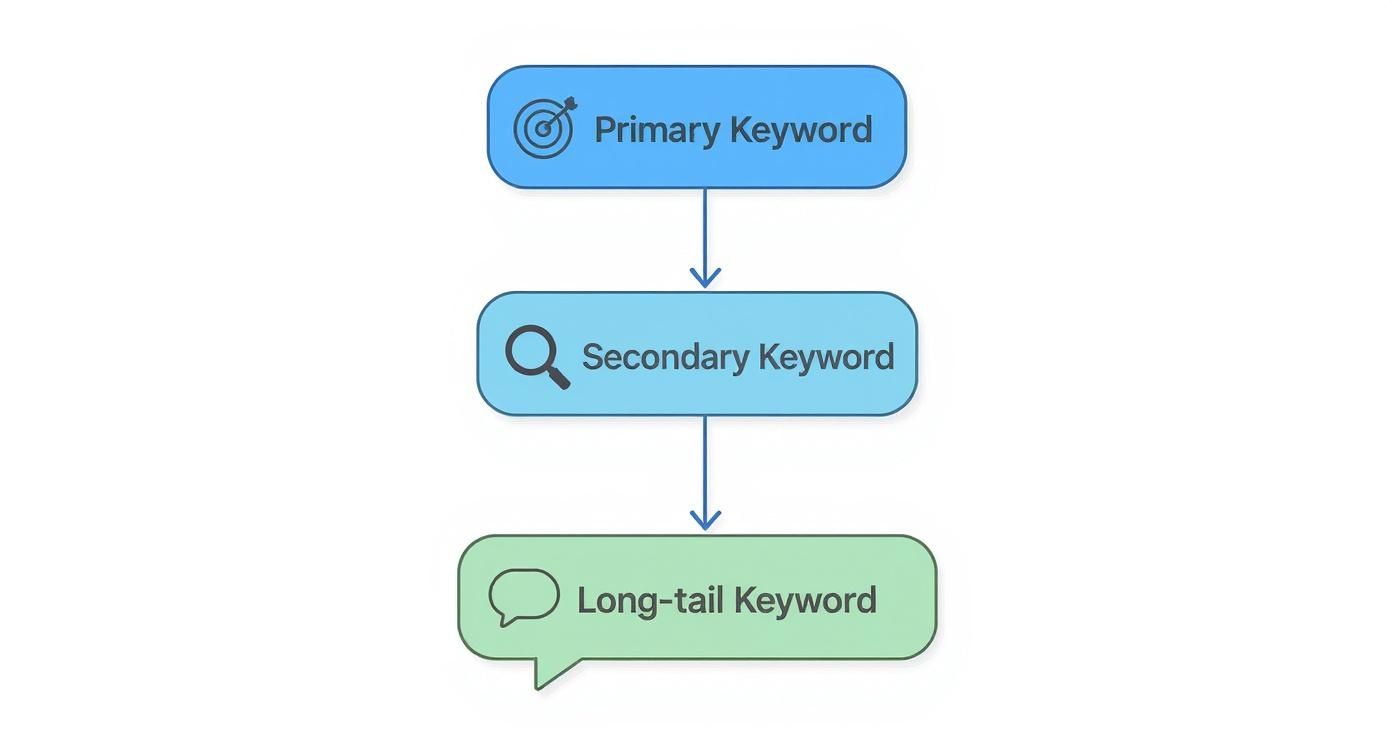
As you can see, the primary keyword sets the main topic, while secondary and long-tail keywords flesh out the supporting details.
To put this into a more practical format, here’s a sample keyword map that lays out how you might assign keywords across a typical restaurant equipment website.
Example Keyword Map for a Restaurant Equipment Website
| Page Type | Example Page | Primary Keyword Target | Example Secondary Keywords |
|---|---|---|---|
| Homepage | domain.com |
restaurant equipment |
foodservice equipment, commercial kitchen supplies
|
| Category Page | /commercial-ovens/ |
commercial ovens |
convection ovens for sale, commercial pizza ovens
|
| Sub-Category Page | /commercial-ovens/convection/ |
commercial convection ovens |
electric convection oven, gas convection oven reviews
|
| Product Page | /blodgett-mark-v-convection-oven/ |
Blodgett MARK V oven |
Blodgett MARK V price, double stack convection oven
|
| Blog Post | /blog/how-to-clean-oven/ |
how to clean a commercial oven |
oven cleaning tips, best commercial oven cleaner
|
This table shows how each page has a unique job. This clarity prevents your pages from competing and helps you build authority for a wide range of relevant search terms.
Mapping Keywords by Difficulty and Intent
As you build out your map, you have to think about the competition. Here’s a little secret weapon: long-tail keywords. These longer, more specific phrases often have lower competition but attract visitors who are much closer to making a purchase.
In fact, industry data shows that long-tail keywords make up roughly 70% of all global search traffic. They are an absolutely critical piece of your keyword map, bringing in highly qualified visitors who know exactly what they’re looking for.
By strategically assigning one primary keyword per page, you create a clear roadmap for search engines. This eliminates internal confusion and builds topical authority, helping your most important pages rank for the queries that matter most to your business.
Ultimately, this methodical approach transforms your website from a random collection of pages into a powerful, organized resource that consistently attracts and converts the right customers.
Integrating Keywords Naturally Into Your Content

Okay, you've got your keywords picked out and a solid map of where they belong. Now comes the final, crucial step: actually weaving them into your content.
The real goal here is to place them where they’ll have the biggest impact for search engines without making the page sound clunky or weird to a human reader. Think of it less like "keyword placement" and more like an organic part of building a genuinely helpful, well-written page.
When you get this right, your keywords will feel completely natural. They’ll just be part of a valuable piece of content. This whole process is the very heart of on-page SEO—it’s how you signal your topic’s relevance to Google in all the right places.
Prioritizing Key On-Page Elements
Some parts of your page simply carry more weight with Google than others. By getting your primary and secondary keywords into these high-impact spots, you give search engines clear, powerful signals about your page's purpose.
But always, always remember the golden rule: write for people first, then optimize for search engines.
Here are the most important spots to hit:
- Title Tag: This is the clickable headline people see in the search results. Your primary keyword should be as close to the beginning as possible.
- Meta Description: While it's not a direct ranking factor, a good description with your keyword makes people want to click.
- H1 Heading: This is your page's main on-screen title. It needs to include your primary keyword and perfectly match what the user was looking for.
Nailing these three elements creates a consistent, compelling message for both users and search crawlers right from the get-go.
Weaving Keywords into the Body Content
Beyond the big headlines, your keywords also have an important job to do within the content itself. This is where your secondary keywords and long-tail variations really get to shine, helping you build that all-important topical depth.
The best content answers a user's questions before they even have to ask them. Use your secondary keywords in your subheadings to guide readers through the page and show just how much you know about the topic.
Consider these other high-value locations for your keywords:
- Subheadings (H2, H3): These are perfect for your secondary keywords. For a page about a "commercial charbroiler," an H3 like "Best Way to Clean Charbroiler Grates" directly answers a related user question.
- Introductory Paragraph: Try to mention your primary keyword within the first 100-150 words. This immediately confirms the topic for both your reader and the search engine.
-
Image Alt Text: Describe your images for visually impaired users and slip in a relevant keyword where it makes sense. For example,
alt="chef grilling steaks on a countertop charbroiler". -
URL: Your URL should be clean, readable, and include your primary keyword. Something like
/commercial-charbroilers/is perfect.
Integrating keywords across all these elements is what creates a cohesive, well-optimized page that search engines can easily understand and rank.
If you're looking for a practical guide to put all this into action, this on-page SEO checklist from Little Green Agency is an excellent resource. And if you really want to master the process, you can learn even more about how to write SEO-friendly blog posts in our own detailed guide.
Got Questions About Keyword Targeting?
Even with the best strategy, questions are going to pop up. Let's tackle some of the most common ones I hear about keyword targeting. Think of this as a quick-reference guide to clear up any confusion and help you move forward with confidence.
Can One Page Really Rank For Multiple Keywords?
Absolutely. In fact, any well-optimized page should rank for dozens, sometimes even hundreds, of different keyword variations. It's a natural result of good SEO.
While you should always focus your efforts on one primary keyword for a page, the way you use secondary and long-tail keywords will naturally help you show up for all sorts of related searches.
For instance, a page you optimize for "commercial charbroiler" will almost certainly start ranking for things like "restaurant char-grill," "best charbroiler for steaks," and maybe even "how to season a new charbroiler." This happens because Google is smart enough to understand the topical connection between these phrases. The goal isn't to cram multiple primary keywords onto a page, but to cover a single topic so thoroughly that you rank for its entire family of related terms.
How Many Keywords Is Too Many On One Page?
There’s no magic number here. The real answer comes down to one thing: user experience. The question isn't really "how many keywords per page," but rather, "is my content still readable and helpful?" If you find yourself forcing keywords into sentences where they don't fit, making the text sound clunky or repetitive, you've gone too far.
A good rule of thumb is to stick to your main keyword and maybe 3-5 strong secondary keywords. Any other related terms and long-tail phrases should just appear naturally as you write about the topic in a comprehensive way.
The moment your writing process shifts from "how can I best explain this topic?" to "where can I fit another keyword?" you've crossed the line. Always, always write for the human reader first.
This keeps your page helpful, readable, and far away from any risk of being flagged for keyword stuffing.
What’s The Difference Between A Keyword And A Topic?
This is a huge distinction in modern SEO, and it's a critical one to grasp. A keyword is the exact phrase someone types into a search bar, like "Blodgett countertop charbroiler."
A topic, on the other hand, is the broader subject or the user's underlying need. In this case, the topic is something like "finding a durable, high-performance charbroiler for a small kitchen."
Old-school SEO was obsessed with matching the exact keyword. Today, it's all about satisfying the entire topic. When you build a page that covers commercial charbroilers from every angle—exploring different types, explaining cleaning techniques, and detailing the best uses—you naturally answer the intent behind hundreds of different keywords.
Should Every Single Page Target A Keyword?
For the most part, yes. Any page you want people to find through a Google search should have a clear keyword target. This definitely includes your homepage, product pages, category pages, and blog posts.
However, some pages just don't need to rank in the traditional sense. These typically include:
- Your "About Us" or "Contact" pages (they'll rank for your brand name anyway)
- Internal pages like your privacy policy
- "Thank you" pages that appear after someone fills out a form
Focus your keyword mapping on the pages that actually attract new customers and drive your business forward. When you strategically assign keywords, you turn your website from a simple online brochure into a powerful customer-acquisition machine. We help restaurant equipment suppliers achieve this with targeted SEO, blogger outreach, and copyrighting services.
At Charbroilers.com, we understand that the right equipment is the heart of any successful kitchen. Investing in a high-quality charbroiler can elevate your culinary offerings, imparting that perfect smoky flavor and creating irresistible char-grilled textures that customers love. Explore our selection of countertop, modular, and floor model charbroilers to find the perfect fit for your restaurant, bistro, or diner. https://charbroilers.com