

SEO Competitor Analysis: Outsmart Rivals in the Restaurant Equipment Market
So, what exactly is an SEO competitor analysis? It's simply the process of digging into your rivals' SEO strategies to figure out what they're doing right, where they're falling short, and where you can swoop in and win.
For a restaurant equipment supplier, this means pinpointing the exact keywords, content, and backlinks that are helping them sell more charbroilers and other kitchen gear online. By understanding their playbook, you can craft a strategy that leverages our expertise in everything from local citation services to expert article writing, giving you a decisive edge.
Why Your Competitors' SEO Strategy Matters
Imagine knowing the precise search terms that drive qualified buyers—chefs, GMs, and restaurant owners—straight to your competitor’s website. That’s the real value here. This isn't just "spying"; it's smart business intelligence that gives you a massive advantage in a crowded market.
This whole process pulls back the curtain on what actually works in your niche. If you sell charbroilers, it shows you how your rivals are attracting customers searching for everything from "commercial gas charbroiler" to "how to clean stainless steel grill grates."
A Blueprint for Digital Success
Looking at what your competitors are doing with their SEO is like getting a copy of their playbook. You can see which strategies connect with your shared audience and which ones are just wasting their time and money. This intel lets you make decisions based on data, not just a gut feeling.
Here’s a taste of what you can uncover:
- Keyword Opportunities: Find high-value keywords your competitors are ranking for that you've completely missed.
- Content Strengths: See what kind of content—product guides, comparison articles, how-to videos—is bringing them the most traffic and authority. This is where professional copyrighting and article writing can make a huge impact.
- Backlink Sources: Identify the authoritative industry blogs or trade publications linking to them, giving you a ready-made list to target for your own blogger outreach.
By dissecting their playbook, you can capitalize on their weaknesses and replicate their strengths. This transforms their hard-won marketing lessons into your future gains, saving you significant time and resources.
Find and Exploit Their Blind Spots
A really solid analysis does more than just show you what your rivals do well. It shines a bright light on their blind spots.
Maybe they have zero content answering common maintenance questions for commercial charbroilers. Or perhaps their local SEO game is weak, leaving a huge opening for you to dominate "near me" searches. For a deeper dive into the whole process, from finding keyword gaps to backlink strategies, check out this excellent guide on how to do competitor analysis in SEO.
These gaps are your golden opportunities. They're your chance to pull in more qualified traffic and cement your brand as the go-to authority in the restaurant equipment space.
Identifying Your True Online Rivals
First things first, you need to figure out who you're actually up against. It's almost never just the restaurant equipment dealer down the street. Your real competition online are the websites that consistently pop up in search results for the keywords your customers are typing in every single day.
Think about what a potential buyer searches for, like "commercial countertop charbroiler" or "best gas charbroiler for steaks." The sites that own those top spots? Those are your true SEO competitors, even if they don't sell the exact same gear you do. They're grabbing the attention—and the clicks—of your target audience, and it's your job to figure out how they're doing it.
Direct vs. Content Competitors
Your online rivals generally fall into two camps, and knowing the difference is key. It helps you focus your energy where it'll actually make a difference.
You've got your direct competitors, which are other e-commerce businesses selling the same or similar products. If you're selling charbroilers, this is another online store selling commercial cooking equipment. You're both fighting for the same transactional keywords and the same customer's budget.
Then you have content competitors. These sites might not sell a single charbroiler, but they rank for your most valuable keywords by creating genuinely helpful content. This could be an industry blog reviewing different grill types, a food magazine with articles on char-grilling techniques, or even a YouTube channel showing how to maintain the equipment.
Ignoring content competitors is a rookie mistake. They are building trust and authority with your audience, often catching them much earlier in their buying journey. Analyzing their strategy can uncover massive opportunities for your own blog and informational pages, often executed through expert blog posting and copyrighting services.
To give this some structure, let's break down the different types of competitors you'll likely encounter and what to look for with each.
Identifying Competitor Types for a Charbroiler Business
This table breaks down the different online competitor types you'll face and how to approach analyzing each one to gain a strategic advantage.
| Competitor Type | Example | Why They Matter | Key Analysis Focus |
|---|---|---|---|
| Direct E-commerce | WebstaurantStore, Katom | They are after the same customers and "buy now" keywords. Their pricing, product pages, and UX are direct threats. | Product page optimization, keyword targeting for commercial terms, backlink profile from suppliers, and site structure. |
| Niche E-commerce | A smaller online store specializing only in grills and smokers. | They might be outranking you on long-tail, specific keywords because of their deep focus on one product category. | Long-tail keyword strategy, category page structure, and specialized blog content that attracts enthusiasts. |
| Big Box Retailers | Home Depot, Lowe's (in their commercial sections) | While not specialists, their massive domain authority allows them to rank for broad terms. They capture top-of-funnel traffic. | On-page SEO for their category pages, internal linking strategies, and how they use their brand authority to rank. |
| Content Publishers | Food & Wine, Bon Appétit, industry trade journals | They capture informational search traffic with "how-to" guides, reviews, and recipes, building an audience you want to reach. | Top-performing articles, keyword gap analysis for informational terms, and backlink strategies from high-authority sites. |
| Manufacturers | Vulcan, Southbend | They often rank for their own branded terms but may also have resources, spec sheets, and manuals that attract search traffic. | Branded keyword search volume, technical content (PDFs, manuals), and backlinks from their dealer network. |
By categorizing your competitors like this, you move from a vague list of rivals to a clear, strategic map of the search landscape. Each type requires a slightly different analytical lens.
Using SEO Tools to Pinpoint Your Rivals
Trying to find all these competitors by manually searching Google for every keyword is a huge waste of time. This is where SEO tools are indispensable. Platforms like Semrush or Ahrefs let you plug in your website and almost instantly get a list of domains that are ranking for the same keywords you are.
The screenshot below gives you a peek at a competitor overview in Semrush. It’s a great starting point for seeing who's getting traffic and how much your keyword footprints overlap.
This kind of report is your launchpad. From here, you can dive into each competing site to see precisely which keywords are their heavy hitters.
Your goal isn't to create a massive spreadsheet of every website that's ever mentioned a charbroiler. Instead, you want to zero in on the top 3-5 competitors—a healthy mix of direct and content rivals—who consistently own the top 10-20 spots for your most important keywords. A focused approach is a manageable and actionable one.
This focus is crucial. In the cutthroat world of online restaurant equipment sales, our data shows that businesses conducting regular competitor audits see up to a 34% higher click-through rate (CTR) on their top organic pages compared to those who fly blind.
Ultimately, by understanding who you're really up against and using data to spot the biggest threats and opportunities, you're laying the foundation for a powerful SEO strategy. For a deeper dive into the discovery phase, check out our guide on how to find competitor websites and start analyzing their online presence.
Uncovering Competitor Keyword and Content Gaps

Alright, you've figured out who your real online rivals are. Now the tactical work begins. This is where we dissect their keyword and content strategies to find out exactly what’s driving their traffic and—more importantly—where they've dropped the ball.
A solid seo competitor analysis here is what separates the businesses that just keep up from the ones that pull ahead.
The whole point is to find "gaps" in the market. I'm talking about valuable search terms your competitors rank for but you don't. Or, even better, topics your shared audience is searching for that no one is covering well. This process gives you a data-backed roadmap for what content to create next, something that professional article writing services excel at.
Performing a Content Gap Analysis
A content gap analysis (sometimes called a keyword gap analysis) is just a systematic way of comparing your website's keyword footprint against your competitors'. SEO tools make this super efficient. You can plug in your domain next to three to five of your top competitors and almost instantly see a list of keywords they’re ranking for that you’re not even on the map for.
For instance, a restaurant equipment supplier doing this might uncover that their competitors are getting traffic from terms like:
- "commercial charbroiler buying guide": This is a golden opportunity. It shows you can create a definitive resource that walks a new restaurant owner through the whole decision-making process.
- "how to clean a commercial charbroiler": This is a classic informational keyword. It captures people who already own the equipment but need help, building trust and keeping your brand top-of-mind for their next purchase.
- "charbroiler techniques for perfect grill marks": This kind of content speaks directly to chefs. It positions your brand as an expert in the craft, not just some company selling steel boxes.
Finding these gaps is like discovering a new vein of customers. These are real problems and questions your audience has, and by filling that void with expertly crafted blog posting, you can pull in some highly qualified traffic.
Analyzing Top-Performing Pages
It’s not enough to just find missing keywords. You have to dig into why your competitors' top pages are doing so well. Look at the specific blog posts and product pages that bring them the most organic traffic. This isn't about copying them; it's about reverse-engineering the formula for success in our niche.
When you're looking at a competitor's high-ranking page, ask yourself a few key questions:
- What’s the content format? Is it a massive blog post, a side-by-side product comparison, a how-to video, or some kind of interactive calculator? The format itself is often a huge piece of the puzzle.
- How deep do they go? Do they just skim the surface, or did they create the most exhaustive resource on the topic? The best content usually answers every possible follow-up question a reader could have.
- What kind of media are they using? Look for sharp product photos, instructional videos, useful infographics, or downloadable spec sheets. The right media can make a huge difference in how long people stick around.
- How is the page laid out? Check out their use of headings (H2s, H3s), bullet points, and short paragraphs. A well-structured page is easier for both people and search engines to digest.
By breaking down their most successful content, you’ll start to see patterns. If every top-ranking page for "commercial grill maintenance" has a video tutorial, that’s a pretty strong hint you should probably include video in your own content on that topic. If you need a refresher on the basics, our guide on how to build a keyword list is a great place to start before you dive this deep.
Finding Your Unique Angle
The final piece is to take all this intelligence and use it to create content that isn't just better, but actually different and more valuable. Don't just write a longer version of your competitor's article. That's a losing game. Instead, find a unique angle they completely missed.
Your competitive advantage lies in providing value that others don't. If competitors focus solely on product specs, you can win by creating content around operational efficiency, cleaning protocols, or culinary techniques. This is where strategic SEO and expert copyrighting can position you as a partner, not just a vendor.
For example, if all your rivals have a generic "Top 5 Charbroilers" list, you could create an article on "Choosing the Right Charbroiler Based on Your Restaurant's Menu." See the difference? That approach is far more specific and genuinely helpful to a restaurant owner trying to make a smart business decision. It solves their core problem, not just their search query.
This kind of detailed analysis turns your content strategy from guesswork into a data-driven plan. You’ll know exactly what topics to cover, what format to use, and how to structure your content to outmaneuver your rivals and become the go-to resource in the restaurant equipment space.
Analyzing Your Competitors' Backlink Profile

Think of it this way: if your content and keywords are the engine of your SEO strategy, backlinks are the high-octane fuel. Backlinks—links pointing to your website from other sites—are one of the most powerful signals you can send to search engines. They act as votes of confidence from across the web, telling Google that your site is a credible, authoritative resource worth paying attention to.
Any seo competitor analysis worth its salt has to include a deep dive into your rivals' backlink profiles. This process is all about uncovering the high-value, authority-building links they've managed to earn. The end goal? A prioritized list of link-building opportunities you can chase down for your own restaurant equipment supply website, often with the help of targeted blogger outreach.
Pinpointing High-Value Link Sources
First thing's first: you need to figure out who is linking to your competitors. Are they getting mentions from major industry publications like Foodservice Equipment & Supplies magazine? Or are their links coming from popular food blogs that chefs and restaurant owners actually read?
Digging into their links helps you answer some critical questions:
- What type of content is actually earning links? Look for the patterns. Maybe their in-depth buying guide for charbroilers is pulling in links left and right, while their standard product pages are getting none.
- Who are the influential linkers in this niche? You’ll start to see the same names pop up—the influential blogs, review sites, and trade associations that are the kingmakers in your space.
- What’s the quality of their links? A single, powerful link from a top culinary school’s website is worth way more than a hundred links from low-quality, spammy directories.
This initial look gives you a solid map of the "link landscape" in the commercial kitchen equipment world. It shows you what’s possible and who you need to get on the radar of.
Executing a Backlink Gap Analysis
This is where the real gold is buried. A backlink gap analysis is just a straightforward way of finding websites that link to a few of your competitors, but not to you. The logic here is beautifully simple: if a site has already linked to two or three of your direct rivals, they've proven they're interested in your niche. That makes them a prime candidate to link to your valuable content, too.
You can’t do this manually; you’ll need an SEO tool. You can plug your domain and the domains of your top 3-5 competitors into a tool like Ahrefs or Semrush and let it spit out a list of these "missing" link opportunities.
The screenshot below from Ahrefs shows its Link Intersect tool, which is built for exactly this job. It flags all the domains linking to your competitors but not to you, giving you a ready-made outreach list.
This process is incredibly effective because high-quality backlinks, paired with great content that matches what people are searching for, remain a top factor for Google's rankings. The data from these tools gives you a tactical advantage, letting you find and exploit the gaps in your competitors' strategies.
From Analysis to Actionable Outreach
Once you have your target list from the backlink gap analysis, the goal is to earn a link. And I mean earn. This isn’t about sending out spammy, generic requests. It’s about providing undeniable value.
Here’s a mistake I see all the time: people just ask for a link. Don’t do that. Instead, figure out why the site linked to your competitor in the first place. Did they feature their infographic? Quote an expert? Reference their data? Understand the context, then create something even better.
Let's say you find a popular restaurant management blog that linked to a competitor's article on "5 Tips for Maintaining Your Charbroiler." That's your opening. Your job now is to create the definitive resource on that topic—something like "The Ultimate Guide to Commercial Charbroiler Maintenance," complete with a downloadable checklist and a quick video tutorial.
Then, you reach out to that blog owner, mention you saw and liked their article, and offer your more comprehensive guide as an even better resource for their readers. This is the core of effective blogger outreach. For a bit more guidance on this process, you can check out our article on how to find backlinks in Google.
This strategic approach—driven by meticulous competitor analysis—is how you build real authority and systematically climb the search rankings.
Auditing Technical Health and Local SEO Signals
So far, we've focused on the visible parts of the SEO iceberg—keywords, content, and backlinks. Now, it's time to dive below the surface. We're going to inspect the technical foundation and local signals that can make or break a competitor's ability to rank.
This is especially true for a restaurant equipment supplier. A fast, mobile-friendly website isn't a "nice-to-have" anymore; it's the price of entry. A competitor might have brilliant content, but if their site takes forever to load on a chef's phone, they’re bleeding customers and telling Google their user experience is garbage.
And that creates a massive opportunity for you.
Assessing Core Technical Performance
First things first: let's evaluate your competitors' technical health. This might sound intimidating, but you can get a quick, effective snapshot by focusing on just a few critical elements that directly impact rankings and user satisfaction.
Here's where to start digging:
- Site Speed: Pop your competitors' key pages (homepage, top category pages, popular blog posts) into Google's PageSpeed Insights. What do their Core Web Vitals scores look like? If a competitor's site is sluggish, especially on mobile, that’s a major weakness you can exploit with a faster, better-optimized website.
- Mobile Usability: Restaurant owners and managers are constantly on the go, researching on their phones. Pull up their sites on your own phone. Is the experience seamless? Are buttons easy to tap? Is text readable without pinching and zooming? A clunky mobile site is a clear competitive vulnerability.
- Site Structure: How logically is their site organized? Clean, intuitive navigation helps users find what they need—like charbroilers or commercial freezers—and helps search engines crawl and index content efficiently. A confusing or overly deep site structure is a technical flaw that’s holding them back.
A technically sound website is the bedrock of any successful SEO strategy. If your competitors are lagging in site speed or mobile-friendliness, every dollar they spend on content and backlinks is less effective. This is your chance to build a superior foundation and win on user experience.
Dominating the Local Search Arena
For restaurant equipment suppliers, local search is a goldmine. When a walk-in cooler dies, chefs are searching for "restaurant equipment supply near me," and they need it now. This is where auditing your competitors' local SEO signals can reveal major gaps you can drive a truck through.
Your focus here should be on their Google Business Profile (GBP). Take a hard look at their profile and ask some pointed questions. Is it completely filled out with accurate hours, services, and high-quality photos of their showroom and products? A neglected GBP is a huge red flag and an even bigger opportunity.
Next up, analyze their local citations. These are just mentions of their business's Name, Address, and Phone number (NAP) across online directories like Yelp, Yellow Pages, and industry-specific sites. Inconsistent NAP data across these platforms confuses search engines and torpedoes local rankings. Professional local citation services can help you check this, and any discrepancies you find are openings for you to establish a cleaner, more authoritative local presence.
Finally, dive into their customer reviews on Google and other platforms. How often are they getting reviews? More importantly, how are they responding? A competitor who ignores negative feedback or rarely gets new reviews is dropping the ball on their online reputation. By actively encouraging and responding to reviews, you build social proof and signal to Google that you're a trusted local authority.
Building Your Actionable SEO Roadmap
All that data you just collected from your SEO competitor analysis is great, but let's be honest—insights are totally useless without a plan. This is where the rubber meets the road. You’re going to turn all those findings into a concrete, prioritized roadmap that will guide every marketing move you make and help you start systematically taking back market share.
It's easy to get overwhelmed at this stage. You probably have a laundry list of potential to-dos, from fixing tiny technical glitches to brainstorming huge new blog series. The trick is to categorize every opportunity based on its potential impact versus the effort it’ll take to actually get it done.
Prioritizing Your SEO Opportunities
A simple framework can make all the difference in deciding what to tackle first. Just sketch out a quick matrix with "Impact" on one axis and "Effort" on the other, then start plotting out your findings.
- High Impact, Low Effort (Quick Wins): These are your absolute top priorities. Jump on these immediately. This could be something like optimizing an existing product page for a high-value keyword a competitor is sleeping on, or finally fixing that critical mobile usability issue you uncovered.
- High Impact, High Effort (Major Projects): These are the big-ticket items. Think of initiatives like creating the definitive guide to "commercial charbroiler maintenance" or launching a full-blown backlink outreach campaign. These are the projects you'll want to plan for the upcoming quarters.
- Low Impact, Low Effort (Fill-in Tasks): This bucket is perfect for tasks like updating old blog posts with fresh info or cleaning up a few lackluster meta descriptions. They’re great to knock out when you have a bit of downtime.
- Low Impact, High Effort (Reconsider): These are the tasks that demand a ton of your resources for very little payoff. Unless something changes, just put these on the back burner for now.
This visualization below simplifies that initial audit process, zeroing in on core technical and local signals like site speed, mobile experience, and local presence.
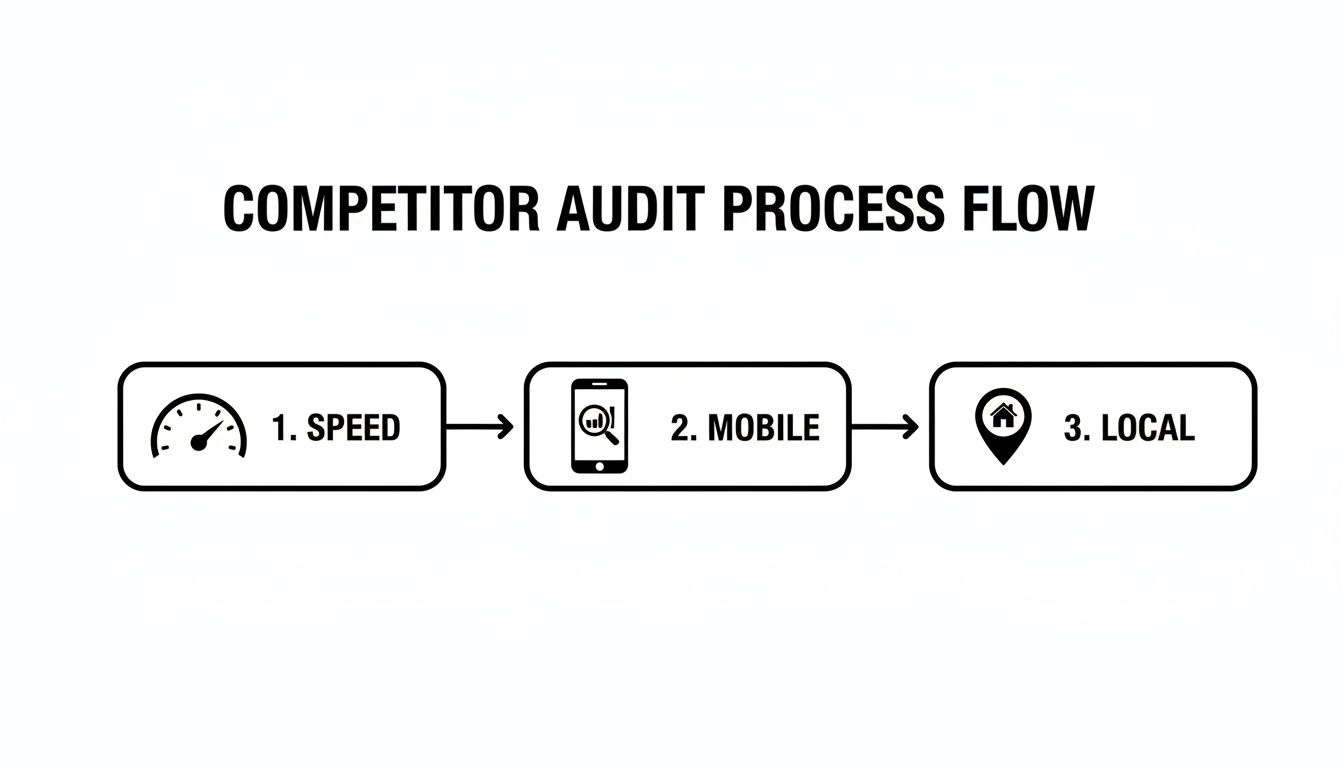
This process flow really highlights the foundational stuff you need to audit first. Why? Because major weaknesses in areas like site speed or mobile-friendliness can completely sabotage all your other SEO efforts.
Structuring Your Roadmap
Once you have your priorities straight, it's time to build a tangible roadmap. I find it’s best to think in terms of quarterly goals—it keeps your plan focused and, most importantly, measurable. A truly effective roadmap doesn't just list a bunch of tasks; it connects them directly to real business outcomes.
And if you need an expert hand to guide you, considering professional SEO competitor analysis services can seriously streamline this whole process and uncover much deeper insights.
A great roadmap translates "we found a keyword gap" into "Q1 Goal: Increase organic traffic for 'countertop charbroilers' by 15%." This simple shift changes the focus from just doing activities to getting results, which makes it way easier to track your progress and prove ROI.
Here’s a rough idea of what a structure for one quarter might look like:
Q1 Goal: Increase organic leads for commercial grills by 20%.
-
Key Result 1: Achieve a top 5 ranking for "commercial countertop gas charbroiler."
- Task: Overhaul the category page with better copy, high-res images, and customer reviews.
- Task: Publish two blog posts targeting informational keywords related to this product.
-
Key Result 2: Secure 3 high-authority backlinks from food industry blogs.
- Task: Create and promote an infographic on "Choosing the Right Grill for Your Restaurant Menu."
- Task: Conduct targeted outreach to the blogs we identified in the backlink gap analysis.
When you use a structured approach like this, your analysis transforms from a simple report into an actionable playbook. It ensures every single SEO task is directly tied to a specific, measurable business objective.
Questions We Hear All the Time
Diving into a full-on SEO competitor analysis usually brings up a few practical questions. Here are the straight-up answers to the most common ones we get from restaurant equipment suppliers who are ready to get serious about their digital game.
How Often Should I Really Be Doing This?
A deep, comprehensive analysis is something you should tackle quarterly. This timing is the sweet spot—it lets you catch major market shifts or big moves from your competitors without getting totally lost in the data.
That said, you don't want to be caught flat-footed. A lighter monthly check-up is a smart move. Just keep an eye on your top 3-5 rivals. Track their keyword rankings for your most important terms and watch for any big, new backlinks they pick up. This keeps you nimble and ready to jump on opportunities or defend your turf.
Can We Actually Compete Against a Huge National Brand?
Absolutely. It’s not about out-muscling them overnight for a huge keyword like "charbroilers." That’s a long, expensive fight. The key is to be smarter and more focused. Your specific expertise is your biggest weapon.
Instead of going head-to-head, zero in on:
- Long-tail keywords: Get specific. Think "best countertop gas charbroiler for a small diner." You can own that space.
- Hyper-local content: Build out pages and write blog posts that speak directly to the chefs and restaurant owners in your service area. This is where local SEO and local citation services become critical.
- Real expert advice: Create incredibly detailed guides on maintenance, cleaning, or specific cooking techniques. The big box stores almost never go this deep.
What are the Best Free Tools to Get Started?
While the paid tools give you a ton more data, you can uncover a goldmine of information without spending a dime. If you're just starting to dip your toes in, these are your best bets:
- Google Search (in Incognito Mode): This is the purest way to see what's actually ranking on the search engine results pages (SERPs) without your own search history skewing the results.
- Google Keyword Planner: It's built for advertisers, but it's still fantastic for digging up keyword ideas and getting a feel for search volumes.
- Ubersuggest (Free Version): Neil Patel's tool gives you a limited but genuinely useful peek at a competitor's domain, including their top pages and recent backlinks.
Ready to stop guessing and start winning? At Charbroilers.com, we provide specialized SEO, local citation services, blog posting, blogger outreach, copyrighting, and article writing tailored for restaurant equipment supply websites. Let us turn these competitive insights into an SEO roadmap that actually drives sales. See how we can build your online authority at https://charbroilers.com.