

A Restaurant SEO Audit Report Format That Actually Drives Growth
An effective SEO audit report is more than just a checklist of technical issues. It's a structured document that takes a mountain of raw data and turns it into a clear, actionable roadmap. It tells the real story of a website's performance and, more importantly, where the biggest opportunities are hiding.
For businesses like restaurant equipment suppliers, this format is what turns complex SEO metrics into a strategy that actually drives sales and growth. It's the bridge between data and decisions. As experts in providing SEO, blog posting, and local citation services specifically for this industry, we know that a well-structured audit is the first step toward online dominance.
Building Your High-Impact SEO Audit Report
Let's get past the generic templates you can download anywhere. The real goal here is to build an SEO audit report that tells a compelling story for a specific business, like a restaurant equipment supplier. This document needs to be a blueprint that turns confusing data into a strategic plan that stakeholders can actually understand and get behind. A great report doesn't just point out problems; it lays out the solutions.
The structure of your report is everything. It has to guide the reader—whether that’s a marketing manager or the company owner—from the big picture down to the nitty-gritty details without anyone getting lost. A solid first step, before you even type a single word of the report, is to complete a comprehensive website SEO audit to arm yourself with all the necessary data.
Starting with a Strong Narrative
Every good report kicks off with an executive summary. This isn't just a formality; it’s your one shot to grab a busy decision-maker's attention. Think of it as the "too long; didn't read" (TL;DR) version that gets straight to the most critical findings and the juiciest opportunities.
For a restaurant equipment site, a powerful summary might say something like: "Our site traffic is steady, but we are missing a significant opportunity to capture chefs searching for 'commercial gas griddles vs. charbroilers,' a high-intent keyword our competitors currently own. The most immediate priority is tackling slow page load speeds on our product pages, which is causing a 25% higher bounce rate on mobile."
See the difference? This approach immediately connects the audit to business outcomes—lost traffic and potential sales—not just abstract technical jargon.
A successful audit report isn't a laundry list of everything that's broken. It’s a prioritized plan that shows the clearest path to hitting business goals, translating SEO metrics into measurable dollars and cents.
Structuring for Clarity and Action
After the executive summary, your report should break down into logical sections that flow naturally from one to the next. This helps stakeholders see how different pieces of the SEO puzzle fit together.
Here’s a look at the key sections every report for a business like a restaurant equipment supplier should have. This table breaks down what each section is for and the kind of metric you should be laser-focused on.
Key Components of a Restaurant-Focused SEO Audit Report
| Report Section | Primary Goal for a Restaurant Equipment Supplier | Key Metric to Watch |
|---|---|---|
| Executive Summary | Grab attention with business-focused outcomes. | Revenue impact or missed opportunity value. |
| Technical Health | Ensure the site is crawlable, indexable, and fast. | Mobile PageSpeed Insights score. |
| On-Page & Content | Verify content meets user intent and is optimized. | Keyword rankings for high-intent product terms. |
| Local SEO | Confirm visibility in local searches for service/repair. | Google Business Profile impressions/clicks. |
| Backlink Profile | Assess authority and trust signals from other sites. | Number of links from industry publications. |
| Competitor Analysis | Identify gaps and opportunities vs. key rivals. | Share of Voice for core keyword groups. |
| Recommendations | Provide a prioritized, actionable to-do list. | Estimated impact vs. effort for each task. |
| KPI Tracking | Set up benchmarks for measuring success. | Month-over-month organic traffic and conversions. |
This structure ensures you cover all your bases, from the foundational technical stuff to the high-level competitive landscape.
A logical flow following the summary could look like this:
- Technical Health Analysis: This is the foundation. Can Google even crawl the site properly? Are there indexing errors holding pages back? How fast does it load for a chef browsing on their phone during a kitchen break?
- On-Page & Content Review: Here, you dig into how well the content actually serves the user. Are the product pages for "countertop charbroilers" fully optimized? Is there useful blog content, like a guide on "How to Season a New Charbroiler," to attract top-of-funnel traffic? This is where expert article writing and copyrighting can make a huge impact.
- Local SEO & Backlink Profile: This section looks at off-page authority. How does the business show up in local searches for equipment repair? Are you getting links from respected food blogs or industry magazines through blogger outreach?
- Competitor Analysis: Where do you really stand? This part reveals what your competitors are doing right and, just as importantly, where their weaknesses are. These are the strategic gaps you can exploit.
Ultimately, the best SEO audit report format is one that not only finds the problems but also prioritizes them based on impact and effort. This simple shift transforms the audit from a boring diagnostic report into a powerful strategic weapon that guides every decision and leads directly to more traffic and sales.
Auditing Your Technical SEO Foundation

Think of your website's technical SEO as the engine room of a busy restaurant kitchen. If the foundation is shaky—slow, confusing to navigate, or completely hidden from search engines—it doesn't matter how incredible your product pages or blog posts are. For a restaurant equipment supplier, a solid technical base is non-negotiable for busy chefs and managers who need information, and they need it fast.
This is why a crucial part of your SEO audit report format must be a deep dive into this foundation. It’s where you’ll unearth the hidden gremlins that stop customers from finding your pages for "countertop charbroilers" or "commercial deep fryers." Fixing these issues is often the very first, and most impactful, step toward better rankings and more sales.
Crawlability and Indexing Your Digital Inventory
Before Google can even think about ranking your website, it has to find it and understand what it's all about. This process is known as crawling and indexing. If search engine bots can't easily move through your site, entire sections of your inventory could remain invisible in search results.
Your audit needs to check for a few common roadblocks:
- Robots.txt file: Is this file accidentally telling search engines to stay away from important pages? It happens more than you'd think. A single incorrect line can de-index huge portions of your site.
- XML Sitemap: This is basically your website's roadmap for search engines. It should be clean, current, and submitted to Google Search Console. It’s how you tell Google which pages matter most, including all your product and category pages.
Another key stop is Google Search Console to check for "Coverage" errors. These reports tell you exactly which pages Google is struggling with and why, handing you a clear to-do list of technical fixes to prioritize. For a detailed guide on this process, check out our article on how to conduct a comprehensive technical SEO audit.
Core Web Vitals and Site Speed
In an industry that never stops, nobody has time for a slow website. Core Web Vitals are the specific metrics Google uses to measure user experience, focusing on how fast your site loads, how quickly it becomes interactive, and whether things jump around on the screen. A poor score here can directly hurt your rankings.
For a restaurant equipment site, page speed is everything. A chef researching a new convection oven between dinner services won't wait more than a few seconds for a product page to load. Since Google's Core Web Vitals became a ranking factor in 2021, sites that optimized their speed saw dramatic improvements. One case study showed organic visits jumped 50% from January to March, climbing from 10,000 to 15,000 monthly visitors, while bounce rates dropped 7% from 45% to 38%.
Pro Tip: Compressing large product images is one of the fastest wins for site speed. High-resolution photos of charbroilers are essential, but they must be optimized for the web to avoid bogging down your load times.
Site Architecture and Mobile Experience
A logical site architecture is like a well-organized stockroom. It should be simple for both users and search engines to find what they're looking for. A flat, clear structure—where important product pages are only a few clicks from the homepage—is always the goal.
Don't make people dig through deep, complicated navigation paths. A customer searching for a "modular charbroiler" shouldn't have to click through five different menus to get there. Clear breadcrumbs and a smart internal linking strategy are your best friends here.
Finally, the mobile experience is no longer optional. With over 60% of B2B buyers now using their phones for research, your site has to be flawless on smaller screens. The audit must involve hands-on testing of every part of your site on various mobile devices. Are the buttons easy to tap? Is the text readable? Is the navigation intuitive? A clunky mobile experience will send potential customers straight to a competitor. For a much deeper dive into getting this right, check out this guide on mastering technical SEO auditing.
Once you've confirmed your website's technical foundation is solid, it's time to shift focus to the content itself. This is the stuff that actually connects you with your audience—whether it's a chef hunting for the perfect char-grill marks or a restaurant manager researching "floor model charbroilers." Your content has a job to do, and this part of the audit is all about figuring out how well it's performing.
We're moving past crawlability and site speed and diving headfirst into content strategy. The goal here is to see if your title tags, meta descriptions, and on-page copy are actually lining up with what your customers are searching for. It’s about making sure that when a potential buyer lands on your commercial charbroiler page, the content immediately tells them they’re in the right place. Our article writing and copyrighting services focus on exactly this—crafting content that converts.

Optimizing Your Digital Storefront
Think of your page titles and meta descriptions as the window display for your online store. They’re often the very first impression a potential customer has of your brand right there in the search results. A proper audit has to scrutinize these elements for clarity, keyword relevance, and language that actually makes someone want to click.
A title like "Product Page" is just a wasted opportunity. Something like "Commercial Floor Model Charbroilers | Charbroilers.com" is infinitely stronger. It immediately tells both search engines and human users what the page is about, hitting a key commercial term right off the bat.
Likewise, meta descriptions need to be more than just a boring list of features. They should act as a concise sales pitch that seals the deal on the click.
Your meta description is your 160-character elevator pitch. Make it count by highlighting the core benefit for the user—for example, "Achieve perfect steakhouse sear marks with our heavy-duty floor model charbroilers. Built for high-volume kitchens. Explore models now!"
Uncovering and Filling Content Gaps
One of the most powerful parts of any content audit is the content gap analysis. This is where you figure out what your competitors are ranking for that you aren't. It's a goldmine for finding high-value topics and keywords you've completely overlooked.
For example, your competitors might be pulling in traffic from blog posts like "how to clean commercial charbroiler grates" or "gas vs. electric charbroilers for restaurants." These are valuable questions your target audience is asking. Your audit should flag these gaps as prime opportunities to create new blog posts, buying guides, or how-to articles.
This analysis gives you a data-backed roadmap for your content marketing, so you can stop guessing what might work and start creating content that actually attracts qualified traffic. Our blog posting services are designed to fill these gaps with high-quality, relevant articles.
When you're auditing a product page, it helps to have a clear checklist. This ensures you're looking at the right elements and can spot problems quickly.
On-Page SEO Checklist for Product Pages
| On-Page Element | Optimal Implementation | Common Mistake to Flag |
|---|---|---|
| Page Title (H1) | Includes primary keyword & brand. Ex: "Vulcan VCCB36 36" Gas Charbroiler" | Generic title like "Product Details" or keyword-stuffed nonsense. |
| Meta Description | 155-160 characters. Compelling, with a call-to-action (CTA). | Auto-generated from the first sentence on the page or missing entirely. |
| Product Images | High-res, multiple angles, descriptive alt text (e.g., "front view of Vulcan VCCB36 charbroiler"). | Missing alt text, generic file names (e.g., IMG_1234.jpg). |
| Product Description | Detailed, benefit-driven copy. Uses secondary keywords naturally. | Thin content, just a copy-paste from the manufacturer's spec sheet. |
| Structured Data |
Product schema with price, availability, reviews, and SKU implemented. |
No schema markup, leaving rich snippet opportunities on the table. |
This kind of focused checklist turns a vague review into a systematic, actionable audit, making it easy to see exactly where the page is falling short.
Leveraging Structured Data for Greater Visibility
One of the single most impactful on-page optimizations you can flag in an audit is the use of structured data, often called Schema markup. It's basically code you add to your site to help search engines understand your content better and, in return, display it more attractively in the search results with "rich snippets."
For a restaurant equipment supplier, this is a total game-changer. You can use Product schema to show prices, availability, and star ratings right there in the search results. We've seen that a solid structured data implementation after an audit can raise organic CTR by 20-30% simply by making your listings stand out. Ever since Schema.org became the standard around 2012, JSON-LD has been the way to go, letting you mark up everything from products to recipes for 'char-grilled chicken tips'.
By filling out these fields correctly, you're spoon-feeding search engines detailed information they can use to generate those eye-catching rich snippets that get more clicks.
This doesn't just make your listing pop; it also pre-qualifies the click. Users see the key info before they even visit your page. Your audit needs to identify which pages are missing this crucial markup and recommend adding it as a high-priority task.
Looking Beyond Your Website: Backlinks and Local SEO
Once you've tightened up everything on your own website, it's time to look outward. The next part of your audit needs to tackle your off-page authority, which is really just your website’s reputation across the internet. Think of it this way: high-quality backlinks are like votes of confidence from other respected sites, while strong local signals make sure you show up when nearby customers need you.
For a restaurant equipment supplier, this two-pronged approach is critical. You need links from national food blogs and industry publications to build broad authority, and you also need razor-sharp local signals to capture a chef frantically searching "commercial oven repair near me." This is where blogger outreach and local citation services become essential.
Dissecting Your Backlink Profile
Let's be clear: your backlink profile is not a numbers game. Quality crushes quantity, every single time. Your audit needs to dig in and separate the valuable endorsements from the junk that could be holding you back. The goal is to see if your links tell a story of a trusted, authoritative voice in the foodservice industry.
Start by looking at the relevance and authority of the sites linking back to you. A single link from a well-respected culinary magazine or a major equipment manufacturer's blog is worth a hundred links from sketchy, irrelevant online directories. Make sure to flag these high-value links in your report—they're your existing strengths.
On the flip side, you have to hunt for toxic links. These are the bad neighborhoods of the internet, often coming from spammy, unrelated websites that can actively hurt your rankings. Finding these is the first step toward creating a disavow file, which is your way of telling Google to ignore those bad votes.
The Foundation of Local SEO: NAP Consistency
For any business that serves a local or regional area, local SEO isn't optional. The absolute bedrock of your local search performance is NAP consistency. That means making sure your Name, Address, and Phone number are perfectly identical everywhere they show up online.
It's amazing how small inconsistencies can cause big problems. Using "St." in one directory and "Street" in another, or having an old phone number lingering on a forgotten profile, confuses search engines and chips away at their trust in your business. Your audit needs to include a thorough check of the major directories and data aggregators to spot every single variation.
A consistent NAP acts like a digital fingerprint, confirming your business's identity and location for search engines. Even minor discrepancies can dilute your local authority and push you down in map-pack rankings.
Fixing these issues is a critical, high-impact task. If you want to dive deeper into this, our guide on local citation building offers a detailed look at how to get this crucial consistency locked in across the web. It's the foundational work that makes all other local efforts more effective.
Optimizing Your Google Business Profile
Your Google Business Profile (GBP) is often your most valuable local asset. It’s your digital storefront, frequently showing up even before your website in local search results. A full audit of your GBP is an absolute must.
Your report should pick apart several key areas:
- Category Selection: Are you using the most specific and relevant categories? "Restaurant Supply Store" is a good start, but adding "Commercial Refrigeration Supplier" can capture more targeted searches.
- Service Area: Is your service area clearly defined to show where you actually do business, from sales calls to equipment repairs?
- Photos and Posts: Is the profile visually interesting? It needs high-quality photos of your products and regular Google Posts that announce new arrivals or promotions.
- Q&A Section: Are you proactively answering common customer questions? This lets you control the narrative and provide instant value to searchers.
A well-oiled GBP has a direct impact on your visibility in the coveted Google Map Pack for money-making searches like "restaurant equipment supplier in [city]."
Managing Customer Reviews and Reputation
Finally, don't forget that customer reviews are a huge local ranking factor and an even bigger driver of trust. Your audit needs to assess more than just your average star rating; look at the volume, frequency, and sentiment of your reviews.
Are you actively encouraging happy customers to leave feedback? Even more important, how are you responding to reviews—both the good and the bad? A pattern of thoughtful, professional responses shows potential customers (and Google) that you're an engaged and trustworthy business. The report should highlight what you're doing well and where you can improve your review management strategy, because this directly shapes how new buyers see your brand.
Creating a Prioritized SEO Action Plan
An SEO audit that just lists problems without a clear plan is just data collecting dust. This final, critical section of your report is where you turn all those findings into a practical roadmap that drives real growth for your restaurant equipment supply website.
The whole point here is to move from "what's broken" to "what we're doing about it, and in what order." This structured approach ensures you tackle the most important fixes first, generating momentum and showing value quickly.
From Findings to an Actionable Framework
Simply handing over a long list of issues is overwhelming and often leads to inaction. A much better way to approach this is to sort every single recommendation into a simple matrix based on two key factors: potential impact and required effort. This instantly creates a clear hierarchy for your action items.
This framework helps everyone understand why you’re recommending fixing a critical site speed issue before you spend time tweaking a few minor meta descriptions. It connects the dots between a technical task and its potential business outcome, whether that's more leads or increased online sales.
- High Impact / Low Effort: These are your "quick wins." Think updating page titles on key product pages or fixing a broken internal link pointing to a high-converting page. These tasks should be done immediately to build some early momentum.
- High Impact / High Effort: These are the major projects, like a full site architecture overhaul or a comprehensive content strategy for your blog. While they definitely take more resources, their payoff is significant.
- Low Impact / Low Effort: These are often smaller, "housekeeping" tasks. It’s good to get to them when you have the time, but they shouldn't distract from more important priorities.
- Low Impact / High Effort: Just avoid these. They consume valuable time and budget for minimal, if any, return.
This process transforms a simple to-do list into a strategic project plan. For a deeper look into organizing these tasks effectively, our guide on SEO project management provides some great frameworks to keep your strategy on track.
Defining Key Performance Indicators for Success
An audit shouldn't be a one-time event. It's meant to become a living document that guides your ongoing strategy, and the only way to do that is by defining the Key Performance Indicators (KPIs) you'll use to measure success.
These metrics turn your one-time audit into a continuous improvement cycle. They provide the hard data you need to prove the value of your SEO efforts to your team and stakeholders, showing exactly how your work is moving the needle.
A great action plan does two things: it tells your team exactly what to do next, and it tells your stakeholders precisely how you'll measure the results. Without both, you're just guessing.
The visual below illustrates a simplified process flow, zeroing in on the core signals of a local SEO strategy for a restaurant equipment supplier: links, local presence (NAP), and reputation (reviews).
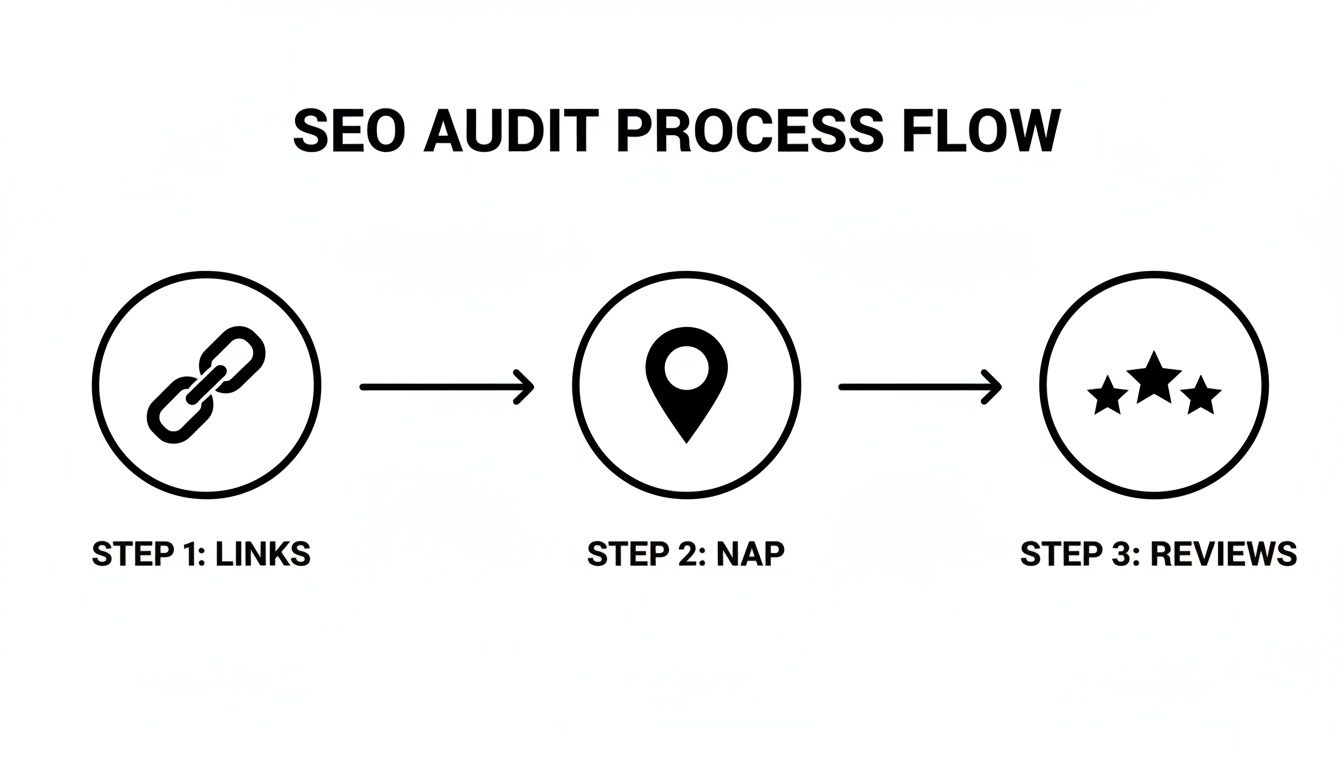
This simple flow emphasizes that building authority, ensuring local accuracy, and managing your reputation are interconnected steps that are absolutely vital for local search visibility.
Essential KPIs for a Restaurant Equipment Website
For a business selling restaurant equipment, you need to track metrics that directly connect to business objectives. Here are a few must-haves to include in your reporting dashboard.
-
Organic Traffic: This is the most fundamental KPI. An increase in organic traffic is a clear sign that your SEO improvements are working and that more potential customers are discovering your site. I always recommend tracking it month-over-month and year-over-year for proper context.
-
Keyword Rankings for Commercial Terms: Don't just track any keyword. Focus on the high-intent terms that your target audience—chefs, restaurant managers—actually use when they're ready to buy. Think terms like "floor model gas charbroiler" or "commercial deep fryer reviews."
-
Conversion Rate from Organic Traffic: Traffic is nice, but sales are what matter. This KPI measures what percentage of your organic visitors take a desired action, like filling out a quote request form, calling your sales line, or making a purchase. An increase here proves you're not just attracting more visitors, but the right visitors.
-
Google Business Profile Actions: For local customers, your GBP is often the first point of contact. You have to track metrics like clicks-to-website, requests for directions, and clicks-to-call directly from your profile. These are incredibly strong indicators of your local search performance.
By building a prioritized action plan and establishing clear KPIs, your SEO audit becomes more than just an analysis—it becomes the strategic engine for your entire digital marketing operation. It provides the clarity and focus needed to make smart decisions and consistently improve your online presence.
Frequently Asked Questions
Running an SEO audit can feel like opening a can of worms—suddenly, you're flooded with questions. This is especially true when you're in a specific industry like restaurant equipment supply.
Whether you're the owner, a marketing manager, or even a chef trying to get your side project noticed online, you need clear answers. Here are some of the most common questions we get about putting together and actually using an effective SEO audit report.
How Often Should I Run an SEO Audit?
This is a big one, and the honest answer is: it depends. A massive, deep-dive audit isn't something most businesses need every month. But you definitely can't treat it as a one-and-done project, either.
- Major Audits: A comprehensive audit is best done annually. It's also a great idea before any big website redesign. This gives you a solid baseline to work from and helps steer your strategy.
- Minor Check-ins: You should be doing monthly or quarterly health checks. These are much quicker. You're mostly just monitoring your KPIs, looking for new errors in Google Search Console, and keeping an eye on keyword rankings for your money-makers, like "commercial charbroilers."
Think of it like this: regular check-ins help you spot a small problem before it turns into a massive, site-killing headache.
What Is the Most Important Part of an SEO Audit Report?
Every piece of the audit has its place, but for a business owner, the two most critical sections are the Executive Summary and the Prioritized Action Plan. The summary is what translates all the technical mumbo-jumbo into dollars and cents, explaining why any of it matters to your bottom line.
Then you have the action plan, which is the "what's next." It’s the roadmap that turns all that data into a real to-do list, sorted by what will make the biggest impact for the least amount of work. An audit without a clear, prioritized plan is just a list of problems—not a solution.
An audit’s real value isn't in finding every single tiny flaw. It's in pointing out the top three to five opportunities that will actually drive business growth and giving you a clear, step-by-step plan to get there.
Can I Do an SEO Audit Myself?
You absolutely can. Anyone can run a basic audit using free tools like Google Search Console and Google PageSpeed Insights. They’ll hand you some really valuable data on technical glitches, site speed, and how you’re performing for certain keywords. It's a great starting point.
Where a professional audit differs is in the depth of analysis and strategy. An expert can look at that same data and see the story behind it, especially within the context of your industry. They understand the nuances, like how a chef searches for equipment versus a home cook. They also have access to specialized software for deep-dive competitor and backlink analysis that really gets to the heart of what's working (and what's not). This is where our expertise in SEO for restaurant equipment suppliers can provide significant value.
How Much Does a Professional SEO Audit Cost?
The price tag on a professional SEO audit can swing pretty wildly, from a few hundred dollars to several thousand. It really boils down to a few key things:
- Website Size and Complexity: A simple five-page website for a local diner is a much smaller job than auditing a massive e-commerce site for a national equipment supplier.
- Scope of the Audit: Are you just looking for a technical health check? Or do you need the full works, including content strategy, a deep dive on competitors, and a complete backlink analysis? The more comprehensive, the higher the cost.
- Agency vs. Freelancer: Who you hire to do the work will also affect the price.
At the end of the day, you should see an audit as an investment. A good one will uncover opportunities that can generate a return that completely dwarfs the initial cost by bringing in more traffic and, more importantly, more sales.
A high-performing website is just as vital as the high-quality equipment in a kitchen. Our team specializes in providing comprehensive SEO, local citation services, blogger outreach, and expert copyrighting for restaurant equipment supply websites. We understand this industry and know how to turn an audit into a growth strategy. Contact us to learn how we can help you serve up better search results and find the right fit for your restaurant.