
SEO and Paid Search: A Growth Guide for Equipment Suppliers
For anyone selling restaurant equipment, the whole "SEO vs. paid search" debate is a distraction. The real question isn't which one to choose, but how to master both. SEO is your long game, building up free traffic and making you a credible name in the industry. Paid search, on the other hand, is your express lane to immediate visibility, putting you right in front of buyers who are ready to pull the trigger.
When you fuse them together, you get a marketing powerhouse that fuels real, sustainable growth. As experts in providing SEO, local citation services, and content solutions like blog posting and article writing for restaurant equipment supply websites, we know how to make this combination work.
Why Your Business Needs Both SEO and Paid Search
Think of your website as a brand-new, top-of-the-line commercial kitchen. SEO is like slowly building an incredible reputation. Over time, the five-star reviews and word-of-mouth buzz bring a steady stream of chefs to your door, all for free. Paid search is your grand opening—a big, flashy event that packs the house from day one.
This is what it looks like in the real world. The paid ads grab those top spots for instant attention, while the organic SEO results build trust and authority just below them. The most dominant restaurant equipment suppliers don't just pick one; they own the entire search page.
The Power of an Integrated Approach
Running a unified seo and paid search strategy does more than just cover all your bases. It creates a powerful feedback loop where each channel makes the other one smarter and more effective. For example, you can run a quick pay-per-click (PPC) campaign to test out which keywords convert best. Then, you can take that data and pour it into your long-term SEO content strategy, ensuring every article, blog post, and product page you create is laser-focused on attracting qualified buyers.
The market trends back this up. The SEO services market is set to explode from $82.3 billion in 2023 to an estimated $143.9 billion by 2030. Why? Because it has a proven edge over paid search in capturing the massive volume of global searches. If you want to dive deeper into the basics, check out our guide on the meaning of SEO vs. SEM.
By owning both the top paid ad and the top organic result, you not only double your visibility but also build immense brand credibility. Users see your business as an undeniable authority in the restaurant equipment space, significantly boosting trust and click-through rates.
This combined power is how you attract high-quality leads, cut through the noise in a crowded B2B market, and build growth that lasts.
Building Your Foundation with SEO
Think of Search Engine Optimization (SEO) as the architectural blueprint for your digital showroom. It’s the long-game investment, the solid foundation that makes sure your business can be found for years to come. SEO is what turns your website into a trusted resource for restaurant owners, earning you top rankings and a steady stream of valuable traffic without having to pay for every single click.
SEO isn't a one-and-done task. It's a continuous effort built on three core components. Getting these pillars right is the first step toward building an online presence that attracts and converts your ideal customers, whether they’re searching for charbroilers or commercial refrigerators.
The Three Pillars of SEO
To build a website that search engines love, you have to nail three distinct but connected areas. Each one plays a huge part in how your site is understood, indexed, and ultimately ranked for the keywords that actually matter to your business.
-
Technical Optimization: This is the bedrock of your website. It’s all about making sure your site is fast, secure, mobile-friendly, and easy for search engine crawlers to read. A solid technical foundation means Google can find and index your product pages efficiently, preventing weird glitches that could tank your rankings.
-
On-Page Optimization: This pillar is all about your content. We're talking about crafting relevant, high-quality product descriptions, blog posts, and articles that directly answer your audience's questions. Through expert copyrighting and article writing, a restaurant equipment supplier can optimize a product page for a term like "commercial convection ovens" or write an article comparing different types of charbroilers.
-
Off-Page Optimization: This is about building your website's authority and reputation across the web. Things like getting backlinks from reputable industry blogs through blogger outreach and managing your local listings with local citation services are central to this pillar. Every high-quality backlink is like a vote of confidence, telling search engines your site is a credible source.
SEO is a marathon, not a sprint. While paid search offers instant visibility, SEO builds sustainable, long-term equity. Achieving first-page rankings for competitive terms can take 6 to 12 months, but the result is a lasting asset that generates "free" traffic and leads consistently over time.
Mastering Technical SEO Health
A slow or confusing website will send both users and search engines running for the hills. Technical SEO is about tightening the nuts and bolts of your site to create a smooth experience. Key elements include optimizing site speed so product pages load in under three seconds and making sure your site works perfectly on mobile, where many restaurant owners do their research.
To get a clear picture of your site's current technical shape, you need to start with a full review. You can learn more by reading our detailed guide on how to perform a website audit. This process will help you find and fix the critical issues that might be holding your rankings back.
Building Authority with Off-Page Signals
While your own content is vital, what other people say about you online carries a lot of weight. Off-page SEO is all about building your site's credibility through these external signals. For an equipment supplier, this could mean getting a product review featured on a popular foodservice blog via blogger outreach or being listed in a major industry directory through local citation services.
These off-page factors are crucial for proving your trustworthiness to Google. For any business that wants to get serious about its online presence, it’s essential to understand how to grow your online exposure through SEO. Each quality backlink and local citation reinforces your expertise, making your website the go-to resource for anyone looking for new kitchen equipment. That authority is the key to winning and keeping those top organic rankings.
Driving Immediate Leads with Paid Search
While SEO is like building your digital storefront brick by brick for the long haul, paid search is the express lane to getting in front of customers right now. Think of it as securing a premium, front-row booth at the industry’s biggest trade show—you pay to guarantee your business is seen by buyers actively searching for exactly what you sell.
This strategy, often called Pay-Per-Click (PPC), places your ads at the very top of the search results page, often above all the organic listings. That immediate visibility is its superpower. A well-run PPC campaign can start driving targeted traffic and generating leads within hours of launch, offering a speed that SEO simply can't match.
Understanding the Paid Search Auction
At the heart of platforms like Google Ads is a lightning-fast auction that happens every single time someone hits "search." It's a common myth that the top spot just goes to the highest bidder. The reality is a lot smarter than that, balancing how much you're willing to pay with how good your ad actually is.
Google uses a metric called Ad Rank to decide your ad's position. It’s calculated using two main ingredients:
- Maximum Bid: This is the most you're willing to pay when someone clicks your ad.
- Quality Score: This is Google's 1-to-10 rating of your ad's relevance and quality. It looks at your ad copy, how likely people are to click it, and the experience they have on your landing page.
Here's the kicker: a higher Quality Score can actually help you win a better ad position for less money. This means a sharp, highly relevant ad from a restaurant equipment supplier can absolutely outperform a competitor who just throws a bigger budget at the problem.
Paid search puts you in direct contact with high-intent buyers. Research shows that paid visitors are 2 times more likely to make a purchase than organic visitors, making PPC an incredibly effective tool for driving sales and revenue from day one.
Crafting Ads That Convert
The success of any paid search campaign boils down to two things: targeting the right keywords and writing ad copy that makes people want to click. For an equipment supplier, this means getting specific and focusing on keywords that scream "I'm ready to buy!"
Forget broad terms like "restaurant oven." A targeted campaign will bid on specific, long-tail keywords like "buy three-door commercial refrigerator" or "Southbend S60DD range price." Bidding on these phrases gets your ad in front of people who are much further down the buying path. Of course, you need to know which terms are worth your money. To learn more, check out our guide on how to determine search volume for keywords.
Your ad copy then needs to match that intent perfectly. Through skilled copyrighting, your ads should be clear, concise, and give them a great reason to choose you.
- Highlight Unique Value: Mention key selling points like "Free Shipping on All Charbroilers" or "Next-Day Delivery Available."
- Create Urgency: Use phrases like "Limited-Time Sale" or "Shop Deals Now" to nudge them into action.
- Include a Strong Call-to-Action (CTA): Tell the user exactly what to do next, like "Get a Free Quote" or "Browse Models Online."
By using paid search, you get precise control over your budget, targeting, and timing, allowing you to score quick wins. Even better, the data you collect from these campaigns is pure gold, offering invaluable insights you can use to fuel and refine your entire seo and paid search strategy for total market dominance.
Choosing the Right Tool for the Job
Deciding between SEO and paid search isn't about picking a winner. It's about knowing which tool to grab for the specific job you have right now. Think of it like a chef in a busy kitchen deciding between a slow cooker and a blowtorch. Both are critical, but you wouldn’t use a blowtorch to simmer a stew.
This choice goes deeper than a simple pros-and-cons list. It really boils down to three things: cost, speed, and trust. Looking at how SEO and paid search stack up in these areas will show you exactly which one to use, whether you're launching a new product line or trying to build a brand that lasts for decades.
Weighing Cost and Investment
The way you pay for SEO and paid search couldn't be more different. Paid search is a straight-up transactional expense. You pay for immediate visibility, and the second you stop paying, that visibility disappears. It’s like renting a billboard on the busiest highway in town—powerful exposure, but it's temporary and tied directly to how much you spend.
SEO, on the other hand, is a long-term capital investment. You’re putting time and resources into building an asset that pays you back for years. Every piece of optimized content from article writing, every link from blogger outreach, and every technical fix—they all add equity to your website. This creates a sustainable lead-generation engine that keeps working for you long after the initial investment.
Evaluating Speed to Market
When you need results yesterday, paid search is the undisputed champion. A well-built PPC campaign can go live in a few hours, putting your restaurant equipment right in front of buyers at the exact moment they’re searching for it. This makes it the perfect tool for specific, time-sensitive goals.
- Launching a New Product: Immediately test market demand for a new line of charbroilers.
- Running a Seasonal Promotion: Drive traffic for a Black Friday sale on commercial refrigerators.
- Clearing Out Inventory: Quickly move last season's models to make room for new stock.
SEO plays a completely different game, timeline-wise. Building the authority you need to rank on the first page of Google for competitive terms is a slow burn. It can easily take six months to a year. While the results are much more permanent, you don't get that "flip-a-switch" capability you get with a paid campaign.
When deciding where to put your budget, think about how urgent the goal is. For quick wins, targeted promotions, and rapid market testing, paid search delivers unmatched speed. For building a brand that customers find and trust for years, SEO is the foundational investment.
Building Trust and Credibility
Trust is a priceless currency online, and this is where SEO truly shines. Ranking organically for a term like "best commercial convection oven" tells potential customers that your business is an established, credible authority. You didn't pay for that spot; you earned it with your expertise and reputation built through consistent blog posting and outreach.
Paid ads, while effective, are still clearly marked as ads. Smart B2B buyers know they’re paid placements. And while they definitely drive clicks and convert, they don't build the same deep-seated brand trust that a top organic ranking does. The data backs this up in a big way. Organic search absolutely dominates paid search in click volume. On peak days, a mind-boggling 99% of Google clicks go to organic results, showing SEO's incredible power to capture user intent without constantly feeding the ad machine. You can dig into more SEO statistics that highlight these trends on Exploding Topics. This makes it clear: while paid search buys attention, SEO earns genuine credibility, which is the cornerstone of any successful, long-term brand.
Comparing SEO and Paid Search Key Differences
To make the choice clearer, let’s break down the fundamental differences between SEO and paid search across the metrics that really matter for your business. This table will help you see which strategy fits your immediate and long-term goals.
| Attribute | SEO (Organic Search) | Paid Search (PPC) |
|---|---|---|
| Speed to Results | Slow (6-12 months for competitive terms) | Fast (within hours or days) |
| Cost Model | Indirect investment (content, expertise, tools) | Direct cost-per-click (CPC) or impression (CPM) |
| Longevity | Long-term, compounding asset | Short-term, ends when you stop paying |
| Trust & Credibility | High; seen as earned and authoritative | Lower; clearly identified as a paid advertisement |
| Targeting Precision | Broad targeting based on search intent | Granular targeting (demographics, location, time of day) |
| Click-Through Rate | Generally higher for top positions | Varies, can be lower than top organic results |
| ROI Measurement | More complex to track, but high over time | Direct and easier to measure in the short term |
| Best For | Building brand authority, sustainable lead gen | Promotions, product launches, rapid market testing |
Ultimately, looking at this comparison shows that you're not choosing one over the other. You're deciding when to deploy each one. Paid search is your tactical sprinter for immediate goals, while SEO is your marathon runner, building enduring brand strength and market position over the long haul.
Creating a Unified Search Marketing Strategy
A truly powerful search presence isn’t built by treating SEO and paid search like they live on separate islands. The real magic happens when you weave them together, creating a smart system where data from one channel makes the other one better. This isn't just about running two campaigns at the same time; it's about creating a powerful feedback loop that amplifies your results across the board.
Instead of seeing them as competitors fighting for your budget, think of them as two different tools working on the same job. Paid search is like a fast, data-gathering scout, while SEO is the long-term builder using that intel to construct a solid, permanent foundation. When they work together, they create a dominant presence that’s way more powerful than the sum of its parts.
This diagram breaks down the core differences between the two, showing how they stack up on speed, cost, and the trust they build with your potential customers.
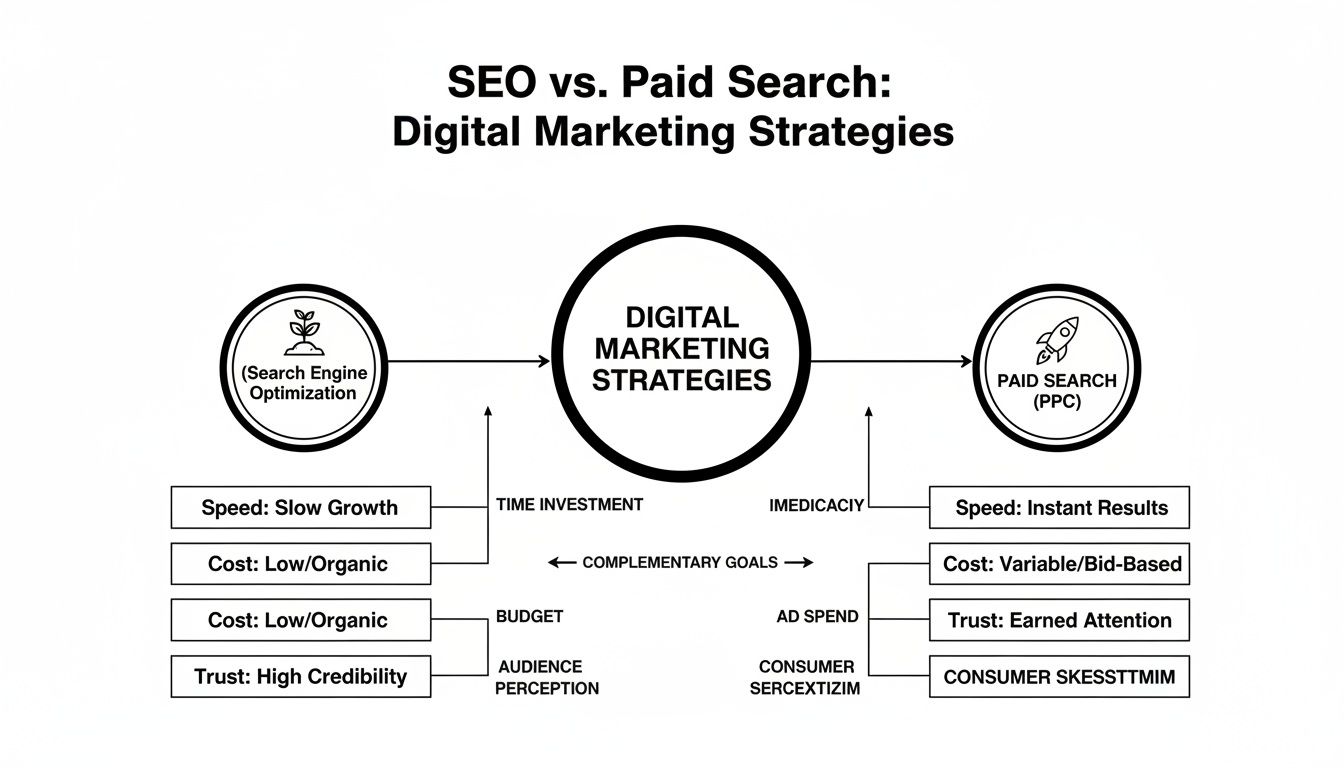
The takeaway is pretty clear: paid search gives you the immediate liftoff of a rocket, while SEO provides the steady, organic growth of a tree. Each has its own strengths depending on your timeline and budget.
Let Paid Data Guide Your SEO Content
One of the smartest ways to get your channels working together is to use PPC data to sharpen your SEO strategy. Paid search campaigns start spitting out a ton of conversion data almost instantly. You can quickly see which keywords don't just get clicks but actually lead to sales or quote requests for your charbroilers and commercial ovens.
This information is pure gold for your content team. Instead of guessing which topics will attract actual buyers, you can use high-converting PPC keyword data to plan your blog posting and fine-tune your product pages. If you find out that "buy stainless steel 3 door freezer" converts like crazy in your ads, you can build a detailed, SEO-focused buying guide around that exact phrase through our expert article writing services.
This tactic takes the guesswork out of your SEO content plan. You end up putting your resources into creating articles and pages that you already know attract customers ready to pull out their credit cards.
Retarget Organic Visitors to Close the Deal
A customer’s journey is rarely a straight line. A potential buyer might find your website through an organic search for "best commercial charbroiler reviews," read your blog post, and then leave to do a little more homework. Without a unified strategy, that lead could be gone for good.
This is where retargeting comes in. By using paid ads, you can strategically get back in front of those organic visitors. You can show them display or social media ads featuring the exact charbroiler models they were looking at on your site. This keeps your brand fresh in their mind and gives them a gentle nudge back toward making a purchase.
By combining the reach of SEO with the precision of paid retargeting, you create a safety net for your sales funnel. You attract users with valuable organic content and use targeted ads to bring back the ones who aren't ready to buy on their first visit, dramatically increasing your overall conversion rate.
Dominate the SERP for Maximum Trust
Owning both the top paid ad and the top organic result for a critical keyword is the ultimate power move in search marketing. This strategy, known as SERP domination, does more than just double your visibility—it sends a huge psychological signal to potential buyers.
When a restaurant owner searches for "commercial kitchen ventilation hoods" and sees your brand in the top ad and the number one organic spot, it builds massive credibility. It instantly positions your company as the undeniable authority and market leader. This boosts trust and has been proven to significantly increase the total click-through rate for both of your listings.
This approach is especially powerful in competitive markets. Considering that Google holds about 90% of the global search market share, dominating its results page is a no-brainer. By locking down both paid and organic real estate, you push competitors further down the page and cement your brand's authority in the eyes of your most valuable customers. To dig deeper into advanced integration tactics, check out how PPC can drive SEO domination by leveraging these shared insights.
Here’s a look at how to get your own integrated search marketing plan off the ground.
Your Integrated Search Marketing Action Plan
Alright, let's bring this all together. The question stops being "Should I do SEO or PPC?" and becomes "How do I get them working together right now?"
For a restaurant equipment supplier, the goal is to create a feedback loop where each channel makes the other one smarter. This isn't about theory; it's a simple, practical framework you can start using today.
Think of it this way: your paid search campaigns are your quick-fire testing lab. Your SEO work is the long-term project, like building a solid foundation for a skyscraper. The real magic happens when insights from the lab directly inform your construction plans, making sure not a single dollar or minute is wasted.
Your First Steps to Integration
You don't need a huge budget or a total marketing overhaul to get started. It's all about small, smart steps that build momentum and, most importantly, start gathering real-world data. This is where you learn what your actual customers respond to.
Here’s a simple checklist to get the ball rolling:
-
Unified Keyword Research: Do your keyword research with both SEO and PPC in mind from the get-go. Pull out the high-intent, "ready-to-buy" keywords (like "buy commercial charbroiler") for your first paid ads. Then, find the informational keywords (like "charbroiler cleaning guide") that are perfect for foundational blog posts.
-
Launch a Small Data-Gathering PPC Campaign: Fire up a small, tightly-budgeted campaign on a platform like Google Ads. Don't try to boil the ocean. Just focus on one product category—say, charbroilers—and target a few of your best transactional keywords. The goal here isn't to make a million sales overnight. It's to get hard data on which search terms, ads, and landing pages actually get people to click and convert.
-
Optimize a Core Landing Page: Make sure the landing page you're sending that PPC traffic to is dialed in. It needs a crystal-clear headline that matches the ad, it has to load fast, and it needs an obvious call-to-action. This single page will end up serving both your paid traffic and, down the line, your organic traffic.
Creating a Cycle of Improvement
Once that first campaign is live and collecting data, the real work begins. This data is the fuel for your entire seo and paid search strategy.
Think of your paid search data as a direct line to your customers' minds. The keywords they use and the ads they click on are not just metrics; they are clear signals of buyer intent. Use this intelligence to make your SEO efforts smarter, faster, and more effective from day one.
From here, you can start feeding what you learn from PPC right into your long-term SEO plan.
Did a specific ad headline get an amazing click-through rate? Great. Adapt that headline and use it for the title tag and meta description on the matching product page. This is how you stop treating these as two separate things and start winning with a truly integrated approach.
Frequently Asked Questions
It's natural to have questions when you're figuring out how to get more customers online, especially when you're busy running a restaurant equipment business. Let's tackle some of the most common ones we hear from suppliers just like you.
These answers should help clear things up and give you a solid foundation for a marketing plan that actually grows your company.
Which Should I Start With If My Budget Is Tight?
If you need leads hitting your inbox right now and you're working with a tight budget, a small, highly-targeted paid search campaign is your best move. It gets you immediate traffic, sure, but the real gold is the keyword data it spits out. You’ll see exactly what your customers are typing into Google.
But for real, lasting growth, you can't skip SEO. The smartest play? Use that initial paid search campaign as a recon mission. Take the keyword intel you gather and pour it directly into your foundational SEO work, like beefing up product pages and writing helpful blog posts. That way, your ad spend isn't just a short-term fix—it’s making your long-term SEO investment smarter from day one.
How Long Until I See Real Results From SEO?
SEO is a marathon, not a sprint. It's about building momentum. You might see some small upticks in traffic within a few weeks, but ranking on the first page for competitive terms like "commercial freezer"? That typically takes a solid 6 to 12 months of consistent effort.
Think of SEO like building a rock-solid reputation in the foodservice industry. It takes time and consistent work—publishing expert advice through blog posting, getting shoutouts from industry blogs via blogger outreach—but the result is a trusted brand that pulls in a steady stream of "free" leads that paid ads just can't replicate.
How fast you get there depends on a few things: how tough your market is, your website's current authority, and how consistently you work at it. The payoff, though, is a powerful asset that keeps generating traffic and leads long after you've put in the initial work.
Can I Send Paid Traffic to Any Page on My Site?
You can, but you absolutely shouldn't. The success of your paid ads is hitched directly to the quality of the landing page you're sending people to. A generic homepage or a cluttered category page just won't cut it and will burn through your budget.
Here’s a pro tip: a page that’s already well-optimized for SEO is your secret weapon for paid ads. A page with genuinely helpful content, a clear call-to-action, and a fast load time will almost always perform better. Google actually rewards this with a higher Quality Score, which lowers your cost-per-click and bumps up your ad position. When you optimize a landing page for the user, you’re hitting two birds with one stone—improving both your SEO and paid search results and getting a better return on every single dollar you spend.
At Charbroilers.com, we know the right equipment is the heart of any great kitchen. Whether you're looking for countertop models for a small bistro or heavy-duty floor models for a bustling diner, our wide selection of commercial charbroilers is designed to deliver the perfect smoky flavor and iconic grill marks your customers love. Explore our collection of high-quality charbroilers today and elevate your menu.