

Optimize Profits with Our Restaurant Profit Margin Calculator
A restaurant profit margin calculator is one of the most honest tools you'll have in your arsenal. It cuts through the noise and shows you the true financial health of your business by stacking your revenue up against your costs.
It tells you exactly how much money you’re actually keeping from every dollar that comes in. This isn't about guesswork; it's about getting hard data you can use to build a more sustainable—and profitable—operation.
Why Most Restaurant Profit Margins Are So Thin

Before we jump into the numbers, we need to talk about the financial reality of the restaurant world. This industry is famous for its razor-thin margins. If you don't understand why, you'll have a tough time improving your own numbers.
I've seen so many owners look at a busy dining room and strong sales figures and assume they're crushing it. But revenue alone doesn't paint the full picture.
The real challenge comes down to understanding the difference between two critical numbers: gross profit and net profit.
Gross Profit vs. Net Profit
Gross profit is what you have left after subtracting your Cost of Goods Sold (CoGS) from your total revenue. CoGS is basically just your food and beverage costs. This number often looks pretty good, sometimes sitting around 70%, and it mainly tells you how well you've priced your menu against ingredient costs.
Seeing a high gross profit can give you a dangerous false sense of security.
The number that really matters is your net profit. This is the money you actually take home after every single expense is paid. We're talking not just food, but also labor, rent, utilities, marketing, insurance, and that leaky faucet you had to fix last week. This is the metric that determines if your restaurant is actually viable.
Think about it this way: that $15 burger might only cost you $4.50 in ingredients, giving you a healthy 70% gross margin. But once you pay the cook who made it, the server who delivered it, the electricity for the grill, and a slice of your rent, the actual profit might be less than a buck. That's where the dream meets reality.
To get a clearer picture of how these two metrics function, here’s a quick breakdown.
Gross Profit vs. Net Profit At a Glance
| Metric | What It Measures | Why It's Important for You |
|---|---|---|
| Gross Profit | Your menu's profitability before operating costs. | Helps you analyze food costs, menu pricing, and supplier negotiations. |
| Net Profit | The overall profitability of your entire business. | Shows your true financial health and long-term sustainability. |
Understanding both is key. A strong gross profit shows you're buying and pricing ingredients well, while a healthy net profit proves your entire business model is working.
This all leads to the industry benchmark, which can be a tough pill to swallow. The average net profit margin for restaurants globally hovers between 3% and 5%. It's a remarkably tight window that highlights just how tough this business is.
Sure, the top performers might hit 10%, but they are the exception, not the rule. Most restaurants, especially full-service spots, are constantly battling rising labor costs, unpredictable food prices, and the commissions from third-party delivery apps. These pressures keep most operators at the lower end of that spectrum. For a deeper dive into these figures, you can discover more restaurant industry statistics.
Different concepts also face different pressures. A full-service restaurant has much higher labor and overhead than a quick-service joint that relies on high volume. Knowing these industry-wide challenges gives you the right context before you start plugging your own numbers into a restaurant profit margin calculator.
Gathering the Right Financial Data for Your Calculation
Any calculation is only as good as the numbers you feed into it. Before you can get a real handle on your restaurant's profitability, you need to pull together the right financial figures. Think of it like prepping your mise en place before service—if you're missing an ingredient, the final dish just won't come out right.
This means you’ve got to track every dollar coming in and every dollar going out. To make this initial data pull less of a headache, you can use tools like financial data extraction software to automatically grab the numbers from bank statements and other financial docs.
Unpacking Your Revenue Streams
First things first, you need your Total Revenue. This is your top-line number, the grand total of all the money your restaurant brought in over a specific period, usually a month. You have to be thorough here. It’s not just about what the POS says from dine-in sales.
Your total revenue number needs to account for every single way you make money:
- Dine-in Sales: The bread and butter of your business, all captured right there in your POS system.
- Takeout and Curbside Orders: Any sale placed directly with your restaurant, whether over the phone or through your own website.
- Third-Party Delivery: This is the revenue from apps like DoorDash or Uber Eats. Crucially, this is the amount before they take their cut.
- Catering and Events: Income from any private parties, off-site catering gigs, or special ticketed events you hosted.
- Merchandise Sales: Don't forget the extras! This includes any branded t-shirts, house-made sauces, or gift cards you sold.
This simple infographic breaks down the basic flow of how to gather your data.
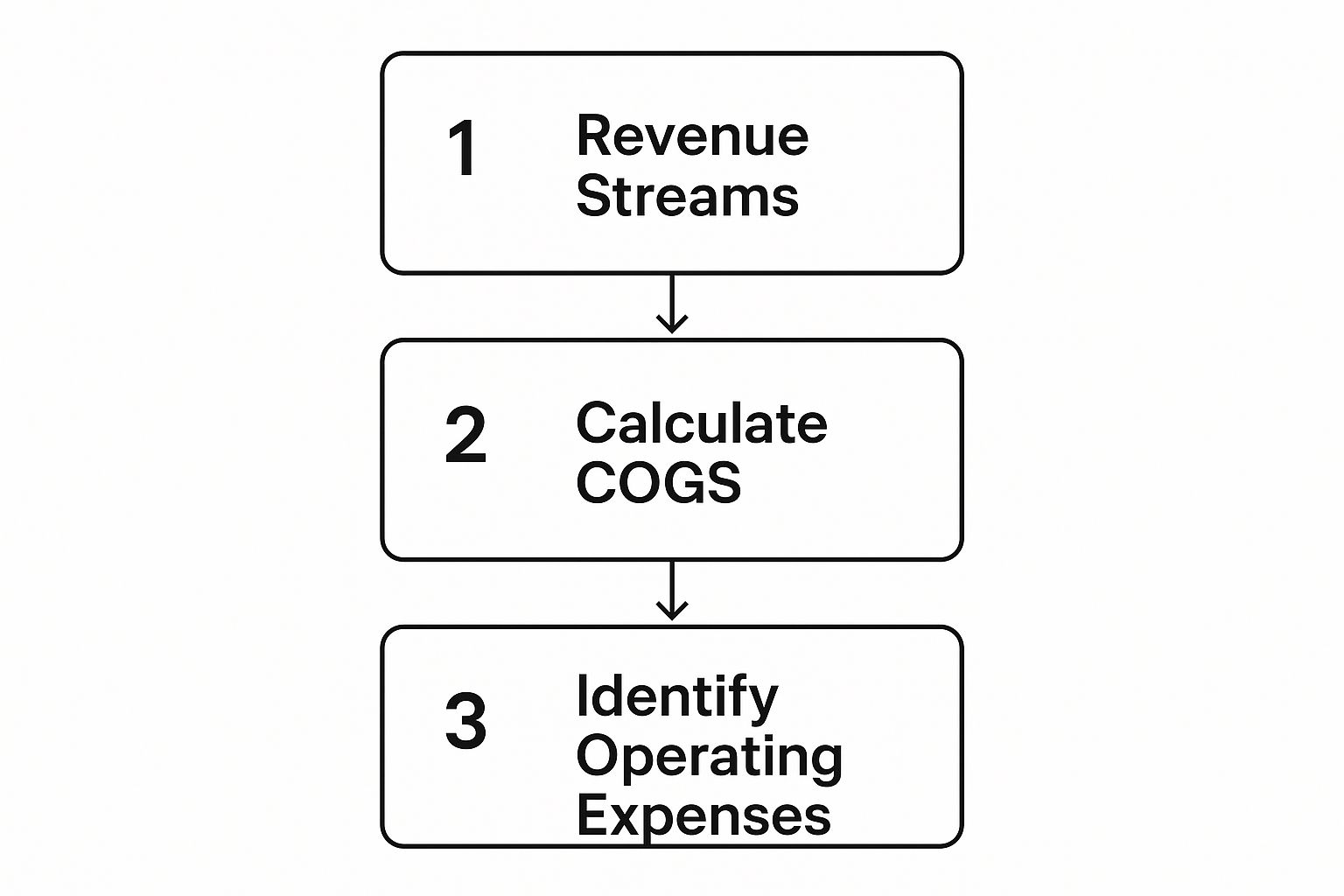
As you can see, a precise calculation always starts with revenue before digging into your two major expense categories.
Identifying Your Key Expense Categories
Once you've got your total revenue nailed down, it's time to tally up your costs. These generally fall into two main buckets.
1. Cost of Goods Sold (CoGS)
This is everything that directly goes into the food and drinks you serve. Think of it as the "cost" side of your menu pricing. Getting this number right is absolutely essential for understanding your gross profit.
Make sure you're accounting for:
- All food and ingredient purchases
- Every beverage, both alcoholic and non-alcoholic
- All your to-go packaging, from containers and bags to cutlery
2. Operating Expenses (OpEx)
This bucket holds all the other costs of keeping the lights on and the doors open. This is often where sneaky, hidden expenses can pop up and surprise you, so it pays to be meticulous.
Your P&L statement is your best friend here. It should neatly categorize everything from payroll and rent to that unexpected plumbing repair. Don't rely on memory; use the documents you already have.
Your OpEx list must include labor costs (salaries, hourly wages, payroll taxes), your rent or mortgage payment, all utilities (gas, electric, water), marketing spend, insurance, POS and other software subscriptions, and any repairs and maintenance. Getting all these figures together gives you the complete financial picture you need to do a meaningful analysis.
How to Calculate Your Restaurant's Profit Margin

Alright, you've got your financial data organized. Now it's time to roll up your sleeves and get into the formulas. Calculating your profit margins is more than just an accounting chore—it's how you translate the day-to-day grind into a clear financial snapshot. We'll kick things off with the big picture to check your menu's health, then we'll drill down to the numbers that really show if your business is built to last.
Don't let the financial lingo intimidate you. We're going to keep it simple and practical. I'll walk you through everything using a fictional restaurant, "The Corner Bistro," so you can see exactly how it works.
Calculating Gross Profit Margin
Your Gross Profit Margin is the first, and maybe the simplest, health check for your restaurant. Think of it as a quick pulse check on your menu. It tells you how much cash is left from sales after you've paid only for the ingredients and drinks you sold (your CoGS). A strong gross margin is a sign that your menu is priced right against what you're paying your suppliers.
The formula is pretty straightforward:
Gross Profit Margin = ((Total Revenue - CoGS) / Total Revenue) x 100
Let’s run the numbers for The Corner Bistro for the month of April.
- Total Revenue: $60,000
- Cost of Goods Sold (CoGS): $18,000
First, you figure out the gross profit: $60,000 (Revenue) - $18,000 (CoGS) = $42,000.
Next, divide that gross profit by your total revenue: $42,000 / $60,000 = 0.70.
Finally, just multiply by 100 to get your percentage: 0.70 x 100 = 70%.
So, The Corner Bistro has a Gross Profit Margin of 70%. That's a solid number. It means for every dollar that comes in, they keep 70 cents to put toward everything else—labor, rent, utilities, you name it.
Calculating Net Profit Margin
Now for the number that truly matters: your Net Profit Margin. This is the bottom line. It's the real measure of your restaurant's financial success because it shows you what percentage of revenue you actually keep as profit after every single bill is paid. We're talking payroll, rent, marketing, utilities—all of it.
Here’s what the formula looks like:
Net Profit Margin = ((Total Revenue - Total Expenses) / Total Revenue) x 100
Just remember, "Total Expenses" in this formula means your CoGS plus all of your other operating expenses (OpEx).
Let's stick with The Corner Bistro's April figures.
- Total Revenue: $60,000
- CoGS: $18,000
- Operating Expenses (Labor, Rent, Utilities, etc.): $39,000
First, add up all your expenses: $18,000 (CoGS) + $39,000 (OpEx) = $57,000.
Then, find out your net profit: $60,000 (Revenue) - $57,000 (Total Expenses) = $3,000.
Now, divide that by your total revenue: $3,000 / $60,000 = 0.05.
And finally, multiply by 100: 0.05 x 100 = 5%.
The Corner Bistro’s Net Profit Margin is 5%, which puts them right in the zone for the typical industry average of 3-5%. It means after all the blood, sweat, and tears, they're pocketing 5 cents of profit for every dollar earned. Knowing this number is the critical first step to figuring out how to make it bigger.
To get an even deeper understanding of your financial tipping points, it’s a smart move to perform a comprehensive break-even analysis to pinpoint the exact moment your revenue covers all your costs.
What Your Profit Margin Results Are Telling You
Getting the number is the easy part. The real work—and the real value—comes from figuring out what that percentage is trying to tell you about your restaurant. Just a single point can reveal a ton about everything from your menu pricing to how efficiently your kitchen is running.
Think of your profit margin as a diagnostic tool. It’s not just a grade; it's a map that shows you exactly where your business is strong and where it’s bleeding money. A low number isn't a failure. It’s a signal pointing you toward what needs your attention right now.
Benchmarking Your Performance
First things first: you need context. How do your numbers stack up against the rest of the industry? It’s important to remember that not all restaurants play by the same rules. Profit margins can swing wildly depending on the type of place you’re running.
For example, full-service restaurants in the US average a net profit margin of around 9.8%, according to some surveys. Broader analyses, however, often put the average closer to 3–6% once you factor in less efficient operations. Then you have fast-casual and quick-service restaurants (QSRs), which can pull in much healthier margins. Square’s data shows some fast-casual spots hitting 17.4% to 21.2% net margins when they’re using modern inventory and labor tools. You can read the full research about restaurant industry statistics to get a better feel for how different segments perform.
This context is everything. If your fine-dining restaurant is at a 4% net margin, you might be doing just fine. But if your QSR is sitting at 4%, that’s a red flag telling you something is off.
Diagnosing Financial Issues
Once you have your benchmark, it's time to put on your detective hat and dig in. Different margin results point to very different problems. This is where you shift from just doing math to making strategic decisions.
-
Low Gross Profit Margin: This almost always leads back to your menu. Your food costs could be creeping up, or maybe your prices are just too low for what you're serving. It could even be an operational issue, like poor portion control or too much food waste.
-
Low Net Profit Margin (with a healthy Gross Margin): This is a different beast entirely. It tells you the problem isn't your cost of goods, but your overhead. High labor costs are the usual suspect, but it could also be soaring rent, utility bills, or a marketing budget that isn't pulling its weight.
A healthy gross margin means you’re pricing your dishes correctly, but a low net margin means your operational costs are eating all of those profits before they reach your bank account. It's like having a fast car with a leaky gas tank—you’re burning through fuel without getting very far.
Uncovering Growth Opportunities
Analyzing your profit margin isn't just about finding problems; it’s also about spotting opportunities. If high operating costs are squeezing your net margin, the next logical step is to find ways to increase revenue without driving those costs up even more. Smart digital marketing can be a game-changer here.
Improving your local SEO, for instance, can bring more high-intent customers through your door without the hefty price tag of traditional ads. When people find you through a quick Google search, you're boosting sales and adding directly to your bottom line. We specialize in providing content services like article writing and blogger outreach that build online authority for restaurant equipment supply websites, helping them connect with their customers. To make that happen, your website needs to be set up correctly. Our guide on setting up your analytics tracking ID is a great place to start.
A stronger online presence fuels revenue, which in turn improves your whole profit equation. That extra cash flow can then justify future investments in things like that new, more efficient oven or walk-in cooler you've been eyeing.
Actionable Strategies to Improve Your Profitability

Okay, so your restaurant profit margin calculator has laid it all out. You know where the financial leaks are. Now what? Just knowing the problem exists won’t fix it; you need a solid game plan to shore up both your gross and net margins. Think of it as moving from diagnosis to treatment.
Improving profitability isn't about one giant, disruptive change. It’s about making a series of smart, targeted tweaks across your entire operation. Little by little, these adjustments add up to a much healthier bottom line. Let's start with your menu and suppliers, then move on to the costs of just keeping the lights on.
Boosting Your Gross Margin
Your gross profit margin is a straight-up look at the relationship between your menu prices and what it costs to make the food. If that number is looking a little thin, it's a clear signal you need to take a hard look at what you’re selling or what you’re paying for ingredients.
One of the most powerful tools in your arsenal is menu engineering. This is all about diving into your sales data to find your "stars"—the dishes that are both popular and highly profitable. Once you know what they are, you can strategically place them on your menu and train your staff to upsell them. You’ll be guiding customers toward higher-margin choices, boosting profits without even touching your prices.
Next, it's time to have a chat with your suppliers. Don't be afraid to negotiate. You're a loyal, consistent customer, and that’s valuable. Many vendors are willing to offer better pricing or bulk discounts to keep your business.
A common mistake I see is treating supplier relationships as purely transactional. Building a real partnership can lead to better deals, first dibs on seasonal ingredients, and even more flexible payment terms. A 5% reduction in food costs can directly translate to a 5% increase in your net profit.
Finally, get serious about waste reduction protocols. Track everything from prep waste in the kitchen to the food that comes back on customers' plates. This data is gold—it shows you where the opportunities are, whether it’s tweaking portion sizes or finding creative ways to repurpose ingredients. You’ll be turning potential losses into profit.
Increasing Your Net Margin
You can have a fantastic gross margin, but it can get wiped out in a hurry by high operating costs. Pushing your net profit higher means getting smarter about how you manage labor, utilities, and even how you get people in the door.
Optimizing staff schedules is absolutely crucial. Labor is often a restaurant's biggest expense right after food. Use your POS data to match your staffing levels to your actual customer flow. Having too many servers on a slow Tuesday lunch is just as damaging to your bottom line as being understaffed during a chaotic Friday night rush.
Investing in energy-efficient equipment is another move that pays off big time. Sure, the upfront cost of an ENERGY STAR certified charbroiler or refrigerator might seem steep. But the long-term savings on your utility bills are substantial, directly improving your net margin month after month. These upgrades often pay for themselves much faster than you’d think.
Lastly, focus on bringing customers through the door as efficiently as possible. Targeted digital marketing, especially local SEO and strategic copywriting, is a super cost-effective way to drive sales. When your restaurant pops up at the top of Google for local searches, you attract diners who are ready to eat, all without the high price tag of traditional advertising.
Building a strong online presence requires authority. This is why many restaurant equipment suppliers focus on building powerful backlinks to cement their credibility and pull in more organic traffic. The exact same principle applies to your restaurant. A strong online game drives revenue, making those critical equipment investments possible in the first place.
Common Questions About Restaurant Profitability
Even with a solid calculator, you're going to have questions. It's totally natural. Making the numbers work for you is the real goal here, and understanding the details can mean the difference between just tracking data and actually driving real growth. Let's tackle some of the most common questions to help you get the most out of your profit margin data.
When you have clear financial insights, you can make smarter decisions on everything from menu pricing to buying a new piece of kitchen equipment. That's what keeps your doors open for the long haul.
How Often Should I Calculate My Profit Margin?
You really need to be calculating your profit margin monthly. Think of it as the sweet spot. It's frequent enough to catch problems—like a spike in food costs or a bad labor schedule—before they have a chance to snowball into something much bigger. Your monthly Profit & Loss (P&L) statement has everything you need to do this.
Sure, a quarterly review is better than nothing, but waiting three whole months can be a huge risk. A small issue that pops up in month one can become a serious financial drain by the time you finally look at the numbers at the end of the quarter.
What Are the Most Common Calculation Mistakes?
The single biggest mistake I see owners make is confusing gross profit with net profit. It’s easy to do. Seeing a 70% gross margin on a popular dish feels fantastic, but that number is pure vanity until you subtract all the other costs like labor, rent, and utilities. This is where a lot of new operators get a false sense of security.
Another classic error is working with incomplete data. It's so easy to forget those smaller, recurring expenses. I'm talking about things like your software subscriptions, marketing tools, or that unexpected repair bill. They all chip away at your net profit. Finally, not tracking your inventory changes accurately can throw your Cost of Goods Sold (CoGS) way off, giving you a number that's just plain wrong.
The key takeaway is to be meticulous. Every forgotten expense, no matter how small, makes your final profit margin number less accurate and therefore less useful for making strategic business decisions.
Beyond a Calculator, What Tools Help?
Modern restaurants just can't run on spreadsheets alone anymore. Your Point of Sale (POS) system is the central hub, giving you all that critical sales data. To get a handle on food costs, you absolutely need specialized inventory management software to track what you have, cut down on waste, and watch your supplier pricing.
For the big-picture view, accounting software like QuickBooks is essential for pulling together accurate P&L statements. And to manage your biggest expense, employee scheduling software is a lifesaver. It helps you line up staffing with actual customer traffic so you aren't bleeding money on overstaffing. A strong online presence is also a critical tool; our expertise in SEO and local citation services helps equipment suppliers thrive online, and those same principles can help you attract more customers. For a deeper dive, check out our guide on how to build consistent traffic growth through Google updates.
Ready to boost your menu's appeal and profitability? A high-quality charbroiler from Charbroilers.com can deliver that perfect smoky flavor and attractive grill marks your customers crave. Explore our selection of commercial charbroilers and find the perfect model to elevate your culinary offerings at https://charbroilers.com.