

Your Guide to Restaurant Auctions Online
Outfitting a commercial kitchen is a serious investment. But what if there was a way to get high-quality equipment for a fraction of what you'd pay retail? That's where restaurant auctions online come in.
For new restaurateurs on a tight budget or established operators looking to upgrade smartly, these platforms are a game-changer. You can find everything from charbroilers to walk-in coolers, often at discounts of 60% or more. This strategic approach helps manage assets effectively in an industry where every dollar counts, a key consideration for restaurant equipment supply websites looking to provide value to their audience.
Why Smart Restaurateurs Use Online Auctions
Let’s be honest, equipping a professional kitchen is one of the biggest checks you'll write. The sky-high cost of brand-new gear can drain your capital before you even serve your first customer. This is exactly why savvy restaurant owners are turning to online auctions, not just to save a buck, but as a core part of their business strategy. It's a powerful way to make your money work harder for you.
This isn't just about finding a cheap stand mixer. It's about intelligent asset management. A startup pizzeria can outfit their entire operation—deck ovens, prep tables, refrigeration, you name it—for thousands less than new. That cash they saved? It can go straight back into a killer marketing campaign and hiring a solid opening crew, giving them a real fighting chance from day one.
The Strategic Advantage Beyond Price
While the savings are the main draw, the benefits of using restaurant auctions online go way beyond the sticker price. These platforms offer a level of access and transparency that you just don't get with old-school liquidation methods.
- Unmatched Variety: Auctions bring together inventory from all over—restaurants that have closed, overstock deals, and equipment from places that are upgrading. This gives you a massive selection of gear all in one spot.
- Efficient Liquidation: On the flip side, if you're renovating or closing a location, an online auction is a streamlined way to sell your used assets. You can reach a huge pool of interested buyers quickly, without the hassle of listing items one by one.
- Informed Decision-Making: Good auction sites give you everything you need to know. You'll find detailed descriptions, plenty of photos, and sometimes even service records, so you can evaluate a piece of equipment thoroughly without ever leaving your office.
This move to digital isn't just a trend; it's a fundamental shift in how the food service industry operates. We're seeing technology change everything from ordering systems to how owners handle their physical assets. As part of a market projected to hit $4.03 trillion globally in 2025, restaurant operators are using these platforms to stay lean and competitive. You can dig deeper into restaurant sales statistics and industry growth on restroworks.com.
The real power of online auctions is turning a potential financial headache—equipment acquisition or liquidation—into a distinct business advantage. It empowers you to be agile, resourceful, and financially resilient.
Ultimately, using online auctions is a strategic play. It lets you build out a fully capable kitchen for a much smaller initial investment. That frees up critical resources so you can focus on what really matters: creating an amazing experience for your customers.
Here’s a quick look at why online auctions are often the smarter choice compared to traditional buying or selling methods.
Online Auctions vs Traditional Liquidation Methods
| Feature | Online Auctions | Traditional Methods |
|---|---|---|
| Reach | Global audience of potential buyers | Limited to local foot traffic and contacts |
| Speed | Fast-paced, with set end dates for quick turnover | Can be a slow, drawn-out process |
| Pricing | Market-driven, competitive bidding sets the price | Often relies on fixed pricing or negotiation |
| Convenience | Buy or sell from anywhere, anytime | Requires physical presence and on-site management |
| Variety | Huge, diverse inventory from multiple sources | Limited to what's available from a single seller |
As you can see, the online model offers clear advantages in efficiency and reach, whether you're trying to outfit a new kitchen or liquidate existing assets.
Finding Trustworthy Restaurant Auctions Online

The internet is swimming with supposed deals, but when it comes to restaurant auctions online, you have to separate the real opportunities from the risks. Finding a reliable auction house is the most critical part of the entire process. Honestly, it’s a lot like sourcing ingredients for your menu—you absolutely have to know and trust your supplier.
To get started, you need to get specific with your search. Forget generic phrases. Instead, try searching for things like "commercial kitchen liquidation auction" or "used restaurant equipment auction [your city]". This small tweak alone will help you cut through the clutter and lead you to professional auctioneers who specialize in this equipment, not just general marketplaces.
Once you’ve got a shortlist of potential auction houses, it's time to put on your detective hat.
Vetting the Auction Company
A good, trustworthy auction company won't make you hunt for information. They'll be upfront and transparent. As you review their websites, keep an eye out for these tell-tale signs of a professional operation.
- A Solid Website: Look for a clean, easy-to-navigate site with high-quality photos. If you see blurry pictures or one-line, vague descriptions, that’s a huge red flag.
- Real Contact Info: Can you easily find a physical address and a phone number? Legitimate companies aren't hiding. They want you to be able to reach them.
- Clear Terms & Conditions: Dig into the fine print. You need to understand the buyer’s premium, what payment methods they accept, and the pickup/shipping rules. If this stuff is buried or confusing, be careful.
Here's a pro tip: sign up for newsletters from a few companies that look promising. It's a great, low-effort way to get a feel for their consistency and professionalism over time, all while keeping you in the loop on upcoming sales.
A legitimate auctioneer wants you to be a successful, repeat bidder. They achieve this through transparency, clear communication, and accurate listings—not by hiding details in the fine print.
Verifying Reputation and Building Confidence
Don't just take the auctioneer's website at face value. You need to see what other buyers are saying about them. A quick Google search for the company’s name plus "reviews" or even "complaints" can tell you a lot. Check out industry forums or local business groups, too.
A company's digital footprint is another good clue. A strong, active online presence usually means they're a stable, ongoing business. For suppliers in this space, building credibility often starts with a solid foundation, like an effective local citation service that helps serious buyers find and trust them more easily.
Before you ever place a real bid, it’s wise to "attend" an auction or two just to watch. See how the bidding works, what items actually sell for, and get a feel for the rhythm of the platform. This is your no-risk practice run. It builds the confidence you'll need to jump on that perfect charbroiler or convection oven when it finally comes up. This is what separates the casual lookers from the bidders who actually win the good stuff.
Evaluating Equipment You Can't See in Person
Buying equipment sight unseen feels like a gamble, doesn't it? But for anyone serious about restaurant auctions online, it's just part of the game. The trick is to stop thinking of it as a risk and start treating it as a skill—one you can absolutely master. You just need to become a digital detective and train your eyes to spot the details others scroll right past.
Think of the auction photos as your crime scene. Don't just glance. Zoom way in. You're looking for the little tells that reveal an item's true story. On a stainless-steel prep table, for example, don't just look for obvious dents; hunt for faint discoloration near the welds, a classic sign of hidden rust. For a commercial fridge, zoom right in on the rubber door gaskets. If they look cracked, brittle, or have hints of mold, that's an immediate red flag and an added replacement cost you have to budget for.
Mastering the Art of Remote Inspection
Once you've dissected the photos, your real work begins. Auction listings are often light on details, so it's on you to dig deeper. This is where having a list of sharp, specific questions for the auctioneer becomes your secret weapon.
Forget asking vague questions like, "Is it in good condition?" You'll get a vague answer. You need to be precise and show you know what you're talking about.
Try these instead:
- "Can you tell me the operational hours on this convection oven?"
- "What's the maintenance and repair history for this ice machine?"
- "Was this charbroiler used in a high-volume diner or a low-volume cafe?"
- "Are there any known functional issues at all, even minor ones?"
A professional auctioneer expects these kinds of questions. How they respond—or if they respond—tells you a lot. A quick, knowledgeable answer is a good sign; radio silence is not.
Your job as a remote buyer is to gather enough evidence to make an informed bid. Every photo, every detail in the description, and every answer from the auctioneer is a piece of that puzzle.
Always Research the Model Number
The model number is the key that unlocks everything. Once you have it, your real investigation can begin. A quick search will pull up the manufacturer’s spec sheet, user manuals, and even parts diagrams. This isn't just busy work; it's critical intel. That spec sheet, for instance, will tell you the exact electrical or gas requirements, so you know for sure if the unit will even work in your kitchen.
This step also helps you look into the future. Are parts for this specific fryer easy to find and affordable, or are they a special-order nightmare? A few minutes of research can be the difference between a great deal and a multi-thousand-dollar paperweight. Getting into the weeds on model specifics is a must, a subject we explore in our guide on writing a well-researched restaurant equipment blog post.
These digital inspection skills are only becoming more critical. The online auction market is projected to jump from $3.8 billion to over $5.2 billion in 2025, and North America is driving about 41% of that growth. More competition means the buyers who do their homework are the ones who will come out on top. You can discover more insights about the online bidding market's growth at archivemarketresearch.com.
Crafting a Smart Bidding Strategy That Wins
Let’s be honest: winning a restaurant auction isn’t just about having the most money. It’s about having the sharpest strategy. It's way too easy to get caught up in the thrill of the final countdown—what we call "auction fever"—where emotions take over and your budget gets left in the dust. The most critical work you'll do happens long before you ever place that first bid.
Here's the first rule: figure out your absolute maximum bid for an item and write it down. This number isn't a random guess. It’s a calculated figure that needs to account for the item's real-world value, potential repair costs, and all the sneaky hidden fees.
Don't forget the buyer’s premium! This is the percentage fee, usually 10-18%, that the auction house tacks onto your winning bid. A $1,000 piece of equipment with a 15% premium actually costs you $1,150 before you even think about shipping. Ignoring these costs is the fastest way to turn a fantastic deal into a financial headache.
Understanding How the Game Is Played
To bid effectively, you need to know the rules. You'll run into a couple of key terms again and again: "proxy bidding" and "soft close."
- Proxy Bidding (or Max Bid): Think of this as your secret weapon against auction fever. You enter the highest price you're willing to pay, and the system automatically places bids for you in the smallest increments needed to keep you in the lead. If your max is $500 and the current bid is $250, the system will only bid up for you if someone else jumps in. It keeps you from getting swept up in the moment.
- Soft Close: This feature is designed to prevent "sniping," where someone swoops in at the very last second to steal the item. If a bid is placed in the final minute or two, the auction clock extends, giving everyone else a fair chance to respond. It ensures the item goes to the person truly willing to pay the most, not just the one with the fastest internet.
This simple breakdown shows just how straightforward it is to get started.
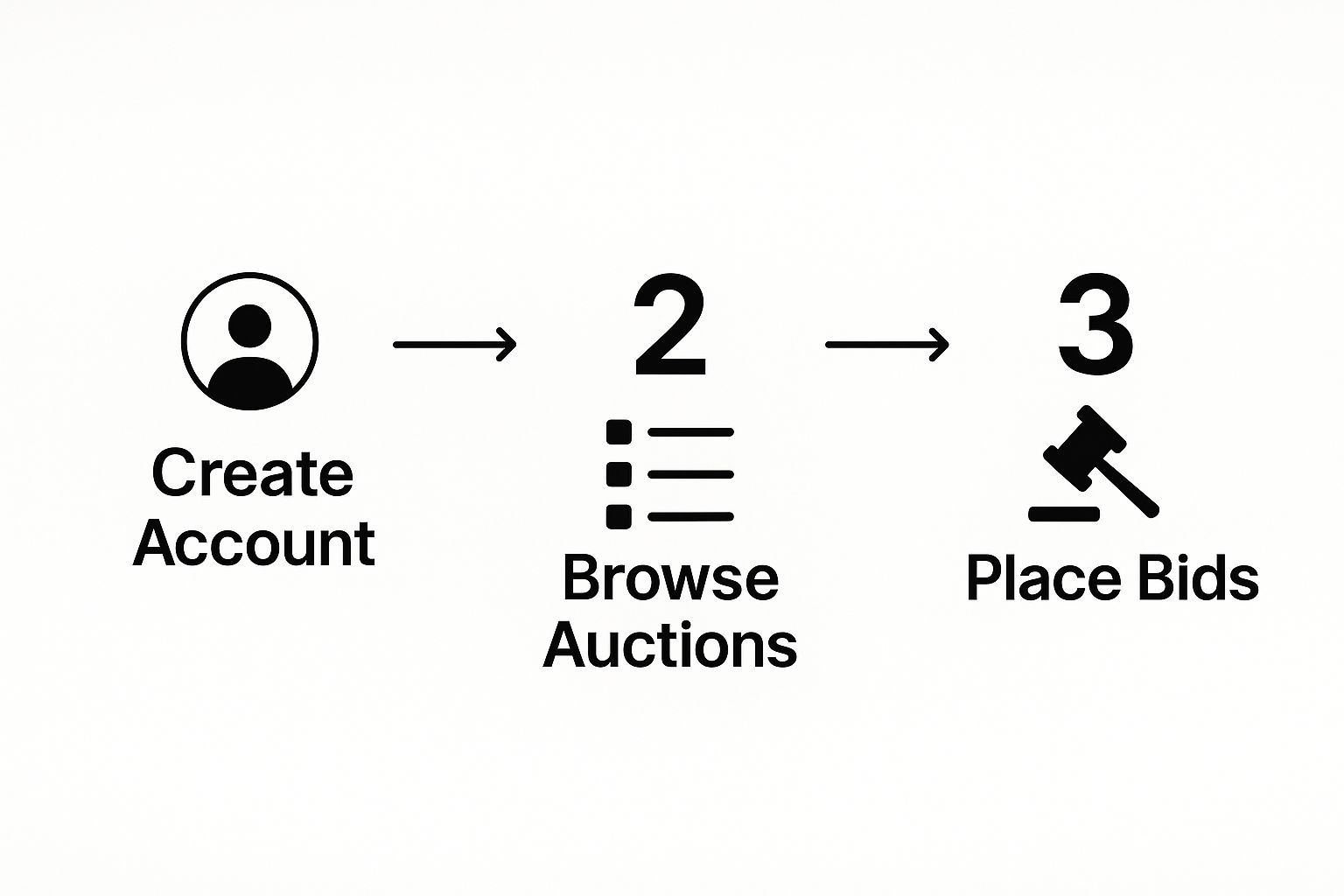
It really boils down to those three steps: create an account, browse the listings, and place your bids. That's the core of every online auction experience.
A Real-World Bidding Scenario
Let's walk through an example. Say you've found the perfect charbroiler. Brand new, it costs a steep $3,000. You've done your homework and know that used models in good shape go for around $1,500. After a close look at the auction photos, you decide to budget $200 just in case it needs a new gas valve. The auction has a 15% buyer’s premium, and you've gotten a freight quote for $300.
Time to do the math. You start with the market value and subtract your costs:
$1,500 (market value) - $200 (repairs) - $300 (shipping) = $1,000.
But wait, you haven't accounted for that 15% premium yet. To make sure your total cost doesn't exceed your budget, your true maximum bid should land somewhere around $870. If you win at that price, your final bill—including the premium and shipping—will be about $1,370. That’s a serious saving.
For a deeper dive into the psychology and tactics of bidding, there are fantastic resources on mastering online auction bidding that apply just as well to kitchen equipment as they do to anything else.
A winning strategy isn't about placing the highest bid; it's about placing the smartest one. Your final number should be calculated, unemotional, and set in stone before the auction begins.
You Won the Bid! Now What? Handling the Post-Auction Logistics
That thrill of winning is fantastic, isn't it? You snagged the perfect piece of equipment for a fraction of the retail price. But take a moment to celebrate, because the real work is just beginning. Getting so caught up in the bidding war that you forget about the aftermath is a classic rookie mistake. Turning that great deal into a real win depends entirely on what you do next.
Once that virtual gavel falls, you're on the clock. The first thing that hits your inbox will be an invoice. Pay it. Immediately. Auction houses are not flexible here; you usually have just 24 to 48 hours. They'll specify how they want their money, and for bigger ticket items, that almost always means a wire transfer or certified funds.
With payment sorted, you're facing your next, and most critical, deadline: the pickup window.
The Realities of Pickup and Removal
Auction houses are serious about their removal timelines. We're often talking about just a few days to get your items out. If you miss that window, you’re in a world of hurt. Not only do you lose the equipment, but you lose your money, too. It’s a harsh reality, but it's the rule. This is why you must be 100% certain you can make the pickup before you even think about placing a bid.
When you show up, don't expect a retail experience. You are entirely responsible for getting your equipment out of there.
- Bring Your Gear: At a minimum, you’ll want a heavy-duty dolly, ratchet straps, and a basic toolkit. You never know if you'll need to remove a door or a small component to squeeze through a tight space.
- Bring Muscle: A commercial reach-in cooler can easily top 500 pounds. The auction staff is there to supervise, not to be your moving crew. Assuming they'll help you load is a mistake you only make once.
- Final Inspection: Give the item one last look-over. Make sure it’s the same one you bid on and that its condition matches what you saw in the listing before you start the heavy lifting.
Remember the auction mantra: "as-is, where-is." That applies to removal, too. You have to disconnect and move everything safely, without damaging the building. A little prep goes a long way.
Shipping Heavy Equipment? Plan Ahead
What if the auction is across the country? You’ll need to line up freight shipping, and you need to do it fast. The moment you win, start getting LTL (Less-Than-Truckload) quotes. You'll need the dimensions and approximate weight from the auction listing to do this.
Here’s a critical detail: most restaurant locations and many auction warehouses don't have a loading dock. This is where you can get hit with surprise fees. When you're arranging the shipment, you need to understand What Is Liftgate Service and When Do You Need It?. A liftgate is a platform on the back of the truck that lowers your heavy equipment to the ground, and it's absolutely essential if you don't have a dock. It's always an extra charge, so factor it in.
For restaurateurs setting up shop in a major city, sometimes sourcing closer to home can sidestep some of these logistical headaches. If you're opening in Southern California, for example, browsing a specialized inventory of Los Angeles restaurant equipment might offer delivery options that save you time and money. Carefully planning these final steps is how you ensure that amazing auction deal actually makes it into your kitchen without any nasty, expensive surprises.
Got Questions About Online Restaurant Auctions? We've Got Answers
Stepping into the world of restaurant auctions online for the first time can feel a little intimidating. It’s totally normal to have questions, and getting them answered upfront is the key to bidding smart and avoiding those rookie mistakes that can be costly.
Let's clear up some of the most common questions and concerns that pop up for new bidders. This way, you can stop worrying about the "what ifs" and focus on snagging great deals for your kitchen.
What’s a Buyer’s Premium and Why Does It Matter?
Think of the buyer's premium as the auction house's service fee. It’s a fixed percentage they add on top of your winning bid, and it’s how they make their money. This isn't an optional charge—it's a core part of the deal, so you absolutely have to account for it.
Here’s a real-world example: You score a great convection oven with a winning bid of $1,000. The auction has a 15% buyer's premium. Your bill isn't for $1,000; it’s actually for $1,150, and that’s before taxes or any shipping costs. Always dig through the auction's terms to find this percentage and build it into your maximum bid from the get-go.
Does the Equipment Come with a Guarantee?
In a word: no. The vast majority of equipment at these auctions is sold "as-is, where-is." You need to burn that phrase into your memory. It means you're buying the item exactly as it sits, warts and all. There are no warranties, no guarantees, and no returns.
The "as-is, where-is" clause is the auction house's way of saying the buck stops with you. It’s your responsibility to do the homework and inspect the gear. Always go into a bid assuming a piece might need some work and budget for potential repairs.
This is exactly why all those evaluation tips we covered earlier are so critical. You're bidding based on what you can see and verify, not on a wish and a prayer that it fires up perfectly.
How Do I Get a Giant Mixer Shipped Across the Country?
So you won a piece of equipment that's several states away. What now? You’ll need to line up a third-party freight shipper. For most single, heavy items, the go-to solution is LTL (Less-Than-Truckload) freight.
Here’s the game plan:
- Get Quotes ASAP: As soon as you win, use the dimensions and estimated weight from the listing to get quotes from a few different freight companies.
- Talk to the Auction House: Find out if they’ll help prep the item for shipping. Many will palletize it or load it onto the truck, but usually for an extra fee. Get that cost in writing.
- Sync Your Calendars: This is crucial. You have to make sure your shipper's pickup schedule lines up perfectly with the auction's removal deadline. Over-communicate with both parties to avoid disaster.
What If I Miss the Pickup Deadline?
Honestly, you don't want to find out. Missing the pickup window is the biggest mistake you can make. In almost every auction's terms, if you don't collect your item by the deadline, you lose it. And you lose all the money you paid for it, too.
Auction companies need to clear out spaces fast to make way for the next sale. They have zero obligation to store your stuff. Some might even hit you with a disposal fee for the equipment you abandoned. Before you even think about bidding, check—and double-check—the removal dates and be 100% certain you or your shipper can be there.
At Charbroilers.com, we know that the right cooking equipment is the heart of your restaurant. A powerful charbroiler that delivers that perfect smoky flavor isn't a luxury; it's a necessity. If you're looking for gear you can count on day in and day out, explore our selection of high-quality, commercial-grade charbroilers built for the pros at https://charbroilers.com.