

Pull vs Push Marketing Strategy for Restaurant Equipment
When you boil it down, the difference between a pull vs push marketing strategy is pretty straightforward. Pull marketing is like a magnet, attracting chefs and restaurant owners who are already looking for a new charbroiler. Push marketing is more like a megaphone, broadcasting your message to a wider audience to let them know you exist.
One strategy draws in people with high intent, while the other interrupts their day to create that intent from scratch.
Defining Push and Pull for B2B Kitchen Equipment
In the B2B world of commercial charbroilers, getting a grip on push vs. pull isn't just academic—it's fundamental to building a sales pipeline that actually works. These two approaches sit at opposite ends of the customer acquisition spectrum. Each has a unique job to do when it comes to connecting your equipment with the right restaurant owners, chefs, and procurement managers.
Picture a steakhouse owner typing "best commercial charbroiler for high-volume kitchen" into Google. They click on your detailed blog post comparing different models. That's a classic pull strategy. You created a valuable resource that answered their exact question the moment they asked it.
Now, think about a push strategy. It’s like a targeted ad for your new high-efficiency charbroiler popping up in that same owner’s LinkedIn feed, long before they even thought about upgrading. The ad interrupts them to introduce a product they weren't actively looking for. One method captures existing demand; the other aims to create it.
Core Differences Between Push and Pull Strategies
To really see how these two concepts work in practice, a side-by-side comparison makes their different mechanics and goals crystal clear.
| Attribute | Push Marketing | Pull Marketing |
|---|---|---|
| Primary Goal | Generate immediate brand awareness and demand. | Attract high-intent buyers already seeking solutions. |
| Communication Flow | Brand-to-Customer (Outbound) | Customer-to-Brand (Inbound) |
| Customer Intent | Low; the customer is often passive or unaware. | High; the customer is actively researching. |
| Typical Tactics | Paid ads, trade shows, email blasts, direct mail. | SEO, blog posting, local citations, blogger outreach. |
| Timeline | Short-term results and campaign-focused. | Long-term asset building and sustainable growth. |
The reality is, a modern marketing plan for B2B equipment rarely relies on just one of these. Today's buyers lean heavily toward pull techniques. In fact, research shows 71% of consumers prefer to find brands through their own online searches and by reading reviews. On the flip side, 72% of marketers confirm that pull-style content boosts both engagement and lead generation.
A powerful pull strategy establishes your brand as the go-to authority, making you the first choice when a chef finally decides it’s time to upgrade their kitchen. It builds trust long before the sales call ever happens.
When you're operating in a specialized field like B2B kitchen equipment, a solid grasp of B2B lead generation strategies is non-negotiable for getting your push and pull efforts right. Mastering both allows you to build a foundation that supports your brand for the long haul.
You can dig deeper into building that foundation in our guide to small business online marketing strategies. In the sections ahead, we’ll break down exactly how to apply these complementary strategies to sell more commercial charbroilers.
How Each Strategy Shapes Your Sales Funnel
Knowing the definitions of pull vs push marketing is one thing. Understanding how they actually work on your sales funnel, shape customer relationships, and drive growth is where the real money is made. These aren't just two different paths to the same place; they build fundamentally different journeys for your buyers.
One approach is about building an audience that comes to you over time. The other is about getting in front of people for immediate action. By looking at how they impact your business from different angles, you can get a much clearer picture of where to put your marketing dollars.
Customer Intent: Creating Awareness vs. Capturing Demand
The biggest difference comes down to customer intent. A push strategy is all about creating awareness where it doesn't already exist. You're targeting restaurant owners or chefs who aren't actively shopping for a new charbroiler right now.
Think about sponsoring a booth at a big restaurant industry trade show. That’s a classic push move. You’re interrupting people as they walk by to show them your new high-efficiency charbroiler, hoping to plant a seed that sprouts when they do need one. The purchase intent is low at that moment, but the potential reach is massive.
A pull strategy, on the other hand, is built to capture existing demand. It’s designed to connect with buyers who already know they have a problem and are looking for an answer. An SEO-optimized blog post titled "Gas vs. Electric Commercial Charbroilers: A Head-to-Head Comparison" is a perfect example. It pulls in chefs who are already deep in their research, positioning you as the helpful expert right when they need one.
A push campaign basically yells, "Look at our new charbroiler!" to anyone who will listen. A pull campaign whispers, "Here's the exact charbroiler info you were looking for," to a buyer who is already leaning in.
Communication Style: Talking At vs. Talking With
The flow of communication is another dead giveaway. Push marketing is a one-way street: a brand-to-customer broadcast. Imagine running a targeted LinkedIn ad campaign aimed at "Restaurant Procurement Managers." Your company crafts the message, pays to place it in their feed, and controls the entire narrative.
Pull marketing flips that around into a customer-to-brand conversation. When a catering business owner finds your video review of a portable charbroiler on YouTube, they started the conversation. Their search, their click, their time watching the video—it’s all part of an inbound process that feels way less intrusive and a lot more helpful to them.
Primary Goal: Brand Visibility vs. Lead Quality
Sure, both strategies ultimately want to drive sales, but their immediate goals are different. Push marketing is playing the long game of brand visibility and reach. The main KPI for a digital ad campaign might just be impressions—how many eyeballs saw your brand name. The goal is to make your company synonymous with "commercial charbroilers," so when a need arises down the road, you're the first name they think of.
Pull marketing is way more focused on lead quality. A detailed guide on "How to Maintain Your Commercial Charbroiler for Peak Performance" might get less overall traffic than a big ad campaign, but the people it attracts are often gold. These are folks who not only have a need but are invested enough to research solutions, signaling a much higher intent to buy.
ROI Timeline: Quick Hits vs. Long-Term Assets
Finally, you have to think about how you see a return on your investment. Push strategies are built for immediate, campaign-based results. You launch a pay-per-click ad, and you can see clicks and maybe even some leads coming in within hours. But as soon as you turn off the ad spend, the faucet shuts off. The leads stop.
Pull strategies are all about building long-term assets. That blog post comparing charbroiler fuel types might take months to climb the Google rankings. But once it hits the first page, it can become a machine, generating a steady stream of high-quality, free organic leads for years. You're building a marketing engine that works for you 24/7, long after you've put in the initial effort.
Executing a Pull Strategy That Attracts Ready-To-Buy Chefs
A solid pull vs push marketing strategy is all about creating digital assets that bring high-intent buyers straight to you. For restaurant equipment suppliers, that means building an online presence so strong that when chefs and restaurant owners need a new commercial charbroiler, they find you. It's about being the answer they’re looking for, not just another ad they scroll past.
This whole approach is built on inbound marketing—attracting customers by giving them real value and solving their problems. To really nail this with ready-to-buy customers, you have to get the principles of inbound sales methodologies right. The aim is to build a machine that keeps bringing in qualified leads on its own.
The numbers back this up, big time. Pull marketing flat-out converts better than push tactics. Research shows that traffic from pull channels converts at a rate 68% higher than traffic from push channels. In one study, search engines—the heart of any pull strategy—drove 48.7% of all traffic, while social media used for push campaigns only brought in 8.2%. It’s clear that building a strong pull foundation is a smart play. (You can dig into more of this research over at Morningscore.io.)
Mastering SEO for High-Intent Keywords
Search Engine Optimization (SEO) is the absolute cornerstone of a great pull strategy. When a chef types "heavy-duty commercial charbroiler" or "best gas charbroiler for steakhouses" into Google, you have to be right there on the first page. This takes a two-part approach.
First, your product pages need to be perfectly optimized. That means they must include:
- Detailed specifications that answer every technical question a chef could have about BTUs, cooking surface area, and materials.
- High-quality images and videos showing the charbroiler in action, not just sitting in a warehouse.
- Customer reviews and testimonials that offer social proof from other industry professionals and build that crucial trust.
Second, you need to create useful blog content through consistent blog posting that goes after informational keywords. These are the questions your customers are asking long before they're ready to buy. Writing in-depth guides with professional article writing establishes you as an authority and catches buyers early in their journey. For some great ideas on how to do this, check out these content marketing examples that show how to build resources that actually attract and convert.
Pull marketing isn't just about getting found. It's about being the most helpful and credible resource when they find you. Every piece of content you create is like a digital salesperson working for you 24/7.
Building Trust Through Local Presence and Social Proof
For many restaurants, buying from a local supplier is a big deal. This is where your local SEO and digital reputation become powerful pull tactics. You absolutely must create and optimize your profiles on platforms like Google Business Profile, Yelp, and other industry-specific directories.
Having these profiles locked in with consistent local citation services ensures you show up for those critical "near me" searches, connecting you with local chefs right when they need you. Plus, the positive reviews on these platforms are pure gold. A high star rating and a handful of glowing testimonials can easily be the one thing that pulls a customer to you instead of a competitor.
Creating Content That Answers Critical Questions
Your content strategy needs to go way beyond just blog posts. Think through the entire customer journey and create assets that guide them from initial curiosity to making a confident purchase. Professional copyrighting can transform technical specs into compelling benefits.
Some of the most effective content formats include:
- Comprehensive Buying Guides: A downloadable PDF that breaks down different charbroiler types (gas vs. electric vs. infrared) and explains which one is best for different kitchens.
- Video Demonstrations: Short, practical videos that show off a charbroiler's key features, how easy it is to clean, or its cooking performance.
- Case Studies: Real stories of how a local steakhouse or bistro improved its menu and kitchen flow using one of your specific charbroiler models.
When you create these kinds of resources, you stop being just a seller of equipment and become a provider of solutions. This positions your brand as a trusted partner, making it a no-brainer for chefs to come to you when they're finally ready to pull the trigger.
Using Push Tactics to Create Market Demand
While a pull strategy is all about capturing existing demand, a push marketing strategy is built to create it from the ground up. Think of it as the proactive, outbound side of the marketing coin. You're not waiting for chefs to come looking for a charbroiler; you're putting your equipment directly in front of them before they even realize they need an upgrade.
This approach is your megaphone. It’s direct, it’s targeted, and it’s designed for immediate impact. Are you launching a revolutionary new charbroiler? Breaking into a new regional market? Running a can't-miss special offer? A push strategy gets the word out fast and wide, making it a must-have for building brand recognition in the competitive B2B kitchen equipment space.
Defining Your Audience for Maximum Impact
Effective push marketing isn't about yelling into a crowded room; it's about whispering in exactly the right person's ear. Precision targeting is what separates a killer push campaign from a pile of wasted ad spend. For a commercial charbroiler supplier, that means looking past generic restaurant categories and getting down to the nitty-gritty of who makes the buying decisions.
Targeted LinkedIn ad campaigns are a fantastic place to start. You can build an audience with criteria that perfectly match your ideal customer.
- Job Titles: Go after roles like "Executive Chef," "Procurement Manager," "Kitchen Manager," and "Restaurant Owner."
- Industry: Narrow it down to "Food & Beverages" or "Hospitality" to keep your ads relevant.
- Company Size: Use employee counts to differentiate between a small indie bistro and a massive hotel group.
- Interests: Layer in interests like "culinary arts," "kitchen equipment," and "food service management" for an extra level of focus.
This kind of detail ensures your ad for a new high-capacity charbroiler lands in front of the head of procurement for a major hotel chain, not a barista at the local coffee shop.
Crafting a Compelling Push Message
Once you know who you're talking to, you have to figure out what to say. A push marketing message is an interruption, plain and simple. So, it better be compelling enough to grab their attention and offer some real value right away.
Imagine you're sending an email sequence to a hand-picked list of prospects who visited your booth at a big industry trade show. A generic "buy now" pitch will get deleted instantly. Instead, your emails should show off your new charbroiler's unique advantages over the competition.
A powerful push message doesn't just announce a product; it presents a solution to a problem the customer may not have fully articulated yet. It connects your charbroiler's features—like faster heat-up times or easier cleaning—to tangible business benefits like lower labor costs and improved ticket times.
To really turn up the volume, think about partnering with influential voices in the culinary world. Getting a well-regarded food blogger or trade publication to feature your equipment can be an incredibly effective push tactic. A professional blogger outreach service can be a great way to connect with credible reviewers who can introduce your products to their loyal followers.
Choosing the Right Push Channels
The B2B commercial kitchen industry operates in its own unique ecosystem, and your push tactics need to reflect that. Digital ads are incredibly powerful, but don't make the mistake of ignoring old-school methods that still carry a lot of weight with industry pros.
Proven Push Channels for Equipment Suppliers:
- Sponsoring Key Industry Events: Being present at national restaurant association conferences or regional food expos puts your brand and your gear directly in the line of sight of thousands of qualified buyers.
- Advertising in Trade Publications: Placing ads in the magazines that chefs and restaurant managers actually read ensures your message hits a dedicated and highly relevant audience.
- Direct Mail Campaigns: A slick brochure or a personalized offer sent straight to a list of restaurant headquarters can cut through the digital clutter and leave a lasting impression.
By blending precise digital targeting with smart, strategic offline engagement, your push marketing can build the brand awareness and create the market demand that your pull strategies will be waiting to capture and convert.
How to Build a Hybrid Push and Pull Marketing Engine
The real debate over a pull vs push marketing strategy isn't about picking a side. The real power comes from making them work together, creating a system where each approach boosts the other's effectiveness. Think of it as a hybrid engine—using the quick, targeted punch of push marketing to get more eyes on the valuable, long-term assets you build with pull marketing.
This integrated method means you aren't just sitting around waiting for customers to find you. But you're not just shouting into the void, either. Instead, you’re building a cohesive journey for your customers. You can use push tactics to make that first handshake, introducing your brand and guiding potential buyers straight to the helpful resources you've already created.
Using Push to Amplify Pull
One of the smartest ways to build this hybrid engine is by using push tactics as a megaphone for your best pull content. Let's say you've invested the time to create a fantastic, SEO-optimized guide on commercial charbroiler maintenance. Now you need to make sure people actually see it.
This is the perfect spot for a targeted push. You could run a paid social media ad campaign aimed directly at restaurant managers, promoting your guide as a free, must-have resource. The push tactic (the ad) isn't just selling a product; it’s driving traffic to a valuable pull asset (the guide). This simple move builds trust, captures leads, and cements your authority in the market—all while getting a much better return on your ad spend.
This infographic breaks down how push tactics can be used for different goals, from getting your name out there to driving action for a new product launch.
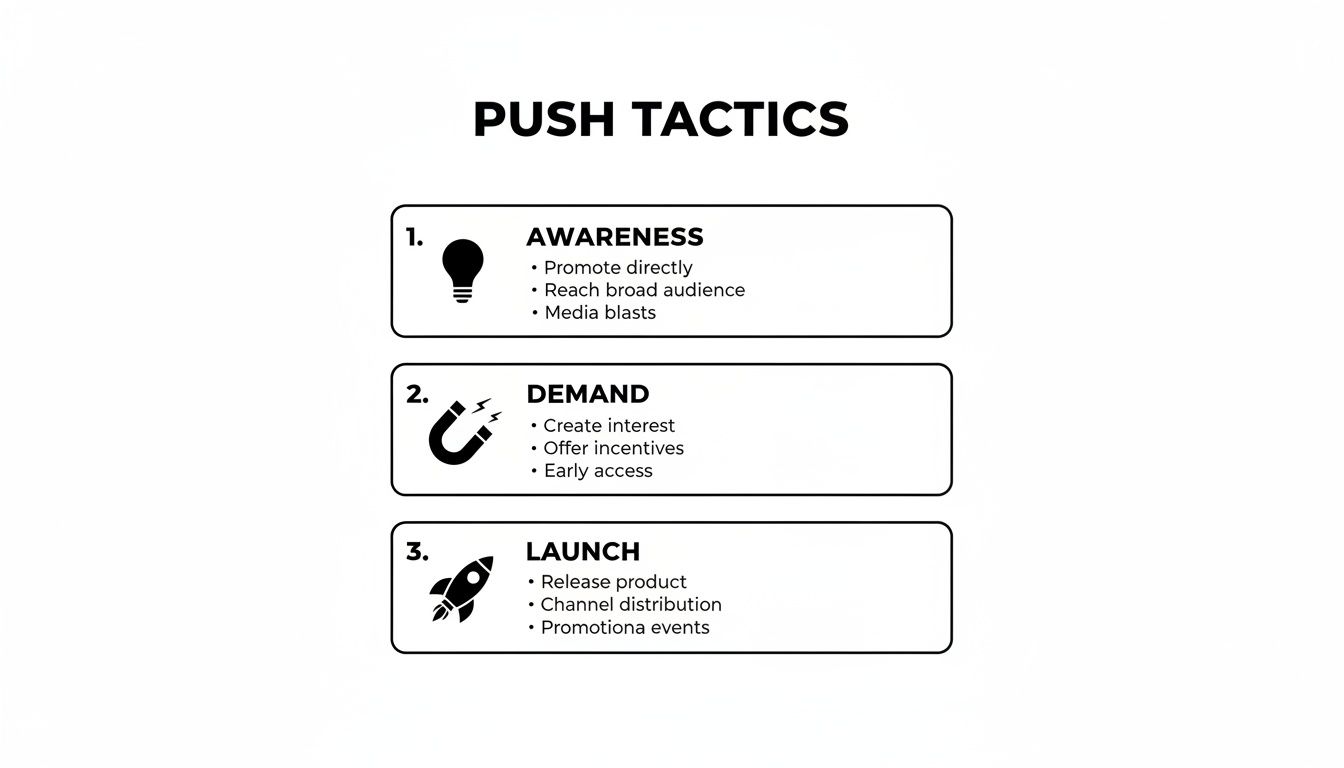
Each of these push goals—building awareness, creating demand, and launching products—can be powerfully tied back to your existing pull content. It’s about creating a complete marketing cycle.
Tailoring Your Mix to Your Business Stage
The right blend of push and pull isn't a one-size-fits-all formula. It really depends on where your company stands in the market. Your strategic mix should be fluid, adapting as your business grows and your goals shift.
-
For the New Market Entrant: If you're a new supplier, your main goal is just getting noticed. Nobody is searching for a brand they’ve never heard of. At this stage, your strategy should lean heavily on push tactics (80% Push, 20% Pull). This means focusing on targeted ads, sponsoring industry events, and direct outreach to get your name in front of potential buyers. Your first pull efforts should be about laying the groundwork with foundational SEO and core content.
-
For the Established Brand: If your company is already a known name, the game changes. Your focus is now on defending market share and snagging those high-intent leads. Here, your mix should be pull-dominant (30% Push, 70% Pull). The priority is owning the search results for key charbroiler terms, creating expert-level content, and nurturing your reputation. Push tactics become more surgical—used to promote new models or special offers to people who already know you.
An integrated strategy means knowing when to hit the accelerator with push tactics and when to let your pull marketing engine cruise. The goal is a self-reinforcing loop where awareness campaigns feed your content, and your content turns that awareness into qualified leads.
Crafting the Perfect Mix for Different Buyer Personas
Different buyers in the restaurant industry have completely different needs and respond to different marketing signals. A successful hybrid strategy means tailoring your push-and-pull mix to specific customer profiles. After all, an independent cafe owner has different priorities than the procurement manager for a national restaurant chain.
To get started, here's a framework for how you can adjust your integrated marketing mix to connect with key buyer personas in the commercial charbroiler market.
This table shows how to blend push and pull tactics to meet the unique goals of different buyers, ensuring your marketing message resonates with the right person at the right time.
Integrated Marketing Mix by Buyer Persona
| Buyer Persona | Primary Goal | Recommended Pull Tactic | Recommended Push Tactic | Key Performance Indicator (KPI) |
|---|---|---|---|---|
| Independent Cafe Owner | Find a reliable, space-efficient charbroiler within budget. | A blog post on "Best Countertop Charbroilers for Small Kitchens." | Targeted Facebook ads promoting a financing offer for small businesses. | Lead Conversion Rate |
| Multi-Location Group | Ensure equipment consistency, durability, and bulk pricing. | Detailed case study on how a similar chain improved efficiency with your charbroilers. | A LinkedIn ad campaign targeting procurement managers with a downloadable spec sheet. | Cost Per Acquisition (CPA) |
| Executive Chef | Achieve specific cooking results and performance. | A video demonstration showcasing the charbroiler's precise temperature control and searing capabilities. | An email to a curated list of chefs inviting them to an exclusive product demo webinar. | Engagement Rate |
By thoughtfully combining push and pull tactics based on where your business is and who you're talking to, you move beyond the simple pull vs push marketing strategy debate. You start building a smarter, more adaptable marketing engine that generates awareness, builds real trust, and drives sustainable sales growth.
Got Questions About Push vs. Pull? We’ve Got Answers.
When you're trying to figure out a pull vs. push marketing strategy for your restaurant equipment business, a lot of practical questions come up. Knowing when to zig and when to zag with each approach is what separates a decent plan from one that actually drives sales. Let's tackle some of the most common questions we hear to give you clear, straightforward answers.
Getting these fundamentals right will help you build a marketing engine for your commercial charbroiler business with a lot more confidence.
Which Strategy Is Better If I'm on a Tight Budget?
If your budget is lean, pull marketing is almost always the smarter long-term play, especially when it comes to content and SEO. It takes more sweat equity upfront, but the digital assets you build—think blog posts and detailed buying guides—can become a lead-generating machine that works for you 24/7 without constant ad spend. A single, well-ranked article on "how to choose a commercial charbroiler" could bring you qualified buyers for years.
A good way to approach this is to build that pull foundation first. Once you have some solid content drawing people in, you can sprinkle in low-cost push tactics, like a targeted email campaign to your subscriber list, to get more eyes on what you've already created.
How Do I Actually Measure If This Stuff Is Working?
Measuring success looks different depending on which playbook you're using. Each side of the pull vs. push marketing strategy has its own set of key performance indicators (KPIs) that tell you whether your time and money are paying off.
For pull marketing, you're looking at metrics that show steady growth and genuine audience interest:
- Organic Keyword Rankings: Are you showing up on Google's first page for money terms like "heavy-duty gas charbroiler"?
- Website Traffic from Search: How many potential customers are finding your site through a search, not an ad?
- Conversion Rates on Content: Are people who read your blog posts actually calling you or downloading your spec sheets?
For push marketing, you need to focus on the immediate impact of a specific campaign:
- Ad Impressions and Click-Through Rate (CTR): How many people saw your ad, and how many cared enough to click?
- Social Media Engagement: Are your posts getting likes, shares, and comments, or are they just sitting there?
- Cost Per Acquisition (CPA): Bottom line—how much did it cost you in ad spend to get one new lead or sale from that campaign?
Can I Use the Same Content for Both Pull and Push?
Absolutely. In fact, you should. Repurposing content is the secret to a marketing strategy that's both powerful and efficient. It lets you squeeze every drop of value from the hard work you put into creating that first piece.
For example, you might create a comprehensive, SEO-friendly guide on "Charbroiler Maintenance for Peak Performance." That’s your core pull marketing asset. From there, you can slice and dice it into a dozen push tactics: turn key tips into a short video for LinkedIn, create a simple infographic for social media, and write a quick summary for your email newsletter—all linking back to the original guide.
When Does It Make Sense to Go All-In on a Push Strategy?
A push-heavy strategy really shines when your main goal is to generate a ton of brand awareness quickly, or if you're launching a product that's completely new to the market. If your target audience doesn't even know a solution like yours exists, they're not going to be searching for it.
In that situation, you have to use push tactics. Think paid ads, sponsoring a booth at a major industry trade show, or a PR campaign to get the word out. You need to interrupt them and introduce your brand to create that initial spark of demand. Once you've built that awareness, your pull strategies will be there to catch all the interest you've generated.
At Charbroilers.com, we know that the right equipment is the heart of any great kitchen. Whether you need a small countertop unit for a cozy cafe or a high-volume floor model for a packed steakhouse, we have a huge selection of commercial charbroilers built to perform. Explore our range of professional-grade charbroilers and find the perfect piece to take your menu to the next level.