

Propane Tank Size Calculator for Restaurants
Picking out the right propane tank is about more than just buying fuel. It's a huge decision that directly impacts your restaurant's efficiency, budget, and honestly, your own sanity. A reliable propane tank size calculator is your best friend here, helping you dodge a disastrous fuel outage during a packed dinner service or sinking cash into a giant tank you’ll never really use.
Why Getting Propane Sizing Right Is a Game Changer
Guessing how much propane you need is just asking for chaos in the kitchen. If you get it wrong, you’re either looking at an emergency shutdown that kills your profits or you've wasted precious capital on a tank that's way too big for what you actually burn through. For a kitchen that runs smoothly and makes money, a calculated approach isn't just nice to have—it's essential.
This guide will walk you through the key things you absolutely have to consider:
- The BTU ratings of your commercial charbroilers and other gas appliances.
- Your peak usage during the busiest hours of service.
- The daily consumption of your appliances based on how long they actually run.
The Financial and Operational Stakes
Running out of fuel mid-service? That's a kitchen's nightmare. It brings everything to a screeching halt, damages your reputation, and sends paying customers walking out the door. On the flip side, overestimating means you've tied up money in fuel you're not using and a bigger tank lease than you needed. Nailing your propane sizing is a masterclass in resource management and a big part of maximizing cost efficiency in restaurant operations.
Think of a perfectly sized tank as an insurance policy against downtime. It guarantees you have the fuel to crush an unexpected rush while keeping your operating costs lean and predictable.
The worldwide demand for propane just shows how vital it is. The market hit USD 85.41 billion in 2022 and is only expected to grow, which tells you how much commercial kitchens and other sectors rely on it. This trend really highlights why smart planning tools are so critical for managing this resource. You can dig deeper into the numbers in this detailed propane market report.
Having seen firsthand how restaurant equipment supply websites succeed, we know that smart planning—from your SEO strategy to your fuel management—is what separates the successful from the struggling. We provide information on SEO, local citation services, blog posting, blogger outreach, copyrighting, and article writing to help businesses in this space thrive online.
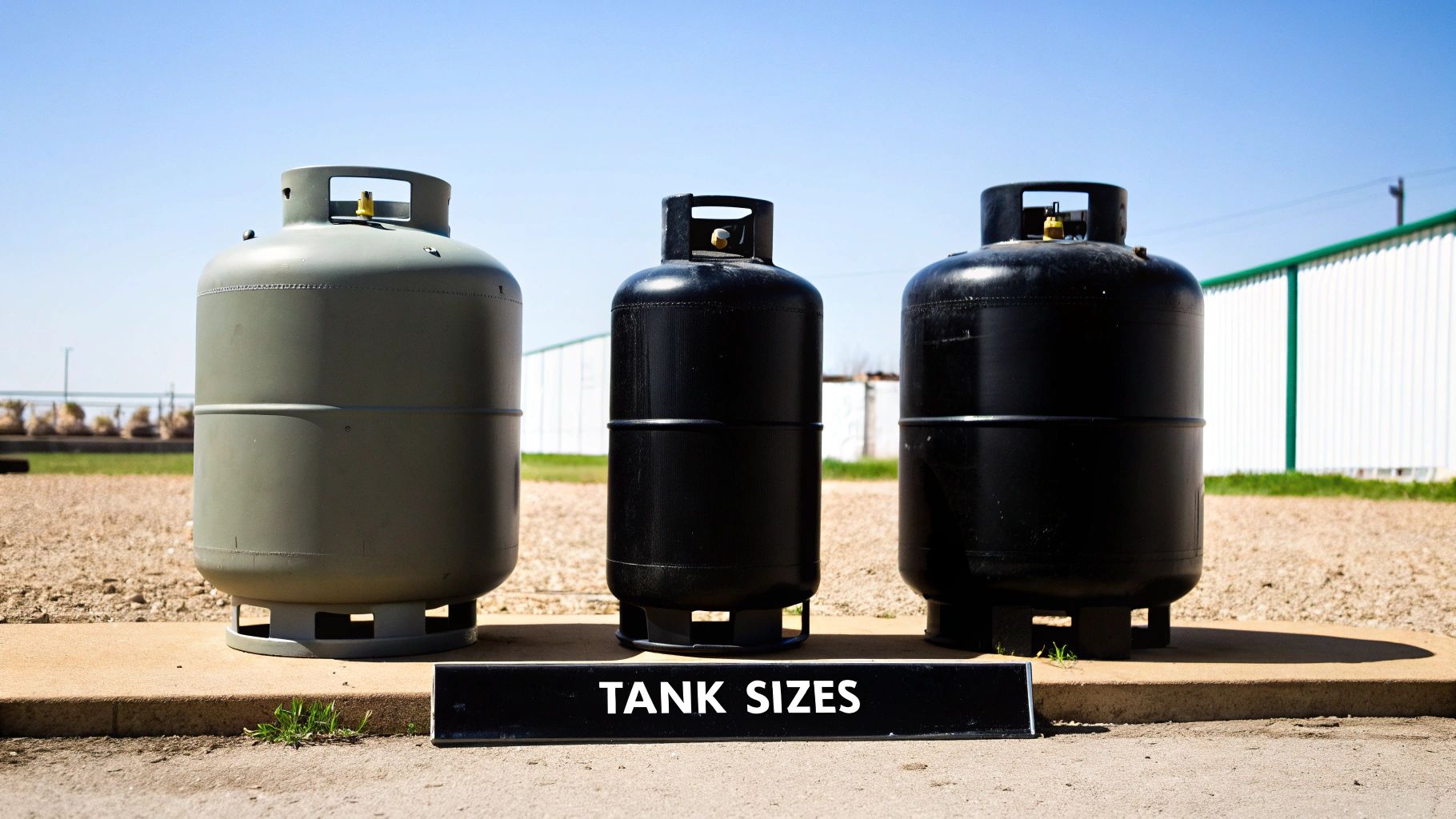
Common Restaurant Propane Tank Sizes and Typical Uses
To give you a better idea of what's out there, here’s a quick rundown of standard tank sizes and where they usually fit in a commercial kitchen environment.
| Tank Size (Pounds) | Tank Size (Gallons) | Best For | Example Use Case |
|---|---|---|---|
| 100 lb | 23.6 gal | Single, low-demand appliances or food trucks | A single patio heater or a small food cart's flat-top grill |
| 200 lb | 47.2 gal | Small kitchens with one or two appliances | A small cafe running a single 4-burner range and a fryer |
| 420 lb | 100 gal | Moderate-use kitchens, backup fuel | A small-to-medium restaurant's primary cooking line |
| 500 gal | ~2,120 lb | Medium to large restaurants | Powering multiple ranges, ovens, charbroilers, and fryers |
| 1,000 gal | ~4,240 lb | Large, high-volume operations | Large restaurants, catering kitchens, or institutional use |
This table should help you start to visualize what size might make sense for your operation, but remember, your specific BTU load is what will ultimately determine the perfect fit.
Calculating Your Kitchen's Total BTU Demand
Before you can even think about picking a propane tank, you need a solid handle on your kitchen's maximum energy appetite. This is measured in British Thermal Units (BTUs), the standard unit for heat energy. Every single gas appliance in your operation has a specific BTU rating, which tells you how much fuel it devours per hour when running at full tilt.
Think of it as an audit of your kitchen's power. Your first job is to take a complete inventory of every piece of propane-powered equipment you own. Grab a clipboard or open a spreadsheet and start listing them out—from the big charbroilers and fryers down to the ranges and ovens.
Finding Your Appliance BTU Ratings
The best place to find an appliance's BTU rating is right on the manufacturer's data plate. It's that little metal tag, usually tucked away on the back, side, or just inside the door. This plate is packed with crucial info like the model and serial number, but what we're after is the BTUh (BTUs per hour).
Just to give you a feel for what you're looking for, here are a few real-world examples:
- A workhorse commercial 6-burner range can easily pull 180,000 BTUh.
- That double-stack convection oven is probably in the ballpark of 100,000 BTUh.
- A standard 40-lb commercial fryer will typically hover around 90,000 BTUh.
If you can't find the data plate or the numbers have worn off, don't just guess. A quick online search for the appliance's make and model will almost always pull up the official spec sheet. Getting this number right is critical, as it prevents major headaches later.
Once you’ve hunted down the BTU value for every piece of equipment, just add them all up. This final number is your kitchen's total potential hourly demand—the absolute maximum fuel you'd burn if every single appliance was cranked up at the same time.
This figure is the cornerstone for everything that follows. In a world where propane demand is always climbing, accurate forecasting is no longer a "nice-to-have," it's essential for managing your costs. The global propane market was valued at 187.5 million tons in 2024, which shows just how much this fuel powers commercial operations like yours. You can learn more about the trends driving the propane market's growth to see why smart fuel management is simply smart business.
Translating BTUs Into Real-World Fuel Usage
Your total BTU demand is like knowing your car's top speed—it tells you the maximum power, but not how much gas you'll burn on your daily commute. The real key is figuring out how long each appliance actually runs. This is where we bridge the gap between technical specs and the reality of a busy kitchen.
You need to create an honest, realistic profile of your kitchen's operational hours. Think about your daily workflow. Your main charbroiler might be firing on all cylinders for a solid eight hours during a dinner rush, but a specialty fryer might only see two hours of action.
Estimating Daily Appliance Run Time
Go through the appliance inventory you made earlier and assign an average daily run time to each piece of equipment. Be practical here. This isn't about the hours your restaurant is open, but the hours an appliance is actively gulping down fuel.
A few real-world examples might look like this:
- High-Use Charbroiler: A 150,000 BTU beast running for 6 hours per day.
- Main Fryer: A 90,000 BTU fryer that's hot for about 5 hours daily.
- Secondary Oven: A 50,000 BTU oven used mostly for prep, running just 3 hours per day.
This exercise transforms a static list of BTUs into a dynamic picture of your kitchen's energy rhythm. It's a core component of any effective propane tank size calculator.
Accounting for Peak and Slow Seasons
Let's face it, your fuel needs aren't the same year-round. A slammed summer patio season will burn through far more propane than a quiet January. It's critical to factor in these seasonal swings to avoid getting caught with an empty tank during a rush.
Think about your busiest and slowest months. If your summer sales are 30% higher than in the winter, it's a safe bet your propane consumption will see a similar spike. Average these out to find a reliable daily usage figure that accounts for your entire business cycle.
The goal is to find a realistic daily average. By calculating your fuel needs for both peak and off-peak seasons, you can establish a baseline that prevents over-ordering in the slow months and running dry during a rush.
Once you have these run times locked in, you can finally calculate your daily propane consumption. Since one gallon of propane provides approximately 91,500 BTUs, you can convert your total daily BTU usage into a clear gallon figure. This number is the single most important piece of data for picking the right tank size.
Using a Simple Formula to Find Your Ideal Tank Size
Alright, you’ve done the legwork and have your total BTUs and daily run times. Now it’s time to connect the dots and figure out exactly what size tank you need. This is where we turn those abstract numbers into a concrete gallon requirement for your restaurant's charbroilers.
The magic number you need to remember is this: one gallon of propane delivers roughly 91,500 BTUs of energy. This simple conversion factor is the key to translating your kitchen's hourly BTU demand into a clear gallons-per-hour consumption rate. From there, a little straightforward multiplication gets you to your daily and weekly fuel needs.
This visual guide really breaks down the process, showing how you get from individual appliance ratings to a final tank recommendation.
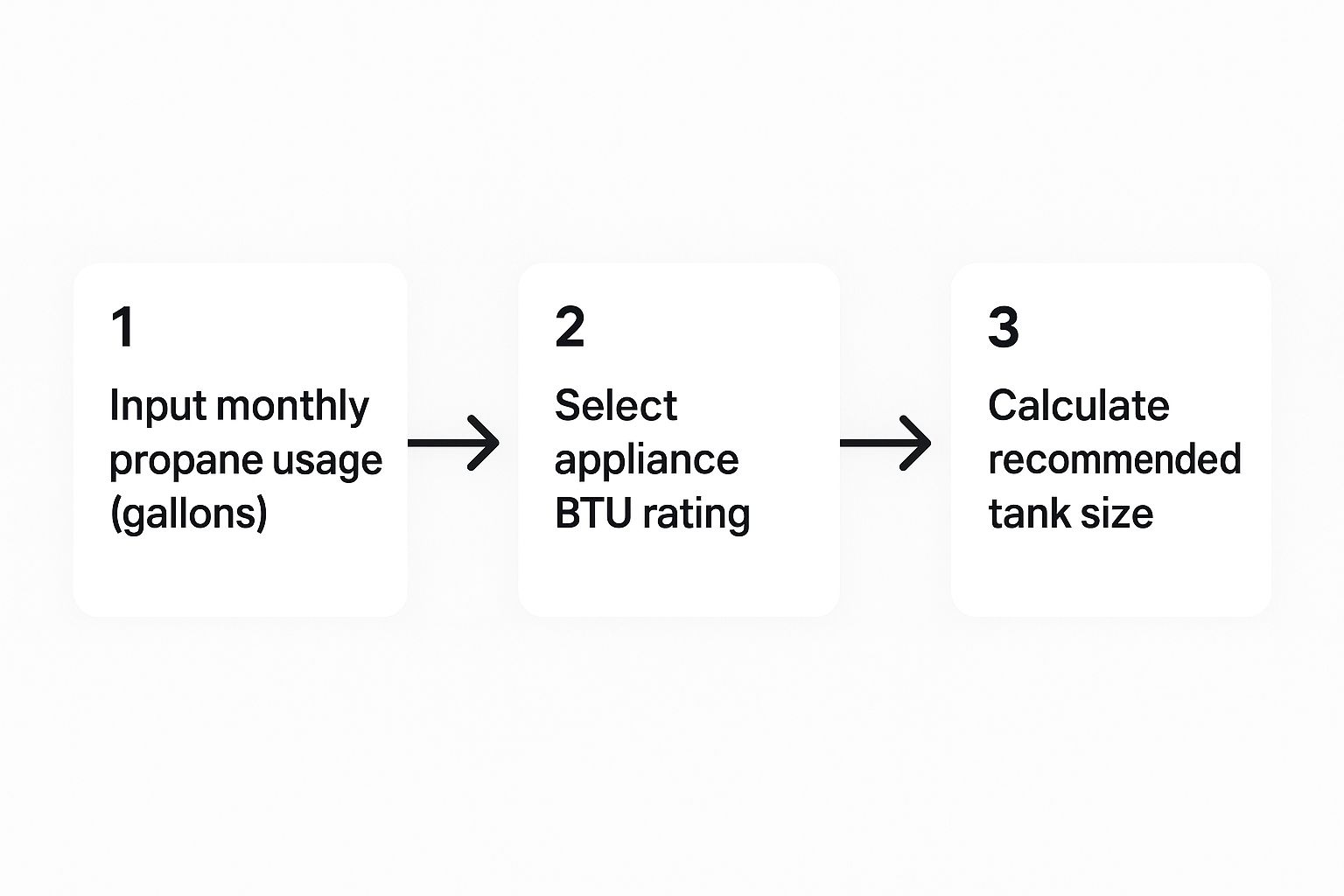
As you can see, everything starts with your appliance's BTU rating—get that right, and you're well on your way to an accurate estimate.
Don't Forget to Build in a Safety Buffer
Here’s a crucial piece of advice I’ve learned over the years: never calculate just for your exact weekly usage. You absolutely have to build in a safety buffer. A smart move is to size your tank to hold at least one full week’s worth of fuel, even after factoring in the 80% fill rule.
Think of this buffer as your insurance policy. It protects you from a sudden catering order, an unexpected festival weekend, or even just a delivery delay because of bad weather. It's what keeps you from making a frantic, last-minute call for a refill when you're in the middle of a dinner rush.
Let's Walk Through an Example:
Imagine a restaurant kitchen with a combined load of 400,000 BTUh that runs its equipment for an average of 6 hours a day.
- Daily BTU Use: 400,000 BTUh x 6 hours = 2,400,000 BTUs
- Daily Gallon Use: 2,400,000 BTUs / 91,500 BTUs per gallon ≈ 26.2 gallons
- Weekly Gallon Use: 26.2 gallons x 7 days = 183.4 gallons
To keep that one-week buffer and account for the 80% fill rule, this restaurant should be looking at a 500-gallon tank. That size gives them 400 gallons of usable fuel, which comfortably covers their needs and provides peace of mind.
It’s no surprise that the demand for reliable fuel storage is on the rise. The global propane tanks market was valued at a massive US$82.3 billion in 2024 and is expected to hit US$109.8 billion by 2031. This trend really underscores why getting your tank size right from the start is so important in a market focused on efficiency. If you're interested, you can discover more insights about the propane tanks market and what's driving this growth.
Considering Factors Beyond the Calculation
Running the numbers with a propane tank size calculator is a great first step, but it’s just that—a starting point. The real world has a funny way of throwing curveballs that pure math can't predict. Practical logistics and, more importantly, local regulations often have the final say.
Before you even think about signing a contract, you need to dig into local zoning laws. I’ve seen this trip up countless operators. These rules spell out mandatory clearance requirements—exactly how far a tank must be from buildings, property lines, and anything that could spark a fire. These regulations can drastically limit where you can even place a tank, which in turn dictates the maximum size you're allowed to have.
And don't forget, your actual fuel consumption is heavily influenced by how well you maintain your equipment. For example, a routine for efficient hot water system maintenance can stop you from burning through unnecessary propane just because of a poorly performing unit. Little things add up.
Ownership, Leasing, and Supplier Reliability
Another big decision is whether to own your tank outright or lease it. Owning it gives you the freedom to hunt for the best propane prices from any supplier. The trade-off? You're on the hook for 100% of the maintenance, all repairs, and any required safety certifications. That's a lot to manage.
Leasing usually means you’re tied to one supplier, but it completely lifts the burden of maintenance and compliance off your shoulders. For most busy restaurant owners, that peace of mind is easily worth any potential difference in fuel cost.
Finally, you have to be realistic about your supplier’s delivery schedule. A smaller tank might seem perfectly fine on paper, especially if you have a rock-solid supplier who guarantees frequent deliveries. But what if service in your area is a bit spotty? Investing in a larger tank provides a critical safety net, ensuring you never have to shut down your line because of a missed delivery.
Thinking ahead like this is just as important as choosing the right commercial charbroilers and other essential gear from a dependable Dallas restaurant supply company.
Common Questions About Restaurant Propane Tanks
Even when you've done all the math, questions always pop up. Getting straight answers is the best way to move forward with confidence and sidestep the common mistakes I've seen countless restaurant owners make with their fuel supply.
How Does Cold Weather Affect My Propane Needs?
Cold weather is a huge factor for propane. As the temperature drops, so does the pressure inside your tank. This slowdown affects how quickly the liquid propane can vaporize into the gas your charbroiler actually burns.
If your tank is too small for a freezing climate, it's going to struggle to keep up when your kitchen is running full tilt. You might see weak flames or, in the worst-case scenario, have your equipment shut down entirely during a dinner rush. You have to tell your supplier about your local climate—they’ll almost certainly recommend a larger tank to guarantee consistent fuel flow all winter long.
What Is the 80 Percent Fill Rule?
You'll never see a propane tank filled to the brim. For safety, they are only ever filled to 80% capacity. This leaves a buffer zone for the liquid to expand safely as temperatures change, which is a critical safety measure you can't ignore.
This means a 500-gallon tank really only gives you 400 gallons of usable fuel. When you're figuring out what size you need, you have to calculate based on this 80% usable capacity, not the tank's total volume. Otherwise, you're guaranteed to run short.
The most practical solution for any busy kitchen is setting up automatic refills. Your supplier monitors your usage and schedules deliveries proactively, so you never have to think about checking levels or making a last-minute call during service.
This proactive approach is just as important as having the right gear in the first place. A well-equipped kitchen is fundamental, and you can find a great selection of commercial equipment from specialized suppliers, like those offering Los Angeles restaurant equipment. Getting this right ensures every part of your operation, from fuel to hardware, runs without a hitch.
Here at Charbroilers.com, we know that a powerful charbroiler is the heart of many great kitchens. Explore our collection of commercial charbroilers and find the perfect model to deliver that incredible flavor and presentation your customers will love.