

PPC for Ecommerce A Playbook for High-Ticket B2B Sales
Most of the PPC for ecommerce advice you'll find online is just plain wrong for high-value B2B sales. Let's be real: the strategy for selling a $15,000 commercial charbroiler has almost nothing in common with selling a $15 t-shirt. If you don't get that fundamental difference, you're just lighting money on fire. Our expertise in SEO, blog posting, and article writing for restaurant equipment supply websites gives us a unique perspective on what truly works.
Why Generic PPC Fails for High-Ticket B2B Ecommerce
The vast majority of pay-per-click guides are built for a simple, fast transaction. They’re all about the impulse buy, the short sales cycle, and convincing a single person to click "add to cart."
That model completely falls apart when you’re selling commercial restaurant equipment. The stakes are much higher, the research is far more intense, and the final purchase decision often involves multiple people—the chef, the GM, the owner, maybe even the finance department.
Trying to apply generic, B2C strategies in this complex B2B world is a recipe for disaster. You’ll end up paying for a ton of unqualified clicks from home cooks and curious browsers instead of the procurement managers and executive chefs you actually need to reach.
The B2B Buying Journey Is Different
For high-ticket items, the path from that first ad click to a signed purchase order is long and winding. Your PPC strategy has to be built for this reality.
- Longer Sales Cycles: A restaurant owner isn't going to impulse-buy a commercial oven and check out in five minutes. They're going to spend weeks, maybe even months, researching specs, comparing models, getting financing, and waiting for approvals.
- Multiple Touchpoints: Your ads can't just go for the hard sell on day one. They need to support every stage of this extended journey, from building initial awareness to being the final choice when it’s time to buy.
- High-Intent Keywords: You're not bidding on broad, expensive terms like "oven." Your money is better spent on the specific, technical queries that signal a true professional is searching.
A winning PPC campaign for a restaurant equipment supplier isn't just about driving traffic. It's about generating high-quality leads that your sales team can actually close. But before you even think about launching ads, you have to make sure your website is ready. A full technical review is non-negotiable. You can learn more about how to do a site audit to ensure your foundation is solid enough to convert that expensive traffic.
Building Your Foundational Campaign Structure
Before you spend a single dollar on clicks, a winning PPC for ecommerce strategy has to start with a rock-solid campaign structure. For a complex B2B business like selling restaurant equipment, this foundation needs to be logical and incredibly granular.
Think of it like building the digital version of a well-organized warehouse, where every product has its designated aisle and shelf.
The most effective way to do this is to simply mirror your website's architecture. If your site has top-level categories for "Commercial Refrigeration," "Cooking Equipment," and "Food Prep," then your Google Ads account should have campaigns with those exact same names. This isn't just about keeping things tidy; it's absolutely critical for relevance, Quality Score, and controlling where your money goes.
This simple alignment ensures that when a chef searches for something specific, they get an ad that's a perfect match—and that’s the first step to earning their click.
Drilling Down into Ad Groups
Inside each of those campaigns, you have to get even more specific with your ad groups. Your "Cooking Equipment" campaign, for example, can't just be one big, chaotic bucket of keywords. Instead, you need to create distinct ad groups for each subcategory you sell.
- Ad Group 1: Six-Burner Gas Ranges
- Ad Group 2: Commercial Convection Ovens
- Ad Group 3: Countertop Charbroilers
- Ad Group 4: Heavy-Duty Deep Fryers
This level of detail is what lets you write hyper-specific ad copy and send users to the most relevant landing pages possible. The impact on user experience and conversion rates is massive. Of course, crafting these targeted ad groups means doing some serious keyword research. To really nail this part, check out our detailed guide on how to build a keyword list for your business.
The flowchart below shows exactly why a generic, lazy approach to PPC structure just doesn't work in a specialized market like ours.
As you can see, slapping a one-size-fits-all model onto a complex B2B market is a fast track to wasted ad spend and disappointing results.
Mapping a Multi-Campaign Strategy
A truly robust account structure uses different campaign types, each with a specific job to do. Your initial setup should absolutely include a mix of campaigns designed to capture buyers at different stages of their journey.
Don't put all your eggs in one basket. A diversified campaign strategy—combining Search, Shopping, and Performance Max—creates a powerful system that reaches customers wherever they are in their buying process.
This multi-pronged approach is all about maximizing your visibility and efficiency. You'll want a high-intent Search campaign targeting those research-heavy queries, a visually-driven Shopping campaign to showcase products, and a Performance Max campaign to scoop up demand across all of Google's channels. For a deeper dive, especially if you're also selling on major D2C platforms, this A Practical Guide to Amazon Ads Management for DTC Brands offers some great parallel insights.
Getting this structure right from the very beginning means your budget works smarter, your ads hit harder, and your data gives you clear, actionable insights for growth.
Mastering Google Shopping for Commercial Equipment
For any restaurant equipment supplier, Google Shopping isn’t just another ad placement—it's your digital showroom floor. This is where potential buyers visually compare your commercial charbroilers and convection ovens against the competition. Getting this right hinges entirely on the quality and detail of your product feed. Honestly, a well-built feed is your ultimate secret weapon for any serious PPC for ecommerce strategy.
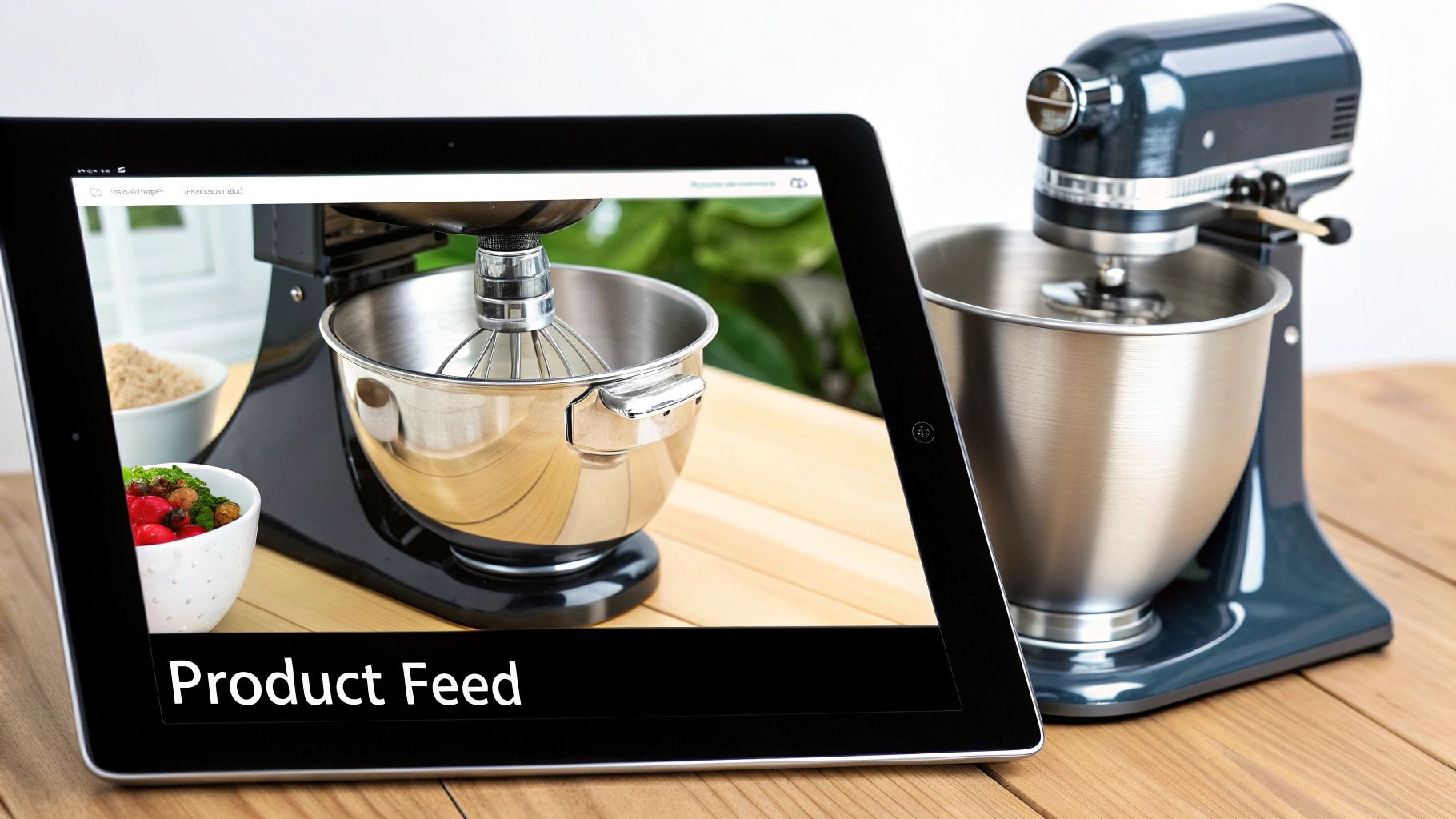
Unlike simple consumer goods, B2B buyers are hunting for specific, technical attributes. Your product titles have to reflect that reality. A generic title like "Planetary Mixer" is a completely wasted opportunity.
Instead, a title like "Hobart HL600-1STD Legacy 60-Quart Planetary Mixer - 208v" gives a professional chef everything they need in a single glance: the brand, model number, capacity, and even the electrical specs. That’s how your customers search.
This level of detail needs to run through every part of your feed. Your images should be high-resolution and show the product from multiple angles, highlighting things like the build quality, control panels, or casters. Put yourself in your customer’s shoes: they need to see that stainless steel finish and be able to picture the unit in their own kitchen.
Optimizing Your Product Feed for Profit
A truly advanced approach goes way beyond just titles and images. The real magic for boosting profitability comes from smart segmentation using custom labels right inside your product feed. This is how you turn a simple product list into a dynamic sales tool.
By using custom labels, you can slice and dice your inventory based on metrics that actually matter to your business. This allows you to create specific product groups within your Shopping campaigns and get incredibly precise with your bids.
- Segment by Profit Margin: Label products as 'high-margin' or 'low-margin.' This lets you bid much more aggressively on the items that make you the most money, like a premium charbroiler, while pulling back on spend for low-margin accessories.
- Segment by Strategic Importance: Create a 'bestseller' label for your most popular equipment or a 'clearance' label for items you need to move quickly. This gives you direct control over how visible your key inventory is.
- Segment by Product Type: Sure, you have product categories, but custom labels like 'floor models' vs. 'countertop models' can help you fine-tune bidding based on the different average order values.
Your product feed is not a 'set it and forget it' document. Think of it as a living, breathing asset that you should be constantly tweaking. The more detail and strategic data you feed into it, the more intelligent and profitable your Google Shopping campaigns will become.
There's a good reason to put this much effort in. Research shows that around 85% of all clicks on Google Ads for ecommerce go to Shopping campaigns. That kind of dominance is exactly why optimizing your feed isn't just a suggestion—it’s non-negotiable for growth.
Of course, a holistic paid advertising plan goes beyond just Shopping. To see how this piece fits into the bigger picture, you need to build effective Google Ads campaigns. This broader knowledge will help you integrate your Shopping efforts into a more powerful, multi-channel strategy that captures B2B buyers at every stage of their journey.
Executing Advanced Targeting and Remarketing Plays
Once you've got a solid campaign structure built, it's time to layer in the more advanced plays. This is what really separates the high-performing PPC campaigns from the ones that just burn through your budget. We're moving beyond just casting a wide net and starting to pinpoint the serious B2B buyers who are actually ready to make a high-value purchase.

For your Search campaigns, this means digging for long-tail keywords that scream commercial intent. A general search for "ice machine" is not only expensive but also attracts a ton of window shoppers. But a specific search like "NSF certified commercial ice machine lease"? That’s gold. It tells you this person is a professional, understands industry standards, and is already thinking about financing.
Pinpointing Your Ideal B2B Customer
Keywords are just one piece of the puzzle. The real magic happens when you start layering on specific audience segments to sharpen your targeting. Google's In-Market audiences are perfect for this, letting you focus your ad spend on people who've shown recent, active interest in commercial kitchen gear.
Try layering these audiences on top of your keyword targeting:
- Commercial & Industrial Products: This gets you in front of users actively researching B2B equipment.
- Food Service Equipment: This is a much more direct signal that they’re squarely in your market.
When you combine these audiences with your high-intent keywords, you're practically ensuring your ads are only shown to qualified pros. This move alone can dramatically improve your click-through rates and slash wasted spend.
Fueling Performance Max with Smart Signals
Performance Max (PMax) campaigns can be absolute powerhouses, but their success completely depends on the quality of the signals you feed them. The algorithm is only as smart as the data it's working with. For a B2B equipment supplier, your first-party data is your most valuable asset here.
Start by building powerful audience signals with the information you already have:
- Customer Lists: Upload an email list of your past purchasers. This is the fastest way to teach Google exactly what your ideal customer looks like, so it can go find more of them.
- High-Value Website Visitors: Create an audience of users who have viewed specific, high-ticket items like a walk-in freezer or a six-burner range. These are your hottest prospects.
- Spec Sheet Downloaders: Anyone who has downloaded a product spec sheet is a huge buying signal in the B2B world. Get them into a targeted audience, fast.
Feeding PMax these kinds of high-quality signals helps it skip the painful learning phase and go straight to finding high-value leads.
In the long B2B sales cycle, a customer might see your ad dozens of times before they make a decision. A smart remarketing strategy doesn't just show them the same ad over and over; it nurtures them through their decision-making process.
Designing a Strategic Remarketing Funnel
Remarketing is non-negotiable for closing deals on high-ticket equipment. But a simple "all website visitors" list just won't cut it. You need to be more strategic. Segment your users based on how they've engaged with your site and serve them ads that actually speak to their specific stage in the buying journey.
For instance, someone who bounced off your homepage might get a general brand awareness ad. Fine. But a user who spent ten minutes digging into the details of a specific charbroiler product page? They should see an ad for that exact model, maybe with a callout about available financing or a link to a video demo. This tailored approach keeps you top-of-mind and provides real value, guiding them from that initial flicker of interest all the way to the final purchase.
Optimizing Your Bids and Budgets for Profitability
In the high-stakes world of commercial kitchen equipment, tracking clicks and impressions is just noise. The only numbers that actually move the needle are profit and your return on investment. A smart PPC strategy isn't about getting the most traffic; it’s about getting the most profitable traffic. This calls for a much sharper approach to bidding and budgeting than the generic advice you see everywhere else.
First things first: you need to stop thinking in terms of flat revenue and start calculating your Target Return on Ad Spend (ROAS) based on real-world product margins. A $10,000 walk-in freezer with a 40% margin has a completely different profit profile than a $100 set of chef knives with a 60% margin. Your bidding has to reflect that financial reality.
Calculating a Realistic Target ROAS
To figure out your break-even ROAS, you simply divide 1 by your gross profit margin percentage. For a product with a 40% margin, your break-even ROAS is 1 / 0.40, which comes out to 2.5, or 250%. This means for every dollar you put into ads, you need to make $2.50 in revenue just to cover the cost of the equipment and the ad spend itself.
Knowing your break-even point is empowering. It transforms bidding from a guessing game into a calculated business decision, allowing you to confidently set goals that ensure every campaign is designed for profitability from the start.
Once you have that baseline, you can set an actual target ROAS that bakes in the profit you want to make. If you’re aiming to double your money after all costs, for instance, you'd aim for a 500% ROAS on that same product. This margin-aware approach is exactly what you need to confidently use value-based bidding strategies like Maximize Conversion Value, which lets Google’s AI go out and hunt for your most profitable customers.
To make this more concrete, let's look at how ROAS goals can change based on the profitability of different product lines.
Sample ROAS Goals Based on Product Margin
This table illustrates how to set different Target ROAS goals for product categories with varying profit margins, ensuring ad spend is optimized for profitability.
| Product Category | Average Price | Gross Margin (%) | Required ROAS for Break-Even | Target ROAS (e.g., 2:1 Profit) |
|---|---|---|---|---|
| Commercial Refrigerators | $4,500 | 35% | 286% (2.86x) | 572% (5.72x) |
| Ice Machines | $3,000 | 40% | 250% (2.5x) | 500% (5.0x) |
| Convection Ovens | $6,000 | 30% | 333% (3.33x) | 666% (6.66x) |
| Smallwares & Utensils | $150 | 60% | 167% (1.67x) | 334% (3.34x) |
Setting goals this way ensures that you're not just chasing revenue but are actively steering your ad spend toward the most profitable parts of your business.
The 70-20-10 Budget Allocation Framework
A smart budget is a balanced one. Instead of dumping all your cash into one campaign type and hoping for the best, a structured framework protects your core revenue while carving out space for growth.
- 70% on Proven Winners: This is the lion's share of your budget. It goes to your most reliable, high-performing campaigns—think branded search (people looking for your company by name) and your top-performing Shopping campaigns for high-margin equipment.
- 20% on Calculated Tests: Dedicate this slice to carefully expanding your reach. This could mean targeting competitor brand names, testing new ad copy on a specific product line, or launching a campaign for a new category.
- 10% on High-Potential Experiments: Use this for your higher-risk, higher-reward plays. This is where you might test a new audience segment in a Performance Max campaign or dabble with video ads on YouTube.
This balanced approach gives you stability while fueling future growth. And the potential returns are huge. Paid search drives 27.6% of new visitor traffic, and while Google estimates a baseline return of $2 for every $1 spent, a well-tuned campaign can do far better. To get a feel for the industry landscape, you can discover the latest PPC statistics and insights on Coupler.io.
Closing the Loop with Smart Tracking and Attribution
Even the most impressive-looking campaigns are just expensive guesswork without clean, reliable data. If you aren't tracking things correctly, you're flying blind, unable to tell a winning strategy from a money pit. Solid attribution is the final, non-negotiable piece of a profitable ppc for ecommerce program.
Your absolute starting point is setting up robust ecommerce tracking in Google Analytics 4 (GA4). This isn't just about watching page views; it's about capturing the entire customer journey, from the moment a chef adds a high-ticket charbroiler to their cart all the way through the final purchase. This data is what lets you see exactly which campaigns and keywords are actually making you money.
Capturing the Full Picture
In today's privacy-first world, some conversion data is bound to get lost along the way. That's why Google's Enhanced Conversions is no longer a "nice-to-have"—it's a must-have tool. It securely uses hashed, first-party customer info (like email addresses from a form fill) to help recover conversions that would otherwise disappear, giving you a much truer picture of your campaign performance.
For B2B sales in this industry, the final online transaction is often just one part of the story. A huge chunk of your most valuable leads will come through offline actions. It's vital to track these "micro-conversions" to get a real feel for what's working.
- Phone Calls: You absolutely need to set up call tracking for the numbers in your ads and on your website. A call could be a five-figure sale in the making.
- Quote Request Forms: Every single form submission needs to be tracked as its own distinct conversion event.
- Spec Sheet Downloads: For a technical buyer weighing their options, this is a massive signal of purchase intent. Don't ignore it.
Understanding these different touchpoints is the key to connecting your ad spend to actual sales. You can dive into the basics by learning how to find your analytics tracking ID to make sure your foundation is solid.
You have to move beyond a simple last-click attribution model for high-ticket B2B. A customer might see a Shopping ad for a walk-in cooler, click a Search ad a week later after more research, and finally convert from an email campaign. A data-driven attribution model properly values every single one of those touchpoints, not just the last one.
Establishing a Testing Rhythm
Finally, all this great data is useless if you don't do anything with it. Optimization isn't a "set it and forget it" task; it's a constant process.
You need to establish a simple, repeatable testing rhythm to make sure your campaigns are always getting better. This could be as simple as testing a new ad headline every two weeks or trying a new audience signal in your Performance Max campaign every month. This constant cycle of tracking, analyzing, and testing is what turns a good PPC account into a great one.
Your Top PPC Questions for Restaurant Equipment, Answered
Jumping into the world of PPC for ecommerce always brings up a few big questions, especially when you're dealing with high-dollar items like commercial kitchen gear. Here are the straight-up answers to the questions we hear most often from suppliers firing up their paid ads for the first time.
How Much Should I Spend on PPC?
There’s no magic number here, but you can get to a smart starting point by working backward. Figure out your revenue goal from PPC, factor in your average profit margin, and then you can calculate your break-even Return on Ad Spend (ROAS).
A good rule of thumb is to dedicate 5-15% of your total marketing budget to PPC. Just be ready to pivot and adjust that number once the real-world performance data starts rolling in.
How Long Until I See Results?
Look, you can start getting clicks and traffic from day one. But seeing a consistent, profitable return? That takes a minute.
For high-ticket B2B sales with those long, considered buying cycles, you should give yourself a 3-6 month window. That’s enough time to gather meaningful data, dial in your targeting, and really start optimizing your campaigns for actual profit. This isn't about getting rich quick; it's about building a dependable sales machine.
The goal in the first few months isn't necessarily massive profit. It's about data acquisition. You're paying to learn what keywords convert, which audiences respond, and how customers move through your sales funnel. This initial investment in learning pays dividends later.
Should I Target Competitor Brand Names?
Yes, but you have to be smart about it. Bidding on competitor terms can be a killer way to get in front of high-intent buyers who are right at the finish line of their decision-making process. The catch? These clicks can get pricey, and you might struggle with a lower Quality Score on your ads.
Zero in on your closest competitors—the ones selling similar high-value equipment. When you do, make sure your landing page immediately screams your unique value. Why should that chef buy your charbroiler instead of the one they were just searching for? It’s an aggressive play, but when it works, it really works.
Ready to stop guessing and start building a PPC engine that actually grows your business? The team at Charbroilers.com doesn't just know equipment; we know how to build the strategy you need to win online. Our services in SEO, local citation, copyrighting, and blogger outreach are designed for your industry. Contact us today and let's talk about dominating the digital shelf.