
PPC Campaign Management: A Guide for Restaurant Equipment Suppliers
When you hear PPC campaign management, what comes to mind? For a restaurant equipment supplier, it’s the engine that drives immediate sales. It's the whole process of planning, launching, tracking, and fine-tuning your paid ads to hit very specific targets, like getting quote requests for a new combi oven or boosting online parts sales. It’s a constant loop of action and analysis, all aimed at getting the best possible return on your ad spend.
Why PPC Is a Must-Have for Restaurant Growth
While a solid, long-term strategy like SEO is the bedrock of your online presence, Pay-Per-Click (PPC) advertising delivers something completely different: immediate results. Think of it as your direct line to high-intent customers right when they’re ready to buy. This isn't just about traffic; it's about connecting with people who are actively looking for the exact solutions you provide.
Let's paint a picture. A local bistro’s charbroiler goes down during Friday night dinner service. The owner isn’t casually browsing for a future kitchen upgrade—they're in full-blown crisis mode, frantically searching Google for "commercial charbroiler near me" or "emergency restaurant equipment supplier." A sharp, well-managed PPC campaign puts your business right at the top of their screen, turning their emergency into your sale. Instantly.
The Power of Immediate Visibility
This speed is what makes PPC so different from other marketing channels. You don't have to spend months trying to climb the organic rankings. You can launch a campaign in the morning and have relevant, targeted traffic hitting your product pages by the afternoon. In the fast-moving foodservice world, where an equipment failure can shut a kitchen down, that kind of speed is priceless.
A core goal for any restaurant equipment-focused PPC strategy has to be generating high-quality leads that actually turn into customers. When done right, these campaigns do more than just get clicks—they pre-qualify your visitors. If you're new to this idea, checking out a guide on PPC for Lead Generation can offer some great insights on how to turn those clicks into real business.
PPC provides a direct line to motivated buyers. While SEO builds your brand's foundation over time, PPC acts as your rapid-response team, capturing immediate demand and driving revenue from day one.
To put the PPC vs. SEO dynamic into perspective for a restaurant equipment supplier, here’s a quick breakdown:
PPC vs SEO Immediate Impact Comparison for Equipment Suppliers
| Attribute | PPC (Paid Search) | SEO (Organic Search) |
|---|---|---|
| Time to Results | Immediate (Hours/Days) | Long-term (Months/Years) |
| Visibility | Top of page, instantly | Gradual climb up the ranks |
| Control | High (control bids, ad copy, targeting) | Lower (influenced by algorithms) |
| Best For | Urgent needs, new product launches, promotions | Building brand authority, long-term trust |
| Example Use Case | Promoting a new line of modular charbroilers | Becoming the go-to resource for "kitchen efficiency tips" through article writing and blog posting |
This table really shows how PPC fills a critical gap, especially when you need to make something happen now.
The Financial Impact of Strategic PPC
The numbers behind active PPC campaign management speak for themselves. In the hyper-competitive foodservice market, it’s become a massive advantage, delivering an average return of 200%. That means for every $1 spent on Google Ads, businesses are seeing about $2 back in revenue.
Even better, paid search visitors are 50% more likely to convert than organic visitors. They aren't just browsing; they're on a mission. This makes PPC perfect for turning a quick search into a bulk order for a full kitchen upgrade.
This blend of speed, precision, and profit is why PPC is an essential tool for growth. It doesn’t replace your other marketing; it supercharges it. For example, while you’re working through a detailed local SEO checklist and building local citation services to build your foundation, your PPC campaigns are already out there grabbing sales and leads. It’s a powerful one-two punch that delivers short-term wins while you build for long-term dominance.
Building Your Campaign Foundation
Any profitable campaign is built on a solid foundation, not just a hunch. Think of this stage as drawing up the architectural plan for a house. Smart PPC campaign management starts long before you write a single ad, beginning with crystal-clear goals that guide every decision you make from here on out.
If you don't have specific goals, your campaign is really just an expensive experiment. Don't aim for something vague like "more website traffic." You need to define sharp, measurable outcomes that actually impact your bottom line.
Defining Your Campaign Objectives
Before you spend a single dollar, you have to ask yourself: what does success actually look like for this campaign? The answer has to be specific and tied to a real business result. For a restaurant equipment supplier, your goals can be pretty diverse.
Here are a few concrete examples of what I mean:
- Generate Qualified Leads: Get 15 quote requests per month for your 'floor model charbroilers' through a dedicated contact form.
- Drive E-commerce Sales: Target a 3:1 Return On Ad Spend (ROAS) for countertop items like commercial panini presses.
- Increase Phone Inquiries: Drive 20 inbound calls each week from restaurant managers looking for emergency equipment repair or replacement.
These goals are specific, measurable, and have a timeframe. They give you a clear benchmark to measure performance against, so you'll know for sure if your campaign is working or if it's time to make a change.
Uncovering High-Intent Keywords
Once you know what you're trying to achieve, the next job is to find the exact search terms your ideal customers are typing into Google. This is where a lot of campaigns fall flat. Targeting broad, generic terms is a surefire way to burn through your budget with almost nothing to show for it.
The key is to focus on high-intent keywords. These are typically longer, more specific phrases that tell you a user is close to making a purchase. There's a world of difference between someone searching for "grill" and someone searching for "buy 36-inch commercial gas charbroiler."
The first person could be anyone, maybe a homeowner looking for a backyard barbecue. The second person is almost certainly a restaurant professional with a specific problem to solve and a company credit card ready to go. Your job is to capture that searcher.
A common mistake is bidding on broad terms that feel relevant but lack commercial intent. Winning at PPC means focusing your budget on the phrases that people type when they are ready to solve a problem, not just research one.
Structuring Your Keyword Research
To find these money-making keywords, you need a structured approach. Just diving in is a recipe for chaos. Think about the customer's journey and start organizing your keywords into logical groups.
- Brand Keywords: Any term that includes your company name (e.g., "Charbroilers.com special offers"). These are almost always cheap and have super high conversion rates.
- Product-Specific Keywords: These target particular models or equipment types (e.g., "Vulcan VCCB36 countertop charbroiler").
- Problem-Aware Keywords: Phrases a user might search when they have an issue (e.g., "restaurant charbroiler not heating evenly"). This is a great way to find motivated buyers.
- Competitor Keywords: The names of your direct competitors. This can be a smart way to get in front of customers who are already in the market and comparing their options.
Tools like Google Keyword Planner or Ahrefs are great for seeing search volume and estimated costs, but honestly, your own industry knowledge is your most valuable asset here. Think like a chef or a restaurant manager—what would you search for in a moment of need?
Pinpointing Your Ideal Audience
Finally, with your goals and keywords locked in, you need to define exactly who gets to see your ads. Modern ad platforms give you incredibly powerful targeting options that go way beyond just keywords. This is a critical part of PPC campaign management that makes sure your ad spend isn't wasted on clicks that will never convert.
On platforms like Google and even LinkedIn, you can layer different targeting methods to really zero in on restaurant decision-makers.
- Demographics: Target users by their job title, like "Executive Chef," "Restaurant Owner," or "Food Service Manager."
- In-Market Segments: Reach people who Google's data suggests are actively shopping for "Food Service Equipment" or "Commercial Kitchen Appliances."
- Remarketing: Show ads to people who have already been to your website—for instance, someone who viewed a specific charbroiler model but didn't fill out the quote form.
By combining sharp goals, high-intent keywords, and precise audience targeting, you're building a campaign foundation that is designed for profitability right from the start.
Crafting Ads That Actually Convert
Alright, this is where your strategy starts to pay off. Running a great PPC campaign isn't just about outbidding the competition; it's about crafting a message that stops a busy chef or restaurant owner mid-scroll and makes them listen. We're getting past the generic, cookie-cutter ad copy and into creating ads that genuinely connect with your audience.
Think about it: your ad is the very first handshake. For a busy kitchen manager juggling a million things, it has to instantly signal that you get their world and have something that will make their life easier or their business more profitable. It’s all about speaking their language through expert copyrighting.
Writing Headlines That Grab Attention
Let's be blunt: your headline is 80% of the ad. If the headline doesn't hook them, the rest of your perfectly crafted copy might as well be invisible. A headline like "Commercial Charbroilers for Sale" is just noise. It's forgettable. Instead, let's tie a real-world outcome to the product.
Try thinking in formulas like these for an equipment supplier:
- Benefit + Product: "Boost Profits & Upgrade Your Line | Commercial Charbroilers"
- Feature + Benefit: "Durable Charbroilers That Sizzle | Built for High-Volume Kitchens"
- Problem + Solution: "Inconsistent Grilling? Get Perfect Heat with Our Grills."
These work because they tap directly into a pain point or a business goal. A chef isn't just buying a hunk of steel; they're buying consistency, efficiency, and a better final product for their diners.
Weaving Key Features into Your Ad Copy
Once you've got their attention with the headline, the description copy needs to deliver the goods. This is your chance to prove you know what you're talking about by highlighting the specific features that a pro actually cares about. These little details build trust and show you understand their daily grind.
What really matters in a commercial kitchen?
- Certifications: Always mention NSF certification. It’s an instant signal of quality and compliance.
- Maintenance: Little things are big things. Highlight features like easy-to-clean grates or removable drip trays. Time spent scrubbing is money lost.
- Performance: Use their language. Phrases like "precise heat distribution," "fast recovery times," and "heavy-duty construction" tell them this equipment can handle the dinner rush.
Sprinkling these details into your ad copy isn't just filler—it shows you’ve done your homework. It tells a potential buyer that your product was built for their kitchen, which is a massive selling point.
The best ads don't just sell equipment; they sell solutions. When you focus on the real-world benefits and professional-grade specs that matter to your audience, you turn a simple ad into a compelling business case.
Creating Thumb-Stopping Visuals
On visual-heavy platforms like Facebook, Instagram, and even LinkedIn, your image or video does all the initial work. The mission is simple: create something that stops the scroll. For restaurant equipment, that means ditching the boring, static product shots on a plain white background.
You've got to bring the equipment to life.
- Show It in Action: A quick, 15-second video of a charbroiler in a real kitchen with steaks sizzling is infinitely more powerful than a catalog photo. Let them hear the sizzle.
- Focus on the Food: Showcase the amazing end result. A photo of a perfectly plated dish made with your equipment connects the product to the delicious outcome every chef is chasing.
- Use Before-and-After Shots: Nothing tells a story of an upgrade quite like a visual. Put an image of an old, clunky piece of equipment next to your shiny, efficient new model. The difference speaks for itself.
When you pair killer ad copy with visuals that pop, you create a smooth, compelling path from their social feed right to your landing page. This one-two punch is crucial for any successful PPC campaign management strategy. Of course, each platform has its quirks. For instance, it's worth learning the ins and outs of writing Facebook Ads that generate leads effectively to really nail your social campaigns. Remember, your ads are a direct extension of your business, and powerful copy is a huge piece of your broader brand and content marketing efforts.
Mastering Bids, Budgets, and Landing Pages
Hitting "launch" on a campaign is just the starting pistol, not the finish line. The real work—the part that separates campaigns that print money from those that just burn it—starts now. It’s all about the ongoing tweaks and refinements that turn a basic setup into a predictable lead-generating machine.
This is where you balance how much you spend, tell the ad platforms how to spend it, and make sure the page people land on actually seals the deal. Get this right, and you control your costs while getting the biggest bang for your buck.
Choosing the Right Bidding Strategy
Think of your bidding strategy as your marching orders for Google Ads. It’s you telling the system exactly how to go after your customers in the ad auction. There’s no single "best" way to do it; the right choice is tied directly to what you're trying to accomplish with that specific campaign. Picking the wrong one is like bringing a sledgehammer to do a surgeon's job.
For example, Manual CPC (Cost-Per-Click) gives you total control. You set the absolute most you’re willing to pay for one click on a keyword like "buy commercial charbroiler." This is perfect when you're just starting out, have zero data, and need to keep a death grip on your budget while you figure out what actually works.
Once you have a steady flow of conversions coming in, you can hand the reins over to Google's machine learning. Automated strategies like Target CPA (Cost-Per-Acquisition) tell Google to hit a specific cost per lead. Or, you could use Target ROAS (Return On Ad Spend), which focuses on getting a certain amount of revenue back for every dollar you put in. These systems optimize your bids in real-time, making thousands of calculations no human ever could.
To make it simple, let's break down how to match your goal with the right bidding approach.
Choosing the Right Bidding Strategy for Your Goal
This table will help you pair your marketing goal with the bidding strategy most likely to get you there.
| Campaign Goal | Recommended Bidding Strategy | Best For |
|---|---|---|
| Maximum Brand Awareness | Maximize Clicks | Getting as much traffic as possible within your budget, maybe for a new product launch. |
| Strict Budget Control | Manual CPC | Smaller budgets or brand new campaigns where you have to test keywords carefully. |
| Lead Generation | Target CPA | Established campaigns with at least 15-20 conversions per month. |
| E-commerce Sales | Target ROAS | Driving sales for specific equipment, like countertop grills, where you have clear profit margins. |
Choosing the right strategy from the get-go aligns your ad spend with your actual business goals, making your entire effort far more efficient.
Setting and Adjusting Your Daily Budget
Your budget is the gas in the tank. Too little, and you’ll never get up to speed or gather enough data to make good decisions. Too much without proper oversight, and you’ll find a nasty surprise on your credit card statement. A daily budget is simply the average amount you’re willing to spend per day over a month.
When you first fire up a campaign for something like "floor model charbroilers," start with a budget you're comfortable with, say $50 per day. The key here is patience. Let it run for at least a couple of weeks to see how it performs. Whatever you do, don't make knee-jerk changes after one or two slow days.
Once you have some real data, start looking for the winners. Are you getting great clicks from one ad group? Is a single keyword driving all your form fills? This is your signal to start making smart adjustments. If your campaign is hitting its Target CPA and you can see there's still room to grow, that’s a green light to slowly increase the daily budget and capture more of that profitable traffic.
Your budget isn't a 'set it and forget it' number. It’s a dynamic lever you pull based on performance data. Profitable campaigns earn more budget; underperforming ones get trimmed or paused while you troubleshoot.
Optimizing Your Landing Pages for Conversion
This is it. This is the one piece of the puzzle that is so often ignored, and it's arguably the most important. You can write the world's best ad and have a perfectly tuned budget, but if the landing page fails to convince someone to take action, all that time and money goes straight down the drain.
Your landing page has one job: get that click to convert.
For a restaurant equipment supplier, your product page needs to be more than just a list of specs. It has to build immediate trust and make it incredibly simple for a busy, distracted chef or restaurant owner to get in touch.
Here are the non-negotiables your landing page needs:
- A Crystal-Clear Call-to-Action (CTA): Use strong, direct buttons like "Get a Quick Quote" or "Download Spec Sheet." Don't make people hunt for it.
- Trust Signals: You have to show you're legitimate. Plaster your page with warranties, NSF certifications, customer reviews, and logos of well-known restaurants you’ve worked with.
- Frictionless Forms: Keep your forms dead simple. Ask only for what you absolutely need: name, email, phone, and maybe a comment box. Every extra field you add kills your conversion rate.
- High-Quality Visuals: Show off the equipment. Use multiple high-res photos from every angle and, if you really want to stand out, include a short video of the product in action.
When you master the delicate dance between your bids, your budget, and your landing pages, you stop just "running ads." You start managing a predictable system for generating sales.
How to Measure and Scale Your Campaigns
Data is your roadmap. Seriously. Effective PPC campaign management isn't about launching a campaign and just hoping for the best. It's a constant loop of measuring what's working, cutting what isn't, and smartly scaling your successes. This is how you turn your ad spend into a predictable growth engine for your restaurant equipment business.
But first, a non-negotiable step: setting up accurate conversion tracking. Without it, you’re completely flying blind. You have to be able to measure every valuable action a user takes after clicking your ad, from an online purchase of a countertop grill to a phone call from a chef who needs an emergency charbroiler replacement.
Focusing on Metrics That Matter
It’s easy to get lost in a sea of data. Clicks and impressions might look impressive on a report, but they don't pay the bills. We call these "vanity metrics" because they feel good but don't actually reflect any real business impact. To get a true picture of performance, you have to focus on the Key Performance Indicators (KPIs) that connect directly to your bottom line.
For a restaurant equipment supplier, these are the numbers you live and die by:
- Cost Per Acquisition (CPA): This is the total cost you paid to get one lead or sale. If you spent $500 on ads and got 10 quote requests, your CPA is $50. Knowing this number is critical for judging if a campaign is truly profitable.
- Return On Ad Spend (ROAS): This measures the total revenue generated for every single dollar spent on advertising. A ROAS of 4:1 means you're making $4 for every $1 you spend. For e-commerce campaigns, this is the ultimate measure of success.
- Conversion Rate: This is the percentage of clicks that turn into a desired action. If you notice a low conversion rate, it could signal a problem with your ad copy or targeting, but more often than not, the culprit is your landing page.
Setting up the technical side of tracking can feel a bit intricate, but it’s the foundation for every optimization decision you'll make down the road. For anyone looking to get into the weeds of the setup process, our guide on implementing a solid analytics tracking ID provides a clear, step-by-step walkthrough.
A Framework for Smart Scaling
Once you have clean, reliable data flowing in, you can start making informed decisions about where to invest more and where to pull back. Scaling isn't just about cranking up the budget on every campaign. It's a strategic process based entirely on performance, using data as your guide to expand your reach without torching your profitability.
This process flow shows you the core parts of continuous PPC optimization that lead to scalable growth.
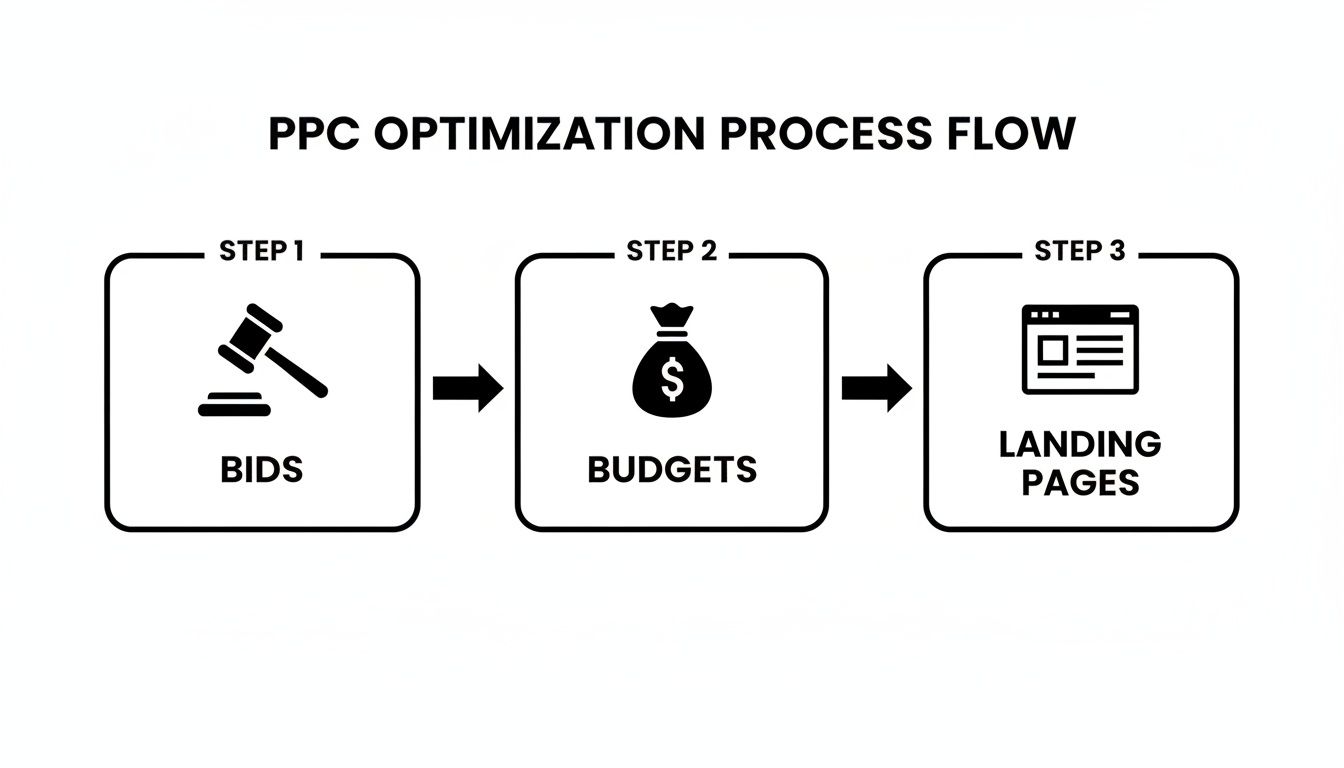
This visual really highlights how bids, budgets, and landing pages are all interconnected. When you make an adjustment in one area, it directly impacts the others, and that's how you drive successful campaign outcomes.
The golden rule of scaling is simple: double down on what's working. Pour more fuel on the fires that are already burning bright, and don't be afraid to cut your losses on campaigns or keywords that consistently underperform.
Knowing When and How to Expand
Your data will tell you exactly when it's time to scale. If a campaign for "commercial convection ovens" is consistently hitting its ROAS target and the search impression share is still below 50%, that's a blinking neon sign that you have more room to grow. You can confidently increase the daily budget to capture more of that existing demand.
Here’s how to decide what to scale:
- Fund Your Winners: First, pinpoint the campaigns with the best CPA or ROAS. Then, slowly increase their daily budgets by 15-20% at a time and watch the results like a hawk. Drastic changes can shock the algorithm, so gradual adjustments are always the way to go.
- Raise Bids on Top Keywords: Dig into your reports and find the specific keywords driving the most conversions. If they are profitable, consider raising their bids to secure a higher ad position, which almost always leads to more clicks and, ultimately, more sales.
- Explore New Ground: Once you've maximized your potential on Google Ads, it might be time to expand. If you've had success with visual-heavy products like display cases or custom kitchen setups, platforms like Facebook or Instagram could be a great next step for reaching chefs and restaurant managers where they actually spend their time.
By adopting a data-first approach, you remove all the guesswork from your PPC campaign management. You'll know with certainty which campaigns deserve more investment and have a clear, logical path to growing your business in the competitive foodservice industry.
Got Questions About Equipment Supplier PPC? We've Got Answers.
Jumping into paid ads can feel like a lot, especially when you're already juggling the demands of running a growing equipment supply business. Getting your PPC campaign management right often just means getting clear, straight answers to the big questions. That's what this section is all about.
Let's break down some of the most common questions we hear from folks in the foodservice supply industry.
How Much Should an Equipment Supplier Spend on PPC Ads?
This is always the first question, and the honest-to-goodness answer is: it depends. There isn't a one-size-fits-all number. A good rule of thumb, though, is to set aside 5-10% of your total marketing budget for PPC.
If you're an equipment supplier just dipping a toe in the water, the best bet is to start small and targeted.
Don't try to advertise every single product you carry. Instead, pick a handful of your most profitable items tied to high-intent keywords—think "commercial countertop charbroiler"—and set a daily budget you won't lose sleep over. This could be as modest as $25-$50 per day.
The real secret isn't how much you spend out of the gate, but how obsessively you track what comes back. The goal is to measure your Return On Ad Spend (ROAS) and only open up the budget when you have proof that the campaigns are making you money.
Is Google Ads or Facebook Ads Better for My Business?
This isn't an "either/or" choice; it's a "when and why" decision. Both platforms are powerhouses, but they play completely different roles for a restaurant equipment business. The smartest play is to use them in tandem to cover the entire customer journey.
Here's how to think about it:
- Google Ads is for capturing intent. This is your direct line to people who are actively looking for a solution right now. When a chef's convection oven dies mid-service and they search "emergency commercial convection oven," Google puts your ad right in front of them at their exact moment of need.
- Facebook Ads (now Meta Ads) is for creating demand. This is where you get in front of people based on who they are, not what they're searching for. You can target users by job titles like "Executive Chef" or interests like "culinary arts." It’s perfect for showing off a new piece of equipment to people who are your ideal customers, even if they aren't looking for it today.
A solid strategy uses Google to catch the people with their hands up and Facebook to find the people who should have their hands up.
How Long Does It Take to See PPC Results?
One of the best things about PPC is the speed. Unlike SEO, which can take months to gain traction, a well-built PPC campaign can start driving traffic and potential leads almost instantly. You can be in front of customers within hours of launch.
But getting profitable results? That's a different story.
While you'll see traffic right away, hitting a stable and positive Return On Ad Spend takes some fine-tuning. You should expect it to take 1 to 3 months of active management to really hit your stride. During that initial period, you're constantly working the levers:
- Adjusting bids on keywords that are (or aren't) performing.
- A/B testing ad copy to see which headlines get more clicks.
- Refining your audience targeting to stop wasting money on the wrong people.
- Tweaking your landing pages to get more visitors to convert.
This optimization phase is absolutely critical. It’s where you dial in your campaigns to get a predictable and profitable Cost Per Acquisition (CPA). Patience here is what turns a short-term cash burn into a long-term, lead-generating machine. This hands-on approach to PPC campaign management is how you make sure your investment pays off.
At Charbroilers.com, we know that the right equipment is the heart of any great kitchen. Whether you need a compact countertop unit for your bistro or a heavy-duty floor model for a high-volume diner, we provide top-quality charbroilers designed to deliver perfect results and stand up to the demands of a professional kitchen. Explore our selection and find the perfect charbroiler to elevate your menu at https://charbroilers.com.