

Boost Your Business Growth with PPC Advertising Management Services
Think of PPC advertising management services as hiring a seasoned pro to handle your online ads from start to finish. Instead of getting bogged down in the complexities of ad platforms yourself, these services take care of everything. They handle the strategy, the setup, the day-to-day tweaks, and the reporting, making sure your ad budget is actually working to bring in hungry customers.
What Exactly Are PPC Advertising Management Services?
Let's use an analogy. You're busy running your restaurant equipment supply business—managing inventory, fulfilling orders, and ensuring every piece of equipment meets high standards. PPC management is like hiring an expert marketing chef for your digital presence. While you focus on the charbroilers and customer service, a PPC manager is in the digital kitchen, expertly navigating the fast-paced world of Google Ads.
This isn't about just "boosting a post" and hoping for the best. It's a full-cycle process designed to turn your ad spend into a reliable machine for generating high-quality leads. Trying to do it all yourself often leads to burning through cash, especially in a competitive space like the restaurant equipment industry.
Core Components of PPC Management
Professional management covers every single stage of an ad campaign’s life. It’s all about making sure every dollar you spend is working as hard as possible to connect your business with the right buyers. The main duties include:
- Strategic Campaign Setup: This is the foundation. It's about setting clear goals, picking the right ad platforms (like Google Ads or Microsoft Advertising), and building campaigns that make sense. For an equipment supplier, this might mean having separate campaigns for "commercial charbroilers" and "restaurant kitchen design services."
- Deep-Dive Keyword Research: A good manager digs deep to find the exact search terms your potential customers are typing into Google, like "heavy-duty commercial convection oven." This goes way beyond the obvious to uncover those specific phrases that show someone is ready to make a purchase.
- Compelling Ad Creation: They write ad copy that grabs attention and speaks directly to what your customers want. An effective ad for a new line of refrigerators might highlight "energy-efficient design" or "flexible financing options" to stand out.
A huge piece of the puzzle is developing solid PPC advertising strategies that can grow with you. You don't want a plan that just works for a month; you need one that can adapt as your product lines expand or you target a new customer segment.
Ongoing Optimization and Analysis
Once a campaign is live, the real work begins. This is where the true value of having an expert in your corner really shines.
This continuous process involves careful bid management, where bids on keywords are constantly adjusted to get you the best ad spots without overpaying. It also means they're always analyzing performance. Managers track all the key numbers, A/B test different ad headlines and descriptions, and refine targeting to stop wasting money on clicks that don't convert.
Ultimately, this ensures your budget is always shifting towards what’s actually working, maximizing your return and delivering a steady stream of new customers to your restaurant equipment supply business.
Why Your Business Needs Professional PPC Management
For a restaurant equipment supplier, jumping into the world of digital ads can feel like trying to cook a five-course meal in a kitchen you've never stepped in before. You're the expert on countertop versus floor model charbroilers, but the complex controls of platforms like Google Ads come with a steep—and expensive—learning curve.
This is exactly where professional PPC advertising management services go from being a potential expense to a powerful, strategic investment. We also specialize in services like SEO, local citations, blog posting, and article writing to create a comprehensive digital marketing plan for restaurant equipment suppliers.
Trying to run campaigns in-house often ends in frustration, with your ad budget disappearing on irrelevant clicks and missed opportunities. An expert manager, on the other hand, turns that same budget into a high-yield investment. They don't just spend your money; they place it with precision to pull in qualified leads and drive measurable equipment sales.
From Costly Guesswork to Profitable Strategy
The real value of bringing in a pro is skipping the expensive trial-and-error phase that sinks most DIY campaigns. A specialist already knows the B2B equipment landscape and can immediately put strategies into action that get results.
They know how to reach high-value decision-makers at the exact moment they're ready to buy. Imagine an executive chef searching for "smoky flavor commercial charbroilers" or a procurement manager comparing "modular kitchen equipment suppliers." A PPC professional makes sure your brand is the first one they see.
This strategic targeting transforms your ad spend from a simple line-item expense into a powerful engine for growth. It’s about ensuring every dollar is aimed at someone who has the authority and intent to buy your equipment.
The digital advertising space isn't just big; it's incredibly competitive. The global search advertising market is expected to hit a staggering $351.5 billion by 2025. Platforms like Google Ads are the dominant force, controlling about 80% of the global paid search share, and professional services are designed to win in this environment.
Experts focus on Return on Ad Spend (ROAS), and it's not uncommon for businesses to earn $2 for every $1 invested. When you consider that 46% of all page clicks go to the top three paid ad positions, having a specialist secure that prime real estate for your key products is absolutely essential. With mobile devices now driving 52% of all paid clicks, managers also make sure your ads are perfectly optimized for on-the-go hospitality professionals.
Maximizing Your Reach and Resources
Beyond just saving money on wasted clicks, professional PPC management saves your most valuable asset: time. Instead of you spending hours trying to make sense of performance data, an expert handles the constant optimization that's required for success. This frees you up to do what you do best—run your business.
They also bring advanced tools and analytics to the table, offering deeper insights than the standard dashboards ever could. This alone can give you a major advantage over your competitors.
Ultimately, hiring a professional gives you several key advantages:
- Expert Keyword Targeting: They find the niche, high-intent keywords that connect you directly with serious buyers.
- Compelling Ad Creation: They write ads that speak to the specific needs of chefs and restaurant owners, highlighting the features that actually matter to them.
- Data-Driven Optimization: They are constantly analyzing campaign data to cut wasteful spending and double down on what’s working.
This focused approach is a core part of effective small business online marketing strategies that drive real, measurable results. By entrusting your campaigns to a specialist, you're not just buying ads; you're investing in a predictable system for attracting new customers and growing your equipment supply business.
Breaking Down PPC Agency Pricing Models
Figuring out the cost of PPC advertising management services can feel a lot like trying to decipher a new chef's complicated recipe. How an agency charges for their time and skill is a huge piece of the puzzle. It has to fit your budget, your goals, and how much risk you're willing to take on.
The good news is, most agencies stick to just a few common ways of pricing their services. Once you get a handle on these, you’ll be in a much better position to find a partner whose financial incentives line up with your business's success. Let's walk through the main options you're likely to come across.
The Flat-Rate Monthly Retainer
You can think of this as a straightforward subscription for PPC expertise. The flat-rate model is as simple and predictable as it gets. You and the agency agree on a fixed fee to be paid each month, no matter how much you spend on ads or how the campaigns perform.
This approach gives you rock-solid predictability for your budget, which is a massive plus for any business that needs to keep monthly expenses stable and consistent. It lets you plan your marketing costs without any surprises.
- Best For: Restaurant equipment suppliers with a steady, reliable marketing budget who prioritize predictable costs above everything else.
- Key Benefit: You know exactly what you’ll pay every single month, making financial planning a breeze.
- Consideration: The fee isn't connected to performance. You pay the same whether you have a blockbuster month or just an average one.
Percentage of Ad Spend
This is one of the most popular models, especially for businesses that are ready to grow. With this setup, the agency’s management fee is simply a percentage of what you spend on ads each month, usually somewhere between 10% to 20%.
The logic here is simple: as you put more money into your advertising, the agency's fee goes up with it. This model gives the agency a direct reason to help you scale your budget bigger and bigger, since their own revenue grows right alongside your ad investment.
This structure is perfect for businesses that are looking to scale aggressively. It ensures your agency is motivated to manage larger budgets because their success is directly tied to your growth.
Performance-Based Pricing
This model gets right to the point by tying the agency's pay directly to the results they deliver. Instead of a flat fee or a cut of your ad spend, the agency earns its money based on hitting specific, agreed-upon goals.
A few common ways this plays out include:
- Cost Per Lead (CPL): The agency gets paid a certain amount for every qualified lead they bring in.
- Cost Per Acquisition (CPA): You pay a fee for each new customer or sale that comes from their campaigns.
- Revenue Share: The agency takes a percentage of the total revenue their PPC work generates for your business.
This is definitely a high-risk, high-reward approach, but it guarantees the agency is 100% focused on delivering real business results—not just clicks and impressions.
To get a clearer picture of how these different models work, you can explore various PPC management pricing models and compare them in more detail. Picking the right one is all about aligning financial incentives to create a true partnership built for mutual growth.
The PPC Performance Metrics That Actually Matter
Running a PPC campaign without tracking the right numbers is like cooking in the dark. You might be busy, but you have no real idea if the final dish will be a winner. With PPC advertising management services, the whole point is to move past "vanity metrics" like impressions (how many people saw your ad) and zero in on the key performance indicators (KPIs) that actually grow your bottom line.
For a restaurant equipment supplier, these aren't just abstract figures on a dashboard; they're direct signals of business health. A click isn't just a click—it's a potential customer looking for a solution. A conversion isn't just a form submission; it's a chef asking for a quote on a new floor model charbroiler.
Getting a handle on these core metrics is crucial. It lets you have real, data-driven conversations with your agency about what’s truly working and what isn't.
Moving Beyond Clicks to Conversions
The most important shift in mindset is moving from tracking activity to tracking outcomes. Clicks are a necessary first step, but they don't pay the bills. The real story is told by the metrics that measure valuable actions people take once they land on your website.
A good agency will obsess over three primary metrics that tell you if your investment is actually paying off:
- Conversion Rate: This is the percentage of people who click your ad and then take the action you want them to, like filling out a quote request form or calling your sales team. A high conversion rate is a great sign that your ads and landing pages are hitting the mark.
- Cost Per Acquisition (CPA): This is your total ad spend divided by the number of conversions. It tells you exactly how much it costs to generate one qualified lead for a specific piece of equipment, giving you a crystal-clear picture of your customer acquisition cost.
- Return on Ad Spend (ROAS): This is the ultimate measure of profitability. ROAS calculates how much revenue you generate for every dollar you put into advertising. A ROAS of 5:1, for instance, means you're making $5 in revenue for every $1 you spend.
These numbers are far more insightful than just counting clicks because they tie your ad spend directly to tangible business results like leads and sales. Many of these principles apply across different marketing channels, which you can see in our guide on how to measure SEO performance.
Understanding Key Industry Benchmarks
Knowing your numbers is one thing, but understanding how they stack up against industry averages gives you powerful context. You need to know if your results are great, average, or in need of serious work.
This is where having expert PPC advertising management services becomes pivotal. For context, the average Google Ads Cost Per Click (CPC) has climbed to $5.26 across all industries. In highly competitive B2B spaces similar to hospitality equipment sales—like legal services where CPCs hit $8.58—costs can swing wildly. To navigate this, professionals often lean heavily on search campaigns, which capture an average 4.4% conversion rate.
This infographic breaks down the common pricing models you'll encounter with PPC management agencies.
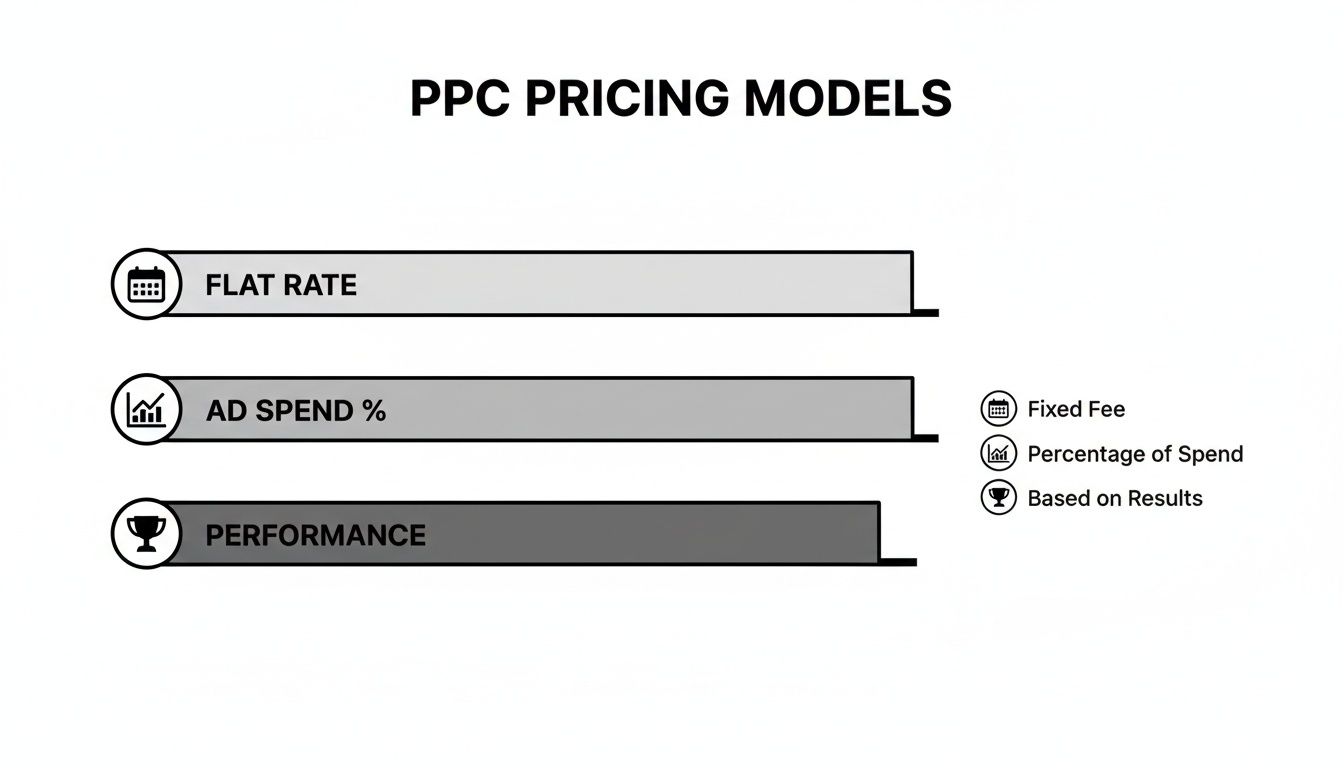
Each model—Flat Rate, Percentage of Ad Spend, and Performance-based—aligns the agency’s incentives with different business goals, whether you prioritize a predictable budget or are aiming for aggressive growth.
Here’s a look at some baseline metrics to help you set realistic expectations for your campaigns.
Google Ads Performance Benchmarks for B2B Equipment Industries
This table provides a realistic snapshot of what restaurant equipment businesses can expect from their PPC campaigns when compared to broader industry averages.
| Metric | Average Across All Industries | High-Competition B2B Example | Relevance for Equipment Suppliers |
|---|---|---|---|
| Click-Through Rate (CTR) | 1.53% | Legal: 3.84% (Search) | Aiming for 2-5% on search campaigns is a solid goal. Your CTR will vary based on ad copy and targeting precision. |
| Cost Per Click (CPC) | $5.26 | Legal: $8.58 (Search) | Expect CPCs to fall in this range, potentially higher for competitive terms like "commercial oven" or "ice machine." |
| Conversion Rate (CVR) | 4.4% (Search) | B2B Services: 3.04% (Search) | A rate of 3-5% is a good starting benchmark, but highly optimized landing pages can push this even higher. |
| Cost Per Acquisition (CPA) | $54.91 (Search) | B2B Services: $116.13 (Search) | Your target CPA should be well below the lifetime value of a new customer. This is a critical number to define with your agency. |
Data sourced from Wordstream's 2025 Google Ads Benchmarks.
These benchmarks aren't rigid rules but guideposts. Your actual performance will depend on your specific niche, the competitiveness of your keywords, and the skill of your campaign manager.
The most important takeaway is that your metrics should tell a story. A low click-through rate might not matter if the few clicks you get have an exceptionally high conversion rate and an amazing ROAS. An expert agency helps you read between the lines and optimize for profit, not just for traffic.
How to Choose the Right PPC Management Partner
Choosing a partner for your PPC advertising management services is easily the most critical decision you'll make on your paid advertising journey. This isn't just about hiring a vendor; it's about finding a strategic ally who gets your specific corner of the B2B world and is genuinely invested in your growth.
The right partner can multiply your investment, turning clicks into customers. The wrong one can burn through your budget with almost nothing to show for it.
The selection process needs to be careful and deliberate. Think of it like you’re sourcing a critical piece of kitchen equipment. You wouldn't buy a commercial charbroiler without checking its specs, reading reviews, and understanding its long-term value. Your PPC agency deserves that same level of scrutiny.
Verify Niche Industry Experience
The very first filter you should apply is industry experience. A generalist agency might know their way around Google Ads, but do they understand the difference between a hotel procurement manager and an executive chef? Your business sells high-value equipment, not pizza slices, and your agency needs to grasp that distinction from day one.
Look for a partner with real, provable experience in the B2B equipment or restaurant supply sector. They should speak your language and understand the unique sales cycles and buyer personas you deal with. This specialized knowledge is what separates a campaign that gets random clicks from one that delivers quote requests for "modular charbroilers."
A tell-tale sign of a competent B2B agency is their focus on lead quality over sheer quantity. They should be more interested in finding you one perfect lead from a multi-unit restaurant chain than a hundred clicks from culinary students.
Scrutinize Communication and Reporting Standards
Transparency is completely non-negotiable. A good agency will give you clear, consistent, and easy-to-understand reports that connect ad metrics to your actual business goals. If their reports are clogged with confusing jargon and vanity metrics like "impressions" without tying them back to sales or leads, that's a huge red flag.
A skilled team uses industry benchmarks to set realistic goals. With the global digital ad spend projected to top $910 billion by 2027, a savvy agency knows how to pick the right platform for the job. They’ll use LinkedIn's higher CPCs to get in front of catering managers but switch to YouTube's lower costs to demonstrate a charbroiler's versatility.
Their expertise in mobile—which drives 52% of clicks—and Shopping Ads, which are vital for equipment sales, is essential for getting the most out of your budget. You can discover more about these advertising benchmarks to see what a professional team really brings to the table.
Demand Proof with Case Studies and References
Don't just take their word for it—ask for proof. A confident, successful agency will be happy to share case studies from clients just like you. These shouldn't be vague success stories but detailed accounts of the challenges, the strategies they used, and the measurable results they achieved.
Even better, ask to speak with current or former clients. A quick chat can tell you a lot about an agency's responsiveness, strategic thinking, and what it’s like to work with them day-to-day. This is how you get past the sales pitch and find out what you’re really signing up for.
Critical Questions to Ask a Potential PPC Agency
To make your vetting process easier, arm yourself with specific questions that get to the heart of what they can do for you. Generic questions get generic answers. Instead, focus on scenarios relevant to your business.
Here is a checklist of questions to guide your conversations:
1. Experience and Strategy:
- Can you show me a case study from a B2B equipment supplier or a similar industry?
- How do you target niche buyer personas, like hotel procurement managers or independent restaurant owners?
- What is your process for keyword research for highly specific products like "floor model charbroilers"?
2. Performance and Optimization:
- Show me an example of how you've optimized a campaign for lead quality, not just quantity.
- How do you approach A/B testing for ad copy and landing pages in a B2B context?
- What is your strategy for managing bids on competitive, high-cost keywords?
3. Reporting and Communication:
- What metrics will be on our weekly or monthly report, and how do they connect to our business goals?
- Who will be our main point of contact, and what is their level of experience?
- How often will we have strategy calls, and what is the typical agenda for those meetings?
By asking these tough questions and carefully evaluating their industry experience and transparency, you can confidently choose a PPC management partner who will act as a true extension of your team.
Essential PPC Campaign Types for Equipment Suppliers
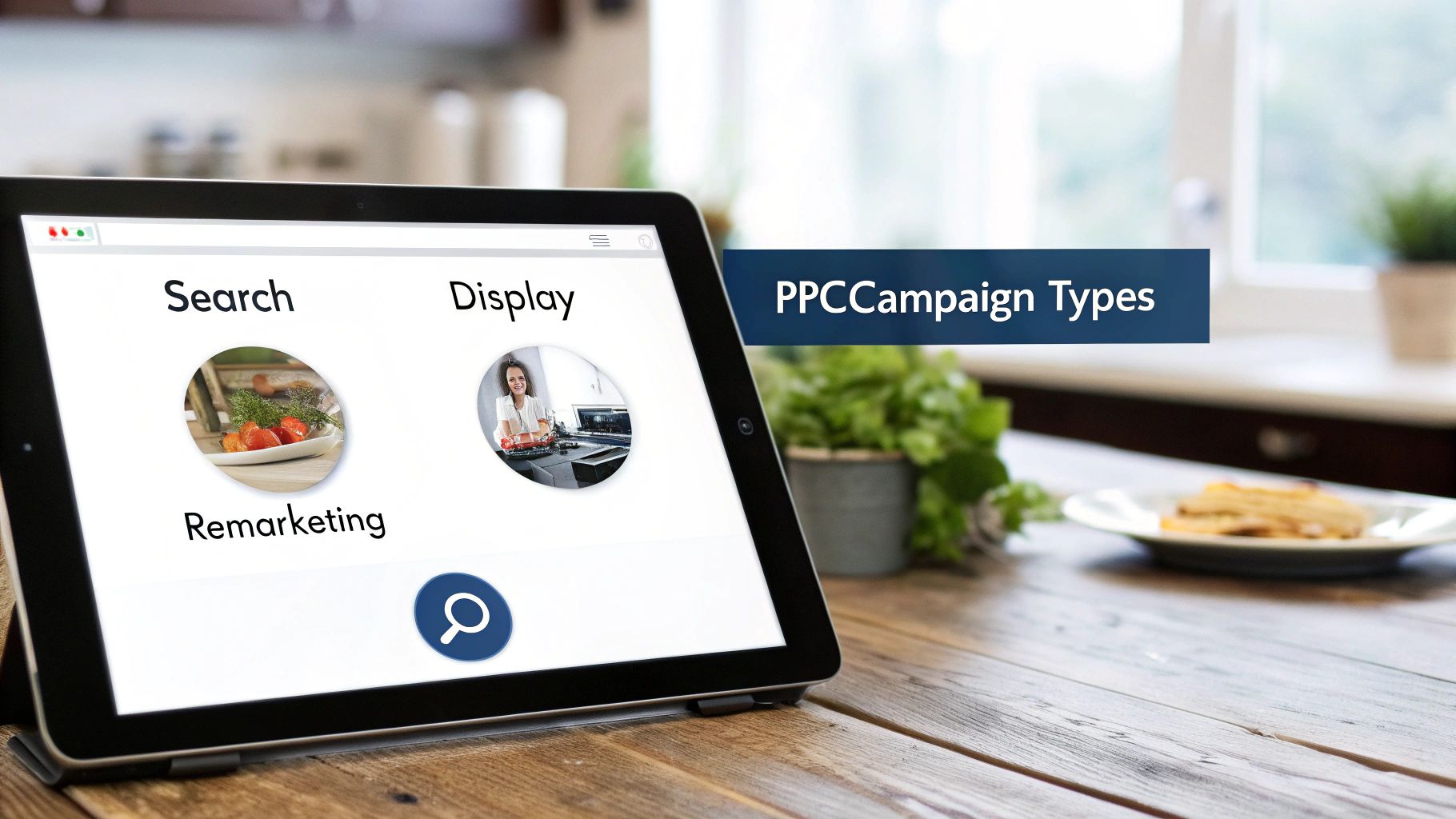
When you hire someone for PPC advertising management services, you're not just getting one type of ad. You’re really getting a full menu of campaign options, and each one is built to hit a specific business goal. For a restaurant equipment supplier, it’s like a chef knowing when to grill versus when to braise—using the right tool at the right time is everything.
A smart PPC strategy never puts all its eggs in one basket. Instead, it mixes different campaign types into a powerful system that pulls in new customers, builds your brand name, and brings back anyone who showed interest. Let’s break down the core campaign types that form the foundation of a winning PPC plan.
Search Campaigns Capturing Immediate Demand
Think of Search Campaigns as your hotline to buyers who are ready to pull the trigger. These are the classic text ads you see at the top of Google when a chef or restaurant owner is actively searching for something they need now. They are the absolute workhorses of PPC, designed to catch high-intent customers the moment they’re looking.
When someone types "buy countertop charbroiler" or "commercial ice machine repair," they aren't just window shopping. They have a problem that needs a solution, fast. Having your ad pop up at that exact moment is incredibly powerful.
The main job of a Search Campaign is to drive leads and direct sales. By targeting keywords that signal a customer is ready to buy, you put your equipment directly in front of people who are looking to request a quote or make a purchase today.
Display Campaigns Building Brand Awareness
If Search Campaigns are all about capturing existing demand, Display Campaigns are about creating it. These are the visual, image-based ads that show up on industry blogs, news sites, and across the vast Google Display Network. Their real strength lies in getting your name out there and keeping your equipment top-of-mind.
For instance, a Display ad showing off your new line of modular charbroilers could pop up on a popular foodservice blog. The chefs reading that blog might not be ready to buy on the spot, but seeing your brand over and over again establishes you as a serious player. That kind of awareness is crucial for long-term growth and also plays nicely with efforts like local SEO services that help nearby customers find you.
Remarketing Campaigns Re-Engaging Prospects
What happens to the potential buyer who visited your site, clicked on a specific floor model charbroiler, but left without filling out a form? That’s where Remarketing campaigns shine. This highly effective strategy lets you show targeted ads only to people who have already been on your website.
Remarketing is like having a helpful salesperson gently remind a customer about an item they were checking out. It just works. These campaigns almost always have higher conversion rates because you're talking to a warm audience that already knows who you are and what you sell.
Here’s a simple way to see how they all work together for different goals:
- To Generate Immediate Leads: Use a Search Campaign targeting keywords like "commercial oven for sale."
- To Introduce a New Product: Run a Display Campaign on websites that restaurant managers and chefs visit.
- To Recover Abandoned Carts: Deploy a Remarketing Campaign to show previous visitors the exact equipment they looked at.
By weaving these core campaigns together, your PPC advertising management services provider can build a complete funnel that guides customers from their first look all the way to a final sale.
Your Top Questions About PPC Services, Answered
Jumping into paid advertising is a big step, and even when you see the potential, it's natural to have a few questions. For restaurant equipment suppliers, those questions usually come down to money, time, and exactly what you're paying for.
Let's clear up some of the common questions we hear from business owners. This information will help you move forward with confidence, whether you need copywriting for your product pages, blog posting to attract new audiences, or blogger outreach to build authority.
How Much Should an Equipment Supplier Budget for PPC?
There’s no one-size-fits-all answer, but a realistic starting point for most B2B suppliers is somewhere between $2,000 and $7,000 per month in pure ad spend. That's before you factor in the agency's management fee. Where you fall in that range really depends on how competitive your specific market is, the average ticket price of your equipment, and what you’re trying to achieve.
A good agency won't just pull a number out of thin air. They should sit down with you and figure out an acceptable Cost Per Acquisition (CPA) that makes sense for your business, based on how much a customer is worth to you over time. From there, they’ll suggest a starting budget that’s designed to prove the concept and show you a return before you even think about scaling up.
How Long Until We See a Return on Our PPC Investment?
You’ll start seeing clicks and website traffic almost right away, but a meaningful return on your investment—think actual sales and leads—realistically takes about 90 to 120 days. The first month is all about getting the foundation right: deep research, campaign setup, and collecting that critical first batch of data.
Months two and three are where the magic happens. This is the optimization phase. Your agency will be aggressively tweaking bids, killing off ads that aren't working, and doubling down on the campaigns that are bringing in the best results. PPC isn't a "set it and forget it" game; it's a long-term strategy where consistent, data-backed adjustments drive real, sustainable growth.
Think of the first 90 days as the learning period. It’s where your management team figures out what clicks with your buyers, setting the stage for long-term profitability.
Do PPC Agencies Manage More Than Just Google Ads?
Absolutely. Any agency worth its salt does. While Google Ads is almost always the cornerstone of a solid PPC strategy, a true management service builds a campaign that reaches your customers wherever they are.
For a B2B equipment supplier, that strategy often includes a few other key players:
- Microsoft Ads (Bing): This is a fantastic platform for reaching a slightly different—and often older—professional audience that you might miss if you only focus on Google.
- LinkedIn Ads: This one is a game-changer. It's unbeatable for its ability to target people by their exact job titles. Want to get your ads in front of 'Executive Chefs,' 'Foodservice Directors,' or 'Restaurant Owners'? This is how you do it.
A skilled agency won't just guess. They’ll do the research to figure out the right mix of channels where your ideal customers are actually spending their time online.
At Charbroilers.com, we understand that investing in the right equipment is key to your success. Our range of countertop, modular, and floor model charbroilers is designed to deliver that perfect smoky flavor and char-grilled texture your customers love. Explore our collection of commercial charbroilers and find the perfect addition to your kitchen today.