

Boost Revenue with On-Site Optimization for Restaurant Equipment
On-site optimization is all about fine-tuning your website's content and structure so you show up higher in search engines like Google. For a restaurant equipment supplier, it's the specific tweaks you make so that when a chef searches for a 'Vulcan VCRB36 Charbroiler', your product page is the first one they see. It’s how you turn your website into your best, hardest-working salesperson. As experts in providing SEO, blog posting, and article writing for restaurant equipment websites, we know that getting this right is fundamental to driving sales.
Why On-Site Optimization Sells More Equipment
Let’s be real—digging into your website's backend can feel like a technical chore you'd rather put off. But for a restaurant equipment business, it's the absolute bedrock of your sales strategy. Good on-site optimization is what connects your digital showroom directly with the chefs and restaurant owners who are actively looking for the exact equipment you sell.
This isn't about chasing vanity metrics; it's about driving actual sales. When a potential customer needs 'commercial refrigeration units' or a specific 'stainless steel prep table', their first stop is Google. Your goal is to be the first and most credible answer they find. This guide cuts through the jargon to give you a practical roadmap to get there.
Bridging the Gap Between Search and Sale
A well-organized site does more than just make Google happy. It creates a smooth, direct path from a customer's initial search to a confident purchase. Every single element, from your product descriptions to how fast your pages load, plays a part in building trust and making the whole experience better for the user.
On-site optimization isn't about "tricking" Google. It's about creating the best, most helpful, and most trustworthy resource for the people you want to sell to. When you solve their problem effectively, the rankings and sales just naturally follow.
The impact here is huge. Think about it: an estimated 53% of all website traffic comes from organic search. That means your visibility on Google is non-negotiable. Better yet, SEO leads close at a staggering 14.6% rate, completely blowing away the 1.7% close rate from outbound leads like cold calls. These numbers don't lie; optimization is critical for attracting buyers who are ready to pull the trigger. You can see more compelling SEO statistics and data that back this up.
Turning Clicks into Conversions
At the end of the day, every optimization effort points to one thing: increasing sales. By making your site easier to navigate, faster to load, and packed with useful information, you remove the friction that kills a sale. This is how your online store transforms from a simple product catalog into a powerful sales engine that works for you 24/7.
Getting these fundamentals right is the first step. You can dive deeper into specific strategies to improve ecommerce conversion rates that build on this foundation. But first, let's walk through the essential on-page elements that drive this success.
Turn Product Pages Into High-Converting Assets
Your product and category pages are your digital showroom. This is where a casual searcher becomes a serious buyer, and for a restaurant equipment supplier, it's where smart on site optimization directly translates into sales. A product page can't just be a spec sheet; it needs to be a persuasive sales tool that solves a real problem for a busy chef or restaurant owner. Our copywriting and article writing services focus on turning these pages into powerful assets.
Too often, we see sites just copy and paste the manufacturer's talking points. This is a huge mistake. Not only does it create duplicate content issues with Google, but it completely misses the chance to speak directly to your customer's unique needs. The real goal here is to transform every single product listing into a high-performing asset that ranks well and, more importantly, converts visitors into customers.
This simple diagram breaks down the journey that good on-site optimization creates for your customers. It’s all about getting found, building trust, and making the sale.
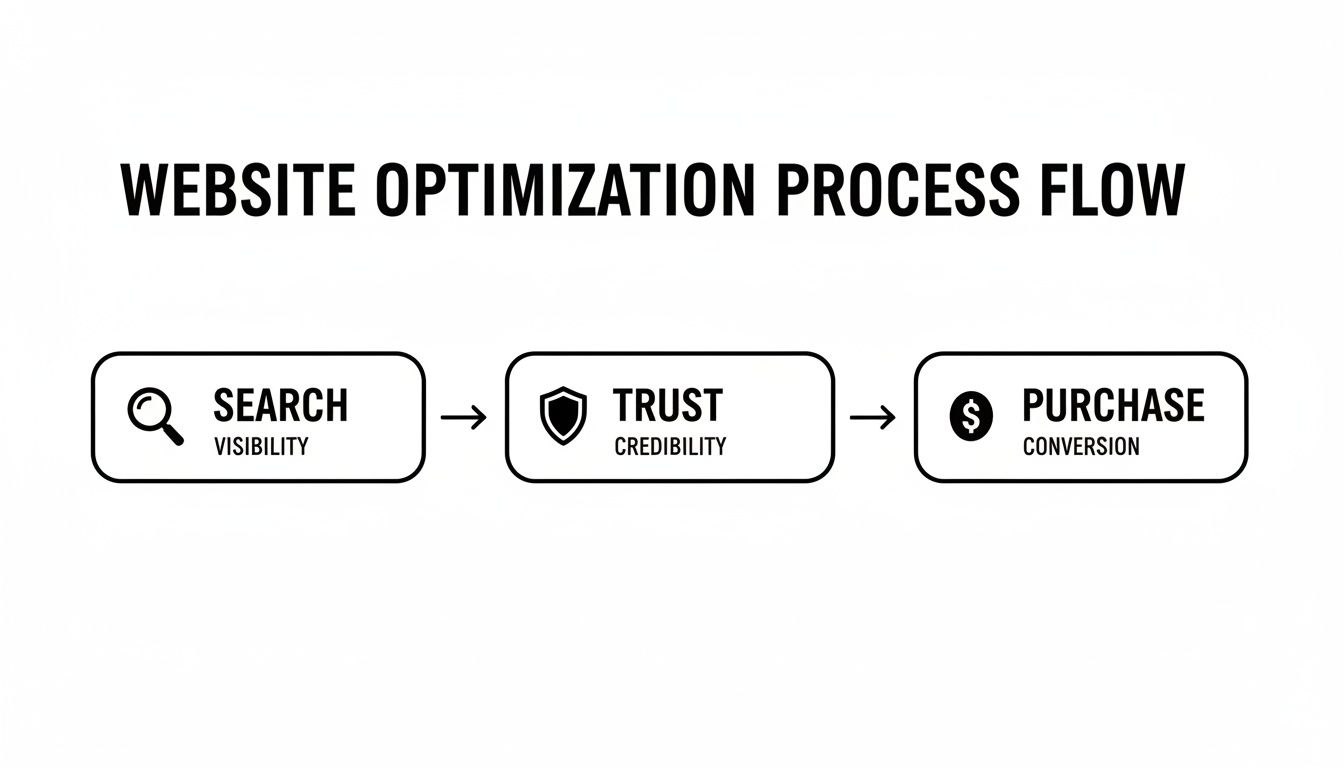
As you can see, the process is straightforward. It helps customers find you in search, builds the credibility they need to feel confident, and then guides them smoothly toward making a purchase.
Crafting Compelling Product Descriptions
Let's get practical. Take a common item like a 'stainless steel prep table.' A generic description will just list its dimensions and the gauge of the steel. Yawn.
An optimized, benefit-driven description, on the other hand, tells a story. It talks about how its NSF certification guarantees it'll pass the health inspection, how the rounded "bullnose" edges prevent staff injuries in a chaotic kitchen, and how the adjustable undershelf creates flexible storage for everything from sheet pans to stand mixers.
Writing unique descriptions is non-negotiable. It's not just about avoiding a slap on the wrist from Google for duplicate content; it’s about proving your expertise. You need to show that you understand the real-world headaches your customers face and position this specific piece of equipment as the solution.
If you're looking for some solid examples, check out our collection of expertly written product descriptions for restaurant equipment.
Think like a chef, not just a marketer. Instead of saying "durable construction," say "built to withstand the daily chaos of a high-volume dinner service." This subtle shift in language connects with your audience on a level they actually understand and appreciate.
By focusing on benefits over features, you're answering the customer's unspoken question: "How is this going to make my life easier?" This approach builds immediate trust and makes the buying decision feel like a no-brainer.
On-Page Element Optimization Checklist for a Product Page
Beyond the main description, a handful of other on-page elements need your attention. These small details add up to have a massive impact on both your search rankings and the user's experience.
Here’s a quick before-and-after checklist to show you what I mean. We'll use a hypothetical 'Turbo Air M3R24-1 Commercial Refrigerator' as our example.
| Element | Unoptimized Example | Optimized Example & Rationale |
|---|---|---|
| Meta Title | M3R24-1 Refrigerator |
Turbo Air M3R24-1 Commercial Refrigerator | Charbroilers.com Rationale: Clear, specific, and follows the proven Brand + Model + Product + Store format. |
| Meta Description | Turbo Air Refrigerator M3R24-1 - in stock now. |
Get the reliable Turbo Air M3R24-1 Refrigerator with free shipping! Stainless steel construction & energy-efficient cooling for busy kitchens. Buy now! Rationale: Highlights key benefits (free shipping, stainless steel) and includes a strong call to action. |
| URL Slug | /products/item-836201_m3r |
/products/turbo-air-m3r24-1-commercial-refrigerator Rationale: Clean, keyword-rich, and easy for both users and search engines to understand. |
| H1 Heading | M3R24-1 |
Turbo Air M3R24-1 Single Door Commercial Refrigerator Rationale: Fully descriptive and matches user search intent perfectly. |
| Image Alt Text | refrigerator.jpg |
Front view of the Turbo Air M3R24-1 commercial refrigerator with the door open. Rationale: Descriptive text for accessibility and image search visibility. |
Nailing these fundamentals on every page is a repeatable process that turns your product listings into consistent performers.
Optimizing Category Pages for Broader Searches
While your product pages are perfect for targeting those super-specific, long-tail keywords (like a model number), your category pages are where you'll capture the broader search terms. Think "commercial ranges" or "countertop charbroilers."
These pages serve as critical hubs, organizing your inventory and guiding users to the exact product they need. Make sure your category pages have some well-written introductory text at the top. This is a prime spot to naturally include your target keywords and link down to important subcategories or your best-selling models.
Why does all this matter? Because these on-page elements directly impact user trust and click-through rates from search results. When a potential customer sees a clear, compelling title and description, they're far more likely to click on your link over a competitor's. And once they're on your site, a well-organized page keeps them there.
Build a Rock-Solid Technical SEO Foundation
While perfectly crafted product pages are your showroom, your site's technical health is the foundation everything is built on. Think of it like a commercial kitchen—if the wiring is faulty or the gas lines are blocked, nothing else works correctly, no matter how skilled the chef. This is where the crucial work of technical on-site optimization comes in.
Don't let the term "technical SEO" intimidate you; you don't need to be a developer to grasp the basics that truly make a difference. Getting these elements right ensures that search engines can easily find, crawl, and understand your entire inventory, from countertop charbroilers to walk-in freezers. It’s all about creating a smooth, reliable experience for both search bots and your customers.
Make Your Site Fast and Mobile-Ready
In this business, speed isn't just a suggestion; it's a requirement. A chef trying to order a replacement part from their phone between dinner service will ditch a slow-loading site in seconds. Every extra moment your page takes to load directly eats into your bottom line.
Just as critical, your website has to work flawlessly on a phone. Today's restaurant owners are constantly on the move, managing inventory and making buying decisions from tablets and smartphones. A clunky, hard-to-navigate mobile site is a guaranteed lost sale.
Your website's performance is a direct reflection of your brand's professionalism. A fast, secure, and mobile-friendly site tells a potential customer that you are reliable and trustworthy, which is essential when they're about to make a significant investment in new equipment.
The numbers don't lie. Nearly 60% of global site visits now happen on mobile devices, and sites that are mobile-friendly are 67% more likely to hit the first page of Google. On top of that, 95% of Google’s top search results are secured by HTTPS, showing just how critical security is as a ranking factor. You can see more technical SEO stats over at pageoptimizer.pro.
Create Clear Pathways with a Logical Site Structure
A confusing website is like a disorganized warehouse—customers and search engines will get lost. Your job is to create a logical hierarchy that guides everyone from broad categories to specific products without any friction.
This means using clean navigation menus and breadcrumbs (e.g., Home > Commercial Ovens > Convection Ovens > Blodgett Mark V) so users always know exactly where they are. Smart internal linking is another one of your best tools. When you mention "commercial refrigeration" in a blog post about kitchen efficiency, you should link it straight to your commercial refrigeration category page.
These internal links create a web of connections that helps Google understand the relationships between your pages and spreads authority across your site. For a deeper dive, our guide on creating an SEO-friendly site architecture lays out a step-by-step framework.
Giving Google the Right Directions
Beyond the structure people see, two key files act as a roadmap for search engines: your XML sitemap and your robots.txt file. They sound technical, but their purpose is incredibly simple.
- XML Sitemap: This is just a list of all the important pages on your site. Submitting it to Google Search Console is like handing Google a map of your store, making sure it doesn't miss any of your valuable product or category pages.
- Robots.txt File: This file tells search engine crawlers which parts of your site they should not look at. You can use it to block off private areas like customer account pages or internal search results, which keeps Google focused on the pages you actually want indexed.
Secure Your Site with HTTPS
Finally, website security is non-negotiable. An HTTPS certificate encrypts the data shared between a customer's browser and your server, protecting sensitive information like credit card details and company addresses.
Google has confirmed that HTTPS is a ranking signal. But more importantly, modern browsers now slap a "Not Secure" warning on any site without it. Seeing that message is the fastest way to make a potential buyer lose trust and abandon their cart. Getting HTTPS set up is a fundamental step in building credibility and making your customers feel safe enough to pull the trigger on a purchase.
Win More Clicks with Rich Snippets and Optimized Visuals
Let’s be honest, in a crowded Google search page, getting noticed is half the battle. This is where the visual appeal of your listing can make or break whether you get the click. Your secret weapon for this is structured data, also known as Schema markup. It’s what transforms a boring blue link into an eye-catching, informative snippet that practically begs to be clicked.
Structured data is essentially a specific vocabulary of code you add to your site. It doesn't change how the page looks to a visitor, but it gives search engines a much deeper understanding of your content. For a restaurant equipment site selling everything from charbroilers to prep tables, the most important type is 'Product' schema.
When you implement it correctly, you’re spoon-feeding Google specific details it can show off right in the search results.

This lets you showcase crucial info like price, availability, and—most importantly—those little gold customer review stars. These beefed-up listings are called rich snippets, and they can seriously boost your click-through rate. They provide immediate value and build trust before a user even lands on your site.
Getting Product Schema Markup on Your Pages
Adding schema isn’t nearly as intimidating as it might sound. Think of it like putting clear, descriptive labels on boxes in a warehouse—it just makes everything easier for Google to find and understand.
Here’s what the official documentation for Product schema looks like, showing the different "labels" you can use.
You can see properties like aggregateRating, brand, offers, and sku that let you give Google the exact details about your equipment. By filling these out, you’re leaving nothing to guesswork.
The good news is you don't need to be a coding guru. Most e-commerce platforms like Shopify have apps or built-in features that handle the heavy lifting for you. If not, you can always use Google's own Structured Data Markup Helper to generate the code.
For a restaurant equipment site, these are the essential Product schema properties to nail down:
-
name: The full product name, including brand and model (e.g., "Vulcan VCRB36 Gas Charbroiler"). -
image: A direct URL to a high-quality product photo. -
description: A short, punchy description of the equipment. -
sku: The manufacturer's stock-keeping unit or model number. -
brand: The brand name, like Atosa or True Manufacturing. -
offers: This is a big one. It's a nested property that holds the sales details:-
priceCurrency: "USD" -
price: The current price. -
availability: Let people know if it's in stock (e.g., "InStock" or "OutOfStock").
-
-
aggregateRating: This is where the magic happens. You pull in customer reviews here, specifying the average rating and the total review count. This is what gets you those gold stars in the search results.
Don't ever underestimate the power of those star ratings. A product with visible reviews stands out dramatically from its competitors. It’s an instant signal of trust and quality that can make a potential buyer choose your link over another, even if you're ranked a spot lower.
Image Optimization That Goes Beyond Alt Text
High-ticket items are sold with great visuals. No chef is dropping thousands of dollars on a commercial range without seeing clean, detailed photos from every possible angle. But when it comes to SEO, image optimization is so much more than just filling in the alt text.
First off, your file names are a huge missed opportunity for most sites. A file named IMG_8432.jpg tells Google absolutely nothing. A descriptive, keyword-rich filename like atosa-commercial-freezer-mbc24f.jpg provides valuable context and helps your images show up in Google Images search.
Second, image size is a page speed killer. Massive, uncompressed photos will slow your site to a crawl, which frustrates users and dings your rankings. Use a tool like TinyPNG or your platform's built-in compression to shrink file sizes without losing visual quality. This is a non-negotiable part of any solid on site optimization plan.
The impact here is well-documented. Some research shows that properly tagged and compressed images can lead to a 23% boost in organic traffic. What’s more, using a Content Delivery Network (CDN) to serve those images even faster can cut your bounce rate by around 15%. You can dig into more stats and data points on technical SEO over at PageOptimizer Pro.
Capture Local Buyers with Targeted SEO Tactics
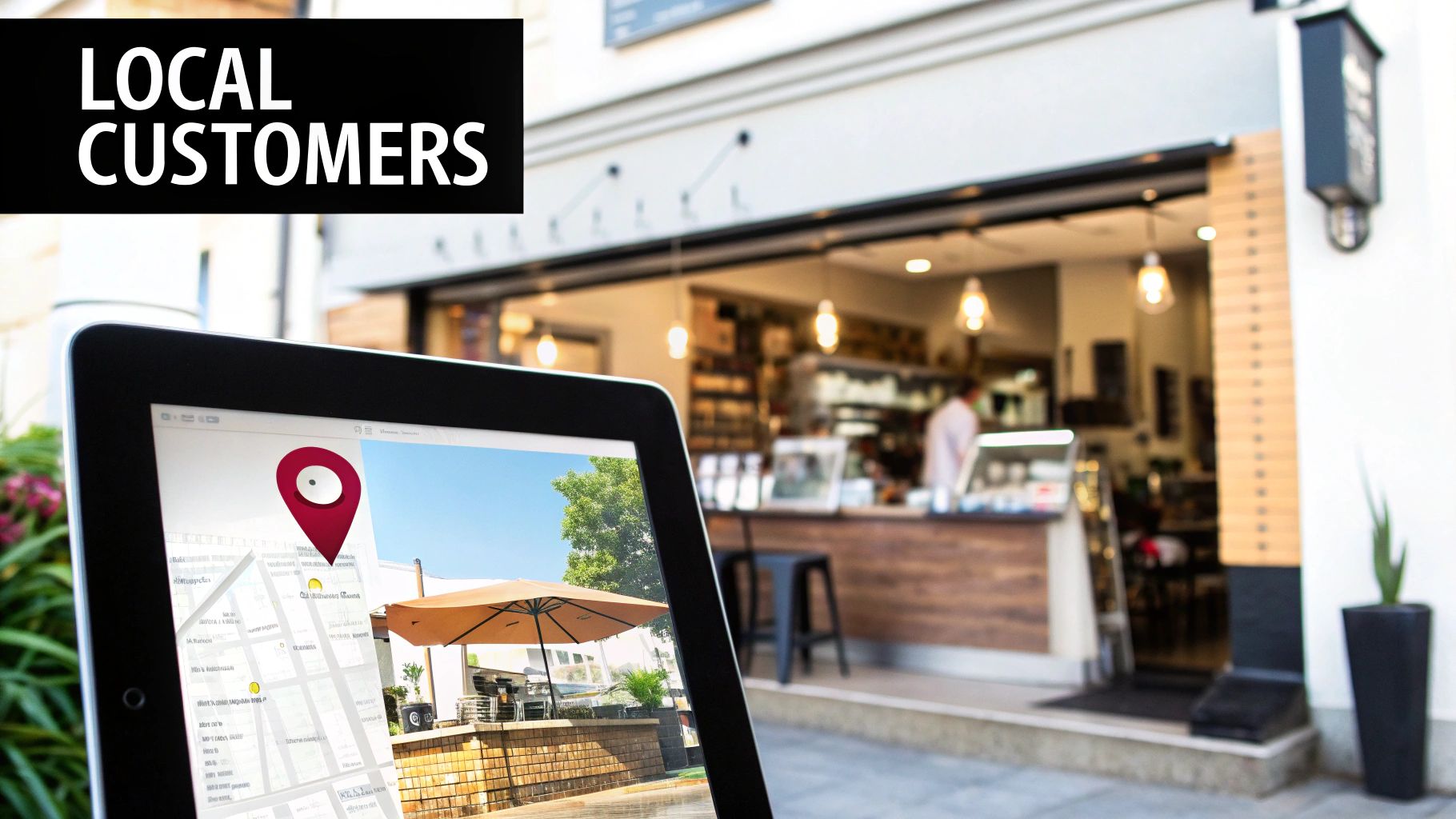
For many restaurant equipment suppliers, the most valuable customers aren't halfway across the country—they're right in your own backyard. While a national e-commerce presence is great, real on-site optimization also means owning your local service area. This is where you connect with restaurant owners who need equipment, service, or repairs now. Our expertise in local citation services ensures your business stands out in these crucial local searches.
Focusing on local SEO turns your website into a magnet for nearby buyers with immediate, high-intent needs. It’s all about being the first result when a local chef is in a jam, searching for a quick replacement or emergency service.
Dominate Local Search with Location-Specific Pages
One of the most powerful local strategies we've seen work time and again is creating dedicated pages for each city or significant area you serve. These aren't just copies of your homepage with a different city name swapped in; they are unique assets built from the ground up to capture targeted local searches.
For instance, a page titled "Restaurant Equipment Repair in Dallas" needs content made specifically for Dallas-area customers. Mention local landmarks, talk about common issues restaurants face in the Texas heat, and feature glowing testimonials from Dallas-based clients. This level of detail shows both users and Google that you are a genuine local authority, not just a national site casting a wide net.
These pages are the perfect place to target valuable long-tail keywords like:
- Commercial oven installation Houston
- Walk-in freezer service Austin TX
- Used restaurant equipment Miami
Your Google Business Profile is Non-Negotiable
Think of your Google Business Profile (GBP) as your digital storefront for anyone searching nearby. It's often the very first interaction a local customer will have with your business, popping up in Google Maps and the coveted "local pack" in search results. A fully optimized profile isn't just a good idea—it's an absolute must.
Make sure your GBP is fleshed out with high-quality photos of your showroom and service vans, accurate business hours, a complete list of your services, and the correct business category. Pushing customers to leave reviews here is also critical, as those positive ratings heavily influence both your local rankings and a buyer's trust.
Your business's Name, Address, and Phone number (NAP) must be perfectly consistent across your website, your Google Business Profile, and all other online directories. Even a tiny variation like "St." vs. "Street" can confuse search engines and water down your local authority.
This consistency is a foundational trust signal for Google. If you're struggling to get this right, our expertise in local citation services can provide a detailed roadmap for aligning your NAP information everywhere it counts.
Build Trust with Local Reviews and Testimonials
In local markets, social proof is king. A strong recommendation from a fellow local business owner carries immense weight. You need to be actively soliciting reviews from your happy customers and making it dead simple for them to leave feedback on platforms like Google, Yelp, and other industry-specific sites.
Once you have these reviews, don't hide them! Create a testimonials section on your location pages, feature powerful quotes on your homepage, and use schema markup to get those little gold review stars showing up right in the search results. This builds immediate credibility and helps a potential buyer feel confident choosing you over some faceless national competitor. A great practical guide on Local SEO for Small Businesses can offer even more insight into driving both in-store and local online traffic.
Your On-Site Optimization Questions Answered
Jumping into on-site optimization can feel like opening a can of worms, especially in a niche e-commerce world like restaurant equipment. Let's cut through the noise and get straight to the questions we hear most often from suppliers like you.
How Long Does It Take to See Results from On-Site Optimization?
This is the big one, isn't it? The honest, no-fluff answer is: it depends. Anyone promising you overnight rankings isn't giving you the full story.
Some of your work will pay off almost immediately. For example, if you compress a bunch of heavy product images, you'll see your page speed improve right away. That means a better user experience and lower bounce rates—quick wins that Google notices. Fixing broken links or finally moving your site to HTTPS are other fixes that give your site an instant health boost.
But the real meat-and-potatoes changes, the ones involving content and keyword strategy, demand patience. You're typically looking at a 3 to 6-month window before Google fully crawls, indexes, and re-evaluates your updated pages. That's when you'll start to see real, meaningful movement in the search results.
Think of on-site SEO like tending a garden. First, you prep the soil (technical fixes). Then you plant the seeds (new content and keywords). Then you water them consistently (ongoing updates). You won't get a full harvest tomorrow, but with steady work, you'll see it grow.
A few things can speed this up or slow it down:
- Site History & Authority: An established site with a solid reputation and good backlinks will see changes register much faster than a brand-new domain.
- Competition Level: Trying to rank for a monster term like "commercial refrigerators" is a long haul. Ranking for "specialty bakery proofing cabinets" will be a quicker fight.
- Scope of Changes: Tweaking a few product descriptions is one thing; a complete site overhaul is another beast entirely.
The trick is to stop thinking of it as a one-and-done project. It's a continuous process. Consistent, steady effort is what builds unstoppable momentum.
Should I Optimize for Model Numbers or General Equipment Names?
Great question, and the answer isn't "either/or." You absolutely need to do both. You just have to be smart about where you do it. This two-pronged approach lets you catch buyers at every single stage of their journey.
Your individual product pages need to be laser-focused on specific, long-tail keywords—and that absolutely includes exact model numbers. A chef searching for a "Hoshizaki KM-515MAH" isn't just window shopping. They're at the finish line. They know what they want and they're ready to buy.
To reel in these high-intent buyers, that model number needs to be everywhere on the product page:
- In the page title
- In the main H1 heading
- In the URL itself
- All over the product description and specs
- In the image alt text
On the flip side, your category pages are where you target the broader equipment names. Think "commercial ice machines" or "countertop charbroilers." These are the terms people use when they're just starting their research. They know they need something, but they haven't settled on a brand or model yet.
Optimizing category pages for these general terms casts a much wider net. You can use that page to educate them, walk them through the different options you carry, and guide them toward the perfect product for their kitchen.
Is a Blog Really Necessary for an Equipment Website?
Yes. A thousand times, yes. A well-kept blog is one of the most powerful tools in your entire SEO toolbox. It's your primary engine for building authority and pulling in customers with genuinely helpful content. We specialize in blog posting and blogger outreach specifically for this reason.
Just think about the questions your customers ask before they're ready to buy. They're searching for things like "how to choose a commercial deep fryer" or "best convection oven for a small bakery." You can't just cram that information onto a product page—it would feel forced and kill your conversion rate.
That’s where the blog comes in. By creating detailed articles, buying guides, and comparison posts, you can:
- Attract Top-of-Funnel Traffic: You get in front of potential buyers way early in their research phase, long before your competitors do.
- Build Trust and Authority: When you provide real, helpful advice, you stop being just another online store and become a trusted expert.
- Create Internal Linking Goldmines: That blog post about choosing a deep fryer? It's the perfect spot to link back to your main deep fryer category page and even specific models you recommend. This passes SEO value around your site and walks users right toward a purchase.
A blog doesn't just sit on the side; it actively supports your entire site’s performance. It creates fresh content that search engines love, answers your customers' biggest questions, and weaves a powerful network of internal links that strengthens your overall on-site optimization.
At Charbroilers.com, we know the right equipment is the heart of any kitchen. From high-performance charbroilers that put the perfect sear on a steak to versatile countertop models for tight spaces, we provide the quality and expertise you need. Explore our extensive collection of commercial charbroilers today and find the perfect fit for your restaurant.