

National Search Engine optimization services for Restaurant Equipment Suppliers
National search engine optimization is all about helping a business attract customers from across the country, not just from its own backyard. The strategy hinges on ranking for broad, non-geographic keywords, which is perfect for e-commerce stores, national chains, and B2B suppliers with a nationwide market. Think of it as a long-term investment in building a powerful, coast-to-coast brand presence online, especially for businesses like restaurant equipment supply websites.
Moving Beyond Your Local Market with National SEO
Has your successful local equipment shop hit an invisible growth ceiling? It’s a common roadblock. Your operations are ready to scale, but your online presence is still stuck within your city limits. This is the exact moment when a national SEO strategy becomes the key to unlocking a much larger customer base.
Think of it like this: local SEO is like running a hugely popular stall at your town's farmers' market. You're a local legend, trusted by everyone nearby who’s searching for what you offer. National SEO, on the other hand, is the strategic plan that gets your products stocked on the shelves of every major supermarket chain in the country. It takes your brand from a local favorite to a recognized national player.
Expanding Your Digital Footprint
For businesses like multi-location restaurant chains or an e-commerce supplier such as Charbroilers.com, making this shift is a game-changer. A local strategy helps an individual franchise location pull in diners searching "best burger near me." A national approach, however, targets the purchasing director of a hotel group searching for "commercial-grade charbroilers in bulk." The goals, the audience, and the tactics are worlds apart.
A national campaign pulls from a broader playbook, one designed to build authority on a massive scale. As experts in SEO for restaurant equipment supply websites, we know key components almost always include:
- Authoritative Content Creation: Building out in-depth guides, articles, and blog posts that answer complex questions for a national audience, not just a local one.
- Strategic Blogger Outreach: Getting your brand mentioned and linked to from high-profile industry publications and respected websites across the country.
- Advanced Technical SEO: Making sure your website's architecture can handle huge amounts of traffic and is easily understood by search engines looking at broad, competitive queries.
- Comprehensive Link Building: Earning high-quality backlinks that tell Google your website is a go-to resource for the entire industry, not just a single town.
By focusing on these core areas, you can systematically build the digital authority needed to compete on a national stage. It’s how you break free from the limits of local search and turn your website from a simple online brochure into a powerful customer acquisition engine.
Ultimately, investing in national search engine optimization is about future-proofing your growth. It positions your brand to capture valuable traffic and leads from every corner of the market, setting the stage for some serious expansion.
For a deeper dive into what a full-scale strategy looks like, exploring comprehensive national SEO services can give you a clearer picture. This is the approach that transforms your digital presence, connecting you with a far bigger audience and building a rock-solid foundation for sustained growth.
National SEO vs Local SEO A Strategic Comparison
Figuring out the difference between national and local SEO is the first critical step toward picking the right growth plan for your business. While both might use some of the same tools, their goals, tactics, and who they’re trying to reach are worlds apart. Getting them mixed up is like trying to spread butter with a steak knife—sure, you might get the job done, but it’s clumsy and definitely not the right tool for the job.
Local SEO is all about your immediate surroundings. Think of it as the digital version of a bright, welcoming sign in your storefront window. The entire goal is to catch the eye of customers right in your area who are looking for what you offer right now. It answers searches like "best tacos near me" or "restaurant equipment repair in Chicago." This approach is built on proximity and immediate need.
National SEO, on the other hand, plays on a much bigger field. The aim here is to build a brand that’s seen as an authority across the entire country, no matter where the person searching is located. It targets broad, informational searches from a national audience, like a purchasing director researching "commercial kitchen ventilation standards" or a potential franchisee looking up "gourmet burger franchise costs."
Defining the Intent Behind the Search
The biggest difference comes down to search intent. A local search has a clear geographical boundary and often signals an urgent need. When someone types in "emergency plumber," Google knows they need options within a few miles, not a company three states over. The whole strategy is built around these location-specific signals.
In contrast, national intent is all about the topic. The user is looking for information, products, or services without being tied to a specific place. A chef in Miami and a restaurant owner in Seattle could both search for "how to choose a commercial charbroiler," and a national equipment supplier wants to be the answer for both of them. This means you have to build authority around the subject itself, not just your location.
This infographic breaks down what it looks like to move from a local focus to a national one, a common goal for businesses ready to scale.
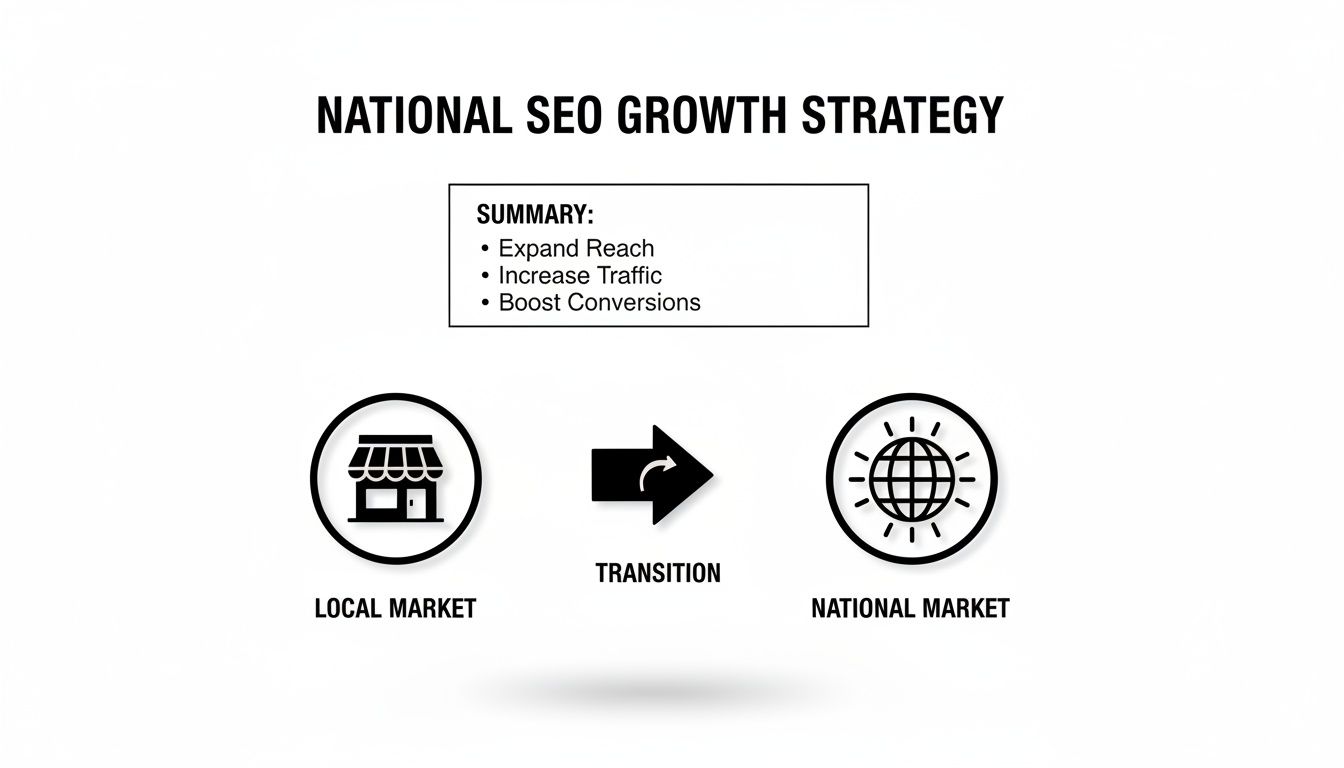
It really shows how a business can grow its online footprint, shifting from serving a single community to capturing customers from coast to coast.
Content Strategy and Link Building Tactics
Because the intent is so different, the content and link-building tactics have to be, too. Local content is often about community news, sponsoring local events, or highlighting neighborhood specials. The link strategy is all about getting mentions from local business directories, the Chamber of Commerce, and local news sites. You can get a deeper dive on this in our guide to local SEO services for restaurants.
A national content strategy is about cementing your brand as the industry resource. This means creating massive, comprehensive guides, reports on industry trends, and deep-dive product comparisons. Link building for a national campaign is about earning high-authority links from major culinary publications, equipment review sites, and respected industry blogs anywhere in the country. Our blogger outreach services specialize in building these exact types of connections for restaurant equipment suppliers.
The core difference is simple: Local SEO proves you're the best option in a specific place. National SEO proves you're one of the best resources for a specific topic in the entire country.
To really hammer this home, the table below breaks down the key strategic differences for a hospitality business. It’s a quick-glance guide to help you see which path lines up with your growth goals.
Key Differences National SEO vs Local SEO Strategy
| Strategy Element | Local SEO Focus | National SEO Focus |
|---|---|---|
| Target Audience | Customers in a specific city, town, or neighborhood. | A nationwide audience with broad, topic-based interests. |
| Keyword Intent | Geo-specific terms like "pizza delivery Boston." | Informational queries like "best commercial pizza oven." |
| Content Strategy | Local event recaps, location-specific pages, community news. | In-depth industry guides, thought leadership articles, product reviews. |
| Link Building | Local directories, Chamber of Commerce, neighborhood blogs. | National publications, respected industry websites, major review sites. |
Ultimately, choosing between a local and national SEO strategy depends entirely on where your business is today and where you want it to be tomorrow. This table should make it clear which set of tools and tactics you need for the journey.
The Core Pillars of a National SEO Service
Putting money into national SEO can feel a bit abstract, almost like buying a blueprint for a building you can't see yet. So, what are you actually paying for? A winning national campaign isn’t built on secret tricks or a single tactic. It stands on four solid pillars that work together to make your brand an authority across the country.
For a growing restaurant equipment supplier, understanding these pillars cuts through the confusion. It shows you how a coordinated strategy can take your digital presence from a local shop to a national powerhouse, pulling in customers from coast to coast. Each pillar tackles a different challenge that comes with competing on a much bigger stage.

This methodical approach is more important than ever. The global SEO services market is booming, now valued at $92.74 billion and growing at a compound annual rate of 16.7%. For businesses using charbroilers—or supplying them—this growth shows why a strong online game is no longer optional. You can see more insights about the global SEO services market growth on ResearchAndMarkets.com.
Advanced Technical SEO
The first pillar is the absolute foundation of your entire digital presence. Think of technical SEO as the structural engineering of your website. You can't put a skyscraper on a shaky foundation, and you can't handle national traffic and competition with a poorly built website.
For an equipment supplier, this is about more than just a fast website. It means using advanced schema markup for every single product, from charbroilers to walk-in freezers. This structured data feeds search engines specific details about your products—price, availability, model number—making them much more likely to show up in detailed search results nationwide.
A strong technical foundation ensures search engines can crawl, index, and understand your site's content efficiently, no matter how large it grows. It's the silent, invisible work that makes everything else possible.
Scalable Content Strategy
If technical SEO is the foundation, content is the framework and all the rooms inside the building. A scalable content strategy for a national audience means creating authoritative articles, guides, and resources that answer questions for people all over the country. This isn't about a blog post on a local food festival; it's about creating the definitive guide on "How to Choose Between Gas and Electric Charbroilers."
This pillar is all about building topic clusters—groups of interlinked content around one central subject. For a restaurant equipment supplier, this might look like a main page on "Commercial Grilling" that links out to supporting articles on maintenance, cleaning, and cooking techniques. This tells Google that you're a true expert on the topic.
Key parts of a national content strategy include:
- In-depth Guides: Creating long-form content that covers a topic from every angle, making your site the go-to resource.
- Targeted Blog Posts: Answering the specific questions your nationwide audience is asking, from "best commercial grill for a steakhouse" to "industrial kitchen ventilation requirements."
- Strategic Copyrighting: Writing compelling product descriptions and landing pages that connect with a broad audience of chefs, managers, and purchasing directors.
Authoritative Link Building
The third pillar, authoritative link building, is all about earning your reputation. In the SEO world, links from other respected websites are like votes of confidence. A link from a small local blog is nice for local SEO, but a link from a major publication like Food & Wine or a top equipment review site tells Google you're a nationally recognized authority.
This process, which often involves blogger outreach, is about building real relationships. It’s not about buying links. It’s about creating content so valuable that other industry leaders want to reference it. For a restaurant supplier, this could mean publishing an original research report on kitchen efficiency that gets cited by culinary schools and trade magazines.
Every high-quality backlink strengthens your site's credibility, making it easier to rank for those tough, non-geographic keywords. Building this kind of trust is a long game, and you can get a better feel for the strategy in our guide on how to build domain authority for your website.
Performance Analytics and Reporting
Finally, the fourth pillar is performance analytics. You can't improve what you don't measure. For a national campaign, this means looking beyond simple traffic numbers and tracking the metrics that really show growth in brand visibility across the country.
This involves keeping a close eye on key performance indicators (KPIs) like:
- Rankings for Broad Keywords: Tracking your position for high-value, non-local terms like "commercial kitchen supplies" or "restaurant charbroilers."
- Non-Branded Organic Traffic: Measuring the growth in visitors who find you by searching for a topic, not just your company name. This shows you're reaching new audiences.
- Geographic Performance: Analyzing which states or regions are driving the most traffic and sales, helping you spot new market opportunities.
Together, these four pillars provide the complete structure needed for a successful national SEO campaign. By methodically strengthening each one, a business can build a commanding digital presence that drives real, sustainable growth.
Building a Content Engine to Attract National Customers
Content is the fuel for any successful national SEO campaign. While technical fixes and backlinks are absolutely part of the puzzle, it's the high-quality, strategic content on your site that really attracts, engages, and converts a nationwide audience. Without it, your SEO efforts are like a powerful engine with no gas—it might look impressive, but it’s not going anywhere.

For a restaurant equipment supplier, the mission is clear: become the go-to resource for your ideal customers, whether they're in New York or California. You don't get there by publishing random blog posts. You get there by building a carefully structured content ecosystem that establishes undeniable authority. This is where strategic blog posting and professional article writing services become a critical part of your growth plan.
From Pillar Pages to Topic Clusters
The smartest way to build this content engine is with the topic cluster model. Think of it like organizing a library. Instead of having books scattered everywhere, you have dedicated sections (like "Cooking Techniques") with specific books inside ("Grilling," "Baking," "Frying"). This structure makes it incredibly easy for visitors—and search engines—to find information and recognize you as an expert.
With this model, you start with a broad, high-value "pillar page" that covers a core topic from top to bottom. This page then links out to more specific "cluster" articles that explore subtopics in greater detail.
Let's walk through a real-world example for a restaurant equipment supply website.
- Pillar Page: A monster guide titled "The Ultimate Guide to Commercial Charbroilers." This page would cover everything from types and fuel sources to the top brands and key buying considerations.
- Cluster Content: Supporting articles that dive deeper into the specific questions a buyer has. These pieces link back to the main pillar page, creating a powerful web of interconnected, authoritative content.
This systematic approach proves your expertise to Google, helping you rank for a huge range of related terms. It transforms your website from a simple product catalog into an indispensable educational hub.
A well-executed topic cluster strategy doesn't just attract traffic; it builds a "content moat" around your brand. It becomes so comprehensive and valuable that competitors will find it almost impossible to challenge your authority on the subject.
Mapping Content to the Buyer's Journey
To make this strategy really work, your content has to meet customers exactly where they are in their purchasing process. The questions a chef casually researching new equipment asks are completely different from those of a facilities manager who’s ready to pull the trigger on a purchase. Your content engine needs to power them through that entire journey.
Here’s how that breaks down using our "Commercial Charbroilers" example:
-
Awareness Stage: The customer is just starting to identify a problem or opportunity. They're probably searching for broad, informational topics.
- Content Example: "Signs It's Time to Upgrade Your Restaurant's Grill." This article helps a restaurant owner realize their current equipment is costing them money.
-
Consideration Stage: Now, the customer is actively researching solutions. They’re comparing different options and need detailed, useful guidance to make sense of it all.
- Content Example: "Choosing Between Gas and Electric Commercial Charbroilers." This piece gives them a balanced, in-depth comparison to help them make an informed choice.
-
Decision Stage: The customer is ready to buy and is looking for that final bit of validation. They need information on things like maintenance, ROI, and specific product features.
- Content Example: "Maintenance and Cleaning Guides for Commercial Grills." This practical resource shows you're a long-term partner, not just a seller pushing a product.
By creating valuable assets for each stage, you build trust and guide potential customers straight to your products. This is the hallmark of a successful national search engine optimization services campaign—it uses strategic content to attract and convert a broad audience that’s looking for solutions, not just products.
How Technology and AI Power Modern SEO Campaigns
Effective national SEO isn't about guesswork or gut feelings. It's a data-driven science, and the labs are powered by an impressive stack of technology. Top-tier agencies don’t just rely on intuition; they use sophisticated software to dig into market research, perform deep-dive competitor analysis, and track rankings across the entire country. Success is all about blending expert human strategy with these powerful tools.
And this reliance on tech is only growing. The SEO software market, currently valued at $84.94 billion, is expected to rocket to $265.91 billion by 2034. This boom is driven by the need for smarter tools that can predict what customers want and automate the heavy lifting of content optimization. It's a clear signal that businesses are investing serious money into the tech required to win online.
For an e-commerce business like a national charbroiler supplier, this means using technology to figure out exactly what restaurant owners are searching for, whether it’s "commercial grill maintenance tips" in California or "gas vs. electric charbroiler" in New York.
The AI Revolution in SEO
Artificial intelligence and machine learning have officially moved from buzzwords to workhorses in the world of national search engine optimization services. These aren't just futuristic concepts anymore; they are everyday tools that help strategists uncover search trends and automate keyword discovery at a scale no human team could ever match.
AI tools can sift through millions of data points to spot emerging topics before they go mainstream or identify content gaps your competitors have completely missed. That's the kind of edge you need to stay ahead. If you're serious about your strategy, understanding the future of SEO in the time of generative AI is no longer optional.
This screenshot shows Semrush, a popular SEO platform, giving a high-level view of a site's authority, traffic, and top keywords.
Tools like this are the command center for any national campaign. They provide a complete picture of the digital battlefield and inform every single strategic move.
Automating Content and Technical Analysis
Beyond just research, AI is now playing a huge role in content creation and technical site audits. While nothing can replace the expertise and nuance of a human writer for crafting genuinely authoritative articles, AI can help generate outlines, optimize for readability, and ensure content perfectly matches what searchers are looking for. We explore this in more detail in our guide on how AI-generated articles can support your restaurant equipment business.
On the technical side, AI-powered crawlers can scan a massive e-commerce site in minutes. They instantly flag issues like broken links, slow-loading pages, or other technical gremlins that could torpedo your national rankings. This level of automation frees up the human experts to focus on what they do best: high-level strategy and creative problem-solving.
Ultimately, technology and AI act as a force multiplier. They don't replace skilled strategists. Instead, they give them the intelligence and efficiency needed to build and manage a winning national SEO campaign in an incredibly competitive environment.
Measuring ROI and Choosing the Right SEO Partner
Pouring money into national search engine optimization services without a clear way to measure success is like throwing darts in the dark. You're just hoping something hits. It's not enough to simply watch your website traffic tick upwards; you need to track the key performance indicators (KPIs) that prove your investment is actually fueling business growth on a national scale.

This focus on real, measurable results is everything, especially when you consider who runs the show. With Google dominating 86.83% of the search market in the U.S., their platform is the main arena. Any serious strategy has to play by their rules and cater to their users. You can dig into more of the numbers on the current search engine market share on gs.statcounter.com.
Key Performance Indicators That Matter
If you want to accurately see the return on investment (ROI) from your national SEO campaign, you have to look past the vanity metrics. Focus on the data that ties directly to your bottom line.
- Growth in Non-Branded Organic Traffic: Are more people finding you by searching for a topic (like "commercial charbroiler maintenance") instead of your company name? That’s a huge win. It means you're reaching brand-new audiences across the country who didn't know you existed.
- Keyword Rankings for Broad Commercial Terms: You need to track your position for high-value, non-local keywords. Watching your site climb the ranks for something like "restaurant equipment financing" is a powerful sign that your national authority is growing.
- Domain Authority (DA) Improvements: While it's a third-party metric, a rising DA score is a good general indicator. It suggests your backlink profile is getting stronger with authoritative links, which is a cornerstone of national visibility.
- Lead and Conversion Growth: At the end of the day, this is what it's all about. You need to know how many contact forms, quote requests, or direct sales are coming from your organic search traffic.
The real measure of success is not just appearing in more searches, but appearing in the right searches—the ones that lead to profitable customer actions. A solid partner will provide transparent reporting that connects their work directly to these outcomes.
Finding the Right SEO Agency
Choosing the right partner is just as critical as the strategy itself. The best agency won’t just be a group of technical wizards; they’ll have a genuine understanding of your world, whether you’re in restaurant equipment supply or running a multi-location hospitality brand.
When you're vetting potential providers of national search engine optimization services, you need to ask sharp, direct questions to see what they’re really made of. A good agency will have clear, confident answers ready to go.
Here is a checklist of critical questions to ask:
- Can you share case studies or results from our specific industry? Proven experience with websites like yours—in restaurants or equipment supply—is a massive head start.
- What is your approach to technical SEO for a large, multi-location business or e-commerce site? Their answer should show they get the unique challenges, like site architecture and schema markup at a large scale.
- How do you integrate content strategy with SEO? You want to hear that strategic blog posting, copyrighting, and article writing are core to their campaigns, not just optional add-ons.
- What is your process for blogger outreach and earning high-authority links? A quality partner will talk about building real relationships and creating value, not just buying links from a list.
By zeroing in on these KPIs and asking the right questions, you can make a smart choice and find an agency that delivers transparent, measurable results that line up perfectly with your national growth goals.
Common Questions About National SEO for Restaurant Suppliers
Diving into national SEO can feel like a big step, especially when you're used to the local scene. For restaurant equipment suppliers looking to grow beyond their city limits, a few questions always seem to pop up. Let's tackle them head-on so you can make smart, confident choices for your brand.
How Long Until We See Results from National SEO?
Let’s be real: national SEO is a marathon, not a sprint. It’s an investment in building your brand’s long-term digital authority. While you might notice some early positive signs within 3-4 months, seeing significant, first-page rankings for those tough, non-branded keywords usually takes anywhere from 6 to 12 months.
Your starting point, how fierce the competition is, and the intensity of the campaign will all play a part in that timeline. Think of it like building a reputation in a new, massive city—it doesn't happen overnight.
Should We Use National SEO and Local SEO Together?
Absolutely. For most multi-location businesses or suppliers with a physical presence, running both at the same time is the most powerful way to go. It’s a hybrid strategy that covers all your bases.
This approach lets your individual showrooms or service centers snatch up all those valuable "near me" searches through local citation services, while your main corporate brand builds a nationwide presence. A unified strategy, often mixing blog content with local citation work, ensures you’re attracting local buyers looking for a specific part and national interest, like large contract inquiries.
This dual approach maximizes your overall search footprint. Local SEO wins the neighborhood, while national SEO builds the empire, creating a comprehensive digital presence that drives growth at every level.
Why Are National SEO Services More Expensive?
It really comes down to scope and competition. National campaigns cost more because the playing field is so much bigger and the competition is way tougher. You're no longer just up against the businesses in your city; you're competing with every relevant business across the entire country.
This means you have to invest more heavily in:
- High-Authority Content: You need top-tier copywriting and articles to position yourself as an industry thought leader, not just another option.
- Advanced Technical SEO: Larger, national-focused sites demand more sophisticated technical work to perform at their best.
- Aggressive Link Building: This involves a serious amount of outreach to bloggers and publications to earn the kind of domain authority needed to rank on a national stage.
The bigger price tag directly reflects the scale of the challenge and, of course, the massive potential reward of capturing a nationwide audience.
Ready to expand your reach? Charbroilers.com provides the high-performance equipment you need to serve customers coast-to-coast. Explore our commercial charbroilers and start building your national brand today.