

A Restaurant Supplier's Guide to Low Competitive Keywords
You know the saying, "work smarter, not harder"? That’s the whole idea behind low-competition keywords. These are specific, often longer search phrases that your ideal customers are using, but your competitors are ignoring. They might not have massive search volume, but they pack a punch with high relevance and serious purchase intent.
They're the secret sauce for connecting with chefs and restaurant owners who are ready to pull out their wallets.
The Hidden Advantage in Restaurant Equipment SEO
Stop trying to out-muscle the giant online retailers for broad, crazy-expensive keywords. It’s a losing battle. The real opportunity for restaurant equipment suppliers is in precision targeting. Sure, a term like 'commercial grill' gets thousands of searches, but it also pits you against industry titans with bottomless marketing budgets.
The smarter path—the one that actually grows your business—is a sharp focus on low-competition keywords.
Think about it. A chef searching for a 'countertop gas charbroiler for a small bistro kitchen' isn't just window shopping. This is your ideal customer, and they’ve just handed you their exact shopping list. By targeting these super-specific, high-intent phrases, you can gracefully sidestep the budget-draining brawl over generic terms.
Shifting Focus From Volume to Value
The game has changed. We need to move away from vanity metrics like overall traffic and get laser-focused on what actually drives your business: qualified leads. Hunting for low-competition keywords isn't about getting less traffic; it’s about attracting the right traffic.
Here’s what that looks like in the real world:
- Sky-High Conversion Rates: People using specific phrases are much further along in the buying journey. That means more sales and quote requests for you.
- A Healthier Marketing Budget: It's way more cost-effective to compete for these niche terms than to throw money at broad, high-difficulty keywords.
- Becoming the Go-To Expert: When you consistently answer specific customer questions through expert article writing and blog posting, you build topical authority. This makes you look like a trusted expert to both chefs and, just as importantly, Google.
The real power here is connecting directly with a restaurant owner who is trying to solve a very specific problem right now. You become the immediate, obvious solution they're looking for, building instant trust and generating sales without a massive ad spend.
The Data Behind the Strategy
This isn't just a hunch; it's a proven method in the foodservice industry. In the dog-eat-dog world of digital marketing for things like commercial charbroilers, targeting low-competition keywords is a total game-changer. Our research shows that a staggering 92% of all keywords driving organic traffic to foodservice equipment sites are long-tail phrases with low monthly search volumes.
Here's the kicker: those same keywords can deliver up to 70% higher conversion rates because they attract restaurant owners who are ready to buy.
To really nail this strategy, you first need a solid grasp of what drives organic search traffic. It’s the foundation for this entire approach. Once you've got that down, you can dive deeper into the specific tactics with our complete guide on long-tail keyword research.
How to Uncover Keywords Your Competitors Ignore
Finding the right low-competition keywords feels like discovering a secret entrance to a crowded market. While your rivals are locked in a costly battle for the big, obvious terms, you can find the specific, high-intent phrases that signal a chef is ready to buy.
This is all about moving beyond guesswork. We're going to use powerful, free resources to build a keyword list that actually brings in customers, not just clicks.
The whole process starts with a simple "seed" keyword. For a restaurant equipment supplier, this could be something foundational like "commercial charbroiler." This is your starting point, not your final destination. From here, we'll expand by thinking exactly like a chef—what are their real-world needs and biggest headaches?
Brainstorming with Intent Modifiers
Your customers aren't just typing "charbroiler" into Google. They have specific problems they need to solve, and their searches reflect that. By adding "intent modifiers" to your seed keyword, you start to uncover the language of a serious buyer.
Just think about these practical examples:
-
Problem-Based:
commercial charbroiler easy to clean -
Use-Case Specific:
countertop charbroiler for outdoor catering -
Feature-Driven:
charbroiler for smoky flavor infusion -
Location-Based:
36 inch gas charbroiler for food truck
Each of these phrases is a low-competition keyword goldmine. Sure, they have lower search volume, but the person searching has a clear need and is much, much closer to making a purchase. This initial brainstorming is the bedrock of your entire SEO strategy.
For a deeper dive into this initial stage, check out our detailed process for how to build a keyword list that generates real business.
Mining Google's Free Data Trove
You don't need expensive software to find out what your customers are asking. Google itself gives you a ton of information right on the search results page. The "People Also Ask" (PAA) section, in particular, is a fantastic resource for discovering real questions that signal what people want to know before they buy.
For instance, searching for "commercial charbroiler" might show questions like:
- What is the difference between a radiant and lava rock charbroiler?
- How many BTUs do I need for a commercial grill?
- Can you put pans on a charbroiler?
As you click on one question, Google helpfully expands the list to show even more related queries.
Every single one of these questions is a potential topic for a blog post or an FAQ page, perfectly aligned with what your audience wants to know. These are the kinds of queries your competitors often completely ignore.
By directly answering these questions, you position your website as the go-to expert. You're not just selling equipment; you're providing the guidance that builds trust and helps a chef make a confident decision.
Listening In on Niche Communities
To really understand your audience, you have to go where they talk. Online forums and communities are unfiltered sources of the exact language chefs and restaurant managers use every day. Places like Reddit's r/KitchenConfidential or professional culinary forums are filled with real discussions about equipment frustrations, brand preferences, and operational headaches.
Monitoring these conversations helps you:
- Discover Slang and Jargon: Hear the real terms professionals use, not just corporate marketing-speak.
- Identify Pain Points: Find out what features they actually care about, like durability or how easy something is to maintain.
- Uncover Unmet Needs: Learn about the specific challenges they face, which can spark brand new content and keyword ideas.
Beyond just browsing, you can use specialized forum search engine tools to zero in on highly specific, low-competition keywords directly from these niche discussions.
Imagine finding a thread where chefs are debating the best "compact charbroiler for a tight galley kitchen." That's a keyword phrase you won't find in most tools, but it represents a highly motivated buyer with a very precise need.
Tapping into these authentic conversations gives you an incredible edge. You end up building a keyword strategy that speaks your customers' language and solves their most pressing problems.
Low Competition Keyword Discovery Methods
To wrap this up, let's look at how these different methods stack up. Each one has its own strengths, and using a mix of them will give you the most comprehensive list of keywords your competitors are sleeping on.
| Method | Example Keyword Found | Best For | Effort Level |
|---|---|---|---|
| Intent Modifiers | charbroiler for smoky flavor infusion |
Uncovering high-intent, purchase-ready queries. | Low |
| Google "People Also Ask" | what is the difference between a radiant and lava rock charbroiler |
Finding informational topics for blog content. | Low |
| Niche Forum Mining | compact charbroiler for a tight galley kitchen |
Discovering ultra-specific, long-tail keywords. | Medium |
There's no single "best" method. The real power comes from combining these approaches to build a well-rounded keyword strategy that targets customers at every stage of their buying journey.
Validating and Prioritizing Your Keyword List
Uncovering a long list of potential keywords is a great start, but it's just that—a start. An unorganized list is overwhelming and almost always leads to wasted effort. To turn your raw discoveries into a real strategic plan, you need a solid process for validating and prioritizing what you've found.
This means you have to filter your list through two critical lenses: search intent and the competitive landscape. Getting this part right ensures you focus your content creation, copywriting, and blogger outreach efforts on terms that will actually drive business value by attracting chefs and restaurant owners who are ready to engage.
Decoding Search Intent for Better Leads
The first and most important validation step is to get inside the searcher's head and understand the "why" behind their query. Not every keyword means someone is ready to buy equipment. Some people are just looking for information, while others are in the middle of comparing their options.
For a restaurant equipment supplier, that distinction is everything. You have to know if you're talking to a chef in the early research phase or one who has a credit card in hand.
Think about these two charbroiler-related keywords:
- Informational Intent: "how to season a new charbroiler"
- Transactional Intent: "buy 36 inch radiant charbroiler"
The first search comes from someone who likely already owns the equipment. The second one? That's a buyer with a specific need, and that's a high-value lead. Prioritizing transactional and commercial investigation keywords is the key to generating sales-qualified traffic.
Analyzing the Competitive Landscape
Once you've grouped your keywords by intent, it's time to size up the competition. The whole point of finding low competitive keywords isn't to find terms with zero competition—it's to find the ones where you have a realistic shot at ranking.
Your best friend here is a good old-fashioned manual SERP (Search Engine Results Page) analysis. Just search for your target keyword and start scrutinizing the top-ranking pages.
Ask yourself these questions as you look:
- Who is ranking? Are the top spots all held by major manufacturers and giant retailers? Or are you seeing smaller blogs, local suppliers, or even forum discussions? Seeing smaller players on page one is a fantastic sign.
- How good is the content? Actually read the top articles. Are they comprehensive, well-structured, and genuinely helpful? Or is the content thin, outdated, or just plain poorly written? Gaps in quality are your opportunity.
- What type of content is it? Does Google favor product pages, in-depth blog posts, or video reviews for this query? This tells you exactly what kind of content format you'll need to create to compete.
By manually checking the SERPs, you get a real-world feel for the competition that a simple "keyword difficulty" score can't provide. You can spot weaknesses and identify clear paths to outranking the current top results.
This decision tree shows how you can move from a broad idea to a much more targeted, low-competition keyword.
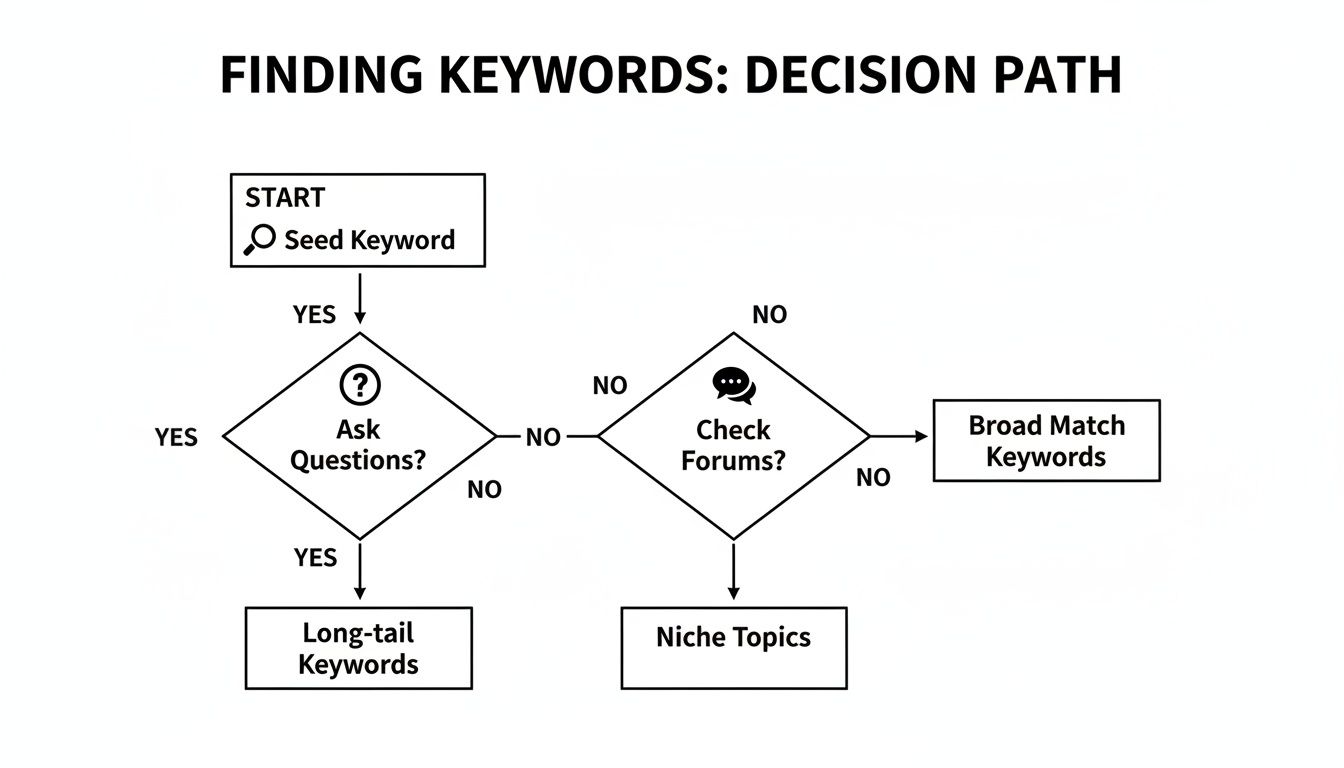
As the flowchart shows, starting with a seed keyword and exploring related questions or forum topics is a direct path to uncovering those valuable niche opportunities.
A Simple Scoring Method for Prioritization
To bring it all together, create a simple scoring system. This is how you turn your analysis into a clear, actionable priority list. You don't need anything fancy; a basic spreadsheet is perfect.
Create columns for:
- Keyword: Your target phrase.
- Search Intent (1-5): Give a higher score for transactional intent (5) and a lower score for purely informational queries (1).
- Competition (1-5): Score higher for weaker competition (5) and lower for dominant, hard-to-beat competitors (1).
- Total Score: Add the intent and competition scores together.
Now, just sort your list by the "Total Score" in descending order. The keywords at the top are your highest-priority targets—they have strong commercial intent and a beatable level of competition. This data-driven approach removes the guesswork, ensuring your copywriting and content creation efforts are aimed squarely at the keywords that will make the biggest impact on your bottom line. As part of this, it's helpful to understand how to determine search volume for keywords as another piece of your evaluation.
Recent data backs this up. Analysis shows that a staggering 87% of keywords related to 'commercial charbroilers' have competition indices under 30. Even better, these low-competition terms have organic click-through rates averaging 18-25% for top positions, which blows the 5-10% CTR of broad, high-competition terms out of the water. This highlights the immense opportunity in focusing on validated, niche keywords. You can discover more insights about commercial charbroilers on 360iResearch.com.
Creating Content That Ranks for Niche Searches

You’ve done the hard part—you've dug up a fantastic list of low-competition keywords with real potential. Now comes the fun part: turning that research into content that doesn’t just rank, but actually turns curious chefs into paying customers.
This isn’t about just stuffing a keyword onto a page and hoping for the best. The real goal is to build a resource so comprehensive and genuinely helpful that it becomes the definitive answer for that very specific search. Do this right, and you’ll build trust, establish your authority, and naturally pull in high-intent buyers looking for exactly what you sell.
Structuring Content for a Niche Query
Let’s get practical. Imagine one of your high-priority keywords is "best charbroiler for achieving deep sear marks." A generic product page just won’t cut it here. To win this search, you need to create an in-depth article—a real piece of cornerstone content—that tackles every possible angle of that query.
Your article needs a logical flow that walks a reader from their initial question all the way to a confident buying decision. That means organizing your content with clear, benefit-driven headings that naturally include your keyword and related terms.
For our charbroiler topic, a solid structure would look something like this:
- An intro that immediately connects with the reader’s goal: getting those perfect sear marks.
- A quick science lesson on searing and why certain charbroilers are better at it.
- A detailed breakdown of the key features to look for (think BTUs, grate material, heat distribution).
- A comparison of different charbroiler types (like radiant vs. lava rock) specifically for searing performance.
- Practical tips on technique and maintenance to get the most out of their equipment.
This approach turns a simple keyword target into a comprehensive guide, making your page infinitely more valuable than a competitor's basic product listing.
Weaving Keywords into Your Content Naturally
Once you’ve got a solid structure, it’s time to integrate your main keyword and its semantic cousins throughout the piece. This is a crucial step that signals relevance to search engines without sounding like a robot wrote it.
Think beyond just the main phrase. For "best charbroiler for achieving deep sear marks," you should also be talking about concepts a chef would naturally associate with the topic.
- Headings and Subheadings: Your H2s and H3s are prime real estate. A heading like "Choosing the Right Grate Material for Deep Sear Marks" is both helpful for the reader and great for SEO.
- Image Alt Text: Don't skip the alt text on your images. Something descriptive like "Close-up of deep sear marks on a steak from a commercial gas charbroiler" reinforces your topic for search engines and improves accessibility.
- Body Paragraphs: Mention your keyword in the intro and conclusion, then sprinkle it naturally a few more times in the body. Also, pull in synonyms and related terms like "perfect char," "grill marks," and "high-heat cooking."
- Product Descriptions: When you feature specific models, make sure their descriptions highlight the features that are actually relevant to searing, using variations of your keyword.
The key is to write for the human first and the search engine second. If your content provides genuine value and completely answers the user's question, the keywords will feel like they belong there.
A Real-World Content Outline Example
Let's flesh out that outline. This is the kind of detailed planning that separates content that ranks on page one from everything else. Our content teams build briefs just like this to make sure every piece of article writing is an authority on its subject.
Blog Post Title: The Ultimate Guide to the Best Charbroiler for Achieving Deep Sear Marks
H2: What Really Creates Those Perfect Grill Marks?
- Explain the Maillard reaction in simple terms.
- Discuss the role of intense, direct heat in the process.
H2: Key Charbroiler Features for Superior Searing
- H3: The Power of High BTUs: Explain how BTUs lead to faster heat-up and recovery times.
- H3: Grate Materials Matter: Compare cast iron vs. stainless steel for heat retention and sear quality.
- H3: Radiant vs. Infrared Technology: Break down which heating method delivers the most consistent, high-temp surface.
H2: Top Charbroiler Models for Steakhouse-Quality Searing
- Feature 2-3 specific models from your inventory.
- Include detailed descriptions that focus on their searing capabilities.
- Use high-quality images and link directly to the product pages.
H2: Pro Tips for Flawless Sear Marks Every Time
- Use a numbered list to cover preheating, oiling the grates, and proper protein placement.
- Add a short section on cleaning techniques to maintain peak performance.
This detailed, problem-solving approach ensures your content isn’t just optimized for a keyword—it’s optimized to help your ideal customer. That’s how you win with low-competition keywords.
Measuring Success and Refining Your SEO Strategy

Executing a strategy built around low-competition keywords is a powerful move, but how do you actually know if it’s working? Success isn't just about watching your website traffic go up; it's about attracting the right people and proving a clear return on your content investment.
For a restaurant equipment supplier, this means moving beyond vanity metrics. You need to track the key performance indicators (KPIs) that directly translate to business growth. This is how you make data-driven decisions, refine your approach, and figure out what to double down on.
Setting Up Your Measurement Toolkit
You don't need a pricey suite of tools to get started. The single most powerful resource for tracking your SEO performance is completely free: Google Search Console (GSC). Think of it as your direct line of sight into how Google sees your website and how users are actually finding you.
If you haven’t already, setting up GSC is your top priority. It gives you the raw data on impressions, clicks, click-through rate (CTR), and your average ranking for every single keyword that sends traffic your way. This is where you'll see your hard work pay off as you start ranking for those niche terms.
Key Performance Indicators That Matter
Don't get lost in a sea of data. For a restaurant equipment supplier, your focus should be on a handful of high-impact metrics that tell a clear story about whether your strategy is working or not.
- Keyword Rankings: Inside GSC, you can filter performance by specific queries. Are you seeing your target low-competition keywords, like "best countertop charbroiler for small kitchens," climbing the search results? Tracking this week-over-week shows you're making real progress.
- Organic Traffic to New Content: When you publish a new blog post targeting a niche keyword, keep an eye on its organic traffic in Google Analytics. A steady increase in visitors to that specific page is a strong signal that your content is hitting the mark with the right audience.
- Conversion and Goal Completions: This is where the rubber meets the road. Traffic is great, but actions are better. Set up goals in Google Analytics to track what really matters to your business.
Your ultimate goal is not just to rank, but to generate leads. Tracking conversions like "Get a Quote" button clicks, spec sheet downloads, or contact form submissions is the only way to demonstrate a tangible return on investment from your content efforts.
A Simple Monthly Review Checklist
To keep your strategy sharp, you need a simple review process at the end of each month. This doesn't have to be complicated. Just pull up your GSC and Analytics data and ask a few smart questions.
Here’s a checklist to guide your monthly analysis:
- Which new keywords cracked the top 10? These are your winners. Identify these pages and see what's working.
- Which pages saw the biggest traffic spike? Look at your top-performing content. What topics are resonating most with your audience?
- What’s the conversion rate on new content? Are your targeted articles actually driving actions? If a post gets tons of traffic but zero quote requests, you may need to tweak your call-to-action.
- Any "striking distance" keywords? Look for keywords ranking on page two (positions 11-20). These are your lowest-hanging fruit; often, a few content updates or internal links can push them onto page one.
This disciplined, data-backed approach transforms your SEO from a guessing game into a predictable growth engine. By consistently measuring what works and refining what doesn't, you can systematically scale your success with low-competition keywords and attract a steady stream of qualified buyers.
Answering Your SEO Questions
When you start digging into a specific SEO strategy like targeting low-competition keywords, you’re bound to have questions. For restaurant equipment suppliers, getting straight answers is the only way to feel confident you're making the right marketing moves.
Let's cut through the noise and tackle the most common questions we hear from marketers in the foodservice industry. We'll give you direct answers so you understand the real-world impact of this SEO approach.
How Long Does It Take to Rank for Low Competitive Keywords?
Good news: this is a much faster game than trying to rank for those massive, hyper-competitive terms. For a well-optimized page targeting a low-difficulty keyword, you can realistically see movement into the top 20-30 search results within 60-90 days.
Getting into that coveted top 10? That could take anywhere from 3 to 6 months. A lot depends on your website’s overall authority and just how good your content is. The main thing to remember is that these wins stack up. Every ranking you secure builds your site's authority, contributing to a slow-but-steady stream of qualified traffic over the long haul.
Are Low Volume Keywords Really Worth the Effort?
Absolutely. One of the biggest mistakes people make is confusing "low volume" with "low value." They are worlds apart. A super-specific phrase like "best gas charbroiler for searing steaks" might only get 40 searches a month, but the intent behind that search is pure gold.
The person typing in a low-volume, high-intent keyword isn't just browsing. They're a motivated buyer, incredibly close to pulling out their credit card. The conversion rate on this kind of traffic is exponentially higher than for a generic term like "commercial grill," which brings in thousands of looky-loos with no real plan to buy.
It's the classic quality over quantity argument. Your goal isn't to attract thousands of casual visitors who will never convert; it's to attract a handful of highly qualified leads who are ready to talk business. This is the exact reason focusing on low-competition keywords is so effective for a niche business like a restaurant equipment supplier.
Should My Entire SEO Strategy Focus on These Keywords?
Think of them as the foundation of your SEO house. For a specialized business selling complex equipment, low-competition keywords are your bread and butter. They are hands-down the most efficient path to building topical authority and driving a consistent flow of high-intent leads from chefs and restaurant owners.
As your website gets stronger by ranking for these niche terms, you'll find it gets easier to start going after more moderately competitive keywords. It's a strategic way to build momentum. You're methodically growing your online presence instead of trying to fight an impossible battle for keywords you can't win right out of the gate.
What Is the Biggest Mistake to Avoid?
The single biggest mistake is pumping out thin, generic content just to check a keyword off a list. The very reason you have a shot at ranking for these terms is that your competitors dropped the ball. They failed to provide a detailed, genuinely helpful answer to what the searcher was asking.
Your goal has to be to become the absolute best, most comprehensive resource for that specific question. If your target keyword is "countertop charbroiler for food trucks," your content needs to dive deep into the unique problems of a mobile kitchen.
That means covering things like:
- Space Constraints: Discussing compact footprints and tricky ventilation requirements.
- Power Sources: Covering propane vs. natural gas hookups in a truck environment.
- Durability: Highlighting models built to survive the bumps and rattles of travel.
- Cleaning Procedures: Offering practical tips for maintenance in a cramped space.
Simply listing a few products won't cut it. You have to solve the searcher's entire problem, and that’s where expert copywriting and in-depth articles become your secret weapon.
At Charbroilers.com, we live and breathe the nuances of the restaurant equipment market. Our team specializes in creating high-quality SEO content, from detailed blog posts and local citation services to expert copywriting and blogger outreach, all designed to connect you with serious buyers. Elevate your digital strategy and attract more qualified leads by exploring our solutions at https://charbroilers.com.