

Unlocking Sales with Long Tail Keyword Research for Restaurant SEO
Long-tail keyword research is all about digging up those super-specific, multi-word phrases that people type into Google. Sure, they have lower search volume, but the intent behind them is sky-high. You're targeting customers who know exactly what they need, not just kicking tires.
Your Secret Weapon for Restaurant Equipment SEO
Let's be real: trying to rank for a single, broad term like "charbroiler" is a brutal, uphill battle. You’re going toe-to-toe with industry giants who have marketing budgets bigger than your warehouse. This is where a smarter approach—zeroing in on long-tail keywords—becomes your most powerful advantage in the cutthroat restaurant equipment market.
Instead of shouting into a crowded convention hall, you get to have direct conversations with chefs and restaurant owners who are deep in the buying cycle. Our expertise in SEO, blog posting, and article writing for restaurant equipment supply websites consistently shows that targeting these specific phrases is the key to attracting qualified buyers. These aren't just browsers; they're professionals actively looking for a solution to a specific problem.
Why Specificity Wins in SEO
Think about the searcher's mindset for a second. Someone typing in "charbroilers" is probably just starting out. They could be a culinary student doing a research paper, a competitor snooping on prices, or just someone curious. Their intent is informational, and their search is wide open.
Now, picture a search for a "24-inch countertop radiant charbroiler for a small kitchen." This isn't just a vague query; it's practically a purchase order. The person behind that search has a specific need, a defined space, and is likely comparing models to pull the trigger on a purchase. This is the customer you want knocking on your digital door.
By focusing your SEO efforts on these detailed phrases, you filter out all the noise and connect directly with high-intent buyers. It’s the difference between putting up a billboard on the highway and having a one-on-one conversation with a qualified lead who walked into your showroom.
To put it simply, here’s how these two keyword types stack up.
Head Terms vs. Long-Tail Keywords: A Quick Comparison
| Attribute | Head Keywords (e.g., 'Charbroilers') | Long-Tail Keywords (e.g., 'Floor model charbroiler for high-volume bistro') |
|---|---|---|
| Length | 1-2 words | 3+ words |
| Search Volume | Very high | Low |
| Competition | Extremely high | Low to moderate |
| User Intent | Broad, informational, top-of-funnel | Specific, transactional, bottom-of-funnel |
| Conversion Rate | Low | High |
| Cost (PPC) | High | Low |
The takeaway is clear: while head terms cast a wide net, long-tail keywords are the precision tools that land the most valuable customers.
The Power of Niche Search Traffic
The data backs this up in a big way. A staggering 70% of all search queries are long-tail terms. While broad terms like 'charbroiler' are drowning in competition, highly specific phrases like 'best countertop charbroiler for small diners' actually make up the majority of search traffic. These queries, often three or more words long, come from hospitality pros with laser-focused intent—they're ready to buy the exact piece of equipment that delivers that perfect, crave-worthy char on their chicken or fish. For more stats on this, Analytify.io has some great insights.
Shifting your focus to these niche searches gives you several immediate advantages:
- Higher Conversion Rates: Visitors arriving from long-tail searches are much further along in their buying journey. They’re primed to convert.
- Lower Competition: It's infinitely easier to rank for "energy-efficient floor model charbroiler" than it is for the head term "charbroiler." You're not fighting the same battles as everyone else.
- Building Authority: When you consistently answer specific customer questions through your content, you establish your brand as a trusted expert in the restaurant equipment field. People start seeing you as the go-to source.
Ultimately, mastering long-tail keyword research is about attracting the right kind of traffic, efficiently. It aligns your content directly with the problems your customers are trying to solve, turning your website into an indispensable resource. And for restaurant suppliers, don't forget that local buyers are your bread and butter; our local citation services can boost your visibility, and you can get more tips in our guide on the essential local SEO checklist for your business.
Finding Your First High-Value Keywords
Ready to move from theory to action? This is where we start digging for gold. Forget the expensive, complex SEO tools for a moment; your first high-value keywords are often hiding in plain sight, and you can find them with some surprisingly powerful—and free—methods.
The key is to start thinking exactly like your customers. A restaurant owner isn't just searching for "charbroiler"; they’re asking specific questions and looking for solutions to their immediate problems. Our job is to find and capture those exact phrases.
Mine Google for Direct Customer Insights
Google itself is one of the best long-tail keyword research tools you can get your hands on, and it costs nothing. When you start typing a query, the Google Autocomplete suggestions that pop up are based on real searches that actual people are making every single day.
For example, start typing "commercial charbroiler for..." and just watch what Google suggests. You’ll probably see phrases like:
- commercial charbroiler for food truck
- commercial charbroiler for outdoor use
- commercial charbroiler for small restaurant
These aren't just guesses; they're direct reflections of user behavior. Every suggestion is a potential long-tail keyword you can build a piece of content around. It's a simple yet incredibly effective way to find keywords with built-in demand.
Another goldmine right there in the search results is the "People Also Ask" (PAA) box. These are the direct questions your audience is asking. A search for "how to clean charbroiler" might pull up PAA questions like "What is the best way to clean charbroiler grates?" or "Can you use oven cleaner on a charbroiler?"
Every question in the "People Also Ask" section is a ready-made long tail keyword. Our copyrighting and article writing services focus on answering these questions directly in blog posts or dedicated FAQ pages as a surefire way to attract highly targeted traffic.
This visual flow shows how broad, high-competition head terms naturally evolve into specific, high-intent long-tail keywords.
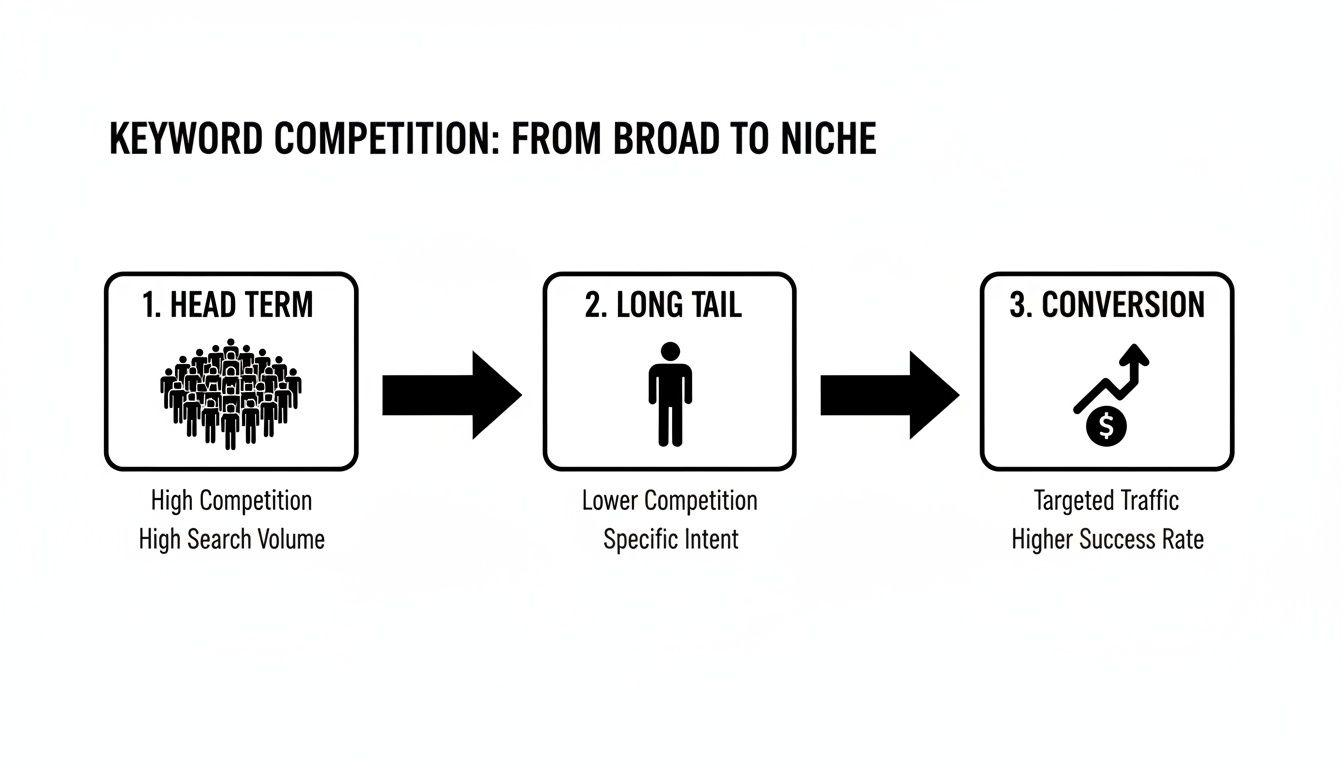
As a keyword gets more specific (moving from head to long-tail), the competition drops significantly while the searcher's intent becomes crystal clear. That's where you want to be.
Explore Niche Online Communities
To truly get inside your customer's head, you need to go where they gather online. Niche communities are absolute treasure troves of conversational, natural-language keywords you’d never uncover with a standard tool.
Think about forums, social media groups, and Q&A sites where chefs and restaurant managers are hanging out. A few places to start your search include:
-
Reddit: Subreddits like
r/chefitorr/KitchenConfidentialare filled with pros discussing equipment, sharing tips, and asking for recommendations. A quick search for "charbroiler" could reveal threads with titles like, "Advice on an energy-efficient floor model charbroiler for a new steakhouse?" - Industry Forums: Websites dedicated to the foodservice industry often have active forums. Here, you’ll find unfiltered discussions about the pros and cons of different charbroiler models, maintenance headaches, and specific cooking techniques.
- Q&A Sites: Platforms like Quora contain thousands of questions directly from your target audience. Search for topics related to your products and see what problems people are trying to solve.
The language used in these communities is authentic and specific. Capturing these phrases allows you to create content that speaks directly to your audience's needs. Of course, knowing the specifics of search volume for these terms is a crucial next step, and you can get an in-depth look at how to determine search volume for keywords in our detailed guide: https://restaurantequipmentseo.com/blogs/restaurant-equipment-seo-blog/how-to-determine-search-volume-for-keywords
As search habits continue to shift, it's also smart to consider how people use voice-activated devices. Incorporating effective voice search optimization strategies into your research can uncover new, conversational opportunities. People tend to ask full questions when using voice search, which naturally creates the long, specific queries that are perfect for your content strategy.
Using SEO Tools to Build Your Keyword List
While manual checks on Google and forums are great for getting a gut feel for your audience, you need more firepower to really scale up your long tail keyword research. That's where dedicated SEO tools like Semrush and Ahrefs come in. They take your initial seed list and turn it into a massive arsenal of data-backed opportunities.
These platforms do more than just spit out a bunch of keywords. They arm you with the critical metrics needed to make smart decisions, helping you prioritize where to focus your energy for the biggest impact in the competitive restaurant equipment market.
Interpreting the Metrics That Matter
When you open up an SEO tool, you're hit with a sea of data. For a restaurant equipment supplier, not all of it is equally important. You have to zero in on the numbers that signal a valuable, high-intent customer.
Here are the key data points to look at for every potential keyword:
- Search Volume: This is the average number of times a keyword gets searched each month. Don't let low numbers scare you off; a query like "best countertop charbroiler for small diners" might only get 20 searches a month, but those 20 people are highly qualified leads who know exactly what they need.
- Keyword Difficulty (KD): This score (usually on a scale of 0-100) gives you a rough idea of how hard it will be to crack the first page of Google. Lower scores mean less competition—exactly what we're hunting for with long-tail keywords.
- Cost Per Click (CPC): This metric tells you what advertisers are willing to pay for a single click from a specific keyword. A high CPC, even on a low-volume term, is a huge sign of commercial intent. If people are paying good money for those clicks, it's because those searchers turn into paying customers.
Remember, the goal isn’t to find keywords with the highest search volume. It’s about finding that sweet spot of relevance, low competition, and high commercial intent. That's where the most profitable opportunities are hiding.
A Practical Walkthrough with Charbroiler Keywords
Let's make this real. Imagine you plug your seed term, "commercial charbroiler," into Semrush's Keyword Magic Tool. You can immediately start applying filters to dig for long-tail gold. A great starting point is filtering for keywords with four or more words and a KD score under 30.
This screenshot from Semrush shows just how quickly you can generate a list of related long-tail queries from a single starting point.
The tool instantly gives you dozens of specific, actionable phrases like "how to clean stainless steel charbroiler grates" or "natural gas vs propane commercial charbroiler." Every single one of these is a potential blog post, FAQ, or video that directly solves a customer's problem.
It might surprise you, but a staggering 92.42% of all keywords get just 10 or fewer searches per month. Yet, when you add them all up, they drive a massive amount of traffic. For a niche business like a charbroiler supplier, this statistic proves why focusing on these hyper-specific queries is a winning strategy.
Expanding Your List with Modifiers and Questions
Beyond basic filters, you can use these tools to find even more nuanced opportunities. Look for keywords that contain modifiers relevant to your audience.
- Transactional Modifiers: "buy," "deal," "for sale," "cost"
- Informational Modifiers: "how to," "what is," "guide," "vs"
- Brand Comparisons: "[Your Brand] vs [Competitor Brand]"
- Location-Based: "commercial charbroiler service in Atlanta"
Most SEO tools have built-in features for this. Using a "Questions" filter, for example, will instantly pull all the queries phrased as a question, giving you a direct line into your customers' biggest pain points.
For more advanced discovery, you might also look into specialized AI SEO tools that can help brainstorm topics and generate keyword variations at scale. By working through these tool-driven methods, you can build a truly robust and actionable keyword list. For a more detailed guide on organizing your findings, check out our article on how to build a keyword list that drives real results.
Matching Keywords to Customer Intent

Finding a great long-tail keyword is a solid start, but it's only half the battle. The real magic happens when you figure out the why behind the search. You need to get inside the head of that chef or restaurant manager and understand exactly what they're trying to figure out.
This "why" is what we call search intent. It’s the user's main goal, and getting it right is the difference between a visitor who clicks away instantly and one who ends up becoming a customer.
Decoding the Three Core Search Intents
For a business selling restaurant equipment, search intent usually falls into three big buckets. Each one represents a different stage in a customer's journey and demands a completely different kind of content.
- Informational Intent: The searcher needs knowledge. They have a question or a problem and are looking for answers. Think queries that start with "how to," "what is," or "why."
- Commercial Investigation Intent: Here, the user is shifting from learning to comparing. They know what kind of product they need but are now weighing their options, digging into reviews, and comparing features. These keywords often include terms like "vs," "best," "review," or "comparison."
- Transactional Intent: This person is ready to pull out their wallet. They've done the research and are now actively looking to make a purchase. You'll see strong buying signals like "buy," "for sale," "deal," or even specific model numbers.
Nailing this down is everything. If a chef searches "how to season a new charbroiler," throwing them onto a product page is just going to annoy them. They're looking for a guide, not a "Buy Now" button.
The most effective content strategies are built on a perfect marriage of keyword and intent. You have to give the searcher exactly what they're looking for, at the exact moment they need it. A mismatch is a surefire way to lose a potential sale.
Let the SERP Be Your Guide
So, how do you figure out the intent behind a keyword like "modular vs floor model charbroiler"? Simple: let Google tell you. The Search Engine Results Page (SERP) is basically a cheat sheet showing you what kind of content Google already knows is the best answer for that query.
Just type your long-tail keyword into the search bar and see what comes up on page one.
- Are the top results blog posts and detailed guides? That signals informational intent.
- Seeing lots of comparison articles, review sites, or product category pages? That’s pointing to commercial investigation.
- Is the page dominated by e-commerce product pages with pricing and "add to cart" options? That's a clear sign of transactional intent.
This little trick takes all the guesswork out of it. Google has already spent billions figuring out what people want; your job is just to look at the results and create content that fits the proven mold.
Mapping Keywords to the Right Content
Once you know the intent, the final piece of the puzzle is mapping each long-tail keyword to the right kind of content on your website. This strategic alignment makes sure you’re creating pages that serve a specific purpose and meet the user's expectations head-on.
Keeping this organized in a simple table can be a huge help. It becomes a blueprint for your content team, guiding everything from blog posts to building out new product pages.
This template shows how we might map keywords to strategically align them with the most effective content types to satisfy user intent for a site like Charbroilers.com.
Keyword to Content Mapping Template for Charbroilers.com
| Long Tail Keyword Example | Primary Search Intent | Ideal Content Type | Example Page on Charbroilers.com |
|---|---|---|---|
| "how to clean cast iron charbroiler grates" | Informational | How-To Blog Post or Video | A detailed guide with step-by-step cleaning instructions |
| "best countertop charbroiler for food trucks" | Commercial Investigation | "Best Of" Listicle / Buying Guide | An article reviewing the top 3 models with pros and cons |
| "buy 36 inch radiant gas charbroiler" | Transactional | Product Detail Page (PDP) | The specific sales page for that 36-inch model |
| "Vollrath 40725 charbroiler reviews" | Commercial Investigation | Product Review Page / Blog Post | A dedicated page featuring customer reviews and specs |
By systematically digging into intent and mapping keywords to the right content, you build a website that acts like a helpful expert. You answer your customers' questions, guide their buying decisions, and ultimately, make it incredibly easy for them to buy from you when they're finally ready.
Putting Your Long Tail Strategy into Action

You've done the hard work of digging up keywords and mapping them to user intent. The research phase is officially over. Now comes the part where all that effort starts to pay off—turning that validated list into real website assets that bring in customers.
This isn't about awkwardly stuffing phrases where they don't belong. The real art is weaving your long-tail keywords into the very fabric of your content. You want to create pages so helpful and relevant that they become the absolute best answer for someone's very specific search.
Integrating Keywords for On-Page SEO Success
Think of on-page SEO as giving Google a clear roadmap to understanding your content. When you optimize a page for a phrase like "how to clean stainless steel charbroiler grates," you're sending unmistakable signals that your page is the go-to resource for solving that exact problem.
There are a few critical spots to focus on:
- Title Tag: This is the big blue link people see in the search results. It's a massive ranking factor, so your primary long-tail keyword should fit naturally here, ideally toward the beginning.
- Headings (H1, H2, H3): Your H1 is the main title on the page. Use your subheadings (H2s and H3s) to break up the content logically and sprinkle in your main keyword or close variations.
- Body Content: Aim to include the keyword within the first 100-150 words of your text, and then let it appear naturally from there. Always write for the human reader first, not the algorithm.
- Image Alt Text: This is a simple but often-overlooked step. Describe your images for visually impaired users and slip in the keyword where it makes sense. For a picture of a sparkling grate, alt text like "A freshly cleaned stainless steel charbroiler grate" is perfect.
The goal is to optimize without sounding like a robot. If a sentence feels clunky or forced, rewrite it. Google is more than smart enough to understand context and synonyms, so never sacrifice readability for keyword placement.
Tracking Performance in Google Search Console
You can't fix what you don't measure. Google Search Console (GSC) is your direct line of communication with Google, showing you exactly how your pages are performing in the wild. It’s the ultimate source of truth for your long-tail strategy.
After your content has been live for a bit, jump into the "Performance" report in GSC. From here, you can filter by a specific page URL to see precisely which search queries are sending people your way. Pay close attention to two key metrics:
- Impressions: How many times your page showed up in search results for a given query.
- Clicks: How many people actually clicked through to your site.
You’ll often discover your page is ranking for long-tail keywords you never even thought to target. This is gold. It creates a powerful feedback loop, sparking new ideas for expanding your content or fine-tuning what you already have.
Connecting SEO Efforts to Business Goals
Clicks and impressions feel good, but they don't keep the lights on. The final, most crucial step is to connect your SEO work to tangible business outcomes like leads and sales. This is where Google Analytics steps in, helping you prove the ROI of all this effort.
By setting up conversion tracking, you can measure the valuable actions people take after landing on your site from a long-tail search. These are your money-makers:
- A user fills out a "Request a Quote" form.
- Someone downloads a detailed product spec sheet.
- A customer makes a direct online purchase of a countertop charbroiler.
With this data, you can finally connect the dots. You can confidently report, "Our article on the 'best countertop charbroiler for food trucks' brought in 150 visitors last month, resulting in 5 qualified leads and 1 sale." Suddenly, your keyword research isn't just a marketing task—it's a measurable engine for business growth.
Got Questions About Long Tail Keywords?
Even with a solid plan, a few questions always seem to pop up once you start digging into long-tail keyword research. Let's tackle some of the most common ones we hear from folks in the restaurant equipment space so you can move forward with confidence.
How Long Until I See Results from a Long Tail SEO Strategy?
This is the big one, right? While those hyper-competitive "head" terms can take months or even years to crack, the beauty of long-tail keywords is the speed. You can see results much, much faster.
For a new piece of content targeting a low-competition long-tail phrase, it's not unusual to start seeing some traffic within a few weeks to a couple of months. Of course, this depends on your website's overall authority, how tough the competition is for that specific keyword, and the quality of your content.
The real magic happens with consistency. When you build a library of helpful content around related long-tail keywords, you create this powerful snowball effect. Each piece reinforces your expertise, boosting your site's authority and traffic over time.
What Is a Good Search Volume for a Long Tail Keyword?
There's no magic number here. Search volume is completely relative to your niche, and for a specialized industry like commercial charbroilers, a keyword with just 10-50 monthly searches can be pure gold.
Think about the intent behind a search like "buy radiant charbroiler for steakhouse." That’s a hot lead.
Don't forget, the data shows that a whopping 92% of all keywords get 10 or fewer searches a month. Instead of getting hung up on high volume numbers, you need to be laser-focused on relevance and purchase intent.
A keyword with only ten searches a month that lands you one new customer is infinitely more valuable than a keyword with 1,000 searches that brings in zero business.
Should I Still Try to Rank for Broad Head Keywords?
Absolutely, but think of it as a long-term play, not your starting point. You earn the right to compete for broad terms by first dominating a bunch of related long-tail keywords. This is SEO 101.
It's like building a reputation in the real world. As you create comprehensive content clusters around topics like "countertop charbroilers," "charbroiler maintenance," and "gas vs. electric charbroilers," Google starts to see your site as the expert on the subject.
This is what we call "topical authority," and it's what eventually makes it possible to compete for those bigger, tougher head terms. Your long-tail keywords are the foundation you lay before you even think about building the skyscraper.
How Does Voice Search Impact Long Tail Keyword Research?
Voice search isn't just a trend; it's a massive reason why long-tail keywords are more important than ever. It completely changes how people search, moving them away from choppy, typed phrases and toward full, conversational questions.
People don't talk to Alexa or Siri in two-word commands. They ask questions just like they’d ask a person. Someone might type "best charbroiler" at a keyboard, but they'll ask their smart speaker, "What is the best commercial charbroiler for a small diner?"
This behavior naturally produces conversational, long-tail queries. When you're doing your research, you should be actively hunting for these question-based keywords (who, what, when, where, why, how). They are a perfect match for the way people search now, putting your content directly in front of these highly motivated users.
At Charbroilers.com, we provide comprehensive digital marketing services tailored for the restaurant equipment supply industry. From SEO and local citation services to expert blog posting, copyrighting, and blogger outreach, we help you connect with qualified buyers. Explore our extensive selection of charbroilers and let us help you build an online presence that delivers results. Visit us at https://charbroilers.com to learn more.