
Hiring a Local SEO Service for Your Restaurant Equipment Supply Business
Ignoring local search is like putting up a "Closed" sign for restaurant owners who are actively looking for equipment suppliers right now, right around the corner. A dedicated local SEO service is what turns those online searches into actual quote requests, phone calls, and a busy sales pipeline. It's how you get your supply business to be the top result when someone is looking for exactly what you sell.
This is the most direct way to translate digital visibility into real-world sales.
Turning Local Searches into Loyal Customers
Think about how a new restaurant owner finds a supplier. They probably grab their phone and type something like "commercial charbroiler supplier near me" or "restaurant equipment service with local showroom." That immediate, location-based search is exactly what thousands of potential B2B customers are doing every single day.
For restaurant equipment supply websites, local search isn't just a marketing channel—it's the channel. Consider this: over 46% of all Google searches are local. Even more telling, "near me" searches have exploded by more than 900% in just the last few years. This isn't a trend; it's a fundamental shift in how businesses find local partners.
Why Generic Marketing Just Doesn't Cut It
Traditional marketing is like casting a wide, hopeful net. A local SEO service, on the other hand, is like using a laser pointer. It’s not just about being online; it’s about showing up for the right business owners at the exact moment they’re deciding where to spend their budget.
This is especially critical for suppliers who pride themselves on specific product lines. If you are the go-to source for high-quality charbroilers, you want to attract local restaurant owners who will appreciate that quality. Appearing in local search connects you directly with a high-intent audience. These aren't just casual browsers; they're active, motivated buyers ready to become your next long-term clients.
A strong local SEO strategy ensures that when a chef in your city needs a new commercial oven, your supply business is the very first one they see. It's the straightest line from a customer's need to your sales team.
Building Your Digital Footprint
A powerful local presence is built on a few key pillars, all of which a professional service will handle for you. These elements all work together to boost your visibility and make you look like the obvious choice online.
- Google Business Profile (GBP) Optimization: Think of your GBP listing as your digital showroom. It’s often the first thing a customer sees, showing off your product catalog, hours, photos, and client reviews.
- Local Citation Management: This is all about consistency. It means making sure your business's name, address, and phone number (NAP) are identical across all the important online directories, B2B portals, and industry-specific listings.
- Targeted Content and Outreach: Creating a blog post about choosing the right commercial kitchen equipment or connecting with local restaurant industry bloggers helps cement your company's place in the community.
- Reputation Management: Actively encouraging clients to leave reviews—and then responding to them—builds immense trust and sends positive signals to search engines.
To really get your restaurant equipment business set up for success in such a competitive industry, it's worth digging into a complete guide to Local SEO for Restaurants that lays out all the essential strategies. Having this knowledge will help you understand exactly what a quality local SEO service should be doing for you.
Finding the Right Local SEO Partner

Choosing a local SEO service isn’t like hiring another vendor; you’re bringing on a strategic partner who needs to get the B2B world of restaurant supply. This is the team that will help you cut through the local noise and actually connect with buyers in your area.
To find the right fit, you have to move past the generic sales pitches. You need a partner who can give you straight answers and prove they understand the unique challenges your equipment supply business faces. It's all about digging into the details of their strategy and what they’ve done for others.
Asking the Right Questions
When you’re vetting a potential local SEO partner, your questions need to be sharp and specific to the restaurant equipment industry. Vague questions will only get you vague answers. You want to test their real-world experience and how they think on their feet.
Start by digging into their past work. Don't just ask if they've worked with B2B suppliers before. Get specific.
- Ask to see concrete results they’ve gotten for a supplier in a competitive city market.
- Inquire about their game plan for cleaning up inconsistent business citations, a common and incredibly damaging issue for established businesses.
- Challenge them on how they’d approach Google Business Profile optimization for a supplier with a showroom, service department, and online sales.
Questions like these force them out of theory and into practical application. That’s how you’ll get a clear picture of what they can actually do for you. Their answers should be confident, detailed, and backed up with real examples.
Red Flags to Watch Out For
Knowing what to look for is only half the battle; knowing what to avoid is just as critical. Certain promises and behaviors are massive red flags and should give you serious pause. Be extremely wary of any agency that guarantees results—it’s a classic sign of inexperience or, worse, shady practices.
No legitimate SEO professional can guarantee a #1 ranking on Google. Search algorithms are complex and always changing. A true partner will focus on a sustainable strategy for long-term growth and visibility, not on impossible promises.
Other warning signs include fuzzy reporting, a one-size-fits-all strategy, or any hesitation to give you full ownership of your online profiles. A trustworthy local SEO service will be transparent about their process, deliver clear and measurable reports, and make sure you always have the keys to your own digital assets.
Industry experience isn't just a nice-to-have—it’s non-negotiable. A great partner understands what drives leads to a commercial refrigeration specialist versus a general equipment supplier. If you're looking to dive deeper into the nuts and bolts of citation management, check out our guide on how to build local citations for your business.
Local SEO Service Provider Comparison Checklist
Once you've narrowed it down to a few potential partners, use this simple checklist. It'll help you evaluate them side-by-side and make an objective decision based on what truly matters for your business's growth.
| Evaluation Criteria | Provider A | Provider B | Key Questions to Ask |
|---|---|---|---|
| Industry Experience | "Can you show me case studies from B2B suppliers similar to mine?" | ||
| Strategy & Approach | "What is your 90-day plan for our local SEO?" | ||
| Google Business Profile | "How will you leverage Posts, Products, and Q&A to drive leads?" | ||
| Citation Management | "What's your process for finding and fixing inconsistent NAP data?" | ||
| Review Strategy | "How do you encourage positive reviews and handle negative feedback?" | ||
| Local Content Plan | "What kind of local content will you create to connect with our professional community?" | ||
| Reporting & KPIs | "What metrics do you track, and how often will we receive reports?" | ||
| Communication | "Who will be our main point of contact, and what's your response time?" | ||
| Pricing & Terms | "Are there any setup fees? What are the contract terms?" | ||
| Ownership of Assets | "Will we have full ownership of our GBP and other profiles?" |
By comparing providers across these critical areas, you can move beyond the sales pitch and identify the partner who is genuinely equipped to help your equipment supply business succeed. It ensures you're not just hiring a service, but investing in a team that's aligned with your goals.
What a Great Local SEO Campaign Includes
So, you're thinking about hiring a local SEO service. What are you actually paying for? A real campaign isn't just one thing; it's a bunch of interconnected strategies working together. The goal is to make your business the obvious choice for any restaurant owner searching for equipment nearby.
These are the core pillars that separate a dead-in-the-water online presence from one that actually gets you leads.
The absolute foundation of any local campaign is your Google Business Profile (GBP). Think of it as your digital showroom. For many potential customers, it's the very first time they'll interact with your business. This goes way beyond just listing your address and hours.
A great agency will treat your GBP like a living, breathing marketing tool. They'll handle everything from uploading high-quality photos of your commercial charbroilers and refrigeration units to using Google Posts for announcing new product arrivals or special promotions.
Mastering Your Digital Storefront
Getting your Google Business Profile right has become a make-or-break factor for local businesses. The data doesn't lie: customers are 70% more likely to visit a business that has a complete and optimized profile. Considering the average local business profile pulls in over 1,200 views every month, ignoring this is like leaving money on the table.
A huge part of this is actively managing how you talk to your customers online. Responding to every single review—the good and the bad—shows everyone that you care about feedback and are serious about customer service.
If you’re just getting started and don't even have a profile yet, our guide on how to get a Google Business listing is the perfect place to begin.
A fundamental component of a successful local SEO strategy involves actively implementing proven strategies for getting reviews for restaurants to boost online reputation.
Building Trust with Citations and On-Page SEO
Beyond Google, a quality local SEO service will work on building consistency and trust all over the web. This is where local citations come into the picture. A citation is simply any online mention of your business's Name, Address, and Phone number (what we call NAP). We specialize in providing local citation services to ensure your business stands out.
A top-tier service will hunt down every important platform—from B2B directories to local business associations—and make sure your NAP information is perfectly consistent. Even small inconsistencies can confuse search engines and potential customers, which can really hurt your ability to rank.
Finally, a good campaign connects everything back to your own website through on-page SEO. We provide copywriting and article writing to create content that is genuinely useful for your local customers.
This usually involves a few key things:
- Creating location-specific content, like a blog post about the benefits of buying from a local equipment supplier or a guide to the best commercial ovens for pizzerias in your city.
- Making sure your website is mobile-friendly. A restaurant owner needs to be able to pull up your product specs and tap-to-call from their phone without any friction.
- Optimizing your product pages with clear descriptions, spec sheets, and appealing photos, helping buyers decide what they want before they even contact you.
With our expertise in blog posting and blogger outreach, all these pieces work together, sending strong signals to Google that your business is a relevant, trustworthy, and important local supplier.
Setting a Realistic Budget and Timeline
Let's get right to it and talk about the two biggest questions on every business owner's mind: How much does a local SEO service cost, and how long until I actually see results? Getting straight answers here is crucial for managing your expectations and making a smart investment.
The truth is, SEO is a marathon, not a sprint. It’s all about building a strong, trustworthy online presence over time, not flipping a switch for instant traffic. Real, sustainable results demand patience and a consistent game plan.
What Does a Local SEO Service Cost?
Pricing for a quality local SEO service really depends on your market's competitiveness and what you're trying to achieve. A single-location supplier in a quiet suburb is playing a completely different game than a large distributor in a jam-packed downtown district.
The current pricing reflects this reality. Basic packages for less competitive areas might start around $300-$800 per month. For most small to mid-sized equipment suppliers, growth-focused packages typically land somewhere between $1,000-$2,500 monthly.
If you're in a hyper-competitive city where restaurant equipment suppliers are on every corner, you’ll likely need to budget $2,500-$5,000+ per month for a truly comprehensive campaign. You can get a deeper dive into how these local SEO costs are determined by market factors.
The key is to see this not as an expense, but as an investment in your business's long-term visibility and profitability. A higher investment often correlates with faster, more aggressive growth in competitive areas.
Mapping Out the First Six Months
A realistic timeline helps you understand what to expect and when. While you might see some quick wins early on, the significant, needle-moving results generally start to pop up within three to six months as your online authority grows.
A well-structured campaign follows a logical path, starting with foundational work before moving into growth-focused tactics.
-
Months 1-2: Foundational Fixes. The first phase is all about cleanup and optimization. This means a full audit, claiming and perfecting your Google Business Profile, and stamping out inconsistent citations across the web. Think of it as setting a solid foundation.
-
Months 3-4: Gaining Momentum. With the basics locked in, the focus shifts to building authority. This is where generating positive reviews, creating localized content, and building relationships with local industry directories or business bloggers come into play.
-
Months 5-6: Seeing Measurable Growth. By this point, you should see a noticeable lift. Expect higher rankings in the local map pack, increased website traffic from local searches, and—most importantly—a clear uptick in phone calls and quote requests.
This timeline shows how a typical local SEO campaign flows, kicking off with Google Business Profile optimization and moving through citation building and on-page improvements.
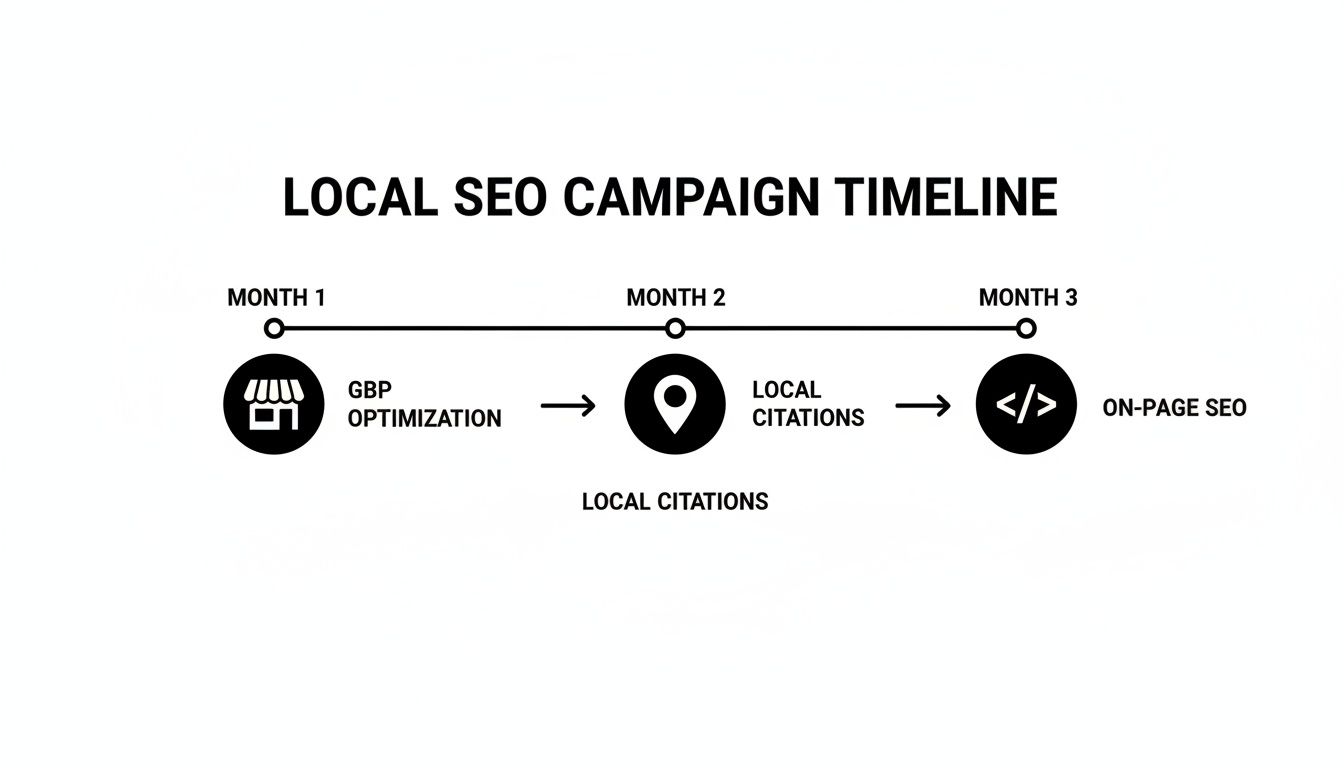
As you can see, each step builds on the last, creating a compounding effect that leads to sustainable local search visibility for your equipment supply business.
How to Measure Your SEO Success
How do you actually know if your investment in a local SEO service is paying off? Forget the fluffy, feel-good metrics like "impressions" or chasing broad keyword rankings that don't lead to business. For a restaurant equipment supplier, real success is measured in qualified leads and ringing phones.
The goal is to zero in on the Key Performance Indicators (KPIs) that directly fatten your wallet. These are the hard numbers showing that your online presence is convincing real business owners to contact you. It's about having smart, productive conversations with your SEO provider to make sure their efforts are fueling your growth, not just checking boxes.
Focusing on Actionable Metrics
Instead of getting bogged down in complex analytics reports, you need to focus on data that reflects real customer actions. Your Google Business Profile (GBP) is an absolute goldmine for this information, and the best part? It's completely free to access.
These are the metrics that truly matter:
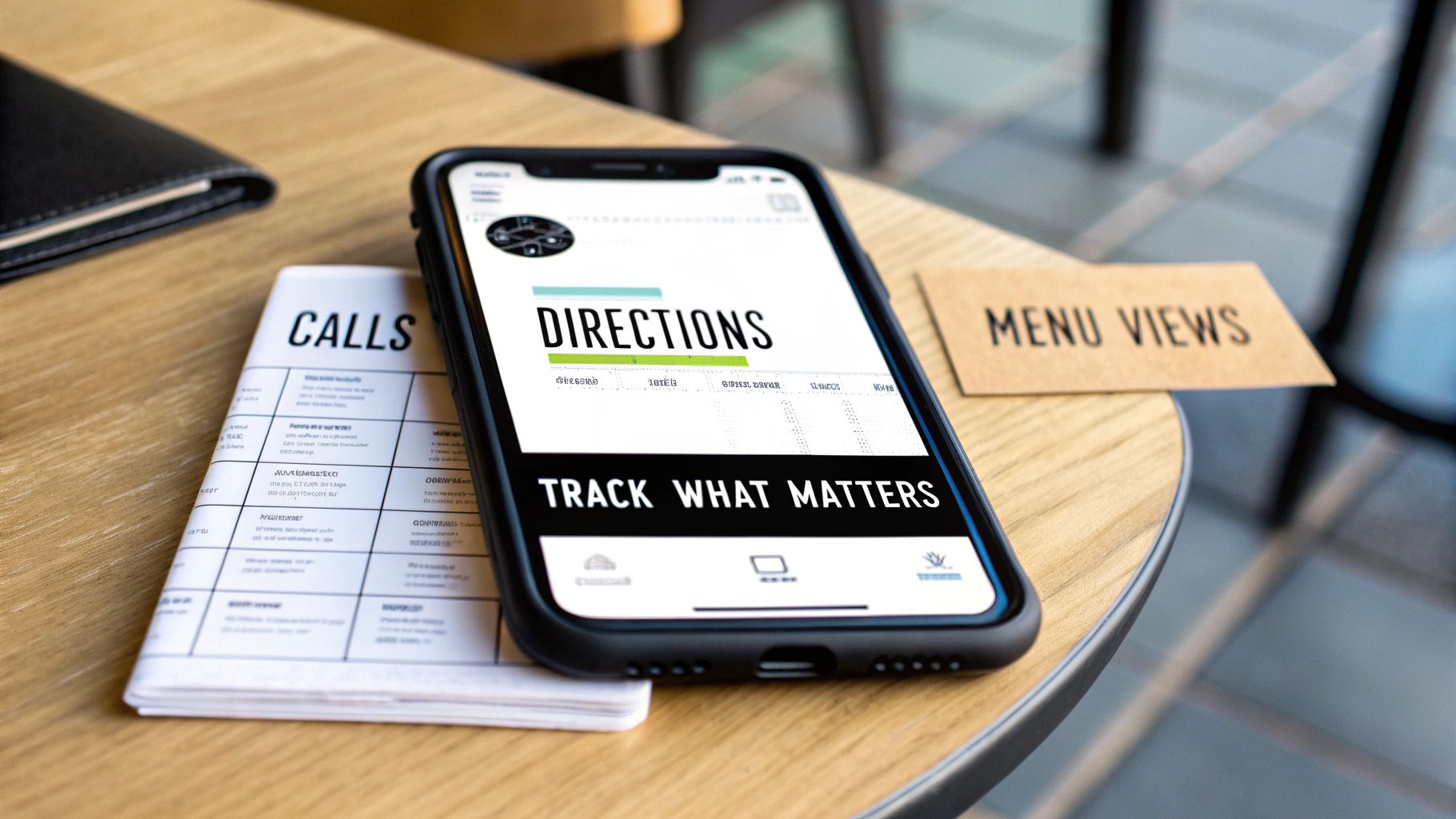
- Direction Requests: This is a strong signal of intent, especially if you have a showroom. When someone asks for directions, they are actively planning a visit.
- Click-to-Call Actions: This tracks how many people tapped the "call" button right from your GBP listing. Every one of those calls is a potential sales inquiry or service request.
- Website Clicks to Product/Contact Pages: Keep an eye on how many users click through to your product category pages or your "Request a Quote" form. This shows you're attracting qualified traffic that's interested in what you sell.
By tracking these specific KPIs, you draw a straight line from your SEO efforts to actual customer behavior. The conversation shifts from, "Are we ranking?" to, "Are we getting more leads?"
Your SEO success isn't defined by your position on a search results page. It's defined by the increase in quote requests, showroom visits, and phone calls that come directly from people finding you online.
Using GBP Insights for Clear Communication
Google gives you a straightforward dashboard right inside your GBP called "Performance" (which used to be called Insights). This tool visualizes how customers are finding your listing and what they do once they land on it. You don't need to be an SEO wizard to understand it.
Use this data as the foundation for your monthly check-ins with your local SEO service provider. For example, if you see a big jump in website clicks right after they optimized your product listings on GBP, you know that tactic is working. If phone calls are down, you can ask what their strategy is to improve that specific number.
This approach empowers you to have data-driven conversations. If you want to dive deeper, our full article on how to measure SEO performance offers a closer look at the tools and metrics that matter most for B2B suppliers. At the end of the day, tracking these real-world actions is the only way to ensure your investment is generating a tangible return.
Common Questions About SEO Services for Suppliers
Choosing a local SEO partner is a big step, and it's smart to have questions before you commit. To help you feel more confident in your decision, I’ve put together some of the most common questions I hear from equipment supply business owners, along with some straight, no-fluff answers.
Making the right choice now is what sets you up for success down the road. You want to find an agency that genuinely gets what you're trying to achieve.
How Long Until I See Real Results?
This is always the first question, and for a good reason. While you’ll probably see some small wins in the first month—like a much cleaner Google Business Profile—you should really expect to see significant, needle-moving results within 3 to 6 months.
Local SEO isn't about quick tricks; it’s about building lasting authority and trust with Google. A noticeable lift in map rankings, more clicks to your website, and an actual increase in phone calls take time to build up. How competitive your city is and the current state of your online presence will also play a huge role in that timeline.
Can I Just Do My Own Local SEO?
Absolutely. You can definitely handle some of the basics yourself, like claiming your Google Business Profile and posting photos of new equipment. Plenty of owners do, and it's a great place to start.
Where a professional local SEO service comes in is the deeper expertise. They live and breathe competitive analysis, technical on-page SEO, and the tedious work of managing your business information consistently across dozens of online directories. For a busy business owner, hiring an expert saves a massive amount of time and, frankly, almost always delivers a stronger, faster return on your investment.
The real value of an agency is their ability to run a complex, multi-front strategy consistently. That frees you up to focus on what you're best at: running your equipment supply business.
What Does a Local SEO Agency Need From Me?
Getting started is a team effort. To kick things off, your agency will need access to key things like your website's backend and, of course, your Google Business Profile.
You should also be ready to hand over some essential business info:
- Your exact, official business name (no variations!).
- The correct physical address and main phone number.
- Your most up-to-date hours of operation.
- A digital copy of your current product catalog.
And I can't stress this enough: high-quality photos are gold. We need great shots of your products, your showroom, your team, and even your warehouse. The more you can share about what makes your supply business special, the better your agency can tell that story online.
At Charbroilers.com, we understand that a perfectly char-grilled steak or burger starts with the right equipment. Let us help you find the ideal commercial charbroiler to make your menu stand out and keep those five-star reviews rolling in. Explore our collection of commercial charbroilers at Charbroilers.com.