

9 Critical Local SEO Ranking factors to Master in 2025
In the highly competitive market for restaurant equipment, having the best commercial-grade charbroilers or refrigerators is only half the battle. Your ideal customers, from local chefs to catering business owners, are searching online right now. The critical question is, will they find you or your competitor? This is where mastering local SEO becomes your most valuable business asset. Google relies on a sophisticated set of local SEO ranking factors to determine which businesses earn top spots in the valuable 'Map Pack' and localized search results. A strong local presence ensures that when a nearby restaurant's oven fails, your business is the first one they call.
This comprehensive guide is your roadmap to local search dominance. We'll dissect the 9 most crucial ranking factors that directly impact your visibility. Forget vague theories; we are providing a checklist of actionable strategies tailored for restaurant equipment suppliers. You will learn precisely how to optimize your Google Business Profile to attract local queries, manage online reviews to build trust, and ensure your business information is consistent across the web through strategic local citation services. We'll also cover advanced topics like creating location-specific content for your blog, securing powerful local backlinks through blogger outreach, and leveraging technical signals like mobile-friendliness to get ahead. By understanding and implementing these specific factors, you will transform your website from a simple online catalog into a powerful magnet for high-intent local customers, ensuring your business is the top result when they need equipment now.
1. Google Business Profile Optimization
Topping the list of local SEO ranking factors is the optimization of your Google Business Profile (GBP). Formerly known as Google My Business, this free tool is the cornerstone of your local online presence, acting as a digital storefront on Google Search and Maps. A complete and accurately managed profile is arguably the most significant signal you can send to Google about your business's relevance, legitimacy, and geographic service area.
Your GBP listing is where customers find essential information like your business name, address, and phone number (NAP), along with hours, service categories, photos, and customer reviews. For a restaurant equipment supply company, a well-optimized profile can mean the difference between being found by a local chef opening a new bistro or being completely invisible online.
Why GBP is Non-Negotiable for Local SEO
An optimized GBP profile directly impacts your visibility in the coveted "Local Pack," the block of three business listings that appear at the top of search results for local queries. This prime digital real estate captures a massive share of user clicks. Businesses that consistently manage their profiles see tangible results. For example, a restaurant equipment supply company using GBP Posts to announce a sale on new commercial ovens might see a significant increase in quote requests. Similarly, using the service area settings correctly allows your business to appear in searches across multiple suburbs without needing a physical address in each one, capturing a wider local audience.
Actionable Optimization Tips
To transform your GBP from a simple listing into a powerful customer acquisition tool, focus on completeness and ongoing activity.
- Be Specific with Categories: Choose the most precise primary category possible (e.g., "Restaurant Supply Store" instead of just "Store"). Add secondary categories like "Commercial Refrigeration Supplier" or "Kitchen Supply Store" to cover all your offerings.
- Keep Photos Fresh: Google reports that businesses with photos receive 42% more requests for directions. Upload high-quality images of your products, showroom, and team weekly. Showcase your latest commercial mixers or walk-in coolers.
- Engage with Reviews: Respond to every review, both positive and negative, within 24-48 hours. This shows Google and potential customers that you value feedback.
- Utilize GBP Posts: Share weekly updates, feature new equipment, or announce promotions using the Posts feature. These act like mini-ads directly on your profile, perfect for showcasing a new line of charbroilers.
For a deeper dive into maximizing your profile's potential, this resource provides a comprehensive walkthrough. For an in-depth understanding of how to maximize your visibility on Google, delve into The Ultimate Guide to Optimizing Your Google Business Profile.
The following graphic summarizes the immense impact of a well-maintained GBP profile.
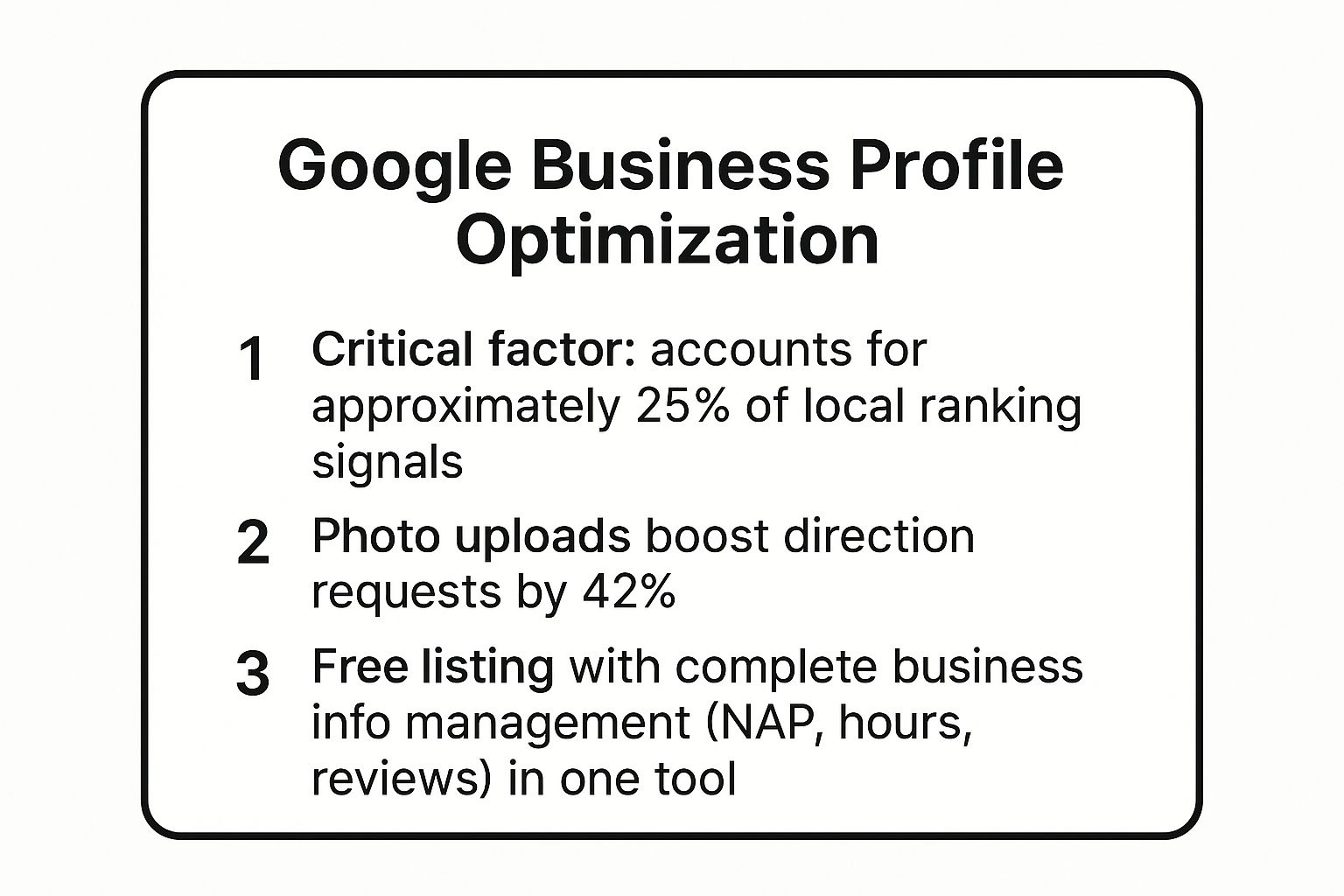
As the data highlights, GBP is not just a listing; it’s a dynamic tool where consistent effort, like adding photos, directly correlates with increased customer engagement and is a major component of local search algorithms.
To see these principles in action, the video below offers a visual guide to setting up and optimizing your profile for maximum impact.
2. Online Reviews and Ratings
Following closely behind your GBP is the powerful influence of online reviews and ratings. These are critical local SEO ranking factors that act as social proof for both search engines and potential customers. Google views a steady stream of positive feedback as a strong signal of trust and relevance, directly influencing your position in local search results. Reviews provide fresh, user-generated content that often includes location-specific keywords, reinforcing your geographic authority.
For a restaurant equipment supply company, a high star rating and numerous positive reviews can be the deciding factor for a new restaurant owner choosing between your showroom and a competitor's. They confirm your credibility and the quality of your service, impacting click-through rates and, ultimately, sales.

Why Reviews are a Local Ranking Powerhouse
The quantity, quality, and velocity (the speed at which you get new reviews) of your reviews are direct ranking signals. Moz Local's research has shown that businesses with over 40 reviews can rank 54% higher in the local pack. This is because reviews demonstrate that your business is active, valued by its community, and legitimate. For a restaurant equipment supplier, a review mentioning "fast delivery of our new convection oven in downtown" provides valuable keyword and location context that search engines love.
Actionable Optimization Tips
To turn customer feedback into a ranking asset, you need a proactive reputation management strategy.
- Systematize Your Requests: Implement an automated system that sends a review request via email or SMS 3-7 days after a purchase or delivery of equipment.
- Respond to Everyone: Reply to every review, both positive and negative, within 24-48 hours. A professional response to criticism can turn a negative experience into a positive impression.
- Diversify Your Platforms: While Google is key, encourage reviews on other relevant sites like industry-specific directories or Yelp. Aim for a healthy mix, with the majority on Google.
- Train Your Team: Instruct your sales and service staff to verbally ask satisfied customers for a review. A personal request is often highly effective.
- Showcase Reviews: Use review schema markup on your website to display star ratings directly in search results, which can dramatically increase your click-through rate.
To understand the profound effect customer feedback has on your search rankings and overall local SEO strategy, delve deeper into how Google reviews directly impact SEO.
3. NAP Consistency and Citations
Beyond your Google Business Profile, the consistency of your core business information across the web is a foundational local SEO ranking factor. This consistency is built upon your NAP (Name, Address, Phone number) and the online mentions of it, known as citations. Think of each citation on a directory like Yelp, an industry-specific site, or a social media platform as a vote of confidence that confirms your business's existence and location.
Google's algorithm relies on these external signals to verify that your business is legitimate and that the information it shows to searchers is accurate. When your NAP is identical everywhere, it creates a strong, unambiguous signal. Conversely, inconsistencies like using "St." on one site and "Street" on another, or having an old phone number listed on a forgotten directory, can confuse search engines and dilute your local authority, directly harming your rankings. Utilizing a professional local citation service ensures this critical data is managed accurately and efficiently.
Why NAP Consistency is Non-Negotiable for Local SEO
Consistent NAP data is critical for building trust with search engines and is a key component of local search algorithms. Google cross-references your NAP information from hundreds of sources to validate your GBP listing. The more consistent, high-quality citations you have, the more confident Google becomes in your location, leading to higher visibility in the Local Pack. For multi-location equipment suppliers, this is paramount. Managing NAP for multiple showrooms ensures each location ranks in its respective area. A Moz Local case study highlighted this impact, showing an 87% improvement in citation accuracy led to a 19% increase in local visibility.
Actionable Optimization Tips
To ensure your digital footprint is clean and consistent, you need a systematic approach to managing your citations.
- Establish a Master NAP: Create a master document with the one, official format for your Name, Address, and Phone Number. Use this exact format for every single online mention.
- Audit Existing Citations: Use a tool like BrightLocal or Whitespark to conduct a citation audit. This will uncover inconsistencies and duplicate listings that need to be corrected.
- Prioritize Core Directories: Start by ensuring your NAP is correct on major platforms like Google Business Profile, Yelp, Facebook, Apple Maps, and Bing Places.
- Build Niche Citations: For a restaurant equipment supplier, getting listed on industry-specific directories is crucial. Focus on sites relevant to the foodservice and hospitality sectors.
- Use Management Tools: For businesses serious about scaling their local presence, using a citation management service can automate the process of building and correcting listings across dozens of sites, saving valuable time and ensuring accuracy.
For a deeper look into a strategic approach, explore this guide to local citation building for restaurant equipment suppliers.
4. On-Page SEO and Localized Content
While your Google Business Profile acts as your digital storefront, your website is the home base where you control the narrative. On-page SEO involves optimizing your website's content, structure, and HTML elements to explicitly signal your local relevance to search engines. This foundational practice is one of the most crucial local SEO ranking factors because it tells Google exactly where you are, what you do, and which geographic areas you serve.
For a restaurant equipment supplier, this means going beyond a generic "About Us" page. It involves creating dedicated content that speaks directly to the needs of chefs and restaurateurs in specific cities, embedding location-specific keywords into title tags, meta descriptions, and headers to capture local search intent. Quality copywriting and strategic blog posting are essential for this.
Why On-Page Signals are Non-Negotiable for Local SEO
Strong on-page signals reinforce the information in your GBP and other local listings, creating a consistent and trustworthy digital footprint. When Google's crawlers see your website's content aligning perfectly with your claimed service areas, it significantly boosts their confidence in ranking you for local queries. For a restaurant equipment supplier, creating distinct pages for "Commercial Ovens in Brooklyn" and "Refrigeration Repair in Queens," each with unique, neighborhood-specific content, is far more effective than a single, generic service page. This strategy allows businesses to appear in organic results below the Local Pack, capturing additional clicks.
Actionable Optimization Tips
To turn your website into a local authority, you need to think geographically about every piece of content you create.
- Create Dedicated Location Pages: If you serve multiple areas, build a unique, high-quality page for each. A page for "Restaurant Equipment in Dallas" should discuss local health codes or highlight projects with Dallas-area restaurants, not just swap out the city name.
- Optimize Your Title Tags: Place your target city and primary keyword near the beginning of your title tags (e.g., "Commercial Ovens in Miami | [Your Brand Name]").
- Embed Google Maps: Add an interactive Google Map of your location on your contact and location-specific pages to provide a strong geographical signal.
- Use LocalBusiness Schema: Implement LocalBusiness schema markup on your site. This structured data explicitly feeds your name, address, phone number, and hours to search engines in their native language.
- Write Local Content: Develop blog posts that are relevant to your local audience, such as "Choosing the Right Ice Machine for Houston's Climate" or a case study featuring a well-known local eatery you supplied. Professional article writing services can help you consistently produce this type of high-value content.
For a deeper understanding of how to weave these elements together effectively, you can get more details on what is on-page optimization.
5. Link Building and Local Backlinks
While a broad backlink profile is important for any SEO strategy, link building for local SEO requires a more focused approach. This factor centers on acquiring high-quality backlinks from other websites that are geographically relevant to your business. These local links act as powerful endorsements, signaling to search engines like Google that your business is a trusted, authoritative, and active member of its local community.
Think of it as a digital version of word-of-mouth. When a well-respected local news outlet, a city's chamber of commerce, or a popular food blogger in your area links to your restaurant equipment supply website, it’s a strong vote of confidence. This is one of the more challenging, yet highly impactful, local SEO ranking factors because it demonstrates genuine community integration and trust, which search engines aim to reflect in their results. A well-executed blogger outreach campaign can be instrumental here.
Why Local Links are a Powerful Ranking Signal
Local links provide crucial context that generic links cannot. They tether your business to a specific geographic area, reinforcing the location signals you send through your Google Business Profile and on-site content. This geographic relevance is a cornerstone of local search algorithms. For example, if your business supplies the equipment for a new, highly-anticipated local restaurant and their "About Us" page links to your site as a key partner, that is a powerful local signal. Similarly, being featured in a "Best of Austin" roundup for commercial kitchen suppliers by a local blogger gains both visibility and a highly relevant backlink.
Actionable Optimization Tips
Building a strong local backlink profile requires a proactive, community-focused strategy. Quality will always trump quantity.
- Start with Local Directories: Get listed in your local Chamber of Commerce, Better Business Bureau, and other relevant business association directories. These are often considered foundational local links.
- Sponsor Local Events: Sponsoring a local food festival, a culinary school competition, or a charity cook-off is a great way to earn links from event pages, community calendars, and news articles.
- Host Community Workshops: A restaurant equipment supplier could host a free "Kitchen Safety 101" or "Maintaining Your Commercial Fryer" workshop, often resulting in valuable links from attendees' blogs or community sites.
- Partner with Neighbors: Collaborate with non-competing local businesses. For example, a bakery you supply could write a blog post about their new oven and link back to your product page as their trusted supplier.
- Create Newsworthy Content: Develop a unique story, data report, or host a noteworthy event and pitch it to local journalists and bloggers. A story about how your equipment helped a local charity kitchen could be very compelling.
For a deeper look into creating a strategy for your business, you can learn more about our approach to Link Building and Local Backlinks and how it can solidify your local authority.
6. Behavioral and Engagement Signals
Beyond static information like your address or reviews, Google increasingly analyzes how real users interact with your online presence. These behavioral and engagement signals are powerful local SEO ranking factors because they provide a direct feedback loop on your business's relevance and appeal. Google's machine learning algorithms, like RankBrain, interpret actions like clicks, calls, and direction requests as votes of confidence from searchers.
For a restaurant equipment supply business, strong behavioral signals indicate that your listing effectively meets the needs of local chefs and food service managers. When a user chooses your business from the Local Pack and then spends several minutes browsing your equipment catalog online, it signals to Google that you provided a valuable answer to their query, justifying a higher ranking.
Why Engagement Signals are Crucial for Local SEO
Strong user engagement directly influences your visibility in the Local Pack and on Google Maps. Google's goal is to connect users with the best possible local solution, and engagement metrics are its primary way of measuring satisfaction. A business that consistently earns more clicks, calls, and website visits than its competitors is demonstrating superior relevance. For example, a restaurant equipment website with detailed product videos might achieve a 4-minute average time on site, signaling high user interest. Similarly, a GBP listing with compelling photos of a showroom can achieve a 40% higher click-through rate (CTR) than nearby competitors, directly boosting its local search performance.
Actionable Optimization Tips
To improve your behavioral signals, you must optimize for user action and satisfaction at every touchpoint. This involves making your listings more compelling and your website more user-friendly.
- Optimize for Clicks: Craft a compelling business description and use high-quality, professional photos. Google data shows businesses with photos receive 35% more clicks on average.
- Enable All Actions: Ensure all Google Business Profile action buttons are active, including "Call," "Directions," and "Website," to make it easy for users to connect with you.
- Enhance Website Experience: Ensure your mobile site loads in under three seconds and features prominent click-to-call buttons. The content on your landing pages must directly match the user's search intent to reduce bounce rates.
- Use GBP Insights: Regularly review your GBP Insights data to understand which queries drive calls, clicks, and direction requests. Use this information to refine your profile and content strategy.
7. Mobile Optimization and Page Speed
In today's on-the-go world, mobile optimization and page speed have become indispensable local SEO ranking factors. With over 60% of local searches happening on mobile devices, often from users ready to make a purchase, a seamless mobile experience is no longer a luxury but a necessity. Google’s mobile-first indexing means it primarily ranks your website based on its mobile version, making performance on smartphones and tablets paramount.
For local businesses, especially those in fast-paced industries like restaurant equipment supply, a potential customer is likely searching for a part or service while on the move. A slow or difficult-to-navigate mobile site directly translates to lost revenue. Slow load times increase bounce rates, signaling to Google that your site provides a poor user experience, which can negatively impact your rankings.
Why Mobile and Speed are Non-Negotiable for Local SEO
The connection between mobile performance and local search success is direct and measurable. A fast, mobile-friendly website directly impacts your ability to convert searchers into customers. For example, a restaurant equipment supplier that implements a mobile-optimized site with a streamlined quote request form can see a dramatic increase in leads. Research shows that a one-second delay in mobile page load can decrease conversions by up to 20%. These examples prove that speed and mobile usability are critical components for driving local transactions.
Actionable Optimization Tips
To ensure your website is a powerful asset for local search, focus on creating a fast, intuitive mobile experience.
- Benchmark Your Performance: Use tools like Google's PageSpeed Insights and Mobile-Friendly Test to get a baseline understanding of your site's performance and identify specific issues.
- Prioritize Core Web Vitals: Focus on improving Largest Contentful Paint (LCP), First Input Delay (FID), and Cumulative Layout Shift (CLS). Passing Google's thresholds is a direct ranking signal.
- Compress and Optimize Media: Use modern image formats like WebP and implement lazy loading so that images below the fold only load as the user scrolls down.
- Streamline for Mobile Users: Implement prominent click-to-call buttons. Ensure all tap targets (like buttons and links) are at least 48x48 pixels to avoid user frustration.
- Aim for Sub-3-Second Load Times: In local search, every second counts. A load time under three seconds is good, but achieving a speed of 1.5 seconds or less will put you ahead of the competition.
8. Social Media Signals and Local Engagement
While not a direct ranking factor in the same way as a backlink or a keyword, the influence of social media signals on your local SEO performance is undeniable. An active, engaged presence on platforms like Facebook, Instagram, and even LinkedIn serves as a powerful indirect signal to search engines. It validates your business's legitimacy, builds brand awareness within the community, and drives traffic to your website and physical location, all of which are key local SEO ranking factors.
For a restaurant equipment supplier, a vibrant social media feed can showcase new inventory, highlight customer successes, and connect with local chefs and restaurateurs. This activity creates a digital footprint that reinforces your local authority and relevance. When Google's crawlers see a business being actively discussed and engaged with on social platforms, it contributes to a holistic picture of a prominent local entity.
Why Social Engagement is a Local SEO Amplifier
An engaged social media presence indirectly boosts local rankings by creating a halo effect. It generates brand-name searches, drives referral traffic, and creates opportunities for user-generated content and local backlinks. For instance, an equipment supplier using Instagram to post a video of a new high-efficiency fryer in action at a popular local restaurant can generate significant buzz and shares. These actions are potent social proofs that signal local popularity to search engines. This engagement demonstrates a clear link between social activity and real-world business results.
Actionable Optimization Tips
To leverage social media as an asset for your local SEO strategy, focus on community building and consistent, geo-targeted content.
- Ensure NAP Consistency: Your Business Name, Address, and Phone number (NAP) must be identical across all social profiles, matching what's on your GBP and website. This is a foundational local SEO practice.
-
Use Local Tags and Hashtags: Always tag your location in posts on platforms like Instagram and Facebook. Research and use relevant local hashtags (e.g.,
#YourCityChefs,#YourNeighborhoodEats) to increase visibility. - Share User-Generated Content: Encourage customers to tag your business in their photos showing off their new kitchen setup. Reposting this content builds social proof and creates authentic marketing material that resonates with a local audience.
- Engage with the Community: Actively follow and interact with other local businesses, culinary schools, and food bloggers. Responding to comments and messages promptly (ideally within 1-2 hours) shows you are an active and valued part of the local ecosystem.
9. Proximity and Geographic Relevance
Proximity, the physical distance between a searcher and your business, is one of the most powerful and uncontrollable local SEO ranking factors. Following Google's "Venice" update, the search engine heavily prioritizes showing users the businesses closest to their physical location or the location specified in their query. This is the primary driver behind the explosive growth of "near me" searches and a core component of how the local pack is populated.
For a restaurant equipment supplier, this means a chef searching for "commercial refrigeration near me" from two blocks away is far more likely to see your business than a competitor across town. While you can't move your showroom, you can significantly influence your geographic relevance, which is how well you signal to Google the specific areas you serve, even beyond your immediate address.
Why Proximity is Non-Negotiable for Local SEO
Proximity directly dictates your visibility at the moment of highest user intent. It's a foundational signal of relevance; Google assumes the closest option is often the best option. A restaurant equipment showroom will rank number one for a user standing outside its door but may not even appear on the first page for someone a few miles away. This hyperlocal reality means businesses must optimize for geographic signals to capture relevant local traffic. For instance, a supplier can use service area settings to appear in searches across a 30-mile radius, ensuring they are found by restaurateurs in multiple suburbs, not just the one where their showroom is located.
Actionable Optimization Tips
To maximize your visibility within and around your service areas, focus on creating strong geographic signals.
- Define Service Areas in GBP: In your Google Business Profile, accurately set your service areas. You can list up to 20 cities, zip codes, or counties to tell Google precisely where you operate. If you are a Service Area Business (SAB), hide your physical address to avoid confusing customers.
- Create Location-Specific Landing Pages: If you serve multiple distinct neighborhoods or cities, build dedicated pages for each one. A page titled "Restaurant Equipment Supply in [City Name]" with localized content sends a powerful relevance signal.
- Build Local Citations and Links: Earn mentions of your business Name, Address, and Phone number (NAP) on directories and websites relevant to each service area. A link from the [City Name] Chamber of Commerce is a potent local signal.
- Develop Hyperlocal Content: Write blog posts about community events, local restaurant openings, or guides to navigating health codes in a specific county. This content, like that created through professional article writing services, demonstrates your deep integration within the community.
Local SEO Ranking Factors Comparison
| Item | Implementation Complexity 🔄 | Resource Requirements ⚡ | Expected Outcomes 📊 | Ideal Use Cases 💡 | Key Advantages ⭐ |
|---|---|---|---|---|---|
| Google Business Profile Optimization | Medium - Requires ongoing updates and monitoring | Low - Free tool, but time intensively managing multiple locations | Critical - ~25% local ranking influence, direct local pack visibility | Local businesses wanting visibility on Google Search & Maps | Free, strong local visibility, customer engagement, analytics |
| Online Reviews and Ratings | Medium - Requires review generation and response management | Medium - Time for monitoring/responding; some tools may be paid | High - ~15% ranking factor; increased trust and CTR | Businesses focusing on building reputation and social proof | Builds trust, improves CTR, fresh user-generated content |
| NAP Consistency and Citations | Medium-High - Time-consuming to build and maintain citations | Medium - Effort or paid tools needed for audits and management | Medium-High - ~10% ranking impact; improved local authority | Multi-location businesses and those in competitive local markets | Builds trust with search engines, stable rankings, referral traffic |
| On-Page SEO and Localized Content | High - Requires content creation and site optimization | Medium-High - Content development and technical SEO resources | High - ~20% local ranking impact; better organic and voice search rankings | Businesses serving multiple cities/neighborhoods | Improves relevance and user experience, enhances keyword targeting |
| Link Building and Local Backlinks | High - Outreach and relationship building intensive | High - Time-consuming, some sponsorship costs | High - ~17% ranking influence; stronger domain authority | Businesses in competitive markets needing authoritative backlinks | Boosts domain authority, drives referral traffic, long-lasting SEO impact |
| Behavioral and Engagement Signals | Low-Medium - Indirect control, mainly optimizing UX and engagement | Medium - Requires analytics tools and ongoing UX improvements | Medium-High - ~12% ranking influence; improved user satisfaction | Businesses with well-functioning websites aiming to boost engagement | Hard to manipulate, reflects true user satisfaction, rewards quality |
| Mobile Optimization and Page Speed | High - Technical expertise required for fast, mobile-friendly sites | High - Developer resources, testing across devices | High - Confirmed ranking factor; improved conversions and lower bounce | Businesses with significant mobile traffic and transactions | Enhances UX, improves rankings, supports mobile and near-me searches |
| Social Media Signals and Local Engagement | Medium - Requires consistent, ongoing content creation and engagement | Medium - Time investment, possible paid promotions | Low-Medium - ~5% indirect ranking impact; brand awareness benefits | Businesses investing in community engagement and brand building | Increases local visibility, supports reputation, cost-effective marketing |
| Proximity and Geographic Relevance | Low - Cannot change location; optimization via service areas | Low-Medium - Content and citation efforts for geographic reach | Very High - One of top 3 ranking factors for local pack | Businesses targeting specific local areas or service radii | Strong local relevance, mobile near-me search advantage, reduced competition |
Putting It All Together: Your Recipe for Local SEO Success
Navigating the world of local SEO can feel like perfecting a complex recipe. Each ingredient, or ranking factor, must be measured and combined with care to achieve the desired outcome: top placement in local search results. We've explored the nine essential local SEO ranking factors, from the foundational importance of your Google Business Profile to the nuanced impact of social media signals and behavioral cues.
The key takeaway is that local SEO is not a "set it and forget it" task. It's a dynamic, ongoing process that requires consistent effort and a holistic strategy. Think of it as maintaining a thriving restaurant; you can't just create one great menu and expect customers to flock in forever. You must consistently deliver quality, engage with your community, and keep your establishment in pristine condition.
From Theory to Tangible Results
Let's distill this comprehensive list into a practical, actionable blueprint. Your journey to mastering local search begins with building a rock-solid foundation. This means meticulously optimizing your Google Business Profile, ensuring absolute NAP consistency across all directories, and building a technically sound, mobile-friendly website. These are the non-negotiables, the base of your digital storefront.
Once that foundation is set, the real work of community building and authority establishment begins. This is where you differentiate yourself. Actively soliciting and responding to reviews, creating hyper-localized content that speaks directly to your target audience (like a blog post on "Choosing the Right Commercial Oven for a Pizzeria in [Your City]"), and earning backlinks from local food bloggers or industry partners are crucial steps. Each of these actions sends powerful signals to Google that you are a relevant, trusted, and authoritative presence in your geographic area.
An Integrated Strategy for the Restaurant Equipment Industry
For a restaurant equipment supplier, mastering these local SEO ranking factors is the difference between being a hidden gem and the go-to resource for every new restaurant opening in town. Your strategy must be multifaceted:
- Your GBP is your digital showroom: Use high-quality photos of your equipment, post updates about new inventory, and use Q&A to address common questions from chefs and restaurateurs.
- Citations build targeted authority: Beyond general directories, seek listings in specialized food service and hospitality industry publications. Consistency here is paramount, and leveraging a professional local citation service can save hundreds of hours while ensuring accuracy.
- Content connects with your community: Your blog is your most powerful tool. Instead of generic posts, create articles that solve local problems. For instance, an article titled "Navigating [Your City]'s Health Code for Commercial Kitchens" will attract exactly the right kind of local traffic. Engaging services for article writing or blogger outreach can help you create and promote this valuable content.
Ultimately, each of these factors interconnects. Strong on-page SEO makes your localized content more visible, which in turn earns local backlinks and drives positive engagement signals. A well-managed GBP encourages reviews, which boosts your authority and click-through rates. Success lies not in mastering one element, but in orchestrating all of them into a cohesive strategy that continuously reinforces your local relevance and authority. By doing so, you're not just climbing search rankings; you're embedding your business into the fabric of your local community, ensuring a sustainable flow of high-intent customers for years to come.
As you optimize your digital presence to attract local chefs and restaurateurs, ensure your product offerings are just as impressive. Charbroilers.com provides top-tier equipment that forms the heart of any successful kitchen, helping you deliver on the promises your marketing makes. Explore our extensive selection of commercial charbroilers and other essential cooking equipment at Charbroilers.com to equip your local clients for success.