

Local SEO For Contractors A Practical Guide To Winning More Jobs
Local SEO for contractors is all about showing up when a homeowner in your area needs help. It's a targeted strategy that puts your Google Business Profile, local directory listings, and your own website front and center in the Google Map Pack and local search results. Get it right, and your phone will ring.
Your Google Business Profile Is Your Digital Handshake
Before a homeowner even thinks about calling you for a quote, they’re going to find you on Google. That makes your Google Business Profile (GBP) your most important first impression—it's your digital handshake.
A flimsy, incomplete profile hints that you might not be serious about your business. On the other hand, a detailed, active profile builds immediate trust. For contractors, this isn't just another online listing; it's the engine that drives your entire lead-generation machine.
Getting this right is about more than just your business name and phone number. The small details are what separate the contractors who get consistent calls from the ones who stay invisible.
Choosing The Right Business Categories
The first thing you have to nail is selecting the right categories. This might sound simple, but it has a massive impact on who finds you.
For example, a roofer has a few options. Are you a "Roofer," a "Roofing Contractor," or something else entirely? Choosing "Roofing Contractor" as your primary category tells Google exactly what you do. Then, you can add secondary categories like "Gutter Cleaning Service" or "Siding Contractor" to cast a wider net for relevant searches.
Be specific. If you're a remodeler, a primary category like "Kitchen Remodeler" is way more effective than a generic "Construction Company."
Defining Precise Service Areas
Next up, you have to meticulously define your service areas. Don't just list your main city and call it a day. Pinpoint every single town, suburb, and neighborhood you actually work in.
A homeowner searching for "kitchen remodel in Crestwood Hills" is far more likely to see a contractor who has specifically listed that neighborhood than one who just put "Los Angeles." This level of detail tells Google you're a true local expert in those specific communities.
This simple flow—choosing precise categories, defining your service area, and then showcasing your work with photos—is the core of a powerful setup.
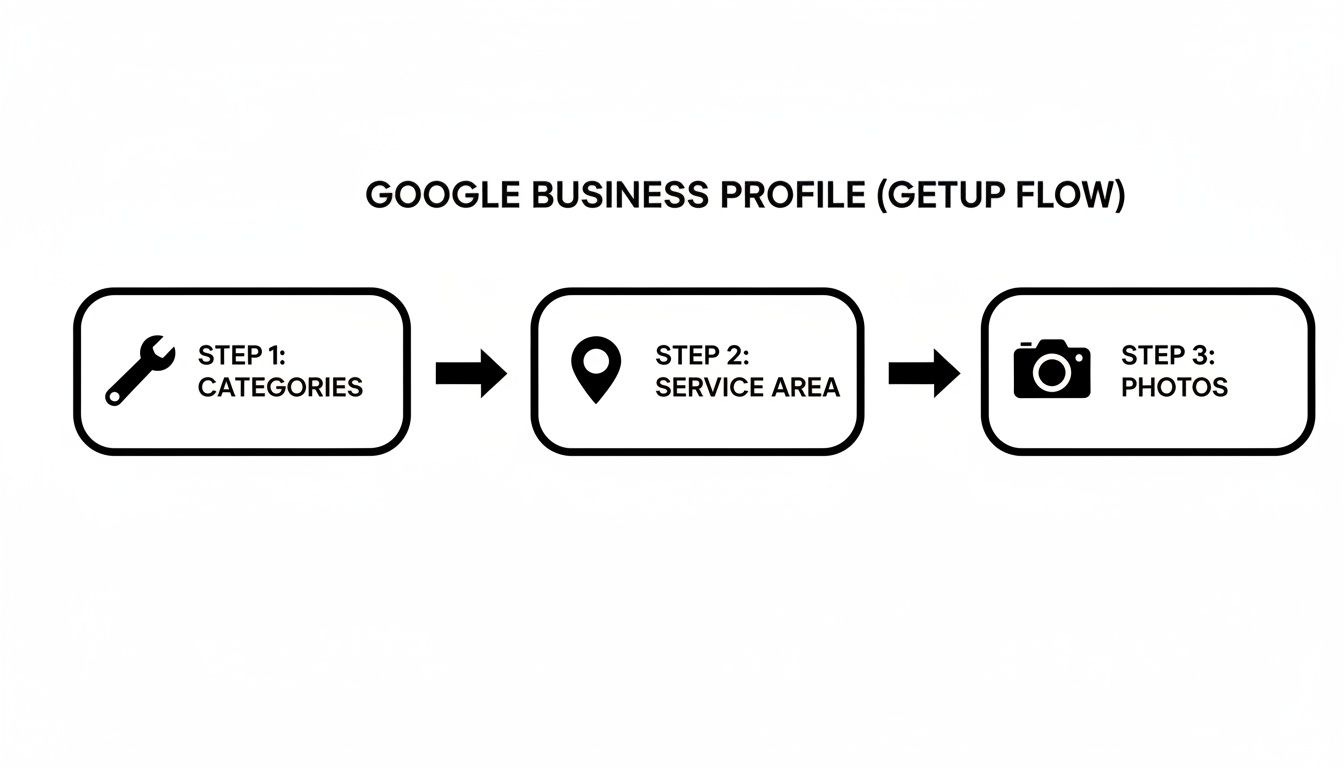
This visual just hammers home the point: a strong GBP isn't about just existing, it's about being precise at every step.
Leveraging All Available GBP Features
An optimized profile uses every single tool Google gives you. Never leave a section blank.
- Business Description: Write something that speaks directly to a homeowner's problems. Instead of "We offer roofing services," try "Protect your home from harsh weather with our trusted, warrantied roof replacement services for local families."
- Photos and Videos: You absolutely need high-quality photos of your finished projects. Before-and-after shots are pure gold. Show your team, your trucks, and your crew in action. This visual proof is often the final nudge a customer needs.
- Q&A Feature: Be proactive with the Questions & Answers section. Ask and answer common questions yourself. Think: "Do you offer free estimates?" or "Are you licensed and insured?" This cuts through customer hesitation and puts important info right where they can see it.
- Google Posts: Use Google Posts to show off your latest work, run a special offer, or highlight a project you just wrapped up in a specific neighborhood. These act like mini-ads directly on your profile, showing everyone that you're active and engaged.
To help you stay on track, I've put together a quick checklist of the most important GBP elements for contractors. Focusing on these will have the biggest impact on your lead flow.
GBP Optimization Checklist For Contractors
| GBP Element | Optimization Action | Why It Matters For Contractors |
|---|---|---|
| Business Name | Ensure it matches your legal business name exactly. No extra keywords. | Consistency builds trust with Google and customers. Keyword stuffing gets you penalized. |
| Primary Category | Choose the most specific service you offer (e.g., "Plumber," not "Home Services"). | This is the single most important ranking factor for what you show up for. |
| Services | List every single service you provide, from "leak detection" to "water heater installation." | This helps you rank for long-tail searches and tells customers the full scope of your work. |
| Service Areas | List every city, zip code, and specific neighborhood you serve. Be granular. | You'll appear in searches for "plumber near me" in all those specific locations. |
| High-Quality Photos | Add new, geotagged photos of your work, team, and vans every week. | Visual proof is everything. It shows you do quality work and builds immediate credibility. |
| Consistent Reviews | Actively request reviews from every customer and respond to all of them. | Social proof is a massive conversion factor. More positive reviews = more calls. |
| Google Posts | Post updates at least once a week (e.g., project photos, offers, tips). | Keeps your profile fresh, engages potential customers, and sends positive activity signals to Google. |
| Q&A Section | Pre-populate with your most frequently asked questions and clear, helpful answers. | Positions you as an expert and removes friction for potential customers doing their research. |
This isn't an exhaustive list, but if you nail these eight elements, you'll be miles ahead of most of your competition.
Your Google Business Profile isn’t a set-it-and-forget-it tool. It's a dynamic, living storefront that requires regular updates. Treat it like your best salesperson—it works 24/7 to bring you qualified local leads.
For a deeper dive into the initial setup, our guide on how to get a Google business listing covers more of the basics. If you want to go even further, check out this complete guide to local SEO for contractors.
Building Local Trust With Consistent Online Mentions
While your Google Business Profile is your digital handshake, the consistency of your business info across the web is what builds your reputation. In the world of local SEO for contractors, every time your business gets mentioned online, it sends a small signal to Google. To build trust, you need all those signals to be perfectly aligned.
The core of this is something we call NAP consistency. This stands for your business Name, Address, and Phone number. For Google to see your contracting business as a legitimate, stable entity, these three details must be identical everywhere they show up online.
Think about it from a customer's perspective. If they found three different phone numbers for your business, they'd probably hesitate to call. Google has the same reaction. Inconsistencies create doubt and can quietly torpedo your chances of ranking in local search results and the all-important Map Pack.
Understanding Citations and Why They Matter
These online mentions of your NAP information are called citations. Every single citation acts like a vote of confidence, verifying that your business exists and is located where you say it is.
A strong citation profile is all about having accurate listings on the right websites. A restaurant equipment supply website might focus on food service directories, but as a contractor, you need to be where homeowners are actively looking. For a deeper dive, our guide to local citation building has some great insights that apply across different industries.
For contractors, the most critical citation sources fall into a few key categories:
- Major Data Aggregators: These are the big data companies that feed information to thousands of other websites and apps. Get your info right with them, and it creates a massive positive ripple effect.
- General Directories: Think of the household names like Yelp, Yellow Pages, and the Better Business Bureau. You have to be there.
- Industry-Specific Platforms: This is where you get a real competitive edge. Getting listed on sites like Houzz, Angi, HomeAdvisor, and Thumbtack is absolutely non-negotiable for contractors.
Auditing Your Current Online Presence
Before you start building new citations, you need a clear picture of where you stand right now. The first move is always a citation audit to hunt down and fix any inconsistencies that are holding you back.
Start by just searching for your business name online and see what pops up. Check the top directories for any listings that already exist. You need to be meticulous here—is "Street" abbreviated as "St." on one site but spelled out on another? Does one listing include "Suite 200" while another one doesn't? Believe it or not, these tiny differences matter.
A common mistake we see is forgetting about old listings. If your business moved or changed phone numbers years ago, those outdated citations could still be floating around online, actively confusing search engines and watering down your authority.
Fire up a simple spreadsheet to track what you find. List the website, the URL to your listing, and the NAP information exactly as it appears. Highlight any inconsistencies so you have a clear hit list of what to fix. This methodical approach ensures you're building your local SEO on a rock-solid, trustworthy foundation. Honestly, fixing these errors is often one of the quickest ways to see a real jump in your rankings.
Creating Website Content That Gets You Hired Locally
Your website is your digital showroom, but for local SEO, it needs to do more than just list what you do. It has to be a magnet, pulling in local customers and screaming to Google that you are the contractor for their specific neighborhood.
This is where dedicated service and location pages become your secret weapon.
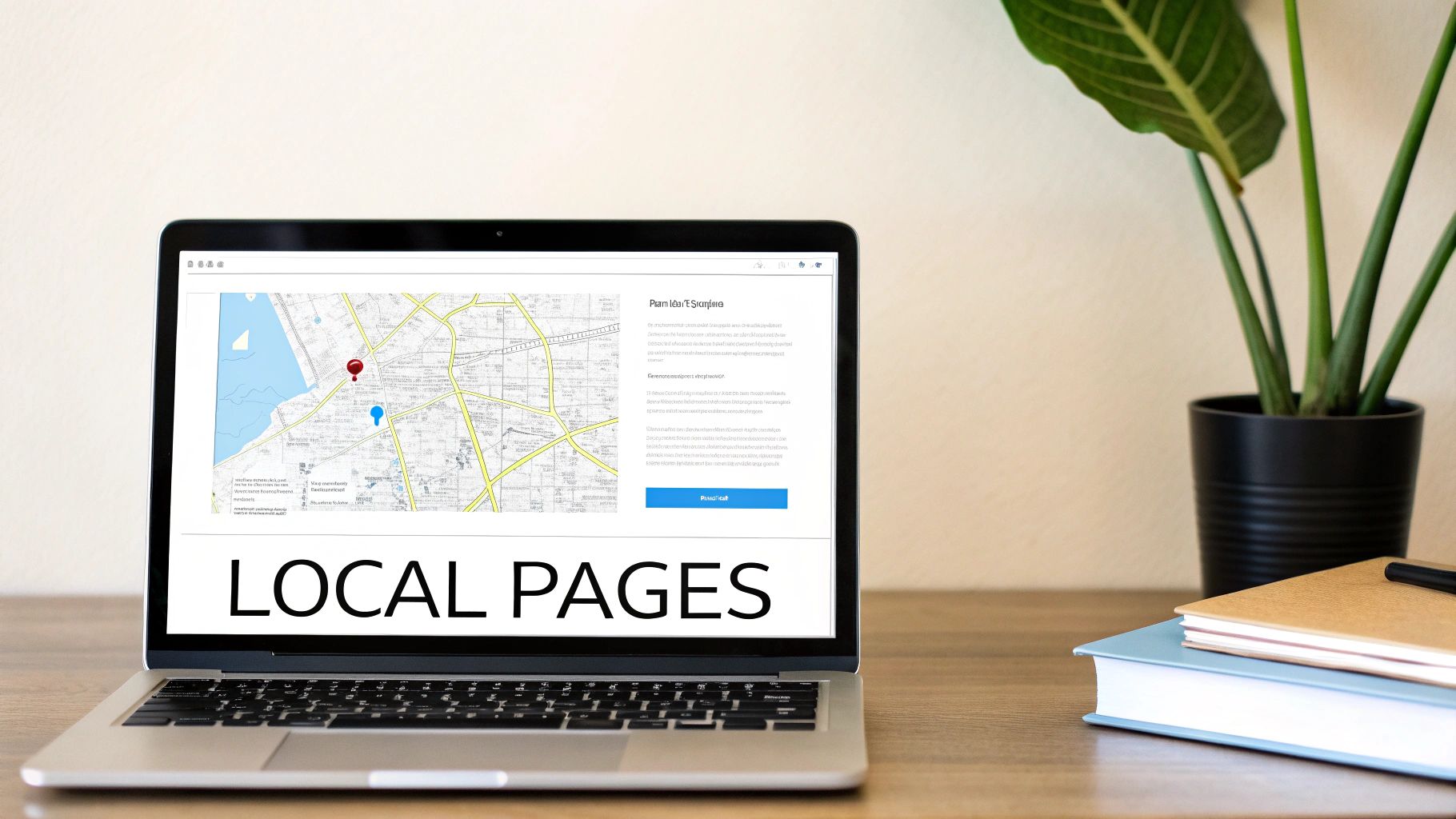
Think about it. A generic "Roofing Services" page is okay, but a "Roofing Repair in Silver Lake" page? That speaks directly to a homeowner with a leaky roof in that exact town. This is how you stop being just another name in a long list and become the obvious local expert.
The content you build out on your site is a huge piece of the puzzle. In fact, on-page signals—like having dedicated pages for your services and peppering in geographic keywords—are absolutely critical. Recent data shows these signals make up a massive 36% of what influences your local organic rankings, even more than backlinks.
We saw this firsthand with an HVAC contractor who was struggling to get noticed. By building out individual city pages with unique, localized copy and schema, they jumped into the top 3 of the map pack in multiple suburbs. It was a night-and-day difference from their old, generic service pages.
The Anatomy Of A Perfect Location Page
So many contractors make the same mistake: they create one service page and then just list a bunch of towns at the bottom. This is a massive missed opportunity. If you really want to own the search results in your area, you need to build out dedicated pages for each key city or suburb you serve.
And I don't mean just copying and pasting, swapping out the city name. That won't cut it. Each page needs to be a unique, valuable resource that proves you belong in that community.
Here's what every powerful location page needs:
- Localized Headlines: Don't just say "Kitchen Remodeling." Get specific with headlines like "Expert Kitchen Remodeling for Historic Homes in Oak Park."
- Neighborhood-Specific Content: Show you know the area. Mention local landmarks, common architectural styles, or problems homeowners there face. Something like, "We have years of experience working with the historic brick homes in the North End" shows you're a true local.
- An Embedded Google Map: Drop a map onto the page that shows your service area or, even better, pinpoints a recent project you completed in that town.
- Local Testimonials: Nothing sells like social proof. Feature reviews from clients who live in that specific city. A glowing quote from a customer in "Westwood" on your "Westwood Services" page is pure gold.
This level of detail sends a powerful signal of hyper-relevance to Google, making it way more likely you'll pop up for searches like "plumber in Westwood."
Crafting Service Pages That Showcase Real Expertise
While location pages prove where you work, your service pages are where you prove how well you work. This is where you close the deal. These pages need to be packed with details and evidence of your craftsmanship.
Don't just write that you offer "bathroom remodeling." Break it down. Talk about your meticulous process for tile installation, your expertise in walk-in shower conversions, or how you source custom vanities. The more specific you get, the more trust and authority you build. This is also your chance to get a jump on what people are actually looking for; our guide on local keyword research is a great place to start.
Pro Tip: A project gallery is one of the most powerful tools you have. But instead of one giant gallery page, embed small, relevant galleries directly onto each service page. Your "Deck Building" page should feature photos of incredible decks you've built, not random pictures of kitchens.
Don't Forget Your Secret Weapon: Local Business Schema
Okay, this last part gets a little technical, but it's an absolute game-changer for local SEO. Local business schema is a chunk of code that gets added to the backend of your website. Your visitors will never see it, but search engines read it like a billboard.
This code spells out critical information for Google, leaving nothing to chance. It tells them things like:
- Your exact business name, address, and phone number (NAP)
- Your hours of operation
- The specific services you offer
- Your defined service area
- Your customer reviews and average rating
You're basically spoon-feeding Google all your key info in a language it understands perfectly. This removes any guesswork, reinforces the details in your Google Business Profile, and solidifies your legitimacy as a local pro. Implementing schema can give you a serious edge, helping you show up in more prominent search results and cementing your status as the go-to contractor in your target areas.
Turning Happy Customers Into Your Best Marketing Asset
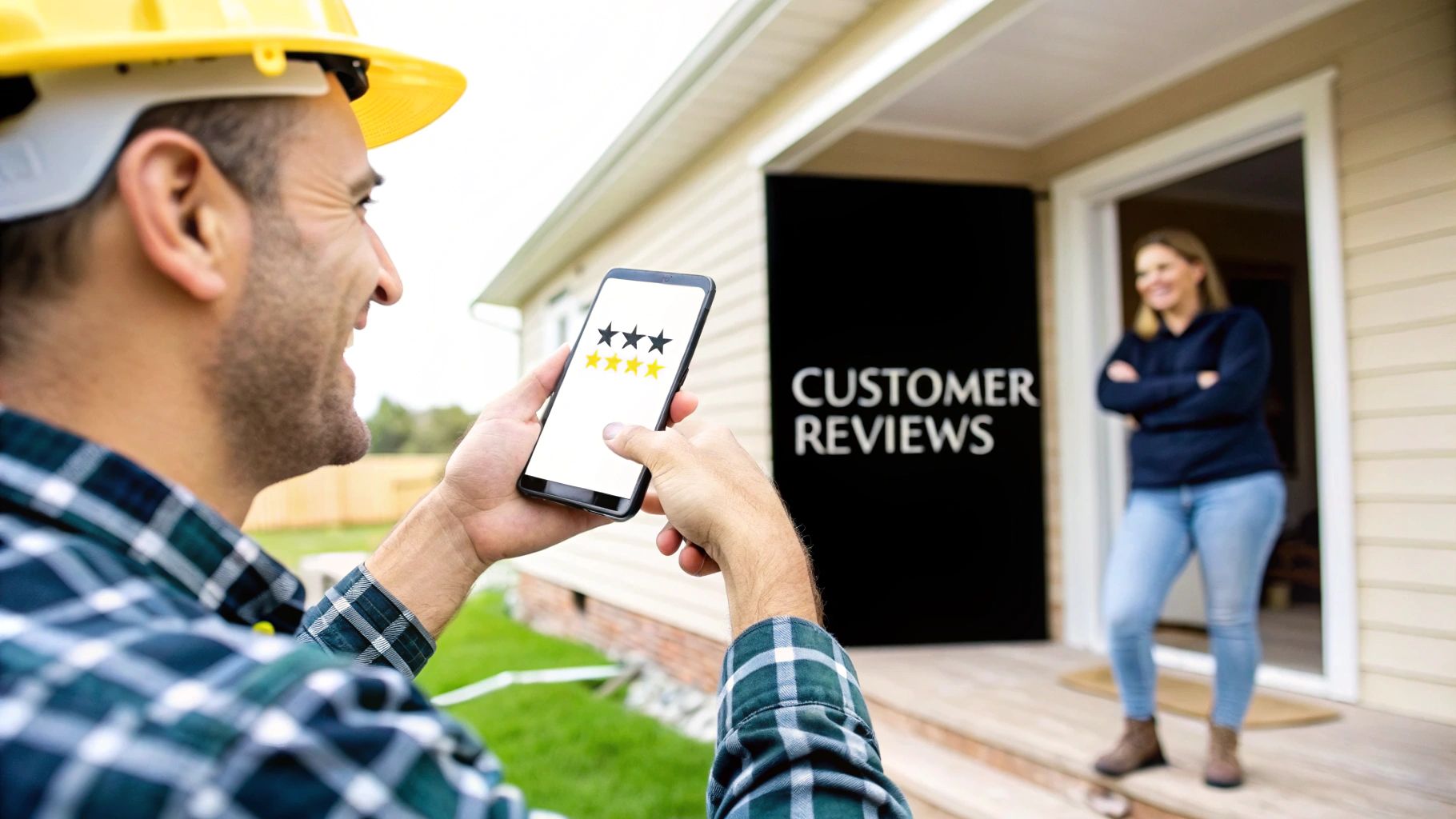
For contractors, word-of-mouth has always been the lifeblood of the business. These days, online reviews are the new word-of-mouth, acting as digital gold that can make or break your ability to land new jobs.
Think of them as much more than just testimonials. They are a direct and powerful ranking signal for local SEO. A steady stream of positive reviews tells potential customers you’re reliable, and it sends strong signals to Google that your business is active, legitimate, and valued by the community.
This has a huge influence on your visibility in the Google Map Pack, turning your satisfied clients into a powerful engine for attracting new business. The simple truth is that the quantity, quality, and frequency of your reviews all play a massive role.
Why Fresh Reviews Are Critical For Rankings
Google’s algorithm loves fresh activity. A business with 100 five-star reviews from two years ago can easily be outranked by a competitor with 20 recent reviews. Why? Because recent feedback is a much better indicator of your current quality of service.
In fact, research consistently shows that review signals are a top driver for Map Pack rankings, often carrying more weight than even your online directory listings. I’ve seen it firsthand: a contractor with 150 five-star reviews saw their rankings tank after going six months without any new feedback. But after generating just ten fresh reviews in two weeks, their visibility shot right back up. You can dig into these powerful ranking factors to see just how direct the impact is.
Don't let your review pipeline run dry. A consistent flow of new, positive feedback is a clear signal to both Google and potential customers that your business is thriving and actively delivering excellent service right now.
This means you absolutely need a simple, repeatable process for asking every single happy customer for their feedback.
Making It Easy To Get Great Reviews
The biggest barrier to getting reviews isn't that your customers are unwilling; it's that life gets in the way. You have to make the process as frictionless as possible.
The best time to ask is right after the final walkthrough when the client is admiring your work and their satisfaction is at its peak.
Here are a few proven methods that just work:
- The Direct Link Text: While you're on-site, just say, "We're so glad you love the work! Would you mind sharing your feedback on Google? I can send you a direct link right now." A simple text with your Google review link makes it effortless.
- The Follow-Up Email: A day after the job is done, send a short, personalized thank-you email. Include a clear call-to-action button that says something like, "Share Your Experience on Google."
- Leave-Behind Materials: Put a QR code on your final invoice or a small leave-behind card that takes customers directly to your review page. It’s a great, low-pressure way to remind them.
Don't be afraid to send a single, polite follow-up a week later if you haven't heard back. People are busy, and a gentle nudge is often appreciated.
The Overlooked Power Of Responding To Reviews
Generating reviews is only half the battle. The crucial step most contractors miss is responding to every single review—good, bad, or indifferent. This simple action has a surprisingly big impact.
When you respond, you're not just talking to that one customer. You're showing every future prospect who reads your reviews that you are engaged, professional, and stand behind your work.
Here’s a quick guide on how to handle responses:
- For Positive Reviews: Thank the customer by name and mention a specific detail. For example, "Thanks, Mark! We're thrilled you love the new composite deck in Springfield." This subtly reinforces your services and location for SEO.
- For Negative Reviews: Respond quickly and professionally. Acknowledge their issue, apologize that their experience wasn't perfect, and take the conversation offline to fix it. "We're sorry to hear this. Please call our office so we can make this right." This shows you care and are proactive, which builds immense trust with anyone watching.
Earning Links From Your Local Community
While your website content and glowing customer reviews are building trust with homeowners, earning backlinks from other local websites is how you build trust with search engines. Think of a local link as a digital referral from a respected neighbor down the street. Each one tells Google that your contracting business is a legitimate, recognized authority in your town.
This isn't about shady tricks or buying links from some random directory. Real local link building is about weaving your business into the online fabric of your community. It’s a powerful signal that you're an active, trusted partner in the area you serve, and it’s a huge piece of the local SEO puzzle for contractors.
Forge Partnerships With Non-Competing Businesses
Honestly, one of the best ways to get valuable local links is by building genuine relationships with other businesses that serve the same homeowners you do—just not your direct competitors. These symbiotic partnerships create a natural, logical reason for them to mention and link to your website.
Think about the typical journey of a new homeowner. Long before they need a roofer, they probably worked with a real estate agent. After they get the keys, they might be looking for an interior designer or a landscaping company.
Here are a few prime partnership opportunities I've seen work wonders:
- Real Estate Agents: Offer to write a guest article for their blog on something like "Top 5 Upgrades to Boost Home Value." In exchange, they link back to your site. It’s a win-win.
- Mortgage Brokers: They're always handing out resource packets to new buyers. Just ask to be included in their list of recommended local contractors.
- Interior Designers: A designer can link to your remodeling work from their online portfolio, and you can return the favor by featuring their design work in your project galleries.
- Material Suppliers: Got a favorite lumber yard or hardware store? Check if they have a "Featured Contractors" or "Pro Partners" section on their website.
These partnerships are gold because they provide real value to everyone involved, especially the homeowner. You get a powerful local backlink, and your partner gives a genuinely helpful resource to their clients.
Get Involved In Your Local Community
Community engagement is another fantastic way to earn natural, high-authority backlinks without even trying too hard. When you're an active participant in local events and organizations, you create organic opportunities for your business to be mentioned online. This strategy cements your reputation both on the ground and on the web.
Getting a single link from your local Chamber of Commerce or a news article about your company sponsoring a charity 5k is worth more than dozens of generic directory listings. These links carry immense local authority.
Consider these tried-and-true ideas:
- Sponsor a local little league team. Their website will almost certainly list their sponsors and link right back to your business page. It’s an easy win.
- Host a free workshop. Team up with a local hardware store to host a "DIY Basics" or "Winterizing Your Home" workshop. The store's website and local event calendars will likely promote it with a link.
- Get featured in a local blog. Reach out to neighborhood bloggers or online news outlets. Offer to share your expert tips on a timely topic, like "How to Spot Storm Damage After a Hailstorm," in exchange for a mention and a link.
Every one of these actions strengthens your community ties, and as a natural byproduct, it boosts your local SEO. It’s all about building a brand that is genuinely part of the neighborhood—something search engines are getting much better at recognizing and rewarding.
Why 'Near Me' Searches Are a Goldmine for Contractors
Picture this: a pipe bursts under the kitchen sink, or a nasty storm rips a hole in the roof. What's the homeowner's first move? They're not casually flipping through a phonebook. They’re grabbing their phone and frantically typing "plumber near me" or "emergency roof repair" into Google.
That's the exact moment you want to show up.
This isn't someone just kicking the tires or planning a project for next year. This is a customer with an urgent problem and a wallet in hand, ready to hire right now. For a contractor, getting in front of these high-intent searches is everything. Your visibility in that critical moment can be the difference between landing a profitable emergency job and your phone staying silent.
All the pieces we’ve been talking about—your Google Business Profile, the right local citations, a steady stream of good reviews—they all come together for this one purpose. The goal isn’t just to build a brand over time; it's to be the first and best solution when a potential customer is in a jam and needs a pro, fast.
The Sheer Urgency of Local Search
The numbers here don't lie. Searches that include phrases like "near me" or "close by" have skyrocketed by over 900% in the last couple of years. It’s a massive shift in how people find local services.
Even more telling is what happens after the search. A staggering 76% of people who make a 'near me' search on their phone visit a related business within 24 hours. That's an incredible path from search to sale. You can dig into more of these powerful local SEO statistics for contractors to see just how big the opportunity is.
This isn't just a trend; it's a fundamental change in customer behavior. If your contracting business isn't optimized to pop up for these high-urgency searches, you're essentially invisible to the customers most ready to hire you.
Common Questions About Local SEO For Contractors
Diving into local SEO can feel like opening a can of worms—lots of questions pop up. We get it. Here are some straightforward answers to the most common questions we hear from contractors trying to get more local jobs on the books.
How Long Does It Take For Local SEO To Start Working?
This is the big one, and the honest answer is: it depends.
While you might see some small wins from tuning up your Google Business Profile in just a few weeks, a real, solid local SEO strategy usually takes 3-6 months to deliver significant, steady results.
Think of it like building a new deck, not just flipping a light switch. Things like how tough your local competition is, the current state of your website, and how consistently you work on this stuff all play a huge part. It's a long-term investment in your business's visibility, not some magic overnight fix.
What Is The Difference Between Local And Traditional SEO?
The difference is everything. Traditional SEO is all about ranking for keywords nationally, or even globally. That’s great if you’re selling software, but it does absolutely nothing for a local roofer in Des Moines.
On the other hand, local SEO for contractors is laser-focused on getting you seen by people searching right in your service area.
It’s all about sending the right signals to Google that prove you're a legitimate local player. This includes things like:
- Your complete Google Business Profile information.
- Getting listed in local and trade-specific directories.
- Using location-specific keywords on your website (e.g., "kitchen remodeling in Plano, TX").
The end game is simple: show up in the Google Map Pack and get in front of nearby customers who are ready to pull the trigger and hire someone.
Your GBP is often the first impression a customer gets and it's your ticket to the Map Pack. Your website is where you seal the deal by showing off your expertise with detailed service pages, project galleries, and testimonials. They're a one-two punch—a strong GBP gets them interested, and a great website convinces them to call.
As your local SEO starts working and the phone rings more often, you’ll need a way to handle all those calls without dropping the ball on your actual work. Looking into the best answering service for small business can be a lifesaver, ensuring every potential lead gets a professional and prompt response.
Do I Need A Physical Address To Rank In Local Search?
Nope, you don't need a fancy commercial storefront. Most contractors are "service-area businesses." You can register your business using your home address and then simply tell Google to hide it from the public on your profile.
The real key is to clearly map out your service area within your Google Business Profile and, most importantly, keep your business name, address (even if hidden), and phone number 100% consistent everywhere it shows up online. Consistency is king here.
At Charbroilers.com, we provide information on SEO, local citation services, blog posting, blogger outreach, copyrighting, and article writing for restaurant equipment supply websites. For restaurants looking to serve perfectly grilled dishes that keep patrons coming back, our selection of commercial charbroilers is second to none. Explore our top-tier equipment at https://charbroilers.com and find the ideal charbroiler to elevate your menu.