

Mastering Local Listings Management for Restaurant Equipment Suppliers
Local listings management is the ongoing process of keeping your business's information—name, address, phone number (what we call NAP), and hours—up-to-date across every online directory and platform out there.
It's all about making sure that when a restaurant owner or chef searches for equipment, they find accurate and compelling information about your supply company. This is what leads them straight to your door or your website. Think of it as your digital first impression; you absolutely have to get it right.
Why Your Digital Front Door Matters
Imagine this scenario: a restaurant manager is in urgent need of a new charbroiler and searches for "commercial kitchen suppliers near me." Your company pops up on Google Maps, the reviews are great, and they decide to head over. But when they arrive, you’re closed. Why? Your listing had outdated hours.
You’ve just lost a customer, probably earned a frustrating one-star review, and dinged your online reputation—all from one tiny data error. This happens far more often than you'd think.
Your online listing isn't just a static entry in a database; it's your company's digital front door. It's the very first interaction many potential buyers will have with your brand. Accurate, consistent information across platforms like Google, Yelp, and trade directories builds trust with both customers and search engines.
The High Stakes of Local Search
Ready for some numbers? A staggering 46% of all Google searches now have local intent. This means making sure your listings are spot-on across every directory can literally make or break your foot traffic and sales calls.
And it gets more serious. About 92% of consumers pick a business from the first page of local search results. For your supply shop, this means that even mentioning a specific brand of countertop or floor model charbroiler in your profile could drive qualified buyers straight to you.
This visibility translates directly into revenue. An optimized profile filled with high-quality photos of your showroom, current product catalogs, and a steady stream of positive reviews doesn't just inform—it persuades. It tells a story that convinces a searcher to become a customer.
To understand the real-world impact, let's break down how this all connects to your bottom line.
How Local Listings Impact Your Success
This table highlights the direct connection between effective local listing management and measurable business outcomes for your restaurant equipment supply business.
| Statistic | Impact on Your Business |
|---|---|
| 86% of consumers rely on the internet to find a local business. | Your online listing is your primary discovery tool. If it's wrong, you're invisible to the vast majority of potential customers. |
| 76% of people who search for something nearby on their smartphone visit a business within a day. | An accurate, optimized listing turns a quick search into immediate foot traffic or a sales call. |
| Listings with photos receive 42% more requests for driving directions. | High-quality photos of your products and showroom directly encourage customers to make the trip. |
| Businesses with a complete Google Business Profile are 2.7x more likely to be considered reputable. | A fully filled-out profile builds trust before a customer even sees your inventory, making them more likely to choose you over a competitor. |
As you can see, the data doesn't lie. Investing time in your local listings isn't just a "nice-to-have" marketing task; it's a fundamental part of running a successful business today.
Your local listing is more than just contact information. It’s a dynamic marketing tool that answers customer questions before they even ask them, showcasing what makes your equipment and service unique.
To truly succeed, you also have to master your restaurant's online reputation management, because your listings and your reviews work hand-in-hand to build a powerful online presence.
Inconsistent data erodes this entire foundation, making it harder for people to find you and, more importantly, to choose you. At the end of the day, effective local listings management is one of the most critical tools you have to get more qualified leads.
Conducting Your Digital Presence Audit
Before you can fix, update, or optimize anything, you first need a clear picture of your company's current digital footprint. Think of it as taking inventory of your stock. This audit shows you exactly where your business is listed online, what info customers are seeing, and where the most urgent problems are hiding.
You might be shocked by what you find. Listings can pop up automatically from data aggregators or even from well-meaning customers. Too often, they contain old product lines, incorrect hours, or—worst of all—the wrong address. Every single one of these inaccuracies is actively costing you customers.
This simple flowchart shows the powerful journey a potential buyer takes when looking for a supplier like yours.
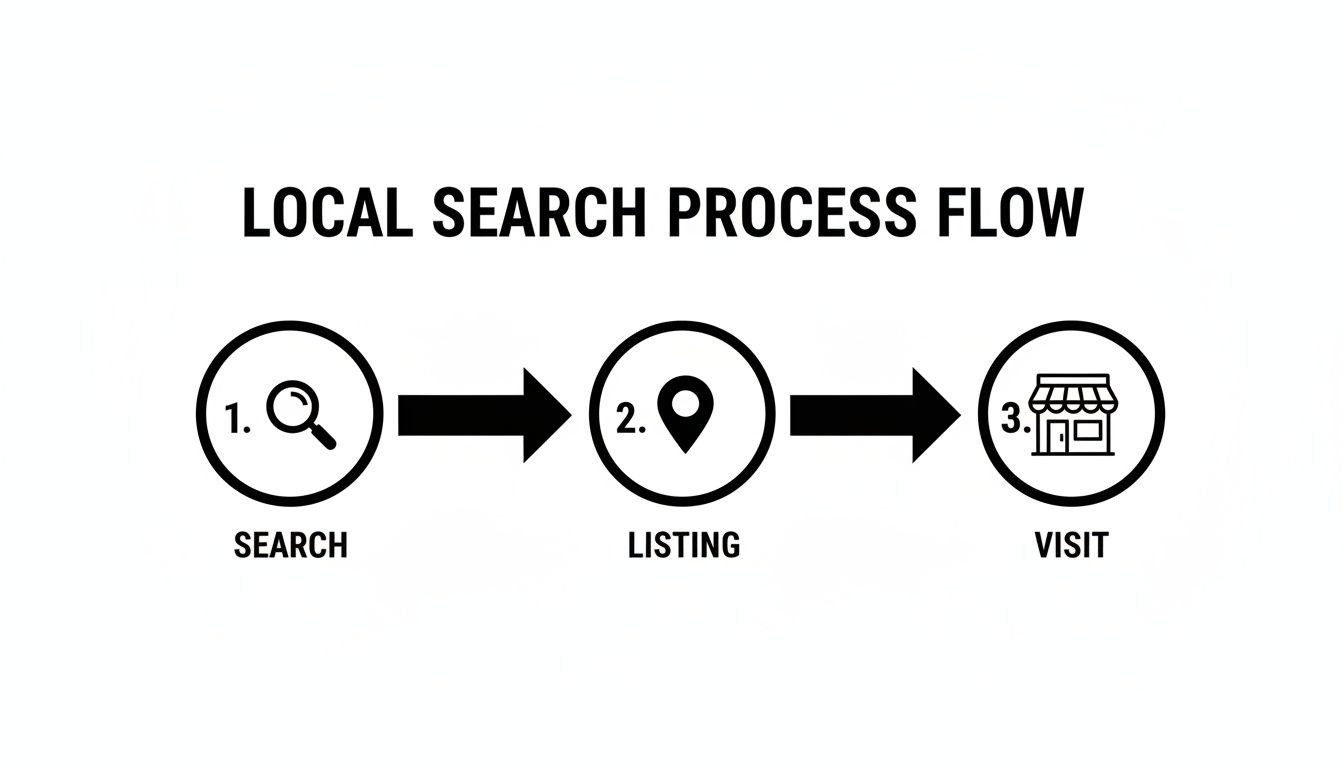
From their first search to landing on your listing and deciding to visit, each step is a critical moment. Accurate information can win you that customer, while bad data sends them right to your competitor down the street.
Uncovering Your Existing Listings
The first job is to hunt down every single place your business shows up online. This goes way beyond a quick Google search. You need to find all your structured citations (like directory listings) and even the unstructured ones (mentions in blogs or local news articles).
Start digging by searching for your business using a few different variations:
- Your exact business name (e.g., "Metro Kitchen Supply")
- Common misspellings or old names (e.g., "Metro Kitchin" or "City Restaurant Supply")
- Your business name + address
- Your business phone number
This process will almost certainly uncover listings you never knew existed, including duplicates on major platforms. Duplicate listings are especially toxic because they split your reviews, confuse search engines, and dilute your online authority. Make sure to flag every single duplicate you find for removal later.
An audit isn't just about spotting errors. It’s about seizing control of your company’s online identity to make sure every potential customer finds a consistent, professional, and trustworthy brand story.
Prioritizing and Verifying Your Profiles
Once you have a comprehensive list of all your online mentions, it's time to prioritize. You can't tackle everything at once, so focus on the platforms that deliver the biggest punch for B2B suppliers.
I recommend creating a simple spreadsheet to track your progress. List the platform, the URL to your listing, the accuracy of your NAP (Name, Address, Phone) data, and whether you've claimed ownership.
Here’s a practical hierarchy to guide your audit:
- The 'Big Three': Google Business Profile, Yelp, and Apple Business Connect. These platforms drive the most traffic and have a massive influence on local search rankings. Your goal here is 100% accuracy and verified ownership, no exceptions.
- Major Directories: Facebook and Bing Places. These are still heavy hitters that feed information to countless other apps and services.
- Niche B2B & Industry Directories: Think of trade-specific directories, local business associations, or supplier portals. These sites attract high-intent buyers who are actively looking for equipment right now.
Verification is just the process of proving to a platform that you are the legitimate owner of the business. This usually involves getting a postcard with a PIN, a phone call, or an email. It can be a slow, frustrating process, but gaining that verified control is non-negotiable for effective local listings management.
For a deeper technical dive that complements this work, you can perform a website audit in our comprehensive guide.
Crafting Profiles That Make Buyers Choose You
Once you’ve sorted through your digital footprint, it’s time to turn those basic listings from online placeholders into your best marketing tools. Just claiming your profile gets you on the map, sure. But a fully optimized one? That gets qualified buyers in your showroom or on the phone. This is where we shift from playing defense to going on the offense with local listings management.
Think about your profile description—that’s prime real estate. Don’t just throw up a generic sentence. Use that space to answer the questions people are already asking. What are they searching for? Maybe it's "commercial charbroilers," "restaurant-grade refrigeration," or "durable stainless steel prep tables." Weaving these kinds of keywords into your description helps search engines connect you directly with people ready to buy.

This kind of detail is what separates you from the competition that just lists a name and address. You’re not just providing data; you’re telling a story that showcases your expertise and product range.
The Anatomy of a Winning Profile
Treat your local listing like a mini-website. Every single section needs to be complete, compelling, and consistent across the board. An incomplete profile doesn't just look sloppy—it creates headaches for potential customers and can even drag down your search rankings.
Here are the absolute must-haves for a standout profile:
- High-Quality Photos: People want to see what they're buying. You need clear shots of your top products, your showroom, and your helpful staff. Listings packed with great photos get way more clicks and requests for directions.
- A Current Product/Service List: Make it easy for customers to see what you offer. Highlight key product categories and brands you carry. If you offer services like installation or repair, make sure those are listed too.
- Accurate Hours and Services: Get this right. Double-check your regular hours, any special holiday hours, and closures. Don't forget to highlight key services like delivery, financing options, or showroom appointments.
- Engaging Google Posts: This feature is gold. Use it to announce new product arrivals, promote special offers, or share a case study of a recent installation. These posts pop up right in the search results and signal to everyone that your business is active and engaged.
To really put these digital tools to work, you have to get into the weeds of platforms like Google. For a deeper dive, there are some great guides on optimizing your Google Business Profile.
Why NAP Consistency Is Non-Negotiable
The absolute bedrock of local listings management is NAP consistency. That stands for your Name, Address, and Phone number. Every single time your business is mentioned online, this core information has to be identical. Down to the last comma.
Even a tiny difference, like using "St." on one site and "Street" on another, or "(555)" versus "555," can throw off search engines. This confusion makes Google less confident in your data, which can cause your ranking to slide. It basically tells the algorithm it can't be sure which information is correct, making it less likely to show your business to searchers.
When listings aren't actively managed, location data is inaccurate a whopping 8% of the time. That's led to 40% of customers ditching their search if they can't find your spot online. For a B2B supplier, this translates directly to lost sales opportunities.
Nailing your NAP data is the single most important technical step in this whole process. It builds a foundation of trust with search engines that helps you rank higher and win over more customers. To get the ball rolling, our guide on how to get a Google Business listing is the perfect place to start.
Turn Your Online Reviews Into a Marketing Engine
Your online reputation is built one review at a time. It’s easily one of the most valuable assets you have in the digital world. You should think of your reviews not just as customer feedback, but as a real-time, public conversation with your market. Getting a handle on review management is a total game-changer for building loyalty and showcasing your top-notch service to anyone searching for an equipment supplier.
Responding to every single review—the glowing ones and the critical ones—is completely non-negotiable. When a potential customer sees you actively engaging with what people are saying, it sends a powerful message: you actually care about their experience. That simple act builds a layer of trust before they even pick up the phone.
Why Every Single Review Matters
A steady flow of recent, positive reviews is one of the strongest signals you can send to search engines that your business is popular and relevant. This directly bumps up your local search rankings, making it a whole lot easier for new buyers to find you.
But beyond that, reviews provide powerful social proof that convinces someone on the fence to give you a shot.
Think about it. You see two suppliers with similar product lines and prices. One has 150 reviews with an owner who's clearly engaged and responding to comments. The other has 20 reviews and total radio silence. For a new customer, the choice is a no-brainer.
Responding to both positive and negative feedback shows you're transparent and committed to great service. This turns a simple review platform into a dynamic marketing channel that works for you 24/7.
Crafting Professional and Timely Responses
The real key to managing reviews effectively comes down to two things: speed and tone. You absolutely have to aim to respond to all new reviews within 24-48 hours. A quick reply shows you’re paying attention and that you value what your customers have to say.
For positive reviews, a simple, personal touch works wonders. Something like, "Thanks so much for your business! We're thrilled you're happy with the new charbroiler and hope to work with you again soon" is perfect. It’s not generic and it acknowledges their specific experience.
Handling negative feedback, on the other hand, requires a bit more finesse. Here’s a simple framework that always works:
- Acknowledge and Thank: Kick things off by thanking them for the feedback, even if it's harsh. "Thank you for taking the time to share your experience with us."
- Apologize Sincerely: Offer a genuine apology that their experience wasn't up to par. "We're very sorry to hear that your purchase did not meet expectations."
- Take it Offline: Never, ever get into a public back-and-forth. Give them a way to connect with you privately. "We'd appreciate the opportunity to learn more. Please contact our manager at [email] or [phone number]."
This approach shows every other potential customer reading the reviews that you take criticism seriously and you’re committed to making things right. It’s an essential piece of a solid local listings management strategy.
Proactively Asking for More Reviews
Don't just sit back and wait for reviews to trickle in—get out there and actively encourage them. Your happiest customers are usually more than willing to share their experience, but they might just need a gentle nudge.
Train your sales staff to ask satisfied customers to leave a review on Google or Yelp.
You can also send a follow-up email after a purchase with a direct link to your preferred review site. The easier you make it for them, the more likely they are to follow through. This builds a constant flow of fresh, positive feedback that keeps fueling your marketing engine.
Automating Your Listings to Save Time and Effort
Let's be realistic—as a busy business owner or manager, manually updating dozens of online listings is the last thing you have time for. One small change to your holiday hours or a new product line could trigger hours of tedious data entry. This is exactly where automation tools for local listings management come in, completely changing the game and letting you get back to running your business.
This is where the real power of these platforms lies. Instead of logging into twenty different websites, you use a single dashboard to push updates everywhere at once. It’s a massive time-saver, but more importantly, it ensures absolute consistency across the board.
Tapping Into Local Listings Management Platforms
Several platforms are built specifically to solve this headache. They connect to a huge network of directories and data aggregators, acting as the single source of truth for your company's information. When you make a change in the platform, it automatically syncs that update across the web.
This approach pretty much eliminates the risk of human error and keeps your information perfectly consistent. That consistency is a huge trust signal for search engines like Google, which can directly boost your visibility in local search results.
For a business owner, time is your most valuable asset. Automation isn't a luxury; it's a strategic tool that gives you back countless hours you'd otherwise burn on repetitive admin tasks.
Investing in tools like Birdeye or AdviceLocal can help you reclaim that time. These platforms automate updates across an average of 23+ directories. Agencies managing these tools for clients report seeing 34% more qualified leads coming from those niche platforms.
For a supplier trying to stand out, getting local listings right isn't optional—it’s your ticket to serving more customers and boosting revenue. You can dig into more stats about how these platforms drive growth on llcbuddy.com.
A Look at Popular Automation Tools
While plenty of tools are out there, a few really stand out for their features and extensive networks. Each one tackles the core problem of data consistency a little differently.
Let's compare two popular options:
| Feature | Birdeye | AdviceLocal |
|---|---|---|
| Primary Focus | All-in-one reputation management, pulling in reviews, listings, and customer messaging. | Streamlined listing distribution and accuracy monitoring, often used by agencies and multi-location businesses. |
| Network Size | Syncs to over 50 platforms, including major directories and niche sites. | Distributes to a wide network with a focus on core data aggregators that then feed hundreds of other sites. |
| Best For | Businesses that want a single platform to manage their entire online presence, from reviews to listings. | Businesses focused purely on ensuring maximum NAP consistency and accuracy across the web. |
Choosing the right tool really comes down to your company's specific needs and budget. But any reputable local listings management platform will save you a ton of time and dramatically improve your online accuracy.
This is a fundamental piece of a strong digital presence, and it works hand-in-hand with your other online efforts. To learn more about building a solid foundation, check out our guide on the importance of local citation building.
Answering Your Top Questions About Local Listings
If you're running a supply company, you're juggling a million things at once—and the finer points of digital marketing probably aren't at the top of the list. That's totally understandable. Let's cut through the noise and tackle some of the most common questions we hear from owners just like you.
How Often Do I Really Need to Update My Listings?
Think of your listings as a digital extension of your business. Core information—your address, phone number, and hours—needs to be updated the instant it changes. No exceptions. One wrong phone number or outdated closing time can send a potential buyer straight to your competitor.
For everything else, like new product lines, special promotions, holiday hours, or fresh photos of your inventory, a weekly or bi-weekly update is a great rhythm to get into. This consistent activity tells platforms like Google that you’re open, active, and paying attention, which can give you a nice little boost in local search results.
When it comes to local listings, quality will always beat quantity. A single, perfectly polished Google Business Profile is worth more to your business than fifty half-finished listings on websites nobody's ever heard of.
Should I Chase More Listings or Perfect the Ones I Have?
Always, always start with quality over quantity. Your first job is to get your profiles on the big-name platforms into flawless condition. We're talking about Google Business Profile, Yelp, and other major directories.
These are the heavyweights. They drive the most traffic and have a massive impact on where buyers decide to shop. Once these key profiles are 100% accurate, optimized, and looking sharp, then you can start branching out to smaller, niche B2B directories and other local sites.
Can I Mention Specific Kitchen Equipment, Like My Charbroiler?
Yes! And you absolutely should. This is a simple but incredibly powerful move that most suppliers completely overlook. Getting specific in your business description helps you show up for people who are searching for exactly what you offer.
Mentioning specific brands, models, or product types like "commercial charbroilers," "walk-in coolers," or "NSF-certified prep tables" pulls in customers with high intent. It's a fantastic way to stand out from the crowd and attract buyers who are ready to make a purchase.
What's the Best Way to Handle a Fake or Unfair Negative Review?
It’s one of the most frustrating things to see, but it’s bound to happen. The first step is to see if the review actually violates the platform's rules. Is it spam, hate speech, or clearly from a fake account? If it is, flag it for removal right away.
If the review is technically within the rules, your best bet is a prompt, public, and professional response.
- Acknowledge their experience without getting defensive.
- State the facts calmly if something is flat-out wrong.
- Offer to take the conversation offline to resolve the issue directly.
Responding this way shows every other potential customer that you’re on top of your game and committed to great service. That professionalism can actually build more trust than the bad review could ever take away.
At Restaurant Equipment SEO, we help suppliers like you dominate local search and attract more customers. Through expert SEO, local citation services, and compelling content writing, we turn your online presence into a powerful sales-generating machine. Contact us to learn how we can elevate your brand.