

Local Citations Building: A Guide for Restaurant Equipment Suppliers
Local citation building is the ongoing work of getting a business's name, address, and phone number (what we call NAP) listed correctly across a ton of online directories, websites, and apps. It seems simple, but this one activity is a huge signal to search engines like Google that your restaurant equipment supply business is a legitimate, operating entity.
Getting this right is what makes it easier for your ideal customers—local restaurants, caterers, and food service businesses—to actually find you.
Why Citations Are a Supplier's Secret Ingredient for SEO
Think of local citations as your equipment supply business's digital fingerprint. Every single time your business name, address, and phone number (NAP) show up online, it leaves a trail that search engines follow to verify who you are and where you're located.
For restaurant equipment suppliers, where local B2B relationships are the lifeblood of the business, these digital fingerprints are the most direct line between a restaurant owner searching "commercial refrigeration repair near me" and them calling your service desk.
This whole process is a cornerstone of local SEO, and it's only gotten more important. A mind-blowing 76% of people who search on their smartphone for something nearby will visit a business within a day. If your company's information is a mess—or just plain missing—you're basically invisible to a massive chunk of potential clients.
Turning Online Mentions into Sales Leads
For a restaurant equipment supplier marketing to local businesses, getting a handle on citations is the first real step toward winning in a crowded local market.
When your online mentions are consistent, you start to see real results:
- It Builds Trust with Search Engines: When Google finds the exact same NAP information for your business on Yelp, industry directories, and a local business journal's website, it gets more confident that you are a real business at that specific location.
- It Improves Local Pack Rankings: Getting your citations right is a massive factor in ranking in the Google "Local Pack"—that coveted map and the three business listings staring everyone in the face at the top of the search results.
- It Increases Brand Visibility: The more directories and sites your business is listed on, the more chances you have to get discovered by new restaurant owners who are actively looking for equipment or service right now.
A local citation isn't just a boring directory listing; it’s a vote of confidence for your business in the eyes of search engines. Each consistent mention reinforces your legitimacy and relevance to a specific area, making you a much stronger choice for local searches.
If you want to go deeper on the fundamentals, you can learn more about what a local citation is and why it's so vital.
Ultimately, consistent and accurate citations make sure that when a potential customer needs a new walk-in cooler or emergency oven repair, your business shows up as a top contender. That's how you turn abstract "online visibility" into actual revenue and a busy sales floor.
Building a Rock-Solid Citation Foundation
Before you even think about building new local citations, you need a blueprint. It's just like designing a new commercial kitchen—you wouldn't start ordering charbroilers and prep tables without precise measurements. Your online presence needs that same flawless, consistent foundation, and it all starts with one single source of truth for your business's most critical information: its Name, Address, and Phone number (NAP).
This isn't just about getting the information right; it's about obsessive consistency. To a search engine like Google, "Metro Restaurant Supply on Main Street" and "Metro Restaurant Supply on Main St." can look like two entirely different businesses. These tiny mistakes create confusion, water down your authority, and ultimately kill your chances of ranking for those valuable "near me" searches.
Define Your Official NAP
Your first job is to decide on one, and only one, official version of your business information. Don't leave this up to interpretation.
- Business Name: Is it legally "Main Street Equipment LLC," but everyone knows you as "Main Street Restaurant Supply"? Go with the customer-facing version and use it everywhere, without fail.
- Address: This is where most businesses mess up. Decide on your abbreviations. Will you use "Street" or "St."? "Suite" or "Ste."? Pick one format and make it the law.
- Phone Number: Always use a direct, local number. Steer clear of tracking numbers that can change, as this creates conflicting signals for search engines and confuses the heck out of them.
Once you've locked this down, this official NAP becomes your master template for every single citation you build or fix from this point forward. Think of it as the cornerstone of your entire local SEO strategy.
Conduct a Thorough Citation Audit
With your blueprint ready, it's time to survey the property. You need to hunt down every single mention of your business online to see where things stand. While automated tools like BrightLocal are fantastic for a quick scan and can find dozens of listings in minutes, a manual check is non-negotiable. It’s the only way to spot the hidden, damaging errors that tools can miss.
Start by Googling your business name in every variation you can think of—include common misspellings and any old addresses if you've ever moved. Dig deep into the search results and document every citation you uncover. This process is all about seeing your business exactly how customers and search engines see it right now.
The journey a potential client takes is a perfect illustration of why the information they find at each step has to be perfect.
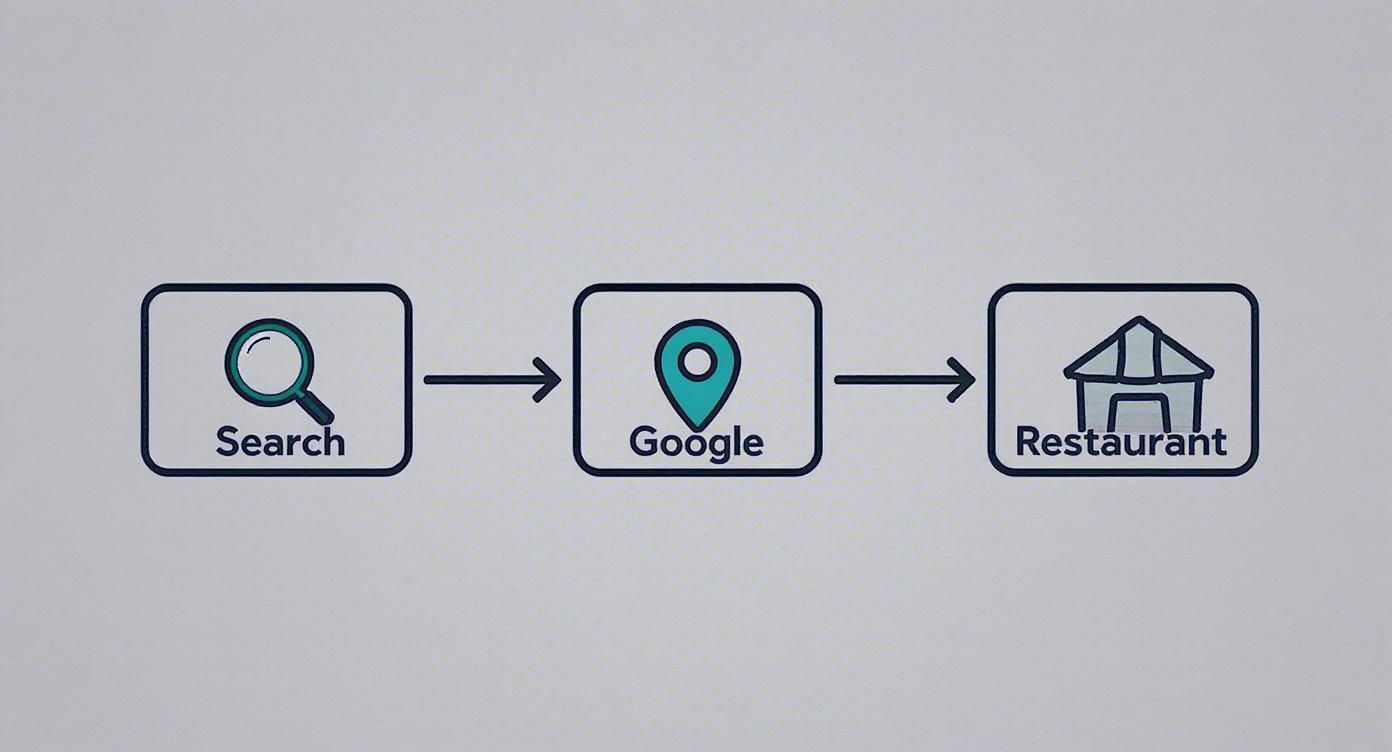
This visual path from a simple search to your front door shows just how critical accurate data is at every digital touchpoint. One wrong turn and that potential customer is gone.
Organize Your Findings
To keep your head on straight during this process, set up a simple tracking spreadsheet. This document is about to become your command center for citation management.
Create columns for:
- Directory/Website URL: Where did you find the citation?
- Status: Is it correct, incorrect, or a duplicate?
- NAP Details: List the exact NAP as it appears on that site.
- Notes: Add login details, the date you requested an update, or any other important info.
This methodical cleanup is what prevents you from building on a messy foundation—a classic mistake that sabotages so many local SEO campaigns. Don’t forget, accurate local citations are consistently one of the top 5 ranking factors for local SEO. They're how search engines verify your business is legit.
Remember, your Google Business Profile is the most important citation of all. It often serves as the primary source of truth for other directories. Ensuring it's perfect is your top priority before moving on to other platforms.
If you haven't fully optimized your Google listing, stop everything and start there. Check out our detailed guide on how to get a Google Business listing to make sure your most powerful asset is working for you. A complete and accurate audit gives you a clear action plan to clean up your digital footprint, ensuring every new citation you build reinforces your authority instead of creating more confusion.
Where to Build Citations for Maximum Impact
So, you’ve done the hard work of auditing and cleaning up your existing citations. Your foundation is solid. Now it’s time to start building, but this isn't about throwing spaghetti at the wall to see what sticks.
Simply blasting your business's information across hundreds of random, low-quality directories won't move the needle. A strategic, quality-over-quantity approach is what gets real results. Think of it like sourcing inventory for your showroom—you wouldn't buy from just anywhere. You prioritize suppliers who are reliable and reputable. The same exact logic applies here. We’re going to focus on placing your company’s info precisely where restaurant owners are already looking.
The Undisputed King: Google Business Profile
Let's be clear: Your Google Business Profile (GBP) isn't just another listing. It's the absolute cornerstone of your local marketing. For most potential B2B clients, your GBP is your digital front door, and optimizing it to the fullest is non-negotiable.
Don’t just fill out the basics and call it a day. Treat every single field as a marketing opportunity. Upload high-quality photos of your showroom, your key product lines, and your knowledgeable team. Write a compelling business description that naturally includes keywords people actually search for, like "commercial kitchen design services" or "used restaurant equipment dealer."
The demand for local information is staggering. There are over 1.5 billion searches containing "near me" terms every single month. A recent study found that 32% of people look up local businesses online multiple times a week. Even more telling, 76% of people who search on their smartphone for something nearby will visit a related business within 24 hours.
Core Data Aggregators and Top-Tier Directories
Once your GBP is dialed in, the next layer of your strategy involves the major data aggregators and the big-name directories. These are the heavy hitters that feed your business information to a huge network of smaller sites, apps, and mapping services.
- Data Aggregators: Services like Express Update and Neustar Localeze are the wholesalers of business data. Getting your NAP information correct with them creates a powerful ripple effect of consistency across the web.
- Top-Tier Directories: These are the household names that customers know and trust. A complete, accurate profile on these sites is essential. Think Yelp, Apple Maps, Bing Places, and Facebook.
Getting these right is crucial. An incorrect pin on Apple Maps can literally send a client driving in circles, frustrated, while a neglected Yelp profile can turn away business owners before they even consider your catalog.
Building citations is really about creating a web of trust. When authoritative platforms like Yelp and Apple Maps all point to your business with the same, accurate information, it sends a powerful signal to Google that your company is legitimate and trustworthy.
As you build out this layer, exploring various local directory listings can help you spot other platforms with high local authority you might have missed.
Hyperlocal and Niche Industry Directories
This is where the real magic happens for B2B suppliers. While the major directories are table stakes, niche and hyperlocal platforms are where you connect with your most motivated customers—the restaurant owners, chefs, and facilities managers who trust industry-specific recommendations.
Your presence on these sites does more than just list your NAP; it shows you’re a serious player in the foodservice and hospitality world.
Industry-Specific Platforms to Prioritize:
- Restaurant and Hospitality Association Directories: Membership often includes a valuable, trusted listing.
- B2B Supplier Platforms: Sites like Thomasnet or regional supplier portals can be very effective.
- Trade Show or Event Directories: If you exhibit at industry events, ensure your listing is perfect.
- Specialized Service Directories: If you offer HVAC or refrigeration repair, get listed on relevant contractor sites.
Hyperlocal Opportunities to Uncover:
- Local Chamber of Commerce: A listing here is a strong, trusted local signal.
- Business Journals and Local News Sites: A mention in an article about local business growth is a powerful "unstructured citation."
- Community Portals or Economic Development Websites: Being listed as a key local employer or supplier builds serious credibility.
Priority Citation Sources for Restaurant Equipment Suppliers
Not all citation sources are created equal. To help you focus your efforts where they'll have the biggest impact, we've broken them down into tiers. Start with Tier 1 and work your way down.
| Priority Tier | Platform Examples | Key Optimization Tip |
|---|---|---|
| Tier 1 | Google Business Profile, Apple Maps, Yelp | Must-Have. These are your digital storefronts. Fill out every single field, upload 20+ photos, and actively manage reviews. |
| Tier 2 | Bing Places, Facebook, Local Chamber of Commerce | High Impact. These platforms have massive user bases. Ensure product categories, hours, and service areas are always up-to-date. |
| Tier 3 | Industry Association Sites, B2B Directories, Trade Publications | Niche & Local. These build relevance and trust. A good mention here can be more valuable than dozens of generic listings for attracting qualified leads. |
This tiered approach ensures your efforts are focused and effective. You’re not just creating listings for the sake of it; you're strategically placing your business's digital fingerprint in all the right places, making it incredibly easy for new clients to find their way to your door.
Optimizing Your Citations for Modern Search

Getting your basic Name, Address, and Phone number (NAP) listed online is a solid first step, but let's be honest—it's just the starting line. The world of local search has evolved way past simple directory entries. If you want to grab the attention of today’s business owners and the smart algorithms that guide them, your citations have to do more than just exist. They need to be rich, descriptive, and compelling.
This means we need to shift our thinking. Instead of just stating what your business is, your citations need to communicate why a customer should choose you. It’s about enriching your online profiles with the kind of details that answer a potential client's questions before they even have to ask. Done right, each listing transforms from a static line of text into a powerful magnet for local customers.
Going Beyond the Basic NAP
The most effective citations feel less like an old-school phone book entry and more like a miniature, persuasive ad. They weave in rich data that gives immediate value to a restaurant owner who is actively deciding who to call for a quote, right now.
Think of this process as preparing a detailed sales sheet for your prospects before they even contact you. You're adding layers of helpful information directly into your profiles wherever you can.
Here are the key elements you need to add:
- Detailed Business Descriptions: Don't just say "Restaurant Equipment." Use descriptive, compelling language like, "A leading supplier of new and used commercial kitchen equipment in Denver, specializing in full kitchen design and installation services."
- High-Quality Photography: Your photos should do the selling. Show off your showroom, installations you've completed, your service vehicles, and your expert staff.
- Product & Service Categories: Be specific. List out categories like "Commercial Refrigeration," "Cooking Equipment," "Warewashing," and "HVAC Services" to attract targeted searches.
- Brands You Carry: Listing major brands like Hobart, True, or Vulcan can capture searches from customers looking for specific equipment.
This evolution is at the heart of modern local SEO. Building citations today is all about optimization, accuracy, and aligning your content with what B2B customers are actually looking for.
The Power of Unstructured Citations
While structured listings on sites like Yelp or industry directories are the foundation, some of your most powerful online mentions will come from less formal places. We call these unstructured citations, and they pop up as natural mentions on business blogs, local news sites, social media feeds, or community forums.
An unstructured citation might be a local business journal profiling your company's expansion or a news article mentioning you supplied the equipment for a popular new restaurant. These mentions carry incredible weight because they come across as genuine, third-party endorsements.
While a structured citation on a directory tells Google where you are, an unstructured citation on a respected local business blog tells Google why you matter. This kind of social proof is invaluable for building authority and trust.
To earn these valuable mentions, you can’t just sit back and wait. You need a proactive outreach strategy. Think about sponsoring a local culinary school event, partnering with food service consultants, or sending out a press release about a new exclusive product line. Every one of these activities creates an opportunity for a natural, authoritative mention of your business's name and location. You can track all these moving parts with our comprehensive local SEO checklist to make sure nothing slips through the cracks.
Integrating Citations into Your Broader SEO
At the end of the day, optimizing individual citations is a critical piece of a much larger puzzle. Each enriched listing and earned mention should work together, boosting your overall online visibility. This means making sure your citation strategy aligns perfectly with your on-site SEO, your content marketing, and what you’re doing on social media.
While getting each citation right is crucial for local search, always think about how it fits into your wider SEO plan for maximum impact. For more in-depth support, you can always explore options like those offered by comprehensive Search Engine Optimization services. When you stop treating local citations as an isolated chore and start seeing them as an integral part of your marketing, you create a powerful, unified online presence that consistently brings new clients through the door.
Keeping Your Citation Profile Clean and Consistent
Building your local citations is a huge step, but it's not a "set it and forget it" kind of deal. After all that hard work auditing, cleaning up, and building out your business's online footprint, the real job begins: protecting that investment. Your digital presence is always shifting, thanks to data aggregators, user suggestions, and even your own business changes. If you don't have a simple plan to stay on top of it, your perfectly clean profiles can get messy again, fast.
This isn't about adding another massive project to your plate. It's about putting a manageable, repeatable system in place that keeps your business's information accurate and trustworthy for the long haul.
Put a Simple Quarterly Check-Up in Place
The best way to protect your citation profile is with a regular check-up. A quarterly audit is just the right frequency—it lets you catch problems before they snowball, but it won't eat up all your time. This whole process is about spotting new errors, rogue duplicate listings, and any changes you didn’t authorize.
That tracking spreadsheet you made during the initial audit? It's about to become your best friend again. Instead of starting from scratch, you'll just use it as your guide.
Your quarterly check-in should focus on a few key tasks:
- Spot-Check the Big Players: Take a quick look at your listings on the most important sites, like your Google Business Profile, Yelp, and key industry directories.
- Run a Quick Automated Scan: Use a tool like BrightLocal or Moz Local to run a quick scan. This is a great way to catch new duplicates or inconsistencies that might have popped up from data aggregators behind the scenes.
- Look for New Mentions: Set up a Google Alert for your business's name. It's a free, easy way to get notified when new blogs or articles mention your business, giving you a chance to hop in and make sure they got your details right.
This proactive approach stops tiny data issues from turning into major SEO headaches. It makes sure the digital fingerprint you’ve worked so hard to create stays clear and consistent.
What to Do When Your Business Changes
At some point, your business is going to have a big change. Maybe you're moving to a fantastic new location, getting a new phone number, or rebranding. These are exciting times, but they can wreak havoc on your local SEO if you don't handle them carefully. The secret is to manage the transition step-by-step.
Think of it like moving houses. You wouldn't just tell the post office your new address; you'd have to update the DMV, your bank, your credit cards, and your insurance. The same idea applies here—you have to update your core digital profiles before you tell the rest of the internet.
Start with your Google Business Profile. For most platforms, it's the ultimate source of truth. Once you've updated your info there and it's been verified, then you can move on to the other top-tier directories and the major data aggregators. This creates a strong, authoritative signal that your change is legitimate, which helps the new information spread correctly across the web.
Dealing with User Edits and Wrong Information
One of the trickiest parts of citation maintenance comes from the public. Platforms like Yelp and Google Maps let anyone suggest an edit to a business listing. While people usually mean well, these suggestions can lead to incorrect hours, the wrong phone number, or an outdated service link on your profile.
Staying on top of this means you have to be actively watching. Make a habit of checking your key profiles for any pending "user suggestions" or notifications about changes. If you spot an incorrect edit, reject it right away and provide the correct info. The faster you act, the less likely it is that the wrong data gets approved by the platform or scraped by another website. This vigilance is what ensures potential clients find the right information, guiding them to your door instead of a competitor's.
Common Citation Problems and Their Solutions
Even when you're careful, things can go wrong. Here’s a quick troubleshooting guide for the most common issues that can trip up a supplier's local search rankings and how to fix them.
| Problem | Impact on SEO | Actionable Solution |
|---|---|---|
| Duplicate Listings | Confuses search engines, splitting your authority and reviews between two profiles. This really waters down your ranking power. | Hunt down the duplicate, claim it if you can, and then use the platform's tools to either merge it with your main listing or request its removal. |
| Incorrect User Edits | Gives potential customers the wrong information, which leads to frustration, negative reviews, and lost business opportunities. | Actively monitor your key profiles. Reject bad suggestions immediately and report any persistent issues to the platform's support team. |
| Inconsistent NAP Data | Erodes trust with search engines. If they can't confirm your basic info, they'll be less likely to show you in local search results. | Use your master spreadsheet to find the incorrect listing. Log in and manually update the information so it perfectly matches your official NAP. |
Keeping a close eye on these common slip-ups will help you maintain a strong, trustworthy online presence that consistently brings new customers to your business.
Your Questions on Local Citations Answered
Running a busy equipment supply business leaves little time for navigating the often-confusing world of local SEO. It’s easy to get tangled up in the terminology and wonder where to put your energy for the best results. We’ve been there.
Below, we’ve answered some of the most common questions we hear from business owners and marketers in the restaurant supply industry. These are straightforward, practical answers to help you move forward with confidence.
How Long Does It Take to See Results?
This is always the first question, and the honest answer is: it depends. Building local citations isn't an overnight fix, but you can typically start seeing a positive shift in your local search rankings within two to four months.
What makes it faster or slower? A few things. If your online presence is a mess of wrong phone numbers and duplicate listings, the initial cleanup can take a while to register with search engines. On the other hand, if you're building fresh, high-quality listings from scratch, the impact can show up quicker. The authority of the directories you get listed on and just how competitive your local market is also play a huge role.
One quick tip from the trenches: Fixing major errors or just completing an unfinished Google Business Profile often brings the fastest wins. Since Google is the biggest player, improvements there can sometimes show a noticeable lift in just a few weeks. The real key is consistent, steady effort.
Should I Use an Automated Service or Build Citations Manually?
There's a strong case for both, and honestly, the best approach is usually a mix of the two.
Automated services like Yext or BrightLocal are incredibly efficient. They can blast your business's info across dozens of directories in a flash, saving you a massive amount of time. But that convenience comes with recurring subscription fees, and here’s the big catch: some of your listings might revert or even disappear if you ever cancel the service.
Manual building is the slow-and-steady route, but it gives you total control. You own those listings forever. Plus, you can add the rich, descriptive details and product categories that automated services sometimes miss—and for B2B suppliers, those details matter. This is especially true for niche industry directories where a personal touch makes all the difference.
Here’s a smart strategy we’ve seen work time and again:
- Use an automated service for the heavy lifting—getting your info out to the major data aggregators and top-tier directories.
- Manually build and perfect your listings on the platforms that are absolutely critical for your industry. Think industry association sites, B2B portals, and any hyperlocal business journals.
This gives you the best of both worlds: speed and deep, meaningful optimization where it counts most.
What Is the Difference Between a Citation and a Backlink?
This one trips a lot of people up, but the distinction is pretty important for understanding how local SEO works.
A local citation is simply any online mention of your business's Name, Address, and Phone number (NAP). Its main job is to act as a verification signal for search engines, proving that your business is a real, legitimate entity at a physical location. Think of it as your business's digital fingerprint.
A backlink, on the other hand, is a clickable link from another website to yours. Its purpose is to pass "authority" or "link equity." When a reputable website links to you, it’s basically vouching for your business, telling search engines that your website is a valuable resource.
A citation can include a backlink—your Yelp profile page, for instance, links back to your company’s website. But even a plain mention of your NAP without a link still counts as a citation. Their core jobs are different: citations verify your location, while backlinks build your website's authority.
How Should I Handle Citations for Multiple Locations?
If your supply company has more than one location or showroom, treating each one as its own separate entity is absolutely critical. Lumping them together is a recipe for confusing both your customers and the search engines, which can torpedo the rankings for all your locations.
For every single branch, you need to create its own unique set of citations.
- Create a separate Google Business Profile for each distinct address. This is non-negotiable.
- Use the specific physical address and a unique local phone number for that location on every single directory listing you create for it.
- Build dedicated landing pages on your website for each location (e.g.,
yoursite.com/denverandyoursite.com/boulder). - Make sure the citations for each location link back to their own specific landing page, not just your homepage.
This clear separation leaves no room for error. It ensures that when a restaurant owner searches for "commercial ice machine repair near me," the right branch shows up on their map.
At Charbroilers.com, we know getting customers in the door starts with being found online. Just as the right charbroiler perfects a restaurant's signature dishes, a solid local citation strategy ensures they can find you, their trusted equipment supplier. Explore our selection of commercial charbroilers to elevate your catalog and help your clients stand out. Find your perfect equipment at https://charbroilers.com.