

A Practical Guide to Local Citation Building for Restaurant Equipment Suppliers
So, what exactly is a local citation? In the simplest terms, it’s any place online your business's Name, Address, and Phone number (NAP) gets mentioned.
Think of each citation as a digital breadcrumb. These breadcrumbs lead search engines back to your business, confirming you are who you say you are and that your restaurant equipment supply company is a legitimate, physical operation. When these details are consistent and accurate across the web, they build a tremendous amount of trust with search engines, which is a huge factor in boosting your local search rankings. As a company that provides SEO, local citation services, and article writing for restaurant equipment supply websites, we've seen firsthand how crucial this is.
Why Citations Are a Cornerstone of Local SEO
Let's put this into a real-world context. A local chef is desperately searching for a new commercial charbroiler. They pull out their phone and search "restaurant equipment supply near me." Google immediately shows them the local map pack with a few top businesses.
Those businesses didn't just get lucky. They've put in the work to show Google they're prominent and trustworthy local players, and a massive part of that is having a strong citation profile. Every time a reputable directory or website lists your correct NAP, it’s like casting a vote of confidence for your business.
The Power of NAP Consistency
Search engines are like digital detectives, constantly cross-referencing information across the internet to verify business details. If your NAP is identical across dozens of quality platforms, you're creating a crystal-clear digital footprint. This consistency hammers home your legitimacy, making it a no-brainer for Google to rank you for relevant local searches.
For example, a restaurant equipment supplier in Chicago with perfectly consistent listings on Yelp, Bing Places, and industry-specific directories is going to look far more credible to Google than a competitor whose information is a mess of old addresses and incorrect phone numbers online. Understanding the fundamentals of https://restaurantequipmentseo.com/blogs/restaurant-equipment-seo-blog/what-is-local-seo really puts into perspective why this consistency is such a big deal.
This isn't just theory—it has a real, measurable impact. We’ve seen that businesses maintaining complete and consistent citations can see their local search visibility jump by up to 25%. That's because NAP consistency is one of the most significant ranking factors Google's local algorithm looks at.
Beyond Just a Listing
Building citations isn't just a numbers game of getting your name out there. It’s about being strategically placed on platforms where your potential customers are actually looking.
- It Builds Authority: Getting listed on well-regarded sites signals that your business is a stable, established part of the local scene.
- It Drives Referral Traffic: A potential customer might find you on a local directory, click through to your website, and become a direct lead. No search engine required.
- It Improves the Customer Experience: Accurate information is non-negotiable. It stops customers from getting frustrated by calling a disconnected number or driving to an old showroom.
At the heart of any effective local SEO strategy, and closely tied to local citation efforts, is thorough Google Business Profile optimization. Your GBP is often the first and most important citation customers will see.
How to Conduct a Thorough Citation Audit

Before you even think about building new local citations, you have to get a clear picture of what’s already out there. Jumping straight into a campaign without this crucial first step is like building a house on a shaky foundation. An audit is your chance to see what's right, what's wrong, and what’s missing entirely.
The whole point is to track down every single online mention of your restaurant equipment supply business. You’re looking for those pesky inconsistencies—an old address, a wrong phone number, or duplicate listings—that are actively confusing search engines and frustrating potential customers. Our local citation services always begin with this critical audit phase.
Starting Your Search Manually
The easiest place to start is to put yourself in your customers' shoes. Open up a search engine and start looking for your own business using a few different search strings. It’s a simple, manual check that gives you a raw, unfiltered view of your digital footprint.
Give these search variations a try, swapping in your actual business info:
- "Your Business Name" + "Your City"
- "Your Business Name" + "Your Phone Number"
- "Your Business Name" + "Old Street Address" (definitely do this if you've moved)
- "Your Phone Number" -site:yourwebsite.com (this little trick excludes your own site from the results)
As you find listings, keep track of everything in a simple spreadsheet. I recommend columns for the website where you found the citation, the NAP info it displays, and a note on whether it's correct or not. This process is a lot like a technical SEO review; if you want to go deeper on that, check out our guide on how to perform a website audit.
Using Tools for Deeper Insights
While a manual search is a great starting point, automated tools can dig up citations you'd never find on your own and save you a ton of time. Platforms like BrightLocal or Moz Local are built specifically for this, scanning hundreds of directories for any mention of your business.
These tools generate a report that quickly highlights the most critical issues needing your attention. They are especially good at catching:
- NAP Inconsistencies: They’ll flag any listing where your name, address, or phone number doesn’t perfectly match your official record.
- Duplicate Listings: They sniff out multiple profiles for your business on the same directory, which can split your SEO value and confuse Google.
- Missing Information: You’ll get a clear view of the core directories where your business isn’t listed at all.
This organized report becomes your to-do list for the cleanup phase. With a clear list of errors, you can work your way through each one to claim, correct, or remove it. This whole audit is about taking back control of your online identity, which is more important than ever.
Consider this: local searches on smartphones have shot up by 900% in recent years, and 60% of those people use click-to-call options right from the search results. You can read more about these mobile search statistics and see why a clean, consistent presence is non-negotiable.
Identifying the Citation Sources That Matter
Let's be clear: not all citations are created equal. In the world of local SEO, quality trumps quantity every single time. You could blast your restaurant equipment business information across hundreds of random, low-quality directories, but it would be a complete waste of time and money. The real wins—the ones that actually move the needle—come from getting strategic placements on platforms that both search engines and your potential customers already know and trust.
Think of it like building a solid business portfolio. You need a mix of different assets to be successful. This means securing foundational listings, getting into industry-specific directories, and tapping into hyperlocal opportunities. Each tier plays a specific role, from simply verifying your business exists to directly connecting you with chefs and restaurant managers in your area.
The first, most critical step is to get the foundational platforms right. Before you do anything else, you need to focus on optimizing your Google Business Profile for maximum local impact. Alongside Google, getting listed on platforms like Bing Places and Apple Maps is non-negotiable. These are the primary sources search engines look at to confirm your core business details.
Prioritizing Your Citation Sources
Once you've locked down those foundational profiles, the next layer is all about directories specific to your niche. For a restaurant equipment supplier, this means getting listed where your actual customers—chefs, restaurateurs, and food service managers—are actively looking. We're talking about trade association websites, B2B supplier directories, and online forums for the hospitality industry.
These industry-specific sites are goldmines because they send powerful relevance signals to Google. A listing on a respected foodservice directory acts as a strong endorsement, telling search engines you're a legitimate player in that market. That kind of targeted relevance carries far more weight than a generic listing on some obscure, catch-all directory.
To really nail your priorities, you need to think about two main types of citations. Structured citations are your classic, organized listings in directories. But unstructured citations, which are mentions in blog posts, articles, or on social media, are just as important for a well-rounded local SEO profile. This is where blogger outreach and professional article writing can make a significant impact.
Structured vs Unstructured Citations
Getting a handle on the different types of citations is key to building a complete strategy. In 2025, a solid citation plan has to include both.
- Structured citations are what most people think of: clearly formatted business listings with consistent NAP data (Name, Address, Phone Number). You'll find these on major platforms like Google Business Profile, Yelp, BBB, and industry-specific sites like TripAdvisor.
- Unstructured citations are a bit different. These are more organic mentions of your business that might pop up on blogs, in news articles, on social media, or on event pages.
To help you map out where to focus your energy, I've broken down citation sources into different tiers. This should give you a clear roadmap for prioritizing your efforts.
Citation Source Tiers for Maximum Impact
This table breaks down the different types of citation sources to help you prioritize where to spend your time and resources for the best results.
| Citation Tier | Description | Examples for Restaurant Equipment Supplier | Priority Level |
|---|---|---|---|
| Tier 1: Foundational | These are the absolute must-haves. They are the primary data aggregators and major search platforms that verify your business's existence and core details. | Google Business Profile, Apple Maps, Bing Places, Foursquare, Data Axle, Neustar Localeze | Highest |
| Tier 2: Industry-Specific | Niche directories and websites that signal relevance within your specific market. A listing here tells Google you're a specialist. | Foodservice Equipment & Supplies (FE&S) Directory, The NAFEM Show Exhibitor List, Restaurant-focused B2B portals | High |
| Tier 3: Hyperlocal | Sources that anchor your business to its physical community. These build local trust and authority. | Local Chamber of Commerce, neighborhood business association websites, community event sponsorships | Medium |
| Tier 4: General | Broad, national directories that are good to be on but offer less targeted value than the other tiers. | Yelp, Yellow Pages, BBB | Low |
By tackling your citation building in this tiered order, you ensure you're building a strong foundation first before moving on to more specialized and local opportunities.
Finally, don't ever sleep on the hyperlocal opportunities. These are the sources that truly ground your business in its local community and can make a huge difference.
- Local Chamber of Commerce: Joining and getting listed is a powerful, trusted signal of local legitimacy.
- Neighborhood Blogs: A feature or even just a mention in a local food or business blog can drive incredibly targeted traffic.
- Community Sponsorships: Sponsoring a local food festival or a charity cook-off can result in valuable mentions and links on event pages and press releases.
When you categorize and prioritize your efforts this way, you make sure every minute you spend on local citation building is actually working to improve your visibility and, most importantly, attract the right kind of customers.
A Step-by-Step Manual Submission Workflow
Once your audit is done and you know which directories to target, it’s time to roll up your sleeves. This is where the manual work of local citation building begins, and where being incredibly meticulous really pays off. A methodical approach is your best defense against errors and makes the whole process feel less like a chore.
The very first thing to do is create a master document. Think of this as your single source of truth—a file containing every single piece of information you'll need for submissions. Having everything in one place guarantees perfect consistency every single time you create a new listing.
Preparing Your Master Information Sheet
Your master sheet will be your best friend during this process. It completely eliminates the need to hunt down information for every submission and dramatically cuts down on the risk of typos.
Make sure it includes these key details:
- Official Business Name: This needs to be the exact name on your legal documents and, most importantly, your Google Business Profile.
- Full Address: Use the standardized version, like "Street" instead of "St.", and stick with it everywhere.
- Primary Phone Number: The main contact number you want customers to use.
- Website URL: Your complete homepage URL.
- Business Description: A well-written, keyword-rich paragraph (aim for around 250 words) that clearly explains what you sell. Our professional copyrighting services can help craft the perfect description.
- Categories: Your list of primary and secondary business categories, such as "Restaurant Supply Store" or "Commercial Kitchen Equipment Supplier."
- High-Quality Photos: Direct links to your logo, storefront shots, and key product images.
Having this document ready means you can just copy and paste information directly into submission forms. This simple step is the number one defense against the NAP inconsistencies that can tank your local SEO rankings.
The infographic below shows the hierarchy of citation sources. It's a great way to visualize where to focus your manual efforts, starting with the big foundational platforms and moving toward more niche directories.
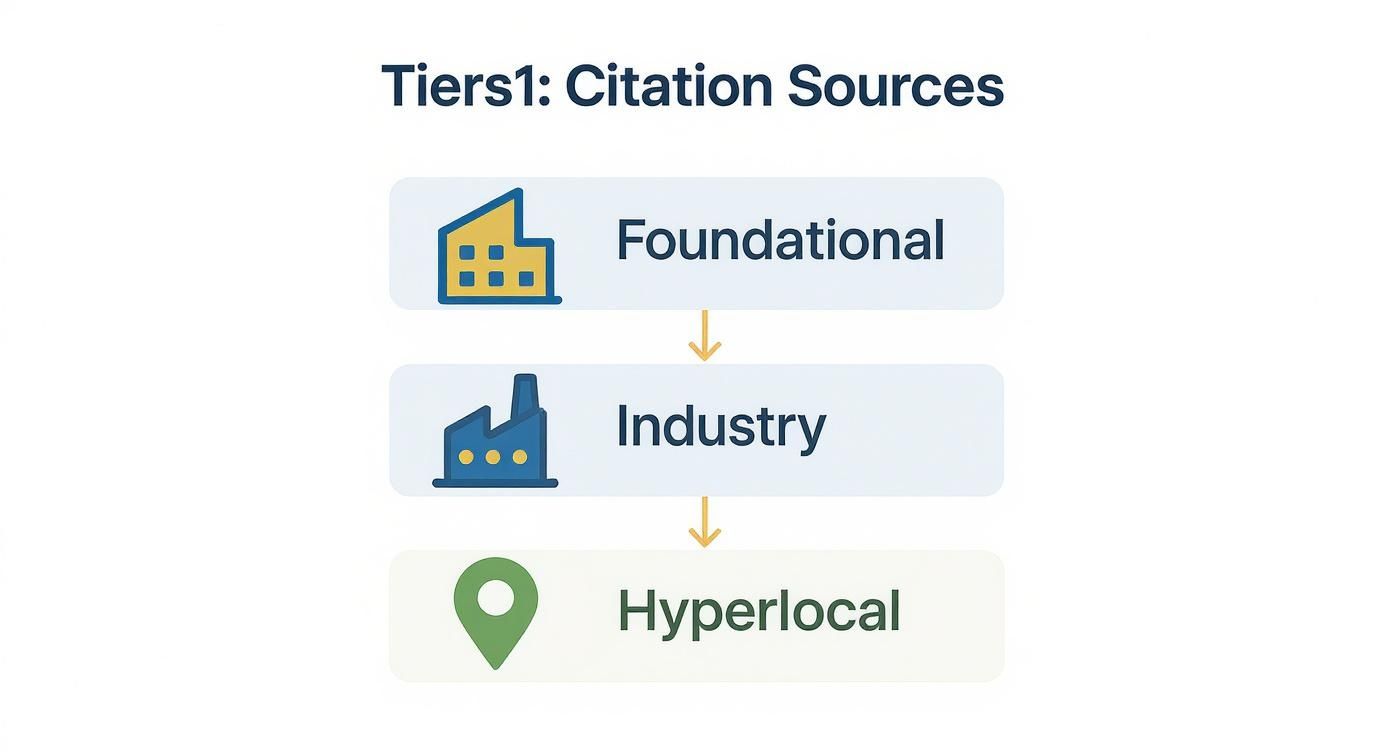
This visual really drives home the strategy: build a strong base with foundational citations first, then layer on the more specialized industry and local sources to get the biggest impact.
Executing and Tracking Submissions
With your master sheet in hand, the submission process becomes a simple, systematic task. Just work your way down the priority list you made earlier, starting with the most valuable directories. As you finish each one, it's absolutely crucial to track your progress right there in your audit spreadsheet.
Add a few new columns to your sheet for "Submission Date," "Status" (like Submitted, Pending, or Live), and "Live URL." This turns your audit sheet into a living document that tracks the entire lifecycle of your local citation campaign. Of course, getting your main Google listing correct is the most important first step. Our guide on adding your business to Google gives you a complete walkthrough for that.
Just be aware that some directories will want to verify your submission, often with a phone call or a postcard in the mail. Be ready for this and act on it quickly to get your listing approved. A meticulous workflow like this ensures every single citation is accurate, tracked, and working to boost your local search visibility.
Using Tools to Streamline Citation Management
While going through the citation building process by hand gives you total control, it can get out of hand—fast.
If you’re a restaurant equipment supply business with one location, it’s probably doable. But what happens when you have multiple showrooms? Or what if you just don’t have the hours in the day to dedicate to manual submissions?
This is where citation management tools and services really shine. They're built to help you work smarter by automating the most grueling parts of the process, making sure your business info is consistent everywhere without the manual grind. These tools aren't just for building new citations, either; they’re a lifeline for ongoing management, fixing bad data, and keeping an eye on your online footprint.
Data Aggregators: The Foundation of Citation Distribution
Think of data aggregators as the wholesalers of the business data world. These are massive companies that gather, check, and send out business information to hundreds of other online directories, search engines, and apps. In the U.S., the big names you'll hear are Data Axle, Foursquare, and Neustar Localeze.
Submitting your information directly to these aggregators is a super-efficient way to cast a wide net. Instead of painstakingly creating profiles on dozens of smaller sites, you just give your NAP data to a few key players, and they push it out across their huge networks.
- Pros: This gets you broad distribution and can land your business on platforms that don't even allow you to submit manually. It's a foundational step that ensures your core data is widely available.
- Cons: The whole process can be slow, sometimes taking months for listings to finally show up. You also don't get much direct say over how each individual listing looks in the end.
For any multi-location business, using data aggregators is simply non-negotiable. It's the only practical way to establish a baseline of consistent data across a staggering number of platforms—something that would be nearly impossible to pull off manually.
Semi-Automated Submission Services
Another popular route is to use a paid submission service like BrightLocal or Moz Local. These platforms are a nice middle ground between a completely manual approach and relying only on aggregators. They plug directly into a hand-picked list of high-quality directories and let you manage everything from one dashboard.
These services will scan for all your existing citations, pinpoint any inconsistencies, and help you push out the correct information. So, when your restaurant supply business moves or gets a new phone number, you just update it once in the dashboard. The service then gets to work updating that info across its whole network of partner sites.
This is a seriously powerful way to manage those critical Tier 1 and Tier 2 directories we talked about earlier. You can quickly fix incorrect listings, zap duplicates, and make sure your profiles are fleshed out with photos and accurate business descriptions.
The real win here is the mix of automation and control. You get the efficiency of sending data to many places at once but still keep the ability to monitor and fine-tune those key profiles directly. These services also tend to offer detailed reports, so you can track your progress and see exactly where your business is listed correctly and where problems still need to be fixed, saving you countless hours of manual auditing.
Of course, even with a solid game plan, you're bound to run into a few specific questions when you get into the nitty-gritty of local citation building. Getting those questions answered is what separates a smooth, effective strategy from one that's full of frustrating little snags.
Let's dig into some of the most common ones we hear from business owners.
How Long Until New Citations Affect SEO?
This is usually the first thing people ask, and the honest answer is: it’s not an overnight fix. You can expect to see the needle start moving anywhere from a few weeks to several months after you begin.
Think of it like building a good reputation in a new town. It doesn't happen the day you move in. It builds up over time as people get to know you. Search engines work the same way; they need time to crawl, index, and start trusting all the new information you're putting out there.
The big, foundational directories—think Google Business Profile and Apple Maps—tend to get picked up pretty quickly, sometimes within a few weeks. But those smaller, industry-specific sites might take a bit longer for search engine bots to find and process.
What really matters here is consistency. The more high-quality, perfectly matched citations you build, the louder and clearer the signal you send to Google. That steady, ongoing effort is what eventually nudges your local rankings and visibility upward.
One of the biggest points of confusion for people is the difference between a citation and a backlink. They’re related, sure, but they do very different jobs for your SEO.
A citation is just an online mention of your business’s Name, Address, and Phone number (NAP). It doesn't even have to be a clickable link. Its main job is to prove to local search algorithms that your business is a real, legitimate entity at a specific physical location.
A backlink, on the other hand, is a clickable hyperlink that sends a user from one website to yours. Backlinks are a huge ranking factor in traditional SEO because they act like votes of confidence, signaling that other sites trust your content. While some citations do include a backlink, many don't—and they're still incredibly valuable for local SEO.
What to Do After a Business Move?
If your restaurant equipment supply business has packed up and moved to a new location, your first order of business is non-negotiable: update your Google Business Profile with the new address. That’s your single most important citation. Done? Good. Now, immediately update the contact page on your own website and any other online profiles you control directly.
Next, pull out that citation audit spreadsheet you made. This is now your to-do list for updating all your existing listings. Start with the heavy hitters—your Tier 1 directories—and methodically work your way down the list. This ensures the most important listings are fixed first, which helps avoid confusing customers and sending messy signals to Google.
Finally, a lot of business owners get caught up thinking they need to be listed on every directory under the sun. Let me be clear: you absolutely do not. Chasing a huge number of listings is a classic case of quantity over quality, and it’s a strategy that just doesn't work well.
Instead, put your energy where it counts:
- Foundational Directories: The must-haves. This means Google, Bing, Apple Maps, and the other major data aggregators.
- Industry-Specific Sites: Get listed on directories that cater specifically to the restaurant and foodservice industry.
- Hyperlocal Sources: Think about your local chamber of commerce or community business portals. These are gold.
Remember, a single, powerful citation on a website that’s highly relevant to what you do is worth way more than a hundred listings on spammy, low-quality directories.
At Charbroilers.com, we understand that getting found online is just as important as having the right equipment. For restaurant owners looking to perfect their menu with delicious, char-grilled flavor, explore our selection of commercial charbroilers at https://charbroilers.com.