
A Modern Guide to Local Business SEO for Restaurant Equipment Suppliers
For a restaurant equipment supplier, local SEO isn't just another line item in the marketing budget—it's your direct line to local chefs and restaurant managers who are looking for exactly what you offer, right now. This is all about making sure that when local customers search online, your business is the first one they see. It’s about driving immediate, high-value traffic to your showroom or to your phone.
Why Local SEO Is Your Most Powerful Ingredient
Ignoring local search is like running a supply warehouse with no sign out front. You might have the biggest equipment inventory in town, but if nobody knows you exist, your warehouse will stay full. Local SEO gets you in front of the people who matter most: those in your immediate area who are ready to buy.
Let's walk through a real-world scenario. A head chef's charbroiler goes down in the middle of a Friday night dinner rush. They don't have time to browse catalogs; they need a fix, and they need it now. The first thing they do is grab a phone and search "commercial charbroiler supplier near me." The businesses that pop up in Google Maps and the local search results are the ones getting that desperate, high-value call. This isn't just a theory; it's how business gets done today.
The Core Concepts of Local Search
To really win at local SEO, you have to understand what Google cares about when it shows local results. It really boils down to three big ideas:
- Proximity: This one's simple—how close is your business to the person searching? Google uses location data to serve up the most convenient options first.
- Relevance: How well does your online presence actually match what the person is looking for? If someone searches "restaurant equipment supply," Google scans for businesses that have that exact category, those keywords, and content to back it up.
- Prominence: This is basically your online reputation. Google gauges how well-known your business is by looking at things like online reviews, local citations (mentions of your business across the web), and links from other local websites.
The data backs this up, too. By 2026, a massive 46% of all Google searches will have local intent. That means nearly half of the billions of searches happening every day are from people looking for nearby businesses. For equipment suppliers and the restaurants they serve, that's a huge opportunity you can't afford to miss.
The real goal of local SEO is to become the obvious, top-of-mind answer when a potential customer in your city has a problem you can solve—whether that's finding a new oven range or a reliable floor model charbroiler.
Getting these elements right ensures you aren't just on the map; you're the destination. When you focus on these principles, you turn your online presence into a magnet for foot traffic and sales calls, which is exactly why understanding the many benefits of local SEO is so critical for growth.
Optimizing Your Google Business Profile for Success
Think of your Google Business Profile (GBP) as your digital storefront. For many potential customers, it's the very first time they'll interact with your brand—long before they ever click through to your website or walk through your showroom door. Just having a profile isn't enough. You have to actively manage it to turn it into a tool that brings in customers.
This isn't just about putting up your address and hours. A well-optimized GBP is an interactive hub right inside Google's search results and Maps. It answers questions, shows off what you sell, and builds trust on the spot. For a restaurant equipment supplier, this free listing is probably the most important part of your local business seo playbook.
Choosing the Right Business Categories
This is the first and most critical step. Your primary category tells Google exactly what you do, and it's a huge factor in the searches you show up for. So many businesses get this wrong by picking something way too broad.
A perfect example: a business selling commercial kitchen gear must choose ‘Restaurant Equipment Supplier’ as its primary category. Picking something generic like 'Store' or 'Appliance Store' is a huge mistake. That little detail is what separates you from the noise, making sure you attract high-intent searches from chefs and restaurant managers, not homeowners looking for a new fridge.
Once your primary category is locked in, you can add secondary categories to fill in the gaps. That same supplier could add:
- Commercial Refrigeration Supplier
- Cooking Equipment Wholesaler
- Bar Equipment Supplier
This paints a much clearer picture for Google. It helps you show up for a wider range of relevant local searches without muddying the waters of what you do best.
Crafting a Compelling and Keyword-Rich Description
You get 750 characters for your business description—make them count. This is your elevator pitch. It’s your chance to tell your story and weave in the keywords your customers are actually searching for. Don't just list what you do; tell people why they should choose you.
Instead of a boring, generic line like "We sell restaurant equipment," try something with a bit more flavor:
"As [Your City]'s leading restaurant equipment supplier, we provide top-tier commercial kitchen equipment for chefs and restaurateurs. From high-performance floor model charbroilers to energy-efficient refrigeration, we offer expert advice and reliable service to help your kitchen succeed."
See the difference? This version packs in keywords like ‘commercial kitchen equipment’ and ‘floor model charbroilers’ but also sells your value. If you're just getting your feet wet, we have a detailed guide on how to set up and get a Google Business listing.
Showcasing Your Business with High-Quality Photos
Photos are what bring your business to life online. They have a massive impact on whether someone decides to engage with you. In fact, profiles with photos get 42% more requests for driving directions and 35% more clicks to their websites. You need a steady stream of high-resolution images that tell a story.
Post shots of your showroom, close-ups of specific products like charbroilers or mixers, your warehouse, and your team helping customers. Keep adding new photos. This signals to Google that you're an active business, and it gives customers a fresh look at what you’re all about.
A well-curated photo gallery does more than just show what you sell; it builds an emotional connection and helps a potential customer visualize their experience with your brand before they even contact you.
Leveraging Advanced GBP Features
If you really want to stand out, you need to go beyond the basics and use the interactive features Google gives you. These tools can transform your static profile into a dynamic channel for marketing.
Google Posts: Think of these as mini-ads right on your profile. Share promotions, announce new equipment arrivals, highlight a specific brand, or talk about an upcoming trade show. Posts show up directly in search results and are a fantastic way to grab attention. They only last for seven days, so you have to be consistent.
Products Feature: For equipment suppliers, the 'Products' tab is your digital catalog. You can add great photos, detailed descriptions, and even pricing for items like ‘countertop charbroilers’ or ‘commercial ice machines’. This is a must-use feature.
Q&A Section: This feature lets anyone ask a question about your business, and anyone can answer it. Don't wait for others to ask. Get in there and seed it with your own FAQs. Answer common questions like "Do you offer financing on equipment?" or "Do you provide installation services?" This solves problems for customers before they even have to ask and shows you know your stuff.
Making Your Website a Local SEO Powerhouse
Your Google Business Profile is the digital handshake, but your website is where the real conversation happens. This is your home turf—the one place online where you control the entire narrative from top to bottom. A rock-solid on-page SEO strategy ensures that when a potential customer clicks through from the map pack, they land on a page that instantly confirms they’ve made the right choice.
Think of it this way: your GBP gets them to your digital front door, but your website's on-page SEO is what convinces them to walk inside and browse your inventory. This all comes down to using the right language, structuring your pages logically, and sending crystal-clear signals to search engines.
It's a simple flow: get the Profile right, fill it with great Content, and then Engage with your audience.
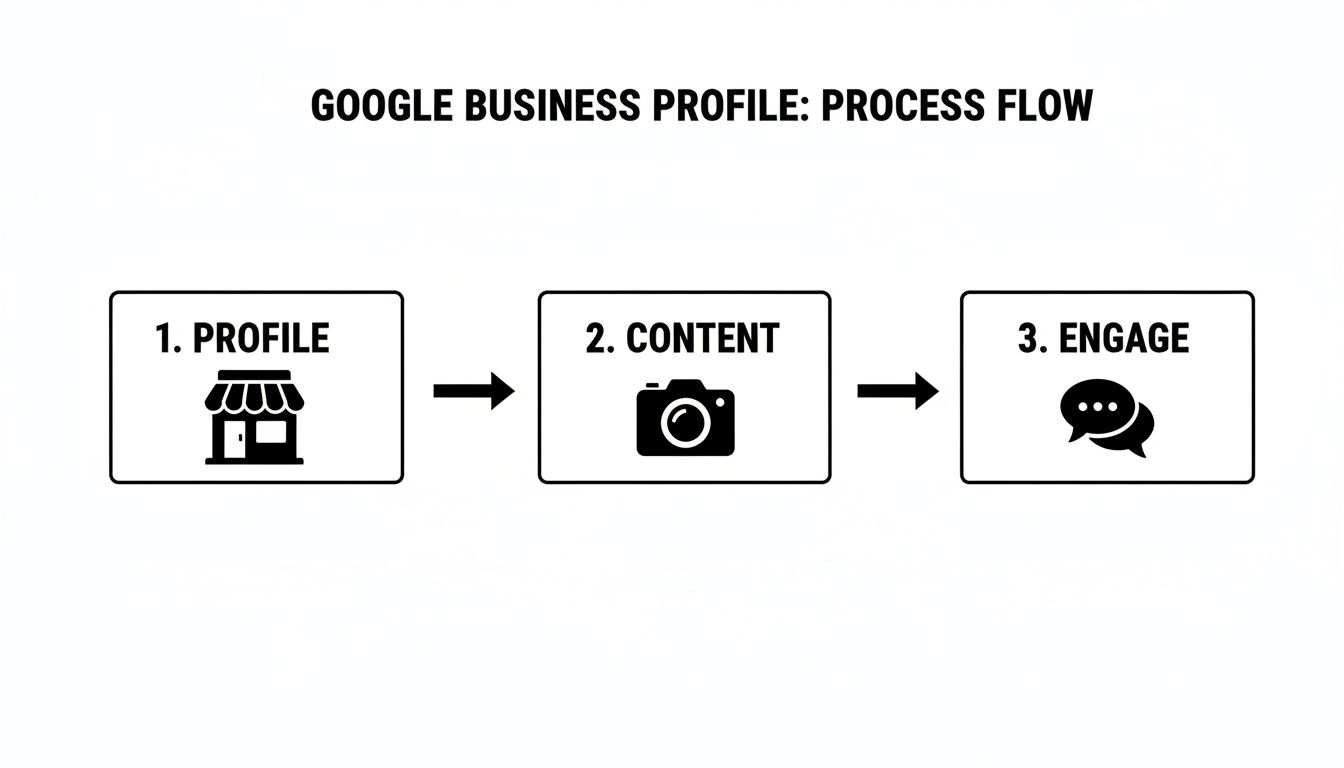 These three pieces—your digital storefront (Profile), what you show people (Content), and how you interact (Engage)—are all connected. Get them working together, and you're on the path to local success.
Finding the Keywords Real Customers Use
Great on-page SEO starts with getting inside your customers' heads and knowing the exact phrases they’re typing into Google. You’re not just selling equipment; you're solving an immediate, location-specific problem.
For a restaurant equipment supplier, the intent is different from a typical consumer, but it’s just as local. A chef with a broken-down charbroiler isn't searching globally—they need a solution, and they need it now.
- "Chicago restaurant supply store"
- "commercial charbroiler repair Miami"
- "walk-in cooler installation near Phoenix"
- "used kitchen equipment [city name]"
- "commercial oven supplier near me"
Once you have a solid list of these terms, the next step is to weave them naturally into the fabric of your website.
Weaving Keywords into Your Website
You need to place your chosen keywords where they’ll be seen by both people and search engine bots. This isn’t about stuffing keywords into every sentence. It’s about strategic, natural placement that provides valuable context.
This checklist breaks down the most critical on-page elements you need to tackle. Following these steps will give Google (and your customers) a much clearer picture of who you are, where you are, and what you offer.
On-Page Local SEO Checklist
| Element | Optimization Action | Example for a Supplier |
|---|---|---|
| Title Tag | Include your primary keyword and city. Keep it under 60 characters. | "Restaurant Equipment Supply in Chicago, IL | KitchenPros" |
| Meta Description | Write a compelling summary that includes your keyword and a call to action. Keep it under 160 characters. | "Your top Chicago restaurant supply store. We offer commercial charbroilers, refrigeration & more. Expert advice for your kitchen. Visit our showroom!" |
| H1 Heading | Use your primary keyword in the main heading of the page. | "Chicago's Premier Restaurant Equipment Supplier" |
| Body Content | Naturally mention keywords and related terms (e.g., "commercial kitchen," "cooking equipment," "Chicago restaurants") throughout the text. | "Our showroom features top-of-the-line cooking equipment from leading brands, perfect for any commercial kitchen in the Chicago area..." |
| Image Alt Text | Describe your images using keywords. | "Showroom floor at our Chicago restaurant supply store with commercial ovens" |
| Internal Links | Link from your homepage or blog posts to your product or location pages using relevant anchor text. | "...learn more about our commercial refrigeration units." |
| NAP Info | Ensure your Name, Address, and Phone number are clearly visible on the page (usually in the footer or on a contact page). | "KitchenPros | 123 Kinzie St, Chicago, IL 60654 | (312) 555-1234" |
By systematically checking these boxes, you're building a foundation that makes it much easier for local customers to find you online.
Build Powerful Location-Specific Pages
If you operate in more than one city or serve a wide geographic area, creating dedicated landing pages for each location is a non-negotiable. And I don't mean just copying your homepage and swapping out the city name. Each page has to be unique.
For instance, a location page for a restaurant supply company with a showroom in Houston should feature:
- The unique address, phone number, and hours for the Houston store.
- An embedded Google Map pointing directly to that storefront.
- Testimonials from Houston-area chefs you've worked with.
- Content specific to the Houston market, maybe mentioning popular local food trends or major culinary events you've supplied.
These pages send a powerful signal to Google that you have a real, physical stake in that community, making you a far more relevant result for anyone searching there.
Add Local Business Schema Markup
Finally, let’s talk about a slightly more technical but incredibly powerful tool: local business schema markup. This is essentially a snippet of code you add to your website that speaks directly to search engines in their native language.
It explicitly labels critical information about your business, like:
- Your business name, address, and phone number (NAP)
- Your hours of operation
- The types of products you sell
- Your price range and accepted payment types
Adding this "structured data" removes any guesswork for Google. It helps the search engine understand and display your information with confidence, often rewarding you with rich snippets in the search results. Think of it as spoon-feeding Google the exact data it needs to feature you prominently.
Building Trust with Citations and Online Reviews
While your Google Business Profile and website are your digital home base, your reputation spreads far wider. You don't control all of it directly. Two of the heaviest hitters for building local authority are citations and online reviews.
Think of them as third-party endorsements. They signal to both Google and potential customers that you're a legitimate, active, and respected business in the local scene. It's the digital equivalent of word-of-mouth, and mastering it is a core part of any real local business seo strategy.
The Power of Consistent Citations
At its simplest, a citation is just a mention of your business's Name, Address, and Phone number (NAP) on another website. These pop up in online directories like Yelp, on industry-specific sites, or on your local chamber of commerce page.
The single most important rule here is consistency.
If Google finds an old address on one site and a wrong phone number on another, it gets confused. That confusion hurts its trust in your business, which can directly harm your local search rankings. It's that simple.
Your first move should be a citation audit. You can use a tool or just manually search for your business to see where you're listed and sniff out any mistakes. Once you have a clear picture, you can start building new, high-quality citations.
- Foundational Directories: Get your listings perfect on the big players like Yelp, Bing Places, and Apple Maps.
- Industry-Specific Sites: For an equipment dealer, this means food service directories, supplier portals, or manufacturer find-a-dealer pages.
- Local Portals: Don't sleep on local sources. This includes your city's business journal, neighborhood blogs, or the chamber of commerce website.
Systematically cleaning up old listings and building new ones is a foundational task. For a deeper dive, you can explore how to build local citations to really solidify your online footprint.
Mastering the Art of Online Reviews
Reviews are the social proof that drives customers through your door. Good reviews directly influence a restaurant manager's choice to buy from your supply store. Just as important, though, is how you handle all reviews—good, bad, and in-between. Your responses put your customer service on public display.
You can't just sit back and wait for reviews to appear. You need a proactive game plan. Make it incredibly easy for happy customers to share their thoughts. Put a link to your Google review page on invoices, add it to your email signature, or have a simple QR code at the checkout counter.
Every single review is a public-facing opportunity to build your brand's reputation. A thoughtful response to a negative review can often be more powerful than five positive ones because it demonstrates accountability and a genuine desire to make things right.
This public back-and-forth is pure gold. It's no surprise that 88% of local smartphone searches lead to a store visit or call within 24 hours. A huge number of those result in a purchase, sometimes within hours. That's a massive opportunity for pros who depend on suppliers like Charbroilers.com for critical equipment. You can find more stats on how local searches drive sales on seoprofy.com.
Real-World Templates for Responding to Reviews
Having a plan for responding is non-negotiable. Here are a few simple, effective templates you can adapt.
Responding to a Glowing 5-Star Review:
- Acknowledge and Personalize: "Thank you so much for the wonderful review, [Customer Name]! We're thrilled you were happy with the [Specific Product Mentioned]. We look forward to serving your business again soon!"
- Share with the Team: "This means so much to our team! I'll be sure to pass your kind words along to our sales associate. Hope to see you again!"
Responding to a Negative 1-Star Review:
- Apologize and Empathize: "Hi [Customer Name], I am so sorry to hear about your experience. This is not the standard we aim for, and I sincerely apologize for the [Specific Issue]."
- Take it Offline and Offer a Solution: "We want to learn more and make this right. Please contact me directly at [Email/Phone Number] so we can discuss this further. We appreciate you bringing this to our attention."
By consistently managing your citations and engaging with reviews, you're building a powerful layer of trust that makes all your other local SEO efforts work that much harder.
Creating Content and Links That Build Local Authority
Once you’ve dialed in your website and Google Business Profile, it's time to start building your reputation out in the community—both online and off. True local authority isn't just about what you say about yourself; it’s about what others are saying about you.
This is where smart content and local link building come in. For a busy equipment supplier, this means getting your name woven into the fabric of your local culinary community. It’s about building real-world connections that translate into powerful digital signals for Google, boosting your local business seo and cementing your reputation as the go-to expert.
Practical Link Building for Busy Business Owners
Link building for a local business has nothing to do with sending thousands of spammy emails. It’s much simpler. It's really just an online reflection of your real-world community engagement.
Every local partnership, event, or sponsorship is a golden opportunity to earn a valuable backlink from another trusted local website. In Google's eyes, these links are basically votes of confidence.
Think about the community activities you might already be doing:
- Sponsor a Local Food Festival: When you sponsor the local chili cook-off or food truck rally, make sure part of the deal is a link back to your website from their official page. It's a highly relevant, local link that makes perfect sense.
- Partner with Culinary Schools: Offer to give a guest lecture or supply equipment for a student competition. The school will likely promote the event and link back to your business as a partner.
- Join a Restaurant Association: Being a member of a local or regional restaurant association often gets you a listing in their member directory—another high-quality, relevant link.
Getting Featured in the Local Press
One of the most powerful local links you can possibly get comes from a local media outlet. Getting your business or one of your expert staff featured in a local food blog or business journal is more achievable than you might think.
Don't just sit back and hope a reporter stumbles upon you. Proactively reach out to local food bloggers and journalists with a story they can actually use. A new piece of innovative equipment, a guide on making kitchens more energy-efficient, or a community charity event you're hosting are all newsworthy angles.
A single feature can drive a ton of relevant traffic and provide a high-authority backlink that gives your entire website a lift. This is where blogger outreach comes in handy. Build a small list of local food writers and send them a personal, interesting pitch.
Creating Content That Speaks to Your Community
While links build your authority with other sites, your own content establishes you as an expert to your customers. The numbers don't lie: businesses that blog consistently generate 55% more website visitors and 67% more monthly leads than those that don't.
Your blog is the perfect place to create resources that attract both local chefs and valuable backlinks. This isn't about writing for the sake of it. It’s about creating genuinely useful content that answers the specific questions your local audience is asking. Expert copywriting and article writing are key here.
Blog Post Ideas That Attract Local Links
Forget generic topics and think hyper-local. Create content that only a true local expert could write. This is the kind of stuff that's magnetic for local bloggers, news sites, and other businesses looking for resources to share.
- "A Guide to Choosing the Right Charbroiler for a [City Name] Diner": You could discuss local health codes, popular diner menu items in your city, and which charbroilers (like floor models or countertop units from a supplier like Charbroilers.com) are best suited for the job.
- "Our Favorite [Neighborhood] Restaurant Openings This Season": Write a roundup post featuring new local restaurants (who are also potential customers). They'll be thrilled for the mention and will almost certainly share it and link back to you from their own websites.
- "Navigating [City Name]'s Permitting Process for a New Restaurant Kitchen": Break down a complex, frustrating local issue and you'll become an invaluable resource for any new restaurateur.
When you create this kind of valuable, locally-focused content and build real-world relationships that earn you links, you complete the local SEO puzzle. You’re not just optimizing for search engines anymore; you’re embedding your business in the community and building a powerful, sustainable advantage.
Frequently Asked Questions About Local SEO
Jumping into local search always brings up a ton of questions. If you're running a busy restaurant equipment supply business, it's really easy to get lost in the weeds. Let's cut through the noise and get you some straight answers to the most common questions we hear about making local business seo actually work.
My goal here is to give you what you need to move forward, whether you’re just setting up your first Google Business Profile or trying to sharpen an existing strategy.
How Long Does Local Business SEO Take to Show Results?
This is the big one, and the honest answer is: it’s a marathon, not a sprint.
While you can see some quick wins, a real, solid local SEO strategy takes time to build momentum. You might see more phone calls or requests for directions within a few weeks of a deep-dive optimization of your Google Business Profile. That's usually the fastest way to get a little boost.
But for the kind of results that really move the needle—think lasting improvements in your search rankings and a steady flow of new customers—you should be thinking in a 3 to 6-month timeframe. The real power of local SEO comes from consistency. Things like building out local citations, earning a steady stream of good reviews, and creating content about your community all build on each other over time.
What Is the Single Most Important Factor in Local SEO?
If you only have time to focus on one thing, make it your Google Business Profile (GBP). Hands down. While local search is a mix of things like proximity, relevance, and prominence, your GBP is the one thing you have almost complete control over from day one. It's the absolute bedrock of your local visibility.
Think about it: a complete, accurate, and active profile is what gets you into the Google Maps "Local Pack"—that box of three businesses you see at the top of the search results. A huge number of customers make their decision right there. Pouring your initial effort into your GBP will give you the biggest bang for your buck.
A good way to look at it is that everything else you do in local SEO—from link building to content—is designed to strengthen the authority of the business your Google Business Profile represents. It’s the central hub for your entire local presence.
Can I Manage Local SEO Myself or Do I Need an Agency?
You can absolutely handle a lot of the core local SEO tasks yourself, and honestly, you should. No one knows your business better than you do. Things like updating your hours on GBP, creating Google Posts, replying to reviews, and making basic updates to your website are all totally achievable for a savvy owner or manager.
But where many suppliers find success is with a hybrid approach. The really technical or time-intensive stuff—like a full audit of your local citations and cleaning them up, running a strategic blogger outreach campaign, or getting schema markup implemented correctly—can get complicated. Many businesses manage the day-to-day basics in-house and then partner with a specialist who provides SEO, local citation services, blog posting, and article writing to really speed up their growth.
Ready to turn up the heat on your local search performance? At Charbroilers.com, we not only provide top-of-the-line equipment like floor model and countertop charbroilers but also offer the expertise to help your business thrive. Explore our selection and see how the right gear can elevate your menu at https://charbroilers.com.