

Mastering Local Business Citations for Restaurant Equipment SEO
Think of local business citations as digital breadcrumbs scattered all over the internet. Each one leads back to your restaurant equipment supply business, confirming your Name, Address, and Phone number (NAP). The more consistent these breadcrumbs are, the easier it is for Google—and your potential customers—to trust that you're a real, operational business.
What Are Local Business Citations
At its heart, a local business citation is just any mention of your company’s core contact info online: its name, physical address, and phone number. This trio of details, known in the SEO world as your NAP, acts like your business's unique digital fingerprint.
These citations pop up in all sorts of places. You'll find them in structured business directories like Yelp, but they can also be an unstructured mention in a local blog post reviewing a new restaurant you supplied. The key is that every mention reinforces who you are to search engines. For a deeper dive into this foundational concept and how it boosts your local visibility, check out this guide on what local citations are.
The Bedrock of Local Search Trust
Search engines like Google are obsessed with one thing: giving users accurate, reliable answers. When they crawl the web and see your restaurant equipment supply company’s NAP listed the exact same way across dozens of reputable sites, it builds a massive amount of algorithmic trust.
Each consistent citation is like a vote of confidence, telling Google that your business is real, open, and located right where you say it is.
A consistent and accurate citation profile is the foundation of local SEO. It signals to search engines that your business is a legitimate entity, making them more confident in showing your listing to potential local customers.
This trust is what gets you ranked higher in local searches, especially in the coveted Google "Map Pack"—that prime real estate at the top of the search results with a map and three business listings.
More Than Just a Directory Listing
While directories are a huge piece of the puzzle, citations go way beyond a simple listing. A strong citation profile helps ensure that:
- Customers Find Accurate Information: When a chef is in a panic looking for "commercial kitchen supply near me," you want them to find your correct phone number and address, not an old one. Bad data leads to lost sales and frustrated customers.
- Your Brand Appears Professional: A consistent online footprint shows you pay attention to detail and builds credibility. Conflicting NAP information can make your business look sloppy, unreliable, or even closed for good.
- You Dominate Your Service Area: The more your business is mentioned online with a specific geographic location, the stronger the connection Google makes between your business and that neighborhood or city.
Ultimately, managing your citations isn't just a box-ticking SEO task. It's a fundamental part of managing your online reputation. Citations confirm your existence, validate your location, and build the trust needed to turn a local searcher into a paying customer. Without them, your restaurant equipment supply business is practically invisible to the very people who need you most.
Here’s the rewritten section, crafted to sound like it was written by an experienced human expert.
How Citations Actually Fuel Your Local SEO
Think of Google like a detective trying to figure out if your business is legitimate. The internet is its evidence board, and it's constantly looking for clues on websites, directories, and social media to confirm you are who you say you are, and you’re really located where you claim to be.
In this investigation, every single local business citation is like a trusted witness stepping forward. Each time a reputable online directory lists your correct Name, Address, and Phone number (NAP), it’s another voice confirming your story. It tells the detective, “Yep, this restaurant equipment supply company is a real, active business at this address.”
Building a Foundation of Algorithmic Trust
This whole process of cross-referencing information is about one thing: building algorithmic trust. When Google finds your NAP information listed identically across dozens, or even hundreds, of reliable sources, its confidence in your business skyrockets. This consistency is a huge signal that eliminates any doubt the search engine might have.
On the flip side, a business with a messy citation profile—maybe using "St." on one site and "Street" on another, or an old phone number that’s still floating around on some obscure directory—sends confusing signals. This mess makes Google less confident about showing your business to searchers, and your rankings will take a hit because of it.
A strong, consistent citation profile is the digital bedrock of your local SEO. It proves your business is legitimate and prominent, making you a more trustworthy result in the eyes of search engines and, ultimately, your customers.
For a restaurant equipment supplier, this kind of trust is everything. When a local chef is in a panic searching for a new charbroiler, you need Google to serve up your business as the most credible and reliable option in their area.
Dominating the Local Pack and Search Results
The grand prize in local search is landing a spot in the 'map pack' or 'local pack'—that group of three listings you see with a map right at the top of the search results. Having a consistent portfolio of local citations is one of the biggest factors that gets you into this prime real estate.
Appearing in the local pack isn't just about visibility; it massively increases the odds that a customer will actually do something. It puts your business front and center, often pushing you above the regular organic search results and making you the first and most obvious choice.
But the benefit doesn't stop with the map pack. Local citations have been a cornerstone of local SEO for more than a decade. In fact, one Business Listings Visibility Study found that while company websites show up in 47% of the top ten organic results, directories account for 31% and simple business mentions make up another 16%. This just shows how critical directories—the main home for your citations—are in how customers find you. Businesses with complete and consistent citations can see their local search visibility jump by as much as 25%. You can explore the full study on citation sites for local businesses to see the data for yourself.
Why This Matters for Restaurant Equipment Suppliers
Let’s bring this down to a real-world scenario. Imagine two restaurant equipment suppliers in the same city.
- Supplier A has a perfectly clean and consistent NAP across 75 high-quality directories, including some niche sites for the foodservice industry.
- Supplier B is only listed on about 20 sites, and several of them have mistakes like a wrong suite number or an old phone number.
When a new restaurant owner searches for "commercial ovens near me," Google's algorithm instantly verifies Supplier A's info across all those trusted sources. It sees Supplier B's conflicting data and becomes hesitant. The result? Supplier A is far more likely to get that spot in the local pack, earning the click, the phone call, and the sale. For restaurant equipment companies, being the first and most credible solution a local business owner finds is how you turn a simple search into a long-term, profitable partnership.
The Different Types of Business Citations
Not all local business citations are created equal. Just like a chef has different knives for different tasks, you need to understand the distinct types of online mentions to build a solid local SEO strategy for your restaurant equipment business.
These mentions generally fall into two main categories that work together to prove you're a legitimate, local business. Think of it this way: some citations are like neat, organized entries in a phone book, while others are like casual name-drops in a conversation. Both are incredibly valuable, but they work in different ways.
Structured Citations: The Digital Phone Book
The most common type is a structured citation. This is a classic listing of your business's Name, Address, and Phone number (NAP) in a formal business directory. These platforms are built specifically to list and categorize businesses.
Think of major players like Yelp, Yellow Pages, and, most importantly, your Google Business Profile. These sites present your information in a clean, predictable format that search engines can easily read and verify. For a restaurant equipment supplier, getting listed on industry-specific directories is also a huge win, sending powerful, relevant signals to Google.
To get this foundational piece right, a great first step is adding your business to Google. This creates that all-important initial structured citation.
Key sources for structured citations include:
- Major Data Aggregators: Companies like Data Axle and Foursquare that push your business data out to hundreds of other websites and apps.
- Major Directories: Well-known platforms like Yelp, Facebook, Apple Maps, and the Better Business Bureau.
- Industry-Specific Directories: Niche sites that cater directly to the foodservice industry, which are goldmines for suppliers.
Unstructured Citations: Organic Mentions in the Wild
The second category is unstructured citations. These are more organic, contextual mentions of your business that show up on websites not designed as formal directories. This could be a blog post, a news article, a forum discussion, or a social media post.
For example, imagine a popular local food blog writes about a new restaurant's grand opening. If that article mentions the restaurant sourced its state-of-the-art charbroiler from your company, that’s a powerful unstructured citation. It contextually validates your business and connects you to another relevant local entity.
While structured citations build a consistent foundation, unstructured citations provide organic proof of your business's prominence and relevance within the local community. They show search engines that you are an active and recognized part of the restaurant supply industry.
These mentions might not always follow the neat NAP format, and they might not even include a direct link back to your website. But they are still extremely valuable. Search engines are smart enough to recognize your business name alongside location-based text and see it as a positive signal, reinforcing your authority and boosting your local relevance.
To really nail your local SEO, you need a healthy mix of both. They work together to build a comprehensive digital footprint that Google can't ignore.
Key Citation Types and Their SEO Impact
To help visualize how these different citations fit into your strategy, here's a quick breakdown comparing them. This table highlights where to find them, how they impact your SEO, and what your main goal should be for each type.
| Citation Type | Primary Sources | SEO Impact | Strategic Focus |
|---|---|---|---|
| Structured | Google Business Profile, Yelp, Yellow Pages, industry directories, data aggregators. | High. Directly builds a consistent NAP foundation, which is a core local ranking factor. | Ensure 100% accuracy and consistency across all major platforms. This is your digital bedrock. |
| Unstructured | Local blogs, online news articles, forums, social media mentions, supplier lists on other sites. | Medium to High. Provides contextual relevance and authority, showing you're an active community player. | Encourage organic mentions through PR, partnerships, and blogger outreach. More about quality than quantity. |
Ultimately, structured citations are about getting your core information right everywhere, while unstructured citations are about proving you're a real, active player in your local market. A strong strategy uses both to their full potential.
Your Guide to Building High-Quality Citations
Putting together a strong portfolio of local citations doesn't just happen. It takes a methodical approach that values accuracy and authority over just racking up a high count. Think of it like building a house: you have to pour a solid foundation before you can even think about putting up the walls and a roof.
The very first move is always a thorough citation audit. Before you add anything new, you need to hunt down every single mention of your restaurant equipment business already floating around the web. This is how you'll uncover all the pesky inconsistencies and damaging duplicate listings that confuse search engines and drag down your local SEO.
Start with the Foundation: Your Google Business Profile
Your Google Business Profile (GBP) is, without a doubt, the most important structured citation you have. For most potential customers looking for restaurant equipment, it’s their first impression of your business, so getting it perfect isn't optional.
Claiming and completely filling out this profile should be your top priority. Make sure every single field is packed with accurate, current information—from your exact address and phone number to your hours of operation. Don't skimp on the details; high-quality photos of your showroom and equipment, along with in-depth product descriptions, will make your profile a real powerhouse.
Think of your Google Business Profile as the master key for your local presence. When its data is 100% accurate, it sets the standard for all other local business citations across the web, making it easier for Google to trust your information everywhere else.
Prioritize High-Authority Directories
Once your GBP is looking flawless, it's time to lock in listings on other major, high-authority platforms. These are the big, trusted directories that search engines already lean on for credible business data.
Focus your energy on these heavy hitters first:
- Major Data Aggregators: Companies like Foursquare and Data Axle are the source. They feed your business information to hundreds of other smaller sites, apps, and directories. Getting your info right with them creates a massive, positive ripple effect.
- Top-Tier Directories: You know the names: Apple Maps, Yelp, and the Better Business Bureau. A consistent presence on these sites sends powerful trust signals to Google.
- Niche Foodservice Directories: For a restaurant equipment supplier, getting listed on industry-specific sites is like striking gold. These directories are incredibly relevant and scream to Google that you're a specialized authority in your field.
This infographic breaks down how to build both structured directory listings and unstructured, organic mentions.
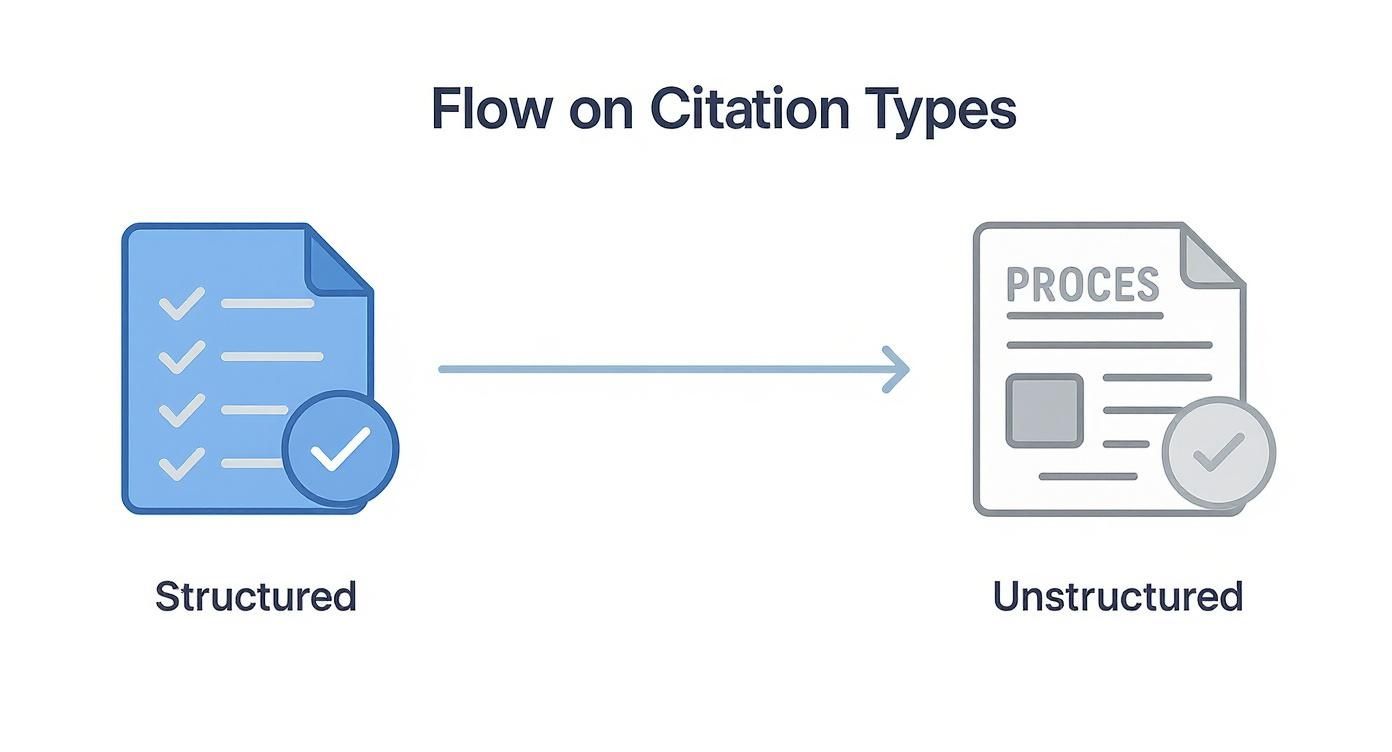
As you can see, a complete strategy depends on both actively submitting to directories and earning those natural mentions through blog posting and blogger outreach to build a truly comprehensive online presence.
The Impact of Mobile on Local Search
The need for accurate local citations has exploded thanks to how we all use our phones. The growth of local search on mobile has been staggering, with some data showing that local queries on mobile phones have shot up by 900% in recent years. This proves that customers are looking for businesses like yours while they're on the move.
This trend is tied directly to features like 'click to call' and 'get directions,' with 60% of mobile users who search locally contacting a business right from the search results.
This whole process can be a grind, but getting it right pays off for years to come. If you're looking to speed things up, there are plenty of tools and local citation services out there. A detailed local business listing services comparison is a great way to figure out which tools fit your strategy and budget.
Building a solid citation profile requires a patient and meticulous touch. By following these steps—auditing your presence, perfecting your GBP, and targeting key directories—you'll build a powerful and trustworthy digital footprint that brings in both search engines and local customers.
Common Citation Mistakes to Avoid
A clean and consistent citation profile is a huge asset for local SEO, but a single mistake can quietly sabotage months of hard work. These common slip-ups are easy to make, yet they create serious confusion for search engines and customers, torpedoing your online visibility.
Avoiding these errors is just as critical as building new listings. Think of it as digital housekeeping—keeping a tidy online presence ensures every citation is working for you, not against you.
The Chaos of NAP Inconsistency
The single most damaging mistake you can make is NAP inconsistency. This is when your business's Name, Address, and Phone number don't match perfectly across different websites and directories. It might seem like a small detail, but to an algorithm, it's a massive red flag.
For example, say your restaurant equipment supply business is listed as "Main St." on Yelp but "Main Street" on your Google Business Profile. Google’s crawlers see two potentially different businesses. This tiny difference erodes the trust you’ve worked so hard to build, making the search engine less confident about where you are and what you do.
The Problem with Duplicate Listings
Just as bad are duplicate listings. This happens all the time when a business moves, changes its phone number, or rebrands. Old listings don't just vanish; they hang around the web like digital ghosts, creating a second, inaccurate profile for your business on the same directory.
These duplicates split your authority and confuse your customers. Imagine a chef finding two different phone numbers for your supply store. Are they going to guess which one is right? No—they're just going to call your competitor.
A scattered and inconsistent online presence is a direct signal of unreliability to search engines. Every duplicate listing and NAP error creates a crack in your local SEO foundation, weakening your ability to rank for critical local searches.
To fix this, you have to actively hunt down and either remove or merge any duplicate profiles you find. It's a non-negotiable part of the process.
Neglecting to Update Your Information
Life happens—businesses move, phone numbers change, and hours get updated for the holidays. A huge mistake is forgetting to update this information across your entire citation portfolio right away. An old address on a key directory can send a potential customer on a wild goose chase, leading to frustration and a lost sale.
Put yourself in their shoes: if a restaurant owner drives to your old location to pick up a new charbroiler and finds an empty building, you haven't just lost a sale. You've likely lost a customer for good.
Submitting to Low-Quality Directories
When it comes to local business citations, quality will always beat quantity. A common mistake is trying to get your business listed on every directory you can find, including sketchy, low-quality sites. This can actually do more harm than good.
Associating your business with spammy directories can tarnish your online reputation. Search engines are smart enough to know which directories are authoritative, and a listing on a junk site offers zero value. It might even be seen as a negative signal.
Stick to reputable, high-authority general directories and, more importantly, focus your efforts on niche-specific directories for the foodservice industry.
The Long-Term Value of Citation Management
Getting your first set of local business citations built is a massive step forward, but it’s really just the beginning of the journey, not the end. The real power comes from keeping a close eye on them over the long haul.
Think of your citations less like a finished project and more like a living, breathing portfolio. It needs consistent attention to stay accurate and valuable. This ongoing management is what turns a one-time SEO bump into a lasting business asset. Over time, search engines notice this consistency and reward you with higher trust, which translates directly into better, more stable local search rankings.
For a restaurant equipment supplier, this means becoming a permanent fixture when local chefs and managers are searching for what you sell.
Sustaining Visibility and Credibility
A well-managed citation profile makes sure your business is the go-to supplier in your local area. As new directories pop up and old ones change their formats, staying on top of your listings keeps your information flawless.
This kind of reliability builds incredible credibility with both search engines and actual customers—like a chef desperately searching for an emergency equipment replacement on their phone.
In the cutthroat foodservice market, this trust is a huge advantage. A solid local presence, built on the foundation of accurate business citations, keeps your brand top-of-mind and positions you as a reliable partner for the restaurants you want to serve.
Managing your citations is an ongoing commitment to your brand's digital accuracy. It’s how you safeguard your local visibility, enhance credibility, and build a reliable pipeline of qualified leads from local restaurants.
Customer behavior backs this up completely. Recent research shows that a staggering 83% of consumers use Google to find info and reviews for local businesses. And 8 out of 10 people search for a local business online at least once a week.
With customers searching that often, even a single piece of wrong information can mean a lost sale. You can discover more insights about these local SEO statistics to see the full picture.
Ultimately, this consistent effort builds a powerful digital moat around your business. While competitors with messy or outdated listings slowly fade into the background, your clean, consistent presence solidifies your authority. If you’re looking to build a strong foundation from the start, our local citation services can help you secure 100 high-quality local citations to get you on the right foot.
Frequently Asked Questions
Even with a solid plan, the world of local business citations can leave you with a few questions. Let's clear up some of the most common ones so you can manage your local presence with confidence.
How Long Does It Take for Citations to Improve My SEO?
While some directories might get your business listed almost instantly, seeing the full impact on your local SEO is more of a slow burn. You can usually expect to see real, noticeable improvements in your local search rankings within 1 to 3 months.
Why the wait? Search engines need time to crawl these new listings, double-check that all your information is consistent, and start trusting your data. Think of it like building a reputation in a new town—it's the consistent, long-term effort that delivers the most significant and lasting results.
Is It Better to Build Citations Manually or Use a Service?
The right choice here really boils down to how much time you have on your hands.
- Manual Building: This route is free, but it's a huge time commitment. You have to be incredibly careful, because even a tiny mistake can create inconsistencies that hurt your SEO.
- Using a Local Citation Service: Paying for a tool or service automates the process across dozens, sometimes hundreds, of directories. It saves you a ton of time and usually guarantees a much higher level of accuracy.
For a busy restaurant equipment supplier, investing in a service often pays for itself. It ensures the job is done right and efficiently, freeing you up to focus on what you do best—helping your customers.
The most powerful citations are those that include a backlink, as they provide both local verification for search engines and direct authority from another website. However, a citation without a link still holds significant value for local search rankings.
What Is the Difference Between a Citation and a Backlink?
This is a common point of confusion, but the difference is pretty important. A local business citation is any mention of your business's Name, Address, and Phone number (NAP) online, even if there's no clickable link. Its main job is to prove your business exists at a physical location, which is crucial for local SEO.
A backlink, on the other hand, is a clickable link from one website to another. Its primary role is to pass authority—what SEO pros call "link equity"—and boost your overall SEO performance, not just local. Think of it as a vote of confidence from one site to yours.
Getting a citation that also includes a backlink is the best of both worlds, as it hits both goals at once.
At Restaurant Equipment SEO, we provide a full suite of content marketing services tailored for the restaurant supply industry. From building authoritative local citations and securing placements through blogger outreach, to crafting compelling blog posts and website copy through our expert copywriting and article writing services, we help your business dominate the digital landscape. Let us handle your SEO so you can focus on equipping the nation's best restaurants.