
Link Acquisition Strategy: Earn High-Quality Backlinks Fast
A link acquisition strategy is your game plan for getting other websites to link back to yours. This isn't about collecting links for the sake of it; it's a focused effort to earn backlinks that boost your site's authority, improve search rankings, and drive your business forward. As experts in SEO for restaurant equipment suppliers, we understand that a targeted approach—combining local citations, strategic blog posting, and blogger outreach—is essential for success.
Building a Link Strategy That Aligns With Business Goals
A solid link acquisition strategy doesn't kick off with a blast of outreach emails. It starts by tying every single link you build back to a real business result. Chasing a high Domain Rating (DR) is just a vanity metric if it doesn't lead to more qualified leads and sales for your restaurant equipment supply website.
Let's put it in perspective. For a company like Charbroilers.com, the goal isn't just to "get links." The real goal is to sell more charbroilers. A smart plan would set clear Key Performance Indicators (KPIs) that actually reflect that mission.
Define Your Strategic Objectives
Before you even think about building a link, you need to define what winning looks like. Vague goals like "get more traffic" won't cut it. You need specific, measurable targets that are tied directly to revenue.
For a restaurant supplier, that might look like:
- Boosting organic traffic to the 'countertop charbroilers' category page by 20% in the next six months.
- Getting a top-three ranking for high-intent keywords like 'best commercial grill for restaurants'.
- Increasing qualified leads from organic search by 15% quarter-over-quarter.
Targets like these turn link building from a fuzzy SEO task into a core driver of business growth. A huge part of any serious link strategy is earning high-authority links from relevant sites that send you referral traffic that actually converts.
This flowchart breaks down the basic process of creating a link strategy that's focused on your goals.
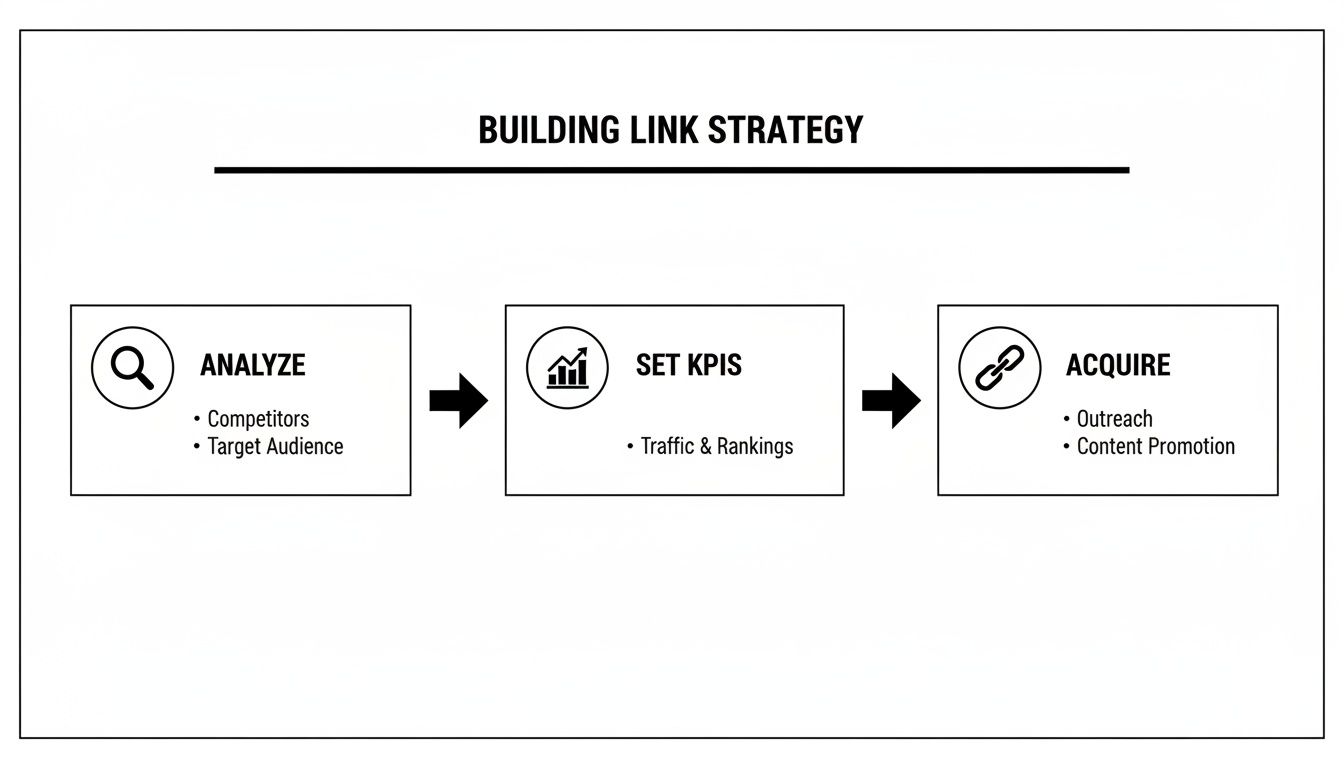
As you can see, successful link acquisition is the final step after you’ve done the hard work of analysis and goal-setting—not just blind outreach.
Analyze Your Current Backlink Profile
To figure out where you're going, you have to know where you're starting from. A deep dive into your current backlink profile is the essential first step. This means firing up your SEO tools to really look at the quality and relevance of the sites already linking to you.
A strong backlink profile is the foundation of high search rankings. It signals to search engines that your website is a credible and trustworthy resource, directly impacting your visibility for valuable commercial keywords.
This audit will show you if your profile is healthy or if it's being weighed down by low-quality links that might be hurting your rankings. It also gives you a clear benchmark to measure your growth against.
Our comprehensive SEO services include in-depth backlink audits and competitor analysis. Comparing your profile against your top competitors in the restaurant supply niche is where the gold is. It quickly reveals gaps and opportunities—showing you websites that link to them but not to you. And just like that, you've got your first list of prime targets.
Creating Content the Food Industry Wants to Link To
A winning link-building plan all comes down to one simple truth: you have to create content that other websites actually want to link to. It sounds obvious, but it's where so many strategies fall apart.
In a competitive space like restaurant equipment, another generic blog post about "grilling tips" isn't going to move the needle. To earn backlinks that matter, you need to think bigger. You need to produce genuinely useful, high-value linkable assets. Our article writing and copyrighting services are designed specifically for this purpose.
These aren't just articles; they're resources. They solve a real problem, offer up unique data, or provide a tool that makes a chef's or a manager's life easier. For a supplier like Charbroilers.com, this is where you can truly set yourself apart from the pack.
Develop High-Value, Practical Resources
The best linkable assets are the ones that become the go-to resources for your industry. They're practical, they're detailed, and they offer a level of expertise that can't be found with a quick Google search. This is the kind of stuff that food bloggers, culinary schools, and industry publications are actively looking to share with their audiences.
Here are a few ideas that a charbroiler supplier could run with:
- In-Depth Technical Guides: Go deep on a topic like "The Science of the Perfect Sear." You could break down the Maillard reaction with detailed diagrams, explain how different grill grate materials affect heat transfer, and really own the topic.
- Downloadable Checklists: A "Commercial Charbroiler Maintenance Checklist" is a perfect example. It's simple but incredibly powerful. Every kitchen manager needs this, making it a highly practical and shareable resource they'll download and reference again and again.
- Data-Rich Infographics: Create a visually sharp infographic on something like "America's Most Profitable Grilled Dishes." Use industry data to show which menu items have the best margins. Restaurant business blogs would eat that up.
This is the level of detail and utility that turns a simple piece of content into a magnet for high-quality backlinks. You stop being just a seller and become a genuine expert.
Here's a look at how different types of assets can work for a supplier.
Linkable Asset Ideas for a Restaurant Supplier
We've found that different content types attract links from different corners of the industry. The key is to match the asset to the audience you want to reach. A deep technical guide will appeal to a different crowd than a cost-savings calculator.
| Asset Type | Target Audience | Potential Link Sources | Example Topic |
|---|---|---|---|
| Technical Guide | Chefs, Kitchen Managers | Culinary Schools, Food Science Blogs, Chef Forums | "The Physics of Heat Retention in Cast Iron vs. Stainless Steel Grates" |
| Interactive Tool | Restaurant Owners | Business Journals, Restaurant Consulting Blogs | "ROI Calculator: Gas vs. Electric Commercial Charbroilers" |
| Data Study | Industry Analysts, Journalists | Food Service Publications, News Outlets, Market Research Sites | "Annual Report: Trends in Commercial Grilling Equipment Purchases" |
| Maintenance Checklist | Operations Managers | Facilities Management Sites, Restaurant Operations Blogs | "The Ultimate End-of-Day Charbroiler Cleaning & Safety Checklist" |
By diversifying your assets, you create multiple avenues for earning authoritative links from a wide range of relevant websites. This strategy builds a much more robust and natural-looking backlink profile over time.
Build Interactive Tools and Calculators
If you really want to stand out, build something interactive. This is one of the most effective ways to earn links because it provides direct, personalized value to the user. These tools are so useful and shareable that they become prime targets for other sites trying to help their own audiences.
An interactive tool does more than just inform; it engages the user directly, making your website a functional destination rather than just a place to read. This utility is what drives natural, authoritative links.
Imagine an interactive calculator that compares the ROI of different commercial grill types. A restaurant owner could plug in their menu prices, food costs, and expected volume to see which charbroiler—be it a countertop, modular, or floor model—offers the best long-term value. That's a unique asset your competitors probably don't have.
At the end of the day, it's about consistency. Sites that are regularly publishing fresh content, like tips on char-grilling fish, manage to snag 97% more external links than websites that just sit there. You can read more about these linking statistics to see the full picture, but the takeaway is clear: a steady stream of valuable assets is the engine of any successful link-building campaign.
Finding and Vetting High-Value Link Opportunities
Your outreach campaigns are only as good as the prospect list you build. You can create the most amazing piece of content the restaurant world has ever seen, but it won't matter if you're not showing it to the right people. That's the other half of the battle. A carefully researched list of targets makes sure every single email you send has the best possible shot at success.
So, where do you start? The fastest way to strike gold is by looking at what your competitors are already doing. SEO tools let you see exactly who is linking to them but not to you. This is called a "competitor gap" analysis, and it's your cheat sheet for finding sites that are already interested in your niche. They just don't know you exist yet.
Uncovering Competitor Backlinks
First, pull together a list of your top three to five direct competitors in the restaurant equipment space. Using your favorite SEO tool, export their backlink profiles to see who is giving them the nod. This isn't just about snooping; it's about gathering strategic intelligence.
Start looking for patterns. Are they getting most of their links from food bloggers? What about culinary school websites or industry trade publications? Every link tells a story about their strategy, and each one can be a potential path for you to follow. Our detailed guide on how to find backlinks in Google can give you a more granular approach to this essential task.
Vetting Prospects Beyond the Metrics
Once you have a big list of potential sites, the real work begins. It’s tempting to just glance at a site's Domain Rating (DR), add it to the list, and move on. That's a rookie mistake. A high DR doesn't automatically mean it's a quality link, and it’s a surefire way to waste your time.
You need to dig deeper. For every single prospect, you should be asking these questions:
- Is the site actually relevant? A link from a high-authority car blog is completely useless to a charbroiler supplier. The site’s content must have a clear connection to the food service or restaurant industry.
- Is their audience your audience? Take a minute to check out their social media profiles and read the comments on their articles. An engaged community of chefs and restaurateurs is infinitely more valuable than a generic, passive audience.
- Does the site look cared for? Are they posting new content regularly? Is the design clean, or is it cluttered with ads? A neglected website is a major red flag.
This vetting process is what separates the high-value opportunities from the time-wasters. It helps you build a prioritized list that makes every outreach email count.
Vetting isn't just about avoiding bad links; it's about proactively identifying the best links. A single, highly relevant link from an engaged community can drive more value than a dozen links from mediocre sites.
This disciplined approach always pays off. A supplier of commercial charbroilers, for example, could land mentions on sites with an average Domain Rating of 41 by pitching relevant stories about equipment choices for small bistros. Quality over quantity. The goal is a tight, focused list that gives your outreach purpose and drives real results.
How to Master Personalized Outreach That Gets Replies

Let's be honest: generic, mass-produced outreach emails are a one-way ticket to the trash folder. In the food industry, relationships are everything. Our blogger outreach service is built on this principle. To earn a reply—let alone a link—your communication needs to feel personal, authentic, and genuinely valuable. This part of your link acquisition strategy is where you stop being a robot and start being a real person.
This means you have to ditch the copy-paste mindset for good. Every single email you send should show you've done your homework. Mentioning a recent article they wrote or complimenting a specific recipe on their blog proves you see them as more than just another name on a spreadsheet.
The Anatomy of a Successful Pitch
A winning pitch is built to respect the recipient's time while making the value immediately obvious. I've found it boils down to a simple four-part structure: a compelling subject line, a personalized opening, a clear value proposition, and a simple call-to-action. Each piece has a job to do.
Think about the subject line. "Link request" is dead on arrival. But something like "Question about your grilled salmon recipe" is specific, intriguing, and doesn't immediately scream "I want something from you." It gets the open.
The goal of your first email isn't just to get a link; it's to start a conversation. A successful outreach email builds a bridge by offering genuine value first, making the request for a link a natural next step in a budding professional relationship.
Once they've opened it, that first sentence has to connect. It can be as simple as, "Hi [Name], I loved your recent article on pairing wines with grilled meats—your point about smoky flavors was spot on." This single sentence instantly separates you from the 95% of generic spam filling their inbox.
Crafting a Compelling Value Proposition
This is the core of your email. Why should they care? You have to make the benefit to them or their audience crystal clear. You aren't just begging for a link; you're offering a resource that makes their own content better.
- For a Food Blogger: Pitch your "Science of the Perfect Sear" guide as a resource they can reference in a recipe post. You're giving them a way to add technical depth and more value for their readers.
- For a Trade Journal: Offer an exclusive article on "Comparing ROI on Gas vs. Electric Charbroilers." You're providing free, expert content their audience of restaurant owners actually needs. Our guide on guest blogging for backlinks dives much deeper into this specific tactic.
Using proven influencer outreach email templates as a starting point can be a huge help, but remember to customize them heavily. They show you what structures work, but your personal touch is what makes them effective.
Finally, your call-to-action should be low-friction. Instead of a demanding "Can you add a link?" try something softer like, "Would you be open to taking a look?" It makes saying "yes" much easier.
The Art of the Follow-Up
I can't tell you how many of my best links have come from the follow-up. People are busy. Inboxes are chaotic. A gentle, polite follow-up a week later is a standard part of the process and shows you're serious.
Keep it short and friendly. A quick "Just wanted to follow up on this in case it got lost in your inbox" is often all it takes. The key is to be persistent without being pushy. That respectful approach is how you turn a non-response into a valuable backlink.
Using Digital PR to Earn Authoritative Backlinks

While reaching out directly for links has its place, the real power move is earning editorial links through digital public relations (PR). This isn't just a fancy term for asking nicely. It's about creating genuinely newsworthy stories that journalists and industry publications actually want to write about.
Instead of just pushing products, digital PR is all about crafting compelling narratives. Think data-driven reports, unique industry insights, or expert commentary that positions your brand as an authority. You shift the entire dynamic from "can I have a link?" to "here's some incredible content your audience will love."
For a supplier like Charbroilers.com, this approach completely changes the game. Imagine them commissioning a data study on "How Grill Type Impacts Restaurant Profit Margins" or releasing a trend report on "The Rise of Char-Grilled Flavors in Fine Dining." These aren't ads; they're stories with real journalistic appeal.
Brainstorming Newsworthy Angles
The secret sauce to successful digital PR is finding an angle that connects what you know to a conversation people are already having. You have to start thinking like a journalist. Ask yourself, "Why would anyone's audience care about this?"
Here are a few story ideas a restaurant supplier could run with:
- Data-Driven Reports: Survey hundreds of restaurant owners to uncover trends in equipment purchasing or menu development. Package it up into an exclusive report.
- Expert Commentary: Position your internal experts to comment on breaking industry news, like rising food costs or new culinary techniques making waves.
- Unique Case Studies: Find a local restaurant that used a specific charbroiler to dramatically increase efficiency or customer satisfaction. Tell their story.
These angles offer real, tangible value. They’re far more likely to get picked up by reputable publications than a generic press release about a new product. This is how you land those powerful backlinks that build true, lasting brand authority.
Digital PR transforms your link acquisition from a transactional process to a relationship-building one. You earn high-authority links because you’ve contributed something valuable to the industry conversation, not just because you asked.
Here's the kicker: this approach is shockingly underutilized. While 48.6% of SEO professionals rate digital PR as the most effective link-building tactic, a mere 17.7% actually use it on a regular basis. That's a massive opportunity gap just waiting for savvy marketers to step into and build a far superior backlink profile.
You can discover more insights about these SEO trends on BuzzStream. By leaning into digital PR, you’re not just playing the same game as your competitors—you’re playing a different one altogether, and it’s the one that earns more authoritative and impactful links in the long run.
Common Link Acquisition Questions Answered
Even with a solid plan, questions always pop up. It's just part of the process. Let's dig into some of the most common ones we hear from restaurant marketers and equipment suppliers. No fluff, just straight answers to help you keep moving forward.
How Long Until I See Results?
This is the big one, isn't it? The honest answer is that link acquisition is a long game. It's a marathon, not a sprint.
While you might spot some early movement in your keyword rankings or referral traffic within a few months, the real, stable improvements in organic performance tend to show up after 6 to 12 months of consistent, quality work. Patience is your best friend here. Every great link you earn is another brick in a strong foundation for long-term success, so always focus on quality over speed.
Low-Quality vs High-Quality Links
Should you chase a handful of powerful links or go for dozens of weaker ones? The answer is always the same: quality trumps quantity, every single time.
A single, relevant backlink from a well-respected food industry publication is worth infinitely more than 100 links from sketchy, low-authority directories. Search engines are smart; they care about trust and relevance. That one great link can do more for your rankings and authority than a mountain of spammy ones ever could.
Think of it this way: a glowing recommendation from a world-renowned chef means more than praise from 100 random people on the street. High-quality backlinks work the same way for your website's reputation.
Link Building vs Link Acquisition
People often use these terms interchangeably, but there's a subtle yet important difference in mindset. "Link building" can sometimes bring to mind older, manual tactics that don't hold up as well today.
"Link acquisition," on the other hand, is a more modern way of thinking. It’s all about earning links naturally. You do this by creating exceptional content, building genuine relationships, and using smart tactics like digital PR. The goal is to become the kind of resource that authoritative sites actually want to reference.
This distinction is crucial. Top-ranking pages have 3.8x more backlinks than those in positions 2-10, which is a massive visibility boost for catering businesses trying to find durable floor model charbroilers. You can discover more insights about these linking stats on BuzzStream. This really drives home why a quality-first link acquisition strategy is non-negotiable if you're serious about growth.
At Charbroilers.com, we provide the essential equipment that helps your culinary vision come to life. From versatile countertop models for compact kitchens to powerful floor model charbroilers for high-volume service, we have the perfect solution to deliver that sought-after smoky flavor and perfect grill marks. https://charbroilers.com