

Lava Rock vs Ceramic Briquettes Grilling Guide
When you're trying to decide between lava rock and ceramic briquettes for your commercial charbroiler, it really boils down to one thing: consistency versus classic flavor.
Ceramic briquettes are all about superior, even heat distribution and durability. This makes them a perfect fit for high-volume kitchens that need precision and reliability, service after service. On the other hand, lava rocks bring that traditional, smoky flavor that many chefs love, but they're less consistent and need to be replaced far more often.
Choosing Your Charbroiler's Heat Distributor
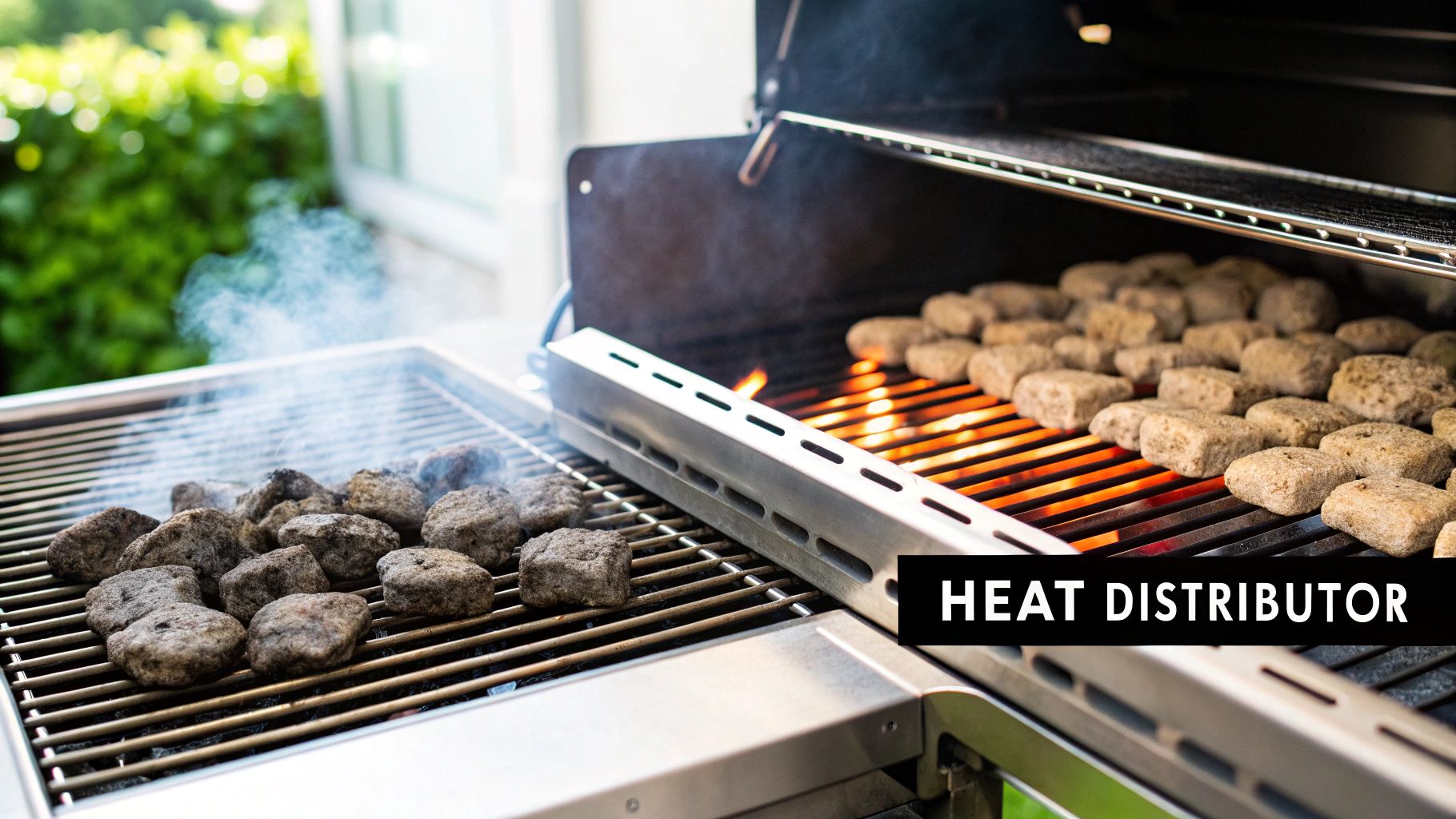
In a bustling restaurant kitchen, your charbroiler's performance can make or break a busy service. The heat distributor—that critical layer sitting between the raw flame and your cooking grate—is truly the heart of the appliance. Its job is to tame the intense, direct heat from the burners and transform it into a consistent, radiant cooking surface. Without it, you’d be fighting massive flare-ups and sending out unevenly cooked food.
This choice has a direct ripple effect on everything from food quality to your operational costs. A poor heat source creates frustrating hot spots, delivers inconsistent results, and ultimately leads to wasted product. A reliable one, however, ensures every single steak, burger, and vegetable is cooked to perfection, which is a cornerstone of customer satisfaction. For restaurant equipment suppliers, providing clear, expert content on topics like this through services like article writing and SEO is key to building trust with clients.
Key Decision Factors
Before we get into the nitty-gritty of each option, it's important to know what we're looking for. These are the factors that will ultimately determine which material is the right fit for your restaurant's specific needs and culinary vision:
- Heat Performance: How fast does it get hot, and how evenly does it spread that heat across the grill?
- Flavor Impact: Does it enhance the food's flavor through vaporization, or does it introduce other elements?
- Durability and Longevity: In a demanding commercial kitchen, how often will you have to replace it?
- Maintenance: What does the day-to-day cleaning and long-term upkeep look like?
- Cost-Effectiveness: What’s the total cost of ownership, looking beyond just the initial price tag?
This thought process isn't so different from choosing any major piece of grilling equipment. If you're looking at the bigger picture, resources like this comprehensive guide on choosing a grill can offer some great perspectives on heat sources and overall performance.
Quick Comparison: Lava Rock vs. Ceramic Briquettes
To give you a quick snapshot, here’s a high-level look at how these two heat distributors stack up in a commercial setting.
| Feature | Lava Rock | Ceramic Briquettes |
|---|---|---|
| Heat Distribution | Prone to hot and cold spots | Highly uniform and consistent |
| Flavor Profile | Intense, classic smoky flavor | Clean, lets food's natural taste shine |
| Durability | Lower; needs frequent replacement | High; lasts significantly longer |
| Flare-Up Potential | High due to grease absorption | Low due to non-porous surface |
| Initial Cost | Low | High |
This table makes the core differences pretty clear. Lava rock is the old-school, budget-friendly choice that delivers on flavor but falls short on consistency and longevity. Ceramic briquettes are the modern workhorse—a higher upfront investment for superior performance and a longer lifespan.
Understanding Lava Rock: The Traditional Choice
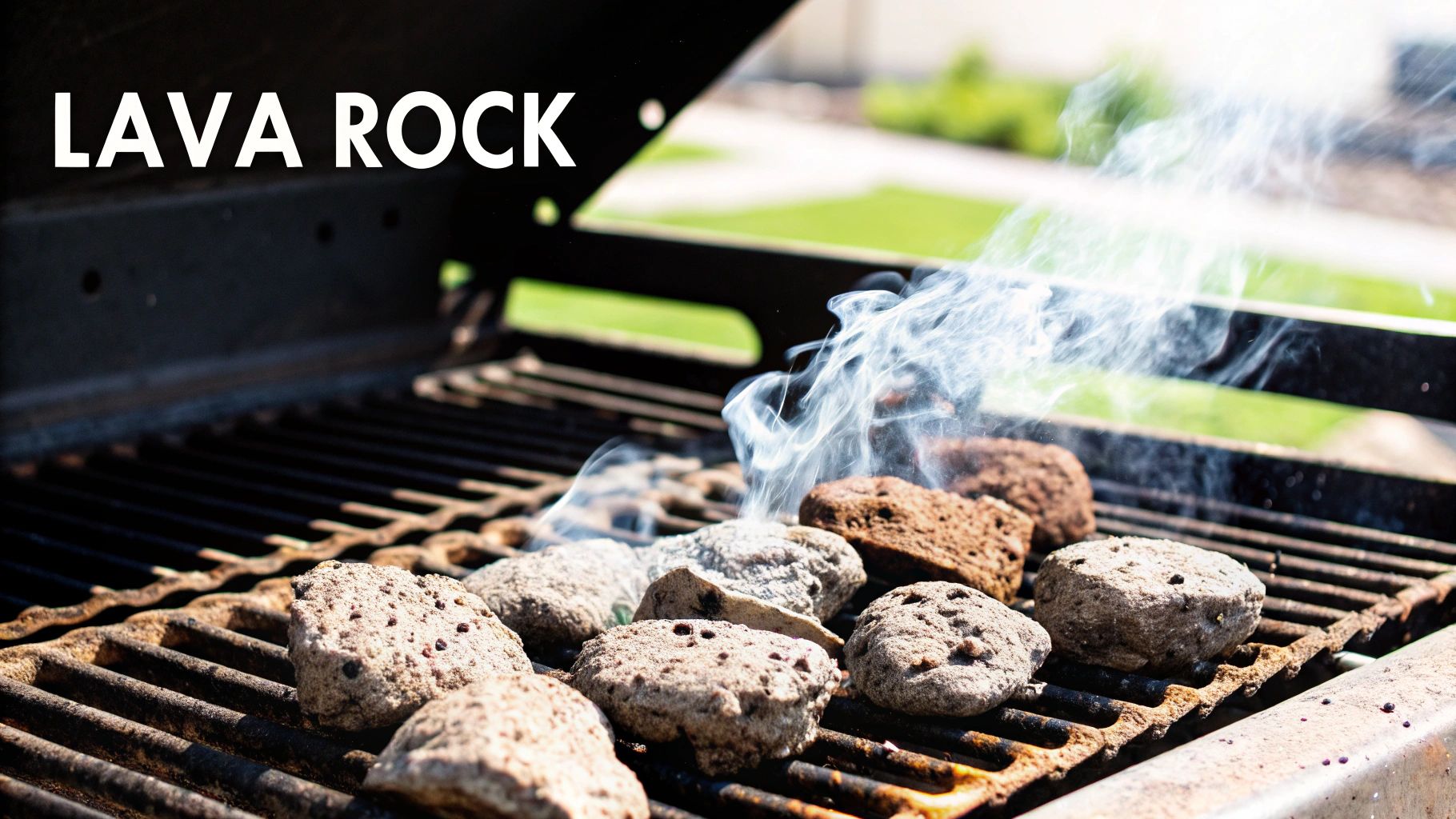
For decades, if you wanted a classic char-grilled flavor, lava rocks were the go-to for commercial charbroilers. They’re the old-school standard, prized for delivering that distinct, smoky taste customers crave from a good barbecue joint. These are just naturally occurring volcanic stones, and their highly porous structure is the secret to their performance—for better and for worse.
When grease from a burger or steak drips onto the super-heated, craggy surface of a lava rock, it instantly vaporizes. That sizzle creates flavorful smoke that wafts back up and infuses the food, creating the signature char-grilled taste so many restaurants built their reputations on.
But the very thing that makes them great for flavor is also their biggest operational headache. Because they’re natural stones with irregular shapes and densities, they simply don't heat up uniformly. This creates a minefield of unpredictable hot and cold spots across the grill, a frustrating reality for even the most seasoned chefs.
Performance in a Commercial Kitchen
In a high-volume kitchen, consistency is everything. The uneven heat from lava rocks means one side of the grill might be putting a perfect sear on a steak while another spot is barely cooking it. This forces the line cook to constantly move food around, which slows down ticket times and raises the risk of sending out an inconsistent product.
Then there's the issue of flare-ups. As grease builds up in the porous rock over a busy service, those trapped oils can easily ignite into sudden, intense flames.
A little flare-up can add a nice char, but the uncontrolled flames from saturated lava rocks can quickly burn food, fill the kitchen with acrid smoke, and create a genuine fire hazard. It turns grill management into a full-time babysitting job.
Maintenance and Longevity Trade-Offs
Lava rocks do heat up pretty quickly, which is a nice perk at the start of a shift. However, that porous nature makes them a nightmare to clean and gives them a very short lifespan in a busy restaurant.
Here’s what you’re up against:
- Grease Saturation: After a while, the rocks get clogged with burnt-on grease that’s almost impossible to fully remove. This build-up not only fuels flare-ups but can also start giving off a rancid, old-grease flavor.
- Frequent Replacement: Because of the grease saturation and their natural tendency to crumble, lava rocks need frequent replacement—often every few months in a busy kitchen. That's a recurring cost and a maintenance chore that never goes away.
- Cleaning Challenges: You can flip them over or give them a quick scrub, but you can never truly get them clean once they're heavily soiled.
Ultimately, lava rocks still have their place. If that powerful, traditional smoky flavor is your absolute top priority and your kitchen staff has the bandwidth to manage the inconsistencies, they can work. But for most modern restaurants that value precision, efficiency, and reliability, the drawbacks are hard to ignore when comparing lava rock vs ceramic briquettes.
Exploring Ceramic Briquettes: The Modern Contender
As commercial kitchens get more sophisticated, so does the gear inside them. Ceramic briquettes are the engineered answer to the old-school inconsistencies of lava rock. They were built from the ground up for the intense demands of commercial charbroiling, where getting it right every single time is the name of the game.
Unlike the porous, crumbly nature of volcanic stone, ceramic briquettes are made from dense materials like alumina or silica. Their non-porous structure is their biggest advantage. It lets them soak up an incredible amount of heat and then radiate it evenly across the entire grill, giving you a stable and predictable cooking surface.
This consistency eliminates the frustrating hot and cold spots you often get with lava rock, giving chefs the precise temperature control they need to run a high-volume service.
Superior Heat Distribution and Control
The uniform, engineered design of ceramic briquettes translates directly to better cooking. Because they deliver even, radiant heat, everything on the grill cooks at the same rate, no matter where you place it. This is a massive advantage in a busy restaurant, where consistency is everything—it impacts customer satisfaction and your kitchen's efficiency.
Grill performance studies back this up, showing ceramic briquettes distribute heat with way less temperature variation (±15°C) compared to lava rocks (±30°C). That creates a much more controlled cooking environment, a key factor when you're weighing lava rock vs ceramic briquettes. You can discover more about how different materials impact grill performance.
With ceramic briquettes, chefs can trust their charbroiler to perform reliably, shift after shift. You spend less time shuffling steaks around to find a hot spot and more time focused on nailing the perfect cook, which is exactly what you need during a packed dinner service.
Clean Vaporization and Simplified Maintenance
Another huge win for their non-porous surface is how they handle grease drippings. Instead of absorbing grease like a sponge, ceramic briquettes instantly vaporize it on contact. You still get that desirable smoky flavor, but it’s a cleaner taste that lets the natural quality of the food shine through.
This clean vaporization leads to two big operational perks:
- Reduced Flare-Ups: Since grease isn't soaking into the material, the risk of sudden, uncontrolled flare-ups drops dramatically. This means a safer kitchen and no more scorched food from surprise flames.
- Easier Cleaning: Maintenance is a breeze. For most day-to-day cleaning, you can just flip the briquettes over and let the heat burn off any residue. For a deeper clean, you can scrub them without worrying about them crumbling or holding onto old, rancid grease.
This combination of durability, consistent performance, and simple upkeep makes ceramic briquettes the clear choice for modern restaurants that want an efficient, reliable, and long-lasting grilling setup.
Comparing Heat Performance and Flavor Profile
When your kitchen hits the dinner rush, the performance of your charbroiler's heat distributor becomes absolutely critical. The whole debate between lava rock vs. ceramic briquettes really boils down to two things: how they handle heat and what they do for the flavor of your food.
These two materials have completely different philosophies when it comes to heat management. Those differences directly impact your cooking times, the consistency of your final product, and what ultimately lands on the customer's plate. Getting a handle on these nuances is the first step in setting your kitchen up for success.
Heat-Up Times and Temperature Stability
Lava rocks, because they’re porous and pretty lightweight, get hot fast. This can feel like a win at the start of a service, letting you get your grill station fired up and ready to go in a hurry.
But that speed comes at a price: they're terrible at holding onto heat. The moment you slap a cold steak or a line of burgers on the grate, lava rocks bleed temperature and take their sweet time recovering.
Ceramic briquettes are the polar opposite. Being dense, they take a bit longer to get up to temperature. Once they're hot, though, they act like a thermal battery, storing an incredible amount of energy and radiating a powerful, steady heat. That stability is a game-changer during a long service, making sure the last burger of the night is cooked just as perfectly as the first.
Consistency: The Great Divide
The biggest performance gap is in heat consistency. The random shapes and varying densities of natural lava rocks create a minefield of hot and cold spots across the grill. You might have one area charring a piece of chicken perfectly while a spot just a few inches over is barely cooking it through.
Ceramic briquettes, manufactured to be perfectly uniform, completely solve this problem. They radiate heat evenly across the entire cooking surface, giving you a reliable and predictable grilling area. This means your cooks aren't constantly shuffling food around to find a hot spot, which improves efficiency and guarantees every dish meets the same high standard.
The chart below really puts the temperature difference into perspective.

As you can see, ceramic briquettes create a much more controlled cooking environment, which is exactly what you need for consistency in a professional kitchen.
For any high-volume restaurant, the predictable, even heat from ceramic briquettes translates directly to faster ticket times, less food waste, and a more consistent final product. It takes the guesswork out of grilling, plain and simple.
To really break down how these materials stack up in a professional setting, let’s look at the key performance metrics side-by-side. This table cuts through the noise and shows what truly matters during a busy service.
Performance Metrics: Heat, Flavor, and Durability
| Metric | Lava Rock | Ceramic Briquettes | Commercial Impact |
|---|---|---|---|
| Heat Distribution | Uneven (hot/cold spots) | Highly even and consistent | Even heat reduces food waste and improves ticket times. |
| Heat Retention | Poor (loses heat fast) | Excellent (maintains temp) | Better retention means faster cook times during a rush. |
| Flavor Profile | Intense, heavy smoke | Clean, subtle smoke | Depends on menu concept; clean flavor is more versatile. |
| Heat Variation | High (±30°C) | Low (±15°C) | Low variation ensures predictable and repeatable results. |
| Longevity | 6-12 months | 2-5+ years | Longer lifespan means lower long-term replacement costs. |
This data makes it clear: while lava rock has its place, ceramic briquettes offer the stability, consistency, and control that most commercial kitchens need to operate efficiently.
The Flavor Profile Showdown
Now, flavor is where the choice gets a bit more personal and really depends on your restaurant's identity. Each material handles grease drippings in a unique way, which creates two very distinct taste profiles.
Lava rock's porous surface is like a sponge; it soaks up drippings from meat, chicken, and vegetables. When that grease gets super-heated, it vaporizes into a thick, heavy smoke that coats the food, giving it that classic, intense char-grilled flavor a lot of people associate with backyard barbecues.
Ceramic briquettes offer a much cleaner flavor. Their surface isn't porous, so they don't absorb grease. Instead, when drippings hit the hot briquette, they're instantly vaporized. This creates a subtle, clean smoke that enhances the food's natural flavors without overpowering them.
- Lava Rock Flavor: Intense, smoky, and traditional. This is the right call for a BBQ joint or any place where a heavy, char-grilled taste is a signature part of the brand.
- Ceramic Briquette Flavor: Clean, subtle, and refined. This is perfect for steakhouses, seafood restaurants, or any fine-dining spot where the quality of the protein is meant to be the star.
At the end of the day, this is a strategic decision. If your menu is built around that rustic, powerfully smoky flavor, lava rock is a serious contender. For most modern commercial kitchens that prioritize precision and consistency, though, ceramic briquettes just deliver superior performance and a more versatile flavor profile.
Analyzing Durability, Maintenance, and Long-Term Costs

Sure, heat performance and flavor are what you notice right away. But the real operational impact in the lava rock vs. ceramic briquettes debate boils down to durability and maintenance. These are the factors that sneak up on your budget and directly influence your total cost of ownership. For any restaurant manager focused on the bottom line, this is where the conversation gets serious.
The lifespan of each material is a direct result of its physical structure. Lava rocks are naturally porous and, frankly, a bit brittle. In a busy commercial kitchen, they get hammered with constant thermal stress and grease saturation, which causes them to crack, crumble, and lose their effectiveness over time.
Ceramic briquettes, on the other hand, are engineered for resilience. They're manufactured to be dense and tough, designed specifically to handle extreme temperature swings without breaking down. This built-in toughness gives them a much longer operational life in a high-volume restaurant.
The Maintenance Divide
When it comes to cleaning and upkeep, the two options are worlds apart. The maintenance routine for lava rocks often feels like a losing battle against grease.
- Lava Rock Maintenance: Their porous nature makes them act like tiny sponges, soaking up every bit of grease and food drippings. This buildup is nearly impossible to clean out completely. Eventually, you’re left with rancid flavors and dangerous flare-ups. The only real solution? Tossing them out and starting over.
- Ceramic Briquette Maintenance: The non-porous surface of ceramic briquettes makes cleaning a breeze. For daily upkeep, you can just flip them over and let the heat burn off most of the residue. For a deeper clean, you can actually scrub them without worrying about damage.
This difference isn't just about labor—it's a kitchen hygiene issue. The old, caked-on grease on lava rocks can create a ton of smoke, which tanks your air quality and puts extra strain on your ventilation system. You can learn more about why that matters in our guide to commercial kitchen ventilation requirements.
Calculating the Total Cost of Ownership
Looking purely at the price tag, lava rocks are the cheaper buy. You can get a full set for a commercial charbroiler for significantly less than a set of quality ceramic briquettes. But that initial saving is often a mirage when you look at the total cost over a couple of years.
The true economic picture emerges over time. The frequent replacement cycle of lava rocks—often every 6-12 months in a busy kitchen—creates a recurring expense that bleeds your budget dry. Meanwhile, ceramic briquettes can last for 2-5 years or even longer.
For suppliers, this long-term value is a key selling point. Educating clients through effective blog posting and copyrighting helps them understand why the higher upfront cost is a smarter investment. This builds brand authority and drives sales for high-margin, durable products.
When you factor in the money saved on replacements, the reduced labor for maintenance, and the consistent cooking performance, ceramic briquettes almost always come out ahead as the smarter long-term investment for a busy restaurant that needs reliability and predictable costs.
Making the Right Choice for Your Restaurant
The final call in the lava rock vs. ceramic briquettes debate isn't about finding one "best" option. It's about matching the gear to your kitchen's reality—your menu, your workflow, and your budget. This choice directly shapes your food's flavor profile and your long-term costs. The right answer boils down to what you value most: authentic smoky flavor or dead-on consistency.
For some spots, the classic, rugged appeal of lava rocks is the only way to go. Think traditional BBQ joints, rustic grills, or any place where a heavy, smoky essence is central to the brand. In those kitchens, the occasional flare-up isn't a problem; it's part of the show, adding to that perfect char-grilled look.
But for most modern commercial kitchens, ceramic briquettes are simply the smarter, more strategic investment. Their precision and reliability are a must-have for any operation where consistency is king.
When to Choose Ceramic Briquettes
Ceramic briquettes are the undisputed workhorse for high-demand kitchens. They should be the default choice for:
- Fine Dining Steakhouses: Where you need absolute temperature control to nail the cook on expensive cuts of meat every single time.
- High-Volume Chains: That depend on serving the exact same product across dozens of locations to protect their brand standards.
- Seafood Restaurants: Where a cleaner, more neutral heat is essential to let the delicate flavor of the fish come through.
The superior heat retention and perfectly even distribution you get from ceramic briquettes lead straight to a more efficient kitchen, which is a massive piece of the profitability puzzle. A smooth-running kitchen doesn't just get food out faster; it's a critical factor when you're exploring how to increase restaurant sales by turning more tables.
The core trade-off is clear: Lava rocks offer smoky authenticity at the cost of precision, while ceramic briquettes provide modern reliability and control, making them the superior long-term investment for most restaurants.
Final Considerations
At the end of the day, your heat distributor is a tool that affects way more than just the food. It impacts your team's efficiency, your cleaning schedule, and your bottom line. While this guide has focused on gas charbroilers, it's always smart to know all your options. For example, understanding the details of choosing charcoal for restaurant operations can give you a broader perspective on creating flavor and managing costs.
The choice between lava rock and ceramic briquettes is a foundational one for your kitchen. By honestly weighing the trade-offs between that old-school smoky flavor and modern, efficient performance, you can set your kitchen up with the right tool to deliver amazing results, shift after shift.
At Charbroilers.com, we understand that the right equipment is the backbone of any successful kitchen. We offer a wide range of high-performance commercial charbroilers designed to meet the demands of any restaurant concept, ensuring you have the reliability and precision needed to create unforgettable dishes. Explore our selection of countertop, modular, and floor model charbroilers to find the perfect fit for your operation.