
How to Price Restaurant Menu: A Practical Guide to Maximizing Profit
Pricing your menu is where the art of running a restaurant meets the science of making a profit. Get it right, and you’re golden. Get it wrong, and you’re bleeding cash without even knowing why. At its heart, the process is about knowing your numbers cold: calculate the cost of each dish, lock in a target food cost percentage, and then build in a markup that covers your team, your rent, and your own take-home pay.
Mastering the Fundamentals of Menu Pricing
Before you even think about putting a price on a single item, you have to get a handle on your costs. Guesswork is the quickest way to go out of business. Every single price on your menu needs to be a deliberate, data-backed decision. This is all about the relationship between what an ingredient costs you and what a customer feels is a fair price for the finished dish.
And I mean all the details. From the prime-cut steak hitting your charbroiler to the single sprig of parsley you use as a garnish, every component has a price tag. The only way to build a profitable menu is to understand how every ingredient impacts your bottom line.
Defining Your Ideal Food Cost Percentage
Your food cost percentage is one of the most vital metrics in your restaurant. It's a simple number that tells you exactly what slice of a menu item's price is eaten up by the ingredients. For instance, if the ingredients for your signature burger cost you $4 and you sell it for $16, your food cost percentage is a healthy 25%.
As a rule of thumb, most successful operators aim for a food cost percentage between 28-35%. This range is a global industry benchmark for a reason—it strikes the right balance between staying competitive and ensuring you’re actually making money. That leaves you with enough margin to cover labor, overhead, and hopefully, a decent profit of around 5-10%.
Keep in mind, setting a target food cost percentage isn't a one-size-fits-all game. A high-end steakhouse might need a lower percentage on its entrees to cover the higher labor and service costs, while a fast-casual joint could live with a slightly higher food cost because its overhead is much lower.
To help you get started, here's a quick reference for the basic math that drives menu pricing.
Essential Menu Pricing Formulas at a Glance
| Formula | Calculation | Example for a $4 Cost Item |
|---|---|---|
| Food Cost | Cost of Ingredients / Number of Servings | $4 per serving |
| Food Cost % | (Total Cost of Dish / Selling Price) x 100 | ($4 / $16) x 100 = 25% |
| Basic Menu Price | Total Cost of Dish / Target Food Cost % | $4 / 0.30 (for a 30% target) = $13.33 |
These formulas are your starting point for making sure every dish pulls its weight financially.
Calculating the Actual Cost of Each Plate
With your target percentage locked in, it’s time to roll up your sleeves and calculate the precise cost of every dish on your menu. This is often called "costing out a recipe" or "plating," and while it’s tedious, it's absolutely non-negotiable for success.
Here's the breakdown of what that looks like:
- Itemize Everything: List every single ingredient in a recipe. Don't forget the salt, pepper, and the oil in the pan.
- Cost Per Unit: Break down your bulk purchases into a per-ounce or per-gram cost. If a 5-pound bag of onions costs $10, that’s $2 per pound, or about $0.125 per ounce.
- Measure Your Portions: Get obsessive about portion control. Accurately measure what goes into a single serving of each dish. This is where consistency saves you a ton of money.
This level of detail ensures your pricing isn't based on wishful thinking but on the reality of your costs. It also prepares you to adapt quickly to market changes. Staying on top of these numbers is crucial for navigating the latest food service industry trends and making smart adjustments on the fly.
Once you’ve nailed these fundamentals, you’ve built a solid financial foundation for your entire operation. For a deeper dive into more advanced tactics, this guide on Restaurant Menu Pricing Strategy is a great resource. From here on out, every price you set will be an informed decision pushing your business toward stability and growth.
Getting Real About Your Plate Costs
Okay, let's get down to the brass tacks. Anyone can use a simple formula to slap a price on a menu item. But if you want to build a truly profitable restaurant, you have to dig deeper. It's time to get granular with your plate costs.
I'm not just talking about the steak or the chicken. I mean everything. Every single component that goes onto that plate has a cost, and if you're not tracking it, you're leaving money on the table. This is where a recipe cost card becomes your best friend.
Think of it as your financial blueprint for each dish. It’s usually just a simple spreadsheet, but it forces you to account for every ingredient, its exact portion size, and what you paid for it. We're talking about the pinch of finishing salt, the swirl of olive oil, and that secret house-made spice rub. Individually, they feel like pocket change. But multiply that by hundreds or thousands of plates a month, and suddenly you're looking at a serious expense that's eating into your margins.
Don't Forget About Yield
Here’s one of the most common—and costly—mistakes I see restaurants make: they cost their ingredients based on the invoice price, or the As Purchased (AP) cost. They completely forget about waste.
You buy a whole fish, but you don't serve the bones and head. You buy a case of bell peppers, but you toss the stems and seeds. This is where understanding yield is absolutely critical to figuring out your true Edible Portion (EP) cost.
Yield is simply the usable product you're left with after all the trimming, deboning, and cooking is done. Take a 10-pound brisket, for example. After you trim the fat cap and smoke it low and slow on your charbroiler, you might lose 40-50% of its original weight. That leaves you with just 5 or 6 pounds of sellable meat.
If you paid $50 for that brisket ($5/lb AP), your real cost for the finished product isn't $5 a pound. It's actually closer to $8.33-$10.00 per pound (EP). That’s a massive difference.
Pro Tip: Do your own yield tests. Seriously. Take a case of your top-selling protein or your go-to produce, process it like you normally would, and weigh the final product. That yield percentage is one of the most important numbers in your kitchen. It ensures your menu pricing is based on reality, not just wishful thinking.
Building a Recipe Cost Card: A Charbroiled Example
Let's walk through a classic dish: a 10 oz Ribeye Steak Dinner, cooked to perfection on a commercial charbroiler. Your spreadsheet should look something like this, tracking every little thing down to the penny.
Example Recipe Cost Card: 10 oz Ribeye Dinner
| Ingredient | AP Cost/Unit | Portion Size | Yield % | EP Cost/Portion |
|---|---|---|---|---|
| Ribeye Loin | $12.00/lb | 10 oz | 85% | $8.82 |
| Russet Potato | $0.50/lb | 8 oz | 90% | $0.28 |
| Asparagus | $3.00/lb | 4 oz | 75% | $1.00 |
| Butter | $4.00/lb | 0.5 oz | 100% | $0.13 |
| Garlic | $2.50/lb | 0.1 oz | 90% | $0.02 |
| House Spice Rub | $8.00/lb | 0.25 oz | 100% | $0.13 |
| Garnish (Parsley) | $1.50/bunch | 1 sprig | 80% | $0.02 |
| Total Plate Cost | $10.40 |
Boom. This detailed breakdown tells you the true cost to put that steak dinner in the window is $10.40. With this number in hand, you can price the dish with total confidence. If you're aiming for a 30% food cost, you know you need to price this plate right around $34.67 ($10.40 / 0.30) to hit your profit goals.
This simple flowchart breaks down the basic process:
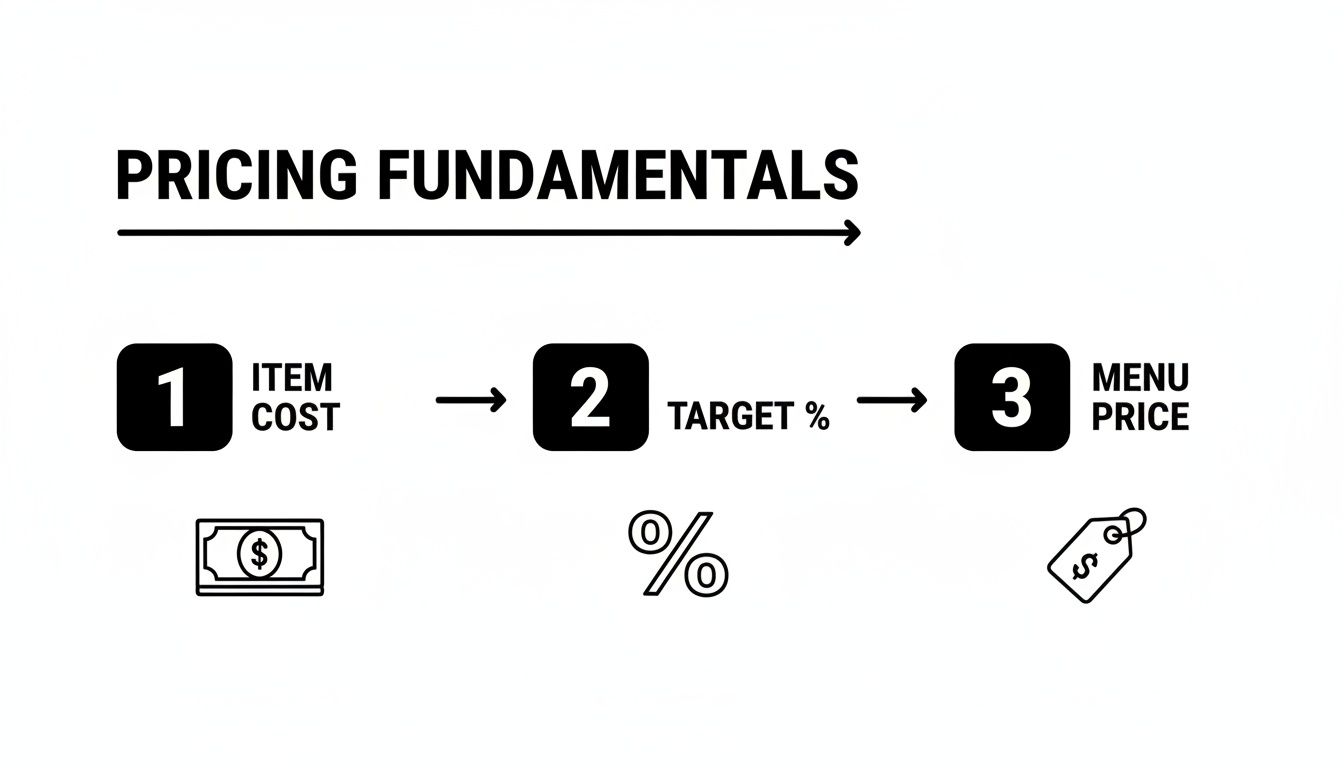
It all starts with knowing your numbers. Accurate plate costing is the non-negotiable first step. Without it, the rest is just guesswork.
Keep Your Costs Current for Profit Stability
The restaurant business is never static. Supplier prices are always moving. The cost of beef can jump in a single quarter, and what was a profitable superstar dish last month could be losing you money today if you're not paying attention.
This is exactly why your recipe cost cards need to be living documents, preferably in a spreadsheet. When your purveyor sends over a new price list, you can update your sheet in a few minutes and instantly see how it impacts the cost of every affected dish. This lets you make smart, proactive decisions—maybe you adjust a price, swap out a side dish, or start shopping for a new supplier.
Having this kind of financial clarity also helps when you're buying equipment. When you know the exact profitability of your grilled items, you can make much smarter investments. For a full rundown on the essentials, our commercial kitchen equipment checklist can help ensure you have the right tools to execute your menu flawlessly. This commitment to rigorous costing is the foundation of a financially healthy restaurant.
Strategic Pricing Models Beyond Simple Markups
Once you’ve nailed down your true plate costs, you’re ready to graduate from a simple cost-plus pricing strategy. Knowing your food cost percentage is fundamental, of course. But relying on that number alone is like driving with only a rearview mirror—it tells you where you've been, but not where you're going.
The most successful restaurants use a blend of pricing models. This allows them to react to the market and price with real intention. Just slapping the same markup on everything is a rookie mistake. Your high-volume, low-effort Caesar salad shouldn't have the same pricing logic as your labor-intensive, signature charbroiled short ribs. That's where these more strategic models give you a toolkit to price with precision.
Competitor-Based Pricing for Crowded Markets
Let's be real: your prices don't exist in a bubble, especially in a competitive neighborhood. Your customers are absolutely looking at your menu and the one down the street. Competitor-based pricing is all about analyzing what similar restaurants are charging and positioning your menu items in that context.
This doesn't mean you have to be the cheapest guy on the block. Far from it. It just means you have to understand the local benchmark. If every other steakhouse in a five-mile radius prices their 8 oz filet mignon between $45 and $50, trying to sell yours for $65 is going to be a tough climb unless you can clearly show why it's worth the premium.
Here’s how to do it right:
- Pinpoint Your Real Competitors: Look for restaurants with a similar vibe, target customer, and level of service. Don't compare your fine-dining spot to the fast-casual joint next door.
- Analyze the Obvious Items: Zero in on universal dishes that customers can easily compare, like a classic burger, a side of fries, or a standard grilled chicken entree.
- Position Your Value Proposition: If your prices are higher, your menu descriptions, ingredient sourcing, and service experience better scream "superior value."
This model is a no-brainer for commodity items where it's hard to be dramatically different. Think about a simple house salad or a standard well drink. For those, matching the market rate is usually the smartest move.
Value-Based Pricing for Your Signature Dishes
While competitor pricing is about looking around you, value-based pricing is about looking inward at what makes your restaurant special. This model sets prices based on the perceived value to the customer, not just what the ingredients cost you. It's the perfect strategy for your signature items—the dishes people can't get anywhere else.
Take a high-end steakhouse's 45-day dry-aged ribeye, seared over a screaming-hot charbroiler. The ingredient cost is high, sure, but the menu price is driven by the unique aging process, the chef's skill, and that incredible flavor. The customer isn't just paying for beef; they're paying for an unforgettable dining experience.
Value-based pricing is your license to charge a premium for being unique and excellent. If you're known for the best charbroiled swordfish in town because you source it straight from the docks and use a secret marinade, price it for that reputation, not just its food cost.
You need confidence to pull this off, though. Your menu, your servers, and your atmosphere all have to tell a story that justifies the price tag.
The Prime Cost Pricing Method
For a much sharper financial picture, many of the sharpest operators rely on the prime cost pricing model. This method is a serious upgrade from basic food cost because it rolls your two biggest expenses together: food costs and direct labor costs. Your prime cost is your total cost of goods sold (COGS) plus all your kitchen labor.
The formula is straightforward:
(Food Cost + Labor Cost) / Target Prime Cost Percentage = Menu Price
Most successful restaurants aim to keep their total prime cost at or below 60% of total sales. This model gives you a much more honest look at what an item truly costs to get to the table. A dish that requires tons of prep, intricate knife work, or constant attention from a line cook has a much higher labor component than a simple soup, and this pricing model actually reflects that.
By factoring in labor, you make sure that even your most complex, hands-on dishes are priced for genuine profitability, not just priced to cover ingredients.
Using Menu Engineering to Drive Profit
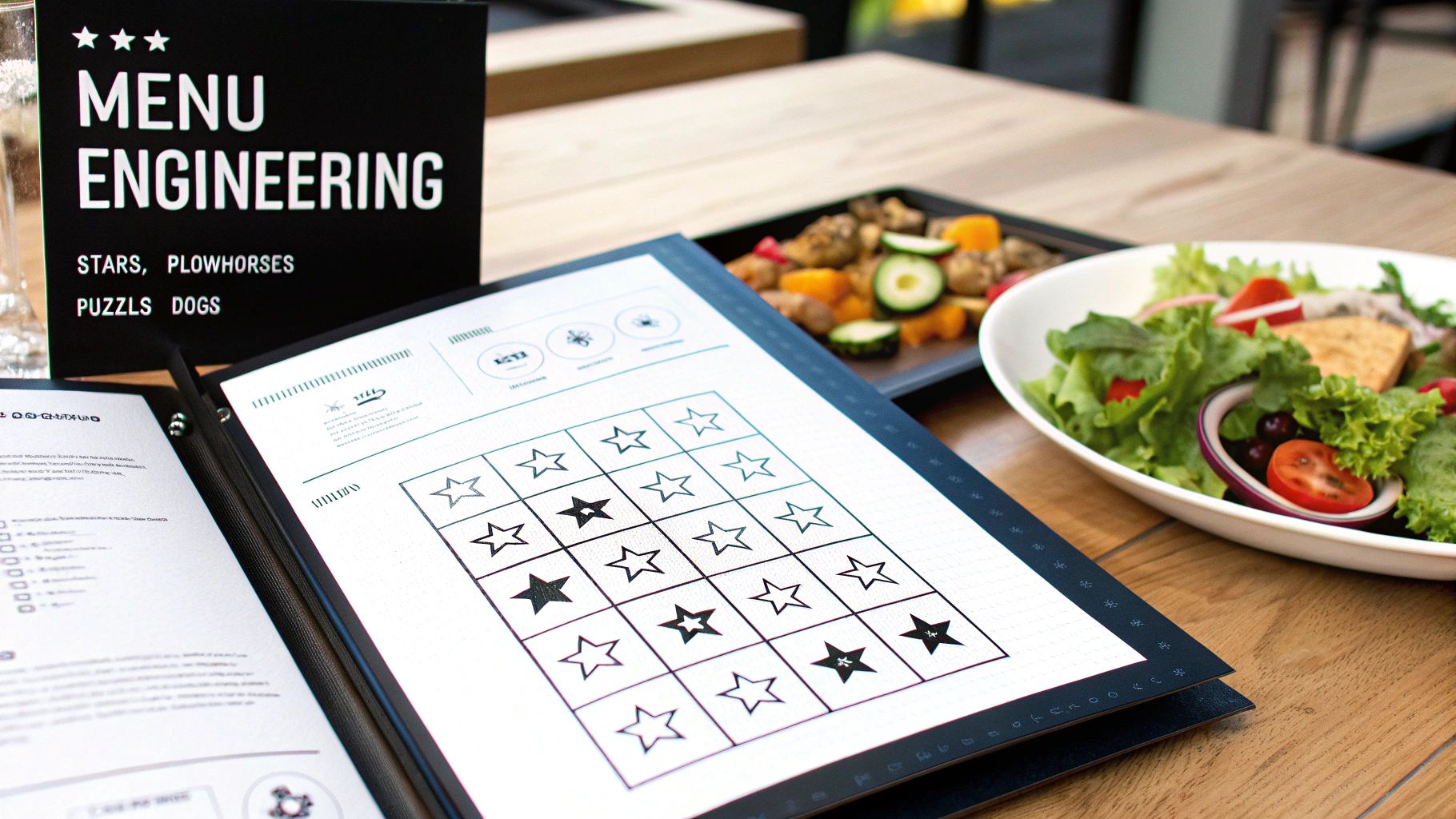
Once your costs are dialed in and you have a solid pricing model, it's time to focus on your single most powerful sales tool: the menu itself. It's so much more than just a list of what you sell. A well-designed menu is a strategic document that can guide customer choices and seriously boost your profits. This is the heart of menu engineering.
Menu engineering is really just the practice of analyzing the profitability and popularity of every single item you sell. When you do this, you can make informed, data-driven decisions on everything from menu design and item placement to subtle pricing adjustments. This whole process turns a static list into a dynamic, profit-generating machine.
The classic approach breaks your menu down into a simple four-quadrant matrix. It’s all based on two key metrics: profitability (the contribution margin per item) and popularity (how many of each item you actually sell). Every dish on your menu will fall into one of four distinct categories.
Identifying Your Stars, Plowhorses, Puzzles, and Dogs
To get started, you'll need to pull some sales data from your POS system for a specific period, like a month or a quarter. You'll also need that accurate plate cost for each menu item that we worked on earlier. The goal here is to classify every dish to see what's truly driving your business forward and what's holding it back.
Here’s the breakdown of those four categories:
- Stars: These are your all-stars—high in both profitability and popularity. Customers love them, and they make you great money. These are the items you protect and promote at all costs.
- Plowhorses: These items are super popular but have lower profitability. They are customer favorites that sell well but don't contribute as much to the bottom line as you'd like.
- Puzzles: These are the head-scratchers. They are highly profitable when they sell, but for whatever reason, they just aren't popular. Solving these puzzles can unlock a ton of hidden profit.
- Dogs: These are the clear underperformers. They’re low in popularity and low in profitability. In short, they’re taking up valuable menu real estate without contributing much of anything.
Categorizing your menu this way gives you an incredibly clear roadmap. You'll know exactly which items to feature, which to re-price or re-plate, and which to maybe get rid of altogether.
Creating Your Action Plan for Each Category
Knowing where your items fall is only half the battle. The real value comes from what you do with that information. For every single category, there’s a specific set of strategies you can apply to optimize your menu's performance.
Think of it as your playbook for squeezing the most profit from every corner of your menu. A well-engineered menu can be a true game-changer; some studies have shown it can boost profits by 10-15% or even more.
Don't treat every item on your menu equally, because your customers certainly don't. Menu engineering lets you focus your energy on the items that have the biggest impact on your bottom line. It's all about working smarter, not harder.
The Menu Engineering Matrix Playbook
Here's a straightforward action plan for each category. This table breaks down what each category means and, more importantly, what to do about it.
| Category | Description (Profit & Popularity) | Actionable Strategy |
|---|---|---|
| Stars | High Profit & High Popularity | Promote Heavily: Feature these items prominently. Use callout boxes, photos, or prime menu real estate. Never discount them. |
| Plowhorses | Low Profit & High Popularity | Re-Engineer for Profit: Slightly increase the price. Reduce the portion size slightly, or pair it with a lower-cost side dish. |
| Puzzles | High Profit & Low Popularity | Increase Visibility: Rename the item, write a more enticing description, or make it a server special. Offer a small taste test. |
| Dogs | Low Profit & Low Popularity | Remove or Reinvent: Consider removing the item from the menu. If it has a loyal following, try a drastic recipe change to increase its margin. |
By implementing these tactics, you’re actively guiding your customers toward your most profitable items. For example, a star like your "Charbroiled Ribeye Combo" should be highlighted with a bold description. A plowhorse like your basic burger could be paired with a higher-margin side of onion rings instead of fries to boost its contribution margin.
This strategic approach is a key part of a broader effort to boost your restaurant's financial health. To explore more tactics beyond the menu itself, check out our in-depth guide on how to increase restaurant sales. At the end of the day, menu engineering ensures every inch of your menu is working to maximize your profitability.
Applying Pricing Psychology to Your Menu
Once you've nailed down the numbers and engineered your menu for profitability, the final piece of the puzzle is how you actually present those prices. It's not just about the numbers themselves; it’s about how they make your guests feel. This is where pricing psychology comes into play—using subtle, proven techniques to shape customer perception and nudge that average check size upward.
The whole game is about reducing the "pain of paying." When a customer looks at your menu, their brain is firing off split-second value judgments. Your job is to frame your prices to spotlight the value of the dish, not just the cost of ordering it.
The Power of Charm Pricing
One of the oldest tricks in the book is charm pricing, which is simply ending your prices with .99 or .95. It works because of a funny quirk in our brains called the "left-digit bias," where we instinctively anchor our perception of a price to the first number we see.
So, a price like $14.99 feels much closer to $14 than it does to $15, even though it’s only a penny shy. This isn't just theory; it's a proven tactic. Menu engineering studies across major chains in the U.S. and Europe have shown that charm pricing can boost sales by as much as 24%. You can dig into more on how pricing affects diner behavior in recent industry reports.
A word of caution, though: charm pricing fits best in casual or mid-range spots. If you're running a fine-dining establishment, a clean, whole number like $32 communicates quality and confidence. Seeing $31.99 on an upscale menu can come across as cheap.
De-Emphasizing the Price Itself
Another incredibly effective strategy is to make the price less of a focal point. We've all seen menus with prices lined up in a neat column on the right side. That’s a huge mistake. It encourages guests to price-shop and scan for the cheapest option.
Instead, tuck the price right at the end of the item's description, without any leading dots.
- Before: Charbroiled Ribeye Steak.........................$34
- After: A 10 oz center-cut ribeye, grilled over an open flame and served with garlic mashed potatoes and seasonal vegetables. 34
This small change gets the customer reading about your delicious dish before they even register the cost. Their focus shifts from price to value.
Want to take it a step further? Ditch the dollar signs ($) altogether. Research has consistently shown that the symbol itself triggers negative feelings about spending. Listing a price as simply "34" instead of "$34.00" has been proven to lead to customers spending more.
Using Anchors and Decoys
Menu psychology is also about how prices relate to each other. An anchor item is a particularly high-priced dish you place strategically to make everything else look more reasonable.
Think about putting a show-stopping "Seafood Tower for Two" at the top of your entrees for $95. Suddenly, your $38 charbroiled salmon and $42 filet mignon look like a fantastic deal. Very few people will actually order the anchor, but that's not its purpose. Its job is to make your other high-margin dishes seem more affordable.
Here are a few other design tricks to guide your customers' eyes where you want them to go:
- The Golden Triangle: People's eyes tend to land in the middle of the menu first, then scan to the top right, and finally to the top left. This is prime real estate for your high-profit "Star" items.
- Callout Boxes: A simple box, a different font, or a subtle graphic can draw attention to a specific dish you really want to sell.
- Descriptive Language: Words like "fresh," "hand-crafted," "locally sourced," and "house-made" build a perception of higher value, making a higher price point feel completely justified.
By putting these principles to work, you can turn your menu from a basic price list into a powerful sales tool, guiding guests toward the choices that give them a great experience and boost your bottom line.
Menu Pricing Questions We Hear All the Time
You've got the formulas down and you understand the psychology, but running a restaurant throws new pricing puzzles at you every single day. Let's get into the real-world questions that pop up long after you've printed that first menu. These are the practical, in-the-trenches answers you'll need.
Because here's the thing: pricing your menu isn't a "set it and forget it" task. It’s a constant process of watching, tweaking, and adjusting.
How Often Should I Be Updating My Menu Prices?
There’s no single magic number, but you should be doing a full-blown menu price review at least twice a year. That said, you need to be watching your key costs—especially for your bestsellers or anything with volatile ingredients like beef or seafood—every single month. If a supplier jacks up the price on a core ingredient by more than 5-10%, you have to react right away.
This doesn't always mean a massive, expensive menu reprint. Sometimes, a few small, strategic bumps on certain items are a much smarter play than a sudden, across-the-board hike that spooks your regulars.
Don't wait until you're already losing money to make a move. Small, proactive adjustments are much easier for your customers to swallow than big, infrequent price shocks. Staying vigilant is what keeps your margins healthy.
How Do I Deal With Ingredient Costs Going Through the Roof?
When your food costs spike, the knee-jerk reaction is to just pass that cost straight to the customer. Hold that thought. Before you raise prices, you've got a few other cards to play:
- Re-engineer the Dish: Can you shave just a little bit off the portion of that most expensive component? Often, customers won't even notice a small change if the plate still looks full and valuable.
- Swap an Ingredient: Maybe you could feature a more seasonal vegetable on the side or use a different, more cost-effective cut of meat to bring that plate cost back in line.
- Get on the Phone with Your Suppliers: Don't be afraid to negotiate. Ask about bulk discounts or see if they have alternative products that could work. Sometimes, just being a loyal customer can get you a better deal.
What's the Best Way to Price My Daily Specials?
Specials are a brilliant tool, not just for getting creative in the kitchen, but for shoring up your bottom line. They're your chance to test-drive potential new menu items and—more importantly—use up ingredients before they go bad.
Pricing them is simple. Calculate the plate cost exactly like you would for any other dish, then apply your target food cost percentage. Because specials often use ingredients you got a great deal on or just need to move fast, they can easily become some of the most profitable items you sell all day.
How Should I Price for Grubhub, DoorDash, and the Other Apps?
This is probably one of the most critical questions for any modern restaurant. Delivery apps like DoorDash and Uber Eats are notorious for charging commissions anywhere from 15% to 30%. If you don’t build that into your pricing, you're literally losing money on every single delivery order.
You basically have two solid options here:
- Raise Your Prices on the App: This is the most common approach. Most restaurants will mark up their menu prices on third-party platforms by 15-25% to offset those hefty commission fees.
- Create a Delivery-Only Menu: You could also offer slightly different versions of your dishes—maybe with smaller portions—specifically for delivery. This helps protect your margins without changing your in-house menu.
When you're constantly juggling different prices for delivery and dine-in, your physical menus can take a real beating. For a busy spot, looking into options like durable waterproof menus can seriously cut down on reprinting costs over the long run.
At Charbroilers.com, we know that a perfectly grilled dish starts with the right equipment. Our commercial charbroilers are designed to deliver that smoky flavor and perfect sear that justifies your premium menu prices. In addition to providing top-tier equipment, we also help our clients succeed online. We offer expert services in SEO, local citations, blog posting, blogger outreach, copywriting, and article writing tailored for restaurant equipment supply websites. Explore our selection of countertop, modular, and floor model charbroilers to find the perfect fit for your kitchen and elevate your culinary offerings. Visit us at https://charbroilers.com to learn more.