
how to market website: A Complete Beginner’s Guide
Before you can really start marketing your website, you have to make sure search engines can find it, understand it, and actually rank it. For anyone selling restaurant equipment, this means you can't just hope customers stumble across your site. You need a strategic pathway for them to find you, and that's where our expertise in SEO for restaurant equipment suppliers comes in.
This whole process is called Search Engine Optimization (SEO), and it's the absolute bedrock of any good digital marketing plan.
Build Your Foundation with Smart SEO
Trying to market a website without thinking about SEO is like building a gorgeous new restaurant but forgetting to add signs, list an address, or build any roads leading to it. You might have the best charbroilers on the market, but if nobody can find your store, that inventory is just going to sit there collecting dust.
It all starts with a solid, searchable foundation. This means getting into the weeds with in-depth keyword research, nailing your on-page content optimization through expert copywriting, and making sure your technical setup is flawless. Get this groundwork right, and every other marketing effort you make will be that much more effective.
Uncover How Your Customers Actually Search
First things first: you have to get inside your customer's head. A restaurant owner who needs a new convection oven isn't just typing "oven" into Google. Their searches are way more specific, and they tell you exactly what they need.
Your job is to dig up these high-intent keywords. Start thinking about terms like:
- Commercial convection oven for bakeries
- Ice machine maintenance services near me
- Best charbroiler for high-volume kitchens
- Walk-in cooler financing options
These longer, more detailed phrases—often called long-tail keywords—are gold. They’re less competitive and tend to attract buyers who are much closer to making a purchase. They signal a very specific problem that your business can solve.
Optimize Your Website Pages for Real People (and Google)
Once you've got your list of keywords, it's time for on-page SEO. This is all about weaving those terms into your website's content in a way that feels natural and, most importantly, helpful. For a restaurant equipment supplier, this means leveraging professional copywriting and article writing to create product descriptions that do more than just list the specs.
Instead of just stating the dimensions of a commercial refrigerator, explain how its features actually help a busy kitchen. Talk about its "energy-efficient cooling that reduces monthly utility bills" or its "adjustable shelving perfect for storing both produce and prepped ingredients." Every single product page, category page, and blog post becomes a new chance to rank and connect with a potential customer.
This graphic breaks down how these pieces fit together—from finding the right keywords to optimizing your pages and technicals.
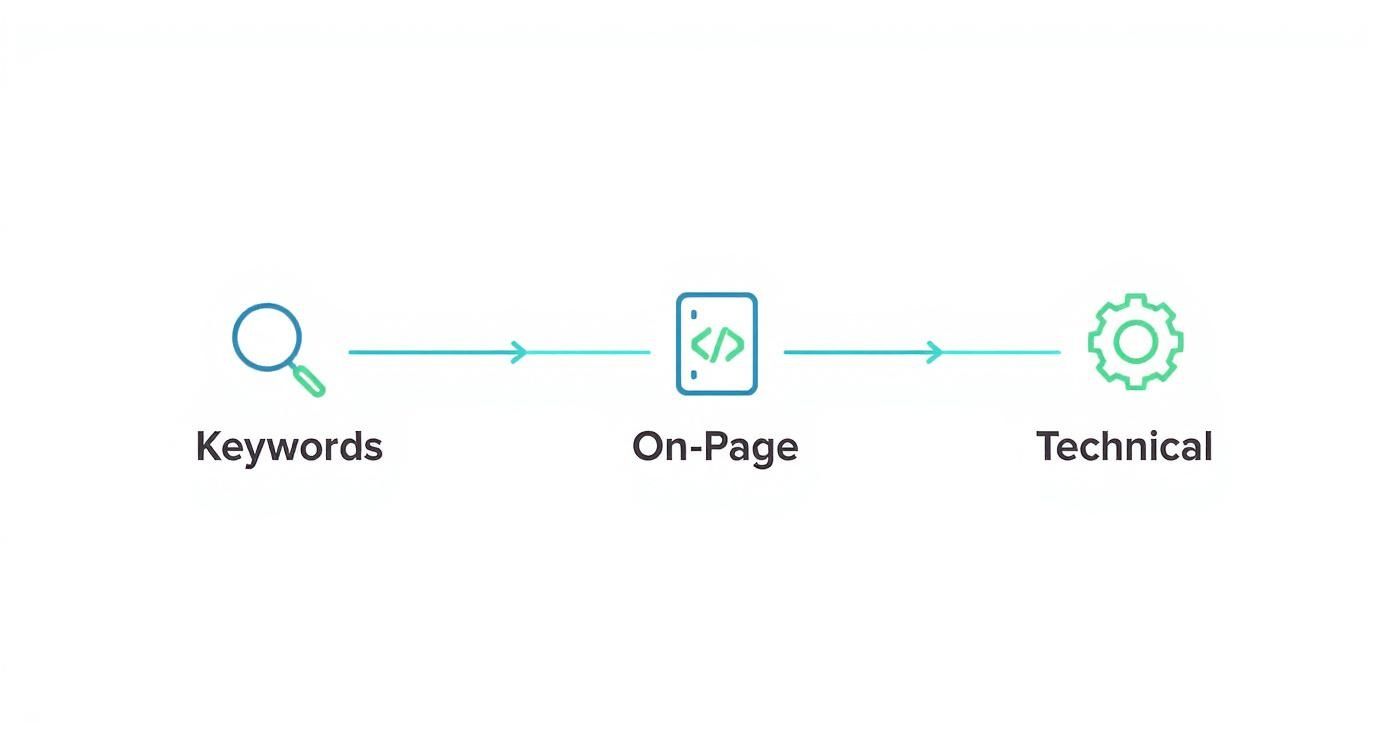
The main takeaway here is that all three elements have to work in sync. Great keywords are useless without well-structured pages, and amazing content will never get seen if the site is a technical mess.
To really build a strong marketing foundation, you need to master the three pillars of SEO. Each one plays a critical role in how search engines perceive and rank your site.
Core SEO Pillars for Website Marketing
A summary of the three essential SEO pillars and actionable steps for each to build a strong marketing foundation.
| SEO Pillar | Key Focus | Example Action for a Restaurant Supplier |
|---|---|---|
| Technical SEO | The health and crawlability of your website's infrastructure. | Ensure your site has a valid SSL certificate (HTTPS) to secure customer data and build trust. |
| On-Page SEO | Optimizing individual web pages to rank higher and earn more relevant traffic. | Use expert article writing to craft a detailed product description for a "Blodgett Convection Oven" that includes keywords like "bakery oven" and "energy-efficient." |
| Off-Page SEO | Actions taken outside of your own website to impact your rankings. | Get a backlink from a popular food blogger who reviewed one of the commercial mixers you sell through targeted blogger outreach. |
Focusing on these three areas ensures you're not just creating content, but also building a website that search engines trust and want to show to users.
Master the Technical Details (Don't Skip This)
Finally, let's talk about the technical health of your website. This part is completely non-negotiable. Google wants to send its users to sites that provide a great experience, which means your site absolutely must be fast, mobile-friendly, and free of glaring errors.
Technical SEO is what makes sure your website's plumbing doesn't stop search engines from crawling and indexing your content. It’s all about making your site as easy as possible for Google's bots to read, which has a direct impact on your ability to rank.
A few key things to watch:
- Page Speed: If your product pages take forever to load, potential customers are gone. A site that loads in 1 second has a conversion rate 3x higher than a site that loads in 5 seconds. It's that simple.
- Mobile-Friendliness: Most chefs and restaurant managers are scrolling on their phones between shifts. Your website has to look good and be easy to use on any device, no exceptions.
- Secure Connection (HTTPS): A secure site is a baseline requirement. It builds trust with both your users and with search engines.
Ignoring these elements will seriously hamstring your marketing. Consider this: search engines drive about 93% of all website traffic across the globe. If you’re not visible in search results, you're missing out on almost all of your potential customers.
The best place to begin is with a full site checkup. Our guide walks you through exactly how to perform a website audit so you can find and fix these critical technical problems. For more hands-on help, you can also explore specific strategies to grow online exposure with SEO.
Create Content That Solves Customer Problems
Once you've got your website's SEO foundation sorted, it's time to focus on the heart of your marketing: creating content that actually helps your customers. This isn't about pumping out generic articles. It's about using strategic blog posting and article writing services to build a library of genuinely useful resources that solve the real-world problems restaurant owners and chefs deal with every single day.
Think of it this way: great content is the engine that drives modern marketing. Instead of just trying to sell a charbroiler, you're giving a chef the knowledge they need to choose the right charbroiler. That simple shift builds incredible trust and attracts qualified buyers long before they're even thinking about making a purchase.

Go Beyond Basic Product Descriptions
If you really want your website marketing to work, your content needs to speak directly to your audience's needs. Think about their entire journey, from the first spark of an idea to post-purchase maintenance. Your mission is to create a complete content ecosystem that supports them at every stage.
Doing this transforms your website from a simple online catalog into an indispensable resource for the entire industry.
Develop In-Depth Buyer’s Guides
One of the most powerful tools in your content arsenal is the in-depth buyer's guide. These are comprehensive, long-form articles that walk a customer through every single thing they need to consider before buying a major piece of equipment. They're magnets for visitors who are actively researching and close to making a decision.
A guide like "How to Choose the Right Commercial Refrigerator," for instance, could dive into:
- Different Types: Breaking down the pros and cons of reach-in units versus walk-in coolers.
- Key Features: Explaining why things like energy efficiency ratings and compressor placement actually matter.
- Sizing and Capacity: Giving them real formulas to calculate the right size based on their restaurant's daily covers.
- Budgeting Advice: Looking beyond the sticker price to talk about long-term costs like maintenance and energy use.
This is the kind of content that answers complex questions, builds massive credibility, and naturally steers people toward the products you sell.
Answer Common Questions with Strategic Blog Posts
Strategic blog posting is all about listening. What are the common, recurring questions your sales team hears every day? Turn those questions into helpful articles. These posts are gold for attracting search traffic from people who aren't ready to buy today but are hungry for information.
Effective content marketing is about becoming the go-to source for reliable information in your niche. When a chef has a question about equipment maintenance or kitchen efficiency, your website should be the first place they think to look.
By consistently publishing articles that solve real problems, you'll see a natural, steady increase in visitors. If you want to get into the nuts and bolts of how this works, our guide explaining what is organic traffic is a great place to start. It shows how valuable, problem-solving content brings the right audience to your door without you having to pay for ads.
Create Practical and Actionable Resources
Go beyond articles and think about creating resources your customers can use in their day-to-day operations. These practical tools get shared around and are a fantastic way to capture leads.
Here are a few ideas that work wonders for restaurant equipment suppliers:
- Equipment Maintenance Checklists: Think downloadable PDFs like a "Weekly Charbroiler Cleaning Checklist" or a "Monthly Fryer Maintenance Guide."
- Compelling Case Studies: Show, don't just tell. Tell a story with real data, like "How Tony's Pizzeria Cut Energy Bills by 20% with Our New Oven."
- Comparison Articles: Write detailed, head-to-head comparisons between two popular models, like different commercial ice machines, to help buyers make a confident choice.
Every piece of content you create should have a clear job: to educate, to solve a problem, or to build confidence in your products. This thoughtful approach is the cornerstone of any successful long-term marketing plan.
Dominate Your Local Market with Targeted Outreach
For a restaurant equipment supplier, winning the local market isn't just an option—it's everything. While your website's content and SEO efforts cast a wide net, hyperlocal strategies are what put you in front of the chefs, GMs, and new restaurant owners right in your own backyard.
This is about becoming the first call they make when a walk-in cooler dies in the middle of a Friday night dinner rush. You get there by showing up exactly where your customers are looking.
Optimize Your Digital Storefront with Google Business Profile
Think of your Google Business Profile (GBP) as your most valuable piece of digital real estate. When a local chef frantically searches "commercial oven repair near me" on their phone, it’s the GBP listings in the Google Map Pack they see first. Neglecting this is like having an unlisted phone number—you're invisible.
To make it work for you, your GBP needs to be more than just a name and an address.
- Fill Out Everything: Get granular. List all your services, from "Equipment Installation" to "Emergency Repair." Showcase your top-selling charbroilers and convection ovens in the products section. Keep your hours dead-on accurate.
- Use Real, High-Quality Photos: Post clear pictures of your showroom, your team on a service call, and your equipment installed in a client's kitchen. It builds instant trust and shows you're a real, active business.
- Chase Down and Respond to Reviews: Actively ask your happy clients for reviews. And make sure you respond to every single one—good or bad. It proves you're engaged and that you care about your customers.
This profile is your local search storefront. Keeping it fresh tells Google you’re a relevant, active player in the area, which directly impacts how you market your website to a local audience.
Build Trust with Consistent Local Citations
Beyond Google, your business's Name, Address, and Phone number (NAP) are scattered across dozens of online directories like Yelp, Yellow Pages, and industry-specific sites. Each of these mentions is a local citation.
Consistency here is non-negotiable. If one directory has your old address while another has a typo in your phone number, it sends mixed signals to both customers and search engines. Google sees these inconsistencies as red flags, and it can tank your local rankings.
A clean, consistent citation profile is a foundational trust signal for search engines. It validates your physical location and legitimacy, making it much easier for Google to confidently recommend you in local search results.
Trying to manage all these listings by hand is a nightmare. That’s where local citation services are worth their weight in gold. We help audit your current citations, clean up the messy ones, and build new ones across relevant directories so your online presence is accurate and authoritative everywhere. For a deeper dive, understanding the fundamentals of local citation building is a great place to start.
Connect with Local Influencers Through Blogger Outreach
The final piece of this local puzzle is about building real relationships. Every city has its share of influential food bloggers, restaurant reviewers, and industry writers whose opinions carry serious weight. Getting on their radar through blogger outreach can lead to incredibly powerful endorsements.
Forget the generic email blast. This has to be personal. Zero in on a handful of local food bloggers whose audience includes restaurant pros and serious foodies.
Your outreach could look like this:
- Offer an exclusive look: Invite a blogger for a private tour of your showroom to see a new line of energy-efficient commercial refrigerators before anyone else.
- Be the expert: Offer yourself as a source for a story they're writing on "kitchen design trends for new restaurants."
- Get involved: Partner with a blogger to sponsor a local food festival or a "best new chef" competition.
A single feature on a respected local blog can drive a flood of qualified traffic to your site and, just as importantly, score you a valuable backlink that gives your SEO a serious boost. It's how you go from being just another supplier to a cornerstone of the local restaurant community.
Amplify Your Reach with Strategic Ads
You've put in the work, building a solid foundation with SEO and content. Your website is now an asset, pulling in customers organically. It's time to pour some fuel on that fire. This is where strategic social media and paid advertising come in, giving you the power to generate immediate, targeted traffic and blast your message to the right people.
This isn't about just throwing money at ads and hoping for the best. It's about precision. For a business like a restaurant equipment supplier, this means pinpointing exactly where your customers—the chefs, general managers, and ambitious restaurateurs—are actually spending their time online.

Choose the Right Platforms for Your B2B Audience
Not all social platforms are created equal, especially in the B2B world. A consumer brand might crush it on TikTok, but your focus needs to be much sharper.
- LinkedIn: This is your primary B2B playground. It’s tailor-made for connecting with decision-makers like procurement managers for restaurant groups or high-level hospitality execs. Use it to share compelling case studies, industry insights, and genuinely valuable content that establishes you as an authority.
- Instagram: Don't sleep on its power for visual products. High-quality photos and short, snappy videos are perfect for showcasing the sleek lines of a new commercial espresso machine or the rugged build of a heavy-duty charbroiler. Instagram is where you sell the aesthetic and build brand desire.
- Facebook: Its true strength is in the deep, powerful ad-targeting capabilities. You can build audiences based on job titles ("Restaurant Owner"), interests ("Commercial Kitchens"), and even specific behaviors, like targeting people who have recently engaged with pages in the food service industry.
The whole point is to meet your customers where they already are. When you show up in their feed, you're delivering a message that speaks directly to their professional needs.
Create Laser-Focused Paid Ad Campaigns
Once you’ve picked your platforms, the real work begins. The magic of paid ad networks like Google and Facebook is their almost scary ability to reach incredibly specific groups of people. This is how you market your website with surgical precision and stop wasting ad spend.
Let's say you're promoting a new line of energy-efficient commercial convection ovens. You could run campaigns that target:
- Geographic Areas: Run ads specifically aimed at "new cafes opening in [Your City]."
- User Behavior: Target people on Google who are actively searching for terms like "best oven for a small bakery" or "commercial charbroiler for sale."
- Lookalike Audiences: Upload a list of your best existing customers, and let Facebook's algorithm build a brand-new audience of users who share similar traits.
The key to a winning ad campaign isn't a massive budget; it's a smart budget. By hyper-targeting your ads, you ensure every dollar is spent reaching a genuine potential customer, which dramatically boosts your return on investment.
This targeted approach turns advertising from a gamble into a calculated business move. The data backs this up. As of 2025, a staggering 93% of marketers globally use social media in their strategies. The giants, Facebook and Google, are central to this, gobbling up a combined 58.5% of the US digital ad market precisely because their ability to reach niche audiences is second to none. You can read more about these marketing trends to get the full picture.
Manage Your Ad Spend and Measure ROI
Launching a campaign is just the beginning. To make sure your efforts are actually profitable, you have to track performance and constantly optimize. The "set it and forget it" mindset is a recipe for disaster.
First, define what success actually looks like for you. What’s the main goal?
- Lead Generation: Are you tracking how many people fill out a "Request a Quote" form?
- Direct Sales: Are you monitoring online sales of smaller equipment or replacement parts?
- Brand Awareness: Is the goal to measure the reach and engagement of your ads?
Dive into the analytics dashboards within Google Ads and Facebook Ads Manager. Keep a close eye on key metrics like Cost Per Click (CPC), Conversion Rate, and, most importantly, Return on Ad Spend (ROAS). If an ad is underperforming, don't be afraid to pull the plug. Pause it, tweak the creative, adjust the targeting, and run it again.
This constant cycle of testing and refining is what separates a money pit from a money-making marketing machine.
Measure What Matters to Grow Smarter
Marketing your website isn’t a “set it and forget it” kind of job. It’s a constant loop of doing, measuring, and tweaking. Honestly, flying blind is the fastest way I’ve seen businesses burn through their marketing budget and waste precious time. If you want to grow smarter, you have to stop guessing what works and start letting the data tell you what to do next.
This means getting your hands dirty in your website's analytics. You need to see exactly how people find you, what they do when they get there, and which of your efforts are actually bringing in sales. When you measure what matters, you can confidently double down on the campaigns that are hitting the mark and pull the plug on the ones that are just eating up resources.
Setting Up Your Data Dashboard
First things first: you can't measure anything without the right tools. The undisputed industry standard here is Google Analytics 4 (GA4). It’s a free, incredibly powerful platform that gives you a complete behind-the-scenes look at how your website is performing. Getting this set up isn't just a suggestion—it's the critical first step.
Once GA4 is up and running, you can start answering the big questions:
- Where is my traffic actually coming from? Is it Google search, Facebook ads, or that local business directory I signed up for last year?
- Which pages on my site are getting all the attention?
- What topics or products are really connecting with my audience?
- Which marketing channels are driving the most quote requests or sales?
Understanding these fundamentals is how you turn a bunch of raw numbers into a clear, strategic roadmap for growth.
Key Metrics to Track for Your Business
It's easy to get lost in a sea of data. Don't try to track everything. Instead, focus on a handful of key performance indicators (KPIs) that directly tie back to your bottom line. For a restaurant equipment supplier, these are the metrics that really tell the story.
Data tells you a story. Your job is to listen to that story and use it to write the next chapter. If you see a spike in traffic from a specific food blogger's review, that’s not just a number—it’s a clear signal to pursue more blogger outreach.
Get in the habit of creating a simple monthly performance report that zeroes in on a few core areas. This simple discipline forces you to regularly check in on your strategy and make nimble adjustments before you get too far off track.
Here's a look at the essential metrics you should be watching, what they mean for your business, and the tools you can use to keep tabs on them.
Key Website Marketing Metrics to Track
| Metric | What It Measures | Why It Matters | Tool to Use |
|---|---|---|---|
| Traffic Sources | The channels that bring visitors to your website (e.g., organic, paid, social). | Shows you exactly which marketing efforts are most effective at driving traffic. | Google Analytics 4 |
| Conversion Rate | The percentage of visitors who complete a desired action (e.g., fill out a quote form). | This is the single best indicator of whether your website is successfully turning visitors into leads. | Google Analytics 4 |
| Top Landing Pages | The most popular entry pages on your site. | Reveals which of your content, products, or offers are attracting the most initial attention. | Google Analytics 4 |
| Bounce Rate | The percentage of visitors who leave after viewing only one page. | Can indicate a disconnect between your ad/link and the landing page content. A high rate often means you missed the mark. | Google Analytics 4 |
Tracking these metrics consistently will give you a solid foundation for making smarter, data-backed decisions that actually move the needle for your business.
Turning Insights into Action
Here’s the thing about data—it's completely useless if you don't act on it. The whole point of measuring all this stuff is to make better, more informed decisions about your marketing. Your monthly review shouldn't just be a report; it should end with a clear list of next steps.
For instance, if your data shows that a blog post titled "How to Choose a Commercial Charbroiler" is your top organic traffic driver, the action is obvious: start creating more in-depth buyer's guides for your other major equipment categories. If you see that paid ads on LinkedIn are bringing in high-quality leads, maybe it's time to increase your budget there.
This simple cycle of analysis and action is what creates a sustainable growth engine. To take this even further, you can explore these 12 Best AI Marketing Tools for Growth to help automate and sharpen your data-driven decisions.
Frequently Asked Questions
When you're marketing a website in the competitive restaurant equipment space, a lot of questions pop up. I get it. To help you out, I’ve put together some quick answers to the most common ones we hear, giving you some clear, actionable advice to sharpen your strategy.
How Long Until My SEO Efforts Start Working?
This is the big one, and the honest answer is: it takes time. While you might see Google notice small on-page tweaks fairly quickly, you're looking at a 4 to 12-month runway before you see a real jump in organic traffic and leads.
That timeline really depends on how tough your competition is, what your budget looks like, and how consistent you are with creating solid content and building quality backlinks. The key is to think of SEO as a long-term investment in a core business asset, not a magic button for overnight traffic.
What Content is Most Important for My Website?
For a restaurant equipment supplier, your best content is anything that helps a customer make a smart buying decision. Forget the fluff. Your top priority should be creating:
- Detailed Product Pages: Don't just list specs. Use expert copywriting to write unique descriptions that spell out how a feature actually helps in a chaotic kitchen environment.
- In-depth Buyer's Guides: Think like your customer. Strategic blog posting and article writing can produce pieces like "How to Choose a Commercial Dishwasher" that are magnets for people who are early in their research.
- Comparison Articles: Put two popular ice machines head-to-head. Breaking down the pros and cons for your customers positions you as a trusted, unbiased expert.
This kind of content does more than just attract eyeballs; it builds real authority and walks potential buyers right to the "add to cart" button.
Should I Focus on Organic Social Media or Paid Ads?
The truth is, you need both. A blended approach almost always wins because each channel plays a totally different—but equally important—role in your marketing game plan.
Use your organic social channels to build a community and share genuinely helpful stuff, like videos on equipment maintenance. Then, turn to paid ads to laser-target specific buyers—like new restaurant owners in your city—and drive that high-intent traffic directly to your product pages.
You don't have to break the bank to start. Kick things off with a modest ad budget, test a few different audiences and ad styles, and pay close attention to the data. Once you find what clicks with your audience, you can scale up your ad spend with confidence, knowing you’ll get a solid return.
At Charbroilers.com, we know that the right equipment is the heart of any great kitchen. Explore our extensive selection of high-quality, durable charbroilers designed to deliver perfect results every time. Find the ideal model for your restaurant at https://charbroilers.com.