

How to Do Competitor Analysis in SEO: A Practical Guide to Outranking Rivals
An effective SEO competitor analysis isn't just a single task; it's a structured process. First, you have to pinpoint your real rivals in the search results, then you can dig into their top keywords, find the gaps in their content and backlink profiles, check out their technical setup, and finally, prioritize all the juicy opportunities you uncover. This whole approach is designed to turn a mountain of data into a clear, actionable roadmap for climbing the ranks. As specialists in SEO, local citation services, and article writing for restaurant equipment supply websites, we've refined this process to deliver results.
Setting the Stage for an Effective SEO Analysis
Before you can start picking apart a competitor's strategy, you need to be crystal clear on who you're actually up against. This isn't about listing every other restaurant equipment supplier you know. It’s about identifying the specific domains that consistently pop up for the search terms your ideal customers are actually typing into Google.
It's a common mistake to assume your business competitors and your SEO competitors are the same list—they rarely are. The goal here is to ditch the guesswork and use real search data to build a focused hit list. As you get started, having the right tools makes a world of difference, and it’s worth understanding what the best AI search tracker tools can bring to the table.
Find Your True SERP Rivals
The most reliable way to find your search engine rivals is to step into your customer's shoes. Fire up an incognito or private browser window to make sure your personal search history doesn't skew the results. Then, start searching for high-intent keywords—the kind of phrases people use when they're ready to buy.
For a business like Charbroilers.com, a great place to start would be a specific query like ‘best commercial charbroiler for diners’ or maybe ‘heavy-duty countertop griddle’.
The process is pretty straightforward: you search, you filter through the noise, and you build your list.
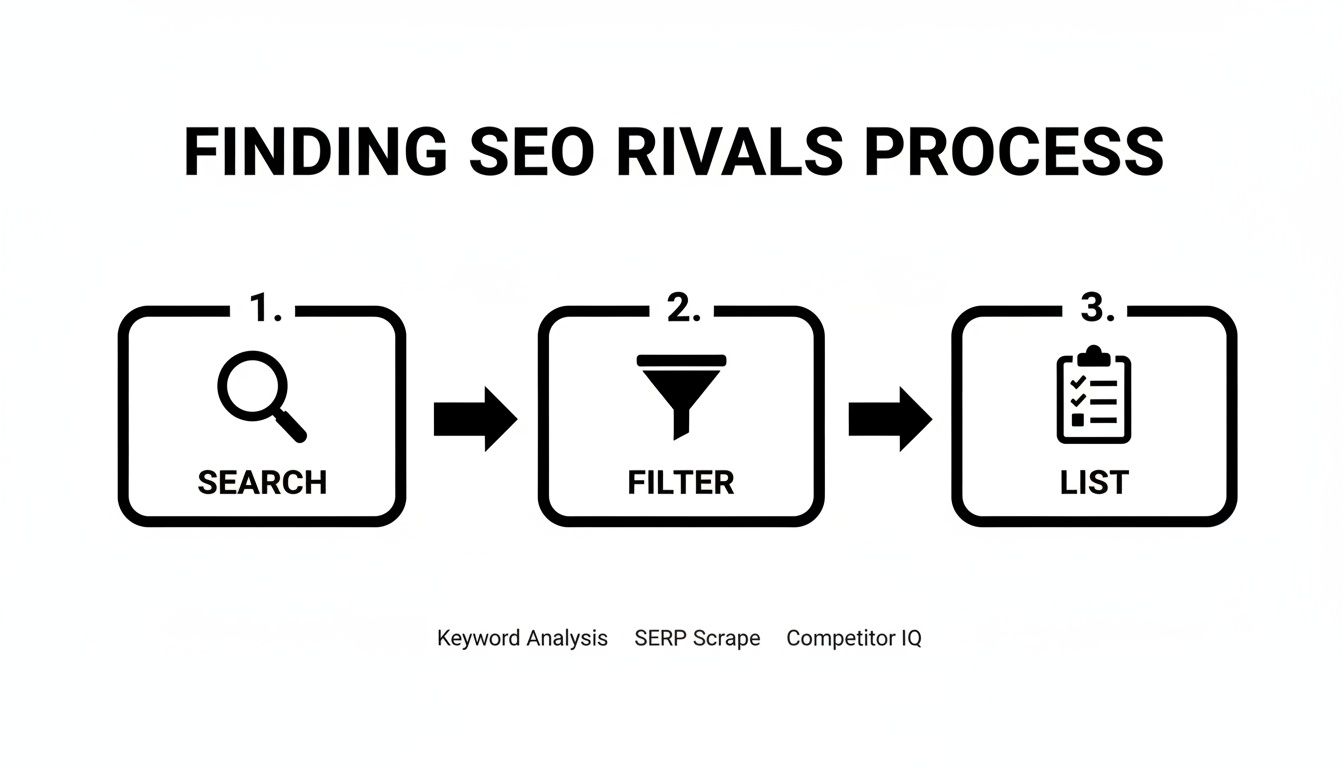
The real insight comes from looking for patterns. You're not just glancing at page one for a single search. You're trying to spot the same domains showing up again and again across multiple, related searches. Those are your true rivals.
As you run these searches, start jotting down the top 10-20 domains that appear. You’ll quickly see that some are informational behemoths like Wikipedia or big review sites. You can filter those out. Your focus should be on the direct e-commerce competitors and niche industry blogs that repeatedly show up.
We've seen businesses that zero in on just 3-5 consistent domains see their Share of Voice (SoV) improve by up to 40% within just 90 days. This method forces you to concentrate on the real obstacles, so you don't waste time and resources analyzing irrelevant sites.
Key Takeaway: The goal isn't to create a massive list of every possible rival out there. It's to build a tight, curated list of the 3-5 domains that are consistently standing between you and your most valuable keywords. Getting this right is the foundation for a successful analysis.
Deconstructing Your Competitor's Keyword Strategy
Once you've got your list of primary rivals, it's time to get under the hood and see what's fueling their organic traffic. This is where you dissect their keyword strategy. We're not just making a big list of popular terms here. The real goal is to get a deep understanding of the exact questions, pain points, and buying signals of the audience you both share.

Think of it as reverse-engineering their success. When you see what's already working for them, you can build a smarter, more effective content and SEO plan without having to guess. You’ll find keywords you never even thought of and get a much better feel for the language your customers actually use.
Finding the Gaps in Their Armor
A keyword gap analysis is the fastest way to uncover these opportunities. You'll use an SEO tool like Semrush or Ahrefs to compare your site's keyword rankings against a competitor's. The tool spits out a list of valuable keywords they rank for that you don't. Simple, but powerful.
It's like finding holes in your net. Let's say a competitor ranks on page one for "how to season a new commercial griddle," but you don't have a single piece of content on that topic. That's a huge gap. It means a chunk of your target audience is going straight to a rival for answers you should be giving them.
This tactic is a goldmine in the commercial kitchen equipment space. Finding keywords your rivals rank for and then sizing them up by search volume and difficulty can seriously expand your online footprint. We know that article titles with questions can boost click-through rates by 14.1%, and since the first page of Google gets 71% of all clicks, these gaps are content gold.
Sifting Through the Data to Find Gold
Running a gap analysis will probably leave you with a massive spreadsheet of keywords. Now comes the important part: filtering that list down to the terms that will actually move the needle. A critical piece of this involves using advanced SERP scraping techniques to gather the full picture of their organic visibility and the why behind their rankings.
Here's how I recommend prioritizing what you find:
- Relevance: Is this keyword actually related to what you sell? A competitor might rank for something that’s only loosely connected to their business. You need to focus on terms that align with your core products, like "commercial flat top grill maintenance."
- Search Intent: What's the person really looking for? Are they just gathering info ("what is the best charbroiler for steaks"), trying to find a specific website, or are they ready to pull out their credit card ("buy Garland X36 charbroiler")? Always prioritize keywords with commercial and transactional intent first.
- Search Volume: How many people are searching for this every month? Big numbers are great, but don't sleep on the low-volume, super-specific long-tail keywords. A term like "NSF certified countertop gas charbroiler" might only get 50 searches a month, but the person searching is almost certainly looking to buy.
- Keyword Difficulty (KD): How tough will it be to rank for this? Most SEO tools give you a KD score. I always suggest targeting some "quick win" keywords with lower difficulty first. This helps build momentum while you chip away at the more competitive terms.
Pro Tip: Don't just look at the keywords themselves. Look at the pages that are ranking. If a competitor's blog post about 'commercial oven cleaning tips' is ranking for 50 different keywords, you know that single piece of content is a powerhouse asset worth digging into.
Keyword Gap Analysis Prioritization Matrix
To make this process more concrete, here's a simple framework I use. It helps you quickly sort and prioritize the keywords you've discovered, ensuring you focus your energy where it will have the most impact.
| Keyword Example | Search Intent | Search Volume | Keyword Difficulty | Priority Level |
|---|---|---|---|---|
| "best commercial charbroiler" | Informational / Commercial | 800 | Medium | High |
| "how to clean charbroiler grates" | Informational | 350 | Low | Medium |
| "buy Vulcan charbroiler online" | Transactional | 120 | Medium | High |
| "charbroiler parts near me" | Navigational / Local | 200 | Low | Medium |
| "what is radiant vs lava rock" | Informational | 90 | Very Low | Low |
This matrix isn't just a list; it's a decision-making tool. By mapping out intent, volume, and difficulty, you can clearly see which keywords offer the best return on your content creation efforts and which ones can wait.
Turning Gaps into a Content Plan
Your analysis is worthless if you don't do anything with it. The final move is to organize these shiny new keywords into a real-world content plan. Start grouping related keywords into topic clusters.
For instance, keywords like "seasoning a charbroiler," "cleaning cast iron grates," and "charbroiler flare-up prevention" can all be bundled together into a comprehensive "Commercial Charbroiler Care Guide."
This approach means you're not just throwing random content at the wall and hoping it sticks. Instead, you're building a strategic library of resources that directly fills the gaps between you and your competitors. For a much deeper look at organizing your findings, check out our guide on how to build a keyword list. This turns competitor research into a clear roadmap for winning over their audience and growing your traffic.
Finding Opportunities in Your Competitor's Content
Just knowing which keywords your competitors rank for is only half the battle. The real fight for search engine dominance is won with superior content. Ranking isn’t just about stuffing keywords onto a page; it’s about giving a searcher the absolute best, most helpful answer to their question. Our blog posting and copywriting services are designed to do exactly this: audit the content that's already winning so you can create something much, much better.
By dissecting your competitor's top pages, you can find their weaknesses and turn them into your strengths. Is their content five years old? Is it a dense wall of text nobody wants to read? Does it lack any real-world examples? Every single shortcoming is an open door for you to walk through and deliver a more valuable resource.
Analyzing the Anatomy of a Winning Page
Before you can build something better, you need a blueprint of what's already working. Go ahead and pull up the top 3-5 ranking pages for one of your target keywords—let's use "commercial oven maintenance tips" as an example. Don't just skim them. You're going to perform a methodical breakdown.
Look for the patterns that emerge across these top-ranking articles. Pay attention to things like:
- Word Count and Depth: Are the top results comprehensive, 2,000-word deep dives, or are they quick, scannable lists? I've seen that content over 3,000 words often gets more traffic, but remember, length without substance is completely useless.
- Use of Media: Do they have high-quality photos of the actual equipment? Are there helpful videos showing maintenance procedures? A total lack of visuals is a massive weakness you can easily exploit.
- Formatting and Readability: Are they using short paragraphs, clear H2/H3 headings, and bullet points to make the content easy to digest? A poorly formatted page is a user experience nightmare and a prime target for you to beat.
This initial analysis gives you a feel for the competitive landscape. If every top result is a long-form guide packed with video tutorials, you know a simple 500-word blog post isn't going to cut it. On the other hand, if they’re all text-only articles, you have a clear shot at creating a much more engaging, multimedia-rich experience.
Identifying Content Weaknesses to Exploit
Once you have the big picture, it’s time to zero in on the specific gaps you can fill. This part of your SEO competitor analysis is all about finding the cracks in their content armor.
Put yourself in the shoes of a frustrated restaurant owner looking for information. What questions are they leaving unanswered? What critical details are they missing?
Key Insight: The goal here isn't to copy your competitor's outline. It's to find what they failed to do and make that the core of your own, superior piece of content.
For instance, you might find a competitor's popular guide on commercial oven maintenance is just a solid block of text. This is a golden opportunity. You can create a resource that's not only more detailed but also includes:
- A Downloadable Checklist: A simple PDF that a busy kitchen manager can print out and use for their weekly maintenance tasks.
- Step-by-Step Images: Clear photos that actually illustrate each step of the cleaning process, from removing racks to cleaning the convection fan.
- Embedded Video Content: A quick, two-minute video demonstrating how to properly calibrate the thermostat—something that’s much easier to show than explain with words.
By adding these simple elements, you’ve turned a basic article into an indispensable tool. You haven't just created content; you've created a genuine solution that serves the user's needs way more effectively than what the competition is offering.
Evaluating E-E-A-T Signals
Google’s focus on Experience, Expertise, Authoritativeness, and Trustworthiness (E-E-A-T) is a big deal, especially for B2B industries like ours. Your content has to prove it comes from a credible source. This is another area where competitors often drop the ball.
When you're auditing their top pages, look for these signals:
- Author Credentials: Is the article written by a named author with clear industry experience (like a former chef or a certified technician)? Or is it just posted anonymously?
- Citing Sources: Are they linking out to manufacturer guidelines or industry safety standards? Citing authoritative sources is a simple way to build trust.
- Original Data or Insights: Does the content include unique tips learned from years of hands-on experience, or is it just rehashed information you can find anywhere?
If your rival's content lacks clear authorship or doesn't back up its claims, you can gain a serious advantage. Make sure to feature content written by your in-house experts, include quotes from industry pros, and always link to official documentation. This elevates your content from just "an article" to "an expert resource."
If you need a more structured way to evaluate your own site, performing a thorough content audit for your restaurant equipment website can show you exactly where you stand.
Ultimately, this deep dive is about shifting your mindset from "What keywords should I target?" to "How can I create the single most valuable resource on this topic?" When you focus on improving depth, user experience, and trustworthiness, you create content that doesn't just rank—it earns loyalty and builds your brand's authority.
Analyzing Backlink Profiles to Build Authority
Once you've dissected your competitors' content strategy, it's time to pull back another layer and look at where their authority comes from. In the world of SEO, backlinks are basically votes of confidence from other websites. When a reputable site links to your competitor, it’s a powerful signal to search engines that their content is valuable and trustworthy.
Figuring out where they get these "votes" is the key to building your own authority and eventually leapfrogging them in the rankings. We specialize in blogger outreach for the restaurant equipment industry, turning competitor analysis into a targeted link-building strategy.

This process essentially turns their link-building efforts into your own strategic roadmap. By seeing exactly who links to them, you can build a hyper-targeted outreach plan to earn high-quality, relevant backlinks that give your own site a serious boost.
Mapping Out Their Digital Footprint
First things first, you need a bird's-eye view of your competitor's backlink profile. Using an SEO tool like Ahrefs or Semrush, you can pull a complete list of every single website linking to them. I know, this initial data dump can feel like a lot, but you're not looking at individual links just yet. You're looking for patterns.
The goal here is to categorize their link sources. Are they getting links from places like:
- Industry Publications: Major restaurant and hospitality magazines or news sites?
- Food Blogs: Popular food bloggers who review or mention equipment?
- Equipment Review Sites: Niche websites that specialize in comparing commercial kitchen gear?
- Local Directories: Business listings specific to the foodservice industry? This is where our local citation services become invaluable.
Let’s say you’re analyzing a top competitor for commercial charbroilers. You might discover they have dozens of links from a well-known blog called "Restaurant Management Today." That's a huge clue. It tells you this specific publication is a valuable source of authority in your niche.
Gauging the Quality of Their Links
It's a simple truth: not all links are created equal. A single link from a high-authority site like Food & Wine is worth a hundred times more than links from spammy, low-quality directories. A critical part of any good SEO competitor analysis is learning to separate the gold from the junk.
As you sift through their profile, keep an eye on a few key metrics:
- Domain Authority (DA) or Domain Rating (DR): This is a score from 1-100 that estimates a website's overall authority. I generally focus on links from sites with a DR of 40 or higher.
- Relevance: Is the linking site even related to the restaurant industry? A link from a culinary school's blog is far more relevant and powerful than one from an automotive website.
- Page Traffic: Does the page linking to them actually get visitors? A link on a high-traffic page is way more likely to send valuable referral traffic your way.
Pro Tip: Look at the specific pages on your competitor's site that attract the most backlinks. If their guide on "Commercial Refrigerator Maintenance" has links from 50 different domains, that's a massive signal that this is a "link-worthy" asset. This insight tells you exactly what kind of content you should create to attract links yourself.
Reverse-Engineering Their Success
Once you've pinpointed their best links, the real work begins. You need to figure out why they got that link in the first place. This lets you replicate their strategy, but with your own unique—and better—content.
For example, if a key competitor was featured in a roundup on a popular blog called "Top 5 Innovations in Commercial Kitchens," don't just email them asking to be added. That rarely works.
Instead, pitch a different, more valuable article idea to that same publication. Something like, "How to Choose Energy-Efficient Charbroilers for a Greener Kitchen."
This approach doesn't just copy their tactics; it improves on them. You're providing fresh, new value to the publication while inserting your brand into a conversation where your competitor is already active. It’s a smart way to siphon off some of their authority. To really get into the nuts and bolts, you might be interested in learning how to find backlinks in Google and what to do with them.
Here’s a quick comparison of a weak vs. strong outreach approach:
| Outreach Approach | Weak (Copying) | Strong (Improving) |
|---|---|---|
| Contacting Site | Restaurant Management Blog | Restaurant Management Blog |
| Your Pitch | "Can you add our charbroiler to your 'Top 5' list?" | "I have an original article idea about energy efficiency that your readers would love." |
| Value Proposition | Asks for a favor | Offers new, exclusive content |
| Likely Outcome | Ignored or rejected | High chance of acceptance |
By analyzing their backlinks, you're essentially building a pre-vetted list of websites that are already interested in your industry. This removes all the guesswork and allows you to focus your outreach efforts where they will have the greatest impact—turning their hard-earned authority into your competitive advantage.
Auditing Technical SEO for a Competitive Edge
Ever had that sinking feeling? You know your content is better, your backlinks are stronger, but you’re still stuck on page two while a competitor sits pretty at the top. It’s beyond frustrating. More often than not, the culprit is hiding in plain sight: your website’s technical foundation.
Solid technical SEO is the invisible engine that drives everything else. If your competitor’s site runs like a well-oiled machine and yours sputters, they’ll win the ranking race almost every time. That's why running a quick technical audit on your top competitors is one of the smartest moves you can make. It helps you find those easy wins by shining a light on their flaws—slow pages, a clunky mobile design, or a confusing site layout. These are the cracks you can exploit.

Assessing Site Speed and Core Web Vitals
Page speed isn't some minor detail; it's a huge part of the user experience. We know that 40% of people will ditch a website if it takes more than three seconds to load. If your competitor’s product pages are sluggish, you’ve just found a massive opportunity.
You can get a quick diagnosis using Google’s PageSpeed Insights. Just grab the URL for one of their high-ranking pages—say, one for "commercial gas charbroilers"—and plug it in. The report will tell you exactly how it performs.
You’ll want to pay special attention to the Core Web Vitals (CWV) metrics:
- Largest Contentful Paint (LCP): How fast does the main content, like the big hero image of a charbroiler, show up?
- First Input Delay (FID): How quickly does the page respond when someone clicks something, like a "View Specs" button?
- Cumulative Layout Shift (CLS): Does the page stay stable, or do buttons and images jump around while it loads?
If your competition is failing their CWV assessment, you have a clear mission. Optimize your own pages to be faster and more stable. It’s a straightforward fix that can give you a real, tangible edge.
Evaluating Mobile-Friendliness and Usability
Think about a busy chef or restaurant manager. They're probably looking for new equipment on their phone between shifts. A clunky mobile site is an instant deal-breaker. If they can't easily find what they need, you've lost a sale.
Start with Google's Mobile-Friendly Test to get a baseline on your competitor's site. But don't stop there. The real insights come from using it yourself. Pull up their site on your phone. Try to find a "36-inch countertop griddle" and go through the process of adding it to the cart. Is it a smooth experience, or a frustrating one?
Pro Tip: Ask yourself these simple questions while browsing their mobile site: Can I read the text without pinching and zooming? Are the buttons big enough to tap without hitting the wrong one? Is the navigation menu a nightmare to use? Every "no" is a weakness you can turn into your strength.
Analyzing Site Architecture and Navigation
A logical site structure isn't just for users; it’s a roadmap for search engine crawlers. It tells them which pages are the most important. Good organization helps "link equity" flow from your homepage down to your key category and product pages, giving them more authority.
Take a hard look at your competitor's main menu and URL structure. For a site selling restaurant equipment, it should be dead simple. A clean, logical structure looks something like this:
charbroilers.com/cooking-equipment/charbroilers/countertop-models
A messy structure, on the other hand, might have ridiculously long URLs or categories that make no sense. If a customer has to click five or six times just to get from the homepage to a specific product, the architecture is broken.
Finding these technical weak spots gives you a clear plan of attack. By making sure your own site is faster, easier to use on mobile, and simpler to navigate, you’re creating a better experience that both people and Google will reward. It’s how you close the gap and start claiming those top spots for yourself.
A Few Common Questions About SEO Competitor Analysis
As you start digging into your competitors' SEO strategies, a few questions always seem to pop up. We hear these all the time from restaurant equipment suppliers, so let's clear the air and make sure you get the most out of your analysis.
How Often Should I Run a Competitor Analysis?
A full-blown, deep-dive analysis isn't something you need to do every week. That’s a recipe for burnout.
For most businesses, a comprehensive competitor analysis works best when done quarterly. This gives you enough time to spot real shifts in their strategy, see if any new players have entered the game, and adjust your own plans without constantly chasing shadows.
That said, you should still keep a finger on the pulse more regularly. I recommend setting aside a little time each month for a quick health check.
- Monthly Check-ins: Just take a quick look at your top 3 competitors. See any new content that's taking off? Any big jumps or drops in their rankings?
- Trigger-Based Reviews: You should also do a focused analysis whenever something big happens, like a major Google algorithm update or if you see a sudden, scary drop in your own rankings for important keywords.
This balanced approach keeps you in the loop without getting stuck in "analysis paralysis." It’s all about staying responsive, not reactive.
What Are the Best Free Tools for This?
You don't need to break the bank to get started. While heavy-hitter paid tools like Ahrefs and Semrush are fantastic, there are several free options that give you some seriously good intel.
- Google Search (in Incognito Mode): This is your ground truth. Use it to manually see who actually shows up time and again for your target keywords, like "commercial countertop charbroiler."
- Google Keyword Planner: Perfect for brainstorming keyword ideas and getting a ballpark figure for search volume.
- Google's PageSpeed Insights: Instantly see how fast a competitor's page is and check their Core Web Vitals. It’s a dead-simple way to spot technical weaknesses.
Juggling these three tools alone can uncover a surprising amount of actionable data without costing you a dime.
Should I Worry About Big Retailers Like Amazon?
This is a really important question. You'll see giants like Amazon ranking for terms like "buy commercial griddle," but here's the thing: they aren't your true SEO competitor.
Their game is built on colossal domain authority and a business model you simply can't (and shouldn't) try to copy.
Your focus needs to be on the other direct-to-consumer e-commerce sites and the specialized industry blogs that pop up over and over again. These are the rivals whose playbooks you can actually study, learn from, and eventually beat. Wasting energy trying to dissect Amazon's backlink profile is a complete distraction.
How Many Competitors Should I Actually Focus On?
It’s easy to get carried away and build a list of 20 or 30 potential rivals. Don't. That just spreads your attention too thin and makes the whole process feel impossible.
Quality over quantity is the name of the game here.
For a truly effective analysis, lock in on 3 to 5 primary SEO competitors. This list should be a smart mix—include your direct business rivals who are doing well in search, but also throw in a niche content site or two that dominates the informational keywords in your space. This tight, focused approach keeps your analysis deep, actionable, and, most importantly, manageable.
At Charbroilers.com, we know that outranking the competition is the key to winning online. Our massive selection of high-quality commercial charbroilers, from compact countertop models to heavy-duty floor units, gives you the edge you need in the kitchen. Explore our equipment and see how the right gear can transform your menu. Find your perfect charbroiler at https://charbroilers.com.