

How to Build a Keyword List: Restaurant Supply Guide
Building a keyword list is the strategic first step to getting found online. It's all about figuring out the exact search terms your customers are typing into Google and organizing them into a real, actionable plan for your restaurant equipment supply website.
This process takes you beyond guesswork. You'll start using real data to guide your blog posting, shape your product pages, and fuel your marketing campaigns. The result? A clear blueprint for attracting qualified buyers who are actively looking for restaurant equipment.
Your Foundation for Dominating Foodservice SEO

Before we get into the nitty-gritty of building your list, we need to answer a core question: What is Keyword Research in SEO?
At its heart, keyword research is the art and science of understanding the language your customers use. For a restaurant equipment supplier, this isn't some abstract marketing task—it’s about getting inside the minds of chefs, foodservice managers, and restaurant owners.
Think of it this way: a chef isn't just searching for a "charbroiler." They might be looking for a "36-inch gas countertop charbroiler" or asking "how to clean cast iron grates." Each phrase reveals a completely different need and a different stage in their buying journey. A solid keyword list captures all of it.
Why a Keyword List Is Your Strategic Blueprint
A well-crafted keyword list is easily the single most important asset you have for your online presence. Seriously. It dictates the success of pretty much every digital marketing activity you’ll undertake, from copyrighting product pages to planning a blogger outreach campaign. Without it, you’re just creating content and running ads in the dark.
This foundational document helps you:
- Understand Customer Intent: Figure out if a searcher is just gathering information, comparing options, or is ready to pull out their credit card.
- Drive Qualified Traffic: Attract visitors who are actively looking for the products you sell, like commercial refrigeration or Blodgett convection ovens.
- Inform Your Content Strategy: Generate endless ideas for blog posts, buying guides, and video tutorials that answer real customer questions.
- Gain a Competitive Edge: Uncover the terms your competitors are ranking for and find the strategic gaps you can fill.
A great keyword list isn't just a collection of terms. It's a direct reflection of your market's needs, problems, and language. It transforms your website from a simple catalog into a valuable resource that solves problems and drives sales.
Building this list requires a methodical approach. It starts with brainstorming those initial "seed" ideas, then expanding them with powerful SEO tools, and finally organizing everything based on relevance and user intent.
When you master this process, you create a clear roadmap for everything from optimizing product pages to launching effective blogger outreach campaigns. You ensure your business shows up right when it matters most.
Finding Seed Keywords in a Commercial Kitchen
The best keyword strategies don't start inside a complicated tool. They start with common sense. Before you even glance at search volume or competition, you need a solid list of what we call seed keywords. These are the simple, foundational terms that act as the bedrock for all your research.
Think of it like taking a walk through a working kitchen. What do you see? What problems are chefs trying to solve every day? This simple exercise grounds your entire strategy in the real-world needs of your customers, giving you a much stronger starting point than any software could.
Brainstorming by Equipment Category
Let's start with the basics. The most direct path to good seed keywords is listing the big-picture categories of equipment you sell. Don't get fancy here; just get the core ideas down on paper. These are the terms a new restaurant owner or a manager planning an expansion will probably search for first.
Your initial list might look something like this:
- Commercial cooking equipment
- Restaurant refrigeration
- Food prep supplies
- Commercial dishwashers
- Ice machines
- Stainless steel work tables
Think of these as the main branches of your keyword tree. We'll find all the smaller branches and leaves later. For now, we're just building the core structure.
The quality of your entire keyword list hinges on these initial seed keywords. If you start with terms that don't match how your customers actually talk, every step after this will be built on a shaky foundation.
Thinking About Specific Products and Brands
Okay, you've got your broad categories. Now it's time to zoom in. A seasoned chef isn't just searching for "cooking equipment." They're often looking for a specific piece of gear or a brand they've trusted for years. This is where your deep product knowledge becomes a massive advantage.
Go through each category and list out the specific product types and brand names people look for. This helps you capture the attention of searchers who are much further along in the buying process and know exactly what they want.
- From "Cooking Equipment": charbroilers, convection ovens, gas ranges, flat top griddles, commercial fryers.
- Brand-Specific Searches: Blodgett convection oven, True refrigeration, Hobart mixer, Vulcan range.
Each one of these is a valuable seed keyword. They open up entirely new avenues for research into model numbers, comparisons, and feature-based searches.
Uncovering Customer Pain Points and Problems
Here's where you can really separate yourself from the competition. It's time to think beyond just listing products and start thinking about the problems your customers need to solve. What are their biggest headaches, questions, and operational needs? These "problem-aware" searches often come from your most motivated buyers.
Think about the practical challenges that come up in a busy kitchen. For example, a restaurant's layout can have a huge impact on equipment choices. You can learn more about that in our guide on commercial kitchen design and layout.
Here are a few examples of pain-point keywords:
- "quietest commercial ice machine" (for a dining room or bar)
- "low-profile undercounter refrigerator" (for a tight, cramped space)
- "easy to clean deep fryer" (to cut down on labor costs)
- "ventless countertop charbroiler" (for kitchens without a hood system)
- "energy efficient walk-in cooler" (to keep utility bills down)
When you gather seed keywords from these three angles—broad categories, specific products, and real-world problems—you create a comprehensive and powerful foundation. This list is now ready to be plugged into your SEO tools, where you'll expand it into a full-scale plan to dominate the search results.
Expanding Your List With Modern SEO Tools
Your seed keywords are a great starting point, but let's be honest—they're just the tip of the iceberg. To build a keyword list that actually drives your business forward, you need to dig much deeper. This is where modern SEO tools like Ahrefs and Semrush come in, turning your initial brainstorm into a data-backed roadmap.
These platforms are built to find the hundreds, sometimes thousands, of related phrases your customers are typing into Google every day. They uncover long-tail variations, question-based searches, and related topics you'd probably never think of on your own.
It’s the difference between knowing people search for "commercial fryer" and discovering they're also looking for "best ventless countertop fryer for a small cafe." One is broad; the other is a customer ready to buy. The process is simple: plug in a seed term, and the tool spits out a massive list of possibilities. It’s like turning a single ingredient into a full menu of content ideas for your article writing strategy.
Uncovering Keyword Variations and Questions
Once you start exploring a seed keyword in a tool, you’ll see several buckets of new keyword ideas. The two I find most valuable are phrase matches and question-based queries. Phrase matches are simply variations that include your original term, while questions reveal the specific problems your customers are trying to solve.
Let’s say you start with "commercial griddle." The tool might uncover:
- Phrase Matches: "36 inch commercial gas griddle," "commercial electric flat top griddle," "heavy duty commercial griddle for sale."
- Question Queries: "how to season a commercial griddle," "what is the best commercial griddle cleaner," "how hot does a commercial griddle get."
Just like that, one seed keyword blossoms into a dozen targeted phrases. Each one signals a unique customer need and gives you a clear idea for a new blog post, FAQ, or product page.
The real power of SEO tools isn't just finding more keywords; it's about gaining a clear view into the entire customer journey. You can see the exact language people use when they're just starting their research versus when they are ready to make a purchase.
Interpreting Volume and Difficulty Metrics
As your list grows, you'll notice two key numbers next to each keyword: Search Volume and Keyword Difficulty (KD). Getting a handle on these metrics is crucial for prioritizing your efforts so you aren't wasting time chasing terms that are way too competitive.
- Search Volume is an estimate of how many times a keyword gets searched each month. A huge number looks tempting, but it almost always means more competition. We have a detailed guide on how to determine search volume for keywords if you want to go deeper.
- Keyword Difficulty is a score (usually from 0-100) that estimates how tough it will be to rank on the first page of Google for that term. Lower scores mean less competition, which is a golden opportunity for newer or smaller websites.
The goal is to find that sweet spot: keywords with decent search volume and a low-to-moderate difficulty score. A term like "best undercounter ice machine" will have a lower search volume than just "ice machine," but it's also likely to have a much lower KD and attract a far more qualified buyer.
This is a screenshot from Ahrefs' Keyword Generator showing what you get for "commercial charbroiler."
You can see how the tool lays out not just the monthly search volume but also the Keyword Difficulty (KD) score, helping you spot the less competitive opportunities at a glance.
Leveraging AI for Deeper Insights
Keyword research has changed a lot with the rise of AI-powered tools. These platforms let marketers analyze massive amounts of data to find nuanced search patterns that were invisible before. In fact, 86% of SEO professionals now use AI in their keyword research, tapping into systems that can process millions of queries in seconds to spot emerging trends.
These tools do more than just find popular terms. They map out related concepts, figure out user intent, and pinpoint long-tail keywords that often have less competition and convert better.
If you want to expand your keyword list efficiently, consider exploring these 12 AI-powered SEO tools. Platforms like these can seriously speed up your research, helping you find valuable terms for everything from charbroiler maintenance to local repair services. When you combine your own industry knowledge with the power of modern tools, you create a truly comprehensive keyword list that covers every angle of your business.
Analyzing Competitors and Winning Local Search
Using tools to grow your keyword list is a great start, but it’s only half the story. Why build a strategy in a vacuum when your competitors have already done some of the heavy lifting? Ethically peeking at what's working for them is one of the smartest shortcuts you can take.
This isn't about blindly copying their every move. It's about strategic intelligence. When you understand which keywords are driving real traffic to their websites, you can spot high-value opportunities, identify content gaps they’ve completely missed, and learn from their wins—and their mistakes.
Uncovering Your Competitors' Keyword Strategy
First thing's first: identify your direct competitors. Think about the other restaurant equipment suppliers who pop up when you search for your top seed keywords. Once you have a list of three to five key players, you can use SEO tools like Ahrefs or Semrush to look behind the curtain.
Just plug a competitor's domain into the tool's site explorer. You'll get a firehose of data showing the exact organic keywords they rank for, how much traffic those terms bring in, and which of their pages are pulling the most weight.
Focus on finding the answers to these questions:
- Which keywords drive their most valuable traffic? Look for terms with obvious commercial intent, like "Vulcan 36-inch gas range price" or "Hoshizaki ice machine for sale."
- Are there any keywords they rank for that you completely missed? Maybe they’re targeting a niche product category or a customer pain point you hadn't even considered.
- What are their top-performing content pages? Analyzing these pages tells you exactly which topics and keyword groups are resonating with your shared audience.
This process hands you a proven list of keywords to fold into your own strategy. You can either create better, more in-depth content to outrank them or target the valuable terms they are neglecting.
Pivoting to High-Intent Local Keywords
While keeping an eye on national competition is smart, many of your most valuable customers are right in your backyard. Chefs and restaurant owners often need equipment or repairs now, and their searches show that urgency. This is where local SEO becomes a massive advantage.
Local keywords are simply search terms that include a geographic modifier, and they signal incredibly high purchase intent because the searcher is looking for a solution nearby. Weaving these into your keyword list is absolutely essential for capturing this ready-to-buy audience.
A restaurant owner with a broken walk-in cooler isn't just searching for "commercial refrigeration repair." They're searching for "commercial refrigeration repair Austin TX" or "emergency freezer service near me." Capturing these local searches is the key to winning immediate business.
To build out your local keyword list, start combining your core product and service terms with geographic locations.
- City-Specific: "restaurant equipment Houston," "commercial oven installation Dallas"
- "Near Me" Queries: "charbroiler parts near me," "used restaurant supplies near me"
- Neighborhood or Regional: "downtown Miami kitchen supply," "Orange County foodservice equipment"
The rise of mobile has completely reshaped this game. Today, 60% of searches in the U.S. happen on mobile devices, which often leads to shorter, more conversational queries with local intent. As you can discover more insights about these search statistics, it's clear that mastering local keywords is no longer optional; it’s a core part of any modern SEO strategy.
Integrating Local Keywords into Your Content
Once you have your list of local terms, the next step is to use them naturally across your website. This is how you signal to search engines that you are a relevant local authority for these products and services.
A great place to start is by creating dedicated location pages. For example, you could have a page titled "Restaurant Equipment Supply in Austin, TX" that specifically targets customers in that area. For a more detailed walkthrough on putting these strategies into action, check out our complete local SEO checklist for restaurant suppliers.
By combining sharp competitor analysis with a strong local keyword strategy, you build a list that gives you a distinct advantage. You're not just competing on a national level; you're ensuring your business is the go-to answer for foodservice professionals in your own community.
Organizing Your Keywords for a Strategic Content Plan
Alright, you’ve done the heavy lifting. You've brainstormed, dug through keyword tools, and peeked at what your competitors are doing. Now you're staring at a massive spreadsheet full of terms. Let's be honest—without some structure, it’s just a bunch of noise. The next step is where the real strategy begins: turning that data into a smart, actionable content plan that builds your website's authority, one piece at a time.
This is all about cleaning up that list, grouping related terms together, and figuring out what your customers actually need at every stage of their journey. It’s how you build a clear roadmap for creating content that doesn't just rank, but genuinely helps your audience and, ultimately, drives sales.
This visual shows how your competitive research helps you find content gaps and local opportunities you can pounce on.
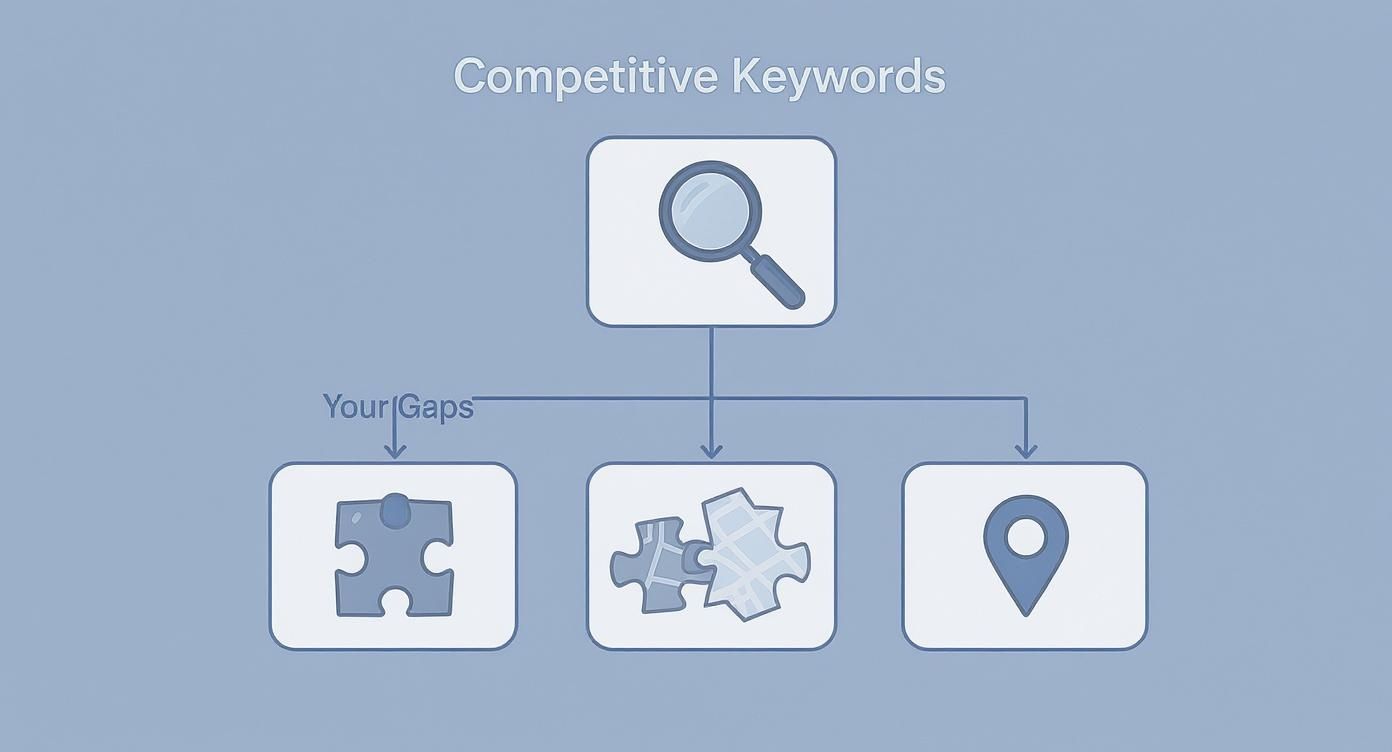
Seeing it laid out like this makes it much easier to decide where to focus your energy to get a real edge in the market.
Grouping Keywords into Topic Clusters
The modern way to organize your keywords is by creating topic clusters. This approach means you stop chasing individual, isolated keywords. Instead, you focus on building authority around a broader subject. The concept is pretty simple: you create one big, comprehensive "pillar" page and then support it with several "cluster" articles that dive deeper into related subtopics.
For a restaurant equipment supplier, this is a game-changer. Let's take a broad topic like "Commercial Griddles."
- Pillar Page: This would be your ultimate guide, maybe titled "The Complete Guide to Commercial Griddles." It covers everything at a high level.
- Cluster Content: These are the supporting blog posts and articles. Each one targets a more specific, long-tail keyword and—this is key—links back to your main pillar page.
Here’s what some cluster content might look like for that topic:
- "How to Season a New Commercial Flat Top Grill"
- "Best Gas Griddles for High-Volume Burgers"
- "Commercial Griddle Maintenance and Cleaning Checklist"
- "Electric vs. Gas Commercial Griddles: Which is Right for Your Kitchen?"
This structure sends a powerful signal to search engines. It tells them you're an expert on the entire topic of commercial griddles, not just a single keyword. Over time, this helps all of your related pages rank higher.
Mapping Keywords to User Intent
Once your clusters are set, the next layer is to map each keyword group to user intent. Simply put, user intent is the "why" behind someone's search. When you understand this, you can create the perfect piece of content for that person, whether they're just starting their research or have their credit card in hand.
There are three main types of intent you need to think about:
- Informational Intent: The person is looking for an answer. Their search probably starts with "how to," "what is," or "why." A perfect example is "how to clean a charbroiler."
- Commercial Intent: They're digging into products and comparing their options before they buy. These searches often include words like "best," "review," "vs," or "comparison." Think "best 36-inch countertop charbroiler."
- Transactional Intent: This person is ready to buy. Now. Their keywords will include "buy," "for sale," "price," or even specific model numbers, like "Vulcan VCRB36 charbroiler for sale."
By tagging your keyword clusters with the right intent, you know exactly what kind of content you need to create. An informational keyword needs a helpful how-to guide. A transactional keyword needs a clean, easy-to-navigate product page.
Grouping keywords by topic and then mapping them to user intent is the final bridge between raw data and a strategic content plan. It ensures that every piece of content you create has a clear purpose and serves a specific audience need.
This whole method reflects a massive shift in how search engines operate. We've moved away from lists of isolated keywords and toward building these content hubs because Google itself has gotten so much better at understanding context. Major updates like RankBrain, BERT, and MUM have made search engines process language more like a human, so exact keyword matching isn't nearly as important as covering a topic thoroughly. You can read more about how search engines have evolved to understand why this thematic approach is absolutely essential today.
When you organize your list this way, you suddenly have a clear content calendar. You can see which pillar pages you need to build and which supporting articles to write next. It creates a systematic path to becoming a dominant voice in the foodservice industry.
Putting Your Keyword List Into Action
So, you've got your keyword list. It’s organized, prioritized, and ready to go. But let's be honest, a list just sitting in a spreadsheet isn't going to bring in traffic or leads. The real magic happens when you start strategically weaving those keywords across your entire online presence. This is where your hard work starts paying off for your restaurant equipment supply business.
The most direct place to start is your own website. Think of each keyword group you built as the inspiration for a specific page or piece of content. Transactional keywords, like "Vulcan VCRB36 charbroiler for sale," are a perfect match for your product pages. On the other hand, informational queries such as "how to clean cast iron grates" are gold for creating detailed blog posts that attract chefs and kitchen managers.
Weaving Keywords Into Your Content
The key is to make keyword integration feel completely natural, not forced. You want to guide search engines, but you never want to sound like a robot to an actual person. A chef searching for a new charbroiler will click away instantly if your product description is just a block of clunky, repetitive phrases.
Instead, focus on placing your primary keyword in a few key spots where it has the most impact:
- The Page Title: This is your prime real estate. A blog post title could be something like, "How to Properly Season a New Commercial Charbroiler."
- The First Paragraph: Try to mention your main keyword within the first 100 words. This quickly signals the page's topic to Google and confirms to the reader they're in the right place.
- Subheadings (H2s and H3s): Sprinkling keyword variations into your subheadings breaks up the text, makes it easier to scan, and reinforces the page's relevance.
- Image Alt Text: This is an easy win. Describe your images accurately using relevant keywords, like "chef grilling steaks on a 36-inch countertop charbroiler."
The best SEO copywriting doesn't feel like SEO at all. It simply answers the searcher's question clearly and comprehensively, using the language they would use. Your keyword list is your guide to that language.
Fueling Outreach and Local SEO Efforts
Your keyword list is much more than just a tool for on-page content; it’s a powerhouse for your off-page strategies, too. All those informational and question-based keywords you found? They are perfect for brainstorming new ideas for blogger outreach and article writing campaigns. When you create a genuinely valuable guide based on a popular "how-to" keyword, other websites have a compelling reason to link back to you.
Finally, don't forget about your local keywords. They are absolutely essential for your local citation service. Making sure your business name, address, and phone number (NAP) are consistent across all online directories is standard practice. You can take this a step further by using your local keywords to enrich the business descriptions on these platforms, strengthening your relevance for searches like "restaurant equipment Austin TX." This holistic approach ensures every part of your marketing is aligned and working together.
Common Questions About Keyword Research
Even with the best plan, you're going to have questions as you build out your keyword list. The foodservice industry moves fast, and your keyword strategy has to keep up. Let’s walk through a few of the most common questions I hear from clients all the time.
Getting these answers right helps you sharpen your approach. It’s all about making sure the hard work you’re putting in actually gets you the results you’re after.
How Often Should I Update My Keyword List?
Your keyword list isn't a "one and done" project. Think of it as a living, breathing part of your marketing. I tell my clients to review and refresh it at least quarterly. The world of restaurant equipment is always changing, whether it's new ventless cooking tech hitting the market or a food trend that suddenly requires a specific type of gadget.
A quarterly check-in lets you:
- Spot what's new: Catch emerging keywords like "ghost kitchen equipment" or "sustainable kitchen practices" before everyone else does.
- See what's working: Figure out which keywords are actually bringing you traffic and which ones are just dead weight.
- Trim the fat: Get rid of terms that aren't relevant to what you sell anymore. This keeps your list lean and effective.
This kind of regular maintenance keeps your SEO efforts locked in with what’s happening in the market right now.
Should I Focus on High-Volume or Long-Tail Keywords?
Honestly? You need both. It's so tempting to go after those huge, high-volume keywords like "restaurant supplies," but they're insanely competitive and the search intent is usually pretty vague. You'll burn a ton of cash and time trying to rank for them.
Long-tail keywords, on the other hand, are gold. They're super specific and signal that the person searching is much closer to making a purchase. A chef searching for an "energy star certified undercounter dishwasher" is a lot further down the buying funnel than someone just typing "commercial dishwashers." Plus, the competition for these longer phrases is almost always lower.
My favorite play is to build a big, comprehensive pillar page for a broad topic, then create a bunch of blog posts and product pages that target very specific long-tail searches. This way, you capture the broad-interest crowd and the high-intent, ready-to-buy traffic.
What Are Negative Keywords and Why Do They Matter?
Negative keywords are the terms you tell your paid ad campaigns (like Google Ads) to ignore. For anyone selling restaurant equipment, they are absolutely critical. They save you from wasting your ad budget on clicks that will never convert.
Think about it. You're selling a brand new "commercial stand mixer." You don't want to pay for a click from someone searching for a "home kitchenaid mixer repair manual." That person is not your customer.
By adding words like "home," "used" (if you only sell new), "jobs," or "repair course" to your negative keyword list, you stop your ad from showing up for those useless searches. It's a simple step that makes sure you're only paying for clicks from qualified, professional buyers.
At Charbroilers.com, we understand that the right equipment is the heart of any successful kitchen. From high-performance charbroilers that deliver the perfect sear to essential cooking supplies, we provide the tools you need to excel. Explore our extensive selection of commercial charbroilers and find the perfect fit for your restaurant today.