

How Many Keywords for SEO? A Guide to Perfect Targeting
Figuring out how many keywords to target can feel like a guessing game, but it’s simpler than you might think. For most pages, the sweet spot is focusing on one primary keyword and about 3-5 closely related secondary keywords. This approach keeps your content sharp and authoritative, which is exactly what search engines and your customers want to see.
Finding Your SEO Keyword Sweet spot

Think of building a webpage like a chef creating a signature dish. Your primary keyword is the star of the show—the main ingredient. For a restaurant equipment supply website, this might be "commercial gas charbroiler." Every single thing on that page should revolve around this core topic, making its purpose crystal clear to Google and anyone who lands there.
The secondary keywords are the complementary spices. They add depth, context, and flavor, creating a more complete and satisfying experience for the user. For that same charbroiler page, secondary keywords like "heavy-duty countertop grill" or "restaurant charbroiler for sale" help you capture a wider net of related searches. This strategy ensures you’re not just targeting one specific phrase but an entire topic.
Matching Keywords To Page Type
Now, the ideal number of keywords isn't a strict, one-size-fits-all rule. It really depends on the page's job. A detailed product page naturally has more room for secondary keywords than a quick blog post. While the general benchmark is one to four SEO keywords per page, you need to adjust based on the content type.
Here’s a quick guide to help you get started on assigning the right number of keywords to your most common restaurant equipment supply website pages.
Recommended Keywords Per Page Type
| Page Type | Primary Keywords | Secondary Keywords | Strategic Focus |
|---|---|---|---|
| Blog Posts | 1 | 2–4 | Answering a specific question or topic in depth. |
| Product Pages | 1 | 3–5 | Describing features, benefits, and use cases. |
| Homepage | 1 | 2–3 | Establishing brand identity and core services. |
| Category Pages | 1 | 5–10 | Covering a broad product group and its variations. |
This table gives you a solid framework, but remember that the quality of your keywords is just as important as the quantity.
Choosing the right keywords is about more than just picking a number. Understanding what is keyword difficulty and how to use it for SEO is critical. A keyword with massive search volume might look tempting, but if the competition is too fierce, you’ll never see page one.
Ultimately, it’s a balancing act. You have to find terms that people are actually searching for but that you can also realistically rank for. This is a crucial first step in building a powerful SEO foundation for your restaurant equipment supply website.
The Role of Primary and Secondary Keywords

To really get SEO right, you have to understand how different keywords work together. Think of your webpage like a theater production. Your primary keyword is the star of the show—it’s the main event, the name on the marquee that defines the page's purpose and draws the biggest crowd.
But no star performs alone. Your secondary keywords are the crucial supporting cast. They aren't the main draw, but they add all the important context, depth, and background detail that makes the whole show richer and more complete for your audience (and for Google).
Defining the Main Attraction: Your Primary Keyword
Your primary keyword is the single phrase that best sums up your page. It's the most direct and relevant term you want to rank for, the one that perfectly matches a customer's search query.
For a product page on your restaurant equipment supply website, the primary keyword is usually pretty obvious. If you're selling a specific piece of gear, your primary keyword might be "commercial convection oven." This phrase is the rock-solid foundation you build the rest of the page's content on.
Building Context with the Supporting Cast: Secondary Keywords
Secondary keywords, sometimes called LSI keywords, are all the phrases and terms that are thematically connected to your primary one. They don't just repeat the main idea—they expand on it, giving Google a much clearer picture of what your content covers.
Let’s stick with our "commercial convection oven" page. The supporting cast would include terms like:
- "Double stack convection oven": This drills down into a specific feature.
- "Commercial bakery oven": This highlights a common use case.
- "Gas vs electric convection oven": This addresses a frequent comparison shoppers make.
- "Convection oven for restaurant": This reinforces who the product is for.
Combining a star performer with a strong supporting cast tells Google your page is a genuinely comprehensive resource. A good rule of thumb is to aim for one primary keyword plus two to four supporting secondary keywords per page. This strategy helps you cover the topic from multiple angles without muddying the waters for search engines.
This teamwork between primary and secondary keywords is your best defense against "keyword cannibalization." That's what happens when two or more of your own pages compete for the same keyword, confusing Google and splitting your ranking power. By giving each page a unique primary keyword, you ensure every piece of content has a clear job to do.
By carefully choosing a primary keyword and its supporting terms, you create focused, authoritative content. Whether through our expert blog posting and article writing services or your own efforts, weaving these keywords is key. To get a better handle on this, check out our guide on how to write SEO-friendly blog posts. This approach is how you attract more qualified traffic from a wider range of customer searches.
All the theory is great, but putting it into practice is where the magic really happens. Let’s walk through how this all plays out with a real-world example for a restaurant equipment supply website. This will show you exactly how to go from a simple list of keywords to a fully optimized page that pulls in serious buyers.
Let's say your job is to build a new product page for a commercial ice machine. The first thing you need to do is pick your headliner—the primary keyword. After a little digging, you land on "commercial ice maker." It’s the most common and relevant term your customers are typing into Google. This becomes the North Star for your entire page.
Brainstorming Your Supporting Keywords
Once you have your primary keyword locked in, it's time to find its supporting cast. Put yourself in the shoes of a chef, restaurant owner, or purchasing manager. What other questions are they asking? What specific needs do they have when looking for this piece of equipment?
This process almost always uncovers a goldmine of secondary keywords that add much-needed context and help you cast a wider net. You’ll probably find valuable terms like:
- "Undercounter ice machine": This speaks directly to buyers who are tight on space.
- "Nugget ice maker for restaurants": This one is for businesses with a very specific need, like cafes or hospitals that want that chewable ice.
- "Hoshiki ice machine prices": This grabs people who are much further down the buying path. They’re already comparing specific brands and costs.
- "Commercial ice machine repair": You can use this for a blog post. It attracts customers looking for service, which can easily turn into a future sale.
See how each of these secondary keywords tackles a different customer need? That’s what makes your content so much more useful—and visible—to the right people.
Weaving Keywords into Your Content Naturally
Okay, the final piece of the puzzle is weaving these keywords into your page in a way that feels helpful, not like you’re just stuffing them in. You're trying to create a complete resource that talks directly to your customer. You’re not just selling a machine; you're solving a problem.
Think about all the different places you can naturally work these terms in:
- Product Descriptions: Your primary keyword should be in the main heading. Then, you can sprinkle secondary terms into the features and benefits. You might write something like, "This undercounter ice machine is a lifesaver for tight kitchens and produces the popular nugget ice your customers love..."
- Category Pages: On a main "Ice Machines" category page, use secondary keywords as subheadings to guide users. You could have sections for "Undercounter Models," "Modular Units," and "Dispensers."
- Blog Posts: An article titled "Hoshiki vs. Manitowoc: Which Commercial Ice Maker Is Right for You?" is the perfect spot to use brand-specific keywords and comparative phrases naturally.
When you thoughtfully place your primary and secondary keywords, you build a page that's more than just an ad. It becomes a helpful guide that answers real questions, builds trust, and ultimately drives sales because you’re proving you get what restaurant professionals actually need.
Scaling Your Keyword Strategy Across Your Website
So, you’ve nailed down your keyword strategy for a single page. Huge win. But how do you take that success and apply it across your entire restaurant equipment supply website? The total number of keywords you should track isn't some random number you pull out of a hat. It's a direct reflection of your business's size and what you offer.
Think of it this way: your website is like a restaurant menu. The more dishes (products, services, blog posts) you have, the more ingredients (keywords) you need to manage. It’s that simple.
Your keyword portfolio should grow right alongside your inventory and content. A great starting point is to multiply the number of pages you want to optimize by three to five keywords per page. This gives you a realistic target for your tracking software and keeps your efforts focused.
This whole process flows from the top down. You start with a single, clear primary keyword, which then branches out into several secondary keywords. Those secondary keywords are what actually shape the content on your page.
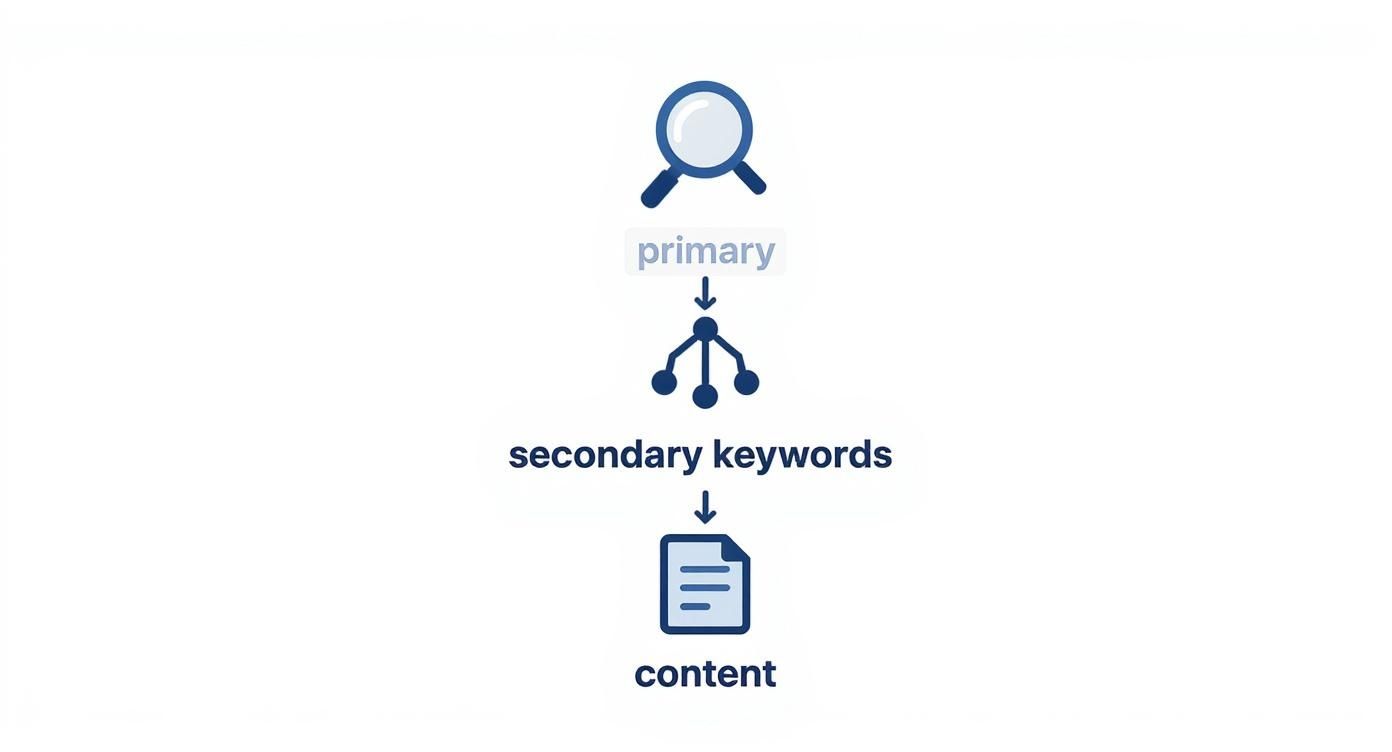
As you can see, a winning content strategy always starts with a focused keyword and builds out from there.
Building Your Total Keyword Portfolio
Your business goals and where you sit in the market should drive your entire keyword strategy. Are you a local supplier laser-focused on a single city, or are you a national distributor trying to compete on a much bigger stage? Your answer changes everything.
- For Local Suppliers: A local business should zero in on a smaller, more geo-targeted set of keywords. Think terms like "commercial oven repair in Dallas" or "restaurant supply Houston." These are the money-makers that build local authority, often supported by our local citation services.
- For National Distributors: A national player needs a much wider net. Their keyword portfolio has to cover countless product categories, brands, and customer questions from all over the country. It's a completely different ballgame.
From a practical standpoint, the number of keywords you track should line up with the number of landing pages you have. As a rule of thumb, each page should be optimized for one to four keywords built around a single topic.
So, if your restaurant equipment supply site has 10 product pages and 15 blog posts, you'd probably be tracking somewhere between 25 and 100 keywords.
Your website's structure is the absolute backbone of your keyword strategy. A well-organized site makes it dead simple for search engines to figure out which pages are important for which topics. This stops your own pages from cannibalizing each other in the search results.
A logical site map gives every keyword a designated home, which is crucial for scaling your SEO as you add more products or content. To really dig into this, check out our guide on optimizing your site architecture for SEO. Getting this foundation right makes it so much easier to build a tracking system that grows with your business.
Is Keyword Density Still a Thing? Nope.
Let's clear the air on one of the oldest, most stubborn myths in SEO: keyword density. Back in the wild west days of the internet, ranking was a much simpler game. If you wanted to rank for "commercial charbroilers," you just repeated that phrase over and over. Easy, right?
That strategy is now a one-way ticket to the bottom of the search results. This practice, known as "keyword stuffing," creates robotic, unreadable content that nobody wants to read. More importantly, it pushes away real customers and can even earn you a penalty from Google, making you practically invisible.
From Repetition to Relevance: The Big Shift
Search engines like Google have gotten incredibly smart over the years. They've moved way beyond just counting keywords. Today, it’s all about topical relevance and understanding language like a human does. The goal is to figure out the meaning and context behind your words, not just how many times you used a specific phrase.
So, instead of obsessing over a magic percentage, your job is to cover a topic so well that you naturally use all the right language. Think about it from a practical, real-world perspective.
If you’re writing a genuinely helpful guide on commercial refrigeration for a restaurant owner, you're going to naturally use phrases like "walk-in cooler," "reach-in freezer," and "restaurant refrigeration maintenance." They'll just show up as you explain the topic thoroughly. It’s that simple.
Write for People First, and Google Will Follow
The absolute best SEO strategy today is to forget you're even doing SEO and just write for your customer. When you create high-quality, valuable content that solves a real problem, you automatically start speaking the language that search engines are built to understand. This is the core of our approach to copyrighting and article writing for restaurant equipment supply websites.
Here’s what that actually looks like in practice:
- Go Deep on the Topic: Answer the questions people are actually asking. Compare different charbroiler models. Offer real solutions to the headaches your customers face.
- Use Natural Language: Just write like you talk. If you were explaining the difference between two pieces of equipment to a customer in your showroom, how would you say it? Write that down. It builds trust and makes your content easy to read.
- Bring in Synonyms and Related Ideas: These add crucial context. For a page about a "commercial charbroiler," you might also talk about "gas grills," "lava rock briquettes," or "radiant heat systems." This shows Google you're an expert who understands the entire topic, not just one keyword.
By finally letting go of the outdated keyword density metric, you’ll start creating content that both your customers and the search engines will reward. This is how you build real authority, drive traffic from people ready to buy, and ultimately, grow your business.
Your Action Plan for Keyword Success
All this theory about keywords and topical relevance is great, but knowledge is only powerful when you put it into practice. None of it means a thing until you apply it to your own restaurant equipment supply website. This last section gives you a clear, step-by-step plan to turn these ideas into real results.
Think of this as your pre-service checklist. Just like a chef preps their station before the dinner rush, this workflow gets your pages ready for peak performance on Google. Let’s walk through the steps to go from planning to execution and start seeing a real business impact.
Step 1: Conduct Your Keyword Research
The entire foundation of a winning SEO strategy is knowing what your customers are actually searching for. You have to get inside the heads of chefs and restaurant owners to find the exact phrases they type into Google when they’re ready to buy or just looking for solutions.
This means using a keyword research tool to dig up terms related to your products, like "commercial charbroilers" or "walk-in freezer maintenance." Your goal here is to build a master list of potential primary and secondary keywords that reflect what real people are looking for.
Step 2: Create a Keyword Map
Once you have your big list of keywords, the next job is to give every single one a home. A keyword map is really just a simple spreadsheet that assigns one primary keyword and its group of supporting secondary keywords to a specific page on your website.
This is a critical step. It prevents "keyword cannibalization," which is what happens when multiple pages on your site accidentally compete for the same search term. That just confuses Google and waters down your ability to rank for anything at all.
Your map can be as simple as this:
- Page URL: /products/commercial-gas-charbroiler
- Primary Keyword: "commercial gas charbroiler"
- Secondary Keywords: "heavy-duty countertop grill," "restaurant charbroiler for sale," "radiant heat charbroiler"
This document becomes the blueprint for your entire content strategy. No more guessing.
Step 3: Integrate Keywords Naturally
With your map in hand, it’s time to start weaving these terms into your pages. Remember, the goal is always to be helpful and sound natural, not like a robot stuffing words into a sentence. Your primary keyword should show up in a few key places to signal its importance to search engines.
A great rule of thumb is to place your primary keyword in the page title, the meta description, at least one heading (like the H1), and somewhere in the first paragraph. This sends a strong, immediate signal about what the page is all about.
Then, you can sprinkle your secondary keywords throughout the product descriptions, feature lists, and even the image alt text. They should feel like a natural part of the conversation, supporting the main topic and making the content more comprehensive and valuable for the person reading it. Our copywriting services excel at this natural integration.
Step 4: Track Your Performance
Finally, you can't improve what you don't measure. Setting up some basic rank tracking is non-negotiable if you want to know what’s working. Use an SEO tool to keep an eye on your position for your target keywords over time.
This data tells you which pages are climbing up the search results and which ones might need a little more work. It’s the feedback loop that lets you refine your strategy, double down on what’s successful, and turn your SEO efforts into a predictable source of leads and sales.
Have Questions? We've Got Answers.
Here are some quick answers to the questions we hear most often about keyword strategy.
How often should I check on my keywords?
A good rule of thumb is to review your keyword performance every quarter. If a page is crushing it and bringing in traffic, let it ride. But if another page isn't ranking or getting any love from Google, it's probably time to go back to the drawing board and find a better opportunity.
Does every single page really need its own primary keyword?
Yes, 100%. Think of it this way: you wouldn't send two of your salespeople to chase the same lead, would you? It's the same with your web pages. Giving each page its own unique primary keyword prevents them from competing against each other. Each page needs its own distinct job to do.
What about those niche keywords with super low search volume?
Go after them! Low-volume keywords are often pure gold because they come with incredibly high buyer intent. Someone searching for a “commercial sous vide immersion circulator” isn't just browsing—they're a serious, ready-to-buy customer. Ranking for these specific terms attracts the exact people you want to talk to.
At Charbroilers.com, we live and breathe SEO for the restaurant equipment supply industry. From blogger outreach and local citations to expert article writing, our goal is to help you master it, making sure every page on your site pulls in the right customers. Find the perfect equipment and get expert advice at https://charbroilers.com.