

Guest Blogging for Backlinks: A Guide to Boosting Your SEO
Guest blogging for backlinks is a simple concept: you write and publish an article on another company's website in exchange for a link back to your own. But don't let the simplicity fool you. This is one of the most powerful tools in your SEO arsenal. It’s how you build real authority, drive targeted traffic, and cement your reputation as an expert in your field.
It's not just about grabbing a link. It's about tapping into another platform's audience to grow your own.
Why Guest Blogging Is a Cornerstone of SEO Strategy
Let's get one thing straight: guest blogging is far from dead. For niche industries like restaurant equipment supply, it's a powerhouse for building the kind of authority that actually moves the needle. Think about it. A well-placed guest post on a respected culinary business blog isn't just another link—it's a powerful endorsement that tells search engines your website is a credible, trustworthy resource.
This strategy is a multi-tool for your digital marketing. Each guest post you publish strengthens your backlink profile and, in turn, helps to build domain authority. That’s exactly what you need to stand out in a crowded market.
The Real-World Impact on Rankings and Traffic
The numbers don't lie. Backlinks from guest posts are a massive SEO factor—a staggering 92% of marketers confirm they are one of the top three ranking factors for Google. In practice, pages with high-quality backlinks are 3.8 times more likely to land in the top three search results.
We've seen it firsthand in our work with restaurant equipment supply websites. One blogger outreach campaign generated 85 new high-quality backlinks in just six months, leading to a 340% surge in organic traffic. Better yet, that referral traffic led to a 25% jump in trial sign-ups.
A single, well-crafted guest post can hit multiple business goals at once:
- Boosts Brand Visibility: It puts your brand directly in front of a new, highly relevant audience you might never have reached otherwise.
- Drives High-Intent Referral Traffic: The people clicking through from your article are already interested in what you have to say, making them much warmer leads.
- Establishes Industry Leadership: Consistently sharing valuable insights on other platforms positions your company as the go-to expert in the restaurant equipment space.
By contributing valuable content to other reputable sites in your industry, you aren't just building links. You're building a reputation, forging new partnerships, and creating new pathways for customers to find you.
To give you a clearer picture, here's a quick summary of the return on investment you can expect from a dedicated guest blogging campaign.
Guest Blogging ROI at a Glance
This table breaks down the core benefits of a strategic guest blogging campaign, giving you a quick reference for the expected outcomes.
| Benefit | Primary Impact | Example Metric |
|---|---|---|
| SEO Improvement | Higher search engine rankings and improved Domain Authority. | Increase in organic keyword rankings for target pages. |
| Referral Traffic | New, high-intent visitors coming directly from other websites. | Number of sessions from referral sources in Google Analytics. |
| Brand Authority | Strengthened reputation as an industry expert and thought leader. | Increase in branded searches and direct traffic over time. |
| Lead Generation | Acquisition of qualified leads who are already engaged with your content. | Conversion rate from referral traffic (e.g., form fills, sign-ups). |
Ultimately, a smart guest blogging strategy delivers compounding returns that support your business growth long after the article is published.
Beyond the Backlink: A Strategic Advantage
Guest blogging is one of the most effective ways to build a strong, resilient SEO foundation. While it's a critical part of link building, remember it's just one piece of a larger puzzle. To make sure your guest posts deliver maximum impact, they need to fit into a broader SEO plan that includes article writing and local citation services. For a deeper dive, exploring a comprehensive guide on how to build high-quality backlinks can help you integrate your efforts for long-term growth and success.
How to Find and Qualify the Right Blogs
When it comes to guest blogging for backlinks, you have to be precise. A shotgun approach just won't cut it. Instead of chasing down every opportunity you see, your goal should be to zero in on blogs that offer real, tangible SEO value.
You need to focus your energy on platforms where your content will actually connect with an engaged audience. That’s where a link back to your site carries some serious weight.
Your search really starts with smart prospecting. While there are a ton of ways to find potential sites, two methods have consistently delivered the best results for our clients: advanced Google searches and digging into competitor backlinks. These techniques help you cut through all the noise and build a solid outreach list from day one.
Uncovering Opportunities with Search Operators
Using advanced Google search operators is like having a secret weapon for finding websites that are actively looking for contributors. Instead of a generic search like "restaurant blogs," you can use specific commands to find pages that explicitly mention guest posting.
Here are a few powerful search strings you can try:
- "restaurant management" + "write for us"
- "food service" + "guest post guidelines"
- "commercial kitchen tips" + "become a contributor"
By mixing your main keywords (like those related to restaurant equipment) with these phrases, you filter out all the irrelevant fluff and get straight to the source. This tactic lands you on blogs that are already open to working with you, which dramatically increases your chances of getting a "yes."
Reverse Engineering Competitor Backlinks
Honestly, one of the sneakiest and most effective ways to find high-value blogs is to see where your competitors are getting their links. If a top-ranking restaurant supply blog has a backlink from a particular site, chances are that site is a perfect target for you, too.
Tools like Ahrefs or Semrush make this process almost too easy.
Just pop a competitor's domain into the tool's backlink checker. From there, you can sift through their entire backlink profile and cherry-pick the guest posts that are fueling their SEO. This method not only helps you find hidden gems but also confirms that these sites are willing to publish content from businesses just like yours.
This whole process is about turning guest posts into traffic, which then becomes tangible authority and leads.
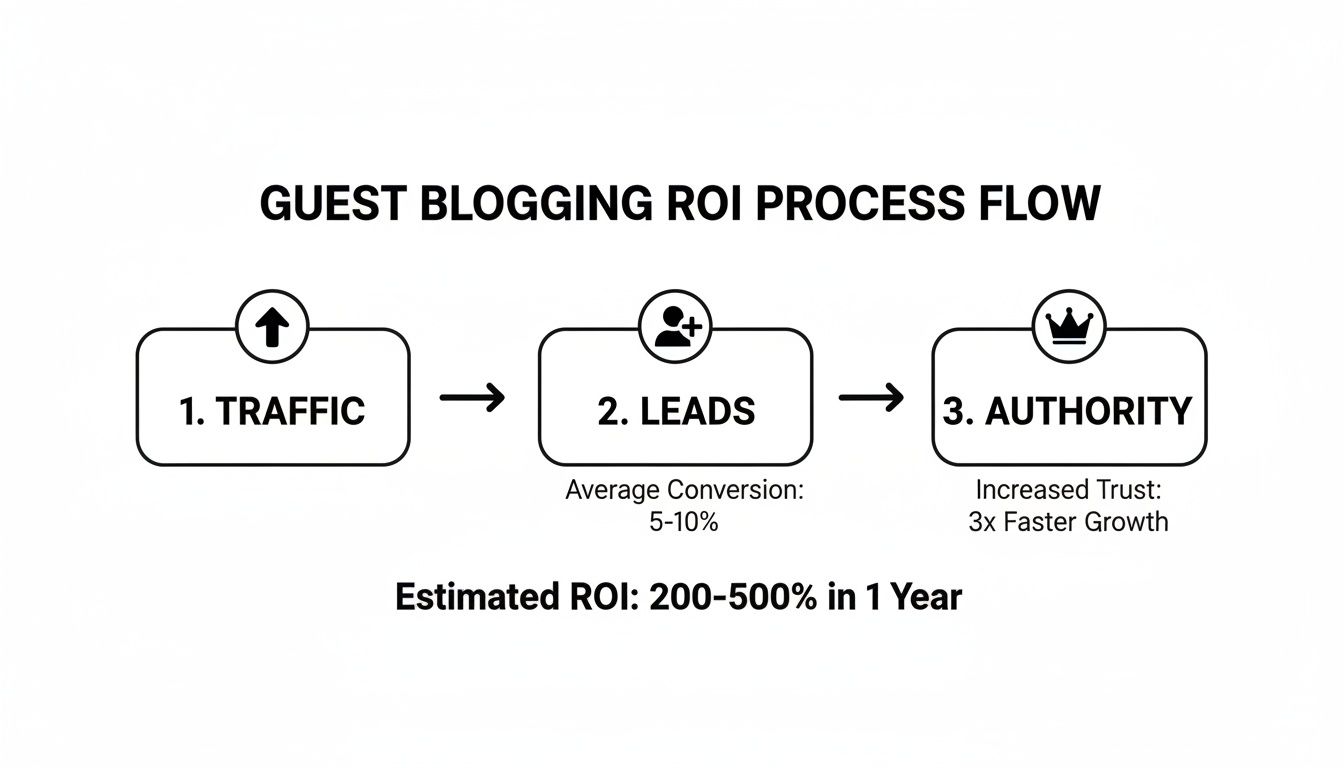
As you can see, a great guest post doesn't just score you a link; it kickstarts a cycle of more traffic, better leads, and stronger industry authority.
The Essential Vetting Checklist
Okay, so you have a list of potential blogs. Now it’s time to vet them. Not all opportunities are worth your time. The hard truth is that 85.3% of guest posting sites might be low-quality duds. But if you can target the elite 15%, you can unlock some serious SEO power.
This matters because pages with backlinks get way more organic traffic. And when you consider that a staggering 96.55% of web pages get zero traffic without them, you see why this is so critical. You can dig into more of these powerful link building statistics on BuzzStream.
The goal is to avoid wasting time on sites that won't move the needle. A single backlink from a high-authority site is worth more than dozens of links from low-quality, irrelevant blogs.
Use this simple checklist to vet every single site before you even think about sending an email:
- Domain Authority (DA) or Domain Rating (DR): Look for sites with a DA/DR of 40 or higher. This is a quick gut check on the site's overall SEO strength and how much value its backlink will pass to you.
- Organic Traffic: Does the site get actual visitors from search engines? A site with at least 5,000 monthly organic visits tells you it has a healthy, engaged audience. No traffic, no point.
- Audience Relevance: Is their audience a good match for your restaurant equipment business? You want blogs focused on things like restaurant management, culinary arts, or food service operations. The closer the match, the better.
- Content Quality and Engagement: Do their articles get comments and social shares? High engagement is a dead giveaway of a loyal, active readership. If you see thin, poorly written content or a total ghost town in the comments, run the other way.
Crafting an Outreach Pitch Editors Actually Read
You've done the hard work of vetting a solid list of target blogs. Now comes the real challenge: getting an editor to actually open, read, and reply to your email. A killer article idea is completely wasted if your pitch dies in a crowded inbox.
The secret to successful guest blogging isn't some complicated formula. It's about ditching the generic templates and crafting a personalized pitch that feels human. As a company that specializes in blogger outreach for the restaurant equipment sector, we know you need to build a genuine connection right from the very first sentence.
An editor's inbox is a battlefield for attention. They can spot a copy-paste email from a mile away, and it gets deleted just as fast. Your pitch has to prove you’ve done your homework and that you respect their time.

The Anatomy of a Winning Pitch
Stop thinking of your pitch as a request. It's a value proposition. You're offering a fantastic piece of content that will genuinely help their audience, and when it comes to getting that message across, mastering cold email best practices will drastically improve your open and reply rates.
Here’s a breakdown of what makes a pitch impossible for an editor to ignore:
- A Subject Line That Sparks Curiosity: "Guest Post Submission" is a one-way ticket to the trash folder. Get specific and intriguing. Try something like, "Idea for your blog: 3 Ways Restaurants Can Cut Energy Costs with New Charbroilers" or even "A new angle on commercial kitchen efficiency."
- A Personalized Opening: This is non-negotiable. Show them you're a real reader. Mention a recent article of theirs you genuinely enjoyed and share a specific takeaway. This simple act proves you aren't just blasting a generic email to a huge list.
- Clear, Compelling Topic Ideas: Don't make the editor do all the work. Come prepared with two or three distinct, well-researched topic ideas that you know fill a gap in their content library. Frame them as catchy headlines that would grab their audience of restaurant owners or chefs.
This initial effort immediately changes the dynamic. You're no longer making a cold ask; you're starting a collaborative conversation. That alone sets you leagues apart from the competition. For an even deeper dive, our complete guide on guest posting outreach has more strategies you can use.
What to Include and What to Avoid
A successful pitch is just as much about what you leave out as what you put in. Keep it short, professional, and focused on them—not you. Nobody cares about your company's long history or your list of achievements in a cold pitch.
Do Include This:
- A Brief Intro: A single sentence is often enough. "As a content specialist for a leading restaurant equipment supplier..." tells them who you are and why you're qualified to write on the topic.
- Proof of Your Quality: Link to one or two of your best published articles on other reputable sites. This is your portfolio. It builds immediate trust and shows them you can actually write.
- A Clear Call to Action: End with a simple question. Ask if they're interested in one of your ideas or if they'd like you to flesh out an outline. Make it easy for them to say "yes."
Avoid These Common Mistakes:
- Vague Compliments: "I love your blog!" is empty. "Your recent article on kitchen ventilation helped me understand the importance of makeup air" is specific, genuine, and shows you paid attention.
- Attaching a Full Draft: Never, ever send an unsolicited full article. It’s presumptuous, ignores their editorial guidelines, and is a huge red flag.
- Focusing on the Backlink: The pitch is about the value you can provide to their readers. The backlink is a natural result of contributing something great, not the entire point of the conversation.
The most effective outreach feels less like a transaction and more like the start of a professional relationship. Your goal is to be seen as a valuable contributor, not just another link builder.
A Gentle Follow-Up Strategy
Let's be real: editors are busy. Even the best-crafted pitch can get buried under a mountain of other emails. A simple, polite follow-up is often what separates a "yes" from total silence. But you have to walk a fine line between being persistent and being a pest.
Give it about a week after your first email. Then, send a short, polite reply directly to your original message. Something as simple as, "Just wanted to follow up and see if you had a chance to consider my ideas," is perfect.
If you still don’t hear back after one follow-up, it’s usually best to cut your losses and move on to the next site on your list. This respectful persistence shows you're professional without burning any bridges, leaving the door open for another pitch down the road.
Writing Content That Secures Your Backlink
Getting an editor to say "yes" is a great feeling, but it's really just the first step. Now the real work starts. You've got to write an article that not only hits their quality bar but also strategically lands you the backlink you're after.
Your job is to create an asset for their blog, not just another piece of filler content. This means your article needs to be genuinely helpful and completely non-promotional. It should fit their audience and writing style like a glove. When you deliver that much value, adding your backlink feels less like a request and more like a natural citation.
This mindset is at the heart of modern link building. There's a reason guest blogging is the most popular method out there—a massive 64.9% of link builders lean on it as their main strategy. And with 60% of bloggers cranking out one to five guest posts every month, the momentum is undeniable.
This isn't just busy work; it's what fuels real growth. Companies that blog consistently generate 55% more traffic and 67% more leads than those that don't. For more on this, check out these fascinating blogging statistics and trends on Inblog.ai.
Structuring Your Post for Readability and Impact
Let's be honest: nobody wants to read a giant wall of text. An editor will take one look and hit delete, and their audience will bounce just as fast. Structure is everything.
You need to hook the reader right from the start with a strong intro that speaks directly to a pain point they're feeling. For example, if you're writing for a blog for restaurant owners, you could open with a common headache like controlling food costs or streamlining kitchen operations. Our article writing and copyrighting services always prioritize this reader-centric approach.
From there, the article should flow logically. Use clear headings and subheadings to act as a roadmap, guiding the reader smoothly from one point to the next.
To make your content easy to digest, always remember to:
- Keep Paragraphs Short: Stick to two or three sentences max. This creates valuable white space and makes the page feel much less intimidating.
- Use Lists: Bullet points and numbered lists are perfect for breaking down complex ideas or outlining actionable steps. They're incredibly scannable.
- Add Visuals: If the blog allows it, use screenshots, custom graphics, or even a quick video to drive your points home. Visuals can make a huge difference in engagement.
Placing Your Backlink Naturally and Effectively
This is where the real strategy comes in. A poorly placed link feels spammy and is the quickest way to get your article rejected or your link removed later. The goal is to make it contextually relevant and genuinely useful.
Think of your link as an additional resource that helps the reader. Let's say your article is about "Choosing the Right Commercial Charbroiler." A perfect opportunity for a link would be to your own in-depth guide on charbroiler maintenance. It’s a logical next step for the reader, not a forced ad.
The best backlink is one the reader is happy they clicked. It should directly answer a question or expand on the topic they're already invested in, feeling like a natural part of the conversation, not an advertisement.
Typically, you get two shots at a link: one within the body of the article (a contextual link) and one in your author bio. The contextual link is almost always the more powerful of the two for SEO, as it passes more authority and is surrounded by relevant text.
Optimizing Anchor Text for SEO Value
The anchor text—the clickable words in your link—is a huge signal to search engines. It tells them what the page you're linking to is all about. It can be tempting to stuff it with your exact target keyword, but doing that too often is a major red flag for Google.
Instead, you want your anchor text profile to look natural and varied.
Effective Anchor Text Strategies:
- Partial Match: Mixes your keyword with other words (e.g., "these tips for charbroiler maintenance").
- Branded: Simply uses your brand or website name (e.g., "a study by Charbroilers.com found").
- Natural/Generic: Uses common, non-descriptive phrases (e.g., "click here to learn more" or "check out this guide").
Varying your anchor text makes your link profile look organic and earned. You're sending a clear, helpful signal to search engines without looking like you're trying to game the system. This thoughtful approach ensures your guest blogging efforts pay off in the long run.
Tracking the True Impact of Your Guest Posts
Guest blogging is a serious investment of your time. Pouring effort into a fantastic article is a great start, but if you aren't measuring its impact, you're just flying blind. You absolutely have to track your results—it’s the only way to prove the value of your work and make smarter moves on your next campaign.
Sure, the most obvious win is the backlink itself. But the real return on your investment goes so much deeper than that.
A single, well-placed guest post can drive qualified traffic, bring in new leads, and give your keyword rankings a nice boost for months—sometimes even years. The trick is knowing where to look for this data and how to make sense of it.
Keep an Eye on Your Referral Traffic
One of the first places you’ll see a guest post pull its weight is in your referral traffic. This metric tells you exactly how many people clicked a link in your article and landed on your website. Think of it as a direct measure of how much your content connected with the host blog's audience.
You can find this data right inside Google Analytics. Just head over to the Acquisition > Traffic acquisition report and filter by "Session source." Look for the domain where you published your post. Seeing a steady flow of visitors from that site is a clear signal you hit the mark.
For a restaurant equipment supplier, this kind of traffic is gold. These aren't just random people browsing the web; they’re folks who just finished reading an article on an industry blog, making them highly qualified potential customers.
Make Sure Your Backlink and Rankings Are on the Radar
A backlink doesn't do you any good until Google actually finds and indexes it. You can check on this using Google Search Console. It might take a little while for Google’s crawlers to discover the new link, but once they do, it will start passing authority to your site.
To confirm your efforts are paying off, it’s always smart to learn how to find backlinks in Google using a mix of tools and manual checks. This is how you verify that your guest posts are creating the SEO assets you were aiming for.
Beyond just getting the link indexed, you need to watch what happens to your organic keyword rankings. If your guest post about commercial cooking equipment linked back to your "commercial charbroilers" category page, is that page climbing the search results for related terms? A jump in rankings for the page you linked to is one of the strongest signs your guest blogging strategy is working.
A backlink is a vote of confidence from another website. When you track your guest posts, you're not just counting votes—you're measuring the direct influence those votes have on your website's traffic, authority, and bottom line.
Don't Forget the "Soft" Wins
The impact of guest blogging isn't just about direct SEO metrics. You should also keep an eye out for the secondary benefits that help your brand grow over time. These can be just as valuable as the backlink itself.
These "soft" metrics paint a much fuller picture of your campaign’s success:
- Social Media Mentions: Is the host blog sharing your article on their social accounts? Are other industry players sharing it and tagging your brand?
- New Leads and Inquiries: Are you seeing more contact form submissions or quote requests that you can trace back to your referral traffic?
- Brand Authority: Over time, are you noticing more people searching directly for your company name? This shows that your guest posts are successfully building brand recognition.
When you combine hard data from analytics with these softer indicators, you get a complete view of your guest blogging ROI. This data-backed approach helps justify the investment and allows you to constantly tweak your strategy for even better results down the road.
Key Metrics for Tracking Guest Blogging Success
To really understand how your campaigns are performing, you need to monitor a handful of essential metrics. This quick checklist breaks down what to watch to evaluate the effectiveness and true return on investment of your guest blogging efforts.
| Metric | Tool to Use | What It Tells You |
|---|---|---|
| Referral Traffic | Google Analytics | How many engaged readers are clicking from your guest post to your site. |
| Link Indexation | Google Search Console | Whether Google has discovered and acknowledged your new backlink. |
| Keyword Rankings | SEO Tracking Software | The direct impact of the backlink on your target page's search visibility. |
| Social Mentions | Social Listening Tools | The level of industry buzz and brand exposure your content is generating. |
| Lead Generation | CRM or Analytics Goals | The number of new business opportunities created from your guest post traffic. |
By keeping these key performance indicators on your dashboard, you'll move from guessing to knowing, ensuring every guest post you write is a strategic step forward.
Common Guest Blogging Blunders to Steer Clear Of
Even a well-planned guest blogging campaign can go sideways if you fall into a few common traps. Sometimes, success is less about what you do and more about what you don't do. Knowing these pitfalls will help make sure your efforts actually build authority and don't just waste time.
One of the biggest mistakes I see is targeting the wrong websites. It’s tempting to chase a high Domain Authority (DA) score, but if that site’s audience doesn't care about commercial kitchen equipment, the link is practically worthless. A backlink from a niche restaurant management blog with a DA of 45 is always going to be more powerful than one from a generic business site with a DA of 65. Context is king.
Overly Promotional Content and Aggressive Anchors
Another surefire way to get your pitch deleted is by writing a glorified sales page. Editors want to publish articles that genuinely help their readers, not an ad for your new charbroilers. Your content needs to be 99% pure value and maybe 1% brand mention. The idea is to prove you're an expert; the backlink should feel like a natural resource, not a forced plug.
In the same vein, getting too aggressive with exact-match anchor text is a huge red flag for Google. If all your links use anchors like "best commercial charbroiler," it just looks manipulative and unnatural. A healthy backlink profile has variety.
Think of your anchor text strategy like a balanced diet. You can't just eat one thing. Overloading on exact-match keywords is unhealthy and will eventually catch up to you. You need a good mix of branded, natural, and partial-match anchors to keep things looking natural.
For instance, look at the difference between these two placements in an article about kitchen efficiency:
- Spammy: "To speed up your cook times, you need the best commercial charbroiler."
- Natural: "Proper maintenance is key for efficiency. You can find more tips for charbroiler upkeep in this guide."
The second one offers real value and context. It makes the link a helpful suggestion, not a clunky advertisement.
Using Generic Outreach Templates
Nothing screams "I don't care about your blog" louder than a generic, copy-and-paste outreach email. Editors see hundreds of these pitches, and they can spot a lazy, mass email from a mile away.
You're probably getting ignored if your emails:
- Start with "Dear Webmaster" or "To Whom It May Concern."
- Don't mention a single specific article on their blog.
- Focus entirely on what you want (a backlink) instead of the value you can provide.
Personalization isn't optional; it's the price of entry. Mentioning a specific point from a recent post or pitching a topic that fills a clear gap in their content shows you’ve actually done your homework. It’s a simple step that turns your pitch from spam into a professional proposal worth considering.
Your Guest Blogging Questions, Answered
When you're starting out with guest blogging for backlinks, a lot of questions come up. It's totally normal. Let's walk through some of the most common ones I hear and get you clear, practical answers to sharpen your strategy.
How Many Guest Posts Do I Actually Need to See Results?
This is one of those "it depends" questions, but not in a frustrating way. Honestly, it’s less about hitting a certain number and much more about the quality of where you post. Think of it this way: one killer backlink from a highly respected industry blog is worth way more than ten links from sites nobody's ever heard of.
Instead of getting hung up on a magic number, your goal should be to land a handful of high-impact placements. You could genuinely see a real shift in your rankings or referral traffic from a single, well-placed article on a site with a Domain Authority (DA) over 50. Just remember, SEO is a long game. Give it at least three to six months to really see the needle move.
Is It Okay to Pay for Guest Posts?
This is a gray area, so you need to tread carefully. It's really important to know the difference between paying for a link and paying for placement. Google is crystal clear about this: buying links just to manipulate your rankings is a big no-no and violates their guidelines.
That said, many legitimate, high-traffic blogs charge an editorial or administrative fee for sponsored content. This is usually fine, as long as the content is top-notch, relevant to their audience, and clearly marked as sponsored. Transparency is everything here.
Paying a fee for an editor's time and resources on a quality blog is a world away from buying a spammy link on a garbage site. To stay on Google's good side, always focus on building real content partnerships, not just transactional link schemes.
What Anchor Text Should I Be Using?
Using the exact same keyword-stuffed anchor text over and over is a huge red flag for search engines. It just doesn't look natural. A healthy, organic backlink profile has a lot of variety.
You want your anchor text to look like it was earned, not manufactured. A good, natural mix usually includes:
- Branded Anchors: Just your company name, like "Charbroilers.com".
- Naked URLs: The straight-up URL, like "https://charbroilers.com/guides".
- Partial-Match Keywords: A natural-sounding variation of your target keyword, like "these tips for charbroiler maintenance".
This mix sends a signal to Google that your links are genuine, which makes them much more powerful for your SEO.
Ready to build real authority and drive traffic with an SEO strategy that actually works? At Charbroilers.com, we do more than just sell equipment. We offer expert insights and services—from blog posting and local citations to strategic blogger outreach—that help restaurant equipment suppliers own their market. Find out how our specialized SEO services can fire up your online growth.