

Grease Trap Sizing Guide for Commercial Kitchens
Sizing a grease trap isn't just a plumbing task—it's a critical business decision for any restaurant equipment supply website. It all boils down to calculating your kitchen's wastewater flow rate, usually measured in Gallons Per Minute (GPM), and then picking a unit that can handle that volume while keeping your local inspectors happy.
Get this right, and you're golden. Get it wrong, and you're in for a world of headaches. This is the kind of foundational knowledge that quality content, like what's produced through expert blog posting and article writing, can provide to your customers.
Why Accurate Grease Trap Sizing Matters

Think of proper grease trap sizing as a direct investment in your restaurant's profitability and reputation. An incorrectly sized unit is a ticking time bomb of financial risk and operational nightmares that can shut you down when you least expect it. It goes way beyond just "avoiding clogs."
When a trap is too small, it gets overwhelmed fast, triggering a domino effect of expensive problems. Emergency plumbing calls are just the start. You could be looking at hefty municipal fines for not meeting wastewater regulations. The worst-case scenario? A full-blown sewer backup, which is a messy, expensive, and hazardous situation nobody wants to deal with.
The High Cost of an Undersized Trap
Going with a trap that's too small for your kitchen's output is a surefire recipe for disaster. The most immediate pain point will be constant, expensive pump-outs. A correctly sized trap might need service every one to three months. An undersized one? You could be calling for service weekly, which absolutely torches your maintenance budget.
This constant need for service isn't just a drain on your bank account. It also leads to:
- Foul Odors: An overflowing trap stinks. That powerful, unpleasant smell can easily drive customers away and make for a miserable work environment for your staff.
- Business Downtime: A serious clog or backup can force you to close your kitchen for hours, maybe even days. That means lost revenue and a hit to your reputation.
- Increased Wear on Equipment: Your entire plumbing system gets put under stress, which can cause pipes and other components to fail way sooner than they should.
An undersized grease trap doesn't save money—it just defers costs. The initial savings are quickly erased by frequent maintenance, emergency repairs, and potential fines that can easily run into thousands of dollars.
The Problem with Oversizing
So, just buy the biggest trap you can find, right? Not so fast. An oversized unit might seem like a safe bet, but it introduces its own set of problems.
If the wastewater flow is too weak for the trap's massive volume, the water cools down too much before it has a chance to exit. This allows grease to solidify inside the trap, creating stubborn blockages that are a real pain to clear. You also end up wasting money on a piece of equipment your kitchen simply doesn't need.
For anyone outfitting a new kitchen, finding that perfect balance is key. This is where providing detailed information through SEO-optimized content and blogger outreach can establish a restaurant equipment supplier as a true industry authority.
Figuring out the right size for a grease trap can feel a bit like you’re trying to solve a complex math problem. In reality, it all comes down to two main methods that the pros use. The very first thing you need to do—and this is critical—is find out which method your local health department or municipality demands.
This one piece of information will shape your entire approach. Honestly, it's the single most common trip-up for kitchen owners, but once you know which formula to use, it's just a matter of plugging in the numbers.
The two big players are the flow rate method, which you'll see measured in Gallons Per Minute (GPM), and the drainage fixture unit (DFU) method. They both get you to the same end goal, just by looking at different parts of your kitchen setup.
The Flow Rate Method in Gallons Per Minute
The GPM method is the go-to formula for sizing those smaller, point-of-use grease traps you see tucked under sinks. These are often called hydromechanical interceptors. This approach is all about calculating the maximum amount of wastewater your fixtures could possibly send down the drain in a hurry. It's a very practical calculation based on the actual physical size of your sinks.
The core idea is simple: measure how much water a sink can hold, then figure out how fast it can drain. The formula itself is pretty straightforward, but you have to get your initial measurements right for it to be accurate.
- Fixture Volume: First, grab a tape measure. You’ll need the length, width, and depth of each sink compartment in inches to get the total volume in cubic inches.
- Conversion to Gallons: Here’s a key number: there are 231 cubic inches in a gallon. Divide your total cubic inches by 231 to get the volume in gallons.
- Drainage Period: This is all about how fast the sink drains. Most codes will specify either a one-minute or two-minute drain period. The faster the drain time, the higher your GPM rating will be.
It makes sense when you think about it. A busy restaurant with a massive three-compartment sink is going to have a much higher GPM flow rate than a small coffee shop with a single-basin prep sink. The calculation directly reflects how much greasy water that fixture can produce.
The Drainage Fixture Unit Method
On the other hand, some areas prefer the Drainage Fixture Unit (DFU) method. You'll see this used more often for sizing the big, central grease interceptors—the ones usually buried outside. Instead of measuring your sinks, this method assigns a standard value (a DFU value) to every type of plumbing fixture that connects to the grease trap.
A DFU is basically an assigned "plumbing weight" that represents how much a fixture is likely to discharge. A three-compartment sink has a high DFU value, while a small hand-washing sink has a very low one.
The most important thing to remember here is that you don't come up with the DFU value yourself. These values are already set in your local plumbing code. Your job is to make a list of every fixture draining into the trap and look up its DFU value in the codebook.
Once you’ve added up the total DFU value from all your fixtures, you’ll use a conversion chart in the plumbing code to find the grease trap size you need in gallons. A higher total DFU means you'll need a bigger interceptor.
Why Sizing Impacts Your Bottom Line
Getting the size right isn't just about satisfying the inspector; it's a huge factor in how efficient your maintenance plan is and how much you spend on waste management. The grease trap service market is a big deal. It was valued at around $1.2 billion and is expected to hit $2.5 billion by 2033, which shows just how much commercial kitchens and environmental rules are growing.
You can learn more about the growth of the grease trap service market on verifiedmarketreports.com. An accurately sized trap means your maintenance provider can do their job efficiently, keeping you in compliance and helping you avoid those nightmare plumbing emergencies.
If you install a unit that's too small, it's going to fill up and fail fast, forcing you into more frequent and expensive pump-outs. A correctly sized unit, chosen with the right formula for your area, matches your equipment to your kitchen's actual output. This optimizes your maintenance schedule and, ultimately, protects your investment.
How to Calculate Flow Rate From Your Fixtures
So, your local inspector is asking for a grease trap sized using the Gallons Per Minute (GPM) method. Don't sweat it. This is the most common way to size smaller, under-sink grease traps, and it's something you can figure out yourself with a tape measure and a calculator.
The whole idea is to determine the absolute maximum amount of wastewater your sinks could possibly dump down the drain at one time. We're talking a worst-case scenario here.
Let's get down to the brass tacks. First thing you need to do is calculate the total holding capacity of your sink compartments. Grab that tape measure and get the dimensions of a single sink basin in inches:
- Length (L)
- Width (W)
- Depth (D)
Got them? Good. Now, just multiply those three numbers together to get the volume in cubic inches.
L x W x D = Total Cubic Inches
This simple flowchart lays out the entire process, from picking the right sizing method all the way to finalizing the grease trap you need.
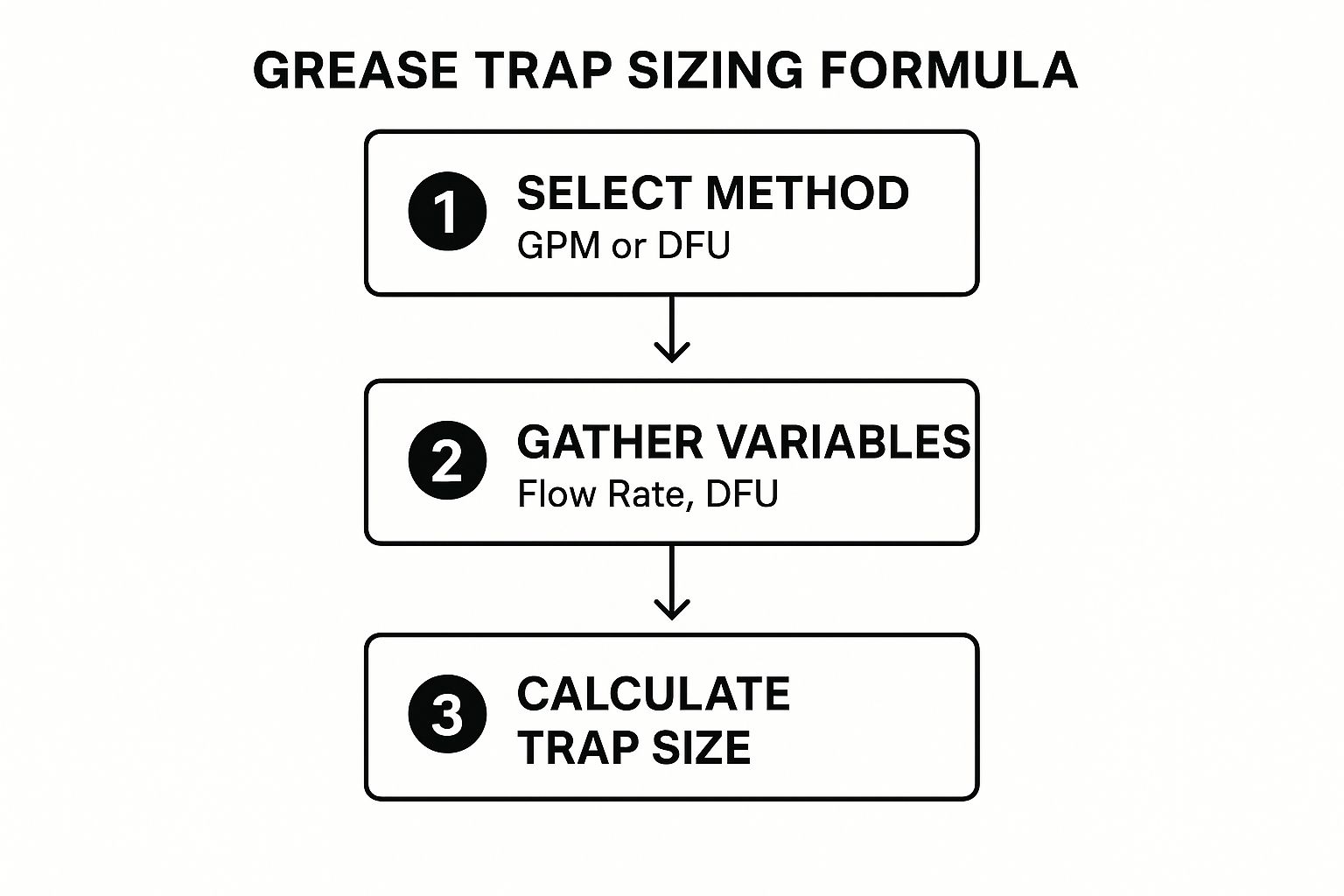
As you can see, the key to getting this right is having all your variables sorted out before you start crunching the numbers for the final size.
From Cubic Inches to Gallons
Cubic inches are great, but grease traps are rated in gallons. Time for a quick conversion. The magic number you need to remember is 231—that’s how many cubic inches are in one U.S. gallon.
The formula looks like this: Total Cubic Inches / 231 = Sink Volume in Gallons.
Let's walk through a real-world example. Imagine you have a standard three-compartment pot sink, and each basin measures 24 inches long, 24 inches wide, and 14 inches deep.
- First, find the volume of one compartment:
24" (L) x 24" (W) x 14" (D) = 8,064 cubic inches - Next, convert that to gallons:
8,064 / 231 = 34.9 gallons
But hold on. No one fills a sink right to the brim, especially during a busy service. To get a more realistic number and avoid messy overflows, we only calculate based on 75% of the total capacity.
34.9 gallons x 0.75 = 26.2 gallons (per compartment)
Since this is a three-compartment sink, we need the total volume for all three: 26.2 x 3 = 78.6 gallons.
The 75% fill rate is a crucial real-world adjustment. It accounts for water displacement from dishes and prevents messy overflows, ensuring your calculation reflects actual kitchen operations rather than just a sink's maximum theoretical volume.
To make this calculation even easier, here's a simple worksheet you can use. Just plug in your own numbers.
GPM Method Sizing Worksheet for Grease Traps
Use this worksheet to calculate the required Gallons Per Minute (GPM) capacity for your grease trap based on your kitchen's sink dimensions and drainage period.
| Step | Action | Example (3-Compartment Sink 24"x24"x14" each) | Your Kitchen's Calculation |
|---|---|---|---|
| 1 | Calculate Cubic Inches per Compartment | 24" (L) x 24" (W) x 14" (D) = 8,064 cu. in. | |
| 2 | Convert Cubic Inches to Gallons | 8,064 / 231 = 34.9 gallons | |
| 3 | Adjust for 75% Fill Capacity | 34.9 x 0.75 = 26.2 gallons | |
| 4 | Calculate Total Fixture Capacity | 26.2 x 3 compartments = 78.6 gallons | |
| 5 | Determine GPM Rating (Divide by Drain Time) | 78.6 gallons / 2 minutes = 39.3 GPM |
With this final number, you can confidently choose the right grease trap for your setup.
Understanding the Drainage Period
The last piece of this puzzle is the drainage period. This is all about how fast that sink is going to empty. Your local plumbing code will have the final say here, but it almost always boils down to two options.
- One-Minute Drainage Period: This is for sinks that drain like a firehose—think disposals, prep sinks without stoppers, or any high-flow setup. You’d divide your total gallons by 1.
- Two-Minute Drainage Period: This is far more common, especially for sinks designed to hold water, like pot-washing stations or three-compartment sinks. Here, you divide the total gallons by 2.
Let’s go back to our three-compartment sink example, assuming the standard two-minute drain time:
78.6 gallons / 2 minutes = 39.3 GPM
And there you have it. Based on this math, you need a grease trap rated for at least 39.3 GPM. You would then round up to the next commercially available size, which would likely be a 40 GPM or 50 GPM unit, to stay compliant.
For a deeper look into creating helpful, expert content like this, see what goes into a 2,500-word well-researched restaurant equipment blog post. It's a great resource for understanding how to build articles that truly connect with and inform your audience.
Navigating Your Local Plumbing Codes

You can run the most precise flow rate calculations in the world, but they don't mean a thing if they don't line up with your local plumbing codes. Before you spend a single dollar on a new grease trap, your most important job is to get in touch with the "authority having jurisdiction"—this could be your municipal plumbing inspector, the health department, or even the local wastewater district.
These regulations are the final word on grease trap sizing. They can change dramatically from one town to the next. One city might demand a minimum trap size no matter what your calculations say, while the neighboring one could mandate a specific wastewater retention time. This isn't a step where you can afford to make assumptions. By helping your clients navigate these rules through expert copyrighting and local citation services, you can build trust and authority.
You can see how seriously cities are taking wastewater management by looking at the global grease trap market. It was valued at around $1.34 billion and is expected to climb to nearly $1.64 billion by 2033, all because of stricter environmental rules. This just goes to show how critical it is to know your local regulations inside and out. You can dig deeper into these market trends over at Market Report Analytics.
Who to Contact and What to Ask
So, where do you find this crucial info? Your first call should be to your city or county’s building and permits department. Ask to speak directly with a plumbing inspector or a plan reviewer who handles commercial food service establishments. These are the folks who will either approve or deny your installation.
When you get them on the phone, be ready. Have your kitchen plans and your initial GPM or DFU calculations handy. It shows you’ve done your homework and respect their time. Trust me, coming in prepared and collaborative is the best way to get a smooth approval.
The goal here is to get crystal-clear answers to avoid expensive headaches later. A rejected installation can set your project back by weeks and cost you a small fortune in rework.
Key Questions for Your Local Inspector
Treat your conversation with the inspector like an interview. You need to walk away with a complete picture of what's required for your specific restaurant or facility.
A five-minute phone call with your local inspector can save you thousands of dollars and weeks of delays. Don’t guess—ask the right questions upfront to get your installation approved on the first attempt. Here’s a checklist to guide that conversation:
- Which sizing method do you require: Gallons Per Minute (GPM) or Drainage Fixture Units (DFU)?
- Do you have a mandated minimum grease trap or interceptor size for a facility like mine?
- Are there specific retention time requirements I need to meet?
- Are solids interceptors required in addition to the grease trap?
- Do you have a list of approved manufacturers or specific models?
- Are there specific installation requirements, like location or venting?
Getting these details straight from the source is the only way to guarantee you're compliant and get your kitchen up and running without any last-minute regulatory surprises.
Common Sizing Mistakes to Avoid

Learning from someone else’s screw-ups is a lot cheaper than making them yourself. When it comes to sizing a grease trap, small oversights snowball into big, messy, and expensive headaches. Knowing what not to do is just as important as running the numbers correctly.
One of the most frequent errors I see is simply forgetting about every single fixture that dumps greasy water down the drain. It’s easy to focus on the big three-compartment sink and totally miss the other contributors. This includes mop sinks, floor drains in the prep area, and even certain high-volume dishwashers. Each one adds to the total load.
Another classic mistake? Underestimating the sheer power of a high-flow pre-rinse sprayer. Those things can blast 5-7 GPM into your pipes, sending a tidal wave of water toward your trap. Not factoring that in is a guaranteed way to overwhelm an undersized unit right in the middle of a dinner rush.
Overlooking Key Details in Calculations
Even when you’re trying to follow the formula, tiny errors can throw your results way off. A really common one is measuring the total depth of a sink instead of the actual water-fill line. This gives you an inflated volume. Always measure to where the water realistically sits, not to the very top rim.
Here are a few other calculation traps I’ve seen people fall into:
- Ignoring the 75% Rule: You have to adjust the sink’s total volume to a more realistic 75% capacity. Let's be honest, no one fills a sink to the absolute brim during a busy service.
- Using the Wrong Drain Time: Applying a two-minute drain period to a fixture that empties much faster, like a prep sink without a stopper, will skew the math.
- Focusing Only on Price: I get it, budgets are tight. But picking a trap based on its initial cost instead of its required GPM rating is a false economy. The "cheaper" unit will cost you a fortune in frequent pump-outs and potential fines down the road.
Planning for today is smart, but planning for tomorrow is profitable. A grease trap that’s barely adequate for your current menu might become severely undersized after a kitchen expansion or a shift to more fried foods.
Failing to Plan for Future Growth
The last major oversight is a failure to look down the road. Are you thinking about expanding the menu next year? Hoping to double your weekend volume? Your grease trap sizing needs to reflect not just today’s reality but also your future ambitions.
Installing a unit that gives you zero room to grow means you’ll be tearing it out and starting this whole expensive process over again in a year or two. Always, always size with at least a small buffer for the future. You’ll thank yourself later.
Answering Your Grease Trap Questions
Even after you've run the numbers and think you have it all figured out, questions always pop up during the grease trap sizing process. It's totally normal. Getting these details right from the start is the key to making a confident, compliant choice for your kitchen.
Let's tackle one of the big ones right away: do you need to factor in your commercial dishwasher when calculating GPM? The answer is almost always a hard no. In fact, most plumbing codes flat-out prohibit connecting a high-temp dishwasher to a grease trap.
You might be wondering why. It comes down to chemistry. The mix of scalding hot water and powerful detergents from a commercial dishwasher doesn't just clean—it emulsifies grease. This turns solid fats into a milky liquid that sails right through the trap, only to cool down and solidify later, causing the exact kind of pipe-clogging nightmare you're trying to prevent.
Grease Trap vs. Grease Interceptor: What Is the Difference?
You’ll hear people use these terms as if they mean the same thing, but in the eyes of a plumbing inspector, they are worlds apart. The real difference boils down to flow rate, sheer size, and where they're installed.
- A grease trap is the smaller unit you'll see installed indoors, often tucked right under a 3-compartment sink. These are built for lower flow rates, typically anything under 50 GPM.
- A grease interceptor is the heavyweight champion. We're talking about a massive tank, often holding 1,000 gallons or more, that gets buried outside to service the entire kitchen's drainage system.
Once you have your final GPM or DFU calculation, it—along with your local health codes—will make it very clear which one your establishment needs.
For a grease trap to work correctly, you have to follow the "one-quarter rule." This is the industry standard, and it's simple: once the floating grease and settled solids together take up 25% of the trap's total liquid depth, it's time to get it pumped.
For most restaurants, sticking to this rule means having the trap cleaned out every one to three months. If you find yourself calling the pumping service way more often because you're hitting that 25% mark too quickly, it's a dead giveaway that your unit is undersized for your kitchen's output. That leads to more frequent, and more expensive, service calls. If you're wrestling with a specific situation, you can always get in touch with our experts for personalized advice.