
Master the Google Map Pack and Win More Customers
Ever searched for something like "best burgers near me" and seen that little box with a map and three businesses pop up at the very top? That's the Google Map Pack. For restaurant equipment supply websites, this isn't just a search result—it's the most valuable piece of digital real estate you can own.
What Is the Google Map Pack and Why It Is Essential
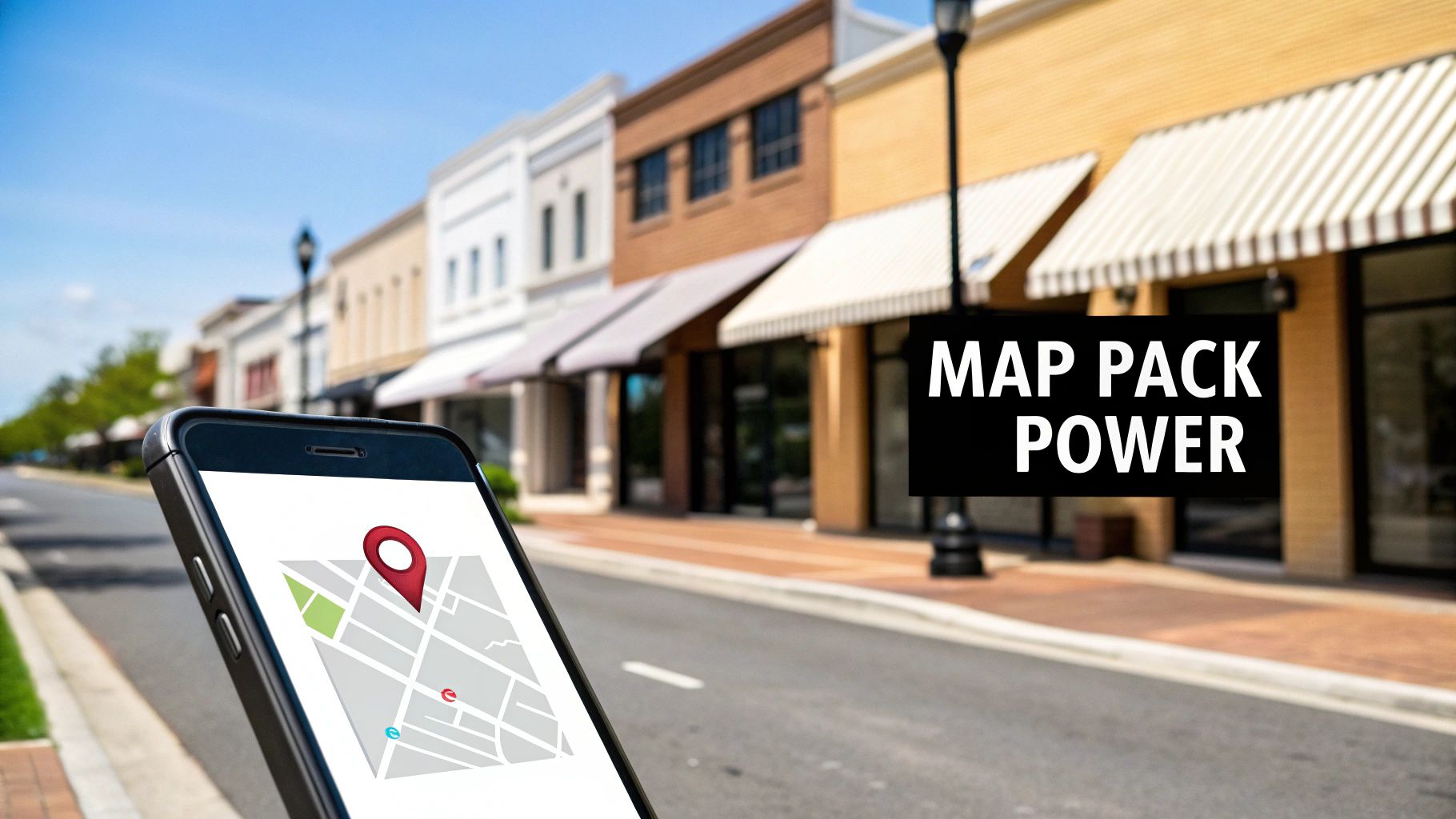
Think of the Map Pack as the modern-day town square. When a chef is frantically searching for a "commercial charbroiler supplier near me" or a family is deciding where to eat downtown, Google doesn't just throw a random list of websites at them. Instead, it serves up a curated, impossible-to-miss box with a map and three top local contenders.
This feature, sometimes called the "Local Pack" or "3-Pack," has one simple job: connect people with local businesses that can solve their problem right now. It’s a shortcut, giving them all the critical info—name, rating, address, hours—at a glance, often without needing to click any further.
The Power of Prime Placement
Getting your restaurant equipment supply website into this exclusive trio isn't just about bragging rights; it's about driving real, tangible growth. The Map Pack sits at the very top of the search results, commanding massive attention and pushing down even the #1 organic result. This visibility directly translates into more qualified leads for equipment suppliers.
The Google Map Pack is not just another search result; it's a powerful signal of trust and relevance to potential customers. Its prominent placement acts as a digital endorsement from Google, telling users, "These are the best, most relevant options for you right now."
For a business selling restaurant equipment, this means you're showing up the exact moment a chef or owner decides they need to buy. It’s the difference between being their first call and being buried on the second page where nobody looks.
Driving High-Intent Customer Actions
The impact of the Map Pack goes way beyond just being seen. It's built for immediate action. Every listing has clickable buttons to get directions, visit the website, or call the business—all right from the search results page.
This seamless experience is a magnet for high-intent customers who are ready to make a move. In fact, research shows the Local Map Pack is the undisputed king of local search, pulling in between 40% and 50% of all clicks. For a supplier like Charbroilers.com, that stat alone shows why ranking here is non-negotiable for reaching decision-makers. You can explore more about these local search trends to see just how dominant it has become.
The Map Pack doesn't just bring you visibility; it delivers customers who are ready to act. The table below breaks down exactly how securing a top spot can directly impact your bottom line.
How Map Pack Visibility Transforms Your Business
| Benefit | Direct Impact on Your Business | Key Statistic |
|---|---|---|
| Increased Local Visibility | Your business appears before organic results for high-intent local searches. | 42% of local searches result in a click on a Map Pack result. |
| Higher Foot Traffic | Customers get one-click access to directions, leading them right to your door. | 76% of people who search for something nearby on their phone visit a related business within a day. |
| More Phone Calls & Leads | The "Click to Call" button drives direct inquiries from motivated customers. | 60% of smartphone users have contacted a business directly from search results. |
| Enhanced Trust & Credibility | A top-3 ranking acts as a strong endorsement from Google, building instant trust. | Businesses on the first page of Google get 92% of all consumer traffic. |
| Competitive Advantage | You capture the customer's attention before they even see your competitors. | The top 3 local search results get nearly 50% of the total clicks. |
As you can see, the data tells a clear story. Ranking in the Map Pack isn’t a nice-to-have—it’s a strategic imperative that delivers measurable results.
More Than SEO It Is a Business Strategy
At this point, it should be clear that mastering the Map Pack is no longer a niche marketing tactic. It's a core business strategy for any company that relies on local customers. The benefits are direct, measurable, and powerful.
- Increased Credibility: Ranking in the top three makes customers see you as one of Google's top recommendations, building instant trust.
- Higher Conversion Rates: The people finding you through the Map Pack are actively looking to buy now, which means more calls, visits, and sales.
- Competitive Advantage: Outranking your local competition means you become the first choice for customers, not an afterthought.
By understanding how the Google Map Pack works and the immense influence it holds, you can start building a strategy that puts your restaurant equipment supply website on the digital main street where your customers are already looking.
Understanding Google's Core Ranking Signals
Getting your business into that coveted Google Map Pack isn't a game of luck. It's about sending the right signals to Google's algorithm, loud and clear, to prove you're the best answer for a local search. Think of Google as a concierge trying to give someone the absolute best recommendation. To pull that off, it zeros in on three core ideas: Proximity, Relevance, and Prominence.
If you can get a handle on these signals, you've found the key to climbing the local search ladder. Our services, which include local citation building, blog posting, and article writing, are designed to amplify these signals and get your business in front of way more customers.
Proximity Where Is the Customer
Proximity is the most straightforward signal of the bunch. It simply answers the question, "How close is this business to the person searching?" If a chef in downtown Chicago searches for "restaurant equipment supply," Google isn't likely to show them a supplier way out in the suburbs, even if it's a fantastic business. The algorithm will always prioritize what's physically closest to wherever the searcher is standing.
Imagine you're on a busy street corner, starving for a slice of pizza. You’re going to look for the pizzerias you can see or walk to in a few minutes, not one clear across town. Proximity in the Google Map Pack works exactly the same way; it’s your digital curb appeal to customers right in your neighborhood.
And while you can't just pick up and move your physical address, you can make sure Google understands the full scope of your service area. This is especially critical for suppliers who deliver across a wide range of locations.
Relevance What Does the Customer Want
Relevance is all about matching what you do with what the customer is looking for. It answers the question, "How well does this business fit what the searcher wants?" If someone types in "commercial charbroilers," Google's entire job is to find businesses that specialize in exactly that.
Think of it like a restaurant menu. If a diner asks for steak, a good waiter wouldn't start recommending seafood dishes. In the same way, you need to make it crystal clear to Google what's on your "menu." This is where a detailed and accurate Google Business Profile becomes your most powerful tool.
You send strong relevance signals by:
- Choosing Precise Categories: Selecting "Restaurant Supply Store" is a good start, but adding secondary categories like "Commercial Kitchen Equipment Supplier" is even better. It adds another layer of detail.
- Describing Your Offerings: Using specific keywords like "charbroilers," "griddles," and "fryers" in your business description and services list tells Google precisely what you sell.
- Featuring Products: Highlighting specific models of charbroilers in your GBP Products section creates a perfect, direct match for what a customer might be searching for.
The more specific you are about what you do, the more confident Google becomes in showing your business for those high-value searches.
Google's goal is to provide the most useful and accurate result. Strong relevance signals tell the algorithm that your business is not just an option, but the right option for the customer's query.
Prominence How Well Known Is the Business
Prominence is Google’s way of figuring out your business's authority and reputation in the real world. It answers the simple question, "How well-known and respected is this business?" To figure this out, Google scours the entire web for information about you.
This is where expert SEO services for restaurant equipment supply websites truly shine. Through local citation services, blogger outreach, and article writing, we build your digital word-of-mouth.
For a restaurant equipment supplier, prominence is built on a few key factors:
- Customer Reviews: The number of reviews you have, how good they are, and how often you get them are huge trust signals.
- Local Citations: Every mention of your business's name, address, and phone number (NAP) on other reputable websites and online directories builds your authority.
- Backlinks: Links pointing to your website from other credible sources, like industry blogs or local news sites, act like votes of confidence.
- Brand Mentions: Even when your business name is mentioned without a link, it still contributes to your online authority.
A business with a strong digital footprint and a positive reputation is seen as a safer, more reliable bet for Google to recommend. By focusing on these three pillars—Proximity, Relevance, and Prominence—you create a powerful framework for dominating the Google Map Pack.
Optimizing Your Google Business Profile for Top Rankings
Your Google Business Profile (GBP) is the engine that powers your performance in the Google Map Pack. Think of it as your digital storefront—it’s the very first impression a potential customer gets of your business. A neglected, half-empty profile is like a dark shop with the lights off, while a fully optimized one is a bright, welcoming space that practically begs customers to come inside.
Turning your GBP from a simple listing into a customer-generating machine is the single most important thing you can do to win at local search. It isn't just about plugging in your name and address. It's about strategically using every single feature to send strong ranking signals straight to Google.
The Foundation of Map Pack Success
When Google decides which businesses get the spotlight in that coveted 3-Pack, it leans heavily on the information inside your GBP. In fact, GBP signals are the most dominant ranking factor out there, making up around 32% of all local pack ranking authority. This makes dialing in your profile the absolute cornerstone of any local SEO strategy.
Google looks at a whopping 149 different factors for local searches, but with GBP and review signals combined accounting for over half of the total weight, it’s pretty clear where you need to focus your energy.
This infographic breaks down the three core signals Google uses when evaluating your business for a spot in the Map Pack.
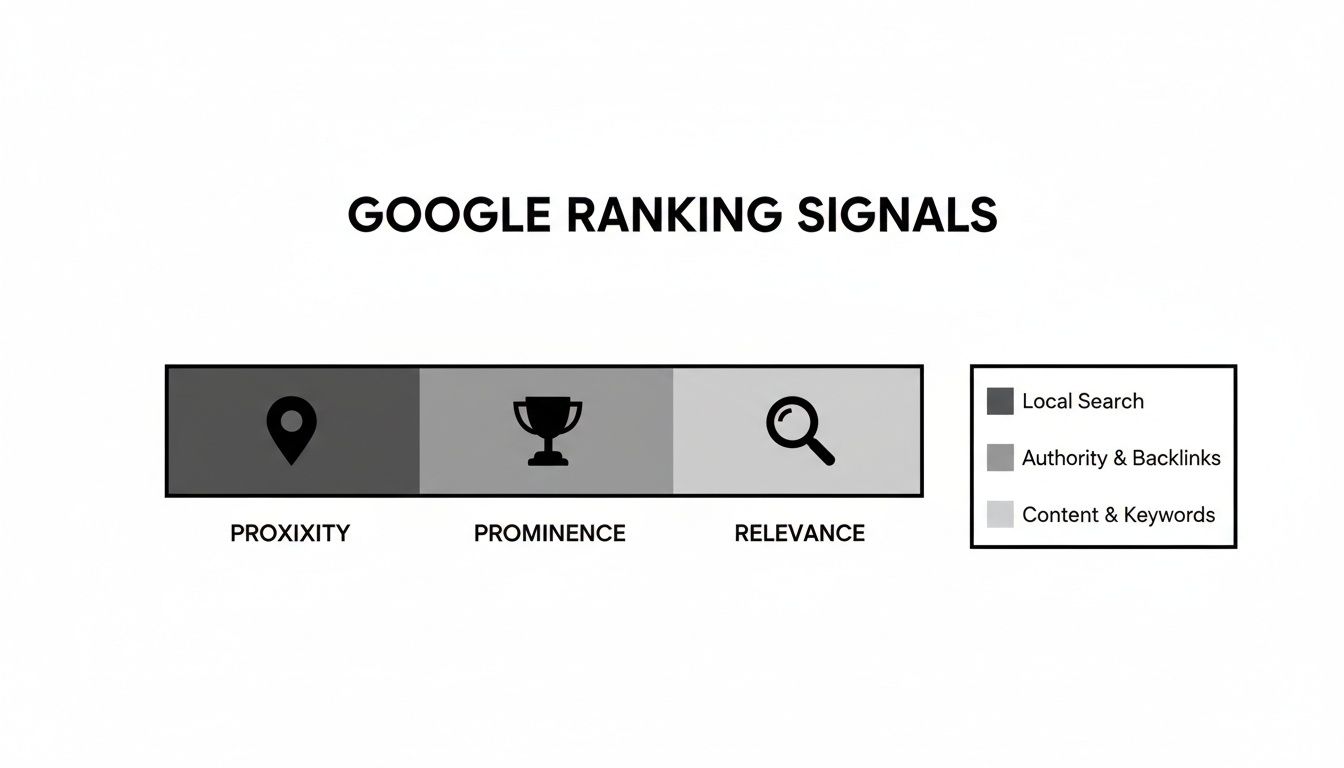
As you can see, Proximity, Prominence, and Relevance are the three pillars of local search. Your GBP is the tool you use to build up all three at once.
Choosing Precise Business Categories
One of the most crucial fields in your entire GBP is your primary business category. This one little selection tells Google exactly what you do at your core. For a restaurant equipment supplier, "Restaurant Supply Store" is a solid choice, but that’s just the starting line.
Google lets you add multiple secondary categories, and this is where you can get really specific. Adding categories like "Commercial Kitchen Equipment Supplier" or "Bakery Equipment and Supplies" adds layers of relevance. The more precise you are, the better your chances of showing up for those high-intent searches like "commercial oven supplier near me."
Choosing the right categories is like telling Google your specialties on a menu. The more specific you are, the easier it is for Google to recommend you to a customer who is looking for exactly what you offer.
Crafting a Keyword-Rich Business Description
Your business description is your chance to tell your story while also reinforcing what you sell. You get 750 characters to explain what makes you different and to weave in the keywords your customers are actually searching for.
Don't just write a generic statement. Craft a narrative that speaks directly to your ideal customer.
- Weak Description: "We sell restaurant equipment. We have been in business since 2005 and offer great customer service."
- Strong Description: "Your trusted partner for high-performance commercial kitchen equipment. We specialize in top-tier commercial charbroilers, griddles, and convection ovens designed for professional chefs. From full kitchen outfitting to single-unit replacements, we provide expert guidance and reliable equipment for restaurants, diners, and catering businesses across the region."
The second one works because it strategically includes keywords while also conveying genuine expertise and value. If you want to dig deeper into the tactics behind this, you can explore ways to improve your Google My Business ranking.
Building a Compelling Digital Storefront
Beyond the basics, GBP has some powerful features that help you create a rich, engaging profile that turns searchers into customers. These tools let you build an informative storefront that really stands out from the competition.
Highlight Your Products and Services
For an equipment supplier, the "Products" and "Services" tabs are invaluable. Use them to showcase specific charbroiler models with high-quality pictures, detailed descriptions, and even pricing. This helps you match up with long-tail searches (like "Vulcan VCRB36 charbroiler price") and gives customers a clear look at your inventory before they even click to your website.
Upload High-Quality Photos and Videos
Photos are a massive trust signal. A profile with at least 100 images gets way more engagement than one with just a handful. Show off your showroom, post pictures of your equipment in action at client restaurants, and introduce your team. This kind of visual proof builds credibility and helps people connect with your brand.
Answer Questions Proactively with Q&A
The Questions & Answers section is a goldmine for showing off your expertise. You can get ahead of the game by asking and answering common questions yourself. Think about what customers always ask, like "Do you offer financing?" or "What is the warranty on your charbroilers?" This not only helps customers but also gives you another place to naturally include relevant keywords.
If you’re just getting started and need to set up your profile from scratch, check out our guide on how to get a Google business listing. By taking the time to fully optimize every part of your GBP, you’re laying a rock-solid foundation for grabbing and holding on to a top spot in the Google Map Pack.
Building Authority With Reviews and Local Citations

If your Google Business Profile is the engine that gets you into the Map Pack race, then reviews and citations are the high-octane fuel you need to win. In local search, trust is everything. Google measures that trust by looking at two things: what real customers are saying about you and how consistently your business shows up across the web.
Think about it from your customer's perspective. When a restaurant owner needs a new commercial charbroiler, they aren't just looking for a product; they're looking for a supplier with a proven track record. Online reviews act as powerful, real-time testimonials that sway both potential buyers and Google's algorithm. A steady flow of positive feedback tells everyone that you're an active, reliable business that deserves a top spot.
The Power of Review Velocity
For a long time, the game was just about piling up as many reviews as possible. While having a good number of reviews still helps, Google's algorithm has gotten much smarter. Today, it puts a massive emphasis on review velocity—that is, how often you’re getting new reviews.
A business with 100 five-star reviews from three years ago looks stale. Compare that to a business with just 50 reviews but that gets a few new ones every single month. That second company looks active, relevant, and like it's keeping customers happy right now. This constant stream of feedback is a powerful signal to Google that your business is not just established, but consistently delivering.
This isn’t just a theory; the data backs it up. Recent findings show that the pace and frequency of new reviews are now incredibly strong ranking factors for the Map Pack. Businesses that manage to get five or more reviews per month hold onto a sustained #1 position about 75% of the time. For a B2B supplier in the restaurant equipment space, this is a game-changer. It means a business with 45 reviews and a 4.5 rating that pulls in 3-4 new reviews each month will consistently outrank a competitor with 50 reviews and a 4.6 rating that only gets 1-2 new reviews.
To really get ahead, you'll want to implement proven strategies to get more Google reviews for your business.
The table below breaks down exactly why this momentum is so crucial.
Why Review Velocity Outperforms Total Volume
| Ranking Scenario | Business with High Velocity | Business with High Volume | Likely Map Pack Outcome |
|---|---|---|---|
| New vs. Stale | 45 reviews (4.7 avg) | 100 reviews (4.8 avg) | High-velocity business likely ranks higher due to recent activity. |
| Monthly Flow | 5 new reviews/month | 1 new review/month | High-velocity business is seen as more relevant and trustworthy by Google. |
| User Perception | Business appears active and currently popular. | Business may seem less popular or inactive. | Customers are more likely to trust the business with fresh, positive feedback. |
| Algorithm Signal | Strong positive signal of ongoing relevance. | Weak signal; past success doesn't guarantee current quality. | Google prioritizes businesses that are actively satisfying customers now. |
As you can see, maintaining a steady pulse of new feedback is far more impactful than resting on old accomplishments.
Demystifying Local Citations
Beyond reviews, Google looks for another critical trust signal: local citations. Simply put, a citation is any online mention of your business's core information: its Name, Address, and Phone number (known as NAP).
These mentions can pop up all over the place:
- Online business directories like Yelp, Yellow Pages, or industry-specific listing sites.
- Social media profiles on platforms like Facebook and LinkedIn.
- Local news articles or blogs that feature your company.
Think of each citation as a vote of confidence. When Google’s crawlers find your exact NAP information listed consistently across dozens of reputable websites, it confirms you're a legitimate, established local business. It’s like having multiple trusted sources vouching for your identity and location.
A strong and consistent citation profile acts like a digital footprint for your business. The more consistent and widespread that footprint is, the more confident Google becomes in your prominence and legitimacy, directly impacting your Google Map Pack ranking.
But consistency is absolutely critical. If one directory lists you as "Charbroilers Inc." and another has you down as "Charbroiler.com" with a slightly different phone number, it creates confusion. These NAP inconsistencies can dilute your authority and hurt your rankings.
Running a regular audit to make sure your information is accurate everywhere is a non-negotiable first step. To dig deeper into this, check out our guide on local citation building and how it solidifies your online presence. By focusing on both a steady flow of reviews and a clean citation profile, you'll build the authority needed to claim and keep a top spot in the Map Pack.
Boosting Your Website's Local SEO Signals
Your Google Business Profile doesn’t exist on an island. To really own the Google Map Pack, it needs a strong partner: your website.
Think of it like this: your website and your GBP are in a constant conversation. When they both tell the same consistent, locally-focused story, Google pays attention. Your website is the home base, providing the deep context and authority that a simple GBP listing can't. By optimizing your site for local search, you pour fuel on your Map Pack efforts.
Creating Hyper-Local Content
One of the best ways to send powerful local signals is to create content that is unapologetically local. This is where our expertise in blog posting, blogger outreach, copyrighting, and article writing becomes invaluable for restaurant equipment supply websites.
For a restaurant equipment supplier, this could mean building out hyper-local landing pages. Instead of a generic "Service Areas" page, create dedicated pages for specific neighborhoods. A page titled "Commercial Charbroiler Supply for Downtown Chicago Restaurants" sends a much stronger signal to Google than something vague.
You can also weave local flavor into your blog posts:
- Community Involvement: Sponsoring a local food festival? Write about it.
- Client Spotlights: Feature a local restaurant that uses your equipment. Tell their story and celebrate their success.
- Neighborhood Guides: Think along the lines of, "Top 5 Pieces of Equipment for Small Kitchens in the River North Arts District."
This kind of content shows both people and search engines that you're truly embedded in the local scene, making you a much more relevant result for nearby searches.
Implementing On-Page SEO for Local Impact
Beyond creating new content, you need to tighten up the nuts and bolts of your website's on-page SEO. These are the technical tweaks that help search engines understand your location with crystal clarity.
A simple but powerful move is to embed a Google Map on your contact page. It’s a direct, interactive signal of where you are. Just as important, make sure your full business name, address, and phone number (NAP) are in the footer of every single page, matching your GBP information exactly.
Local Business Schema is a type of code added to your website that explicitly tells search engines what your business is, what you do, and where you are located. It's like giving Google a perfectly organized business card, removing any guesswork about your local relevance.
Leveraging Local Business Schema Markup
To really dial things in, you need to implement Local Business Schema. This is a specific kind of structured data—basically, a special vocabulary of code you add to your website—that speaks directly to search engines.
It clearly labels all your key information, like your address, hours, and what type of business you run.
Implementing schema removes all doubt. It makes it dead simple for Google to verify your information and trust your website as an authoritative source. This structured data reinforces the details in your GBP and strengthens the link between your website and your listing. Your website becomes an active partner in your local SEO strategy, which is essential for hitting—and holding—those top spots in the Map Pack.
Your Google Map Pack Dominance Checklist
Knowing the theory is one thing, but getting results comes from taking action. I've broken down all the strategies we’ve talked about into a straightforward checklist you can actually use. Think of this as your roadmap for climbing the Google Map Pack rankings, turning those clicks into real customers for your restaurant equipment supply website.
Just start with the basics and work your way down. Each step is a manageable task designed to build on the last one, so you'll see progress as you go.
Google Business Profile Essentials
Your Google Business Profile is the absolute foundation of your Map Pack ranking. If you don't get these details right, nothing else matters. It's non-negotiable.
- Claim and Verify Your Profile: First things first, make sure you have complete control over your profile and that Google has officially verified your location.
- Select Precise Categories: Choose your most important category first, like "Restaurant Supply Store," then layer in more specific ones like "Commercial Kitchen Equipment Supplier" to catch those super-targeted searches.
- Perfect Your NAP: Your Name, Address, and Phone Number need to be 100% identical everywhere—on your website, in directories, everywhere. No exceptions.
- Craft a Compelling Description: You get 750 characters, so use them. Describe what makes you great and naturally work in terms customers search for, like "commercial charbroilers" or "restaurant kitchen outfitting."
- Upload High-Quality Photos: Don't skimp here. Aim for at least 100 good pictures showing off your showroom, your products being used, and your team. Google loves seeing fresh photos.
Ongoing Reputation Management
Your reputation is a massive ranking signal. When you actively manage it, you're sending a strong message to Google that you're a trustworthy, active business people can count on.
Responding to every single review—good or bad—isn't just a nice-to-have anymore. It shows both potential customers and Google that you care about feedback and service, which directly impacts how prominently you're featured.
- Respond to All Reviews: Try to reply to every new review within 24 hours. Make your responses personal to show you're not a robot.
- Generate a Steady Review Flow: Put a simple system in place to ask every happy customer for a review. A steady trickle of new reviews is far better than a huge batch all at once.
- Use the Q&A Feature Proactively: Don't wait for customers to ask questions. Go in and post common questions and answer them yourself. It's a great way to control the information people see first.
Website and Local Signal Optimization
Your website needs to back up everything your Google Business Profile is saying. It’s all about reinforcing those local signals.
- Ensure NAP Consistency: The name, address, and phone number in your website's footer or header must be an exact match for your GBP.
- Embed a Google Map: Put an interactive Google Map on your contact page. It's a simple, direct signal to Google that confirms your location.
- Create Local Content: Write blog posts or build out service pages that target the specific neighborhoods, towns, or cities you serve.
- Implement Local Business Schema: This is a bit of code you add to your site that spells out your business details for search engines in a language they perfectly understand.
By methodically working through this checklist, you'll be well on your way to locking down a top spot. For an even deeper dive, our complete local SEO checklist will help you cover every possible base.
Your Top Map Pack Questions, Answered
Getting the hang of the Google Map Pack can feel a bit like learning a new recipe—it seems tricky at first, but once you master a few key ingredients, you can avoid some common disasters. Let's walk through the questions that pop up most often for equipment suppliers.
Getting these details right is the difference between a local SEO strategy that sizzles and one that fizzles out.
How Long Does It Take to See Results?
This is the big one, isn't it? Everyone wants to know when they'll see their name in lights. Think of ranking in the Map Pack as a marathon, not a 50-yard dash. You might see some movement from simple Google Business Profile tweaks in a few weeks, but building the kind of trust and authority needed for a stable top-three spot usually takes three to six months of consistent work.
That timeline can change based on how fierce the competition is in your city, how dialed in your profile already is, and how steady you are with getting new reviews and building citations. It’s like earning a great reputation in a new neighborhood—it just doesn't happen overnight.
Securing a spot in the Map Pack is a long-term play for your local visibility. Patience and sticking to the fundamentals are what win the game, not chasing after quick hacks.
Can I Rank Without a Physical Address?
This is a huge deal for service-area businesses, like equipment suppliers who deliver directly to restaurants. The short answer is yes, you can absolutely rank without showing your physical address on your profile. But here's the catch: Google is very strict about this. You must have a registered business address in the city you want to rank in, even if you hide it and set a service area instead.
You can't just drop a pin on a map in a city you like and hope for the best. Google’s whole system is built around proximity, so that registered address is your anchor. Trying to game the system with a P.O. box or a virtual office is a fast track to getting your listing suspended. Don't do it.
What Are the Most Common Mistakes?
So many businesses trip over the same, easily avoidable hurdles. Just by sidestepping these common mistakes, you can get a serious leg up on competitors who aren't sweating the small stuff.
Here are the top blunders to watch out for:
- Inconsistent NAP Information: Your Name, Address, and Phone number (NAP) need to be a perfect match everywhere online—every directory, every social media profile, every mention. Even tiny differences like "St." versus "Street" can throw Google off and weaken your authority.
- Neglecting Customer Reviews: Ignoring your reviews is like a chef ignoring feedback from the dining room. It sends a terrible message. If new reviews aren't coming in, you look closed for business. If you're not responding to bad ones, you look like you don't care.
- Incorrect Business Categories: Picking a category that's too generic or just plain wrong is a massive missed opportunity. You have to be as specific as you possibly can to pull in the right kind of customers looking for exactly what you offer.
By getting clear on these questions and steering clear of these simple slip-ups, you'll be building a much stronger, more effective game plan for climbing the Google Map Pack rankings.
At Charbroilers.com, we know the right equipment is the heart of any great kitchen. Find the perfect high-performance commercial charbroiler to elevate your menu by exploring our selection at https://charbroilers.com.