
Effective Food Service Training Programs Your Team Needs
When we talk about food service training programs, we're not just talking about showing new hires how to chop an onion or work the POS system. We’re talking about a structured process that gives your entire team the skills they need—from food prep and safety all the way to stellar customer service.
These programs are the backbone of a great restaurant. They're what keeps your quality high, your service consistent, and your team from making costly mistakes that come from just not knowing any better. As a firm specializing in SEO and content creation for restaurant equipment suppliers, we understand that well-trained staff are just as critical as top-tier equipment.
Why Modern Food Service Training Is a Competitive Edge
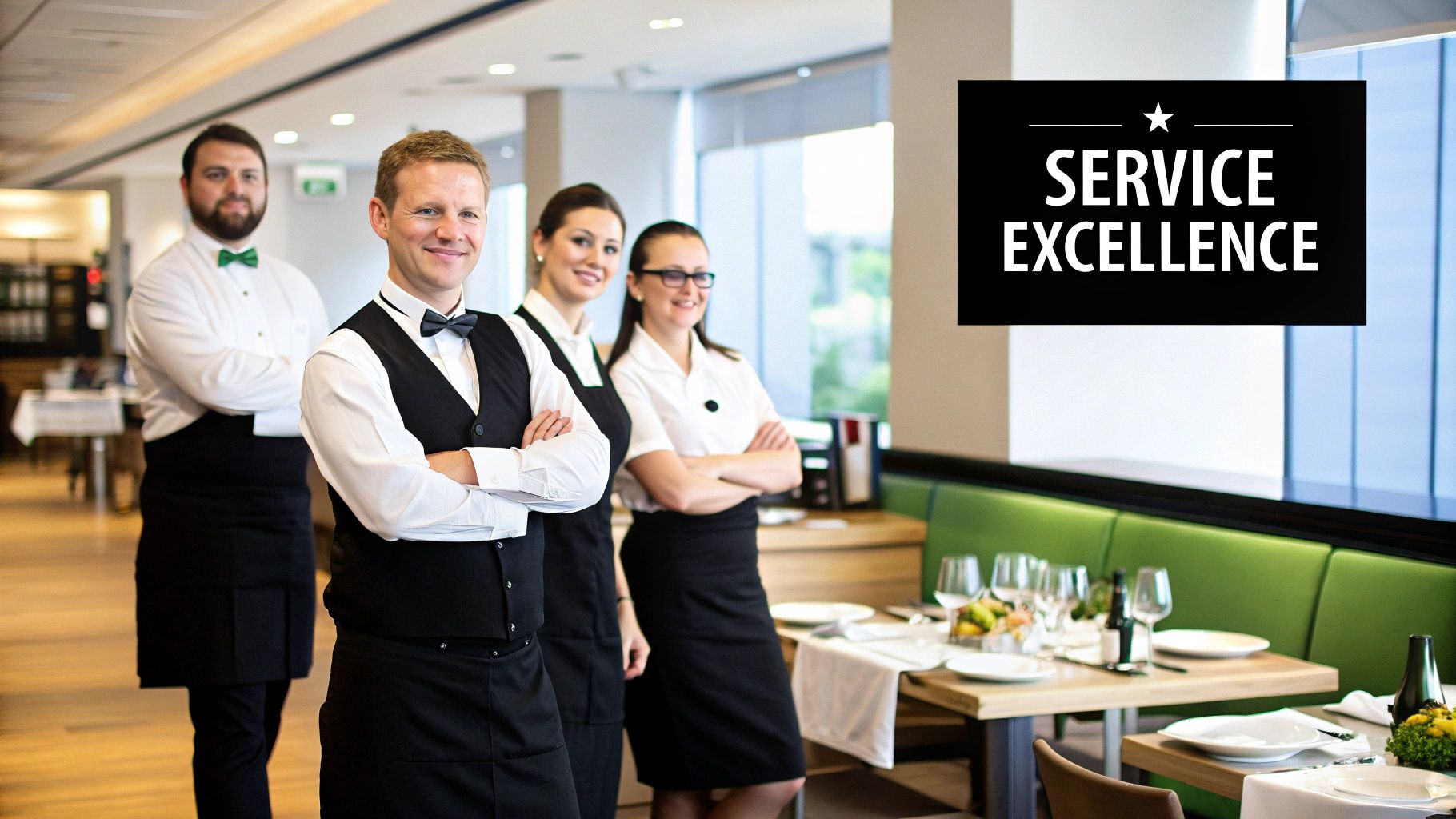
In a market this crowded, with customer expectations higher than ever, just "checking the box" on training won't cut it anymore. Your team’s skill level has a direct line to your bottom line, making a smart training program one of the best investments you can make.
It’s the difference between a crew that just shows up and a team that truly excels.
This isn't just about avoiding slip-ups; it's about building a culture of excellence from the ground up. Good training empowers your employees, boosts their confidence, and makes a real dent in the crippling staff turnover that plagues our industry—a rate that often hangs around a staggering 75% annually.
The Real Cost of Inadequate Training
Letting training slide, or relying on outdated methods, has real and often hidden costs. It only takes one bad service experience blowing up on social media to tarnish your reputation for months. Worse, a single slip in safety protocols can lead to fines, a failed health inspection, or—the ultimate nightmare—a customer getting sick.
Think about the ripple effects of bad training:
- Inconsistent Service: One day the food is great, the next it's not. Customers won't stick around for that kind of gamble.
- Increased Food Waste: When staff don't know proper portioning, storage, or cooking techniques, your profits go straight into the trash can.
- Higher Employee Turnover: People who feel lost, unsupported, and unprepared are the first ones out the door. That just means more money spent on recruiting and training their replacements.
At its core, a modern training program is about building two things: competence and confidence. When your team knows exactly what to do and how to do it well, they can deliver that amazing experience that turns first-time visitors into regulars.
Investing in Skills for Future Growth
The demand for talented culinary pros is only going up. In fact, the global chef training service market is projected to grow significantly between 2025 and 2033, thanks to an expanding industry and more sophisticated customer palates. This isn't just a number; it shows that specialized skills are becoming the key thing that sets one restaurant apart from another.
When you invest in a solid food service training program, you're not just putting out today's fires—you're getting ready for tomorrow's challenges.
A well-trained team is faster, more efficient, and ready to adapt to new menu items, changing customer tastes, and new industry rules. Staying on top of current food service industry trends helps you build a curriculum that's actually relevant. This proactive approach is what separates the restaurants that thrive from the ones just trying to survive.
Building Your Core Training Modules From Scratch
A top-tier food service training program isn't some giant, one-size-fits-all manual. Think of it more like a recipe book, filled with distinct, practical modules that build skills one at a time. When you start from the ground up, you get to focus on the real-world skills your team actually needs to get through a busy shift.
These core modules are the foundation for a team that’s both competent and confident. They need to be clear, actionable, and centered around what actually happens on the floor and in the kitchen, not just abstract rules from a textbook.
Front-of-House Excellence
Your front-of-house (FOH) crew is the face of your restaurant. Their training has to arm them for anything and everything. This isn't just about memorizing the menu; it's about handling the dynamic, unpredictable situations that define a guest's experience.
Get them role-playing. Instead of a slide that says "handle complaints," act out a scenario where a customer gets the wrong dish during a chaotic dinner rush. Give them a simple, three-step process to follow: Listen, Apologize, Solve. Empower your staff to fix the problem right then and there by offering a free dessert or drink.
When it comes to upselling, ditch the pushy sales tactics. Train your servers to ask smart questions like, "Have you seen our new seasonal appetizer? The chef created it to pair perfectly with the entrée you ordered." That feels genuinely helpful, not like a sales pitch, and it’s a natural way to bump up the average check size.
Back-of-House Mastery
In the kitchen, it all comes down to two things: efficiency and safety. Your back-of-house (BOH) training module should build a system where everyone knows their part in the bigger picture. That’s how you get consistency and quality, even when the tickets are flying.
Map out the journey of a popular dish from the moment the ticket prints to when it lands on the table. A visual workflow helps every cook, prep hand, and dishwasher see how their own speed and accuracy affect the next person in line. You should also include hands-on practice with inventory management, demonstrating how spot-on counts cut down on food waste and keep costs in check.
A well-trained BOH team operates with a shared rhythm. They anticipate needs, communicate clearly, and move with purpose, turning a potentially chaotic environment into a smooth and productive operation.
This module absolutely must cover equipment safety. That means more than just showing someone how to turn on the fryer. It means daily cleaning routines, proper maintenance, and understanding the risks. For example, solid training on commercial kitchen ventilation requirements isn't just about passing an inspection—it’s about preventing fires and keeping the air safe for your entire team.
Safety and Compliance Essentials
This part is non-negotiable. It’s the module covering the critical health and safety rules that protect your guests, your staff, and your business. All other training is built on this bedrock.
Again, use real-life scenarios. What is the exact procedure when a guest tells their server they have a severe nut allergy? Your training needs to spell it out: flag the ticket in the POS, speak directly to the chef, and use completely separate utensils and prep surfaces to eliminate cross-contamination.
To make sure your team meets key industry standards and elevates their own professional skills, it's worth looking into a comprehensive guide to food handler certificate training. This kind of external certification adds another layer of credibility and ensures everyone on your team grasps the fundamentals of food safety, from temperature control to proper hygiene.
To give you a clearer picture, here's a breakdown of how these essential modules can be structured.
Essential Training Modules for a Complete Program
This table outlines the key areas your training should cover, what your team should learn in each, and who needs the training most.
| Training Module | Key Learning Objectives | Primary Audience |
|---|---|---|
| FOH Guest Experience | Master upselling, handle complaints effectively, manage reservations, and deliver impeccable table service. | Servers, Hosts, Bartenders, Bussers |
| BOH Workflow & Prep | Understand ticket-to-table process, execute recipes consistently, manage inventory, maintain station cleanliness. | Line Cooks, Prep Cooks, Sous Chefs, Dishwashers |
| Food Safety & Handling | Prevent cross-contamination, adhere to temperature controls, follow proper hygiene protocols, understand allergen risks. | All FOH & BOH Staff |
| Equipment & Safety | Operate kitchen equipment safely, follow daily cleaning procedures, understand emergency shut-off protocols. | All BOH Staff |
| Bar & Beverage Service | Learn cocktail recipes, responsible alcohol service (TIPS/ServSafe), manage bar inventory, and operate POS. | Bartenders, Barbacks, Servers |
| Compliance & Legal | Understand local health codes, labor laws, and workplace safety regulations (OSHA). | All Management, All Staff |
By organizing your program this way, you ensure every single team member gets the specific, targeted information they need to excel in their role.
Connecting Training Theory to On-The-Floor Reality
You’ve poured time and effort into creating a brilliant training module. It’s clear, detailed, and covers all the bases. But then, a few weeks later, you spot a new server making the exact same mistake you trained them not to make. Why? Because a veteran on the team showed them a "quicker" way to do it.
Sound familiar? This is the classic disconnect between the controlled environment of the training room and the chaotic reality of a busy shift.
It’s where even the best food service training programs fall apart. The gap between what's taught in theory and what's actually practiced on the floor is a frustratingly common challenge. The dynamics of a live service—from unofficial "shortcuts" passed down by seasoned staff to the sheer pressure of a dinner rush—can undo all your hard work. This is why making your training stick requires more than just a good manual; you need a solid strategy to bridge that gap.
The Real-World Training Gap
There's a massive difference between knowing something and doing it under pressure. A global survey uncovered a startling statistic: while 88% of companies felt their food safety training was solid, only a mere 40% of their employees actually followed those protocols consistently during their shifts. The biggest roadblocks? Scheduling conflicts, high turnover, and bad habits being passed from one coworker to another.
That number is a wake-up call. It proves that training can't be a "one-and-done" event. It has to be woven into the daily fabric and culture of your restaurant.
Empowering Your Team to Lead the Way
One of the most powerful things you can do to make training stick is to turn your best people into training champions. Think about it: who on your team is skilled, positive, and patient? These are the people you want mentoring new hires through a "train the trainer" program.
This approach pays off in two huge ways:
- Authenticity: Guidance from a respected peer often lands better and feels more genuine than a lecture from a manager.
- Consistency: It ensures the right procedures are being taught during on-the-job shadowing, stamping out those bad habits before they even have a chance to start.
When you empower your top performers, you start building a culture where excellence is passed down organically. Training stops being a top-down mandate and becomes a shared responsibility the whole team buys into.
The goal is to create a continuous learning loop where best practices are not just taught in a classroom but are demonstrated, reinforced, and celebrated on the floor every single day. This is how training becomes part of your restaurant's DNA.
Strategies for Making Training Stick
To really connect theory with reality, you need to attack the problem from a few different angles. A blended learning approach, which mixes up different training formats, works wonders for hectic restaurant schedules.
Here are a few actionable strategies you can implement right away:
- Mentorship Programs: Pair every new hire with a seasoned employee who acts as their mentor for the first 30 days. This gives them a go-to person for questions and reinforces the correct techniques in real-time.
- Micro-Learning: Break down complex tasks into short, digestible videos (2-3 minutes) that staff can pull up on their phones. Think quick refreshers like "How to Properly Clean the Espresso Machine" or "The Five Steps to Handling a Customer Complaint."
- On-Floor Coaching: Managers need to be on the floor, actively observing and giving immediate, constructive feedback during shifts. Don't wait for a formal review—address issues and praise good work right in the moment.
Don't forget that your physical environment plays a huge role, too. A well-designed, logical commercial kitchen design layout can naturally guide your team toward safer, more efficient workflows, making it that much easier for them to apply what they've learned. When the space itself is set up for success, your team is far more likely to succeed within it.
Choosing the Right Training Methods for Your Crew
Throwing a single training manual at your entire team and hoping for the best is a recipe for disaster. Let's be honest, that one-size-fits-all approach just doesn't work. The way you actually deliver your food service training programs is every bit as important as the information itself.
Getting the right mix of training methods is the secret to making sure your crew doesn't just learn the material, but actually remembers and uses it when the dinner rush hits. A line cook learns differently than a server, and a seasoned veteran needs a different approach than a Gen Z new hire. A hands-on workshop is perfect for nailing down knife skills, while an online module they can do on their phone is way better for getting through food safety compliance.
Blending Hands-On and Digital Learning
The most successful restaurants use a blended approach. They mix and match different training styles to create a program that covers all the bases, playing to the strengths of each method.
Here’s a practical way this could look:
-
E-Learning for Foundations: Start new hires with online modules. This is the place for the non-negotiables: your restaurant's story, menu knowledge, allergen info, and basic hygiene protocols. It guarantees everyone gets the same core message, straight from the source.
-
On-the-Job Coaching for Skills: Theory is great, but nothing beats practice. Pair new team members with a trusted veteran for real-world, on-the-job coaching. This is where they learn the flow of the kitchen, how to handle the POS system with a line out the door, and get instant feedback that actually helps.
-
Workshops for Advanced Techniques: For the really complex stuff, get everyone together. In-person workshops are perfect for role-playing how to handle a difficult customer, practicing sophisticated bartending skills, or getting the whole team trained up on a new piece of equipment.
By layering these methods, you turn training from a one-time chore into something that’s constantly happening. It becomes part of the daily workflow, not an event they have to dread.
Sometimes, you need to step back and figure out the right kind of training to improve.
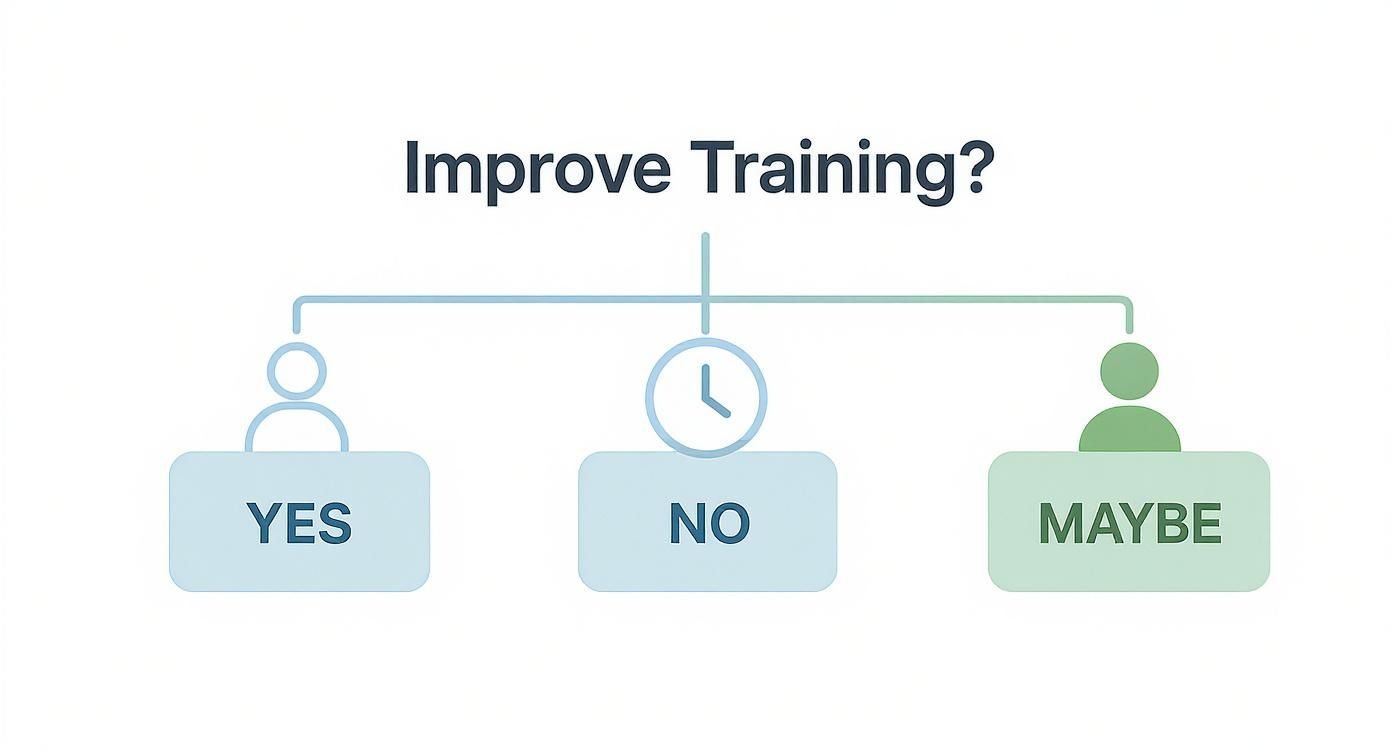
As you can see, the answer isn't always "more training." Sometimes the solution is better mentorship or just smarter time management.
Tailoring Methods to Your Team's Needs
The ideal mix of training methods comes down to your restaurant's specific needs, budget, and crew. A busy quick-service spot with high turnover will probably get the most bang for its buck with short, mobile-friendly videos and peer shadowing. On the other hand, a fine-dining restaurant might invest heavily in intensive workshops led by the executive chef to perfect plating artistry.
There are a ton of different ways to get information across. Picking the right ones can make or break your program.
Comparison of Training Delivery Methods
Choosing a delivery method is about finding the right tool for the job. Here's a quick breakdown to help you decide what might work best for different situations in your restaurant.
| Method | Pros | Cons | Best For |
|---|---|---|---|
| On-the-Job (OJT) | Immediate, practical application; builds mentor relationships. | Can be inconsistent; may pass on bad habits. | Teaching role-specific tasks (e.g., using the POS, station prep). |
| E-Learning Modules | Consistent messaging; flexible schedule; easily scalable. | Lacks personal interaction; can feel isolating or boring. | Foundational knowledge (e.g., food safety, HR policies, menu details). |
| In-Person Workshops | Highly interactive; great for team-building and complex skills. | Expensive to run; requires scheduling staff off the floor. | Advanced skills (e.g., wine tasting, de-escalation training, new techniques). |
| Peer Mentoring | Cost-effective; builds camaraderie; relatable instruction. | Mentor may lack teaching skills; potential for inconsistency. | Reinforcing initial training and teaching unwritten rules of the floor. |
| Videos/Microlearning | Short, focused, and mobile-friendly; great for quick refreshers. | Not suitable for complex topics; requires self-discipline. | Quick "how-to" guides (e.g., cleaning equipment, daily closing tasks). |
Ultimately, the best approach is usually a combination of these methods. Start with one or two that fit your most urgent needs and build from there.
Once you know your options, you can get more specific about choosing the right delivery methods in training for each part of your program. The key is to stay flexible. Listen to your team and be willing to adjust. When you put thought into how you teach, you don't just improve retention—you build a sharper, more confident, and more capable crew.
Why Your Training Needs to Be Interactive and Inclusive
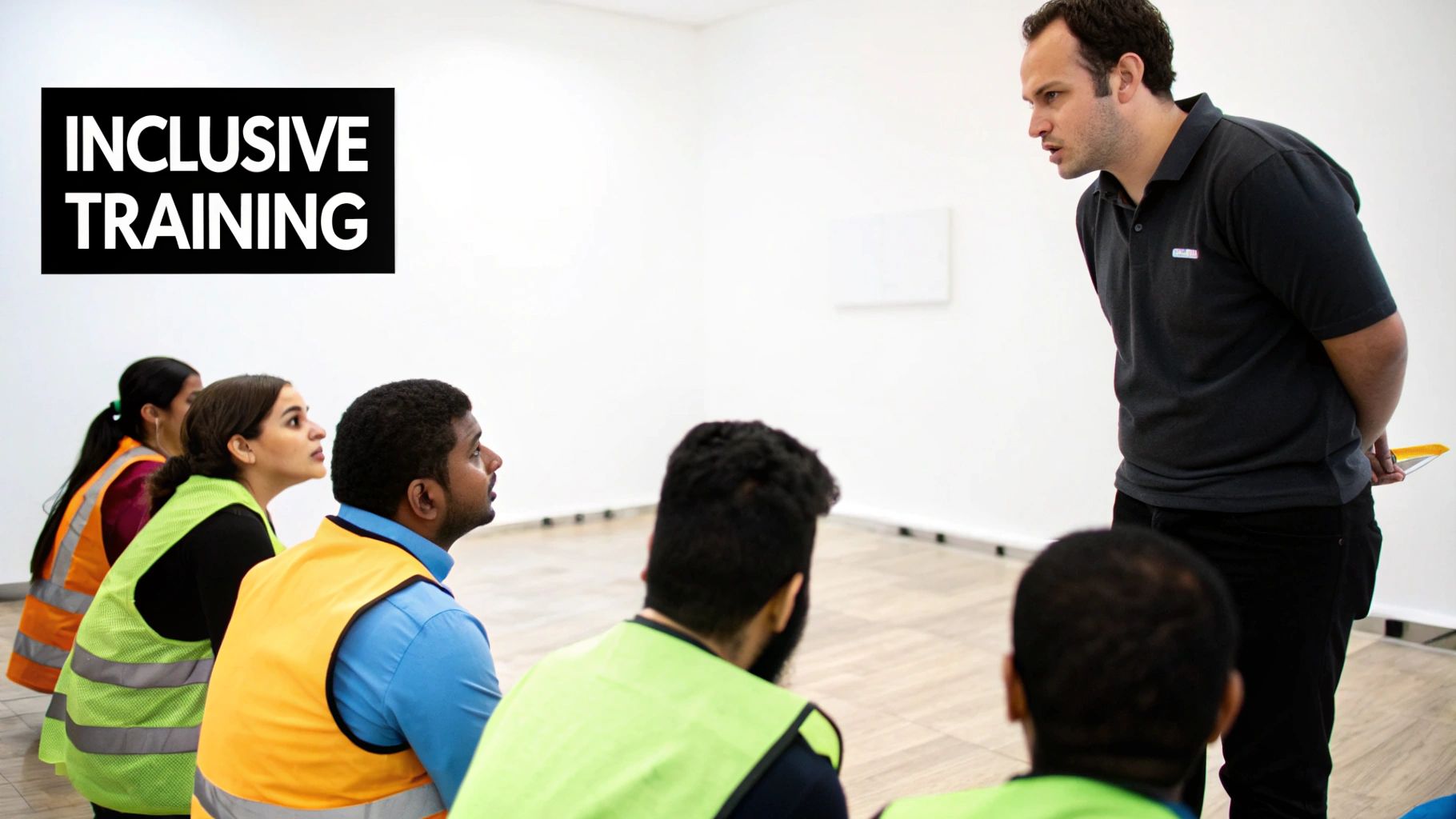
Let's be honest, the days of herding your team into a room for a dull, slide-by-slide lecture are long gone. If you want your food service training programs to actually stick and show up on the floor, you have to get your staff involved.
It really is that simple: engagement is everything. When employees are active—solving problems, talking through real situations, and physically practicing skills—they hold onto that information. This hands-on approach is the secret to improving everything from safety compliance to the quality of your service.
The numbers don't lie. Interactive teaching in food safety training has been shown to boost employee compliance by a whopping 35% over old-school, passive methods. When you look at specific habits, it's even more striking. Handwashing compliance can jump from 45% to 85%, and preventing cross-contamination can go from 48% to 80% after well-structured, engaging training. You can dig into the complete findings on food safety training for diverse workforces to see just how powerful these methods are.
Making Training More Hands-On
Getting interactive doesn't mean you need a huge budget or fancy tech. It's all about shifting your mindset from telling to showing and doing.
Instead of just listing health code violations from a manual, why not set up a mock kitchen inspection? Turn it into a game where teams compete to spot all the errors. Suddenly, a dry topic becomes memorable and even fun.
Another fantastic tool is scenario-based role-playing. Have your servers act out how they'd handle a difficult customer complaint. Challenge your kitchen crew with a simulated equipment failure right in the middle of a dinner rush. These exercises build the muscle memory they'll need when the pressure is real.
The best training feels less like a classroom and more like a workshop. You're creating a safe space for people to make mistakes, ask questions, and build confidence before they’re in front of a real customer or a real crisis.
Building an Inclusive Learning Environment
Your team is a mix of backgrounds, languages, and learning styles. A one-size-fits-all approach just won't cut it. For training to be truly effective, it has to be accessible to everyone, ensuring nobody gets left behind because of a communication barrier.
Here are a few practical ways to make your training more inclusive:
- Lean on Visuals: Pack your materials with images, diagrams, and videos. A picture of a properly sanitized prep station is a universal language.
- Offer Multilingual Support: If you have staff members who are more comfortable in another language, provide key documents or use translation apps. This is critical for important safety information.
- Encourage Peer Learning: Pair up employees from different backgrounds to work on tasks together. This builds camaraderie and lets team members help each other bridge any language or cultural gaps.
When you make your food service training programs both interactive and inclusive, you're not just checking a box. You’re building a smarter, more capable team and a stronger culture where everyone feels valued and set up to succeed.
Answering Your Top Training Questions
As you start putting a real training program in place, you’re going to have questions. It’s only natural. Our expertise in article writing and content strategy for restaurant equipment websites means we've seen these challenges before. Here are a few of the most common ones we hear from owners and managers, along with some straight-up answers.
How Can I Measure the ROI of My Training Program?
Thinking about the return on your training investment doesn't have to be some abstract headache. It really just comes down to tracking the right numbers before and after you get started. You're looking for real, tangible improvements in the metrics that actually hit your bottom line.
First, you need a baseline. Get your numbers down on paper. Then, after about three to six months of consistent training, pull those same reports and see what’s changed.
- Financials: Are your average check sizes climbing because of smarter upselling? Has your food waste percentage dropped now that everyone’s on the same page with prep and portioning?
- Operations: Have you seen a decrease in workplace accidents or silly safety mistakes? That's a huge win.
- People: Is your employee turnover rate going down? Just one less person quitting can save you thousands.
- Customers: Are your satisfaction scores up? Are people leaving online reviews that specifically call out how great the service was?
When you track these kinds of numbers, it’s easy to draw a clear line from the time and money you spent on training directly to the money you’re now saving or making.
What Is the Best Way to Train in a High-Turnover Environment?
High turnover is a painful reality in this business, and it completely changes the training game. Your program has to be brutally efficient, easy to repeat, and fast. You simply don't have the luxury of a manager spending hours teaching the basics to every single new face.
For this kind of environment, a blended learning approach is your best friend.
A smart strategy mixes some self-paced stuff with focused, on-the-floor coaching.
- Get the Basics Online: Use a simple online system or even just a shared folder for the foundational knowledge. New hires can learn the menu, company story, and critical safety rules on their own time—sometimes even before they clock in for their first shift.
- Pair Them Up for Real-World Practice: Once they’ve got the basics, partner them with a trusted senior employee or a designated trainer. This isn't about watching; it's about doing. They get in-the-moment feedback on using the POS, talking to real customers, and finding their way around the kitchen.
- Build a "How-To" Video Library: Create a bunch of short, simple videos they can pull up on their phones. Think "how to clean the espresso machine" or "what are the closing duties for the patio." It’s a digital cheat sheet that empowers them to find answers without pulling a manager away from a problem.
This kind of system gets new team members comfortable, confident, and actually contributing way faster.
In a high-turnover spot, the goal of training isn't just to dump information. It's about building competence and confidence—fast. A streamlined, repeatable process is your most valuable weapon.
How Often Should I Update My Training Materials?
Your training guides should be living, breathing documents. Don’t just create them, print them, and stick them in a binder to collect dust. Plan on giving everything a thorough review at least once a year.
But some things can't wait that long. You need to jump on updates immediately whenever you make a big change.
- You roll out a new menu or seasonal specials.
- You install that fancy new combi oven or espresso machine.
- The local health department changes a rule.
Most importantly, you need a way for your team to give you feedback. They're the ones using this stuff every day. They’ll be the first to tell you when a process is clunky, confusing, or just plain wrong. Their insights are gold for keeping your training relevant.
Where Do I Start with a Very Small Budget?
Look, a tight budget doesn’t mean you get a pass on training. It just means you have to be scrappy and resourceful. Your most valuable assets are already on your payroll. Start by picking your best, most positive employees and officially making them peer trainers.
You don't need fancy software. Create simple, one-page standard operating procedures (SOPs) for the most critical jobs and stick them in a shared Google Drive folder. You can shoot decent "how-to" videos on your smartphone—they don't need to win an Oscar.
Focus your energy on the one thing that will make the biggest impact right now, whether that's food safety or stepping up customer service. Nail that, and then build from there. Remember, consistency is way more important than expensive tech.
A well-trained team is the engine of a successful restaurant, and the right equipment gives them the tools they need to shine. For top-tier cooking equipment that delivers consistent, delicious results, trust Charbroilers.com. Explore our selection of commercial charbroilers designed for durability and performance.