

Master Your Menu with a Food Cost Percentage Calculator
Think of your food cost percentage as the single most important health metric for your kitchen. It’s a simple number that tells you exactly what portion of your sales revenue is being spent on the food itself. This isn't just an accounting chore; it's a critical tool for restaurant equipment supply websites looking to provide value to their clients.
For most restaurants, this number should hover somewhere between 28% and 35%. Get it right, and you're on the path to profitability. Let it creep up, and you could be losing money on every single plate that leaves the kitchen.
Why Food Cost Percentage Is the Key to Your Profitability
Before you even touch a calculator, you need to understand why this metric is the lifeblood of your restaurant. This isn't just an accounting chore. It's a real-time dashboard for your kitchen's efficiency. For restaurant equipment suppliers, providing this kind of business intelligence through SEO-optimized content, blog posting, and article writing can build immense trust with your target audience.
Your food cost percentage tells a story. It can reveal everything from a supplier quietly raising prices to a line cook being a little too generous with pricey ingredients. A few percentage points might not sound like much, but over a year, it can mean thousands of dollars in lost profit.
The True Cost of a "Little Extra"
Let me give you a classic example I've seen play out dozens of times. A popular pizzeria is killing it with sales, but their profits are shrinking. After running the numbers, they discover their food cost is a full 5% higher than their target.
Where's the money going? After a quick audit, they find the culprit. The kitchen team, trying to make customers happy, has been tossing a "little extra" cheese on every pie. That tiny gesture, multiplied by hundreds of pizzas a week, was silently eating away their margins on their number one seller. This is where the numbers connect directly to what's happening on the line.
Mastering your food cost percentage moves you from putting out fires to proactively managing your profits. It’s the difference between guessing where your money went and knowing exactly how to make more of it.
Finding Your Sweet Spot
So, what's the right number for you? While the industry standard is 28% to 35%, your ideal target really depends on your concept. A high-end steakhouse with big-ticket menu items can aim for the lower end, maybe even 28%, because their prices can absorb the ingredient cost.
On the other hand, a fast-casual spot selling burgers and fries might operate perfectly fine closer to 35%. It's all relative. The first step is calculating your current number accurately—that gives you the baseline you need to start making smart pricing and inventory decisions. You can also get a broader view of market conditions by checking out global food price trends on Statista.com.
Gathering Your Data for an Accurate Calculation
Any good food cost calculation starts with solid, reliable data. You can plug numbers into a calculator all day long, but if your inputs are garbage, your outputs will be too. Before you even think about calculating, you need to get precise figures for your inventory, purchases, and sales.
Think of it like prepping a new dish. If your measurements are off, the final plate just won't taste right. It's the exact same principle here. Guessing or using vague estimates will only give you a misleading percentage, hiding serious profit leaks or making you panic over problems that don't actually exist.
Key Numbers You Need to Collect
The whole process really just boils down to tracking the flow of your inventory over a set period—most operators do this weekly or monthly. To get started, make sure you have these three figures ready to go:
- Beginning Inventory Value: This is the total dollar value of every food and beverage item you have on hand—in the walk-in, freezer, and dry storage—at the very start of your chosen period.
- Total Purchases Value: Simply add up all the invoices for food and beverage deliveries you signed for during that same time frame.
- Ending Inventory Value: Once the period is over, it's time to do another full physical count. This gives you the total dollar value of whatever inventory is left.
This infographic breaks down how these simple data points flow together.
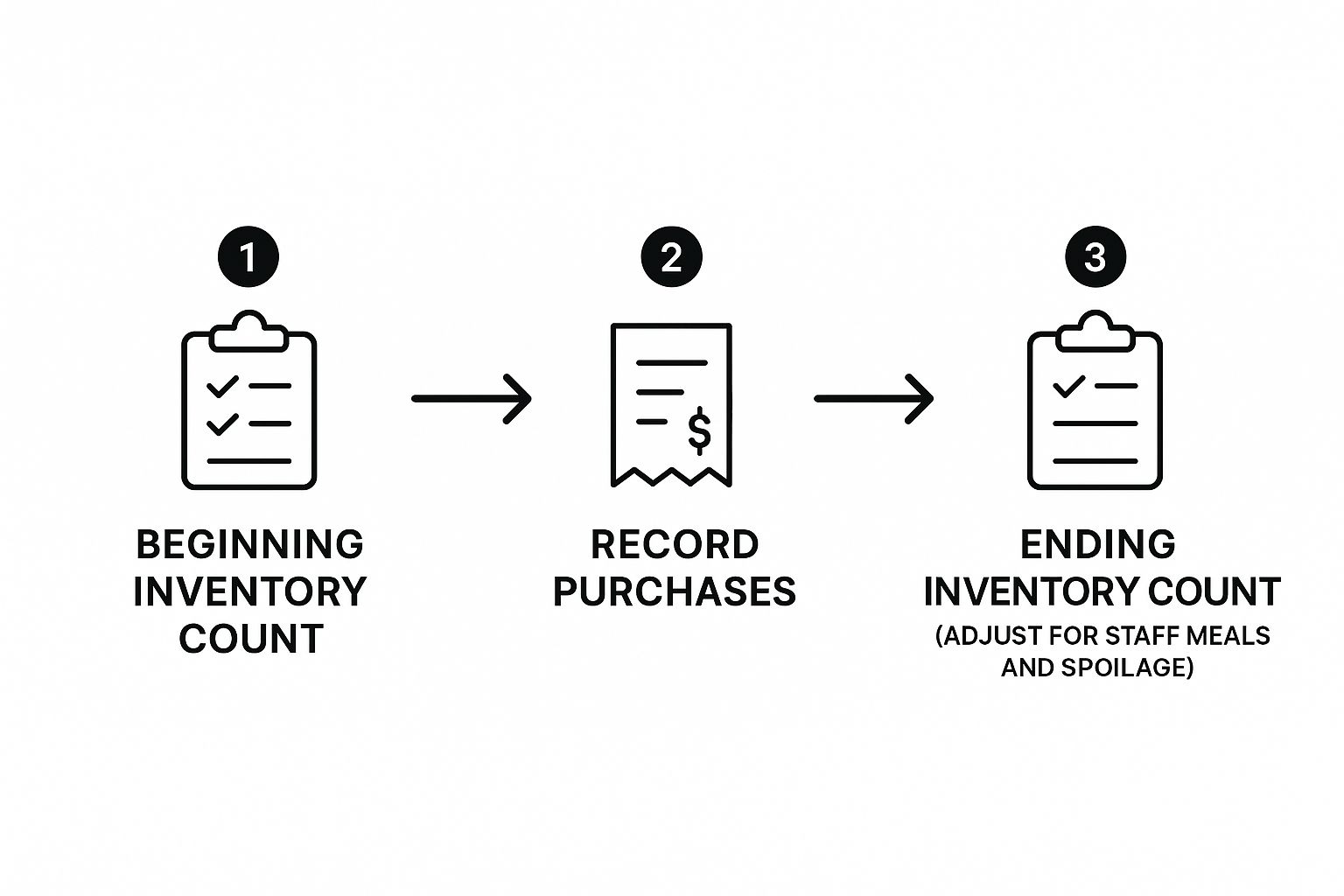
As you can see, it's a logical path. You start with what you have, add what you bought, and subtract what's left over to see exactly what was used.
Don't Forget the Hidden Variables
Just counting boxes and cans isn't going to cut it. For a truly accurate number, you have to account for all the stuff that got used but never sold. These are the common culprits that can throw your numbers way off if you ignore them.
Staff meals, comped dishes to make a guest happy, and daily spoilage aren't sales, but they are absolutely costs. If you don't track them, your food cost percentage will look artificially high, making you think your kitchen is bleeding money when it might not be.
Your POS system is your best friend here, giving you clean data on sales and comps. For things like spoilage and staff meals, a simple log sheet taped up in the kitchen is often all it takes. Properly tracking this data is a cornerstone of good business intelligence. In fact, you can learn more about how effective analytics tracking can improve your restaurant operations over on our blog.
Calculating Your Food Cost Percentage
Alright, let's get into the math. The formula for food cost percentage can look a bit daunting, but it’s really just a snapshot of what’s happening in your kitchen over a set period. Think of it as tracking the value of the ingredients you used up and comparing that to what you made in sales. Simple as that.
The go-to formula is: (Beginning Inventory + Purchases – Ending Inventory) / Total Food Sales.
Before you even touch a calculator, you need to have your numbers straight, especially when it comes to your inventory values. If you're a bit fuzzy on that, a solid grasp of understanding your Cost of Goods Sold (COGS) is non-negotiable. It’s the foundation for this whole calculation.
Putting the Formula Into Action
Let’s walk through a real-world example. Imagine a busy neighborhood bistro wants to run its numbers for the first week of the month. Here's a look at their books:
- Beginning Inventory: They started the week with $12,000 worth of food stocked in the walk-in, freezer, and dry storage.
- Purchases: Invoices from their suppliers for the week added up to $5,000.
- Ending Inventory: After a packed week, they did a physical count and had $10,500 left.
- Total Food Sales: The POS system shows they pulled in $20,000 from food sales.
Now, let's plug those figures into the formula: ($12,000 + $5,000 – $10,500) / $20,000.
This breaks down to $6,500 / $20,000, which gives you 0.325. Multiply that by 100 to get the percentage, and you land at a food cost of 32.5%. That's a solid number, sitting comfortably within the industry's sweet spot.
Using a Food Cost Percentage Calculator
While doing the math by hand is one way to go, why not make it easier on yourself? An online food cost percentage calculator can spit out the answer instantly, no spreadsheets required. These tools are built to do the heavy lifting for you.
Just look at how a simple online tool handles the same numbers—beginning inventory, purchases, ending inventory, and sales—to give you the percentage right away.
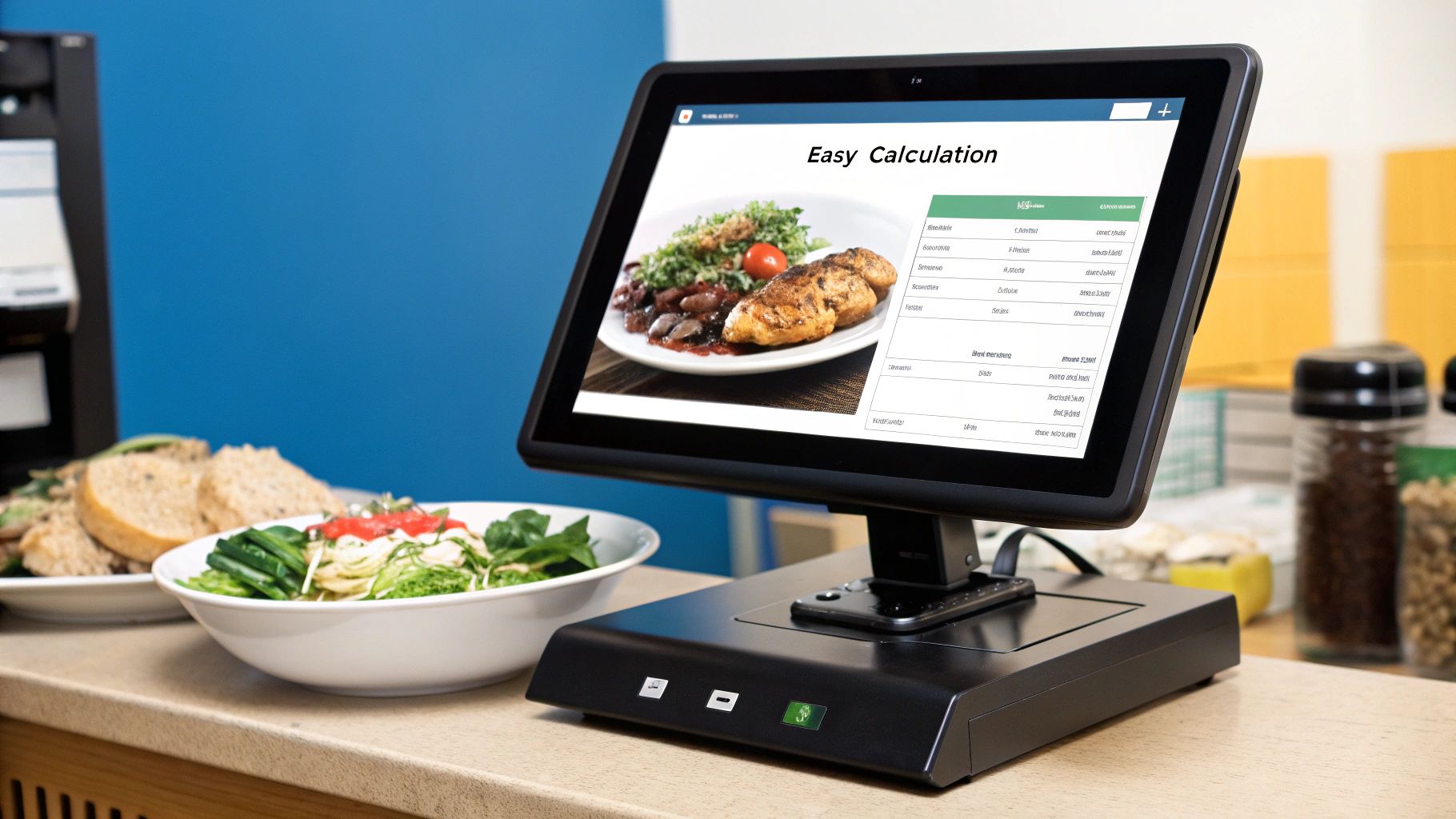
As you can see, the tool confirms the bistro's 32.5% food cost. It’s a fast, foolproof way to keep an eye on your kitchen's financial health and turns a manual chore into a quick, real-time check-up.
How to Interpret Your Results and Take Action
Getting a number from a food cost calculator is the easy part. The real skill is knowing what to do with that number.
So, your food cost is 37%. Is that a disaster, or is it perfectly fine for your high-end steakhouse concept? This is where the data you’ve gathered turns into profitable decisions.
An unexpectedly high percentage is a huge red flag. Don't just shrug it off as the cost of doing business. Think of it as the first clue in a detective story, and start hunting down the common culprits that quietly drain your bank account.
Diagnosing a High Food Cost Percentage
When your food cost percentage starts creeping up, it's almost never one single thing. It’s usually a combination of small leaks that add up to a big problem over time. Before you make any drastic changes to your menu, check these operational weak spots first.
- Inconsistent Portioning: Is your kitchen crew just "eyeballing" ingredients? A little extra cheese here and a heavier pour of sauce there can inflate your costs by several points over a single month.
- Supplier Price Hikes: When was the last time you actually audited your invoices? Suppliers sometimes raise prices without giving you a heads-up. A seemingly small 3-5% increase on a core ingredient like chicken or beef can have a massive impact on your bottom line.
- Untracked Waste: Every spoiled vegetable or burnt steak that ends up in the trash is pure loss. A simple waste log can reveal shocking patterns and highlight where you need better staff training or inventory rotation.
- Theft or Unrecorded Comps: It’s uncomfortable to think about, but employee theft or servers giving away freebies without tracking them can absolutely skew your numbers.
A rising food cost percentage is your restaurant’s early warning system. Acting on it quickly by examining portion control, supplier costs, and waste is how you protect your margins before they erode.
Creating Your Action Plan
Once you’ve sniffed out the likely cause, it’s time to take specific, targeted action.
If portioning is the problem, get your kitchen set up with visual guides, scales, and scoops. If it’s a supplier issue, get on the phone to renegotiate pricing or start looking for alternative vendors. It’s that simple.
Globally, food price volatility is a a constant battle. The FAO Food Price Index (FFPI), a key benchmark, shows that after peaking in 2022, costs have stayed stubbornly high. By mid-2025, the index was hanging around 128 points, reflecting sustained inflation that puts direct pressure on your ingredient costs. You can dive deeper into these global food price trends on TradingEconomics.com.
This makes sharp operational control more critical than ever. The right equipment—backed by clearly defined processes and excellent product descriptions for your kitchen tools—helps your team stay consistent and cut down on waste. It’s your best defense against those rising costs.
Advanced Strategies to Continuously Optimize Food Costs
Alright, you’ve got the basics down. But moving beyond simple weekly checks is where the real magic happens. This is how the top operators build restaurants that don’t just survive, but thrive. For a restaurant equipment supplier, offering this advanced knowledge through blog posting and blogger outreach establishes you as a thought leader.
One of the most powerful tools in your arsenal is menu engineering. This isn’t just about looking at your overall food cost; it’s about dissecting each dish. You analyze its popularity against its profitability to find what’s really making you money.
Think of your menu items in four categories:
- Stars: Popular and profitable. Promote these heavily.
- Plowhorses: Popular, but not very profitable. Can you tweak the recipe to lower its cost?
- Puzzles: Profitable, but nobody orders them. A better description or a staff recommendation could turn these into Stars.
- Dogs: Unpopular and unprofitable. It’s probably time to take these off the menu for good.
From Broad Strokes to Fine Details
Instead of looking at one general food cost percentage, it's time to get granular. You need to know the exact cost for every single item on your menu. This level of detail gives you the power to make smart pricing adjustments, push your high-margin dishes, and rework recipes that aren’t pulling their weight.
Suddenly, your menu isn’t just a list of food—it’s a finely tuned sales machine.
Of course, getting that precise means tightening up your inventory control. For real, continuous improvement, mastering things like managing inventory with precise formulas can make a huge difference in cutting down spoilage and waste from over-ordering.
Your staff is your front line in the battle against waste. Training your team to understand the why behind portion control and waste reduction turns them into active partners in protecting your profit margins.
Don't forget about your supplier relationships, either. A quick chat on the phone can do wonders. Regular communication can lead to better pricing, discounts on bulk orders, and first dibs on amazing seasonal ingredients. These partnerships are gold, especially as food prices keep climbing.
In 2024, the average cost of a daily nutritious diet shot up to around $4.46, making it unaffordable for billions. With that kind of inflation, you absolutely have to manage every penny.
These advanced techniques take some effort, no doubt. But they create a rock-solid financial foundation for your restaurant. For more in-depth strategies, our guide on creating a well-researched restaurant equipment blog post can help you find more ways to drive growth.
Common Questions About Food Cost Percentage
Even with a trusty food cost calculator in your back pocket, some questions always seem to pop up. Let's be honest, the number itself is just the start. Understanding what's really behind that percentage is what allows you to make smart, data-driven decisions for your restaurant.
So, let's dig into some of the most common hurdles I see operators face.
How Often Should I Calculate My Food Cost Percentage?
If you want real control over your kitchen's finances, calculating your food cost percentage weekly is the gold standard. Think of it as an early warning system.
A weekly check-in lets you spot trouble fast—maybe a supplier jacked up the price on produce, or a new line cook is a little too generous with the portion sizes. You can jump on these issues right away, before a tiny leak turns into a flood on your monthly P&L. A monthly calculation is better than nothing, but the speed of a weekly check is what separates the pros from the rookies.
What Is the Difference Between Actual and Ideal Food Cost?
This one is huge. Getting this right is how you find out exactly where your profits are disappearing.
Your 'actual' food cost is the real-world number you get from your inventory counts and purchase records. It’s what you actually spent on the ingredients that went out the door.
Your 'ideal' food cost, on the other hand, is a fantasy number. It’s what your food cost should be in a perfect world with zero waste, no spillage, no theft, and every single dish made exactly to spec. The gap between these two numbers is your variance, and that's where the story is. A big gap is a massive red flag pointing to problems with waste, portion control, or unrecorded comps.
Can a Food Cost Percentage Be Too Low?
Oh, absolutely. While a super-low number might look amazing on a spreadsheet, it can be a sign that you're sacrificing quality.
If your percentage is way below the industry average for your concept, it might mean you're using cheaper, subpar ingredients. It could also mean you're shrinking portion sizes to the point where your guests feel ripped off.
The goal isn't just a low percentage; it's an optimal percentage. You need to find that sweet spot that perfectly balances profitability with the quality and value your customers have come to expect. Chasing a few percentage points at the expense of loyal customers is a losing game.
How Do Employee Meals Affect My Food Cost?
Staff meals are a part of doing business, but they need to be tracked correctly. If you don't account for them, they'll get lumped in with your regular inventory and artificially inflate your food cost percentage. This makes your kitchen look less efficient than it actually is.
The best way to handle this is to track the cost of all employee meals and code them to a separate expense line, like 'employee benefits' or even 'labor costs.' This keeps your Cost of Goods Sold clean and ensures your main food cost calculation is a true reflection of your menu's performance.
Equip your kitchen with the right tools to execute your menu flawlessly and control costs effectively. For top-tier cooking equipment that delivers consistent results, explore the professional-grade options available from Charbroilers.com at https://charbroilers.com.