

Content Marketing and Branding for Restaurant Equipment Suppliers
Think of a brand in the restaurant equipment supply industry as its unique value proposition—that distinct combination of quality, reliability, and service that clients can't get anywhere else. In this relationship, content marketing is the catalog that brings that value to life, guiding restaurant owners and chefs to the exact solutions they need.
The Secret Sauce for Restaurant Equipment Suppliers: Content and Branding
For busy restaurant equipment suppliers, "content marketing and branding" can sound like jargon best left to a marketing agency. But the concept is actually quite simple. Branding is your company's soul—it's what you stand for. Content marketing is how you communicate that soul to the world, turning big ideas into practical, valuable information that pulls people in.
This guide cuts through the buzzwords to show you how consistent, expert content builds a powerful, memorable identity. Your brand is so much more than a logo or a color scheme; it’s the promise of quality and reliability you make to every single client. Content is the key ingredient that helps you deliver on that promise, building trust long before a restaurant owner ever thinks about making a purchase. Through services like expert SEO, local citation building, and strategic article writing, you can ensure this content reaches the right audience.
Building a Connection Beyond the Sale
Great branding creates an emotional connection, even in a B2B space. It’s the reason a chef trusts your brand for a critical piece of kitchen equipment like a commercial charbroiler. Strong brands don't just sell products; they sell solutions and partnership. Content marketing is the bridge that connects your unique brand experience to the professionals you want to reach.
This connection gets built through a few different ways:
- Storytelling: Sharing the engineering behind a new piece of equipment or a case study of a restaurant that transformed its kitchen with your products.
- Demonstrating Expertise: Showcasing the sizzle of a steak on a commercial charbroiler to prove your equipment's performance and quality. This is where high-quality blog posting and copyrighting shine.
- Building Community: Engaging with industry professionals online, answering technical questions, and making them feel like part of your brand's ecosystem. Blogger outreach can amplify this by connecting you with key industry influencers.
Your brand is the reason a restaurant owner considers your equipment. Your content is the reason they choose you over the competition and recommend you to their peers.
This visual map breaks down how these core pieces—your brand, your content, and your customers—work together to drive real, sustainable growth for your business.
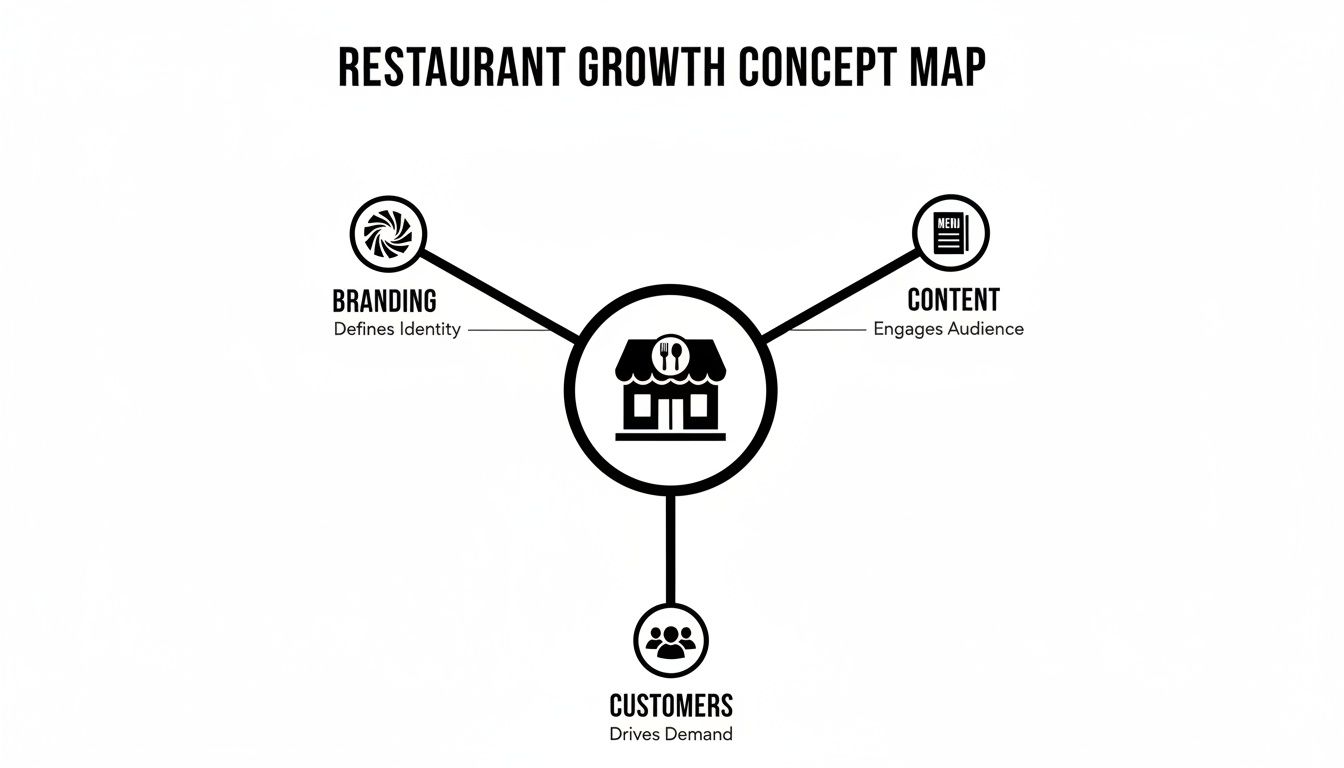
As you can see, a strong brand identity is the foundation. Compelling content, optimized with professional SEO and article writing, is the engine that attracts and engages customers, which ultimately fuels your business's success. When you master the interplay between content marketing and branding, you can turn first-time buyers into loyal partners who champion your brand across the industry.
Defining Your Core Brand Identity
Before you can create compelling content, you need to know exactly what your story is. Great content marketing doesn't just happen; it's built on a rock-solid foundation of knowing who you are as a supplier. This is your brand's soul—the core idea that separates you from every other competitor and makes clients trust your equipment.
Think of it like this: your brand is your unique promise. Is it the unparalleled durability of your commercial charbroilers? Is it a deep commitment to customer service that supports chefs long after the sale? Or maybe it’s the innovative technology that makes your equipment more efficient. Nailing this down is the first real step toward building a brand that industry professionals remember and rely on.

Find Your Unique Selling Proposition
Your Unique Selling Proposition (USP) is the one thing that makes your company the obvious choice for restaurant equipment. It’s the answer to the simple but critical question, "Why should a restaurant buy from me instead of anyone else?" A powerful USP is clear, memorable, and hooks directly into what your professional customers truly care about.
To dig up your USP, ask yourself a few honest questions:
- What are you genuinely best at? Do you offer the most reliable charbroiler on the market, built for high-volume kitchens?
- What do your regulars rave about? Don't guess. Ask them directly, or sift through your best client testimonials for clues.
- What problem do you solve? Are you the go-to for durable, workhorse equipment, or are you the top choice for cutting-edge, energy-efficient technology?
Your USP isn't just a clever marketing slogan. It's the North Star for every piece of content you create, from a technical blog post to a product description, which is where expert copyrighting becomes essential.
Identify Your Ideal Customer
Once you know what makes you special, you need to get crystal clear on who you're talking to. Shifting from a vague idea of a "restaurant owner" to a specific customer persona is an absolute game-changer. This persona is a detailed profile of your perfect client.
For instance, instead of targeting "all restaurant professionals," you might build a persona like this: "Executive Chef Emily, a 42-year-old managing a high-end steakhouse. She values durability and precision, reads industry trade publications, and researches equipment performance online before contacting a sales rep."
That level of detail helps you create content that speaks directly to Emily's challenges and goals, making your marketing infinitely more effective. You'll know exactly what kind of technical guides, case studies, and blog posts will actually grab her attention.
A brand that tries to be everything to everyone often ends up being nothing special to anyone. Defining a specific audience allows you to create deeply resonant content that builds a loyal following.
The global content marketing industry has exploded, jumping from just $36.8 billion in 2018 to a projected $600 billion by the end of this year. This isn't just random growth; it’s proof that businesses are winning by building loyalty through targeted, valuable content. And that whole strategy starts with knowing your brand and your audience, inside and out. You can learn more about these market trends and their implications for restaurants.
Connect Your Brand to Business Goals
Finally, your brand identity has to be tied to real, tangible business objectives. A strong brand isn't just about good vibes; it's about driving results. When you connect your identity to specific goals, you create a clear roadmap for what your SEO and content writing services need to achieve.
Here’s how you can link your brand’s soul to measurable outcomes:
-
Goal: Increase qualified leads from your website by 20% this quarter.
- Brand Connection: If your USP is "the most durable charbroilers for high-volume kitchens," your content should be a firehose of case studies, performance videos, and detailed spec sheets, with a clear call-to-action to request a quote.
-
Goal: Become the go-to authority on grilling technology.
- Brand Connection: Your blog and social channels should be filled with maintenance guides, chef interviews about mastering your equipment, and articles about the engineering behind your products.
This framework creates a powerful blueprint. It makes sure every single piece of content you put out there serves a purpose, reinforcing who you are while actively pushing your business forward.
Choosing Your Best Content Channels and Formats
Once you've nailed down your company's core identity, the next big step is figuring out the best places and ways to share your story. Think of your brand as the star ingredient; now you need to pick the right cooking methods to really make it shine. This is where your content marketing and branding strategy gets real, because where you show up is just as important as what you say.
Different channels have different jobs. A detailed blog post is fantastic for answering a complex question from a chef, like "what's the difference between radiant and lava rock charbroilers?" This builds your authority and gives your website a serious SEO boost. On the other hand, a short video of your equipment in action offers instant visual appeal and a powerful demonstration of performance.
The goal isn't to be everywhere at once. It's to be on the channels where your ideal customers—chefs, GMs, and restaurant owners—are already seeking professional advice.
The Four Pillars of Restaurant Equipment Content
For most restaurant equipment suppliers, a solid content plan stands on four main pillars. Each one gives you a unique way to connect with your audience, whether they're a new restaurateur researching their first kitchen or an established chef looking to upgrade.
Here’s a look at the core channels:
- Insightful Blogging: Your blog is your brand's home base. It’s the perfect spot for in-depth article writing, answering specific questions like maintenance tips for a new charbroiler or ROI calculations for energy-efficient fryers. This kind of content helps you show up in search results and positions you as a trusted expert.
- Dynamic Video Content: Video brings your equipment to life in a way words just can't. Think short, snappy cleaning tutorials perfect for social media or detailed product demos for your website. Video captures the performance and durability that make your products a smart investment.
- Engaging Social Media: Social media (especially platforms like LinkedIn) is where you build your professional community. It’s your stage for sharing high-quality product photos, client testimonials, and industry news that keeps you top-of-mind.
- Strategic Email Marketing: Email is your direct line to your leads and loyal customers. Use it to send out new product announcements, exclusive technical guides, or special financing offers. It’s all about nurturing relationships to drive sales and repeat business.
Why Video Is a Non-Negotiable Channel
Let's be clear: video isn't just an "option" anymore. It's a powerhouse. Global video advertising spend has soared past $190 billion and is expected to top $200 billion this year. The proof is in the numbers.
Data shows that a whopping 71% of B2C marketers used video in the last year, and it’s at the top of their list for new investment—a trend mirrored in B2B. For a restaurant equipment supplier, a dynamic demo showing a charbroiler putting perfect grill marks on a piece of fish can grab the attention of chefs and restaurant owners everywhere.
When you're trying to decide where to post your short-form videos, understanding the differences between TikTok versus YouTube Shorts is key. Each platform has its own vibe and audience, so choosing the right one can make all the difference.
The most effective content strategies meet customers where they already are. Don't force your audience to find you; build your presence on the platforms they already love and use every day.
By picking the right mix of channels, you can build a complete plan that strengthens your brand at every turn. Each format plays its own part, working together to guide someone from just hearing about you to becoming a loyal client. You can see how this works in the real world by checking out our guide on successful content marketing strategies for restaurants.
Choosing the Right Content Format for Your Goals
With so many options, it's easy to get overwhelmed. The key is to match the format to your specific business goal. Are you trying to build trust, generate leads, or close sales? The table below breaks down how different formats can help you achieve your objectives, with a special focus on showcasing a high-performance charbroiler.
| Content Format | Primary Strength | Best For (Example Goal) | Charbroiler-Focused Example |
|---|---|---|---|
| Blog Post | Expertise & SEO: Building authority and ranking in search. | Answering technical questions: "How do I choose the right charbroiler for my restaurant?" | A detailed guide on "Radiant vs. Lava Rock: Choosing the Best Commercial Charbroiler." |
| Short-Form Video | Engagement & Demonstration: Grabbing attention quickly. | Generating interest: Showcasing equipment features and performance. | A 30-second video of a chef easily cleaning the charbroiler after a busy service. |
| Long-Form Video | Education & Connection: Deep dives and client stories. | Building brand trust: In-depth tutorials or client testimonials. | A YouTube video featuring a client explaining how your charbroiler improved their steakhouse's efficiency. |
| High-Quality Photos | Visual Appeal: Making your equipment look professional and durable. | Driving desire: Creating "must-have" appeal for your products. | A professionally shot, close-up image of a charbroiler's heavy-duty stainless steel construction. |
| Email Newsletter | Lead Nurturing & Sales: Direct communication with prospects and clients. | Promoting special offers: Announcing a limited-time financing deal. | An exclusive email offer for subscribers with a discount on a new charbroiler model. |
| User-Generated Content | Authenticity & Social Proof: Building trust through client experiences. | Creating community: Showing real chefs using your equipment successfully. | Re-posting a client's LinkedIn photo of their new kitchen setup, featuring your charbroiler. |
Ultimately, a strong content strategy uses a blend of these formats. A stunning photo on LinkedIn might grab a chef's attention, a video might demonstrate its value, and a well-written blog post might convince them you're the expert they need to trust. It all works together to tell a cohesive and compelling story about your brand.
Putting Your Charbroiler at the Center of Your Content
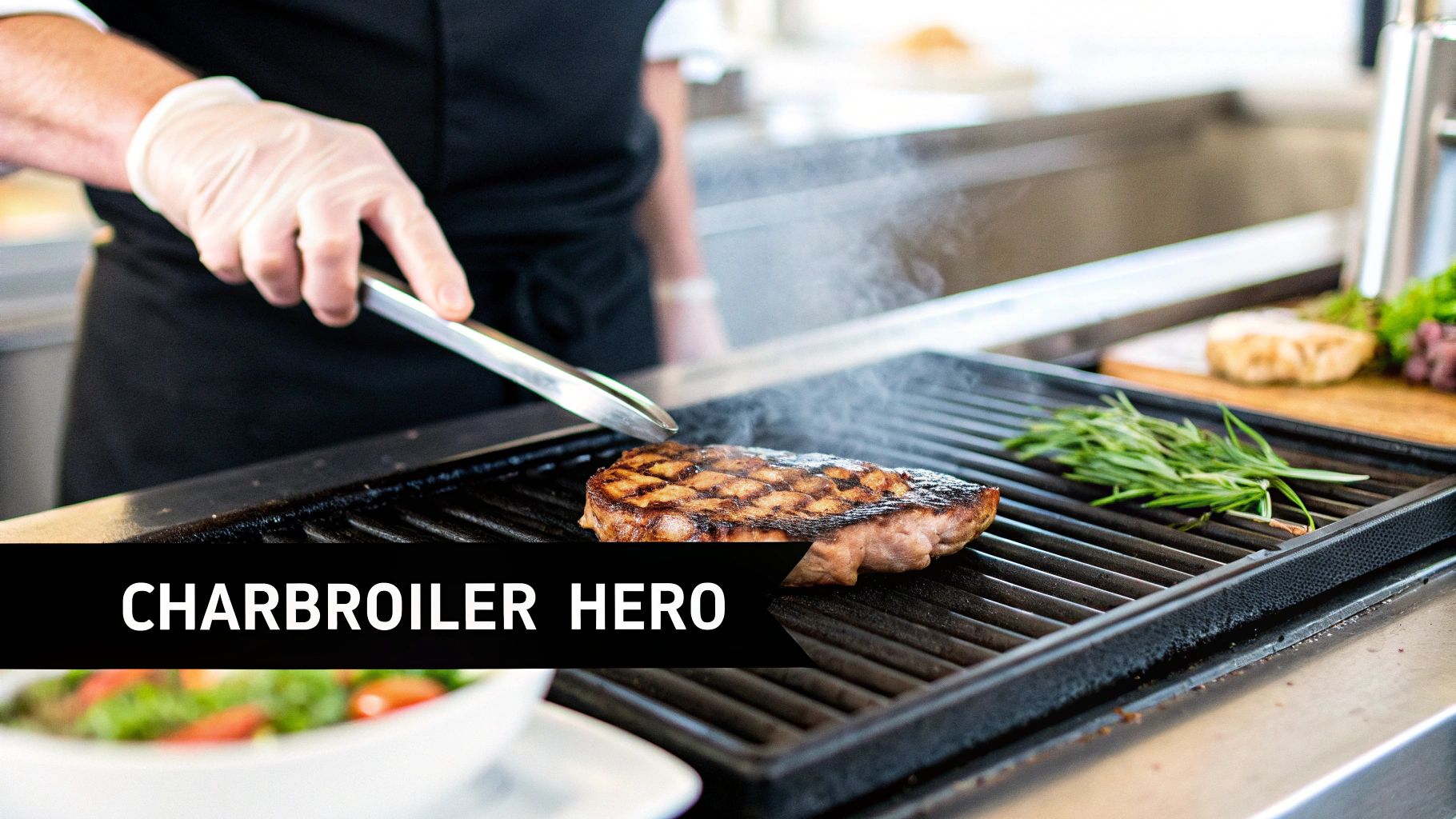
Theory is great, but let's get down to what actually moves the needle. This is where we turn strategy into a real-world playbook for your content marketing and branding. The trick is to find a "hero" for your stories—and for an equipment supplier, a commercial charbroiler is the perfect star. It’s so much more than a piece of metal; it’s a storytelling engine that screams quality, performance, and profitability.
When you focus your content on one powerful product like a charbroiler, you build consistency and lock in your brand identity. Every technical spec, every perfect grill mark shown in a demo, and every glowing testimonial becomes proof of your company's promise. This approach, supported by strategic blog posting and blogger outreach, doesn't just make your content better—it makes it simpler to create.
Weave Stories Directly into Your Product Descriptions
Your product pages are some of the most valuable pieces of content you own. Don't just list specs; use them to tell the story behind the equipment. This is where professional copyrighting connects the technical features to the real-world benefits for a chef.
- Product Description Example: "Our Signature Charbroiler isn't just another grill. It’s engineered with heavy-gauge stainless steel, featuring high-output burners designed to create a perfect, edge-to-edge crust while locking in flavor, service after service."
- Highlight the Engineering: Use call-out boxes or icons to explain key features. This subtly educates buyers on why your equipment delivers superior performance and durability.
This simple tactic turns a spec sheet into a brand-building machine, reinforcing your commitment to quality before the buyer even requests a quote. It primes them to understand the value they’re about to invest in.
A charbroiler is a tangible symbol of your brand's dedication to performance. By making it the hero of your content, you're not just selling equipment; you're selling reliability, efficiency, and the promise of a better final product for your clients.
This kind of focused content is exactly why smart businesses are betting big on marketing. A huge 46% of B2B organizations plan to increase their content marketing budgets. This mirrors a trend where three-quarters of global brands are also boosting their digital media spend. For equipment suppliers, this highlights the lasting power of evergreen article writing—like a guide on choosing the right charbroiler—over ads that just disappear. You can learn more about content marketing's growing investment trends.
Create Irresistible Technical and Maintenance Guides
Position your brand as the expert on all things grilling equipment. When you create valuable, downloadable content, you're not just capturing emails for your sales funnel; you're building massive trust and authority. These guides become assets that your SEO efforts can leverage 24/7.
Think about creating guides like these:
- "10 Maintenance Tips to Maximize the Life of Your Charbroiler": A simple, downloadable PDF that offers real value to kitchen managers.
- "The Buyer’s Guide to Commercial Charbroilers": A shareable infographic that visually breaks down the key decision-making factors.
- "Charbroiler 101: Seasoning Your Grates for Peak Performance": A short blog post packed with expert tips on getting the most from new equipment.
Every piece of content reinforces your expertise and keeps your brand top-of-mind, even when chefs are just in the research phase.
Go Behind the Scenes with Video
Video gives you an incredible chance to show, not just tell. Take your audience right into a test kitchen or a client's restaurant and let them witness the performance firsthand. These authentic demonstrations are incredibly powerful for building a human connection with your brand.
Here are a few video ideas that always work:
- Performance Test: Film a short, dynamic clip of a charbroiler under pressure, handling dozens of steaks during a simulated dinner rush. The fire, the sizzle, and the consistent results create undeniably compelling content.
- Cleaning & Maintenance Demo: Create a quick tutorial showing the step-by-step process of breaking down and cleaning a charbroiler, highlighting ease-of-use.
- "Meet the Engineer" Profile: Make a fun, short video introducing the mind behind the charbroiler. Have them explain why they designed it the way they did and what makes it special.
These videos don't need to be Hollywood productions. Your smartphone and some decent lighting are often all you need to create content that feels real and engaging.
Launch a User-Generated Content Campaign
Finally, turn your clients into your best marketers. User-Generated Content (UGC) is the ultimate social proof because it comes straight from happy customers. All you have to do is launch a campaign that encourages them to share their success stories.
Create a simple campaign with a clear call to action, like #MyKitchenWorkhorse. Encourage chefs to post photos of your equipment in action on LinkedIn or Instagram with your unique hashtag. Offer a chance to be featured on your page or win a discount on their next purchase. This strategy not only floods your feed with authentic content but also builds a vibrant community around your brand.
Measuring Your Content's Impact on the Bottom Line
Creating high-value content is just the first step. To really drive business, you have to understand how it’s performing. With content marketing and branding, you can't just "set it and forget it." Measuring your return on investment (ROI) is crucial, but it doesn't have to be a headache. It’s really just about connecting the dots between your SEO, copyrighting, and article writing efforts and your company's growth.
Think of it like an engineer running diagnostics on a new piece of equipment. You need to check if all systems are performing as expected. Your content analytics are those diagnostics—they tell you what’s working, what’s falling flat, and where you need to recalibrate your strategy.
Translating Clicks into Customers
The real goal here is to turn abstract numbers into real-world results. Sure, a "like" on a LinkedIn post is nice, but what does it actually do for your sales pipeline? The trick is to track Key Performance Indicators (KPIs) that link directly to tangible outcomes, like more quote requests, an increase in demo calls, or a boost in online sales.
Here are the core metrics every equipment supplier should be watching:
- Website Traffic & Leads: Jump into Google Analytics and see how many people are visiting your blog from search or social media. Are those charbroiler-focused posts actually bringing in new visitors who then download a guide or request a quote?
- Engagement Rate: This is all about how industry professionals interact with your content. Look at the comments, shares, and saves on your posts and videos. High engagement is a great sign that your brand story is resonating.
- Click-Through Rate (CTR): For your email newsletters, this tells you what percentage of people actually clicked a link. A strong CTR on a "Request a Demo" button is a clear win.
Measuring content isn't just about counting views and followers. It’s about understanding customer behavior and making data-driven decisions that consistently improve your strategy and grow your bottom line.
Connecting Metrics to Business Goals
Once you're tracking these KPIs, the next move is to tie them back to your bigger business objectives. This is where you start to see the real power of your content. To truly get a handle on the impact, you need to dive into Content Marketing Analytics.
Let's walk through a practical example. Say you published a detailed blog post comparing charbroiler types, optimized with professional SEO services. You can track the organic traffic it gets, but then you need to dig deeper. Did the number of quote requests for charbroilers increase in the following month? Did your sales team report more informed buyers? That’s how you prove ROI. For a closer look at this process, learn more about how to measure SEO performance and its direct impact on your business.
By checking these numbers regularly, you'll start spotting trends. Maybe you notice your video case studies get 50% more lead conversions than static spec sheets. That’s a powerful piece of insight. It tells you exactly where to point your creative energy—and your budget—for the biggest impact.
A Simple Content Calendar to Keep You Consistent
Strong content marketing and branding isn't built on a single viral moment; it’s built on consistency. A great idea is only powerful if you can execute it again and again. This is where a content calendar becomes your most valuable tool, transforming your strategy from a collection of random ideas into a predictable, brand-building rhythm.
Think of it as your production schedule. A factory doesn't decide what to build each morning. They plan, schedule, and organize so that production runs smoothly. A content calendar does the same for your marketing, ensuring your blog posting and social media efforts maintain a steady, professional presence.

Organizing Your Content Workflow
A simple calendar helps you map out your content across all your key channels—your blog, LinkedIn, and email newsletter. This structure empowers you to tell a cohesive story. For instance, an in-depth blog post published on Monday can be sliced and diced into smaller, bite-sized tips for social media throughout the week.
This approach not only saves a ton of time but also reinforces your core brand message. Every piece of content starts working together, building momentum and keeping your audience engaged. The key is planning ahead so you’re never scrambling. To really nail this, you can learn more about how to write SEO-friendly blog posts that become the cornerstone of your calendar.
A content calendar is your roadmap to consistency. It ensures your brand shows up reliably, builds authority, and turns random followers into a loyal community of potential clients.
To show you what this looks like in action, here’s a simple, actionable template you can adapt for your own company. I’ve pre-filled it with some of the charbroiler-focused ideas we've discussed to show you how to put this strategy into practice right away.
Sample Weekly Content Calendar for a Restaurant Equipment Supplier
| Day | Blog Post Idea | Social Media (LinkedIn/Facebook) | Email Newsletter |
|---|---|---|---|
| Monday | New Post: "The Secret to Longevity: A Charbroiler Maintenance Guide." | Announce the new guide with a high-quality photo of a clean, well-maintained charbroiler. | |
| Tuesday | Behind-the-Scenes Video: A 30-second clip from the factory floor or a product testing session. | ||
| Wednesday | Tip of the Week: Share one key maintenance tip from the blog post as a quick, shareable graphic. | ||
| Thursday | Client Spotlight: Feature a client's testimonial about your equipment (with permission and credit). | ||
| Friday | Product in Action: Post a mouth-watering video of a chef using your charbroiler to perfection. | Weekly Insights: Announce the new product guide and link to it for "weekend reading." | |
| Saturday | Engaging Question: Post a poll asking what feature pros value most in a charbroiler. | ||
| Sunday | Industry News: A simple post sharing an interesting article relevant to restaurant owners. |
As you can see, a single blog post can fuel an entire week's worth of content across different platforms. It’s all about working smarter, not harder, to keep your brand top-of-mind.
Common Questions We Hear
Jumping into the world of content marketing and branding for your restaurant equipment supply business always brings up a few questions. Let's tackle some of the most common ones we get from owners just like you, with some straight-to-the-point answers to help you get moving.
What’s a Realistic Budget for Content Marketing?
Honestly, there's no magic number here. Your budget really depends on your company's goals and what you can realistically set aside. But a solid rule of thumb is to dedicate 5-10% of your total marketing spend to content creation and promotion, which might include services like SEO, article writing, or blogger outreach.
For some, that might be a few hundred bucks a month for social media tools and freelance copyrighting. For others, it could be several thousand for a professional video shoot and a comprehensive SEO strategy. The best approach? Start small, see what generates leads, and then double down on what’s working.
How Long Does It Take to See Results?
This is where you need to play the long game. Unlike a paid ad that gives you an instant (but fleeting) boost, content marketing is an investment. Think of it like building a reputation—it takes time and consistent effort to become the trusted name in the industry.
You'll probably start seeing early wins—like more website visits and better social media engagement—within 3-6 months of consistent blog posting. But for the really meaningful results, like ranking high on Google for key equipment terms and getting a steady stream of inbound leads, you're looking at 6-12 months of dedicated work.
Content marketing is a marathon, not a sprint. You're building an asset—an audience that knows and trusts you—and that pays off for years. Consistency will always beat short bursts of intensity.
If I Can Only Do One Thing, What’s the Most Important Content?
While a good mix of content is always the goal, if you have to pick one, high-quality, problem-solving content is non-negotiable. For an equipment supplier, that means technical guides, performance videos, and detailed blog posts that help your clients succeed.
- Expert Articles: This is what makes a chef or owner say, "These guys really know their stuff." Article writing that solves a real problem (e.g., "How to Reduce Energy Costs in Your Kitchen") establishes you as a trusted advisor.
- Demonstration Videos: Nothing proves the value of your equipment like seeing it in action. It builds confidence and answers questions a spec sheet just can’t.
Nail your expert content first. Make it genuinely helpful. Then, you can build out other content like social media updates or email newsletters to promote it and tell the rest of your story. Your expert content is the hook that gets serious buyers interested in the first place.
Ready to make your equipment the star of the show? The unforgettable flavor and perfect grill marks from a top-tier charbroiler can make all the difference for your clients. At Charbroilers.com, we stock the commercial charbroilers designed to deliver that smoky char their customers crave. Explore our selection and find the perfect centerpiece for any professional kitchen.